
Every week, our customer service team in Foshan fields dozens of calls from buyers who ordered the wrong size of شبكة القصب 1. The frustration is real — material gets wasted, projects stall, and costs climb. The root cause is almost always the same: incorrect measurement before ordering.
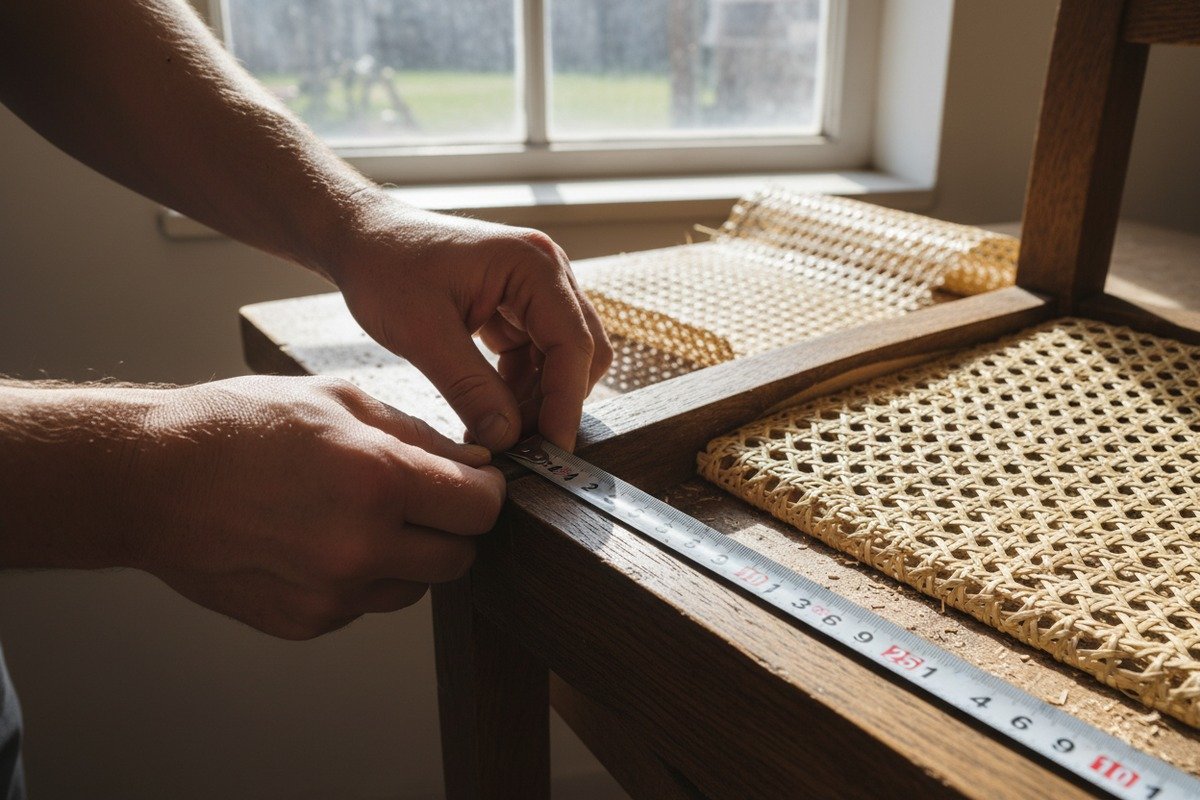
To measure for rattan cane webbing replacement, measure the opening from the outer edge of the groove on one side to the outer edge on the opposite side. Then add 1 to 2 inches on each side for overlap. Also measure the groove width to select the correct spline size.
Getting the right measurements is simpler than most people think, but each step matters. This guide walks you through every detail — from reading your groove to placing your order with confidence. Let’s start with the furniture frame 2 itself.
How do I accurately measure my furniture frame for a rattan webbing replacement?
One lesson we learned early on when shipping rattan webbing to furniture factories in the US and Australia is that "close enough" measurements cause the most returns. Precision saves money and time, every single time.
To accurately measure your furniture frame, place a tape measure across the seat opening from the outside edge of one groove to the outside edge of the opposite groove. Record both the width and the length at the widest points. For irregular shapes, measure at multiple spots and use the largest dimension.
Step-by-Step Frame Measurement
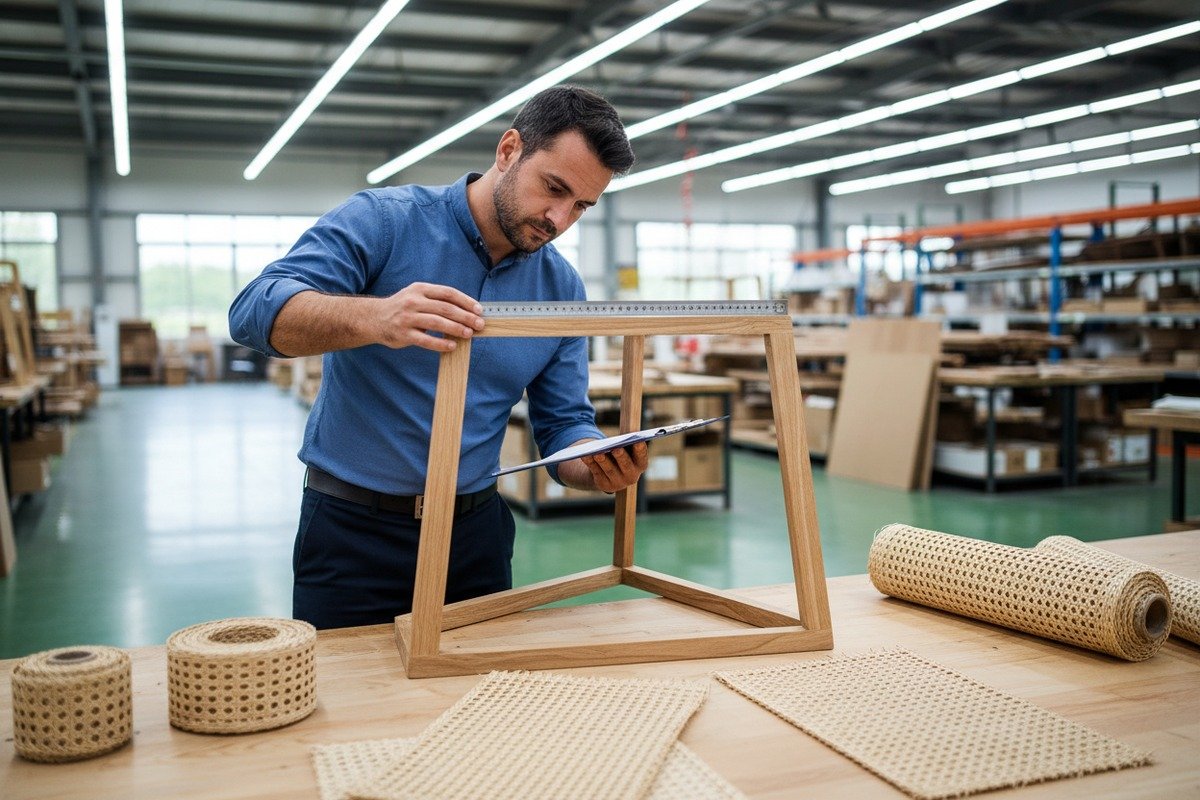
Before you even pick up a شريط قياس 3, inspect the chair frame. Look for structural issues — loose joints, cracks, or rot. A weakened frame cannot hold new cane webbing properly. Tighten any loose joints. Fill small cracks with wood filler and let it dry. This step is easy to skip, but it prevents heartbreak later.
Now, grab a flexible tape measure or a steel ruler. Place one end on the outside edge of the groove on the left side of the seat. Stretch it across to the outside edge of the groove on the right side. Write that number down. That is your width. Repeat the same process from front to back. That is your length.
Why You Should Measure from the Outer Groove Edge
Some guides say to measure from spline to spline. Others say inner groove edge. Here at our production facility, we recommend the outer groove edge method because it gives you the most reliable baseline. The webbing must span the entire opening and tuck into the grooves on both sides.
If your seat is trapezoidal — wider in the front and narrower in the back — always record the widest point for each direction. You will trim the excess during installation. It is far better to have slightly more material than not enough.
Special Cases: Circular and Irregular Seats
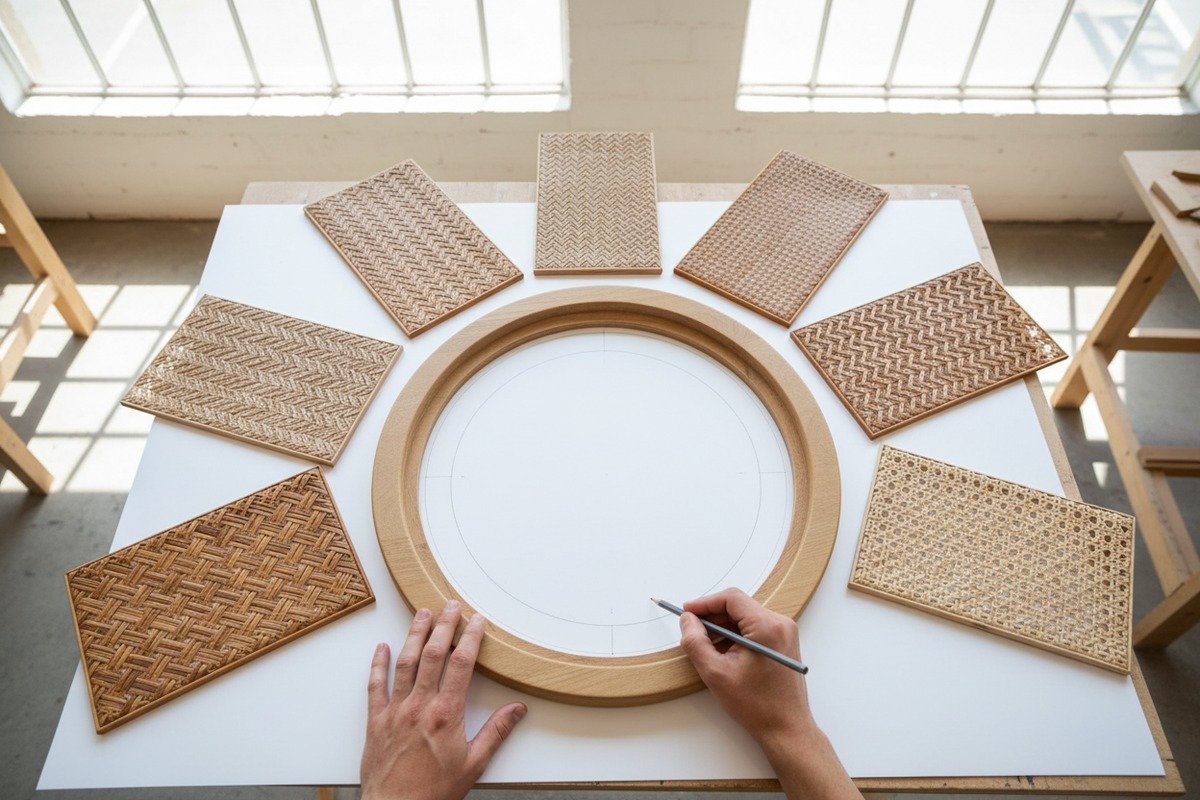
Round or oval seats need a different approach. Measure the diameter at the widest point. For truly irregular shapes, the best method is to create a paper template. Lay a large sheet of paper over the seat. Trace the groove line with a pencil. This template can then be measured flat on a table. You can even send the template to your supplier for confirmation.
| Seat Shape | Measurement Method | Key Tip |
|---|---|---|
| Rectangular | Groove-to-groove, width × length | Measure at widest points |
| Trapezoidal | Front width, back width, length | Use the largest front width |
| Circular | Diameter at widest point | Add overlap to the diameter |
| غير منتظم | Paper template tracing | Send template to supplier |
Pressed Cane vs. Hand-Woven Strand Cane
It is critical to know which type of cane your chair uses. شبكة قصب مضغوط 4 sits in a groove and is held by a spline. Hand-woven strand cane is threaded through individual holes drilled in the frame. The measurement method is completely different for each.
For hand-woven strand cane 5, you do not measure grooves. Instead, count the number of holes within a 6-inch span along one side of the frame. The hole count determines the strand gauge. For example, fewer than 12 holes in 6 inches usually indicates a finer cane. Also measure the distance from center of one hole to center of the next hole. A ½-inch center-to-center spacing typically corresponds to the popular Fine ½" octagonal weave pattern 6.
Mixing up these two methods is one of the most common mistakes buyers make — especially on circular seats, where hand-woven cane is more typical.
How much extra cane webbing should I include in my order for installation?
When we prepare sample shipments for new wholesale clients, one of the first things we explain is the overlap allowance. Under-ordering is the number one cause of installation failure, and it turns a simple repair into a frustrating reorder cycle.
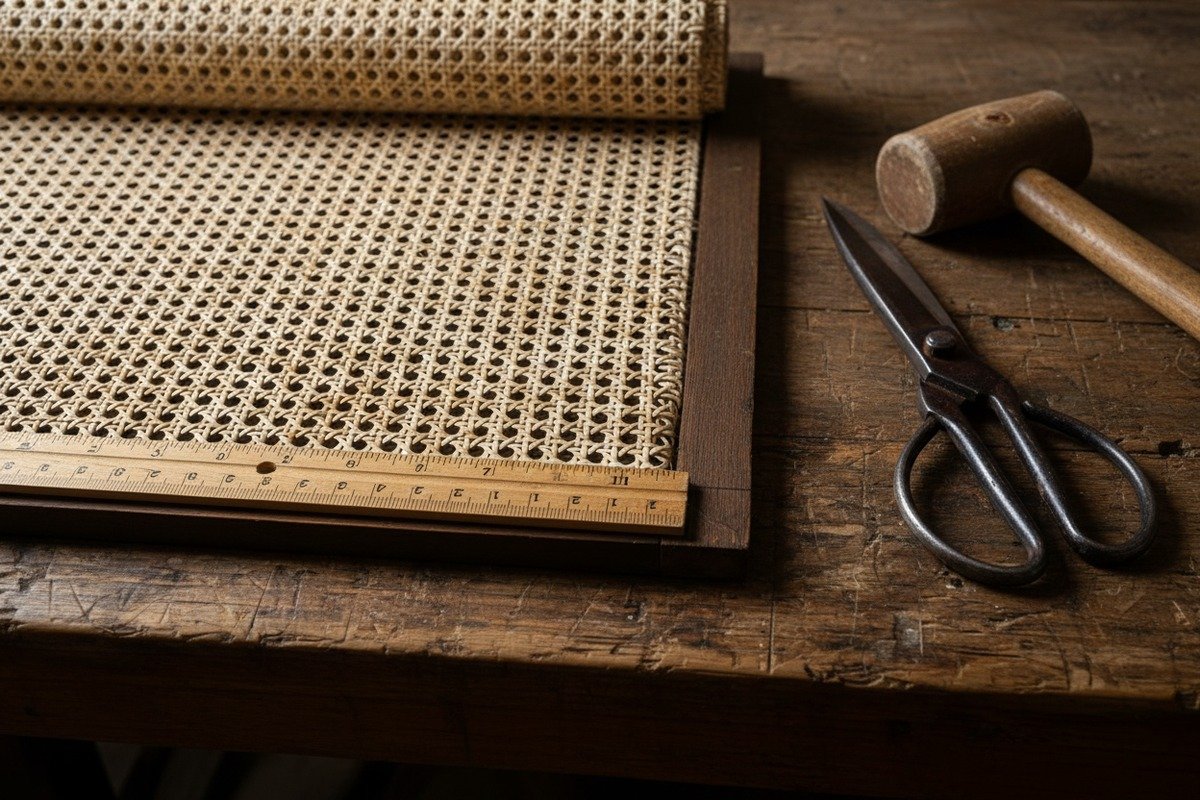
You should add at least 1 to 2 inches of extra cane webbing on every side of your groove-to-groove measurement. This means adding 2 to 4 inches total to both width and length. The extra material allows you to press the webbing into the groove and trim the excess cleanly after installation.
Why the Overlap Matters
The cane webbing does not simply sit on top of the frame. It must be pushed down into the groove on all four sides before the spline locks it in place. If the webbing is cut exactly to the groove-to-groove size, you will not have enough material to grip and push into the channel. The extra 1 to 2 inches per side gives you a workable edge.
Here is a real example. Say your groove-to-groove measurement is 13.5 inches wide and 14 inches long. You would add 2 inches to each dimension at minimum, giving you 15.5 inches wide and 16 inches long. Since standard roll widths come in set increments, you would round up to the nearest available width — in this case, 16 inches.
Standard Roll Widths and Rounding Up
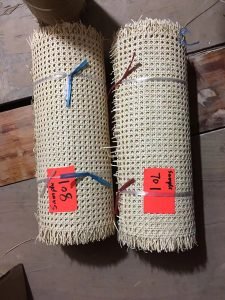
Cane webbing is not custom-cut to the exact inch for every order. It is sold in standard widths 7. When your calculated measurement falls between two standard sizes, always round up.
| Calculated Width Needed | Nearest Standard Roll Width | إجراء |
|---|---|---|
| 13.5" | 14 بوصة" | Round up to 14" |
| 15.5 بوصة" | 16 بوصة" | Round up to 16" |
| 19" | 20 بوصة" | Round up to 20" |
| 25" | 30 بوصة" | Round up to 30" |
| 33" | 36 بوصة" | Round up to 36" |
Standard widths from most suppliers — including our own rolls — come in 12", 14", 16", 18", 20", 24", 30", 36", and 48". Length is usually sold by the running foot or in 50-foot rolls for larger orders.
Soaking and Shrinkage Considerations
شريط قصب الخيزران الطبيعي 8 needs to be soaked in warm water before installation. This makes it pliable and easy to work into the groove. However, once it dries, it tightens slightly. This is actually beneficial — it creates a taut, drum-like surface. But it also means you should never stretch the webbing too tight during wet installation. Allow for a small amount of natural tightening.
In high-humidity environments, consider keeping the initial installation slightly snug. Humidity can cause the material to relax over time. A tighter starting point helps counteract potential future sagging.
How Much Spline Do You Need?
A common oversight is forgetting to order enough أوتاد القصب 9. Measure the total length of the groove around the entire seat perimeter. Add about 10% extra for corners and overlaps. A typical dining chair seat requires roughly 6 feet of spline. Always order a bit more than you think you need. Spline is inexpensive, and running short mid-installation is a real hassle.
What dimensions do I need to provide my wholesaler to ensure I get the right roll width?
Over the years of supplying cane webbing to wholesalers across the Netherlands, Spain, and the Middle East, we have found that clear communication of three key dimensions eliminates almost all ordering errors. Sending vague measurements leads to wrong shipments and costly delays.
Provide your wholesaler with three measurements: the groove-to-groove width plus overlap, the groove-to-groove length plus overlap, and the groove channel width. Also specify the weave pattern you need. These four details ensure you receive the correct roll width, appropriate length, and matching spline size.
The Three Essential Dimensions
Let's break this down simply.
Dimension 1: Total width needed. This is your groove-to-groove width measurement plus the overlap allowance. If the groove-to-groove width is 17 inches and you add 2 inches for overlap, your total width needed is 19 inches. You would then order a 20-inch-wide roll.
Dimension 2: Total length needed. Same calculation applied to the length. If you are ordering for multiple chairs, multiply the per-chair length by the number of chairs and add a small buffer. For example, six chairs each needing 16 inches of length would require 96 inches, or 8 feet. Order 9 or 10 feet to account for cutting waste.
Dimension 3: Groove channel width. This determines your spline size. We will cover this in more detail in the next section.
Specifying the Weave Pattern
Cane webbing comes in several patterns. The most common is the classic open hexagonal weave, sometimes called "radio weave." There is also a tighter square basketweave and more intricate diamond patterns. When ordering, specify the pattern by name or — even better — send a photo of the existing webbing to your supplier.
The Fine ½" pattern is one of the most popular for vintage chair restoration. The "½ inch" refers to the center-to-center distance of the weave holes in the octagonal pattern. If your old webbing has this pattern, matching it exactly ensures a period-accurate restoration.
Bulk Ordering for Multiple Pieces
If you are a furniture factory or a materials wholesaler purchasing in volume, the economics shift. Standard 50-foot rolls in fixed widths are the most cost-effective option. Communicate the total linear footage needed per width category.
| Information to Provide | مثال | لماذا هو مهم |
|---|---|---|
| Groove-to-groove width + overlap | 17" + 2" = 19" → order 20" roll | Ensures correct roll width |
| Groove-to-groove length + overlap | 14" + 2" = 16" per chair | Determines length per unit |
| Number of pieces | 6 chairs | Calculates total roll length |
| Groove channel width | 3/16 بوصة" | Determines spline size (#8) |
| نمط النسيج | Fine ½" open hexagonal | Ensures aesthetic match |
| نوع المادة | Natural or bleached rattan | Matches existing décor |
Photos Save Everyone Time
Our advice to every buyer: take clear photos of the chair seat from above, the groove channel close-up, and the existing weave pattern. Send these along with your measurements. At our Foshan warehouse, our quality team can cross-reference photos with your numbers and catch discrepancies before the order ships. This simple step has saved countless clients from receiving the wrong product.
Also consider whether you need natural, bleached, or synthetic rattan webbing. Natural rattan has warm beige and straw tones with organic variations. Bleached rattan is lighter and more uniform. Synthetic rattan, made from durable plastic, mimics the look of natural fibers but resists moisture and UV damage. Each type has different thickness characteristics that can affect spline compatibility.
How do I measure the groove width to match my replacement rattan and spline?
In our rattan processing facility in Indonesia, every batch of spline is calibrated to standard groove widths. But the spline can only do its job if you measure the groove correctly on your end. A spline that is too thin falls out. A spline that is too thick cracks the frame.
To measure the groove width, clean out all old spline, glue, and cane fragments first. Then use a caliper, ruler, or the coin stacking method to determine the groove's inner width. Match that width to the corresponding spline size number using a standard chart. Never measure the old spline — always measure the groove itself.

Preparing the Groove for Measurement
This step is non-negotiable. You cannot measure a groove that is packed with old material. Use a flathead screwdriver, chisel, or a dedicated groove-cleaning tool to remove all remnants of the old spline. Scrape out dried glue. Pull out any cane fragments stuck in the channel. A clean groove gives you an accurate reading.
Take your time here. Old glue can make the groove appear narrower than it actually is. Run the tool along the entire perimeter of the groove. Check for any sections where the wood has chipped or widened — uneven grooves are more common than you might expect, especially on vintage furniture.
The Coin Stacking Method
Not everyone has calipers. That is fine. The coin method is surprisingly accurate and has become the most popular technique among DIY restorers. Here is how it works.
Stack coins together and find the combination that fits snugly into the groove. Match the stack to the chart below.
| Coin Combination | Approximate Width | Spline Size |
|---|---|---|
| 2 dimes + 1 penny | 5/32" (approx. 4mm) | #7 |
| 2 nickels + 1 dime | 3/16" (approx. 4.8mm) | #8 |
| 3 nickels | 7/32" (approx. 5.5mm) | #9 |
| 2 nickels + 3 dimes | 9/32" (approx. 7.1mm) | #10 |
This method uses US coins. If you are outside the US, a digital caliper is the most reliable alternative. Even an inexpensive caliper from a hardware store will give you readings accurate to 1/100th of an inch.
Measure at Multiple Points
Here is something many tutorials skip: grooves are not always uniform. Wood expands and contracts over decades. Joints shift. A groove might be 3/16" at the front and 7/32" at the back. Measure at least four points — front, back, left, and right. If the readings differ, use the most common measurement. If two sizes appear equally, go with the slightly larger spline and apply a bit more glue to compensate.
Choosing the Right Glue
When you install the new spline, use a غراء الخشب PVA 10 or a clear-drying craft glue. Apply a thin, even line inside the groove before pressing the spline in. Avoid dark-staining glues — they can bleed through the natural cane webbing and leave visible marks. Let the glue dry for a full 24 hours before using the chair.
Why You Should Never Measure the Old Spline
Old spline compresses over time. It dries out, shrinks, and deforms. If you measure the old spline and order that size, the new spline will likely be too small for the groove. Always measure the groove channel itself. This is one of those rules that seems minor but makes a huge difference in the final result.
At corners, take extra care during installation. The spline can crack if you force it around a tight radius. For sharp corners, cut the spline at a 45-degree angle and butt two pieces together. Apply extra glue at the joint. This technique ensures a clean look and a secure hold.
Record Your Measurements for Future Orders
If you restore multiple chairs — or plan to do more projects in the future — keep a written record of the groove width, webbing pattern, and spline size for each piece. This saves significant time on reorders. Many of our wholesale clients maintain a simple spreadsheet with chair model numbers, groove dimensions, and the corresponding spline and webbing specifications. It is a small habit that pays off repeatedly.
خاتمة
Accurate measurement is the foundation of every successful rattan cane webbing replacement. Measure your grooves, add proper overlap, and communicate clearly with your supplier to get the right material the first time.
ملاحظات سفلية
1. Explains what cane webbing is, its types, and uses in furniture. ↩︎
2. Details types of wood and construction methods for furniture frames. ↩︎
3. Provides essential techniques and tips for accurate tape measure usage. ↩︎
4. Differentiates pressed cane from hand-woven, detailing its characteristics and use. ↩︎
5. Explains hand-woven cane, its characteristics, and repair considerations. ↩︎
6. Illustrates and describes various traditional and fancy cane weave patterns. ↩︎
7. Provides examples of standard cane webbing widths available for purchase. ↩︎
8. Explains natural cane webbing characteristics and its distinction from synthetic. ↩︎
9. Defines reed spline and its function in securing cane webbing. ↩︎
10. HTTP 404 ↩︎

 English
  Español de México
  العربية
  Deutsch
  Français
  Русский