
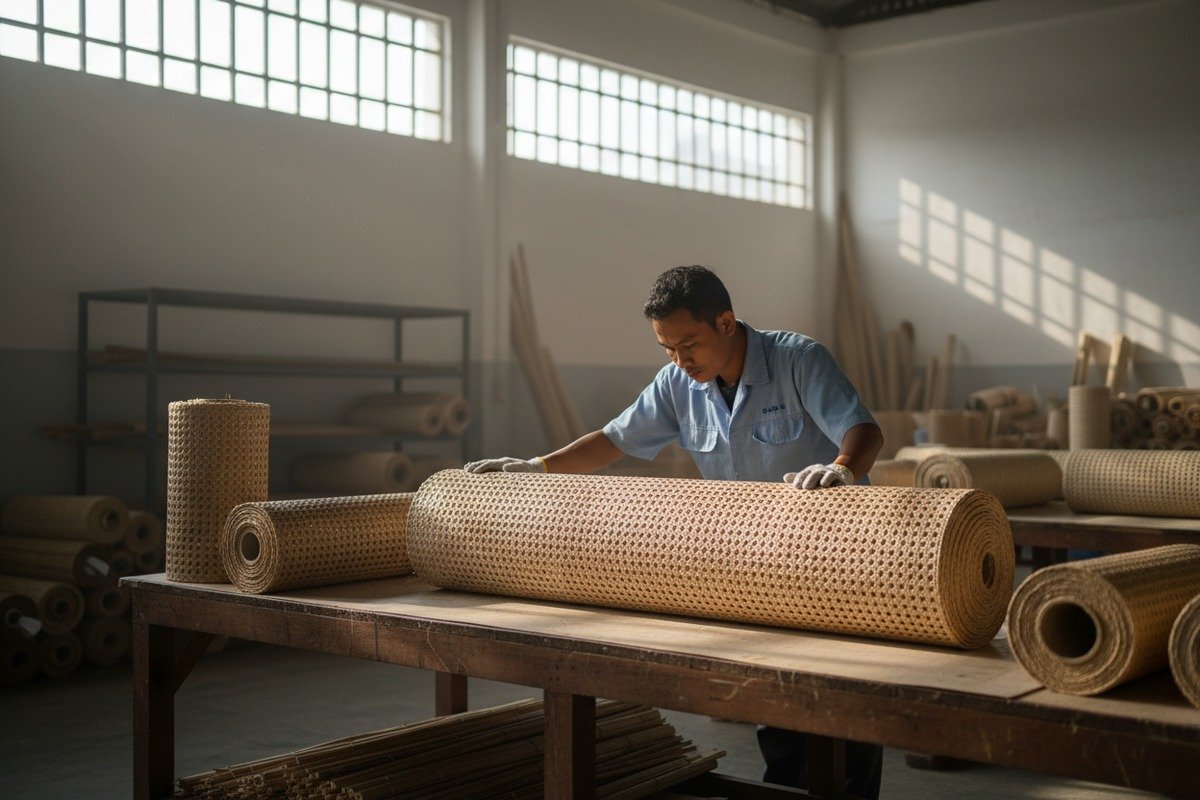
Every season, our production team in Indonesia inspects thousands of rattan cane webbing rolls before they ship out. One recurring issue keeps coming back: moisture. Too wet, and the rolls develop mold in transit. Too dry, and the cane cracks the moment buyers try to install it. Getting the محتوى الرطوبة 1 right is the single biggest quality factor we deal with daily.
The ideal moisture content for natural rattan cane webbing is 8% to 12%. This range ensures optimal stability, workability, and longevity. It prevents brittleness from over-drying and avoids mold or warping caused by excess moisture, making the webbing ready for storage, soaking, and installation.
But knowing the number is only half the battle. You also need to understand how to measure it, why it matters so much for your furniture, how to store it safely, and what to demand from your supplier. Let’s break it all down.
How do I determine the correct moisture percentage for my natural rattan cane webbing?
When we first set up our rattan processing facility, we relied on touch and feel to judge dryness. That led to rejected shipments and costly returns. Measuring moisture content with proper tools changed everything for our عملية مراقبة الجودة 2.
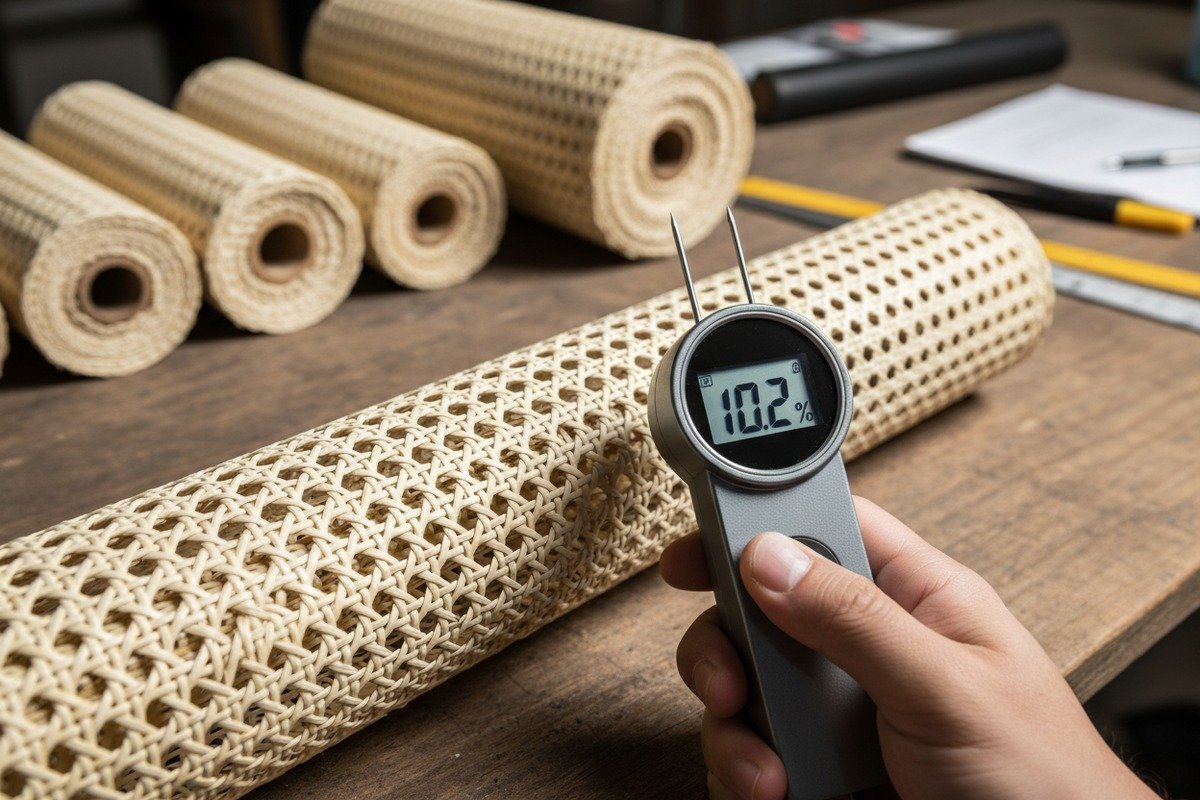
You can determine the correct moisture percentage for natural rattan cane webbing by using a pin-type or pinless wood moisture meter. Insert or press the meter against the webbing in multiple spots. Readings between 8% and 12% confirm your material is within the safe, workable range.
Why the 8–12% Range Matters
Natural rattan cane webbing is made from the outer bark of the نخيل الروطان 3. This bark is mostly cellulose fiber. Like wood, cellulose absorbs and releases water depending on the surrounding air. Scientists call this the equilibrium moisture content 4 (EMC). When rattan sits in a stable indoor environment, it naturally settles within the 8–12% range.
If the moisture content drops below 8%, the cellulose fiber 5s lose too much bound water. They shrink, become rigid, and crack under stress. If it rises above 12%, the fibers swell. They become soft, lose structural integrity, and create a breeding ground for العفن والفطريات 6.
Tools for Measuring Moisture Content
You do not need expensive lab equipment. A basic مقياس الرطوبة 7 designed for wood works perfectly on rattan. Here are the most common options:
| نوع الأداة | How It Works | Accuracy | الأفضل لـ |
|---|---|---|---|
| Pin-type moisture meter | Two metal pins penetrate the surface; measures electrical resistance between them | ±0.5–1% | Spot-checking individual rolls |
| Pinless moisture meter | Uses electromagnetic waves to scan below the surface without damage | ±1–2% | Non-destructive bulk inspection |
| Oven-dry method | Weigh sample, dry in oven at 103°C until constant weight, calculate % loss | Most accurate | Lab verification, supplier audits |
For purchasing managers receiving bulk orders, we recommend using a pin-type meter on at least 5% of rolls per shipment. Test in three spots: the center, the edge, and one end of the roll. If any reading falls outside 8–12%, flag that batch for closer review.
Factors That Affect Initial Moisture Content
The moisture content of raw rattan webbing when it arrives at your warehouse depends on several things. First, the origin matters. Rattan harvested during rainy season in Indonesia or Vietnam starts wetter. Second, the drying method matters. Sun-drying is less controlled than kiln-drying 8. At our facility, we use a combination of air-drying and controlled indoor drying to bring rolls within spec before packing.
Third, shipping conditions play a role. A container sitting in a humid port for weeks can absorb moisture through inadequate packaging. This is why we always include silica gel packets 9 and moisture barrier film in our export packaging.
Quick Field Test
If you do not have a meter handy, try this: bend a single strand of cane gently. If it snaps with no flex, it is too dry—likely below 6%. If it feels limp and rubbery, it is too wet—likely above 15%. A properly conditioned strand will bend with mild resistance and spring back partially.
Why is maintaining the right moisture level critical for the durability of my rattan furniture?
Our team has tracked warranty claims from furniture factories across three continents for over a decade. The single most common complaint is not about weave pattern or color. It is about cane webbing that cracks, sags, or develops mold within months of installation.
Maintaining the right moisture level is critical because rattan's cellulose fibers expand and contract with humidity changes. Outside the 8–12% range, fibers either crack from dryness or swell and weaken from excess water. Correct moisture ensures tight weave tension, structural resilience, and years of service life.

What Happens When Rattan Gets Too Dry
When rattan webbing drops below 8% moisture content, the fibers lose their natural flexibility. The woven structure becomes stiff and fragile. During installation, overly dry webbing resists stretching. It can split when you press it into a frame groove or staple it down.
Even after installation, dry indoor environments—common in heated homes during winter—can push the moisture content lower. The webbing shrinks unevenly. You see gaps opening in the weave. Strands pull apart at intersections. Over time, small cracks become large tears.
What Happens When Rattan Gets Too Wet
Excess moisture above 14% creates the opposite problem. Wet fibers swell and soften. The webbing loses its taut surface. Chairs sag. Cabinet panels bow outward. Worse, moisture trapped inside tightly wound rolls creates perfect conditions for mold and fungal growth.
We once received a complaint from a buyer in the Netherlands whose entire order developed black mold spots within two weeks of arrival. The root cause? The rolls had been stored near an open loading dock during a rainy week before shipping. Moisture content at inspection was 18%.
The Installation Connection
The soaking process before installation is where moisture management becomes most practical. You soak the webbing to make it pliable. Then you stretch it over the frame. As it dries, it shrinks and tightens. This is the core mechanic that gives rattan furniture its signature taut, drum-like seat or back panel.
But the starting moisture content of your raw webbing determines how much it will shrink during drying. If it starts too wet, it over-tightens and can warp the frame. If it starts too dry, soaking may not fully rehydrate the fibers, leading to uneven tension.
| Starting Moisture Content | Soaking Behavior | Post-Drying Result |
|---|---|---|
| Below 6% (over-dried) | Absorbs water unevenly; some fibers remain brittle | Uneven tension, potential cracking |
| 8–12% (ideal) | Absorbs water uniformly in 15–30 minutes | Smooth, even tightening; taut finish |
| 14–18% (too wet) | Already soft; minimal soaking needed | Over-tightening risk; frame stress |
| Above 18% (saturated) | Should not be installed; requires drying first | Mold risk; sagging after partial drying |
Environmental Factors Post-Installation
After installation, your rattan webbing continues to exchange moisture with the air. This is why indoor humidity control matters. The sweet spot is 40–60% الرطوبة النسبية 10. Below 40%, the webbing dries out too fast. Above 60%, it absorbs too much moisture and loosens.
Direct sunlight accelerates moisture loss. UV rays also break down the cellulose structure itself, causing yellowing and brittleness. Our recommendation to all buyers: install rattan furniture away from south-facing windows and heating vents.
Conditioning for Longevity
Occasional conditioning with linseed oil or orange oil can help maintain fiber flexibility without trapping moisture. Apply a thin coat with a soft cloth once or twice a year. Avoid petroleum-based products or thick varnishes. These create an impermeable seal that blocks the rattan's natural ability to breathe and regulate its own moisture content.
Some manufacturers apply breathable natural waxes during production. At our factory, we offer this as an optional finish for clients who want extra protection without sacrificing the material's organic look and feel.
How can I prevent mold or brittleness in my rattan webbing during long-term storage?
We store up to 20,000 rolls of rattan cane webbing in our Foshan warehouse at any given time. Some sit there for weeks, others for months while buyers finalize logistics. Early on, we lost entire pallets to mold because we underestimated how much storage conditions matter.
To prevent mold or brittleness during long-term storage, keep natural rattan cane webbing in a dry, ventilated space with 40–60% relative humidity and temperatures between 15°C and 30°C. Avoid direct sunlight, floor contact, and sealed plastic wrapping. Use breathable packaging and silica gel desiccants.
The Two Enemies: Humidity Extremes
Mold and brittleness are opposite symptoms of the same problem—uncontrolled humidity. High humidity feeds mold. Low humidity starves the fibers. Your storage strategy needs to manage both.
Mold spores are everywhere. They only need three things to grow: organic material (rattan provides this), warmth (above 20°C), and moisture (above 65% relative humidity at the fiber surface). Remove any one of these, and mold cannot establish itself.
Brittleness happens when storage humidity drops below 30% for extended periods. In desert climates or heavily air-conditioned warehouses, rattan can lose moisture to the point of permanent fiber damage. Once cellulose fibers crack at the microscopic level, no amount of soaking will fully restore them.
أفضل ممارسات التخزين
Here is what we implement in our own warehouses and recommend to every wholesale buyer:
| عامل التخزين | الممارسة الموصى بها | لماذا هو مهم |
|---|---|---|
| Humidity | 40–60% RH, monitored with hygrometer | Prevents both mold (high RH) and cracking (low RH) |
| درجة الحرارة | 15–30°C (59–86°F) | Extreme heat accelerates drying; cold can cause condensation |
| Ventilation | Open shelving, air gaps between rolls | Prevents moisture pockets forming between stacked rolls |
| التعبئة والتغليف | Kraft paper or breathable woven PP bags | Allows moisture exchange; sealed plastic traps condensation |
| الارتفاع | Store on pallets or shelves, never on bare floor | Floors transfer ground moisture and cold |
| Sunlight | No direct exposure; use opaque coverings if needed | UV causes fading and accelerates fiber breakdown |
| Desiccants | Silica gel packets inside packaging | Absorbs excess humidity during transit and early storage |
تعديلات موسمية
If you operate in a climate with strong seasonal humidity swings, you need to adjust. During monsoon or rainy seasons, run dehumidifiers in your storage area. During dry winters, consider a light misting system or simply placing open water trays near (not on) the stock to raise ambient humidity slightly.
Our buyers in the Middle East face extreme dry conditions. We advise them to keep rolls in their original breathable packaging and store them in interior rooms rather than metal-roofed sheds where temperatures can spike above 45°C.
جدول الفحص
Even with perfect conditions, inspect your stored rattan at least once a month. Look for dark spots (early mold), musty smell, or strands that snap easily when bent. Catch problems early. A single moldy roll left untreated can spread spores to neighboring stock within days.
If you find surface mold, isolate the affected rolls immediately. Wipe down with a dilute white vinegar solution (1:4 ratio with water), then air-dry thoroughly. If mold has penetrated the fibers, the roll is usually unsalvageable for premium applications.
Packaging for Long-Distance Shipping
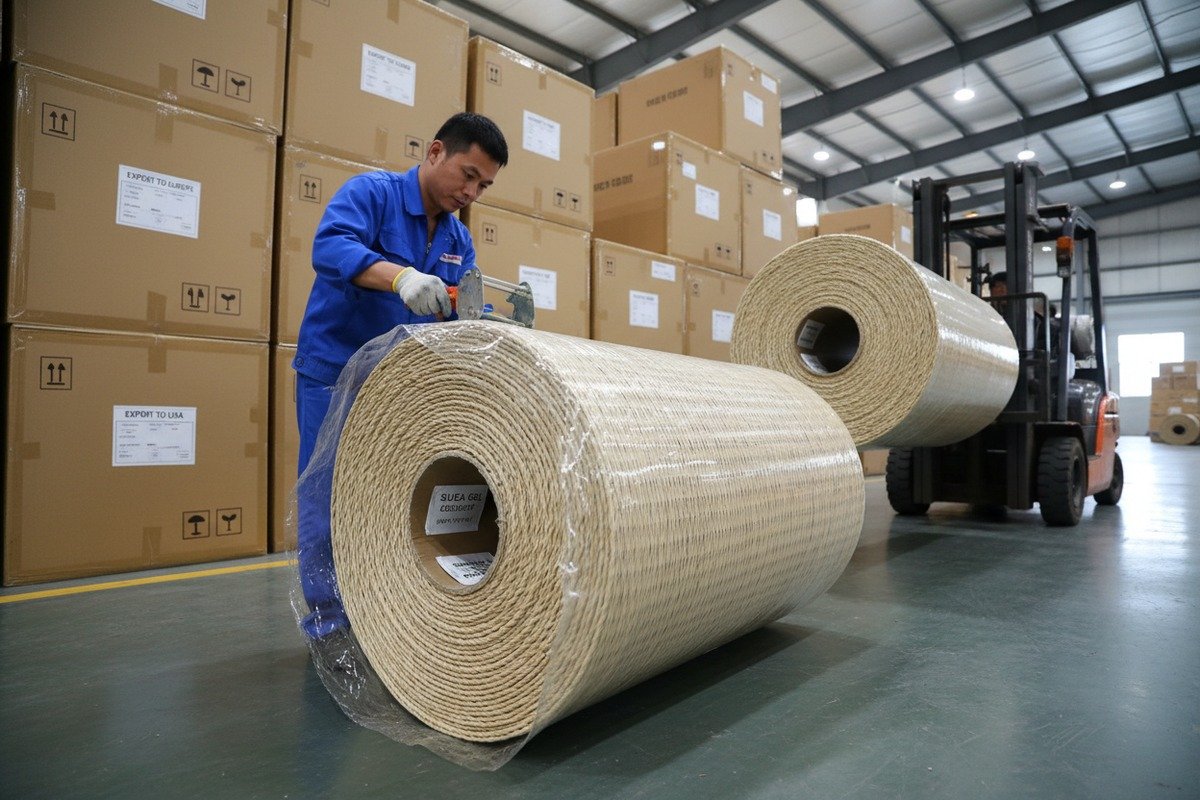
For our international shipments, we double-wrap rolls in breathable kraft paper, add silica gel packets rated for the container volume, and use moisture indicator cards inside the packaging. These cards change color when humidity exceeds a threshold, giving the receiving warehouse instant feedback on transit conditions.
What steps should my supplier take to ensure consistent moisture quality in my bulk orders?
Over the years, we have refined our quality control process based on direct feedback from furniture factories in Spain, Australia, and the US. Consistency is what separates a reliable rattan supplier from one that causes production headaches. Here is what you should expect—and demand—from your sourcing partner.
Your supplier should implement controlled drying to 8–12% moisture content, use calibrated moisture meters for batch testing, apply breathable packaging with desiccants, provide moisture test reports per shipment, and maintain climate-controlled storage. These steps guarantee consistent moisture quality across every bulk order.

Controlled Drying Process
Raw rattan arrives at processing facilities with moisture content anywhere from 25% to 40%, depending on harvest season and transport conditions. The drying process is where quality begins.
There are three common drying methods:
Sun-drying is the cheapest. Workers spread rattan strips on open racks under direct sunlight. The problem is inconsistency. Overcast days slow drying. Sunny days can over-dry the outer layers while the core remains wet. Sun-dried rattan often shows moisture variation of ±5% within a single roll.
Air-drying in covered sheds is better. It protects from rain and direct UV while allowing natural airflow to gradually reduce moisture. This takes longer—often 2 to 4 weeks—but produces more uniform results.
Controlled indoor drying with fans and dehumidifiers is what we use at our Indonesian facility. Temperature and humidity are monitored continuously. Drying time is calibrated to the batch thickness and starting moisture content. This method delivers the tightest moisture range, typically within ±1% of the 10% target.
Batch Testing Protocol
A good supplier does not just test one roll and call the batch approved. Here is the protocol we follow:
- Test a minimum of 5% of rolls per production batch
- Take three readings per roll (center, edge, end)
- Record all readings in a batch inspection report
- Flag any roll outside 8–12% for re-drying or segregation
- Provide the moisture test report to the buyer with each shipment
If your current supplier cannot provide a moisture report, that is a red flag. It means they are not measuring it systematically.
Packaging Standards
Packaging is the last line of defense before your rattan enters the shipping container. Here is what proper export packaging looks like:
| Packaging Component | الغرض | Our Standard |
|---|---|---|
| غلاف داخلي | Breathable moisture barrier | Kraft paper or woven PP |
| مجفف | Absorb excess humidity in transit | Silica gel, 50g per roll |
| Moisture indicator card | Visual humidity alert for receiving team | Color-change card (blue = dry, pink = wet) |
| Outer protection | Physical damage prevention | Corrugated cardboard or woven PP bag |
| Pallet base | Elevation from container floor | Wooden or plastic pallet |
| تجهيز الحاوية | Prevent condensation drip damage | Desiccant poles hung inside container |
Communication and Documentation
Beyond physical quality control, your supplier should communicate proactively. Before shipping, they should confirm the batch moisture readings. If weather or production delays affect drying schedules, they should inform you rather than ship borderline material.
At Seafan Rattan, we share photos of the moisture meter readings alongside the packed goods before container loading. Our buyers in Turkey and Greece have told us this simple step eliminated disputes on arrival.
ما الذي يجب أن تسأله لموردك
If you are evaluating a new rattan webbing supplier, ask these questions directly:
- What is your target moisture content, and what is your tolerance range?
- What drying method do you use?
- Do you provide moisture test reports per shipment?
- What packaging materials do you use for moisture protection?
- How do you handle rolls that fall outside the target range?
A supplier who answers these confidently and with specifics is one who takes moisture quality seriously. Vague answers like "we dry it until it feels right" should make you look elsewhere.
The Cost of Getting It Wrong
Inconsistent moisture quality is not just a technical issue. It hits your bottom line. Moldy rolls mean waste. Brittle rolls mean installation failures and rework. Both lead to delayed production schedules, unhappy end customers, and eroded trust. Investing in a supplier with tight moisture control pays for itself many times over.
خاتمة
Moisture content between 8% and 12% is the foundation of quality natural rattan cane webbing. Measure it, maintain it, store it properly, and hold your supplier accountable for it.
ملاحظات سفلية
1. Replaced HTTP 404 with authoritative definition of moisture content. ↩︎
2. Replaced HTTP 404 with authoritative overview of quality control process. ↩︎
3. Wikipedia page detailing the scientific classification and characteristics of rattan palm. ↩︎
4. Replaced HTTP 404 with authoritative definition of equilibrium moisture content. ↩︎
5. Wikipedia page explaining cellulose fibers, their structure, and properties. ↩︎
6. Replaced HTTP 403 with authoritative definition and distinction of mold and mildew. ↩︎
7. Explains how different types of moisture meters work for wood. ↩︎
8. Describes the kiln-drying process for wood and its benefits for stability. ↩︎
9. Details the structure and desiccant properties of silica gel for moisture control. ↩︎
10. NOAA’s definition of relative humidity and its dependence on temperature and moisture. ↩︎

 English
  Español de México
  العربية
  Deutsch
  Français
  Русский