
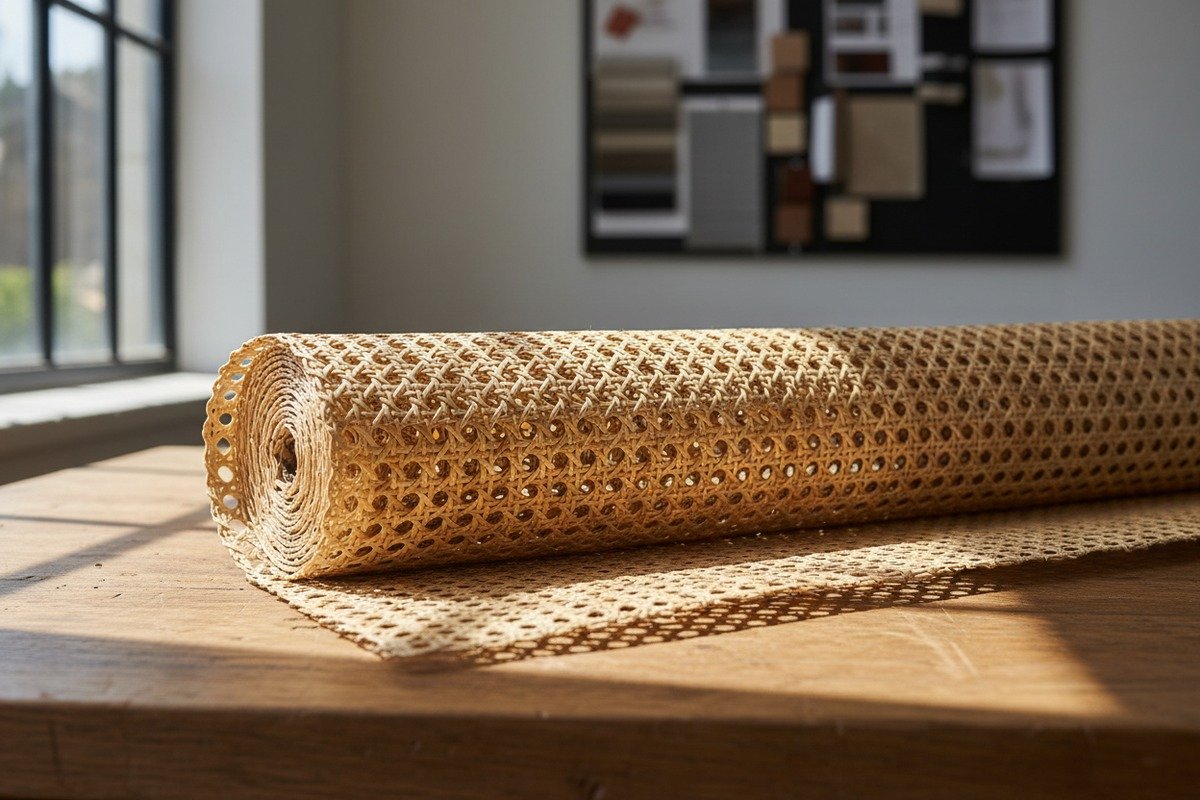
Every week, our production floor in Foshan ships thousands of meters of hexagonal rattan webbing to furniture factories across three continents — and quality questions never stop.
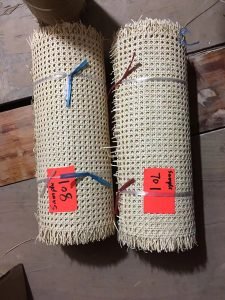
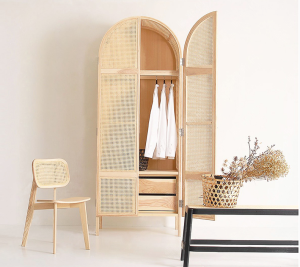
Hexagonal weave rattan cane webbing is a pre-woven sheet material made from thin strips of natural rattan cane skin, featuring an open hexagonal or octagonal pattern. Its key characteristics include lightweight durability, natural breathability, consistent mesh openings for light diffusion, flexible pliability when moistened, and a timeless organic aesthetic suited for furniture, cabinetry, and decorative panels.
Whether you are a furniture factory owner sourcing chair components or a material wholesaler building inventory, understanding the specific traits of this webbing saves money and prevents returns natural rattan cane skin 1. Below, we break down quality markers, material options, customization possibilities, and grading systems so you can order with confidence.
How can I tell if the hexagonal weave is high quality for my furniture production?
عندما يقوم فريقنا بـ مراقبة الجودة 2 inspects finished rolls before export, they follow a strict checklist — because one defective batch can cost a buyer an entire production run.
High-quality hexagonal weave rattan cane webbing shows uniform strand thickness, consistent hexagonal openings, even color tone, minimal nodes, flexible pliability without brittleness, and proper moisture content between 8–12%. These traits ensure structural integrity and visual consistency across furniture production batches.
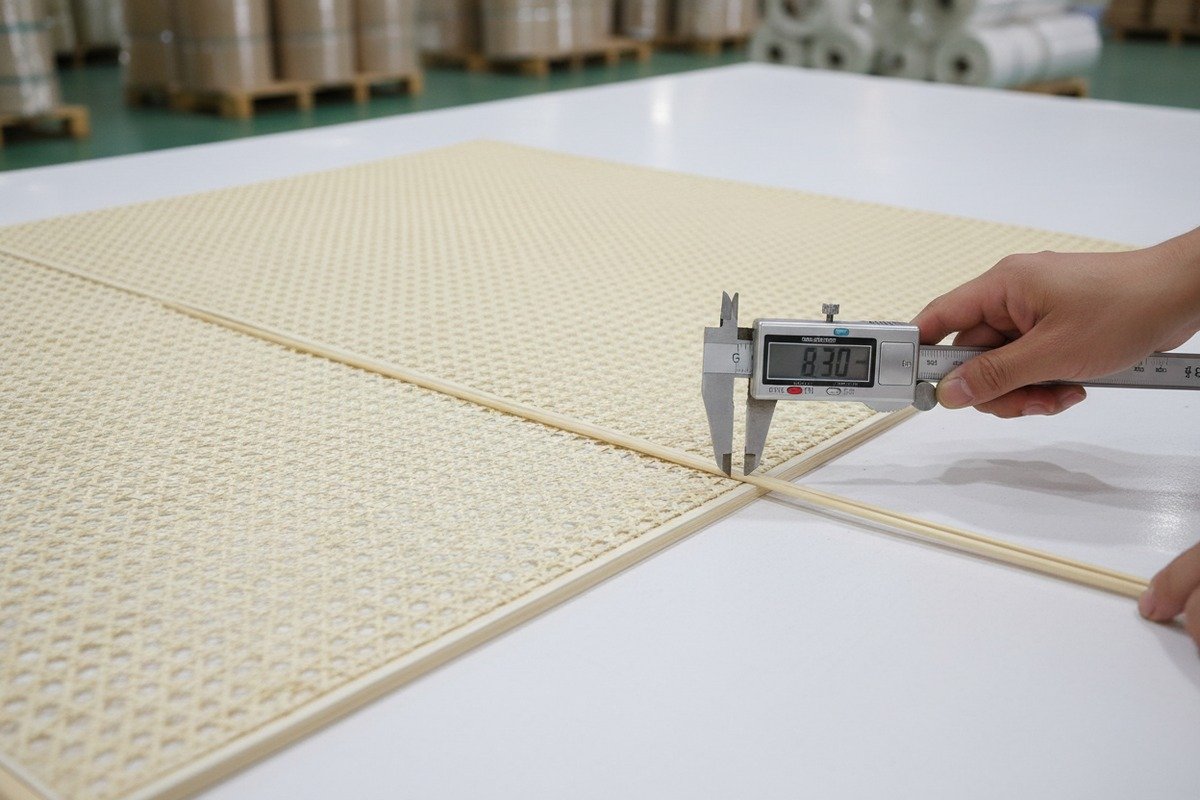
Identifying quality in hexagonal rattan webbing is not guesswork السلامة الهيكلية 3. It requires checking specific physical traits that directly affect how the material performs once installed on a chair, cabinet, or decorative panel. Let me walk you through each indicator.
Strand Uniformity and Thickness
The first thing to examine is the individual cane strand. In premium AAA-grade webbing, every strand should be nearly identical in width and thickness. Variations greater than 0.5mm across a single roll signal inconsistent raw material processing. Our peeling machines in Indonesia are calibrated to produce strands within tight tolerances, but not every supplier maintains that standard. Run your fingers across the sheet. If you feel bumps or thin spots, the grade is lower.
Weave Tension and Pattern Consistency
Each hexagonal opening should be the same size across the entire roll. Uneven tension during weaving creates some hexagons that are stretched and others that are compressed. Hold the sheet up to light. The openings should form a repeating, symmetrical pattern. This matters especially for chair backrests where customers see the webbing at eye level.
Node Count and Placement
Nodes are the natural joints in the rattan cane. They are slightly thicker and harder. A high-quality roll will have minimal nodes, and they will be distributed randomly rather than clustered in one area. Excessive nodes create weak points and visual inconsistency.
Color and Moisture
Color should be uniform — natural beige-gold for unbleached, or consistent cream for bleached rolls. Dark spots indicate mold or improper drying. محتوى الرطوبة 4 matters too. Too dry and the webbing cracks during installation. Too wet and it attracts mold during shipping.
| مؤشر الجودة | AAA Grade | A Grade | B Grade |
|---|---|---|---|
| Strand width variation | < 0.3mm | 0.3–0.8mm | > 0.8mm |
| Nodes per square meter | < 3 | 3–8 | > 8 |
| اتساق اللون | 95%+ uniform | 85–95% uniform | < 85% uniform |
| محتوى الرطوبة | 8–12% | 8–15% | Uncontrolled |
| Hexagon symmetry | Near perfect | Minor variance | Visible irregularity |
| المرونة | ينحني دون تشقق | مقاومة طفيفة | Brittle in spots |
اختبار الانحناء
A simple but effective check: take a small piece of the webbing and gently bend it around a cylinder roughly the diameter of a chair rail. Quality webbing bends smoothly. Low-grade material cracks or splinters. This is especially critical for curved furniture applications.
One common mistake buyers make is judging quality solely by appearance in photos. We always recommend requesting physical samples before placing wholesale orders. A 30cm sample piece reveals more than any product image can.
What are the main differences between natural and bleached rattan for my designs?
Our design consultation team fields this question almost daily — furniture brands want a specific look, but they often underestimate how material choice affects both aesthetics and longevity.
Natural rattan cane webbing retains its original golden-brown color with organic tone variations, while bleached rattan undergoes a chemical lightening process to achieve a uniform pale cream or white tone. Natural offers richer character and slightly higher durability, whereas bleached provides a cleaner, modern look but may lose some flexibility and weather resistance.
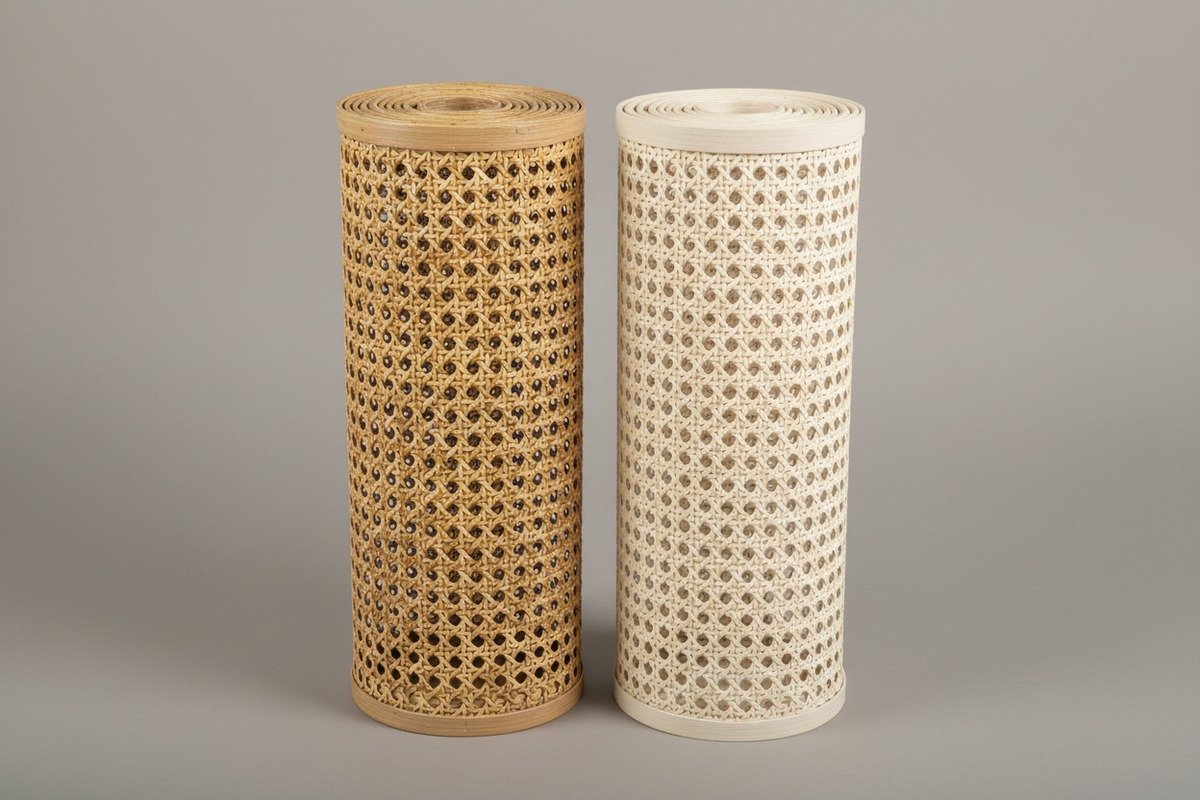
Choosing between natural and bleached rattan is not purely a visual decision. It affects durability, handling, pricing, and how the final product ages over time. Here is what you need to know.
Visual Characteristics
Natural rattan cane webbing 5 has a warm, golden-brown to straw-yellow tone. Each strand carries subtle color variations because rattan is a natural material. These organic variations are prized in bohemian, rustic, and mid-century furniture designs. They give each piece a unique, handcrafted feel.
Bleached rattan, by contrast, has been treated with بيروكسيد الهيدروجين 6 or similar agents to strip pigment. The result is a pale cream or near-white appearance with much greater color uniformity. This makes it popular for Scandinavian-style furniture, coastal interiors, and contemporary minimalist designs where a lighter palette is desired.
Durability and Handling Differences
The bleaching process removes some of the natural oils and lignin 7 from the cane fiber. This can make bleached webbing slightly more brittle than its natural counterpart. In our testing, natural cane webbing consistently shows 10–15% higher flexibility before cracking compared to bleached versions of the same grade.
However, bleached rattan is not fragile. It performs well in indoor applications where it is not exposed to direct sunlight or high humidity. The key is proper moisture conditioning before installation — soaking the webbing briefly in water restores pliability regardless of type.
Aging and Maintenance
Natural rattan deepens in color over time. Exposure to indoor ambient light gradually shifts the golden tone to a richer honey-brown. Many designers consider this patina a feature, not a flaw. Bleached rattan, on the other hand, can yellow unevenly over years, especially near windows. UV-protective coatings can slow this process, but they add cost.
| الميزة | حشو الروطان الطبيعي | Bleached Rattan Webbing |
|---|---|---|
| Color | Golden-brown, straw-yellow | Pale cream, off-white |
| Tone consistency | Organic variation | High uniformity |
| المرونة | أعلى | Slightly reduced |
| مقاومة الأشعة فوق البنفسجية | معتدل | أقل |
| سلوك التقادم | Deepens to honey-brown | May yellow unevenly |
| Price point | قياسي | 5–15% premium |
| Best design styles | Bohemian, rustic, mid-century | Scandinavian, coastal, modern |
| حساسية الرطوبة | Standard care needed | Slightly more sensitive |
Which Should You Choose?
For high-traffic commercial furniture — restaurant chairs, hotel lobby screens — we typically recommend natural rattan. Its inherent oils provide better resilience. For residential indoor pieces where aesthetics are the priority and conditions are controlled, bleached rattan delivers that clean, contemporary look clients love.
Some of our wholesale buyers stock both. Natural outsells bleached roughly 60/40 in our export data to the US and Europe, but the gap narrows every year as lighter interiors gain popularity. The important thing is to match the material to the end-use environment.
Can I customize the mesh size and roll width for my specific wholesale orders?
Running three factories and coordinating with over 30 partner facilities gives us flexibility that single-source suppliers simply cannot match — but customization has practical limits every buyer should understand.
Yes, mesh size and roll width can be customized for wholesale orders. Standard widths range from 16 to 36 inches, with 24 inches being the most common. Mesh openings can be adjusted by modifying strand spacing during weaving. However, custom specifications typically require minimum order quantities of 200–500 meters and 2–4 weeks of additional lead time.

Customization is one of the biggest advantages of working directly with a manufacturer or vertically integrated wholesaler rather than buying off-the-shelf from a trading company. Here is exactly what can be adjusted, and what constraints exist.
خيارات العرض
Standard production widths are fixed-loom sizes. The most common widths available without custom setup are 16, 18, 20, 22, 24, and 36 inches. The 24-inch width dominates orders because it fits the majority of chair seat and backrest dimensions with minimal waste.
For non-standard widths — say 28 inches for an oversized cabinet panel — the weaving loom must be reconfigured. This is feasible, but it requires a minimum run to justify the setup time. In our facilities, that minimum is typically 200 linear meters. Smaller quantities are not economical because the adjustment and calibration process takes nearly as long as the weaving itself.
Mesh Size Adjustments
The hexagonal opening size is controlled by strand spacing during the weaving process. A tighter mesh means strands are placed closer together, resulting in smaller hexagons. A looser mesh produces larger, more open hexagons.
Standard mesh options fall into three categories:
| نوع الشبكة | Approximate Opening Size | التأثير البصري | Common Applications |
|---|---|---|---|
| Fine mesh | 8–10mm hexagons | Dense, semi-opaque | Cabinet doors, radiator covers |
| Standard mesh | 12–15mm hexagons | Classic open weave | مساند الكراسي، ألواح زخرفية |
| Wide mesh | 18–22mm hexagons | Very open, airy | Room dividers, lighting fixtures |
Most buyers choose standard mesh because it balances visual appeal with structural strength. Fine mesh uses more material per square meter and costs 10–20% more. Wide mesh is lighter and cheaper but offers less support for applications like seat bottoms where the webbing bears weight.
Strand Thickness and Type
Beyond width and mesh size, you can specify strand thickness. Standard hexagonal webbing uses strands approximately 2–2.5mm wide. Thicker strands (3mm+) create a bolder, more rustic appearance and add structural strength. Thinner strands (1.5mm) give a more delicate, refined look suitable for decorative applications.
ال rattan species 8 also matters. Rotin Tohiti produces flexible, golden-brown strands ideal for hexagonal patterns. Rotan Sego has smaller-diameter cane better suited for binding and detail work. When you specify your order, the species affects both price and performance.
Practical Tips for Custom Orders
First, always provide a physical sample or detailed drawing of your desired mesh and width. Written descriptions lead to misunderstandings. Second, order 10–15% more than your calculated need. Hexagonal webbing has natural irregularities at roll edges that require trimming. Third, confirm moisture packaging. Custom rolls shipped without proper moisture barriers can arrive too dry or too damp, affecting installation quality.
Our export team in Foshan handles custom specifications regularly for clients in the Netherlands, Australia, and the US. The process works best when buyers plan ahead — rush custom orders cost significantly more and leave less room for quality control.
How do I choose the right grade of hexagonal webbing for my chair backrests?
Over the past decade, we have supplied hexagonal webbing for chair backrest projects ranging from budget café seating to premium designer lounge chairs — and the grade selection process is different for each.
For chair backrests, choose AAA grade for high-end visible furniture where appearance is critical, A grade for mid-range production balancing cost and quality, and B grade only for hidden or structural applications. Key factors include strand uniformity, node count, color consistency, and the expected retail price point of your finished furniture.
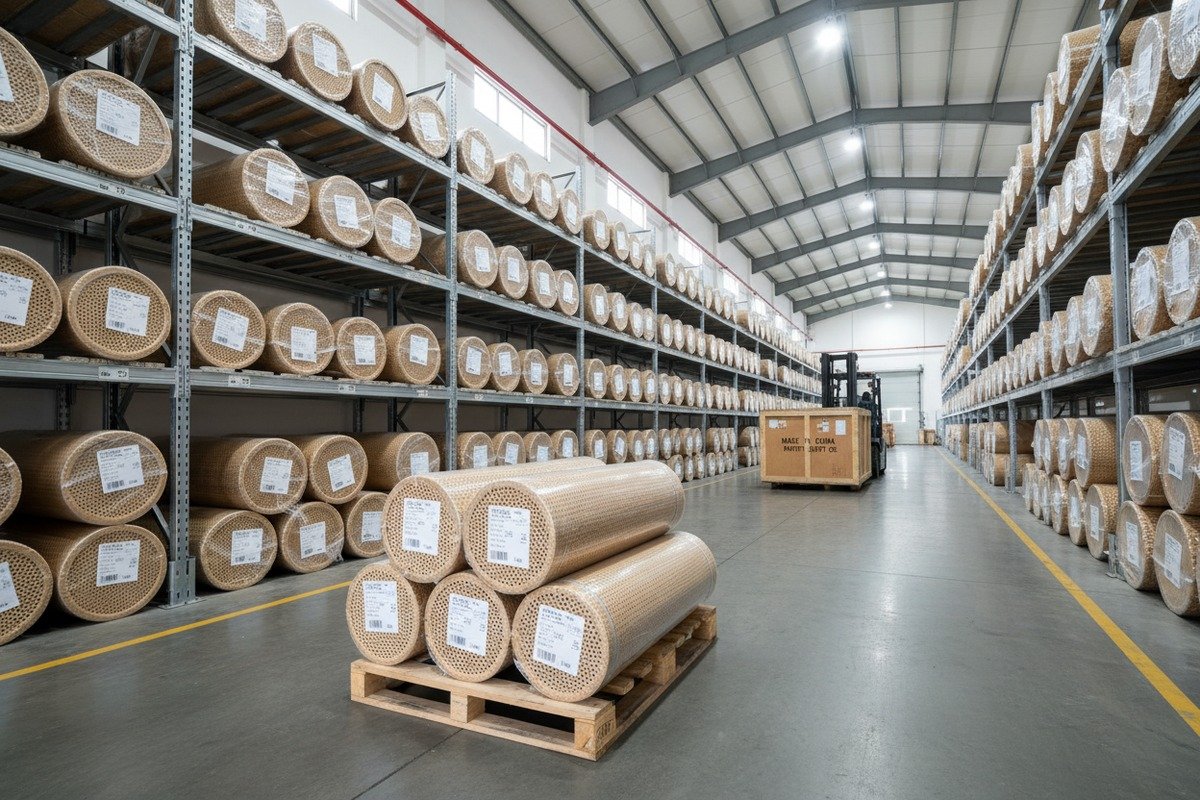
Grade selection is where cost control meets customer satisfaction. Choosing too high a grade wastes margin. Choosing too low risks returns and brand damage. Here is a systematic approach.
فهم نظام التصنيف
Rattan cane webbing grading is not standardized by an international body 10. Grades like AAA, A, and B are industry conventions used across Southeast Asian producers, but the exact thresholds vary by supplier. This is why requesting samples from your specific supplier is non-negotiable — "AAA" from one factory may equal "A" from another.
That said, here is what these grades generally mean in practice:
AAA Grade — The top tier. Strands are hand-selected for uniform width, minimal nodes, and consistent color. Hexagonal openings are symmetrical across the entire roll. This grade is intended for furniture where the webbing is the focal design element — think a statement lounge chair or a luxury headboard. Expect to pay a 25–40% premium over A grade.
A Grade — The workhorse for most furniture production. Minor color variations and occasional nodes are present but not disruptive to the overall appearance. Hexagonal patterns are consistent with slight imperfections visible only upon close inspection. This is what the majority of our wholesale clients order for mid-range commercial furniture.
B Grade — Functional but visually inconsistent. Higher node count, noticeable color variation, and occasional weave tension irregularities. Suitable for concealed applications — like the underside of a chair seat — or for projects where the webbing will be painted or covered.
مطابقة الدرجة للتطبيق
The decision comes down to three questions. First, how visible is the webbing in the finished product? A dining chair backrest sits at eye level — it demands A grade minimum. A cabinet back panel that faces a wall can use B grade. Second, what is the retail price of the finished furniture? A chair selling for $500+ justifies AAA webbing. A $50 café chair does not. Third, what is the expectation of your end customer? Wholesale buyers in the Netherlands and Australia consistently demand A or AAA for their markets. Buyers targeting price-sensitive markets may accept B grade.
Installation Considerations by Grade
Higher grades are also easier to install. AAA and A grade webbing lies flat with consistent tension, reducing labor time during frame attachment. B grade webbing may require more trimming and adjustment, which adds labor cost that can offset the savings on material.
For chair backrests specifically, we recommend the webbing be installed with a slight pre-tension and secured using spline or retainer strips pressed into a routed groove in the chair frame. The hexagonal pattern should be oriented so that the longest axis of each hexagon runs vertically — this distributes sitting pressure more evenly and looks more natural to the eye.
Common Pitfalls
One mistake we see regularly: buyers order AAA grade for a prototype, approve the look, then switch to B grade for production to save cost. The visual difference is immediately noticeable to their customers. If budget is a concern, A grade offers the best compromise. Another pitfall is ignoring strand direction. Hexagonal webbing has a "right side" and a "wrong side." Installing it backwards exposes the rougher strand edges and reduces the polished appearance of higher grades.
خاتمة
Hexagonal weave rattan cane webbing combines natural beauty with practical versatility — and knowing its key characteristics helps you source smarter, produce better furniture, and satisfy your end customers every time.
ملاحظات سفلية
1. Differentiates cane (skin) from rattan, explaining its origin. ↩︎
2. Highlights the critical role of quality control in manufacturing processes and product reliability. ↩︎
3. Defines the engineering concept of structural integrity in components and structures. ↩︎
4. Explains the significance of moisture content for wood stability and performance. ↩︎
5. Explains what cane webbing is and its use in furniture. ↩︎
6. Provides chemical properties and industrial uses, including bleaching. ↩︎
7. Describes lignin’s role as a structural material in plant cell walls. ↩︎
8. Offers general information about the diverse species of rattan palms. ↩︎
9. Defines minimum order quantity and its importance in supply chain management. ↩︎
10. Provides information on a prominent international organization for standardization. ↩︎
 English
  Español de México
  العربية
  Deutsch
  Français
  Русский