

Every week, our sales team in Foshan fields the same question from buyers worldwide: “How do I get the best rattan cane webbing without overpaying or sacrificing quality?” It’s a real pain point. You find a supplier with great prices, but the webbing cracks after three months sechseckiges offenes Rohr 1. Or you lock in premium grade material, only to watch your margins vanish. After nearly three decades shipping rattan from our own factories in Indonesia and China, we’ve learned that the balance between quality and cost isn’t about choosing one over the other — it’s about knowing exactly where to look and what to ask.
To balance quality and cost when sourcing natural rattan cane webbing, buyers should verify material grades through samples, negotiate bulk pricing directly with factories, audit supplier consistency, and consolidate purchases through one-stop wholesalers to reduce logistics overhead and per-unit costs.
This guide breaks down the exact steps you can take — from grading rattan to negotiating prices to verifying large-order consistency long-term contracts 2. Let’s dig in.
How can I distinguish between Grade A and lower-quality rattan cane webbing to ensure I'm getting what I pay for?
When we process rattan at our Indonesian facility, the grading happens right at the raw material stage quality control procedures 3. Most buyers never see this step, and that's where costly mistakes begin. You receive a sample that looks fine, approve it, and then the bulk shipment arrives with thinner strands and uneven coloring. The problem? You didn't know what to check.
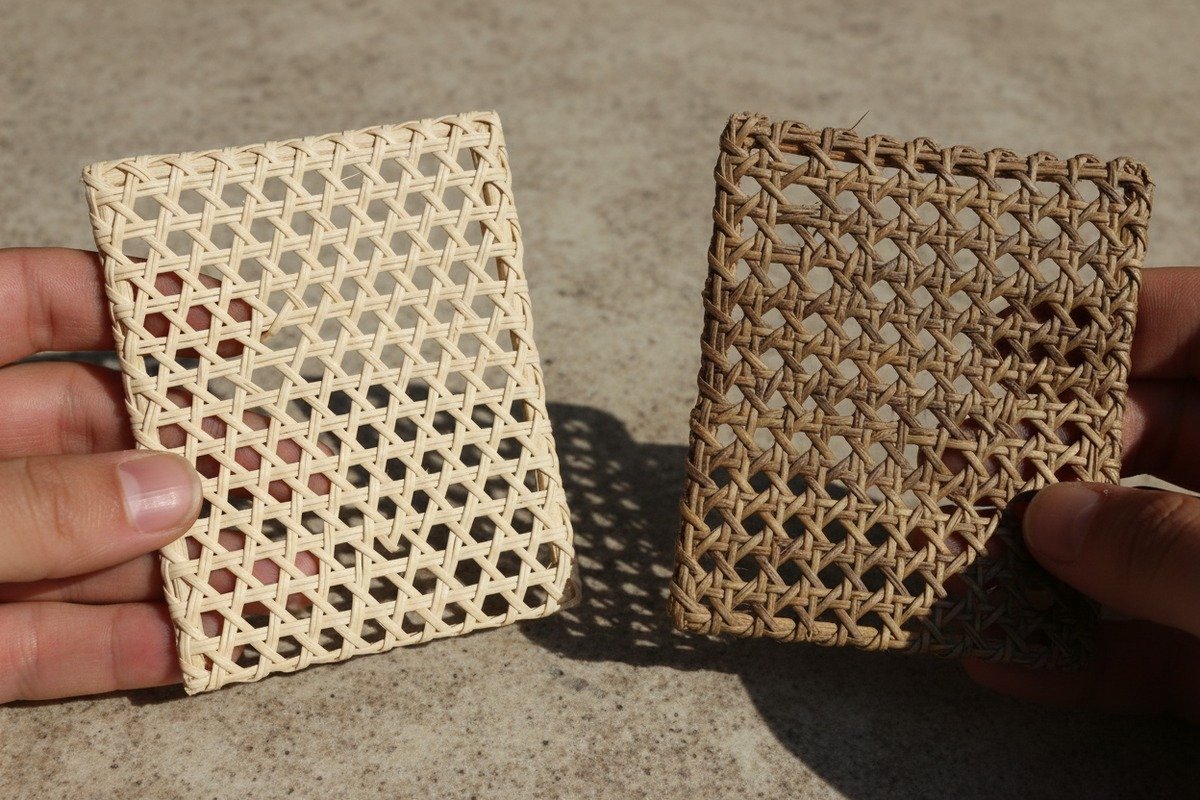
Grade A natural rattan cane webbing uses first-layer peel with uniform thickness, consistent color, no dark spots, and tight weave tension. Lower grades use inner-layer or leftover rattan, showing color variation, brittleness, and loose joints. Always request graded samples before ordering.
Was macht Rattan "Grad A" aus?
Rattan der Güteklasse A 4 cane webbing starts with the raw cane itself. The first layer of rattan peel — the outermost skin — is the strongest, most flexible, and most visually consistent part. It has a natural sheen and resists cracking. Lower-quality webbing often uses second or third-layer peel, or even leftover strips from other production runs. These pieces are thinner, more brittle, and fade unevenly over time.
Here are the key visual and physical indicators to check:
- Farbgleichmäßigkeit: Grade A has a consistent light beige or straw yellow across the entire roll. Lower grades show dark patches, green spots, or streaks.
- Strangdicke: First-layer peel is thicker and rounder. Lower grades feel flat and papery.
- Flexibilität: Bend a strand gently. Grade A flexes without cracking. Lower grades snap or splinter.
- Webspannung: In Grade A webbing, the weave is tight and even. Gaps, loose joints, or uneven spacing signal lower quality.
- Oberflächenbeschaffenheit: Grade A has a smooth, slightly glossy surface. Lower quality feels rough or fuzzy.
Vergleichstabelle der Klassen
| Merkmal | Güteklasse A | Güteklasse B | Grade C / Budget |
|---|---|---|---|
| Rattan layer | First-layer peel | Second-layer peel | Inner core or leftover strips |
| Farbe | Uniform beige/straw | Leichte Variation | Noticeable dark spots, streaks |
| Flexibilität | Hoch — biegt sich ohne zu brechen | Moderate — minor stiffness | Low — prone to snapping |
| Webspannung | Tight, even gaps | Mostly even, minor looseness | Uneven, visible gaps |
| Haltbarkeit | 5–10 years indoor use | 3–5 years indoor use | 1–3 years indoor use |
| Typische Verwendung | High-end furniture, retail | Mittelklasse Möbel | Budget DIY, disposable projects |
| Preisspanne | Premium | Mittelklasse | Niedrig |
How to Test Before You Buy
From our experience exporting to markets in the US, Europe, and the Middle East, we always recommend buyers follow a three-step verification process:
- Request free graded samples. Any reputable supplier will send you samples at no cost. Ask specifically for Grade A and Grade B so you can compare side by side.
- Do the bend test. Take a single strand from the sample and bend it at a 90-degree angle. Grade A will bend smoothly. Lower grades will crack or show stress marks.
- Check the roll edges. Unroll a section and inspect the edges. Grade A rolls have clean, trimmed edges. Lower grades often have frayed or uneven borders.
One thing buyers often overlook is the impact of climate and harvesting season on rattan quality. Rattan harvested during dry season tends to be denser and more uniform. Wet-season rattan absorbs more moisture and may shrink or warp after processing. We control for this at our Indonesian plantation by scheduling harvests and drying cycles carefully — but not every supplier does.
Natural vs. Synthetic: Know What You're Comparing
Sometimes a "low price" isn't a lower grade of natural rattan — it's actually synthetic. PE plastic rattan 5 and paper rattan are common in the market. They look similar in photos but behave very differently. Natural rattan breathes, develops patina, and suits indoor furniture. Synthetic rattan is waterproof and color-stable, better for outdoor use. Neither is inherently better — but you need to know which one you're buying.
What are the best strategies for me to negotiate better pricing when sourcing directly from a rattan factory?
Our pricing team handles hundreds of quotes every month, and we see the same patterns. Buyers who negotiate well don't just ask for a lower price — they structure their orders to unlock natural cost savings. Buyers who struggle tend to focus only on unit price without understanding what drives factory costs.
The best strategies for negotiating rattan cane webbing pricing include ordering in bulk to reduce per-unit costs, committing to long-term contracts for volume discounts, consolidating product categories with one supplier, choosing standard sizes and patterns, and timing orders during off-peak production seasons.
Understand What Drives Factory Pricing
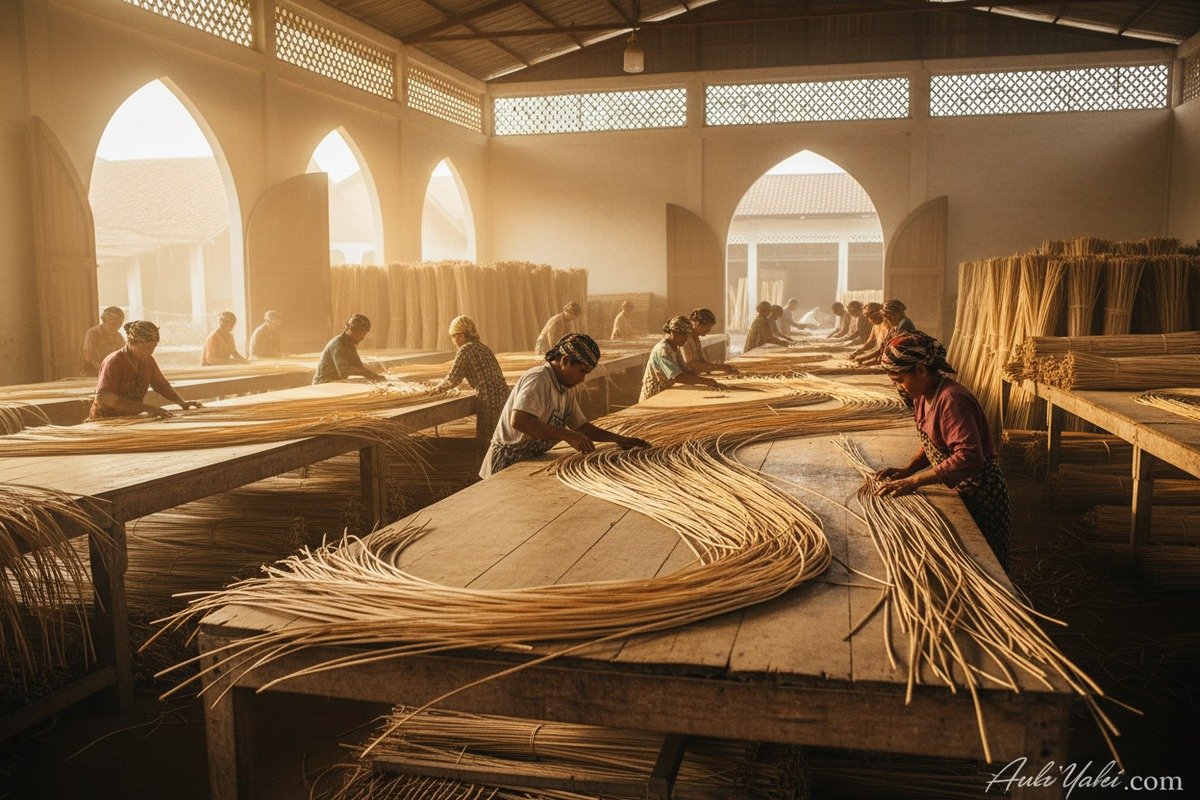
Before you negotiate, you need to understand the cost structure behind rattan webbing production. At our facilities, the main cost drivers are:
- Raw material grade: First-layer peel costs more than inner core.
- Weave pattern complexity: A simple open square grid takes less time than a tight herringbone or hexagonal pattern.
- Rollenabmessungen: Standard widths (60cm/24 inches) are cheaper to produce than custom widths.
- Order volume: Larger orders spread fixed costs (machine setup, quality inspection, packaging) across more units.
- Anpassung: Bleaching, staining, or custom pattern design adds processing steps.
Negotiation Tactics That Actually Work
Here are the approaches we've seen work best across thousands of transactions:
1. Start with volume commitments. Even if your first order is small, share your annual forecast. When we know a buyer plans to order 5,000 square meters over 12 months, we can offer pricing that reflects that volume — even on the initial order.
2. Standardize your specs. Every custom dimension or pattern requires new tooling or manual adjustment. Sticking to standard roll sizes (e.g., 60cm × 15m or 60cm × 30m) and popular weave patterns like Radio-Geflecht 8 or hexagonal open cane keeps costs down.
3. Bundle product categories. If you need rattan cane webbing plus rattan poles, rattan peel strips, or woven panels, ordering everything from one supplier eliminates duplicate shipping costs and often triggers category discounts.
4. Time your orders strategically. Production demand peaks before trade shows and holiday seasons. Placing orders during slower months (typically Q1 and early Q3) can get you faster delivery and better pricing.
5. Negotiate payment terms, not just price. Sometimes a factory can't lower the unit price further, but they can offer better payment terms — like 30% deposit with 70% against B/L — which improves your cash flow.
Pricing Factor Comparison Table
| Preisfaktor | Kostenauswirkung | How to Optimize |
|---|---|---|
| Raw material grade | Hoch | Choose Grade A for flagship products; Grade B for budget lines |
| Webart | Mittel-Hoch | Stick to standard patterns (radio, hexagonal, square) |
| Rollenabmessungen | Mittel | Use standard widths and lengths |
| Order volume | Hoch | Consolidate orders; commit to annual forecasts |
| Anpassung | Mittel | Limit bleaching/staining to essential SKUs |
| Shipping method | Mittel | Fill full containers (20'GP or 40'HC) to reduce per-unit freight |
| Zahlungsbedingungen | Niedrig-Mittel | Negotiate favorable terms to offset unit cost |
The Hidden Cost: Don't Forget Logistics
Many buyers focus entirely on ex-factory price and forget that shipping, duties, and packaging can add 15–25% to their landed cost. When we ship from Guangzhou or Shenzhen ports, a full 20'GP container typically takes 10–20 days to most Asian destinations and 25–35 days to Europe or the US. Filling a full container rather than shipping LCL (less than container load) can cut your freight cost per square meter by 30–40%.
How do I verify that my supplier can maintain consistent quality across large bulk orders of my rattan webbing?
We've seen it happen many times — a buyer approves a beautiful sample, places a 5,000 sqm order, and the delivered product looks noticeably different. The color shifts. The weave is looser. Some rolls have thinner strands. This is one of the biggest frustrations in the rattan trade, and it comes down to one thing: quality consistency systems.
To verify bulk order quality consistency, request pre-production samples matched to your approved standard, require in-process inspection photos at key stages, conduct third-party inspections before shipment, and work only with suppliers who have documented quality control procedures and grading standards.

Why Consistency Fails — And How to Prevent It
Quality inconsistency in rattan webbing usually comes from three sources:
- Raw material variation. Rattan is a natural product. Different batches of raw cane — even from the same plantation — can vary in color, thickness, and flexibility. Without strict incoming material inspection, these variations pass through to the finished product.
- Worker skill variation. In factories with 1,000+ artisans, skill levels differ. If a factory doesn't have standardized training and weave-tension benchmarks, the output varies from worker to worker.
- Lack of in-process checks. Some factories only inspect the final product. By then, it's too late to fix issues that started at the raw material or weaving stage.
A Practical Quality Verification Framework
At our Foshan headquarters, we've built a four-stage quality control process that our B2B clients can audit at any time. Here's a framework you can apply to any supplier:
Stage 1: Pre-Production Approval
Before production begins, the supplier should send you a pre-production sample made from the exact raw material batch that will be used for your order. Compare it against your originally approved sample. Check color, thickness, weave tension, and flexibility. Approve in writing before they proceed.
Stage 2: In-Process Monitoring
Ask your supplier to send photos or videos at three key points during production: raw material sorting, mid-weave inspection, and post-weave before packaging. This catches problems early. We send these updates proactively to our clients, and it saves everyone time and money.
Stage 3: Pre-Shipment Inspection
For large orders, hire a third-party inspection company 9 (like SGS, Bureau Veritas, or a local QC firm) to visit the factory before shipment. They'll check a random sample of rolls against your approved standard, measure dimensions, and document any defects. The cost is typically $200–$400 per inspection — a small price compared to receiving 10,000 sqm of substandard webbing.
Stage 4: Arrival Inspection
Even with all the above steps, do a spot check when goods arrive. Open 5–10% of the rolls and compare them to your retained sample. Document any issues immediately and communicate with your supplier.
Quality Control Checklist Table
| QC-Phase | Worauf Sie achten sollten | Wer macht es | Wenn |
|---|---|---|---|
| Pre-production sample | Color, thickness, weave tension, flexibility | Käufer + Lieferant | Before production starts |
| Raw material sorting | Rattan grade, moisture content, defects | Supplier QC team | Day 1 of production |
| Mid-weave inspection | Weave pattern accuracy, strand spacing | Supplier QC team | During production |
| Post-weave / pre-pack | Dimensions, edge trimming, roll uniformity | Supplier QC team | After weaving, before packing |
| Pre-shipment inspection | Random sampling against approved standard | Third-party inspector | Before container loading |
| Arrival spot check | Visual and physical comparison to sample | Käufer | Upon delivery |
Warnsignale, auf die Sie achten sollten
Be cautious if a supplier:
- Refuses to send pre-production samples from the actual batch.
- Cannot provide photos or videos of production in progress.
- Has no written quality standards or grading documentation.
- Pushes back against third-party inspections.
- Offers prices that seem too low for the stated grade — they may be mixing grades.
From our decades of experience, the suppliers who welcome transparency are the ones worth keeping. We've invested in documented SOPs, trained QC inspectors at every facility, and maintain retained samples of every order for at least 12 months. This level of traceability is what separates reliable suppliers from risky ones.
Can I reduce my overall procurement costs by using a one-stop rattan wholesaler for all my material needs?
Running three factories and coordinating with over 30 partner workshops in Foshan has taught us something most buyers learn the hard way: managing multiple suppliers for different rattan products is expensive, time-consuming, and risky. Every additional supplier means another set of negotiations, another shipping arrangement, another quality standard to monitor.
Yes, using a one-stop rattan wholesaler can reduce overall procurement costs by 15–25% through consolidated shipping, unified quality control, simplified communication, volume-based pricing across categories, and reduced administrative overhead compared to managing multiple separate suppliers.
The True Cost of Multiple Suppliers
Most buyers think about product price when they calculate costs. But procurement cost includes much more:
- Communication time: Each supplier requires separate emails, calls, sample approvals, and order tracking.
- Shipping fragmentation: Multiple small shipments from different suppliers cost far more per unit than one consolidated container.
- Quality alignment: Getting consistent quality across suppliers is nearly impossible. Your cane webbing from Supplier A may not match the rattan poles from Supplier B in color or finish.
- Payment complexity: Multiple invoices, wire transfers, and currency conversions add banking fees and administrative work.
How a One-Stop Wholesaler Solves This
A one-stop rattan wholesaler like our operation covers the full product chain: natural rattan cane webbing in all patterns (radio weave, hexagonal, herringbone, close weave, square grid), synthetic PE rattan for outdoor applications, rattan poles, rattan peel strips, woven panels, and finished decorative elements. Here's what that consolidation means in practice:
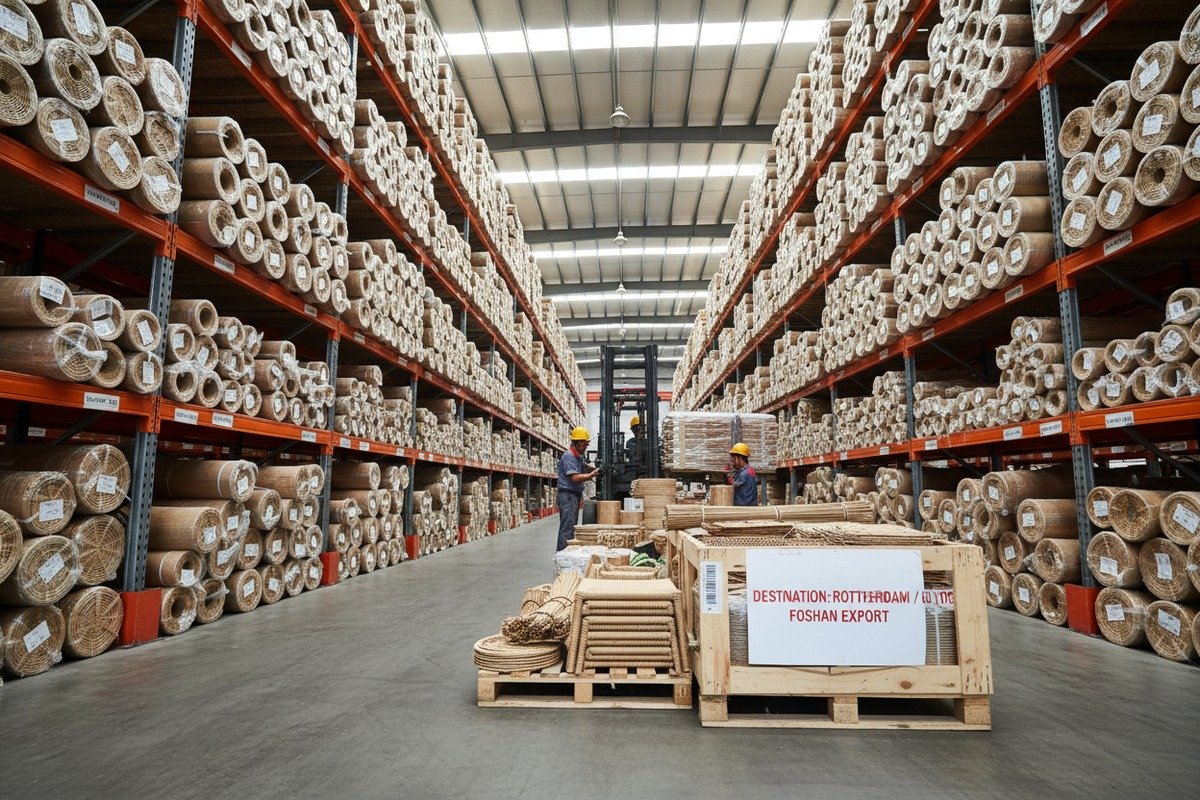
Shipping savings. Instead of three LCL shipments from three suppliers, you fill one 40'HC container from one warehouse. This alone can cut freight costs by 30–40%.
Volume pricing. When your total order across all categories hits a higher value, you qualify for tier pricing that wouldn't be available if you split orders among separate suppliers.
Consistent aesthetics. All your rattan materials come from the same raw material sources and processing lines. The cane webbing matches the poles matches the peel strips. Your end product looks cohesive.
Single point of contact. One sales rep, one invoice, one production timeline. Problems get solved faster because there's no finger-pointing between suppliers.
When Does a One-Stop Approach Make the Most Sense?
This model works best for:
- Furniture factories that use multiple rattan materials in one product line.
- Material wholesalers who resell a range of rattan products to local manufacturers.
- Construction/building material suppliers who need consistent supply of multiple categories.
For buyers who only need one product in small quantities, a specialized single-product supplier might offer a marginally lower unit price. But for anyone ordering across categories or at scale, the total cost of ownership favors consolidation.
Cost Comparison: Multi-Supplier vs. One-Stop Wholesaler
| Cost Category | Multi-Supplier Approach | One-Stop Wholesaler |
|---|---|---|
| Product unit price | May be slightly lower per item | Competitive, with volume discounts |
| Shipping cost per sqm | Higher (multiple LCL shipments) | Lower (consolidated full containers) |
| Quality alignment | Difficult across suppliers | Unified standards and raw materials |
| Communication hours/month | 15–25 hours | 5–8 hours |
| Sample coordination | Multiple rounds with each supplier | One round, all products |
| Payment transactions | 3–5 per order cycle | 1 per order cycle |
| Risk of delays | Higher (any supplier can delay) | Lower (centralized production tracking) |
| Estimated total savings | Basis | 15–25% reduction in total procurement cost |
Making the Transition
If you're currently working with multiple suppliers, transitioning to a one-stop model doesn't have to happen overnight. Start by consolidating your two highest-volume product categories with one wholesaler. Compare total costs — not just unit prices — over two or three order cycles. Most buyers who try this approach don't go back.
We've built our entire business around this principle. From our own rattan processing facility in Indonesia to our three factories and 30+ partner workshops in Foshan, every step of the Lieferkette 10 is designed so that buyers can get everything they need from a single source — with consistent quality, competitive pricing, and reliable delivery through Guangzhou and Shenzhen ports.
Conclusion
Balancing quality and cost in rattan cane webbing sourcing comes down to informed decisions — grading materials properly, negotiating smartly, verifying consistency, and consolidating your supply chain. Apply these strategies, and your margins and product quality will both improve.
Fußnoten
1. Describes hexagonal open weave rattan webbing as a unique and eye-catching pattern. ↩︎
2. Explains the strategic advantages and benefits of long-term supplier contracts in procurement. ↩︎
3. Replaced with an article detailing quality control procedures and processes. ↩︎
4. Provides grading rules and quality categories for rattan materials. ↩︎
5. Explains PE rattan as a synthetic material mimicking natural rattan for outdoor use. ↩︎
6. Describes cane as the outer layer of rattan, used for weaving. ↩︎
7. Explains what rattan cane webbing is, its origins, and characteristics. ↩︎
8. Replaced with a product page that explicitly mentions ‘radio weave rattan cane webbing’. ↩︎
9. Details the services provided by a leading global third-party inspection company. ↩︎
10. Replaced with a Wikipedia article providing a comprehensive definition of supply chain. ↩︎

 English
  Español de México
  العربية
  Deutsch
  Français
  Русский