
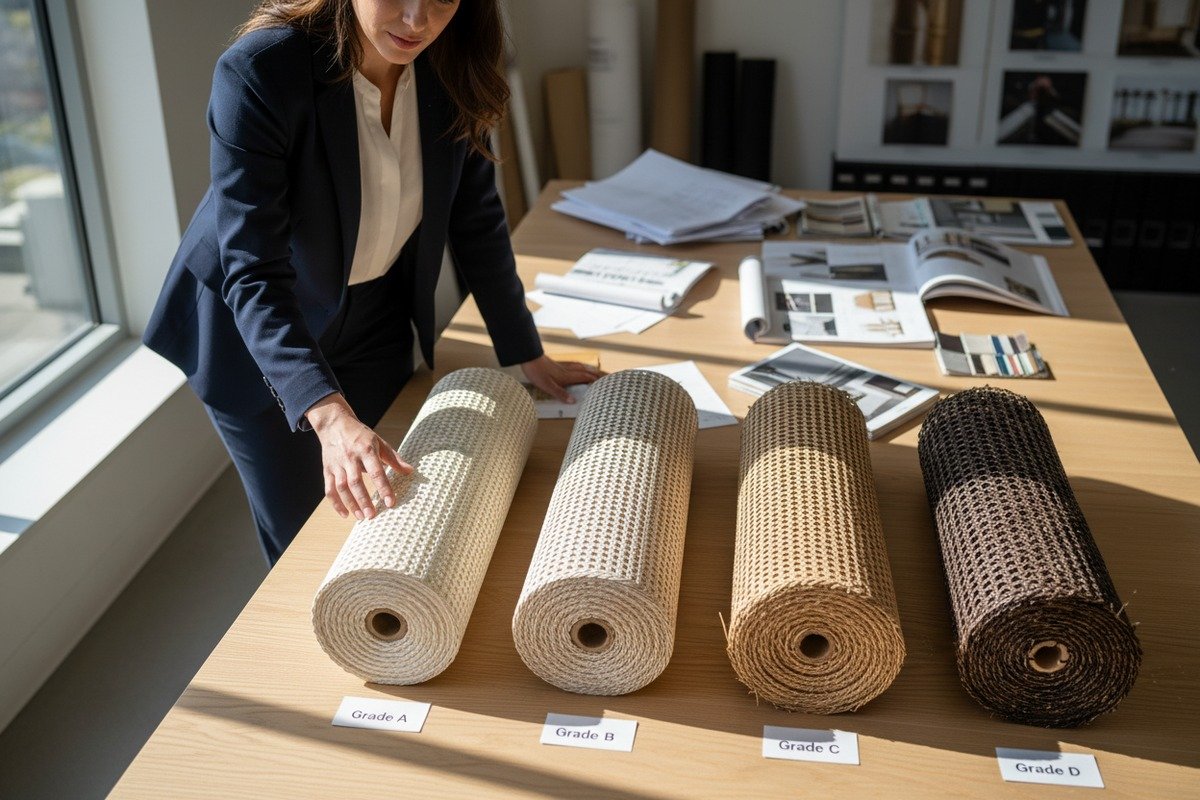
Every year, our Qualitätskontrollteam 1 in Indonesia sorts through thousands of Rattan-Rohrgeflecht 2 rolls before they ever reach a shipping container. The number one complaint we hear from new buyers? They paid for Grade A but received something that looked and felt like Grade C. This mismatch wastes money, delays projects, and destroys trust between buyer and supplier. The problem is real, and it costs the furniture industry 3 millions annually.
To compare Grade A, B, C, and D rattan cane webbing, evaluate five key criteria: surface smoothness, defect count, elasticity, toughness, and color uniformity. Grade A features a smooth, near-flawless surface with excellent flexibility, while Grade D shows rough textures, visible cracks, and poor durability.
Below, we break down exactly how to inspect, select, and verify each rattan grade so you source with confidence every time.
How can I visually distinguish between Grade A and lower-grade rattan cane webbing during my inspection?
When we walk buyers through our rattan processing facility in Kalimantan, the first lesson is always about using their eyes and hands together. Many purchasing managers rely on photos alone. Photos can deceive. Real inspection requires a system.
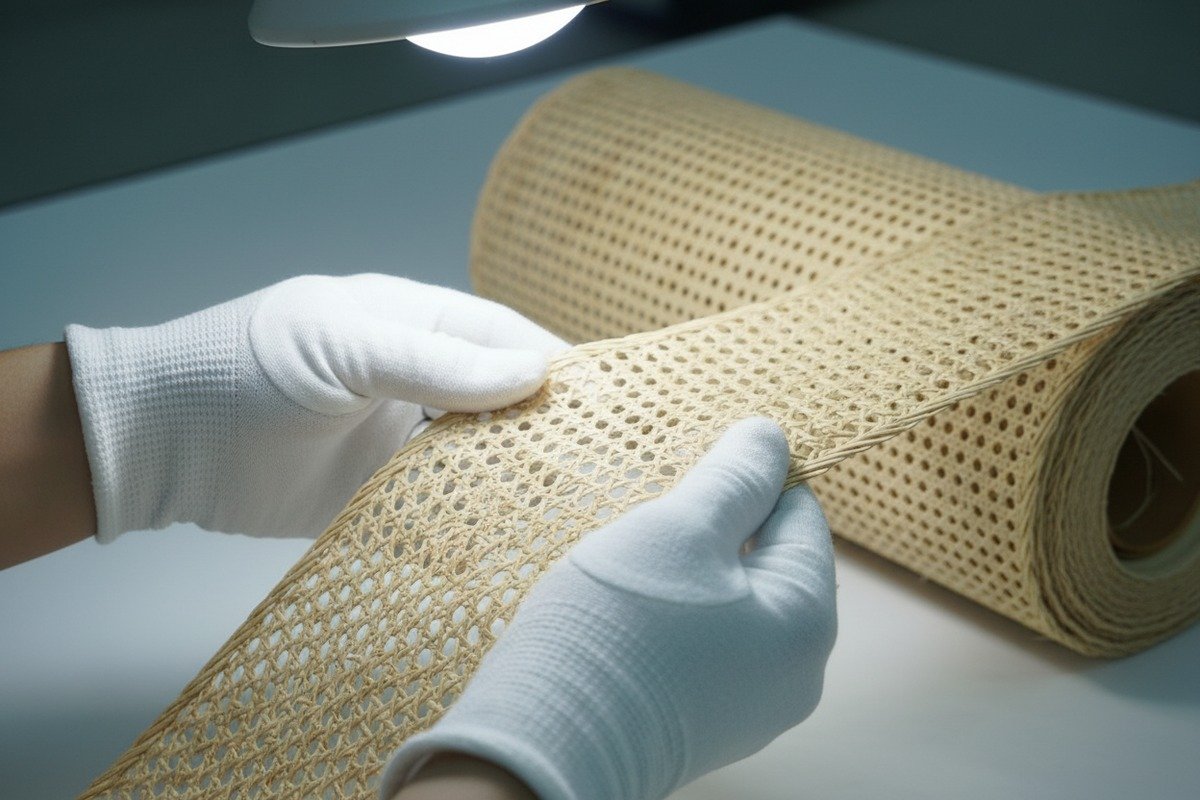
To visually distinguish Grade A from lower grades, examine the surface for smoothness and whiteness, check for cracks or dark spots, and test strand uniformity across the roll. Grade A will show a consistent, clean surface with no visible defects, while lower grades display progressively rougher textures and more blemishes.
Start With the Surface
The outer peel of rattan tells the whole story. surface smoothness 4 Grade A webbing comes from the finest outer bark. It feels silky under your fingers. Run your palm across the sheet. If you feel any bumps, snags, or rough patches, you are likely looking at Grade B or below.
Grade C and D surfaces are noticeably coarser. You can see the roughness without touching it. Dark spots, node marks, and small cracks appear across the weave. These flaws are not just cosmetic. They signal weaker fiber structure underneath.
Check Strand Thickness Consistency
Pull the roll open and look at individual strands. On Grade A webbing, each strand is almost identical in width and thickness. The weave looks tight and uniform. On lower grades, strands vary. Some are thicker. Some are thinner. This creates an uneven weave pattern.
Use the Bend Test
Take a single strand and bend it gently. Bend Test 5 Grade A rattan bends smoothly without cracking. Grade B may show a faint stress line. Grade C often cracks slightly. Grade D will snap or splinter.
Color Tells a Story
Grade A natural rattan has a uniform straw-white or light cream tone. As grades drop, you see more color variation. Brown patches, green streaks, and uneven yellowing are common in C and D grades.
| Visueller Indikator | Güteklasse A | Güteklasse B | Güteklasse C | Klasse D |
|---|---|---|---|---|
| Surface feel | Silky smooth | Slightly coarse | Rough | Very rough |
| Visible defects | Keine | Minor spots | Cracks, dark spots | Many cracks, splits |
| Gleichmäßigkeit der Stränge | Hochgradig konsistent | Mostly uniform | Noticeably uneven | Irregular throughout |
| Color tone | Clean cream/white | Slight variation | Patchy coloring | Uneven, dark patches |
| Bend response | Smooth flex | Minor stress line | Slight cracking | Snaps or splinters |
Request Physical Samples Before Ordering
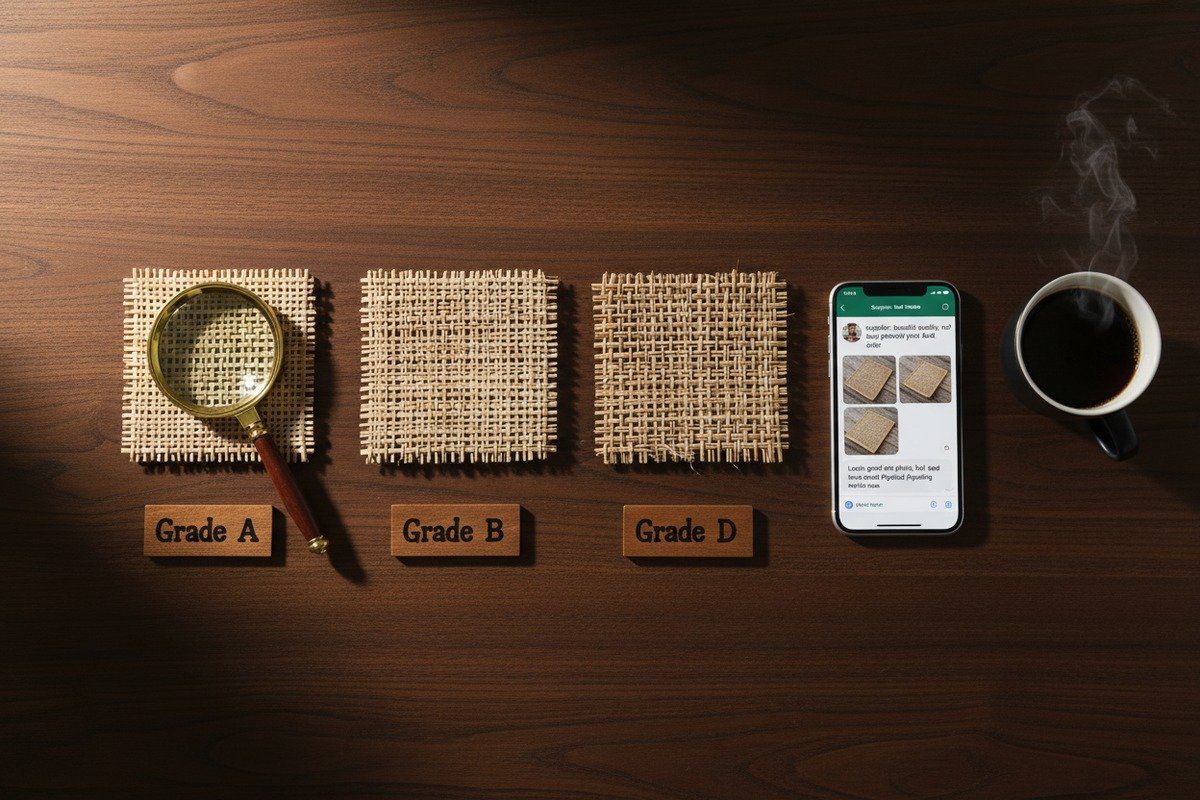
We always recommend buyers request at least three sample pieces from different rolls before placing a bulk order. Photographs compress detail and flatten texture. Holding the webbing in your hand reveals everything a screen cannot. When we ship samples to our clients in the Netherlands or Australia, we include one piece from each grade so they can compare side by side.
Watch for Inconsistent Grading Labels
Not every supplier follows the same grading scale. Some use AAA as a marketing premium above standard A-grade. Others label B-grade material as "A-minus." Our factory uses a standardized four-tier system 6 consistent with Indonesian rattan industry norms. Always ask your supplier to define their grading criteria in writing.
Which rattan grade should I choose to balance high-end quality with my specific project budget?
Our sales team fields this question almost daily from furniture factories in Turkey, wholesalers in Spain, and building material suppliers across Southeast Asia. Budget matters. But so does the end product's reputation.
For most commercial furniture, Grade B offers the best balance between quality and cost. It has good elasticity, minor defects invisible at normal viewing distance, and significantly lower pricing than Grade A. Reserve Grade A for luxury or high-visibility pieces. Use Grade C only for hidden or structural applications.

Passen Sie die Klasse an die Anwendung an
Not every piece of furniture needs Grade A. A dining chair seat visible at arm's length? Grade A makes sense. The back panel of a cabinet that sits against a wall? Grade B or even C works fine. The key is matching material quality to visibility and wear exposure.
Understand the Price Gap
Pricing varies by supplier, width, and finish. But the general pattern is clear. Grade A commands a premium. Grade B typically costs 20–35% less than A. Grade C drops further. Grade D is the cheapest but rarely suitable for any visible application.
| Qualität | Typical Use Case | Relative Cost | Recommended For |
|---|---|---|---|
| A / AAA | Luxury furniture, restoration, designer pieces | Highest ($112+ per meter for 24" width) | High-end brands, visible surfaces |
| B | Commercial furniture, mid-range retail | 20–35% less than A | Furniture factories, wholesalers |
| C | Budget furniture, hidden panels, backing | 40–55% less than A | Cost-driven projects, non-visible areas |
| D | Disposable items, internal padding | Niedrigste | Non-aesthetic, short-lifespan products |
Consider Finish Type in Your Budget
Bleached rattan starts whiter and pairs well with modern, minimalist designs using light woods like oak or ash. Natural rattan has warmer tones and complements walnut or mahogany. Bleached webbing costs slightly more due to the steaming and chemical treatment process. If your client wants a crisp white look, factor that into total material cost.
Think About Lifespan, Not Just Price
A common mistake we see is buyers choosing Grade C to save money on a product meant to last years. The cracks and weak elasticity in Grade C mean faster wear. Replacement costs add up. For furniture that needs to withstand daily use—chairs, headboards, cabinet doors—Grade B is the minimum we recommend.
The "High Cost-Performance" Sweet Spot
In our experience shipping to over a dozen countries, Grade B is the sweet spot for most B2B buyers. It offers clean aesthetics at moderate cost. Many of our repeat clients in the USA and Australia standardize on Grade B for their entire product line, upgrading to A only for flagship collections.
One client in Thailand, a purchasing manager sourcing rattan cane webbing for a hotel furniture project, initially requested all Grade A. After reviewing samples and budgets together, we agreed on Grade A for lobby furniture and Grade B for guest room pieces. The result? A 25% cost reduction with no visible quality difference in the guest rooms.
How do I verify that the rattan grade I receive matches the quality standards I paid for?
After years of handling claims and disputes from buyers who received mismatched grades, our quality assurance team built a verification protocol that we now share with every new client. Trust is important. But verification is essential.
Verify rattan grade by comparing received goods against pre-approved physical samples, checking surface smoothness, testing strand flexibility by hand, counting visible defects per square meter, and documenting findings with photos. Request grade certification and third-party inspection for large orders to prevent mislabeling.
Keep Approved Samples as Your Benchmark
Before any bulk order ships from our factory, we send production samples for buyer approval. Keep these samples. When the shipment arrives, lay your approved sample next to a piece from the new batch. Compare color, texture, and weave tightness. Any significant deviation is grounds for a claim.
Conduct a Defect Count
Pick three random rolls from the shipment. Unroll one meter from each. Count every visible defect: cracks, dark spots, rough patches, uneven strands. Grade A should have zero to one minor imperfection per square meter. Grade B allows two to five minor issues. Anything beyond that suggests a lower grade than labeled.
The Flex Test at Receiving
Bend a strand from the new shipment. Compare its resistance and recovery to your benchmark sample. Grade A springs back cleanly. If the new material cracks or holds a crease, it may be Grade C material labeled as A.
Document Everything With Photos
Take close-up photos of any defects you find. Include a ruler or coin for scale. Photograph the shipping labels and grade markings on each roll. This documentation is critical if you need to file a quality dispute.
Ask for Certifications
Reputable suppliers provide grade certification with every order. At our facility, each roll is tagged with its grade, production date, and batch number. We also offer FSC certification 8 for buyers who need proof of sustainable sourcing. If a supplier cannot provide documentation, that is a red flag.
Use Third-Party Inspection for Large Orders
For shipments worth $10,000 or more, consider hiring a third-party inspection service 9. Companies like SGS or Bureau Veritas can visit the supplier's warehouse before shipping and verify grade claims on your behalf. We welcome third-party inspectors at our facilities because it builds long-term trust.
Common Mislabeling Red Flags
Watch for these warning signs:
- The price seems too low for the stated grade.
- The supplier avoids sending physical samples.
- Color or texture varies dramatically between rolls in the same shipment.
- No batch numbers or grade tags on individual rolls.
- The supplier uses non-standard grading terms like "Super A" or "Premium Plus" without clear definitions.
What are the specific durability and color consistency differences I can expect between Grade A and Grade C materials?
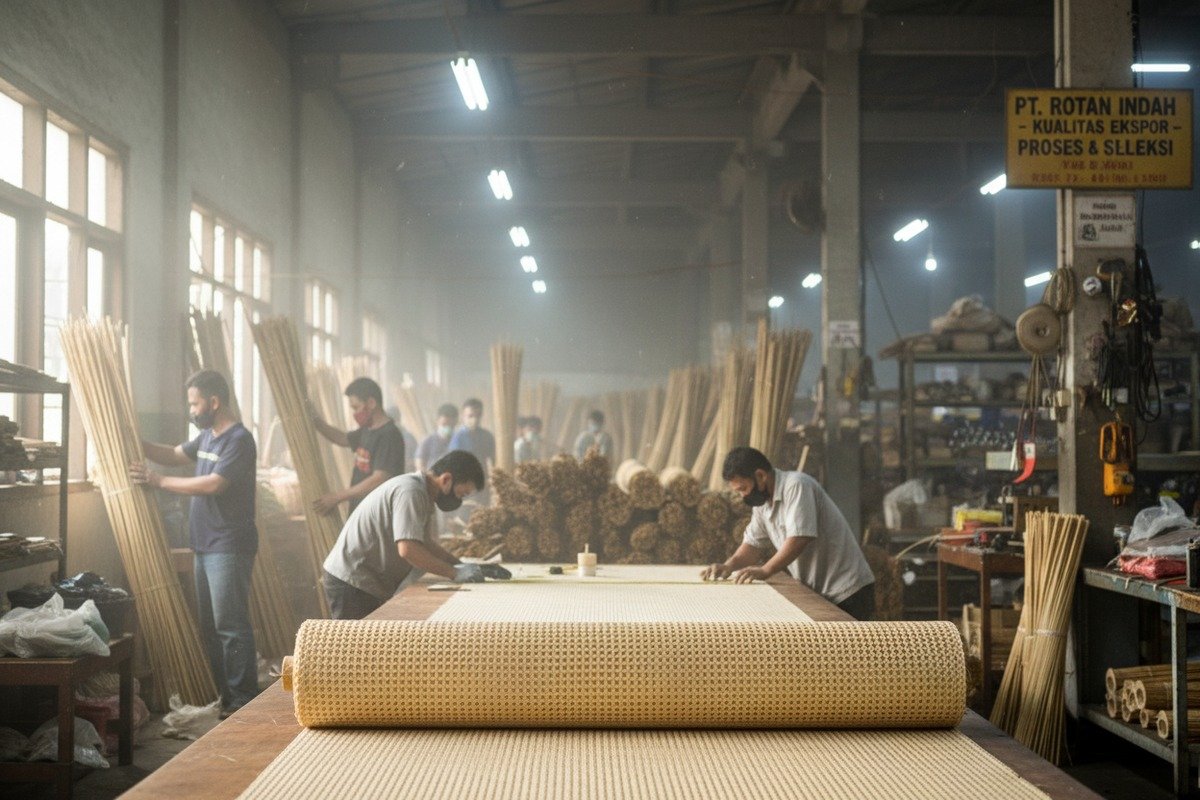
When we run side-by-side aging tests at our processing facility, the gap between Grade A and Grade C becomes impossible to ignore. These are not minor cosmetic differences. They affect product lifespan, customer satisfaction, and your brand reputation.
Grade A rattan lasts 8–15 years with proper care, maintains uniform color over time, and resists cracking under daily stress. Grade C typically lasts 2–5 years, shows uneven yellowing and fading within months, and develops visible cracks under moderate use due to inferior fiber quality and elasticity.
Durability Under Daily Use
Grade A rattan has excellent elasticity and toughness 10. It absorbs the stress of sitting, leaning, and bending without losing shape. The fibers are dense and tightly packed. Grade C fibers are looser. They crack faster under repeated pressure. On a dining chair, Grade A webbing may last a decade. Grade C on the same chair might fail in two to three years.
Color Consistency Over Time
Color is where Grade A truly shines. The outer bark used for Grade A is carefully selected for uniform tone. Whether natural or bleached, the color stays consistent across the entire roll and ages gracefully. Natural Grade A develops a warm honey patina over years. Bleached Grade A holds its white tone longer before gradually yellowing.
Grade C is a different story. The raw material has more color variation from the start. Natural Grade C shows uneven greenish, brownish, and yellowish patches. Bleached Grade C may start looking acceptable, but it yellows unevenly and quickly. Within six months of sun exposure, patches of darker and lighter tones emerge.
| Performance Factor | Güteklasse A | Güteklasse C |
|---|---|---|
| Expected lifespan | 8–15 Jahre | 2–5 Jahre |
| Rissbeständigkeit | Excellent, no cracking under normal use | Poor, cracks appear under moderate stress |
| Color uniformity (new) | Highly uniform | Patchy, uneven tones |
| Color aging (natural) | Even honey patina | Uneven yellowing and browning |
| Color aging (bleached) | Gradual, uniform yellowing | Rapid, patchy yellowing |
| Stain/sealer absorption | Smooth, even coverage | Uneven, blotchy finish |
| Weave tightness under tension | Maintains shape | Distorts, gaps appear |
| Suitability for high-traffic furniture | Ausgezeichnet | Not recommended |
How Finish Treatments Respond Differently
When you apply stain, oil, or sealer to Grade A rattan, the smooth surface absorbs the treatment evenly. The result is a clean, professional finish. Grade C's rough and porous surface absorbs unevenly. Some areas soak up too much product. Others resist it. The finished look is blotchy and inconsistent.
This matters enormously for furniture factories producing painted or stained rattan pieces. If your client expects a uniform walnut-stained rattan panel, Grade C will disappoint.
The Hidden Cost of Grade C Failures
We had a client in Russia who switched from Grade B to Grade C to cut costs on a line of restaurant chairs. Within eight months, multiple chairs showed cracked webbing. The replacement cost—including labor, shipping, and customer complaints—exceeded what they saved on the initial material purchase. They switched back to Grade B permanently.
Environmental and Finish Pairing Notes
Grade A natural rattan with greenish tones pairs beautifully with dark wood stains like walnut or mahogany. Grade A bleached rattan suits modern minimalist designs with light oak or ash. For Grade C, the color inconsistency limits pairing options. Most designers avoid exposing Grade C in any visible application.
Premium rattan varieties like Manau (up to 4 inches in diameter, excellent for structural frames) and Rotin Tohiti (1–2 inches, ideal for detailed weaving) are almost exclusively available in Grade A or B. Grade C and D are typically sourced from less desirable vine sections.
Sustainability and Grading
Buyers increasingly ask about eco-credentials. Higher-grade rattan often comes from suppliers with FSC certification and traceable supply chains. Our Indonesian facility follows responsible harvesting practices, and we can provide full traceability documentation for Grade A and B materials. Grade C and D sourcing is less regulated, and sustainability claims are harder to verify at those price points.
Conclusion
Choosing the right rattan cane webbing grade protects your budget, your product quality, and your reputation. Inspect samples, verify grades at receiving, and match material to application. Our team at Seafan Rattan is ready to help you source confidently.
Fußnoten
1. Replaced with a Wikipedia article defining quality control, which often involves a team. ↩︎
2. Defines rattan cane webbing, its origin, and production process. ↩︎
3. Provides an overview of the global furniture market and its trends. ↩︎
4. Explains the concept and importance of surface roughness in materials. ↩︎
5. Explains the purpose and methodology of a bend test for materials. ↩︎
6. No direct authoritative source for a ‘standardized four-tier system’ for rattan was found. Replaced with a Wikipedia article on product quality, which broadly covers the concept of quality levels and standards. ↩︎
7. Highlights why physical samples are crucial for accurate product evaluation. ↩︎
8. Explains what FSC certification is and its importance for sustainable sourcing. ↩︎
9. Explains the role and benefits of third-party inspection in quality assurance. ↩︎
10. Defines elasticity and toughness as key material mechanical properties. ↩︎


 English
  Español de México
  العربية
  Deutsch
  Français
  Русский