
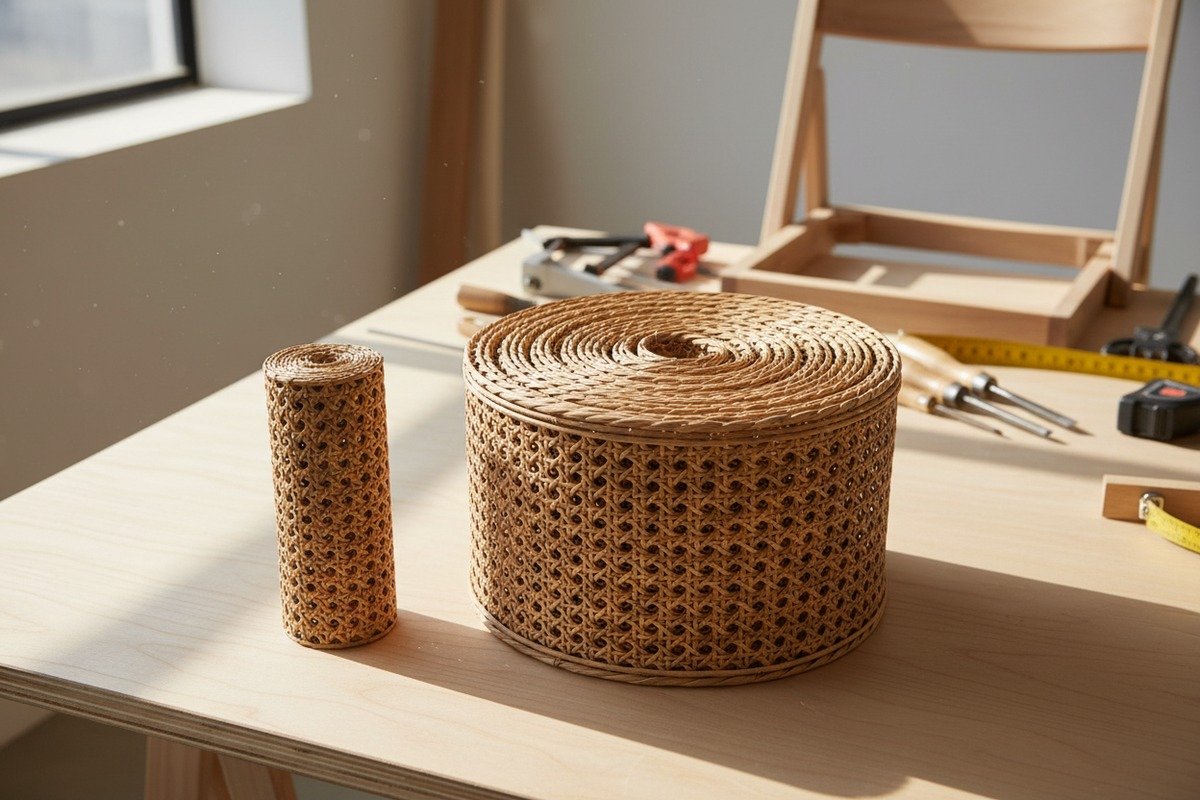
Choosing between roll lengths sounds simple, but it quietly shapes your bottom line cost efficiency 1. Every week, our production team in Indonesia ships both 50-foot and 100-foot rolls of Grade A natural rattan cane webbing 2 to furniture factories and wholesalers across more than a dozen countries. We see firsthand how a wrong choice in roll length leads to excess waste, inflated freight bills, and frustrated workshop managers who run out mid-project.
The primary difference between 50-foot and 100-foot natural rattan cane webbing rolls lies in total material volume, per-foot cost efficiency, and suitability for project scale. 100-foot rolls deliver better value for large production runs, while 50-foot rolls offer easier handling and lower upfront cost for smaller jobs.
Below, we break down the four questions wholesale buyers ask most. Each section covers real cost data, practical waste calculations, shipping considerations, and quality control facts so you can make a confident purchasing decision.
How do I decide which roll length is more cost-effective for my wholesale business?
When we quote prices to furniture material distributors in Europe or the Middle East, roll length is usually the first variable they ask about. The per-foot price gap between 50-foot and 100-foot rolls surprises many first-time buyers—and it can reshape your entire margin structure.
For most wholesale buyers, 100-foot rolls are more cost-effective because they reduce the per-foot unit price by roughly 10–18%, lower reorder frequency, and cut down on packaging material costs compared to purchasing equivalent footage in 50-foot rolls.

Why Per-Foot Pricing Drops on Longer Rolls
The economics are straightforward. Every roll we produce involves fixed costs 3: the initial rattan peeling, the loom setup time, the end-trimming and quality check, and the individual wrapping. When you double the roll length from 50 feet to 100 feet, those fixed costs spread across twice the material. That is why the per-foot price shrinks.
Here is a simplified example based on typical pricing tiers we offer to wholesale clients ordering standard 24-inch-wide open hexagonal cane webbing:
| Kostenfaktor | 50-Foot Roll | 100-Foot Roll |
|---|---|---|
| Approximate price per roll (USD) | $48–$55 | $82–$95 |
| Approximate price per foot (USD) | $0.96–$1.10 | $0.82–$0.95 |
| Savings per foot vs. 50-ft roll | — | ~$0.12–$0.15 |
| Rolls needed for 500 ft of material | 10 rolls | 5 rolls |
| Total approximate cost for 500 ft | $480–$550 | $410–$475 |
That 10–18% discount per foot adds up fast. A mid-size furniture factory processing 2,000 feet of cane webbing per month could save $240–$300 monthly just by switching to 100-foot rolls.
When 50-Foot Rolls Still Make Sense
Not every buyer should default to the longer option. If you run a small workshop doing 15–20 chair restorations a month, a single 100-foot roll may sit in storage for weeks. Rattan is a Naturfaser 4. Prolonged storage in humid conditions can cause mildew or discoloration. In that case, two 50-foot rolls purchased at different times keep your stock fresh.
Also, if you resell cane webbing by the cut meter to retail customers or DIY crafters, 50-foot rolls are easier to handle at a retail counter. They weigh less, unroll more manageably, and reduce the risk of damage during repeated handling.
Reorder Frequency and Hidden Costs
Buying 50-foot rolls means you reorder twice as often for the same coverage. Each reorder carries its own hidden costs: procurement staff time, payment processing fees, customs documentation if importing internationally, and the risk of price fluctuations 5 between orders. With 100-foot rolls, you lock in pricing for more material per transaction.
Will switching to 100-foot rolls help me reduce material waste in my furniture production?
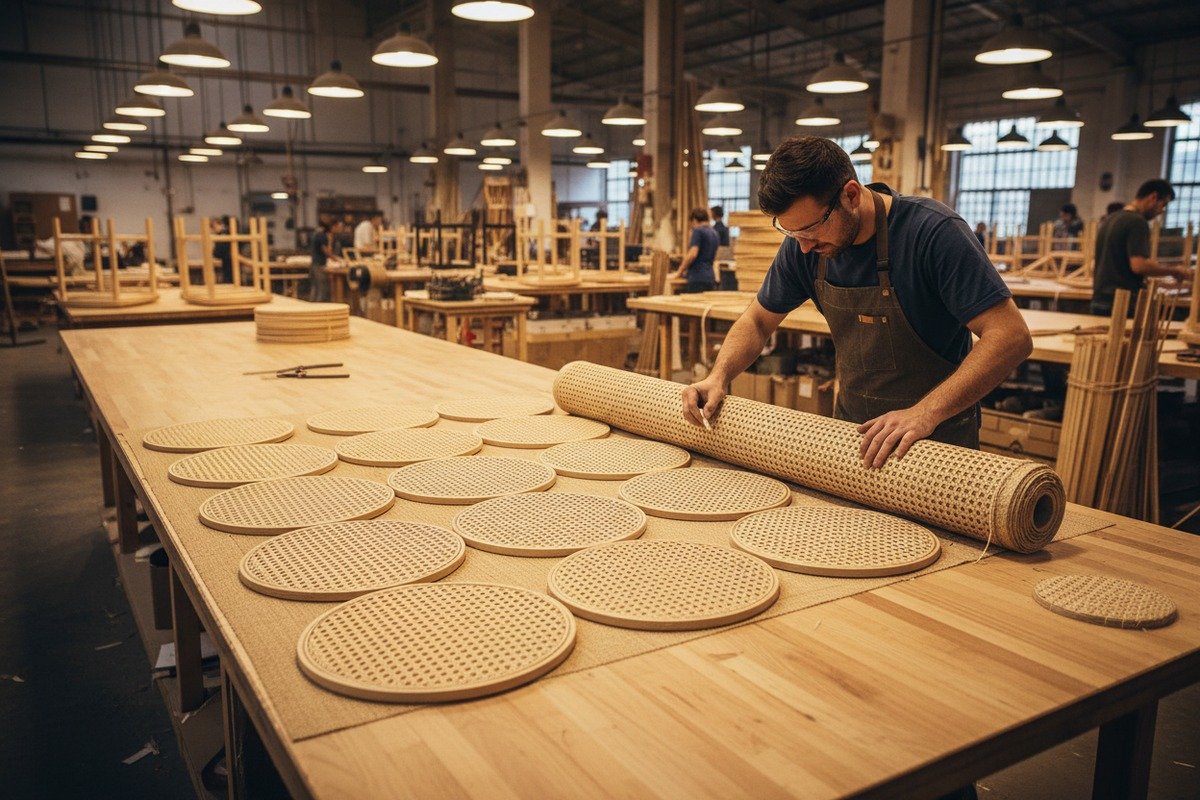
Waste is one of the most overlooked cost drivers in furniture workshops we supply. Our logistics team often hears from factory managers who throw away short leftover pieces from the tail end of a roll—pieces too small for the next chair seat but too large to ignore.
Yes, switching to 100-foot rolls typically reduces material waste by 5–12% in furniture production because longer continuous lengths allow more efficient cutting layouts, fewer unusable tail-end scraps, and fewer roll-start trimmings compared to using multiple 50-foot rolls.
Understanding Where Waste Happens
Waste in cane webbing cutting comes from three main sources:
-
Roll-end scraps. The last 6–18 inches of every roll often have frayed edges or slight inconsistencies from the winding process. With 50-foot rolls, you generate this scrap twice for every 100 feet of material. With a single 100-foot roll, you generate it only once.
-
Pattern alignment trims. When cutting panels for chair seats or cabinet doors, you need to align the weave pattern. Each new roll requires a fresh alignment cut. Fewer rolls mean fewer alignment trims.
-
Dimensional mismatch remnants. If your chair seat requires a 20-inch cut and the roll is 24 inches wide, you get a 4-inch strip left over. This happens regardless of roll length. But when the roll is longer, you can batch-plan more cuts and sometimes rotate the strip into smaller components like drawer fronts or decorative insets.
Waste Comparison by Project Type
| Projekttyp | Cuts per 50-ft Roll | Waste per 50-ft Roll | Cuts per 100-ft Roll | Waste per 100-ft Roll |
|---|---|---|---|---|
| Dining chair seat (20" × 18") | ~30 seats | ~8–10% waste | ~63 seats | ~5–7% waste |
| Cabinet door panel (12" × 14") | ~48 panels | ~6–8% waste | ~100 panels | ~4–6% waste |
| Headboard panel (24" × 60") | ~10 panels | ~10–14% waste | ~20 panels | ~6–10% waste |
The data shows a clear trend. Larger continuous runs cut waste because you eliminate duplicate roll-end losses and alignment trims.
Practical Tips to Minimize Waste Further
Even with 100-foot rolls, smart cutting matters. We recommend creating a cutting plan before unrolling. Measure all your required pieces, arrange them on paper like a puzzle, and cut in sequence. Soaking the webbing for 15–20 minutes before cutting makes it more pliable and reduces cracking at cut edges, which also lowers scrap rates.
Some of our clients in the Netherlands save small offcuts for sample swatches or use them as test pieces for new finishes. Waste drops to near zero when every piece has a purpose.
How does the roll size impact my international shipping costs and packaging safety?
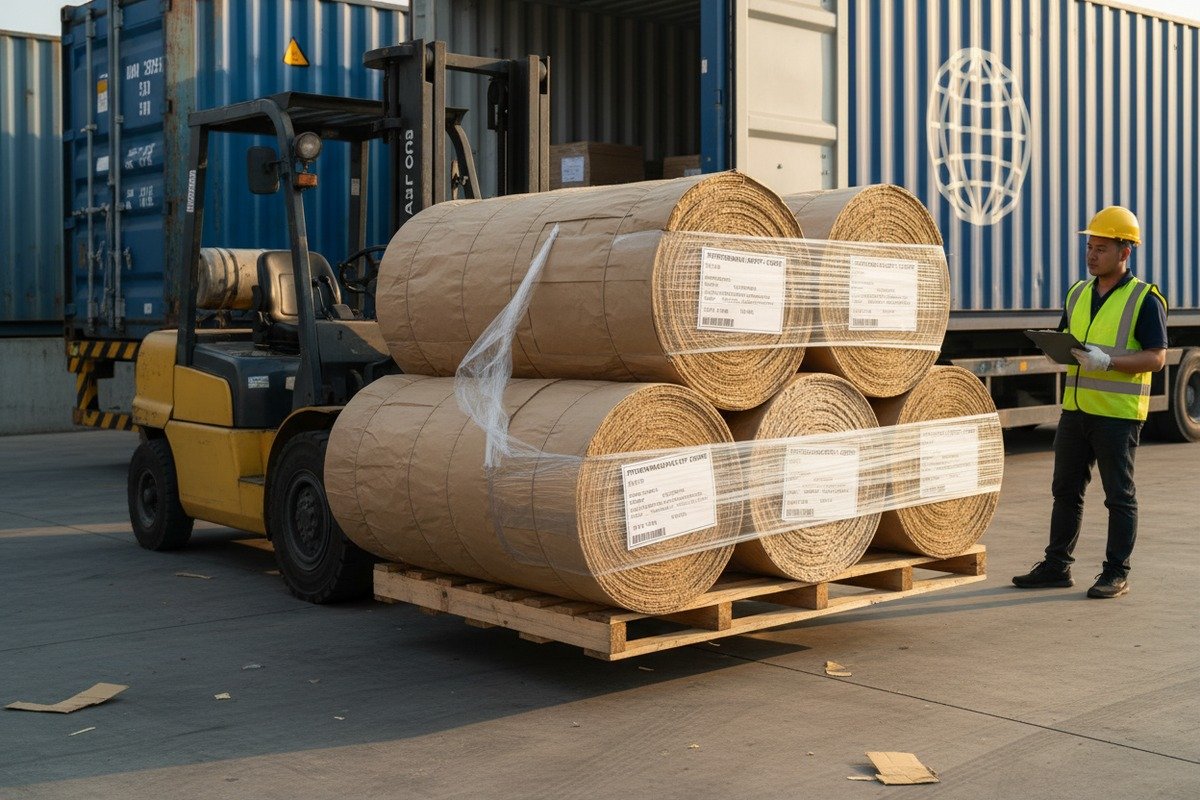
Shipping rattan webbing across oceans is something we manage daily from our facilities in Foshan and Indonesia. The difference between loading a pallet of 50-foot rolls versus 100-foot rolls touches freight cost, carton count, and damage risk in ways that are not always obvious until the container arrives at your port.
Roll size directly impacts shipping costs and safety: 100-foot rolls reduce total carton count by up to 50%, lower per-foot freight expense, and decrease the number of exposed roll ends vulnerable to crushing—but they require sturdier packaging and slightly larger carton dimensions to prevent core damage during transit.
Freight Cost Breakdown
International shipping charges are driven by two factors: Volumengewicht 7 and actual weight. Rattan webbing is lightweight but bulky. A 100-foot roll has a larger diameter than a 50-foot roll, but it is only one package instead of two. Let us compare:
| Shipping Factor | 10 × 50-Foot Rolls | 5 × 100-Foot Rolls |
|---|---|---|
| Total footage | 500 feet | 500 feet |
| Number of cartons | 10 | 5 |
| Approximate weight per carton | 3.5–4.5 kg | 6.5–8.5 kg |
| Total shipment weight | 35–45 kg | 32.5–42.5 kg |
| Total carton volume (approx.) | 0.35 m³ | 0.28 m³ |
| Per-foot freight cost index | 1.0× (baseline) | ~0.80× |
The 100-foot option saves roughly 20% in volumetric space. That matters when you are filling a 20-foot container. You fit more material per cubic meter, which drives your per-foot freight cost down.
Packaging Durability and Damage Risk
Each roll end is a vulnerability point. The outer layers of webbing at the roll's edge can get crushed, dented, or moisture-damaged if the carton is stacked improperly. Ten cartons have twenty exposed roll ends. Five cartons have only ten. Fewer roll ends mean fewer chances for damage.
However, 100-foot rolls are heavier per unit. A poorly packed heavy roll can collapse its own core during a rough sea voyage. At our factories, we address this by inserting rigid cardboard tubes into the center of every 100-foot roll and wrapping each roll in a moisture-barrier plastic film before boxing. This adds a small packaging cost—typically $0.50–$1.00 per roll—but it virtually eliminates core crush complaints.
Storage at Destination
Once the shipment arrives, your warehouse team also benefits from fewer, more uniform cartons. Five cartons stack more neatly than ten. Inventory tracking is simpler. And when you pull a roll for production, you handle one 100-foot roll instead of swapping out two 50-foot rolls mid-job.
One caution: if your warehouse has limited shelf height, the wider diameter of 100-foot rolls may require shelf adjustments. Measure your storage racks before placing a large bulk order.
Can I expect the same Grade A quality consistency across longer 100-foot rattan rolls?
Quality consistency 8 is the number one concern we hear from purchasing managers. Our client Ranoo in Thailand, for example, insists on Grade A standards for every meter of webbing—no color shifts, no weak spots, no loose strands. The question of whether a 100-foot roll can maintain that standard from the first foot to the last foot is completely valid.
Grade A quality consistency is achievable in 100-foot rolls, but it demands stricter raw material selection, tighter loom tension control, and more frequent inline inspections than shorter rolls. Reputable suppliers maintain identical grading standards regardless of roll length, though buyers should verify through sample checks and supplier audits.

Was definiert Rattan-Rohrgeflecht der Klasse A?
Grade A classification is not an industry-wide legal standard. It is a supplier-defined quality tier. quality standards 9 At our facilities, Grade A means the webbing meets all of the following criteria:
- Uniform color: No more than a half-shade variation across the full roll length. Natural rattan ranges from straw-yellow to greenish-tan, and some color variance is inherent. But dramatic shifts within one roll indicate mixed batches of raw cane.
- Consistent strand thickness: Every cane strand in the weave falls within a 0.3 mm tolerance of the target thickness. Thinner strands create weak points; thicker strands distort the pattern.
- Tight weave joints: No loose or skipped intersections in the woven pattern. Each crossing point must hold firmly when the webbing is flexed.
- No surface defects: No splits, insect holes, mold spots, or bark residue on the visible face.
Challenges Specific to Longer Rolls
Producing a 100-foot continuous roll means the loom runs for a longer period. During that time, several things can go wrong:
-
Raw material batch transitions. If the rattan cane strips feeding the loom come from different harvest batches, color or thickness may shift mid-roll. We prevent this by pre-sorting and color-matching all cane strips before they enter the loom.
-
Loom tension drift. Over a longer weaving run, mechanical tension can gradually loosen, creating a slightly more open weave toward the end of the roll. Our operators check tension every 10 meters and recalibrate as needed.
-
Operator fatigue. Handcrafted weaving, common in Indonesian production, relies on human attention. Longer rolls mean longer work sessions. We rotate weavers and use quality checkpoints at fixed intervals to catch errors early.
How to Verify Consistency as a Buyer
Do not rely solely on a supplier's Grade A label. Here are practical steps:
- Request a pre-production sample cut from the middle and end of a test roll, not just the beginning.
- Ask for inspection photos at multiple points along the roll during production.
- Conduct your own incoming inspection. Unroll at least 20% of the first shipment and check for color, thickness, and weave tightness at three points: the start, the center, and the last 5 feet.
- Establish a clear returns or credit policy with your supplier before the first order. A trustworthy manufacturer will stand behind their Grade A claim.
Natural vs. Machine-Woven Consistency
Machine-woven rattan webbing tends to have tighter consistency because the mechanical loom maintains uniform tension and speed. Handcrafted webbing carries more artisanal character—slight pattern variations that some designers actually prefer—but it introduces higher quality variance risk in longer rolls. If your end product demands pixel-perfect uniformity, specify machine-woven in your purchase order. If you value organic texture and accept minor natural variations, handcrafted 100-foot rolls are perfectly viable at Grade A level with proper quality controls in place.
Conclusion
Choosing between 50-foot and 100-foot rattan cane webbing rolls comes down to your project scale, budget priorities, storage capacity, and quality expectations. Match the roll length to your actual production needs, and you will optimize cost, waste, and consistency every time.
Fußnoten
1. Explains the economic concept of cost efficiency. ↩︎
2. Found a comprehensive article defining cane webbing from a reputable supplier. ↩︎
3. Defines fixed costs in accounting and economics. ↩︎
4. Replaced with a Wikipedia page, which is an authoritative and comprehensive source for definitions. ↩︎
5. Describes the phenomenon and causes of price fluctuations. ↩︎
6. Explains industrial waste, a broader category for material waste. ↩︎
7. Defines volumetric weight in the context of shipping. ↩︎
8. Explains the importance and interpretation of quality consistency. ↩︎
9. Provides a definition and overview of quality standards from an authoritative source. ↩︎

 English
  Español de México
  العربية
  Deutsch
  Français
  Русский