
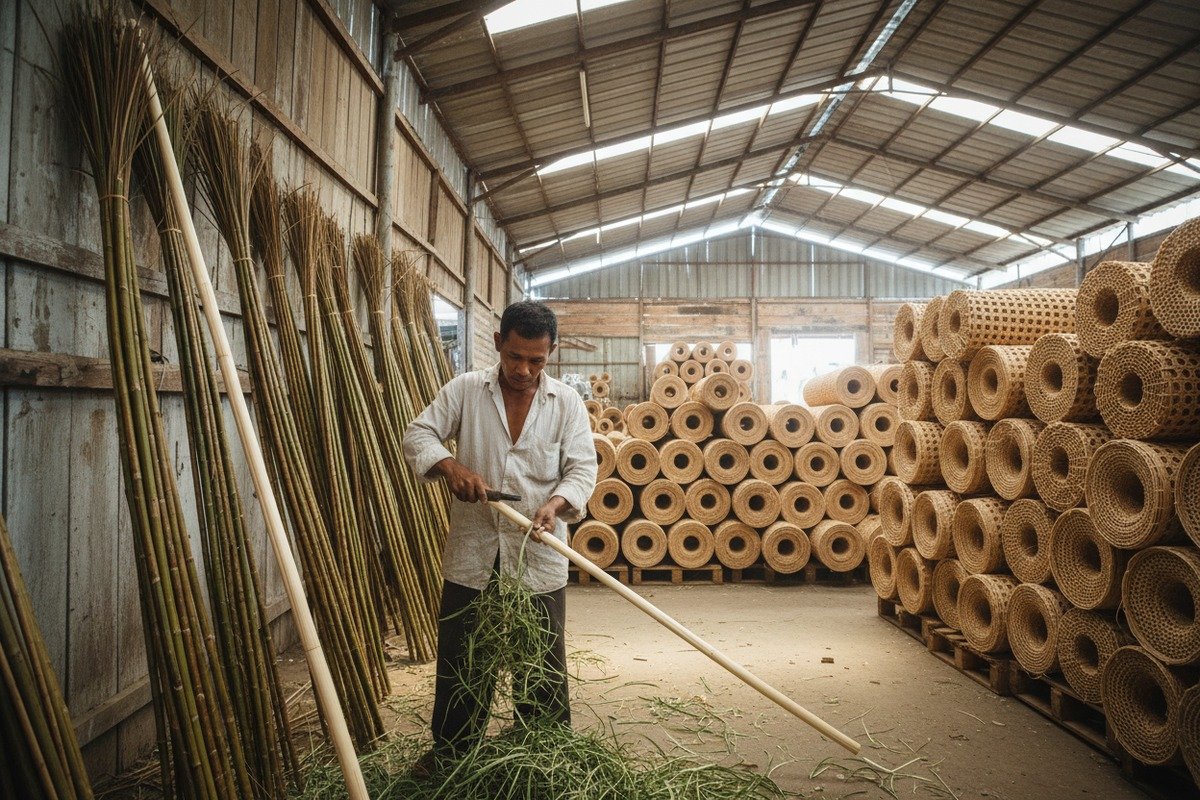
Every week, our production team in Indonesia sorts through thousands of rattan poles tropical forests of Southeast Asia 1. The question buyers ask most often is simple: what exactly goes into this material? If you have ever received a shipment of cane webbing that cracked, yellowed, or fell apart within months, the root cause almost always traces back to the raw material itself.
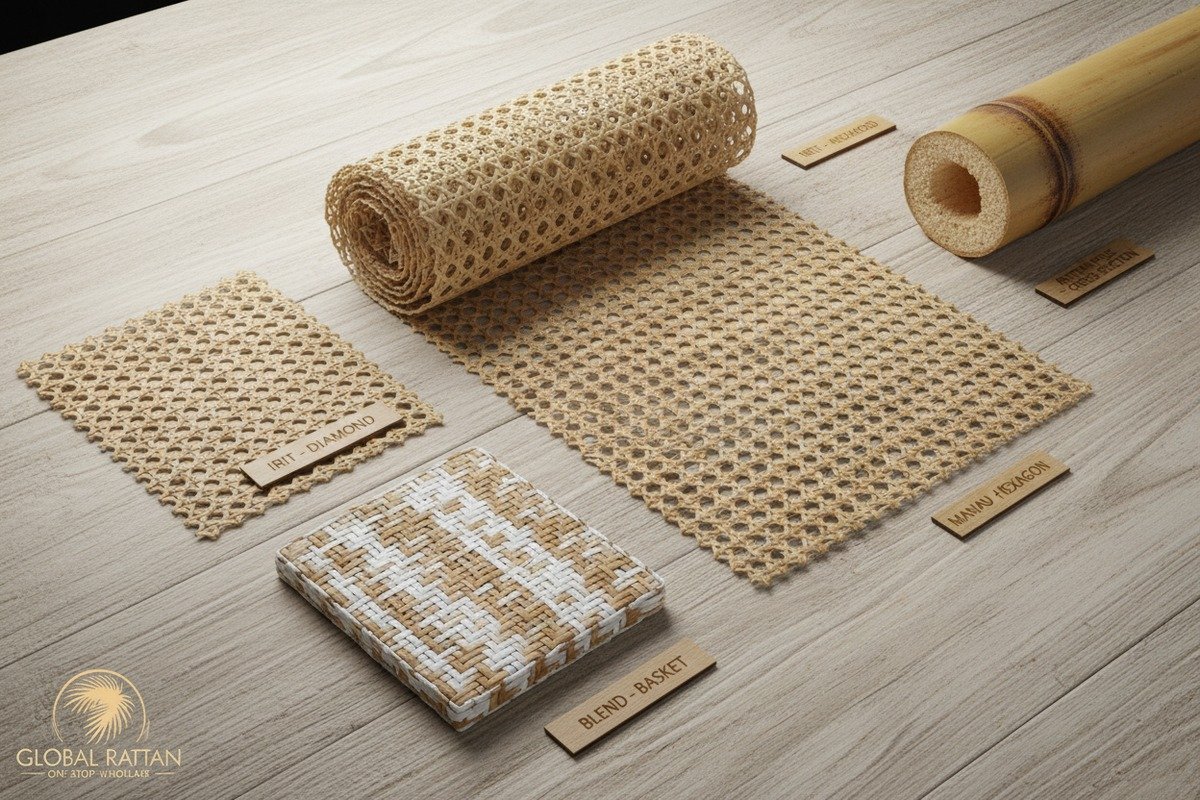
Natural rattan cane webbing is manufactured exclusively from the outer skin or peel of the rattan palm, a climbing vine harvested in tropical forests of Southeast Asia, primarily Indonesia. This outer layer is stripped, processed, cut into uniform strips, and hand-woven or machine-woven into various patterns such as hexagonal, square, and basketweave designs.
Understanding exactly what goes into your rattan webbing helps you make better sourcing decisions. Below, we break down the species, grading, regional advantages, and the critical difference between rattan peel and core — all from a production standpoint.
Which specific rattan species are best for my high-end cane webbing projects?
Choosing the wrong rattan species can ruin an entire furniture line. We learned this early on when a batch of mixed-species cane caused uneven coloring across 500 chairs for a European client.
For high-end cane webbing, the best rattan species are Calamus caesius (sega), Calamus trachycoleus (irit), and Calamus manan. These species offer superior flexibility, consistent diameter, and a smooth outer peel that produces uniform, elegant weave patterns suitable for premium furniture applications.
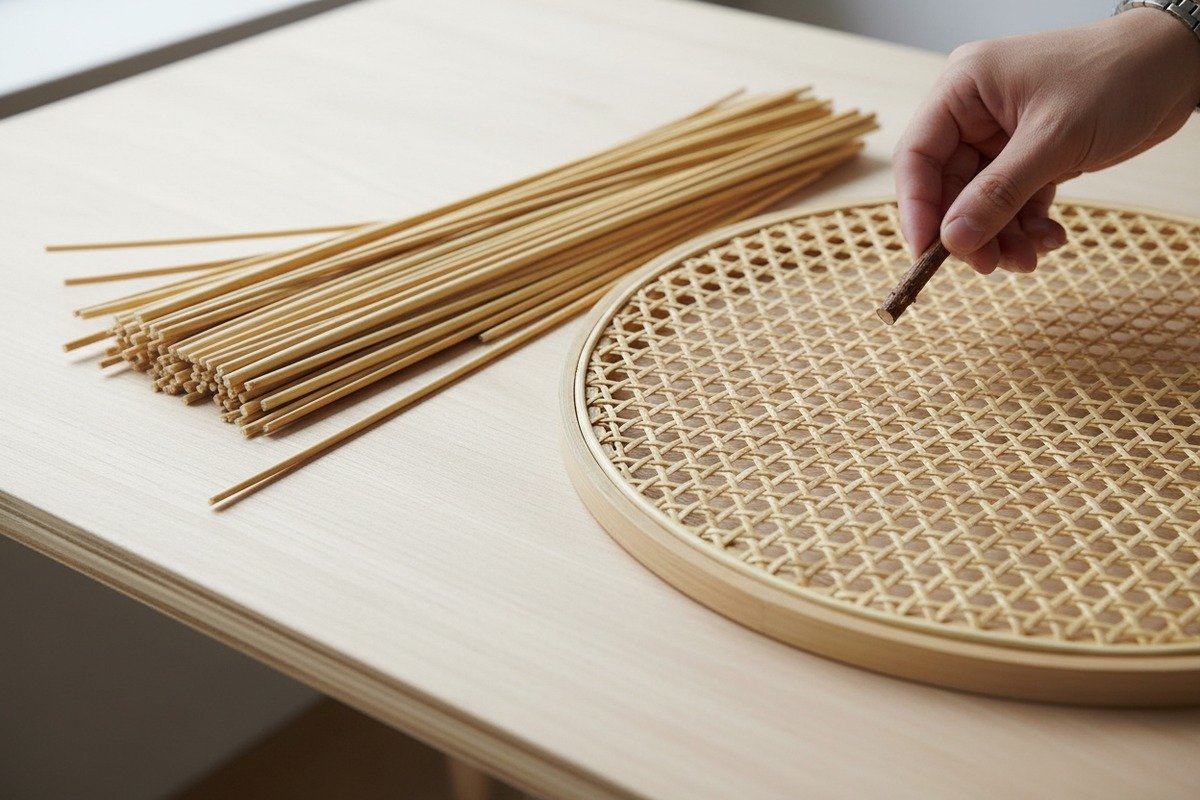
Why Species Selection Matters
Not all rattan is the same. There are over 600 known rattan species 2 worldwide, but only a handful are suitable for cane webbing production. The outer peel 3 must be smooth, flexible, and strong enough to withstand the tension of weaving without splitting.
At our Indonesian processing facility, we primarily work with three species. Each has distinct characteristics that affect the final product.
Comparing Top Rattan Species for Webbing
| Species | Local Name | Key Strength | Beste Verwendung | Peel Quality |
|---|---|---|---|---|
| Calamus caesius 4 | Sega | High flexibility, even diameter | Fine hexagonal webbing | Smooth, light color |
| Calamus trachycoleus | Irit | Strong, long internodes | Large-roll production | Sehr gleichmäßig |
| Calamus manan | Manau | Thick, durable | Heavy-duty webbing, frames | Etwas gröber |
| Calamus scipionum | Rotan lilin | Glossy surface | Decorative panels | Naturally shiny |
| Daemonorops spp. | Jernang | Brittle, resinous | Not recommended for webbing | Inkonsistent |
How to Match Species to Your Project
If your factory produces high-end dining chairs or cabinet panels for the European market, Calamus caesius is the gold standard. Its peel strips cleanly and its natural color is pale and consistent. For larger projects like wall panels or room dividers, Calamus trachycoleus works well because its vines grow longer, allowing wider rolls with fewer joints.
One mistake we see buyers make is assuming all "Grade A rattan" comes from the same species. It does not. A Grade A classification from one supplier might refer to Calamus caesius, while another supplier grades Daemonorops as Grade A simply because it is the best of their available stock. Always ask for the species name.
Wild-Harvested vs. Plantation Rattan
There is also a growing distinction between wild-harvested and plantation-grown rattan. Plantation rattan, especially Calamus caesius cultivated in Kalimantan, tends to have more consistent diameter and fewer surface blemishes. Wild rattan can be thicker and more irregular. For precision webbing patterns, plantation stock gives better results.
How can I verify that my supplier is using Grade A raw materials for my order?
One of the most frustrating calls we receive is from a buyer who opened a shipment and found inconsistent strip widths or dark spots in the webbing. Quality verification should happen before production, not after delivery.
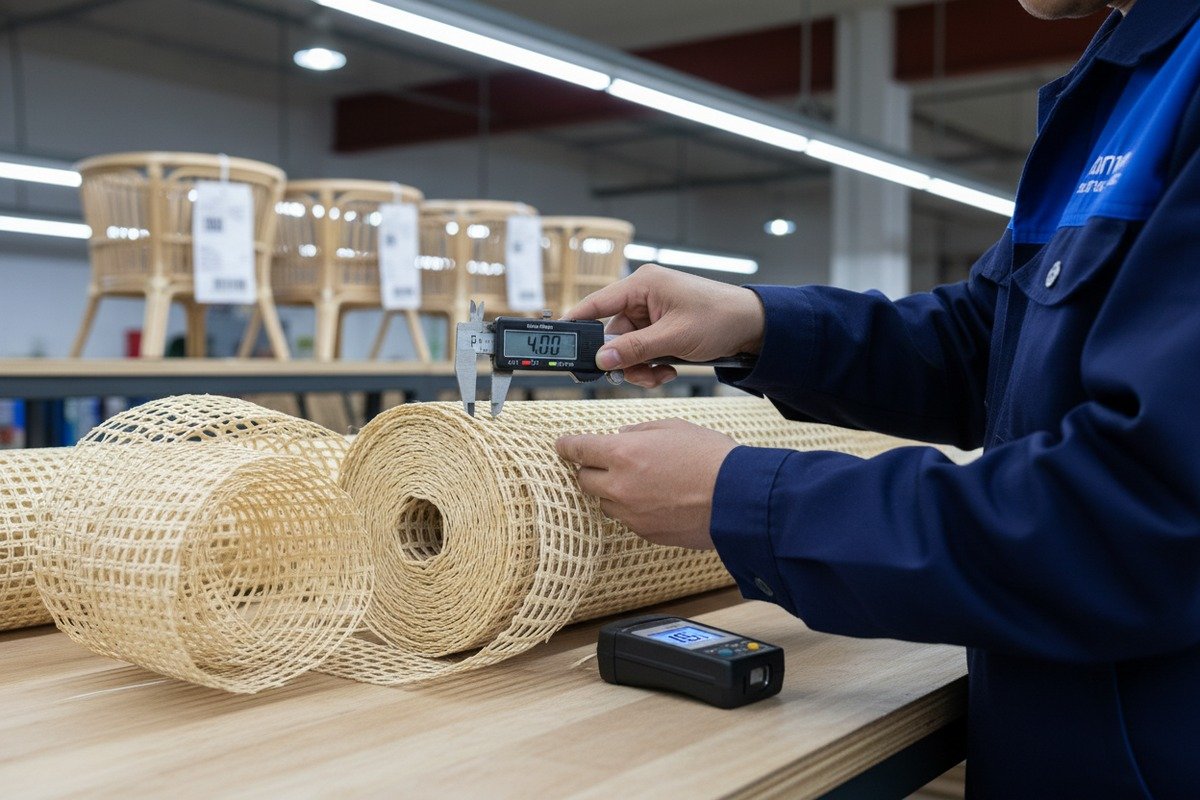
To verify Grade A rattan materials, request pre-production samples with species identification, inspect strip width uniformity (typically 4–5mm tolerance), check for consistent color and absence of mold or insect damage, and ask for documentation of processing steps including drying moisture content below 12% and anti-mildew treatment records.
What Defines "Grade A" in Rattan Webbing?
There is no universal international standard for rattan grading. This is a problem. Different suppliers use different criteria. At our facilities, we define Grade A by five measurable factors.
Grade A Quality Checklist
| Qualitätsfaktor | Klasse A Standard | Grade B (Acceptable) | Grade C (Reject) |
|---|---|---|---|
| Strip width consistency | ±0,3 mm Abweichung | ±0.5mm variance | >0,5mm Abweichung |
| Farbgleichmäßigkeit | 90%+ consistent tone | 75–89% consistent | <75% consistent |
| Feuchtigkeitsgehalt 5 | 8–12% | 12–15% | >15% |
| Oberflächenfehler | <2 per linear meter | 2–5 per linear meter | >5 per linear meter |
| Mold/insect damage | Keine | Minor, treatable | Visible, structural |
Steps You Can Take Before Placing an Order
First, always request a physical sample roll before committing to a large order. A photo is not enough. Feel the strips. Bend them. Check if they crack under stress. Second, ask your supplier to share processing documentation. A reliable manufacturer can tell you the soaking duration (we use 20–40 minutes depending on species), the drying method (kiln-dried vs. sun-dried), and whether anti-mildew treatment 6 was applied.
On-Site vs. Remote Inspection
If you cannot visit the factory, hire a third-party inspection agent. In Foshan, there are several agencies familiar with rattan products. They can verify strip uniformity using calipers, check moisture with a pin-type meter, and photograph any defects before shipment.
The Bleaching Question
Many buyers want bleached rattan for a lighter, more uniform appearance. Natural sun bleaching takes longer but preserves fiber integrity. Chemical bleaching with hydrogen peroxide is faster but can weaken the cane if overused. Ask your supplier which method they use. At our facility, we combine sun exposure with a mild peroxide wash. This gives a clean look without compromising strength.
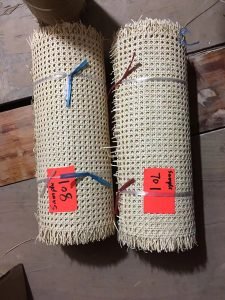
One more tip: check the packaging. Grade A webbing should be rolled tightly on cardboard cores and wrapped in plastic to prevent moisture absorption during shipping. Loose packing leads to warping and mold — especially on ocean freight routes that pass through humid equatorial zones.
Why should I choose Indonesian rattan over other materials for my furniture factory?
When we first set up our own rattan processing facility in Indonesia over a decade ago, the decision was driven by one fact: Indonesia supplies roughly 80% of the world's raw rattan. No other country comes close.
Indonesian rattan is preferred for furniture factories because Indonesia produces approximately 80% of the global rattan supply, offers the widest variety of high-quality species like Calamus caesius and trachycoleus, maintains lower raw material costs through established harvesting networks, and supports sustainable forestry practices that appeal to eco-conscious markets.
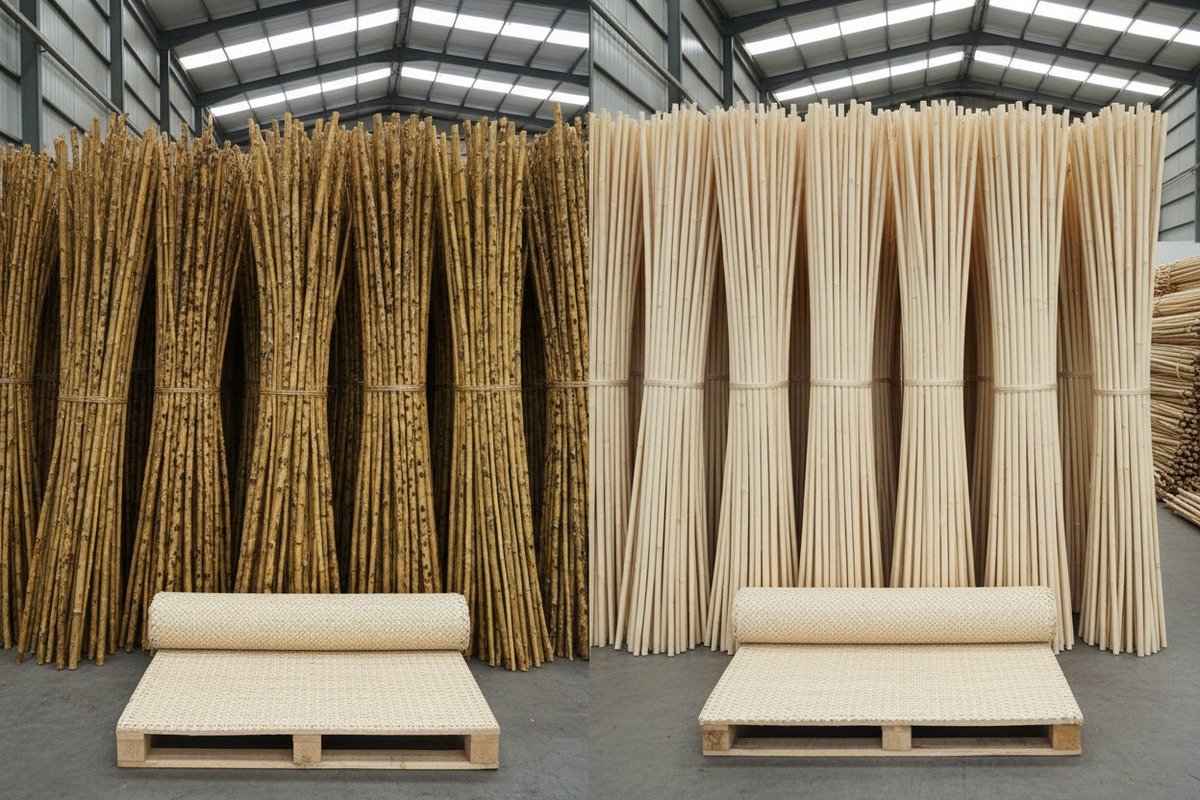
Indonesia's Dominance in Rattan Supply
Indonesia's tropical climate, particularly in Kalimantan, Sulawesi, and Sumatra, creates ideal growing conditions for rattan palm 7s. The vines thrive under forest canopies, climbing trees to reach sunlight. This natural growth pattern produces long, flexible poles perfect for peeling and weaving.
Other countries like the Philippines, Malaysia, and Vietnam also produce rattan. However, their combined output is a fraction of Indonesia's. For a furniture factory that needs consistent supply year-round, Indonesian sourcing is the most reliable option.
Cost and Supply Chain Advantages
Raw rattan poles in Indonesia cost significantly less than in other producing nations. The harvesting infrastructure is well-established. Villages across Kalimantan have generations of experience in sustainable rattan collection. This keeps costs down and quality consistent.
Our own facility in Indonesia handles the initial processing: peeling, sorting, drying, and cutting into strips. We then ship semi-finished or finished webbing to our Foshan headquarters for final quality checks and distribution. This integrated supply chain reduces lead times and eliminates middlemen.
Sustainability as a Selling Point
Rattan ist eine nachwachsender Rohstoff 8. Unlike hardwood trees that take decades to mature, rattan vines can be harvested in 5–7 years and regrow from the same root system. Indonesisches Rattan 9 harvesting, when managed properly, actually supports forest conservation because harvesters need standing forests for the vines to climb.
For furniture brands marketing to environmentally conscious consumers in Europe, Australia, and North America, Indonesian rattan carries a strong sustainability story. It is biodegradable, renewable, and supports rural livelihoods.
Indonesian Rattan vs. Alternative Materials
Some factories consider synthetic PE rattan, paper cord, or seagrass as alternatives. Each has trade-offs.
| Material | Durability (Indoor) | Outdoor Use | Eco-Friendly | Ästhetik | Kosten |
|---|---|---|---|---|---|
| Indonesian natural rattan | Ausgezeichnet | Poor (moisture risk) | Yes, biodegradable | Warm, organic | Mittel |
| Synthetisches PE-Rattan | Gut | Ausgezeichnet | No, petroleum-based | Uniform, weniger Charakter | Niedrig–Mittel |
| Paper cord | Moderat | Schlecht | Partially | Sauber, modern | Niedrig |
| Seagrass | Gut | Schlecht | Ja | Rustic, textured | Niedrig |
| Bamboo strips | Gut | Moderat | Ja | Smooth, pale | Mittel |
Natural rattan wins on aesthetics and sustainability for indoor furniture. If your clients need outdoor products, synthetic is the practical choice. But for the high-end indoor market — think Scandinavian design, boutique hotels, artisan cafés — nothing replaces the warmth and texture of real Indonesian rattan.
What role does the outer peel versus the core play in my rattan material selection?
This is the question that separates informed buyers from those who end up with the wrong product. We regularly get inquiries from new clients who confuse rattan cane (outer peel) with rattan reed (inner core). They look similar in photos. They are completely different materials.
The outer peel (cane) of the rattan vine is the hard, glossy layer used for weaving natural cane webbing — it provides strength, flexibility, and a smooth finish. The inner core (reed) is softer, more porous, and used for basket-weaving, binding, or as filler material. For cane webbing, only the outer peel is used.
Understanding Rattan Anatomy
A rattan vine has a layered structure. The outermost layer is a hard, silica-rich skin. This is the cane. It is naturally glossy, smooth, and incredibly strong relative to its thickness. Beneath this skin lies the softer, spongy core — the reed. Between them sits a thin transitional layer.
When we process rattan at our Indonesian facility, the first step is separating these layers. Skilled workers use sharp blades to peel the outer cane from the pole. The strips are then sorted by width and thickness. The remaining core is processed separately for different products.
How Peel and Core Differ in Practice
The cane (outer peel) has a natural resistance to moisture and abrasion because of its silica content. It bends without breaking when properly soaked. This makes it ideal for the tight, repetitive weaving required in hexagonal, octagonal, and square patterns.
The core (reed) absorbs moisture readily. It swells when wet and shrinks when dry. This makes it unsuitable for structural webbing. However, reed is excellent for basket frames, decorative accents, and the spline that holds pre-woven cane webbing into chair seat grooves.
Why This Distinction Matters for Buyers
If you order "rattan webbing" without specifying that you want outer-peel cane, some suppliers may use core-based material or a blend. Core-based webbing looks acceptable when new but degrades much faster. It lacks the tensile strength to hold weaving tension over time. Chairs with core webbing sag within a year. Cane webbing, properly maintained, lasts decades.
Processing Steps: From Pole to Finished Webbing
The journey from raw rattan pole to finished webbing involves several carefully controlled steps.
- Ernte — Rattan vines are cut from forest canopies, cleaned, and bundled.
- Sortierung — Poles are sorted by diameter. Thicker poles yield wider peel strips.
- Schälen — The outer cane is stripped from the pole using hand tools or machines.
- Cutting — Peel strips are cut to uniform widths (commonly 2.5mm, 3mm, 4mm, or 5mm).
- Boiling and treatment — Strips are boiled to remove sap, then treated with anti-mildew agents.
- Trocknen — Strips are sun-dried or kiln-dried to a moisture content of 8–12%.
- Bleichen — Optional step using sun exposure or mild hydrogen peroxide for color uniformity.
- Weben — Strips are woven by hand or on looms into hexagonal, square, or basketweave patterns.
- Quality inspection — Finished sheets or rolls are checked for pattern consistency and defects.
- Rolling and packaging — Webbing is rolled onto cardboard cores and wrapped for shipping.
Soaking and Flexibility
Before weaving, dried cane strips must be soaked in water for 20–60 minutes. This restores their flexibility. The exact soaking time depends on the strip thickness and ambient temperature. Over-soaking makes the strips too soft and difficult to control. Under-soaking leads to cracking during weaving.
This soaking requirement also applies during installation. If your furniture factory receives pre-woven cane webbing rolls, the webbing should be lightly misted or soaked before being pressed into chair frames. It tightens as it dries, creating a drum-tight seat.
Common Buyer Mistakes
The most common mistake is assuming that thicker is better. For delicate hexagonal patterns, thinner strips (2.5–3mm) create a finer, more elegant result. Thicker strips (4–5mm) are better for heavy-duty applications or rustic designs. Match the strip width to your pattern and end use.
Another mistake is storing rattan in humid warehouses without climate control. Even Grade A cane webbing will develop mold if stored in environments above 70% relative humidity for extended periods. We always recommend climate-controlled storage or at minimum, well-ventilated dry spaces.
Conclusion
Natural rattan cane webbing starts with the right species, verified grading, Indonesian sourcing advantages, and a clear understanding of outer peel versus inner core — every detail in the raw material shapes your final product quality.
Fußnoten
1. Britannica offers an authoritative overview of the natural vegetation, including tropical evergreen forests, in Southeast Asia. ↩︎
2. Confirms the approximate number of rattan species globally. ↩︎
3. Differentiates the outer peel (cane) from the inner core (reed) and their uses. ↩︎
4. Details characteristics and traditional uses of Calamus caesius rattan. ↩︎
5. Explains acceptable moisture content levels for wood and furniture. ↩︎
6. Provides methods and considerations for preventing mold and mildew on rattan. ↩︎
7. Wikipedia provides a comprehensive overview of rattan as a climbing palm species. ↩︎
8. Explains rattan’s rapid growth and sustainable harvesting cycle. ↩︎
9. Highlights Indonesia’s dominance and variety in global rattan supply. ↩︎
 English
  Español de México
  العربية
  Deutsch
  Français
  Русский