
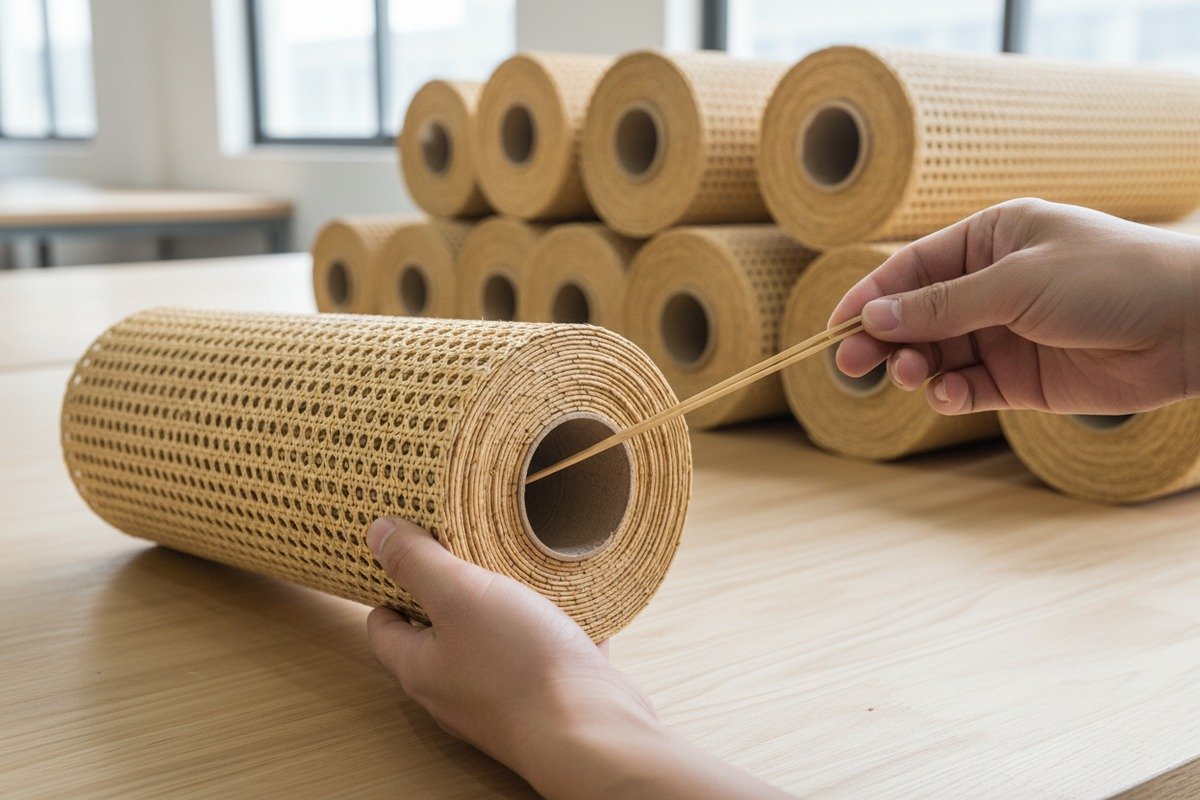
Every year, we see buyers at our Foshan warehouse pick up rattan webbing samples, bend them, and walk away disappointed — the strands crack, the weave gaps are uneven, or the color looks suspiciously uniform from un blanchiment chimique 1.
High-quality, authentic rattan cane webbing shows uniform weave tension, consistent strand thickness, a warm golden-brown color with subtle natural variation, and flexible strands that bend without cracking. Verifying origin, grading transparency, and hands-on testing are essential steps before committing to bulk orders.
Whether you run a furniture factory or wholesale rattan materials to builders and designers, this guide breaks down exactly what to look for — from grading differences and authenticity checks to durability markers and supplier evaluation rotin de qualité A 2. Let’s walk through each step so your next order meets the standard your customers expect.
How can I tell the difference between Grade A and lower-quality rattan cane webbing?
When our sorting team in Indonesia processes a fresh batch of peeled rattan, the difference between grades becomes obvious within seconds — yet many overseas buyers never get to see that stage.
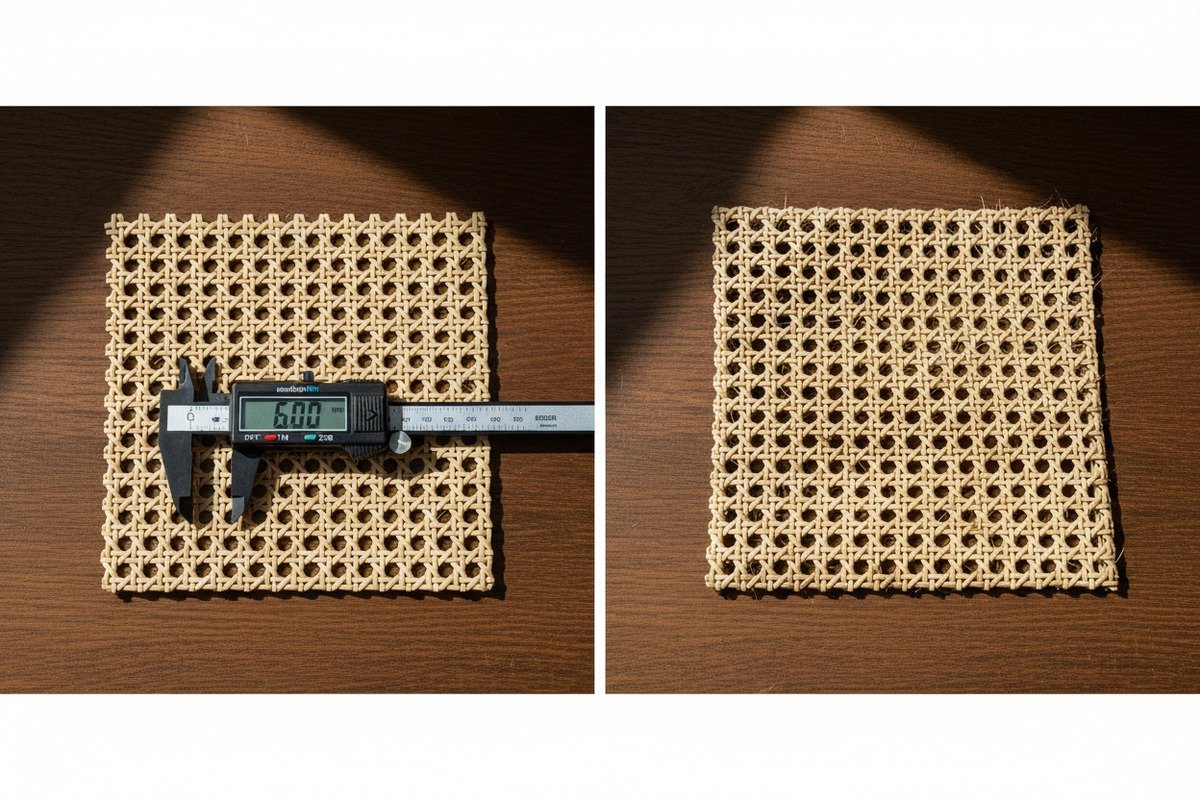
Grade A rattan cane webbing features uniform strand thickness, smooth polished surfaces free of burrs, consistent golden-brown color, tight node spacing, and zero visible defects. Lower grades (B, C, D) show uneven thickness, rough patches, color inconsistencies, and occasional cracks or split fibers.
Comprendre le système de classement
Le classement du rotin 3 happens after harvesting, drying, and peeling. Workers sort each strand by hand. They check diameter consistency, surface smoothness, node frequency, and flexibility. The grading scale typically runs from A (premium) through D (lowest usable quality). Grade A strands come from the best sections of mature palmiers rotins 4 — usually harvested at 5 to 7 years old. These palms yield longer, more uniform fibers with fewer nodes.
At our processing facility, sorters discard any strand that shows cracks, insect damage, or irregular thickness before it even reaches the weaving station. That discard rate is part of why Grade A costs more. You are paying for the rejection process as much as the material itself.
Visual and Tactile Differences by Grade
Here is a breakdown we use internally when training new quality inspectors:
| Caractéristique | Qualité A | Qualité B | Grade C/D |
|---|---|---|---|
| Épaisseur des brins | Uniform (±0.2 mm variance) | Mostly uniform (±0.5 mm) | Noticeable inconsistencies |
| Finition de surface | Smooth, polished, no burrs | Minor rough spots | Visible burrs, unpolished areas |
| Couleur | Consistent warm golden-brown | Légère variation | Stark color differences, dark spots |
| Node frequency | Minimal, evenly spaced | Modéré | Frequent, irregular |
| Flexibilité | Bends 90°+ without cracking | Slight resistance | Cracks or splinters under stress |
| Weave tension (in finished webbing) | Even hole sizes throughout | Points lâches occasionnels | Irregular gaps, uneven tension |
Why Grade Matters for Furniture Manufacturing
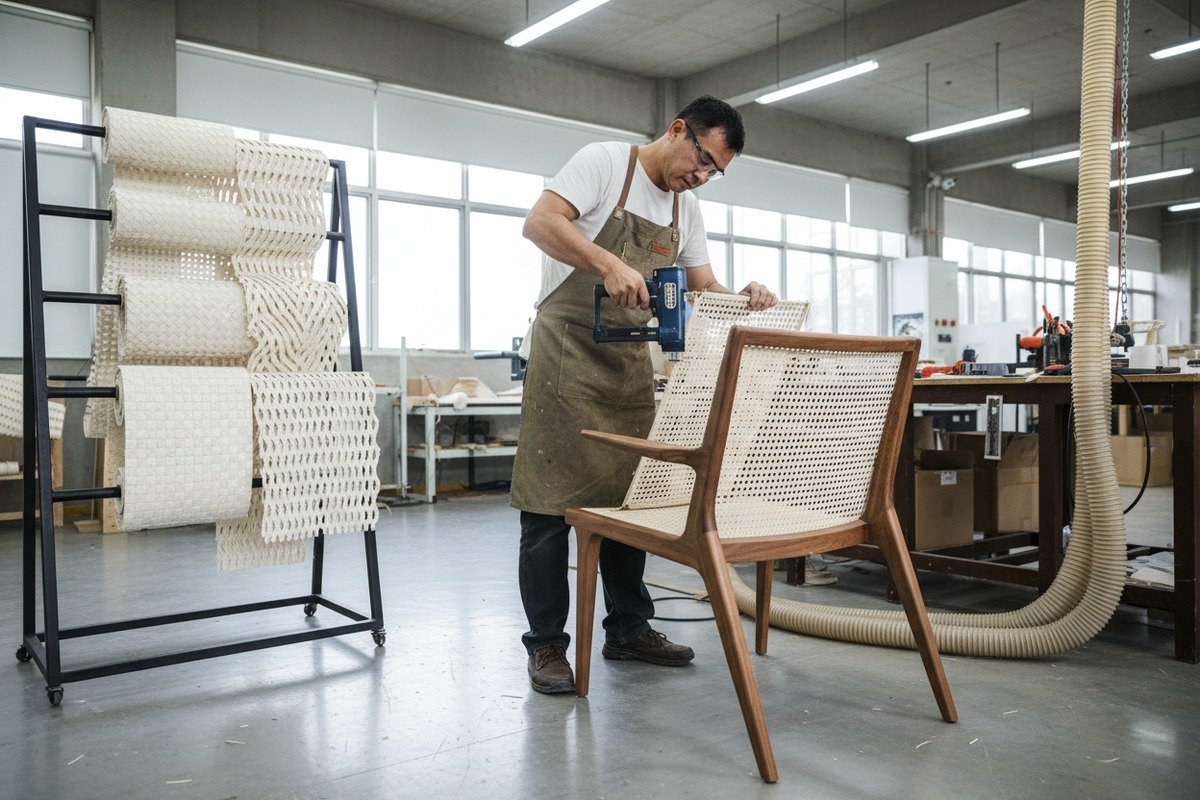
If you are a furniture factory buying rattan webbing for chair backs, cabinet doors, or headboards, Grade A is not a luxury — it is a functional requirement. Lower-grade webbing with inconsistent tension will sag after a few months of use. Strands that crack during bending will fail during the stretching and stapling process on production lines.
We once had a Turkish buyer switch from a Grade B supplier to our Grade A rolls. His rejection rate on finished chairs dropped from 8% to under 1%. The price per roll was higher, but the total production cost went down because he stopped wasting frames and labor on failed webbing installations.
The Role of Species in Grading
Not all rattan species produce the same quality of cane. Indonesian Rotin Tohiti 5, for example, has a natural diameter of 1 to 2 inches and produces flexible, golden-brown strands with minimal nodes. It is the preferred species for Grade A webbing. Other species may grade well visually but lack the tensile flexibility buyers need. Always ask your supplier which species they use — a vague answer like "natural rattan" without specifying the species is a red flag.
How do I verify if the rattan cane webbing I'm buying is 100% natural and authentic?
Our sales team fields this question almost weekly, especially from European and American buyers who have been burned by synthetic rattan marketed as natural.
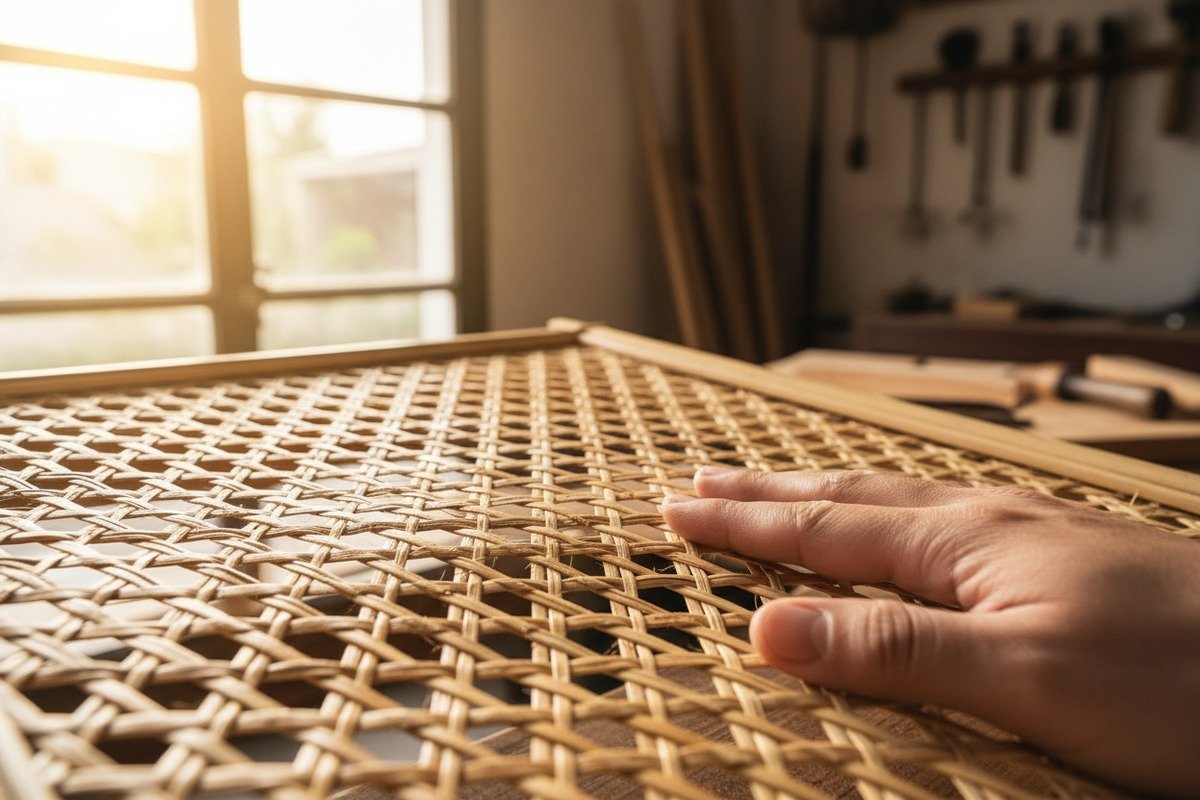
To verify authenticity, check for a distinctive earthy, woody scent; subtle natural color variations rather than perfect uniformity; a fibrous matte texture; and flexibility without plastic-like sheen. Natural rattan does not shrink under heat, while synthetic PE rattan melts or deforms. Always request raw material certificates and origin documentation from your supplier.
Le test olfactif
This is the simplest and most reliable on-site check. Genuine natural rattan has a distinct earthy, woody aroma — similar to dried bamboo or freshly cut cane. Synthetic PE plastic rattan 7 has no natural scent or carries a faint chemical smell. If a sample smells like nothing at all, question it. If it smells like plastic, walk away.
The Heat Test
Natural rattan is heat-stable. Hold a lighter near a small strand edge for a few seconds. Natural cane will char slowly like wood. Synthetic rattan will melt, shrink, or produce a chemical-smelling smoke. We do not recommend this on finished products for obvious reasons, but on a spare strand or sample cutting, it is definitive.
Visual Clues That Reveal Authenticity
Natural rattan has organic imperfections. No two strands are perfectly identical. Look for:
- Subtle color variation between strands (warm beige to light honey)
- A matte, fibrous surface rather than a glossy or waxy coating
- Visible grain lines running along each strand
- Tiny node bumps at irregular intervals
Synthetic rattan mimics this look but struggles with randomness. Machine-made patterns repeat too perfectly. Strand diameters are exactly identical — which, paradoxically, is a sign of inauthenticity in natural materials.
The Bleaching Warning
Be cautious with overly white or perfectly uniform-colored natural rattan. Some processors aggressively bleach rattan to achieve a clean look. While mild bleaching is a standard step in processing, excessive chemical treatment weakens the fibers. The webbing may look beautiful on delivery but become brittle within months. Ask your supplier about their bleaching process. Light boiling and sun-drying are normal. Prolonged chemical soaking is not.
| Authentication Method | Ce qu'il faut rechercher | Natural Rattan Result | Synthetic Rattan Result |
|---|---|---|---|
| Smell test | Earthy, woody aroma | Present | Absent or chemical |
| Heat exposure | Reaction to flame | Chars like wood | Melts or shrinks |
| Texture de surface | Matte vs. glossy | Matte, fibrous | Glossy or waxy |
| Uniformité des brins | Perfect vs. organic | Subtle natural variation | Machine-perfect uniformity |
| Flexibilité | Bend and release | Returns to shape smoothly | May hold crease or snap |
| Color depth | After scratching surface | Consistent fiber color throughout | Surface coating only |
Verifying Origin and Certifications
Ask for documentation. Reputable suppliers can provide origin certificates 8 showing where the raw rattan was harvested. Indonesian rattan, particularly from Sulawesi and Kalimantan, is widely recognized as premium grade. FSC (Forest Stewardship Council) certification 9 is the gold standard for sustainability verification. If a supplier claims "sustainable sourcing" but cannot produce any third-party certification, treat that claim with skepticism.
At our company, we maintain traceability from our Indonesian processing facility through to our Foshan warehouse. Every shipment comes with origin documentation. This is not unusual for serious suppliers — if yours cannot provide it, ask why.
What specific features should I look for to ensure my rattan webbing is durable enough for furniture manufacturing?
During the 15+ years we have been exporting rattan materials from our Foshan headquarters, the most common complaint from furniture factories is not about aesthetics — it is about webbing that fails during installation or deteriorates within the first year of use.
Durable rattan webbing shows consistent weave tension with uniform hole sizes, high strand flexibility that bends without cracking, low moisture content to prevent brittleness, smooth surfaces from proper singeing and polishing, and comes from mature rattan palms harvested at 5 to 7 years. Weather-treated options with anti-insect and anti-corrosion properties extend outdoor longevity.
Weave Tension and Pattern Integrity
The weave is where durability starts. In high-quality webbing, every intersection holds firm. Hole sizes should be consistent — for standard square weave, a half-inch mesh is the benchmark. Pull gently on the webbing sheet. If strands shift easily or gaps widen, the tension is too loose. Loose weave means the webbing will sag under weight and deform over time.
Different patterns also carry different durability profiles:
| Type de motif | Structure | Intensité de la main-d'œuvre | Durability for Furniture | Meilleure utilisation |
|---|---|---|---|---|
| Square (radio cane) | Simple over-under grid | Faible à modéré | High — even load distribution | Chair seats, cabinet panels |
| Hexagonal (open weave) | Six-sided mesh | Modéré | Moderate — less material per area | Decorative panels, headboards |
| Octagonal (star pattern) | Hexagon + diagonal strips | Élevé | Very high — added cross-support | Premium furniture, high-traffic pieces |
| Motif losange | Complex geometric interlocking | Élevé | Élevé | Statement furniture, luxury pieces |
Strand Flexibility as a Durability Predictor
This is the single most important hands-on test. Take a single strand and bend it to 90 degrees. Grade A natural cane will bend smoothly and return close to its original position. If it cracks, splinters, or stays bent, the material is either low-grade, improperly dried, or old stock that has lost moisture.
Flexibility comes from two factors: species quality and processing. Rotin Tohiti from Indonesia is naturally more flexible than many other species. Proper drying — reducing la teneur en humidité 10 without over-drying — preserves the natural oils that keep fibers pliable.
Moisture Content Matters
Rattan that is too wet will mold. Rattan that is too dry will crack. The ideal moisture content after processing sits in a narrow range. While there is no universally published standard for rattan webbing moisture, experienced processors target a level where the cane feels firm but not brittle, and shows no signs of surface moisture.
Storage conditions before shipping matter enormously. We keep our finished rolls in climate-controlled warehouses in Foshan. If your supplier stores rolls in open sheds exposed to humidity swings, the product you receive may perform differently than the sample you approved.
Surface Finishing and Singeing
After weaving, quality manufacturers use a blowtorch to singe off fine burrs and loose fibers. This step, called singeing, creates a smoother surface that resists snagging and makes the webbing easier to handle during upholstery. It also gives the webbing a slightly warmer color tone.
Skipping this step saves time and cost — but leaves a product that catches on fabric, collects dust more easily, and looks less refined. Run your hand across the surface. It should feel smooth with a light texture, not rough or prickly.
Outdoor Durability Considerations
Traditional natural rattan webbing is best suited for indoor use. However, newer weather-proof treatments now allow cane webbing to resist insects, UV fading, and moisture corrosion for outdoor applications. If your furniture factory produces outdoor pieces, specifically ask whether the webbing has been treated. Untreated natural rattan exposed to rain and direct sun will degrade within one to two seasons.
Natural rattan still outperforms synthetic PE plastic in heat resistance — plastic webbing can shrink and deform in direct sunlight. But without proper treatment, natural cane's moisture sensitivity remains its main weakness outdoors.
How can I evaluate a supplier's quality control to ensure consistency across my bulk rattan orders?
We have shipped rattan materials to over a dozen countries — and the question behind every repeat order is not "Was the first batch good?" but "Will the next batch be just as good?"
Evaluate a supplier's quality control by requesting pre-shipment samples from each production batch, asking about their grading and sorting process, verifying storage conditions, reviewing their defect handling policy, and checking for third-party certifications. Consistent suppliers maintain documented QC checkpoints from raw material intake through final packaging.
Ask About Their Production Chain
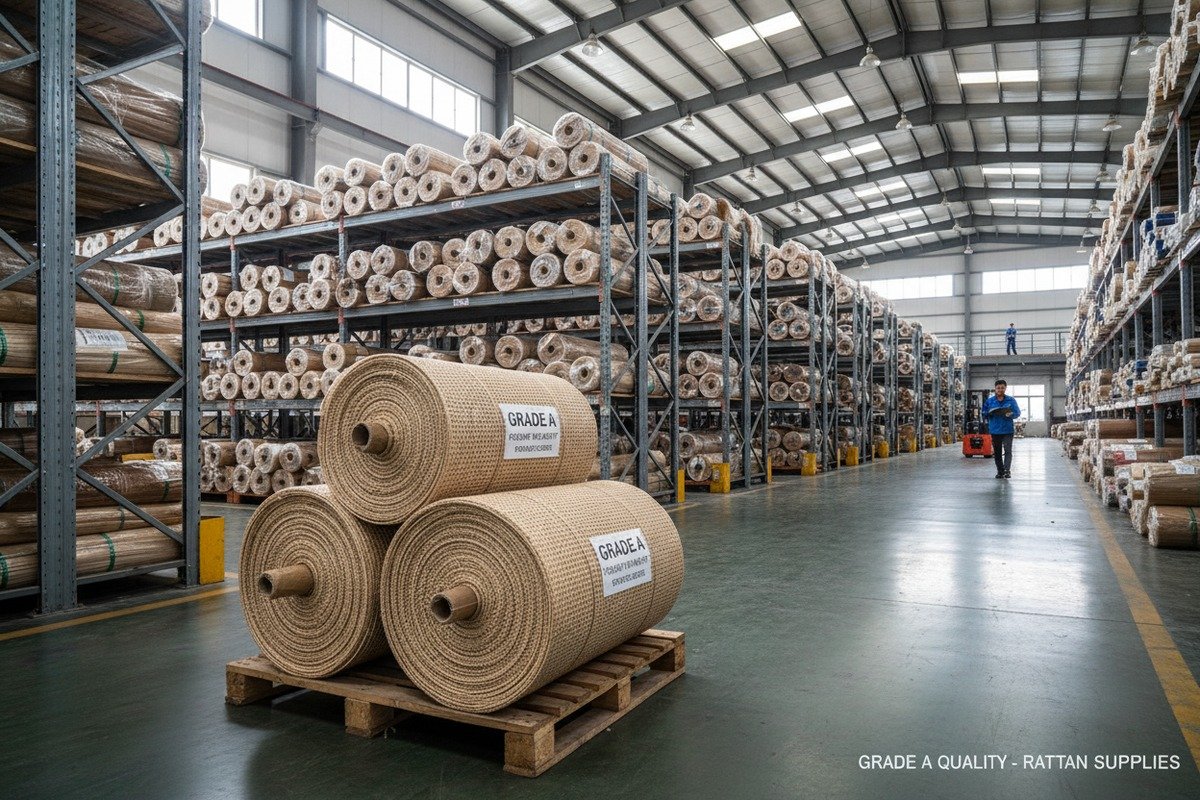
A supplier who only trades rattan — buying finished rolls from anonymous factories — has far less control over quality than a supplier who owns or directly manages processing facilities. Ask where the raw rattan is harvested. Ask where it is peeled, sorted, and woven. Ask who does the quality grading.
At our operation, raw rattan goes through our own Indonesian facility for initial processing, then through our Foshan factories for weaving and finishing. We control every stage. Not every supplier needs to own factories, but they should be able to clearly describe every step and name every facility involved.
Key Questions to Ask Any Supplier
Before placing a bulk order, these questions separate serious suppliers from middlemen:
- What rattan species do you use, and where is it harvested?
- Can you provide photos or video of your sorting and grading process?
- What is your defect tolerance per roll or per shipment?
- How do you store finished rolls before shipping?
- Can you send a sample from the actual production batch (not a separate "sample stock")?
- Do you hold any third-party certifications (FSC, ISO, etc.)?
- What is your policy if a shipment does not match the approved sample?
Red Flags That Signal Inconsistent Quality
Watch for these warning signs:
- The supplier cannot specify which rattan species they use
- Samples look significantly better than bulk deliveries
- No documentation for grading, origin, or processing
- Storage shown in photos appears to be open-air or uncontrolled
- Reluctance to allow factory visits or video calls showing the production floor
- Pricing that seems too low for the grade claimed — Grade A pricing reflects the sorting and discard costs
Building a QC Framework for Your Orders
If you are a purchasing manager placing regular orders, establish a QC framework with your supplier. Here is a structure we use with several of our long-term clients:
| Étape de contrôle qualité | Action | Responsibility | Fréquence |
|---|---|---|---|
| Pre-production | Approve raw material sample | Buyer + Supplier | Every new batch |
| During weaving | Check weave tension and pattern consistency | Supplier QC team | Continuous |
| Post-weaving | Inspect finished rolls for defects, color, flexibility | Supplier QC team | 100% of rolls |
| Pré-expédition | Send photos and samples to buyer for approval | Fournisseur | Every shipment |
| Emballage | Verify roll protection (moisture barriers, padding) | Fournisseur | Every shipment |
| Arrival inspection | Buyer spot-checks against approved sample | Acheteur | Every shipment |
Packaging as a Quality Indicator
How a supplier packages rattan rolls tells you a lot about their standards. Rattan webbing should be wrapped in moisture-resistant material, rolled without creasing, and cushioned against impact damage. If you receive rolls with crushed edges, water stains, or loosened weave from poor handling, the supplier's QC extends only to the product — not to the delivery.
We wrap every roll in plastic film, add silica gel packets for moisture control, and pack rolls in reinforced cartons. Our Dutch and Australian buyers specifically require this because long sea shipments expose cargo to humidity fluctuations. If your supplier does not ask about your shipping route when discussing packaging, they are probably not thinking about what happens between their warehouse and yours.
The Value of Long-Term Relationships
Consistency improves with communication. The best quality control is not a checklist — it is a relationship. Suppliers who understand your specific requirements, your end products, and your tolerance levels will calibrate their process to match. We have clients who have been ordering from us for over a decade. Their QC issues dropped to near zero not because we changed our process, but because we learned exactly what they need.
Conclusion
Identifying high-quality, authentic rattan cane webbing comes down to hands-on testing, informed questions, and choosing suppliers who welcome transparency. Use the grading criteria, authenticity checks, durability tests, and QC evaluation framework in this guide to protect your next bulk order.
Notes de bas de page
1. Discusses the process and effects of chemical bleaching on rattan materials. ↩︎
2. Details the criteria and characteristics of Grade A rattan quality. ↩︎
3. Describes the process and stages involved in rattan grading. ↩︎
4. Authoritative source defining rattan as climbing palms with species diversity and uses. ↩︎
5. Highlights characteristics and uses of the Rotin Tohiti rattan species. ↩︎
6. Comprehensive guide on rattan cane webbing, its source, types, and production. ↩︎
7. Explains PE rattan, its composition, benefits, and comparison to natural rattan. ↩︎
8. Provides information on supply chain traceability, relevant to verifying material origin. ↩︎
9. Links to the official website of the Forest Stewardship Council for sustainability standards. ↩︎
10. Authoritative source on wood moisture content, its importance, and acceptable levels. ↩︎

 English
  Español de México
  العربية
  Deutsch
  Français
  Русский