
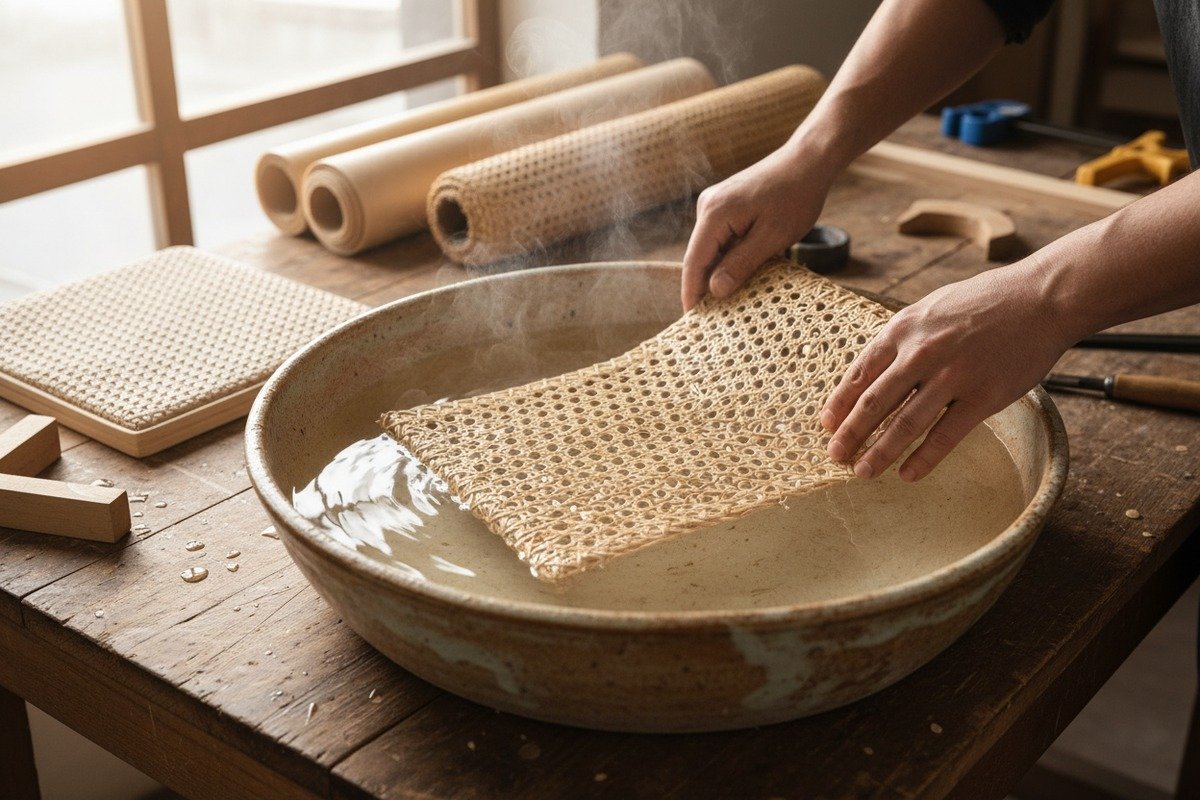
Every week, our production team in Foshan handles hundreds of rattan webbing orders—and the most common question we hear from first-time buyers is about soaking.
Natural rattan cane webbing should be soaked in warm water for 15 to 30 minutes before installation. This soaking time softens the fibers enough for easy bending and stapling without cracking. Never exceed 30 minutes, as over-soaking weakens the cane and causes darkening.
Soaking sounds simple. But the details matter more than you think. The wrong water temperature, the wrong timing, or skipping the rest period can ruin a whole roll of premium webbing intégrité structurelle 1. Below, we break down everything you need to know—minute by minute, step by step.
How many minutes should I soak my natural rattan cane webbing before installation?
We ship rattan cane webbing to furniture factories across more than a dozen countries, and installation failures often trace back to one thing: incorrect soaking time mineral oil 2.
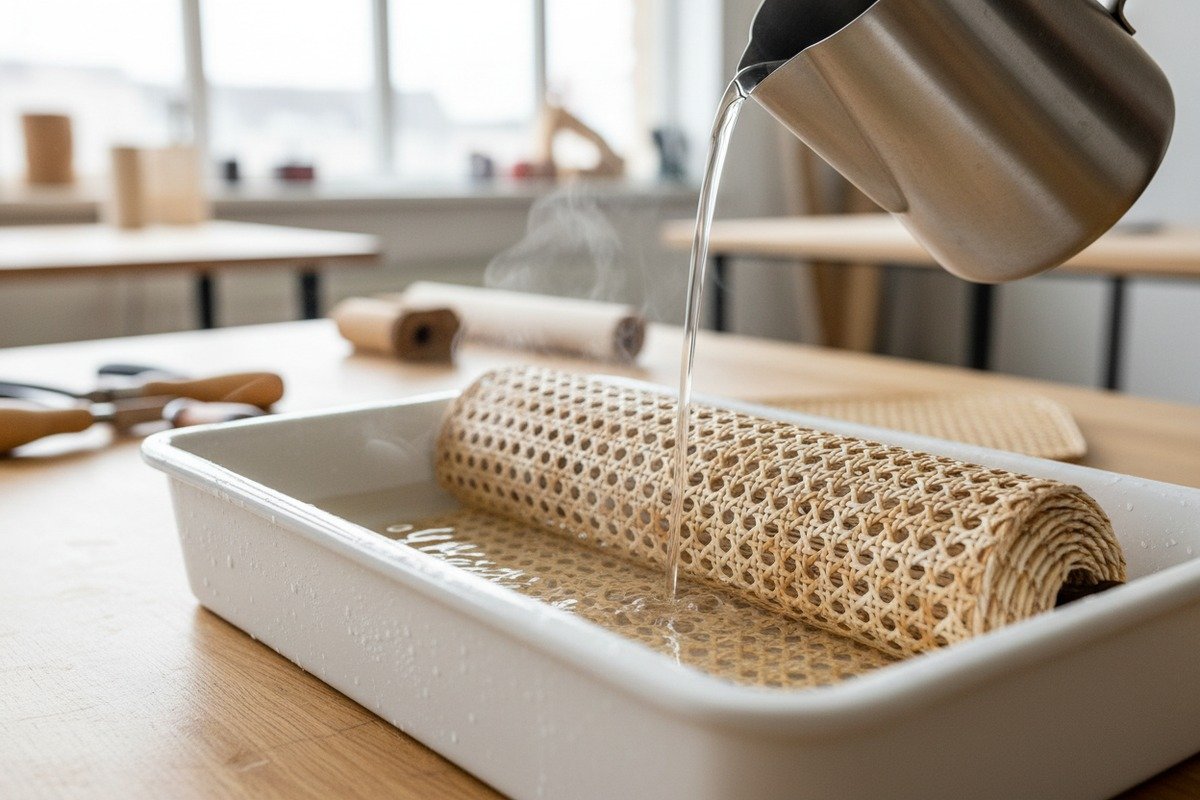
Soak your natural rattan cane webbing for 15 to 30 minutes before installation. Start checking flexibility at the 15-minute mark. Most standard webbing reaches ideal pliability around 20 minutes. Allow a 5-minute rest after removing it from water before you begin stapling or fitting.
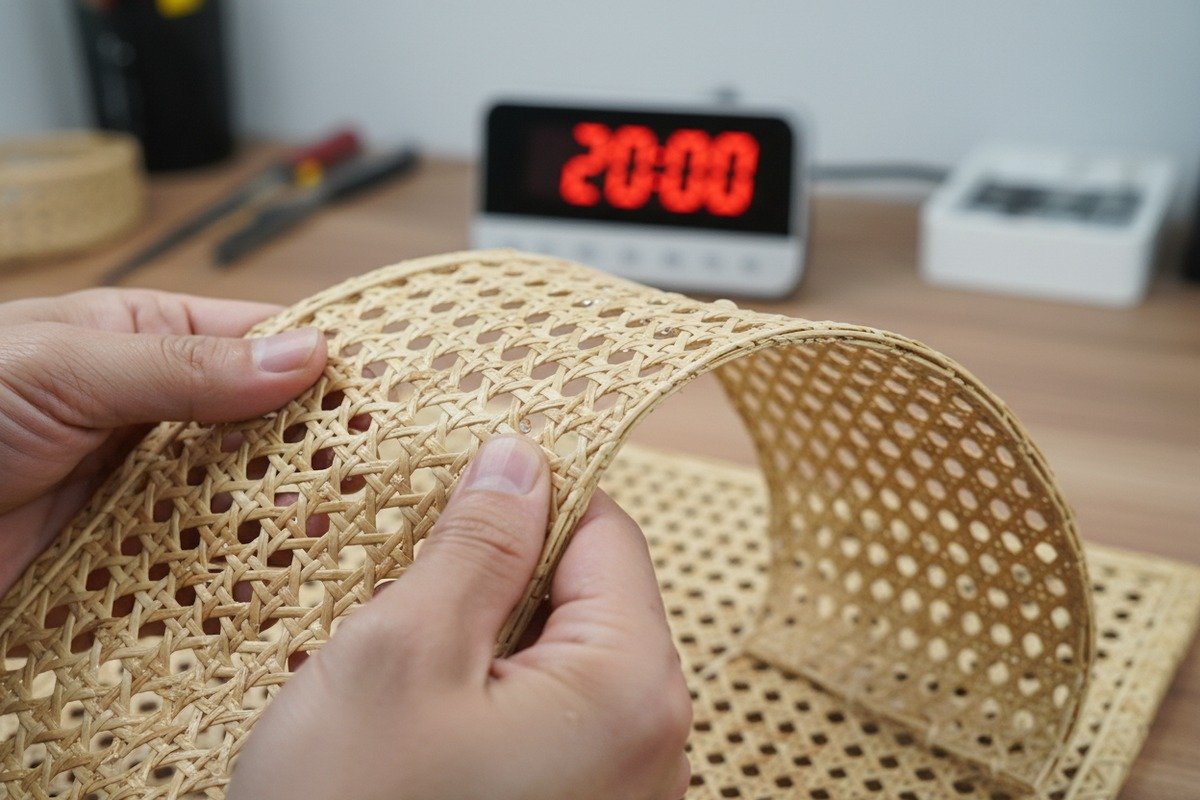
Getting the soaking time right is the foundation of a successful rattan project. Too little time and the cane stays stiff and brittle. Too much and you risk permanent damage. Let's break this down into practical steps.
Why Soaking Time Varies by Webbing Type
Not all rattan cane webbing is the same. The thickness of the strips, the tightness of the weave, and even how long the roll has been stored all affect how quickly it absorbs water. A thin open-weave sheet from a fresh batch may soften in 15 minutes. A thicker, tightly woven piece that has been stored in a dry warehouse for months might need closer to 30 minutes.
At our rattan processing facility in Indonesia, we test each batch before shipping. We know from experience that the density of the weave is the biggest variable. Here is a quick reference guide:
| Type de sangle | Densité du tissage 3 | Durée de trempage recommandée | Rest Period |
|---|---|---|---|
| Open hexagonal cane | Light | 15 minutes | 5 minutes |
| Standard square grid | Moyen | 20 minutes | 5 minutes |
| Tissage losange dense | Heavy | 25–30 minutes | 5 minutes |
| Tissage serré en panier | Very heavy | 30 minutes | 5–7 minutes |
The 5-Minute Rest Period
After you remove the webbing from water, do not rush to install it. Lay it flat on a clean surface for about 5 minutes. This rest period lets excess water drain. It also allows the fibers to settle into a uniform flexibility. If you skip this step, the webbing can feel unevenly soft—some spots too wet, others still stiff.
Step-by-Step Soaking Process
- Fill a tub or container with warm water 4. The container should be large enough to submerge the entire piece flat. For long rolls, a bathtub works well. Some of our clients use PVC pipes with end caps for narrow strips.
- Submerge the webbing completely. Make sure no part sticks out above the water line.
- Set a timer for 15 minutes. At the 15-minute mark, lift one edge and gently flex it. If it bends without resistance or cracking sounds, it is ready.
- If still stiff, return it to the water. Check again at 20 minutes, then 25 minutes. Do not exceed 30 minutes total.
- Remove and rest for 5 minutes on a flat surface.
- Install while still damp. The cane will tighten as it dries, giving you a drum-tight finish.
A Common Mistake We See
Many DIY beginners soak the webbing and then take a break—answering a phone call, having lunch, or working on another task. They forget the webbing is still sitting in water. By the time they return, it has been soaking for an hour or more. At that point, the damage is done. We always tell our wholesale clients: set a timer, and stay nearby.
Should I use warm or cold water to soften my rattan webbing rolls?
When we calibrate soaking instructions for new wholesale clients, water temperature is the first thing we clarify—because it makes a bigger difference than most people expect.
Use warm water, not cold or boiling, to soak your rattan webbing rolls. Warm water at roughly 30–40°C (86–104°F) helps rattan fibers absorb moisture faster and soften more evenly. Cold water works but takes significantly longer, while boiling water can damage and discolor the natural cane.
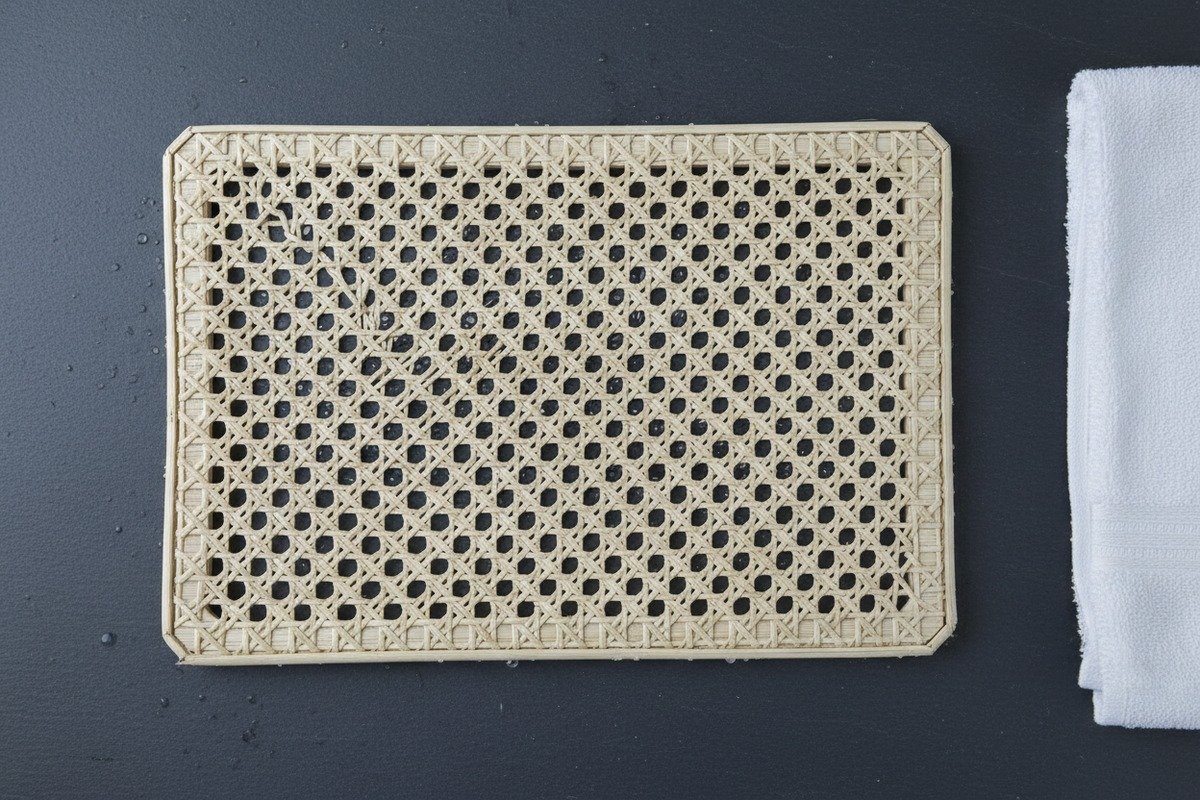
Water temperature is not just a preference. It is a science-backed choice that directly affects how your webbing performs during and after installation.
How Warm Water Works on Rattan Fibers
Le cannage de rotin est fabriqué à partir de la peau extérieure du rattan palm vine 7. This skin is composed mainly of cellulose and lignin—natural polymers 8 that stiffen as they dry. Warm water penetrates these fibers faster than cold water. It hydrates the lignin, which is the rigid component, and allows the cellulose strands to slide past each other more easily. The result is a soft, pliable sheet that bends without snapping.
Cold water can achieve a similar result, but it takes much longer—sometimes 45 to 60 minutes. That extra time in water increases the risk of over-soaking. So warm water is not just faster. It is safer.
Temperature Comparison Table
| Température de l'eau | Approximate Soak Time | Niveau de risque | Fiber Quality After Soaking |
|---|---|---|---|
| Cold (below 20°C / 68°F) | 45–60 minutes | Medium (risk of over-soaking due to long time) | Adequate but uneven softening |
| Warm (30–40°C / 86–104°F) | 15–30 minutes | Faible | Excellent, even pliability |
| Hot (50–60°C / 122–140°F) | 10–15 minutes | High (fiber stress) | Good short-term, may weaken |
| Boiling (100°C / 212°F) | Non recommandé | Très élevé | Severe damage, discoloration |
What About Adding Steam or Heat After Soaking?
For thicker webbing or larger pieces that need to bend around curves, some professionals add a heat step after soaking. The idea is simple: after soaking in warm water for 20–30 minutes, you apply gentle heat—like a heat gun on low setting or a garment steamer—to the damp webbing. This creates internal steam within the fibers, further softening the lignin.
Our team has tested this method extensively. It works well for curved furniture backs and rounded cabinet panels. But for flat installations—like a standard chair back or cabinet door—warm water alone is sufficient. Beginners should start with warm water only and move to steam techniques once they are comfortable with the basic process.
Tap Water vs. Distilled Water
Some crafters ask whether they should use distilled water. For most projects, regular tap water is perfectly fine. However, if your tap water is very hard (high mineral content), minerals can leave faint white deposits on the cane surface after drying. In our experience shipping to regions with hard water—parts of the Middle East and southern Europe—we occasionally recommend a final wipe with a damp cloth after installation to remove any residue.
What happens to my rattan material if I leave it in the water for too long?
Our quality control team has seen the aftermath of over-soaked webbing many times—clients send photos of darkened, limp sheets that tear at the slightest pull.
If you leave natural rattan cane webbing in water beyond 30 minutes, the fibers begin to weaken, lift, and separate. The material darkens noticeably, loses its structural integrity, and becomes too fragile for secure installation. Over-soaked cane cannot tighten properly during drying, resulting in a saggy, unprofessional finish.
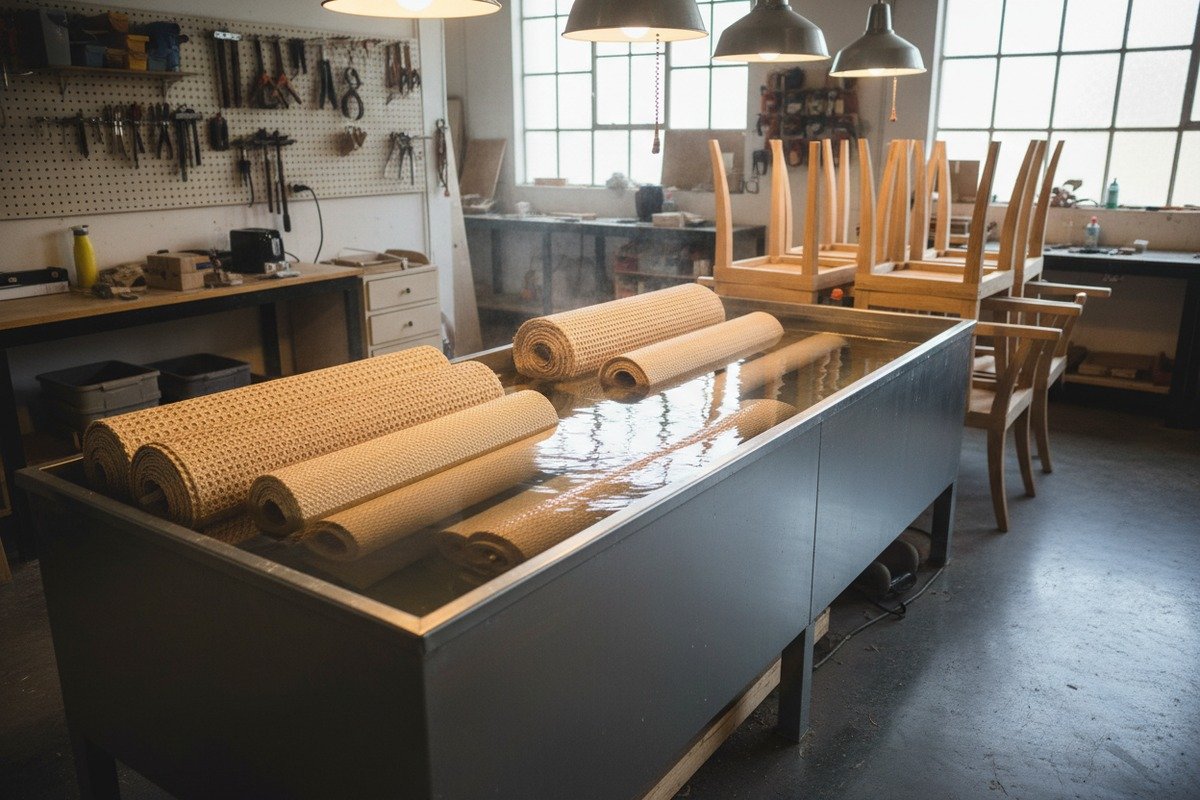
Over-soaking is the single most common mistake we see among first-time rattan users. Understanding exactly what happens—and why—can save you time, money, and frustration.
The Science of Over-Soaking
When rattan cane sits in water too long, the natural bonds between cellulose fibers start to break down. Think of it like soaking a piece of cardboard. At first, the cardboard becomes flexible. But leave it in water for hours and it falls apart. Rattan is tougher than cardboard, but the principle is the same. The lignin that holds the fiber structure together gradually dissolves in prolonged water exposure.
After about 30 minutes, the outer surface of the cane begins to absorb more water than the inner layers. This uneven saturation causes the outer fibers to swell and lift away from the core. Once those fibers lift, they never lay flat again—even after drying.
Visual Signs of Over-Soaking
Here is what to look for if you suspect your webbing has been soaked too long:
- Color change: Fresh rattan cane is light tan or straw yellow. Over-soaked cane turns a darker amber or brownish tone.
- Fuzzy surface: The smooth, glossy surface of the cane develops a fuzzy or furry texture as fibers lift.
- Excessive limpness: The webbing feels like wet cloth rather than a firm, flexible sheet.
- Easy tearing: If you can tear the webbing with minimal force, it has been over-soaked.
- Odeur: A musty or sour odor indicates water has begun to degrade the organic material.
Over-Soaking vs. Proper Soaking: Side-by-Side Comparison
| Caractéristique | Properly Soaked (15–30 min) | Over-Soaked (45+ min) |
|---|---|---|
| Couleur | Light tan, natural | Darkened amber/brown |
| Texture de surface | Smooth, slightly damp | Fuzzy, fibers lifting |
| Flexibilité | Firm but pliable | Excessively limp |
| Tear resistance | Fort | Weak, tears easily |
| Drying behavior | Tightens firmly | Sags, does not tighten well |
| Odeur | Mild, natural | Musty or sour |
Can You Fix Over-Soaked Webbing?
Honestly, no. Once the fibers have lifted and weakened, there is no reliable way to restore them. You can try drying the piece and using it for a non-structural decorative purpose—like a wall hanging or a light panel that does not bear weight. But for chair backs, cabinet doors, or any application where the webbing needs to be taut, over-soaked material must be replaced.
This is why we always recommend starting with a small test piece, especially if you are working with rattan cane webbing for the first time. Cut a 15 cm × 15 cm square from your roll, soak it, and practice before committing the full sheet.
The Spline Warning
One critical note: if you are using lamelle de rotin 9 to finish the edges of your webbing installation, do not soak the spline. Reed spline is a different material. It swells and loses shape when wet. Only the cane webbing goes into the water. Keep your spline dry until you are ready to press it into the groove.
How do I know when my rattan cane is soft enough to start my furniture project?
Over the years of supplying rattan materials to furniture factories in the Netherlands, Australia, and the US, we have developed a simple set of hands-on tests that even beginners can use with confidence.
Your rattan cane webbing is ready for installation when it bends smoothly around your finger without cracking or resisting. The surface should feel evenly damp but not dripping wet. It should hold its shape when curved and spring back gently when released, indicating full pliability without over-saturation.
Knowing when to stop soaking is just as important as knowing when to start. There is no universal timer that works for every sheet of cane. You need to use your hands and eyes to judge readiness.
The Finger Bend Test
This is the simplest and most reliable test. Lift one edge of the soaked webbing out of the water. Wrap it gently around your index finger. If it curves smoothly with no crackling sound and no visible stress lines on the surface, it is ready. If you hear or feel any resistance—a slight crackle or stiffness—return it to the water for another 5 minutes and test again.
The Drape Test
Hold a corner of the webbing and let it hang freely. Properly soaked cane will drape with a gentle curve, like a thick fabric. It should not hang straight down like a wet towel (that means it is over-soaked). And it should not stick out stiffly at an angle (that means it needs more time).
The Press and Release Test
Lay the webbing flat on a table. Press one section down gently with your palm, creating a slight curve. Release it. The cane should slowly return to flat—not snap back instantly (too dry) and not stay pressed down (too wet). A gradual, smooth return indicates the ideal moisture level.
Readiness Checklist for Installation
Before you pick up your staple gun, run through this quick checklist:
- The webbing bends around your finger without cracking.
- The surface is evenly damp with no dry spots or pooling water.
- It has rested for 5 minutes after removal from the water.
- You have patted off excess surface water with a clean towel.
- Your frame is clean, dry, and ready to receive the webbing.
- Your reed spline is dry and within reach.
- Your workspace is at a moderate temperature—not too hot, not too cold.
Working While Damp: The Tightening Effect
One of the most satisfying aspects of working with rattan cane webbing is the natural tightening effect. When you install the damp webbing onto a frame, it will contract as it dries over the next several hours. This contraction creates a taut, drum-like surface that looks clean and professional. If you wait too long after soaking and the cane dries before installation, you lose this tightening effect entirely.
In humid climates—like those our clients work in across Southeast Asia—drying takes longer, so you have a wider working window. In dry, air-conditioned rooms, the webbing can start drying within 15 to 20 minutes of removal from water. Plan your workspace accordingly.
Long-Term Care After Installation
Once your webbing is installed and fully dry (allow 24 hours), basic maintenance keeps it looking great for years. Dust it weekly with a soft cloth. Avoid direct sunlight, which causes fading and brittleness over time. For deeper cleaning, use a damp cloth with mild soapy water and dry completely. Once or twice a year, apply a light coat of de l'huile de lin 10 or mineral oil to the underside of the webbing to maintain moisture in the fibers. Wipe off excess and allow 2 to 4 hours of drying time.
If small splits appear over time, a tiny drop of wood glue can hold the fibers together. For larger damage, replace the affected section with matching webbing to keep a seamless look.
Conclusion
Soak natural rattan cane webbing in warm water for 15–30 minutes, rest it briefly, and install while damp for the best results every time.
Notes de bas de page
1. Defines structural integrity in an engineering context, relevant to material strength. ↩︎
2. Explains mineral oil as a wood finish, its properties, and applications for wood. ↩︎
3. Discusses different cane webbing weave patterns, which relate to density. ↩︎
4. Discusses how warm water retting affects the physical properties of plant fibers. ↩︎
5. Defines natural rattan cane webbing and its origin as a furniture material. ↩︎
6. Explains the composition and structural roles of cellulose and lignin in plants. ↩︎
7. Describes the rattan palm vine, its characteristics, and uses in various applications. ↩︎
8. Provides a general definition and examples of natural polymers, including cellulose and lignin. ↩︎
9. Replaced HTTP 404 with a working, relevant page that defines reed spline. ↩︎
10. Describes linseed oil as a wood finish, its benefits, and uses for furniture. ↩︎

 English
  Español de México
  العربية
  Deutsch
  Français
  Русский