
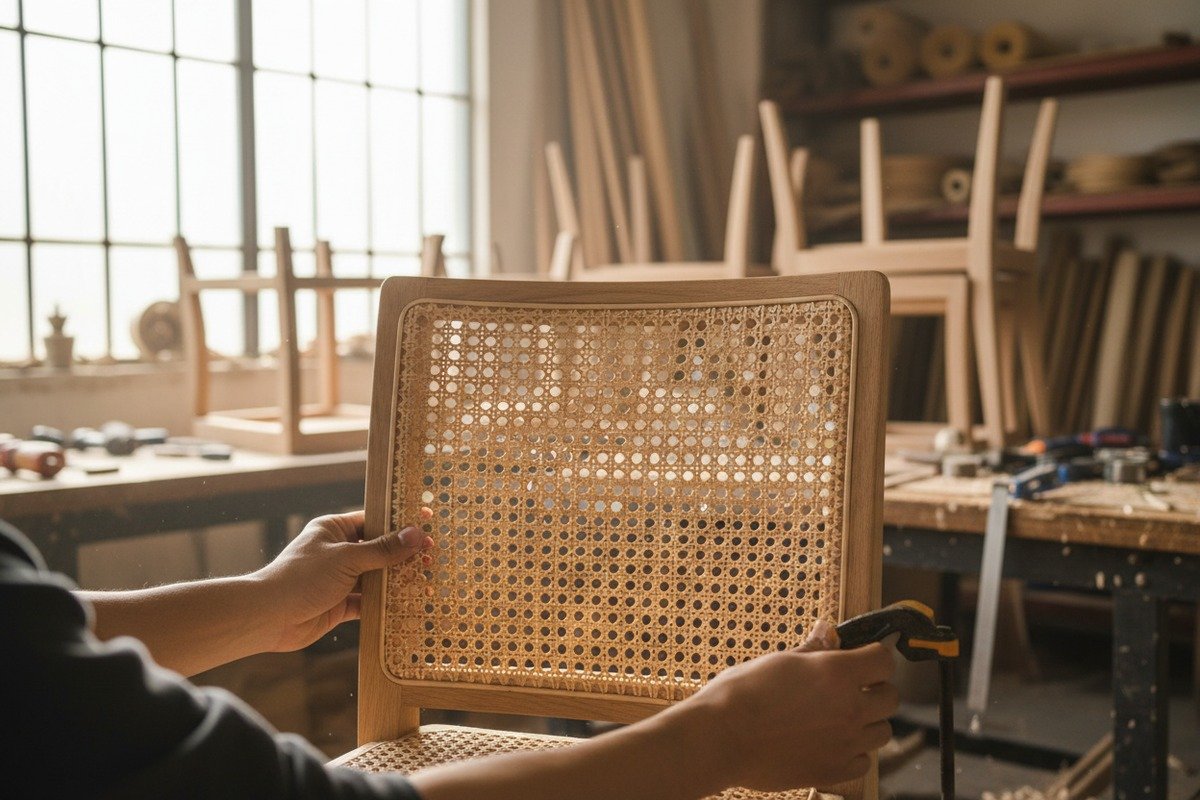
Every week, our production team in Foshan fields calls from furniture makers who pulled beautiful cannage rotin 1 from the box, stapled it to a frame, and watched it ripple, buckle, or droop within days. The frustration is real. A single wrinkled panel can ruin hours of craftsmanship and waste premium material that was meant to elevate a piece of furniture.
To prevent wrinkles and sagging in rattan cane webbing, you must soak the material in warm water for 30 to 60 minutes before installation, secure it with even tension from the center outward, and allow 24 to 48 hours of natural drying so the fibers shrink into a drum-tight, flat finish.
Below, we break down every critical step—from soak times and tensioning methods to material grades and post-installation fixes. Whether you run a furniture factory or manage procurement for a wholesaler, this guide will save you time, money, and rejected panels.
How long should I soak my rattan cane webbing to ensure it dries tight and flat?
When we ship rolls of rotin naturel 2 cane webbing to clients in the US, Australia, and Europe, the single most common installation mistake we hear about is skipping or shortening the soak. Dry cane is rigid. Rigid cane buckles. Buckled cane dries into permanent wrinkles that no amount of misting can fix.
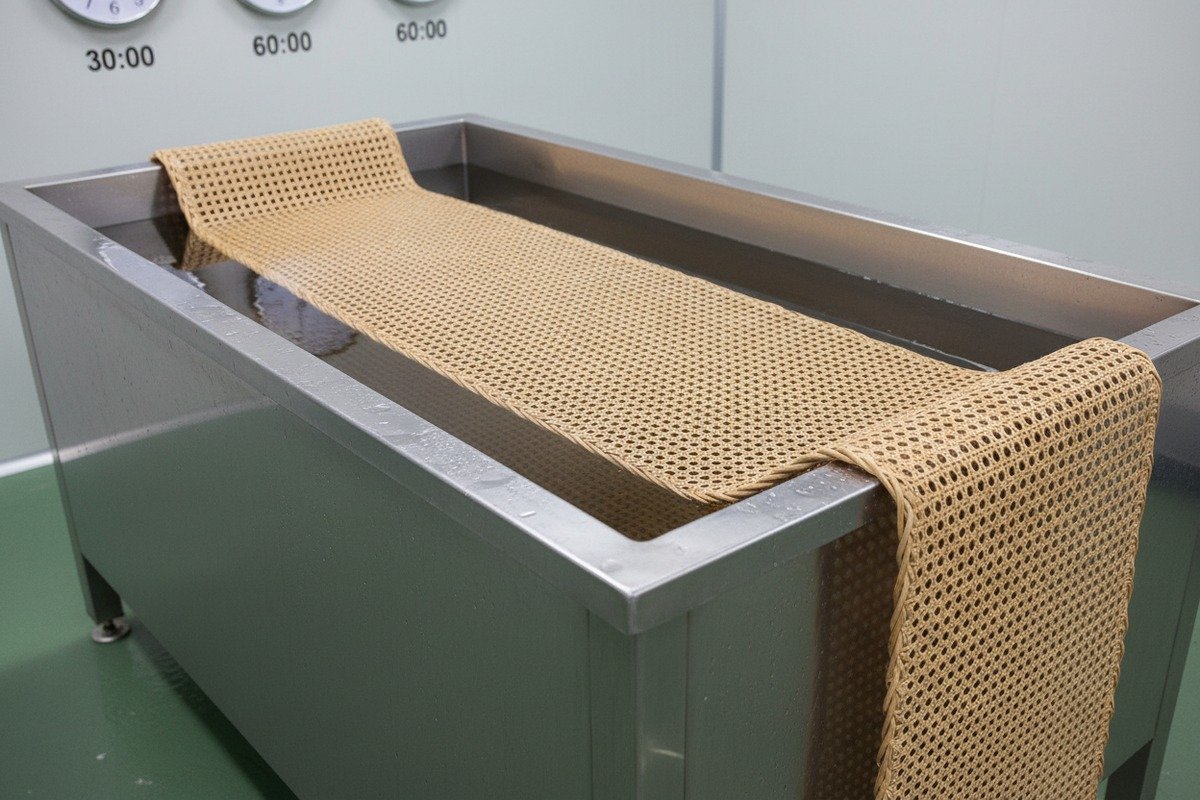
Soak natural rattan cane webbing in warm water (not hot) for 30 to 60 minutes for standard open-weave sheets. Machine-woven or tightly patterned sheet cane may need up to 2 to 4 hours. The water relaxes fibers, expands the weave, and allows the cane to contract evenly as it air-dries.
Why Soaking Matters at the Fiber Level
Le rotin naturel est un palm-based fiber 3. When dry, its cell walls are stiff and resist bending. Warm water penetrates these cell walls 4 and makes them pliable. The weave loosens slightly—expanding roughly 10 to 20 percent—which gives you the slack you need to position, align, and secure the webbing without forcing it. Once the water evaporates over 24 to 48 hours, those fibers contract back. That contraction is what pulls your panel tight and flat.
Soak Time Guidelines by Cane Type
| Cane Type | Durée de trempage recommandée | Température de l'eau | Notes |
|---|---|---|---|
| Maille hexagonale ouverte 5 (radio weave) | 30–45 minutes | Warm (about 30–40 °C) | Most common DIY and factory use |
| Tissage panier carré dense | 45–60 minutes | Warm | Tighter weave needs more saturation |
| Machine-woven sheet cane 6 | 1–4 heures | Warm to lukewarm | Thicker strands; check flexibility every 30 min |
| Tissage de rotin blanchi | 20–30 minutes | Lukewarm only | Bleaching weakens fibers; over-soaking risks breakage |
| Tapis de rotin synthétique 7 | No soak needed | N/A | Plastic does not absorb water |
Practical Soaking Tips
Use a container large enough to lay the sheet flat. A bathtub works well for smaller pieces. For long rolls, our factory team uses PVC pipe sections filled with warm water—this prevents creasing that happens when you fold a roll into a bucket. Never use boiling water. High heat can strip natural oils from the rattan and make it brittle after drying.
After soaking, lift the sheet out and let excess water drip off for a few minutes. The cane should feel soft and flexible but not mushy. If it still feels stiff in spots, give it another 15 minutes. If it feels overly limp and the strands separate easily, you have soaked too long. Work quickly once the cane is out of the water—you want to install while it is still damp.
A Note on Workspace Humidity
Ambient conditions matter. In a dry workshop with air conditioning, cane dries faster and may tighten unevenly if one side dries before you finish securing the other. In a humid environment, drying slows down, giving you more working time but delaying the final tautness. Aim for moderate humidity—around 40 to 60 percent—for the best results.
What are the best techniques I can use to maintain even tension during my installation?
In our experience exporting to over a dozen countries, tension problems cause more rejected panels than any other single issue. Even perfectly soaked cane can end up wavy if the installer pulls one edge harder than another or secures corners before the center.
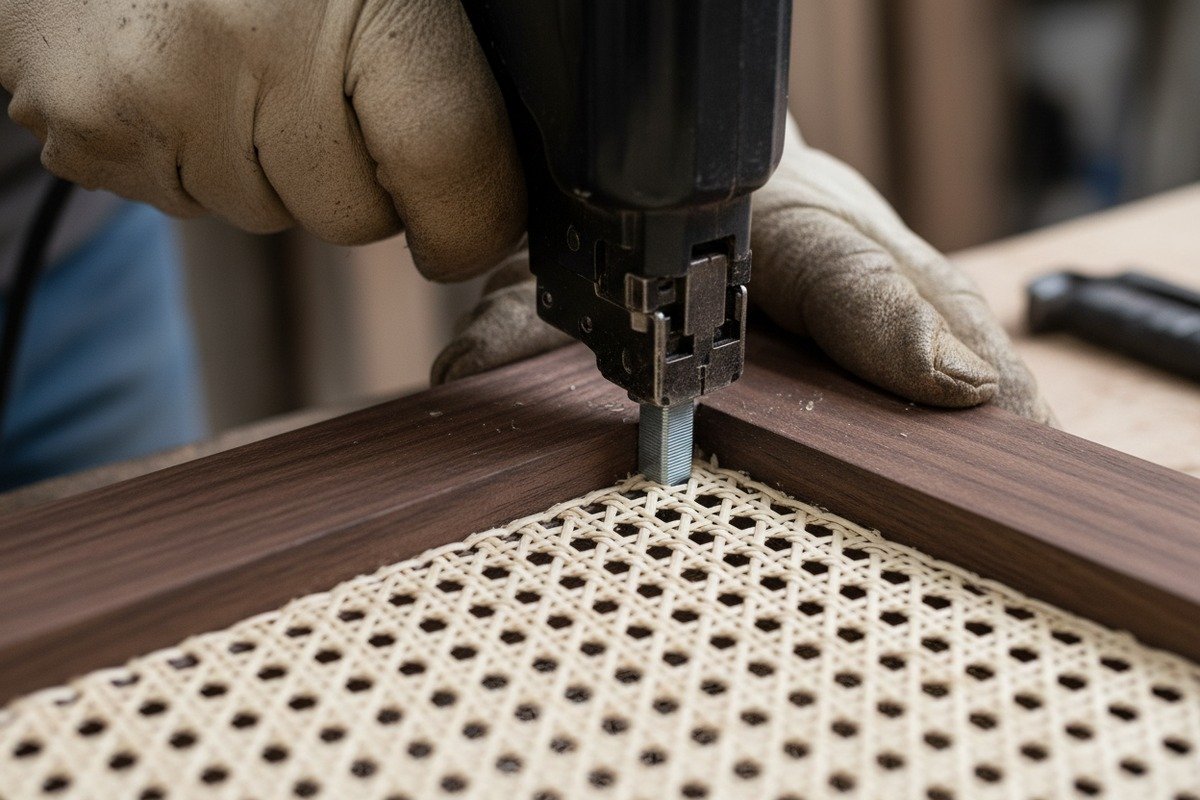
The best technique is to start securing at the center of each side and work outward toward the corners, pulling the damp cane taut—not tight—as you go. Use staples every 2 to 3 inches or tamp the cane into a routed groove with wedges before inserting the spline. This center-outward method distributes tension evenly across the entire panel.
Two Main Installation Methods
There are two widely used approaches, and the right choice depends on your project, skill level, and tools.
Method 1: Staple and Backing Strip (Beginner-Friendly)
This method works best for flat panels like cabinet doors, headboards, and tabletops. Cut your soaked cane with an extra 1 to 2 inches on all sides. Center the sheet over the frame, shiny side up. Staple the center point of one long edge first. Move to the opposite long edge, pull the cane taut, and staple the center there. Repeat for the two short edges. Now fill in staples every 2 to 3 inches, always working from the center outward. Finish by trimming excess cane and covering the raw edges with a backing strip or decorative reed.
Method 2: Groove and Spline (Professional-Grade)
This is the traditional technique used in chair seats, high-end cabinetry, and restoration work. The frame has a rainure fraisée 8—typically 5/16-inch wide and 5/16-inch deep. Lay the soaked cane over the opening. Use a blunt wedge or the handle of a butter knife to push the cane into the groove, starting at the center of one side. Move to the opposite side, gently pull the cane, and wedge it in. Work around all four sides. Then apply a thin bead of wood glue into the groove and press a lamelle de rotin 9 on top using a mallet. The spline locks the cane permanently in place.
Comparison of Installation Methods
| Facteur | Staple & Backing Strip | Groove & Spline |
|---|---|---|
| Niveau de compétence | Débutant | Intermediate to advanced |
| Outils nécessaires | Staple gun, utility knife, ruler | Router, mallet, wedges, spline, glue |
| Wrinkle risk | Moderate (depends on staple spacing) | Low (groove seats cane fully) |
| Long-term sag resistance | Moderate (backing strip helps) | High (spline + glue locks fibers) |
| Idéal pour | Flat panels, cabinet doors, quick DIY | Chair seats, curved frames, heirloom pieces |
| Réversibilité | Easy to remove staples | Requires steaming out spline |
Critical Tension Rules
- Never pull cane tight when it is wet. Pull it taut—meaning smooth and flat with no slack—but do not stretch it. Over-stretching wet cane causes it to shrink too much during drying, which creates new sag lines.
- Keep the weave pattern square. Before securing, visually check that the horizontal and vertical strands run parallel to the frame edges. A skewed pattern creates diagonal tension imbalances.
- For curves, make relief cuts. If your frame has rounded corners, cut small inverted V-notches on the underside of the spline so it bends smoothly without popping out. On the cane itself, you can make tiny relief snips at the curve to prevent bunching.
- Use wedges as temporary anchors. When working the groove method, push wooden wedges into the groove every 4 to 6 inches to hold the cane in position while you move to the next side. Remove them only when you insert the spline.
Avoiding Common Tension Mistakes
Rushing is the enemy. Many installers try to complete the entire securing process in under ten minutes. The cane starts drying during that time, and partially dry cane resists repositioning. Work methodically. If the cane feels like it is stiffening before you finish, mist it lightly with a spray bottle to keep it pliable.
Another mistake is using too few staples. Three staples per side will not hold tension on a 24-inch panel. You need one staple roughly every 2 to 3 inches. More contact points mean more evenly distributed tension and fewer gaps where wrinkles can form.
How does the grade of the rattan material I source affect the final smoothness of my furniture?
Our rattan processing facility in Indonesia grades every batch before it ships, and we can tell you from years of quality control data that material grade is one of the biggest hidden factors behind wrinkled panels. A furniture factory can follow every installation step perfectly and still get wrinkles if the cane itself is inconsistent.
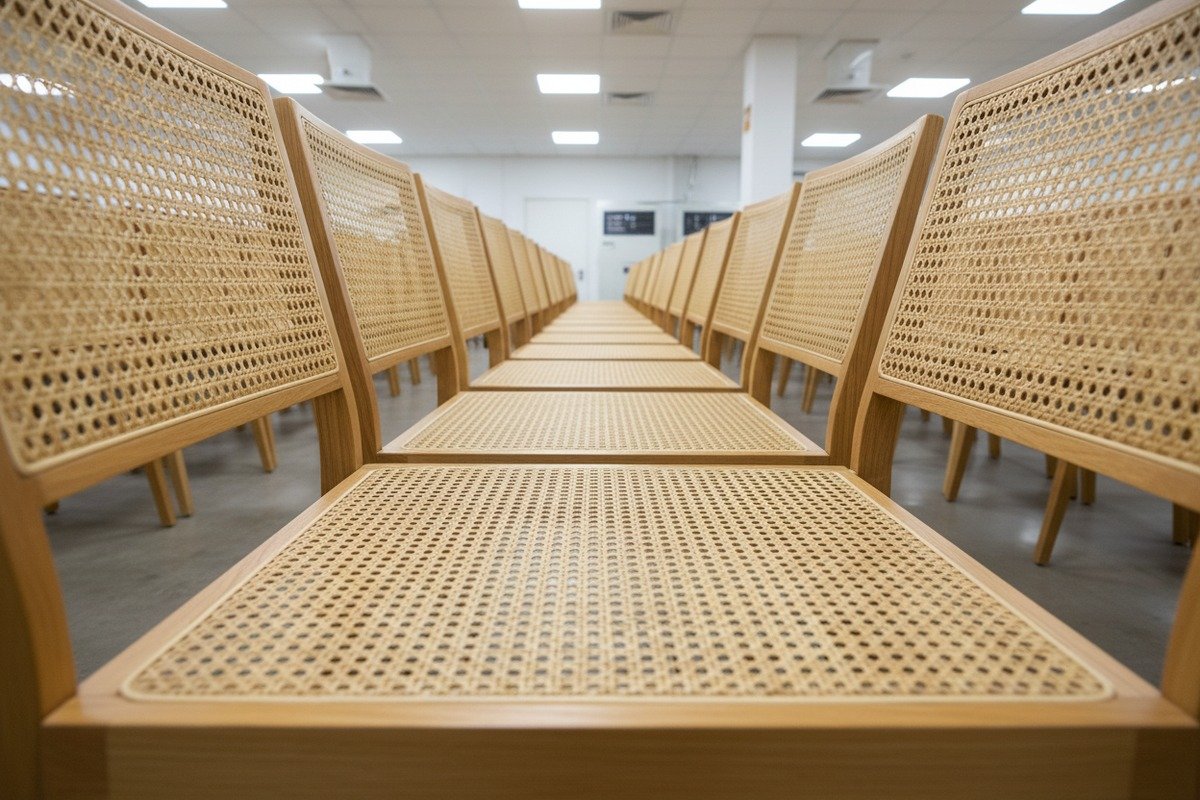
Higher-grade rattan cane webbing—typically labeled Grade A or Premium—uses uniform-diameter strands with minimal knots, splits, or color variation. This consistency ensures even water absorption during soaking, uniform shrinkage during drying, and a smooth, flat finish. Lower grades with irregular strands absorb water unevenly, shrink at different rates, and produce visible wrinkles or bumps.
What Defines Rattan Grade?
Rattan grading is not governed by a single global standard, but the industry broadly evaluates these factors:
- Cohérence du diamètre des brins: Top-grade cane has strands that are nearly identical in thickness across the entire sheet.
- Knot and split frequency: Fewer natural knots and no splits mean smoother surfaces.
- Uniformité de la couleur: Even color indicates consistent drying and processing at the source.
- Serrage du tissage: Properly tensioned weaving at the factory prevents loose spots that sag later.
- Moisture content at shipping: Cane shipped with 8 to 12 percent moisture content stores well without becoming brittle or developing mold.
Grade Impact on Installation Outcomes
| Note | Strand Consistency | Soak Behavior | Drying Shrinkage | Wrinkle Risk | Utilisation typique |
|---|---|---|---|---|---|
| Grade A / Premium | Highly uniform | Even absorption in 30–45 min | Uniform contraction | Très faible | High-end furniture, export-quality panels |
| Grade B / Standard | Mostly uniform, minor variation | Slightly uneven; may need 45–60 min | Minor inconsistencies | Faible à modéré | Mid-range furniture, cabinet doors |
| Grade C / Economy | Noticeable variation, some knots | Uneven; thin strands over-soak, thick ones under-soak | Irrégulier | Modéré à élevé | Budget projects, covered or painted panels |
Why Cheaper Is Not Always Cheaper
We have seen procurement managers choose the lowest-priced cane to hit a budget target, only to face rejection rates of 15 to 20 percent on finished panels due to wrinkles and bumps. When you factor in the labor cost of reworking or replacing those panels, the "savings" disappear. A Grade A roll might cost 20 to 30 percent more per square meter, but it installs faster, rejects less, and produces a finish that buyers in markets like the Netherlands, Australia, and the US expect.
How to Check Grade Before You Buy
If you are sourcing from a wholesaler or directly from a factory like ours, ask for these things:
- Sample swatches: Request a physical sample and check strand thickness with a caliper. Variation of more than 0.3 mm across the sheet is a red flag.
- Moisture content report: Reliable suppliers test moisture content before shipping. Look for 8 to 12 percent.
- Batch photos: Ask for close-up images of the actual production batch, not just catalog shots.
- Weave tension test: Press your finger into the center of the sample. Grade A cane should spring back immediately. If it stays indented, the weave is too loose.
Natural vs. Synthetic: A Grade Consideration
Synthetic rattan matting—made from durable plastic designed to mimic natural wood fibers—does not require soaking and does not shrink. It holds its shape regardless of humidity. However, it lacks the authentic texture and warmth that natural rattan provides. For furniture factories targeting premium markets, natural rattan remains the preferred choice. The key is sourcing the right grade to match the application. Bleached rattan cane webbing, for example, undergoes an additional chemical process that can weaken fibers. It should be handled more gently—shorter soak times, lighter tension—to prevent damage.
What steps should I take if I notice my rattan webbing starting to sag after it has dried?
When our team provides after-sales support, sag complaints usually arrive two to four weeks after installation. The customer followed the steps, the panel looked great on day one, and then gravity, humidity shifts, or a loose edge started pulling the cane downward. It is fixable. But acting quickly is important.
If your rattan webbing sags after drying, lightly mist the affected area with warm water, let it sit for 15 to 20 minutes, then re-tension by adding staples, tightening the spline, or inserting a new spline with fresh glue. Allow 24 to 48 hours for the re-moistened cane to dry and contract again. For severe sag, remove the panel entirely, re-soak, and reinstall.
Diagnosing the Cause of Sag
Before you grab a spray bottle, figure out why the sag happened. Different causes require different fixes.
Loose edges: If the sag is near one side, the staples or spline on that side likely failed. Check for pulled-out staples or a spline that has lifted from the groove.
Humidity changes: Rattan is hygroscopic—it absorbs and releases moisture from the air. A panel installed in a dry workshop that moves to a humid showroom can relax and sag. The reverse can also happen: a panel installed in humid conditions may over-tighten and crack in a dry environment.
Insufficient initial tension: If the entire panel is soft and bouncy rather than drum-tight, the cane was not pulled taut enough during installation or was allowed to dry too slowly.
Low-grade material: As discussed above, inconsistent fibers shrink unevenly. Some areas stay tight while others relax.
Step-by-Step Fix for Minor Sagging
- Lay the furniture piece flat if possible so gravity does not work against you.
- Fill a spray bottle with warm water. Mist the sagging area evenly. Do not drench it—just dampen the surface.
- Wait 15 to 20 minutes. The fibers will soften slightly.
- If using the staple method, pull the softened cane toward the edge and add new staples between the existing ones. Space them every 1 to 2 inches in the problem zone.
- If using the groove and spline method, carefully pry up the spline along the sagging side using a flathead screwdriver. Re-tamp the cane deeper into the groove. Apply fresh wood glue or la colle d'os 10 and press the spline back in.
- Let the panel dry completely for 24 to 48 hours in a well-ventilated space.
Step-by-Step Fix for Severe Sagging
If misting and re-stapling do not solve the problem, a full reinstallation may be necessary. Remove all staples or extract the spline. Peel the cane off the frame. Re-soak it in warm water for 30 to 45 minutes. Inspect for damaged or broken strands—if more than 10 percent of the weave is compromised, replace the sheet. Reinstall using the center-outward technique and allow a full 48-hour drying period.
Preventive Measures for Long-Term Tautness
After successfully fixing a sag, take these steps to prevent it from happening again:
- Apply a clear matte finish: A light coat of polyurethane or lacquer seals the fibers and reduces moisture absorption from the environment.
- Use backing strips on stapled panels: A thin wooden strip glued and stapled over the raw edge distributes stress across a wider area.
- Control storage humidity: If you are a wholesaler or factory storing finished panels, keep them in a space with 40 to 60 percent relative humidity.
- Choose hide glue for reversibility: Hide glue softens with heat and moisture, making future repairs easier than with permanent wood glue. This is a favorite technique among restoration professionals.
Quand remplacer plutôt que réparer
If the rattan webbing has been sagging for months, the fibers may have permanently stretched. Repeated wetting and drying cycles weaken the strands over time. If you notice fraying, cracking, or a mushy texture when wet, it is time for a new sheet. The good news is that quality rattan cane webbing is affordable—typically $20 to $50 per roll depending on size and grade—so replacement is often faster and more cost-effective than extensive repair work.
Conclusion
Preventing wrinkles and sagging comes down to four pillars: proper soaking, even tension, quality material, and timely fixes. Follow these steps, choose the right grade of rattan cane webbing, and your panels will dry flat and stay tight for years.
Notes de bas de page
1. Provides a comprehensive overview of rattan cane webbing as a material. ↩︎
2. Explains the botanical origin and characteristics of natural rattan. ↩︎
3. Describes the general characteristics and uses of palm fibers. ↩︎
4. Explains the structure and function of plant cell walls, relevant to fiber pliability. ↩︎
5. Found a relevant product page for ‘Open Hexagonal Webbing’. ↩︎
6. Describes the manufacturing process and characteristics of machine-woven cane. ↩︎
7. Describes synthetic rattan materials, their properties, and comparison to natural rattan. ↩︎
8. Explains the process and tools for creating a routed groove in woodworking. ↩︎
9. Describes the material and its use in traditional chair caning and repair. ↩︎
10. Details the properties and applications of hide glue, including its reversibility. ↩︎

 English
  Español de México
  العربية
  Deutsch
  Français
  Русский