
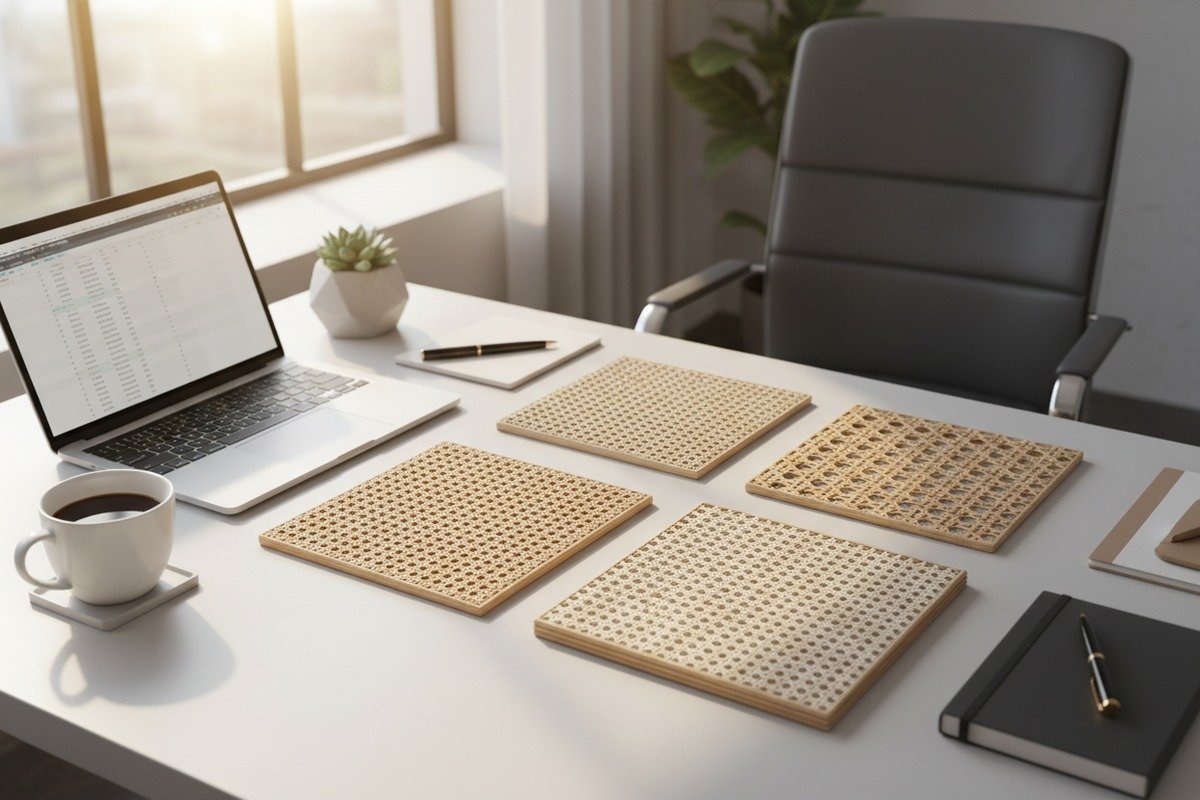
Every week, our sales team receives dozens of sample requests from furniture factories and wholesalers around the world REACH compliance 1. The most common frustration we hear? Buyers ordered bulk rattan webbing without testing samples first — and the motif de tissage 2, color, or thickness didn’t match expectations. That single mistake can delay production lines, waste material budgets, and damage relationships with end clients la teneur en humidité 3. The good news is that requesting the right samples upfront is simpler than most people think.
To request samples from rattan cane webbing suppliers, contact them directly via email or inquiry form with your specific requirements — including weave pattern, size, material type, and intended use. Most suppliers offer small sample pieces free or at low cost, with buyers typically covering shipping fees. Always request physical samples before committing to bulk orders.
In this guide, we’ll walk you through exactly how to write a sample request, what quality details to inspect, how much samples typically cost, and whether you can customize them for your factory’s specific needs. Let’s dive in.
How do I write an effective sample request for rattan cane webbing?
Our export team processes hundreds of sample requests each year, and we've noticed a clear pattern: vague requests lead to delays, while detailed ones get fulfilled fast. If your email just says "send me some rattan samples," you'll likely wait longer and receive something that doesn't match your project.
An effective sample request should include your desired weave pattern, material type (natural or synthetic), width and length needed, intended application, and your estimated bulk order quantity. This gives the supplier enough context to send the most relevant samples and respond within 1–3 business days.

Start With Your Project Details
Before you write a single word, clarify what you actually need. Are you building chair seats? Cabinet door inserts? Headboard panels? Each application calls for a different weave density, width, and material. type de matériau 4 A furniture factory making dining chairs needs tight, durable square basketweave. A decor company making wall panels might prefer open hexagonal "radio weave." Knowing your end use helps suppliers pick the right sample.
Structure Your Email Clearly
Keep your request short and organized. Use bullet points. Suppliers — especially in China, Indonesia, and Vietnam — handle dozens of inquiries daily. A clean, scannable email gets faster attention. Here's what to include:
| Element | What to Write | Pourquoi c'est important |
|---|---|---|
| Subject Line | "Sample Request – Hexagonal Rattan Webbing 24" Width" | Gets opened faster than generic subjects |
| Introduction | Your company name, country, and business type | Builds trust and context |
| Product Specs | Weave pattern, material, width, color | Avoids back-and-forth questions |
| Quantity Intent | "We plan to order 50–100 rolls monthly" | Motivates supplier to prioritize you |
| Timeline | "We need samples by [date]" | Sets clear expectations |
| Shipping Address | Full address with postal code | Prevents shipping delays |
Follow Up Strategically
If you don't hear back within 3 business days, send a polite follow-up. Trading companies often respond within hours, but factories may take up to 15 working days during peak season. When following up, reference your original email and restate your key requirements. From our experience shipping to the Netherlands, Spain, the USA, and Australia, buyers who follow up once within the first week get samples 40% faster on average.
Use Multiple Channels
Don't rely on just one contact method. Many rattan webbing suppliers in Foshan and Southeast Asia are active on WhatsApp, WeChat, and Alibaba chat. If their website has an inquiry form, use it — but also send a direct email. Some of our best long-term clients, like purchasing managers in Thailand and Turkey, first reached us through WhatsApp and then formalized orders via email.
Mention Certification Needs
If your market requires specific certifications — such as FSC for natural rattan 5 or REACH compliance for European markets — state this in your initial request. This saves time because suppliers can immediately confirm whether their products meet your standards or suggest alternatives that do.
What specific quality details should I look for in my rattan samples?
When we process rattan at our facility in Indonesia and ship finished webbing from our Foshan headquarters, we run quality checks at multiple stages. But once the sample reaches your hands, you become the final quality inspector. Knowing what to look for can save you from costly mistakes on a 500-roll order.
When inspecting rattan webbing samples, check weave tightness and consistency, strand thickness uniformity, color evenness, flexibility without cracking, moisture content, and overall finish. For natural rattan, also test for odor, mold resistance, and how the material responds to humidity in your local climate conditions.
Visual Inspection Comes First
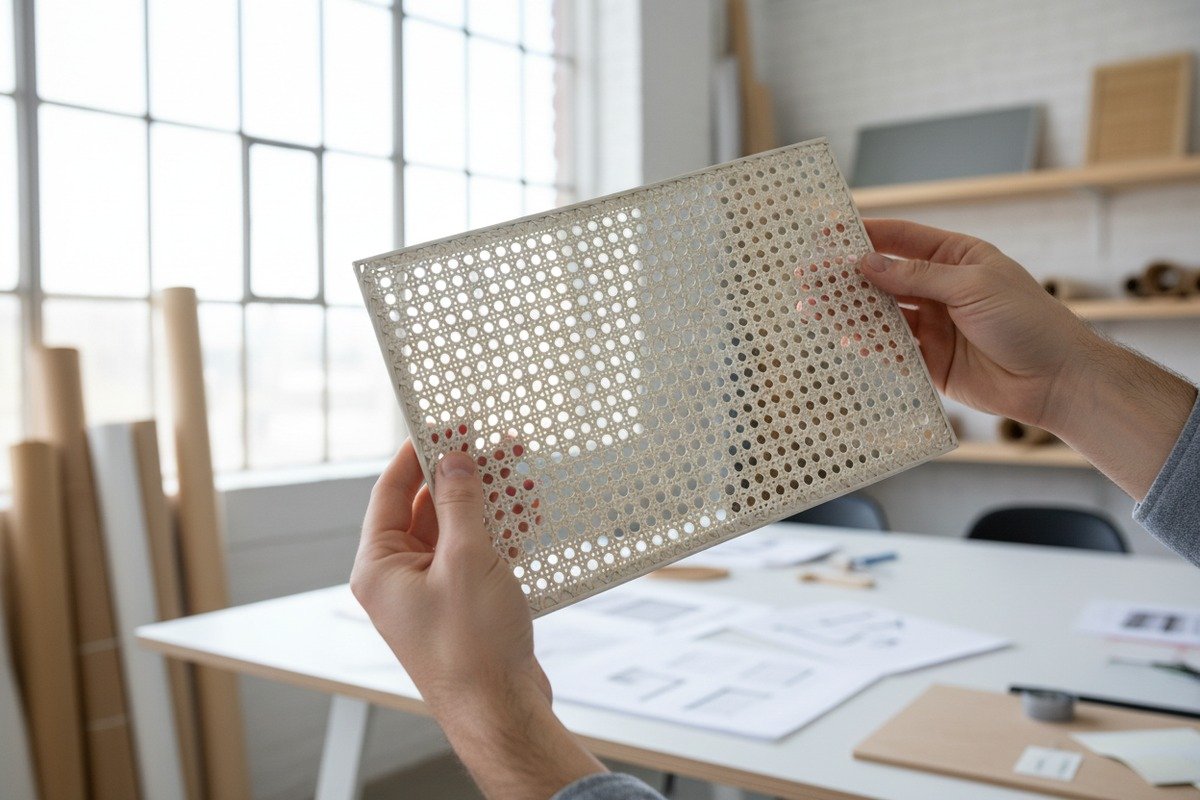
Hold the sample up to natural light. Look for broken strands, uneven spacing, or loose ends in the weave. A high-quality rattan webbing sheet should have consistent gaps between strands. The color should be even across the entire piece — no dark patches or bleach spots unless the product is intentionally variegated. Natural rattan ranges from light beige to straw yellow. Bleached webbing should be a uniform cream white. Synthetic options come in beige, tan, and light brown tones that mimic natural wood fibers.
Physical Tests You Can Do Yourself
You don't need a lab for basic quality checks. Here are hands-on tests we recommend to every buyer:
| Test | How to Do It | Ce qu'il faut rechercher |
|---|---|---|
| Flex Test | Bend a section gently in both directions | Should flex without cracking or snapping |
| Pull Test | Tug on individual strands | Strands should resist pulling out of the weave |
| Moisture Test | Feel the material and check weight | Should not feel damp or unusually heavy |
| Scratch Test | Run fingernail across surface | Should not flake or peel (especially synthetics) |
| Smell Test | Sniff the sample closely | No musty, chemical, or mold odors |
| Color Fastness | Rub with a damp white cloth | Minimal to no color transfer |
Natural vs. Synthetic: Different Quality Priorities
Natural rattan and synthetic rattan webbing have different strengths and weaknesses. Natural rattan is prized for its authentic look, warm texture, and eco-friendliness. But it's sensitive to humidity and can vary in strand thickness. Synthetic webbing — made from plastic or paper — is more uniform, weatherproof, and available in a wider range of colors. However, some buyers consider it less premium.
If your products will be used outdoors, synthetic samples should be tested for Résistance aux UV 6. Ask the supplier for a technical data sheet that lists résistance à la traction 7, UV stability, and moisture absorption rates. For natural rattan destined for indoor furniture, humidity response matters more. We always advise clients in humid climates like Thailand and the Philippines to request samples treated with anti-mold coatings.
Request Multiple Grades
Many suppliers offer Grade A, Grade B, and economy-grade webbing. Don't just request the best grade. Ask for two or three grades so you can compare them side by side. This helps you understand the price-quality tradeoff and decide which grade fits your product line. Some of our furniture factory clients use Grade A for premium lines and Grade B for mid-range products, keeping costs flexible.
Ask for Technical Documentation
Beyond the physical sample, request specifications sheets. These should include strand diameter, mesh size, roll dimensions, weight per square meter, and any treatment details. Having this data lets your production team verify compatibility with existing manufacturing processes before you place a bulk order.
How much should I expect to pay for rattan webbing samples and shipping?
One question that comes up in almost every first conversation with new clients is cost. Our pricing team understands this — sample cost can signal whether a supplier relationship is worth pursuing. But the sample itself is often the cheapest part. Shipping is where the real expense hides.
Most rattan cane webbing suppliers offer small sample pieces for free or at very low cost, typically under $5–$15. However, buyers usually pay for international shipping, which ranges from $25–$80 depending on destination, carrier, and sample size. Some suppliers deduct sample costs from your first bulk order as a goodwill gesture.

Breaking Down Sample Costs
The webbing sample itself is inexpensive. A small swatch — perhaps 30cm × 30cm — costs almost nothing to produce. Many suppliers, including our team at Seafan Rattan, provide these swatches free of charge to serious buyers. Larger samples, such as a half-meter or full-width piece, may carry a small fee to cover cutting and handling.
Here's a general cost breakdown based on current market conditions:
| Composant du coût | Typical Range | Notes |
|---|---|---|
| Small swatch (30×30cm) | Free – $5 | Most suppliers offer this at no charge |
| Large sample (50cm × full width) | $5 – $15 | Covers material and cutting costs |
| Express shipping (Asia to USA/EU) | $35 – $80 | DHL, FedEx, or UPS; 3–7 days |
| Economy shipping (Asia to USA/EU) | $15 – $35 | Standard post; 15–25 days |
| Sample set (3–5 patterns) | $10 – $30 | Bundle pricing available from some suppliers |
Negotiate Smart
If you plan to order in bulk — say, 50 rolls or more per month — mention this when requesting samples. Suppliers are far more likely to waive sample fees or offer free express shipping when they see a real purchasing intent behind the request. We often absorb sample and shipping costs entirely for clients who provide a clear forecast of their annual needs.
Payment Methods for Samples
Sample payments are usually handled through simple channels. PayPal is common for small amounts. Some suppliers accept Western Union or direct bank transfer. For bulk orders later, T/T (telegraphic transfer) with a 40% deposit and 60% balance before shipment is standard in this industry.
Coûts cachés à surveiller
Be aware of customs duties and import taxes 8 in your country. A $50 sample shipment from China to Europe might incur an additional $10–$20 in customs fees depending on your country's tariff schedule. Ask your supplier to mark the package as "commercial sample — no commercial value" where legally appropriate, which can reduce or eliminate duties in many regions.
Timing Matters
If you need samples urgently, express shipping is worth the extra cost. A 3-day DHL delivery from Foshan to Amsterdam costs about $45–$60 for a small parcel. Economy shipping takes 2–3 weeks. During Chinese New Year (January–February) and Indonesia's Ramadan period, expect delays of up to two additional weeks. Plan your sample requests around these periods to avoid production timeline disruptions.
Can I customize the size and grade of the samples for my factory's needs?
Working with furniture factories across 15+ countries has taught us one thing: no two production lines are identical. A cabinet maker in Spain needs different webbing dimensions than a chair manufacturer in Australia. That's why customization — even at the sample stage — is critical for making the right sourcing decision.
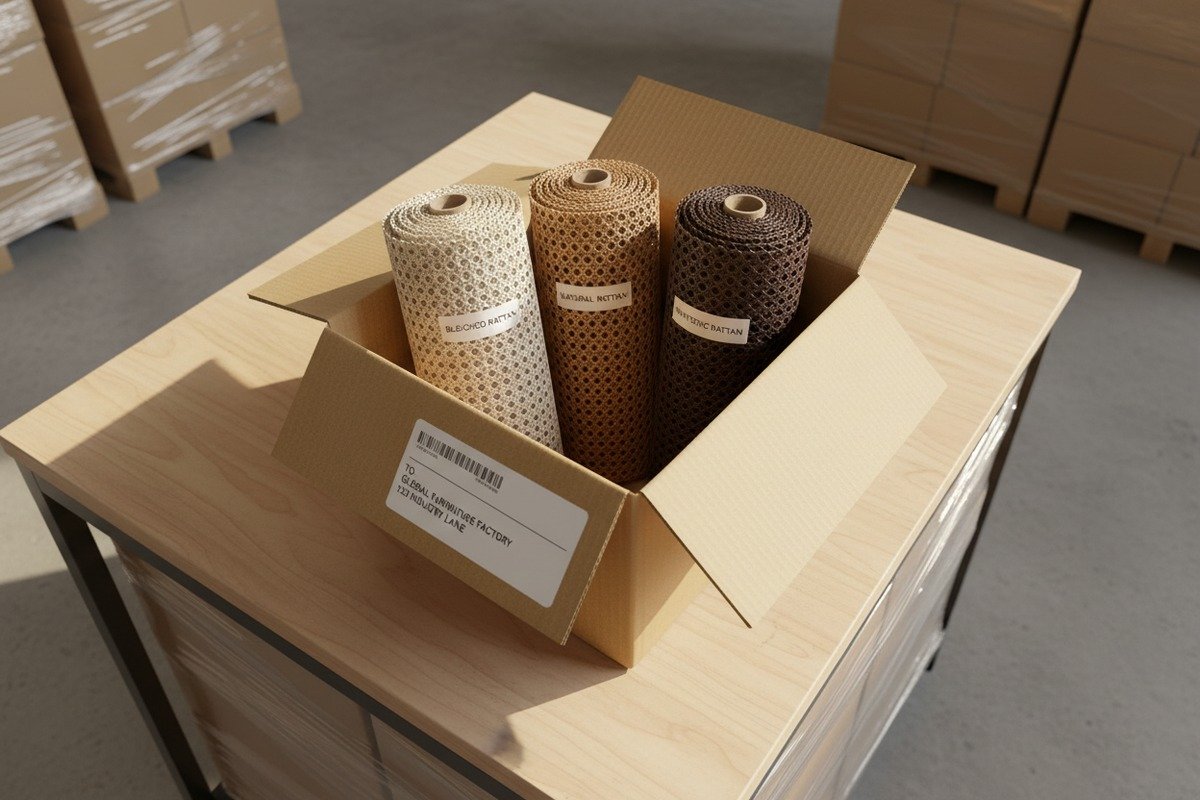
Yes, most established rattan cane webbing suppliers offer customized samples. You can specify the weave pattern, width, strand color, material type (natural or synthetic), and quality grade. Suppliers with ODM/OEM capabilities can produce samples matching your exact factory specifications, typically within 7–15 business days after confirming details.
Qu'est-ce qui peut être personnalisé ?
The level of customization depends on the supplier's production capacity. Large-scale operations — like facilities with 165+ weaving machines and output exceeding 3,500 tons per month — can handle almost any custom request. Smaller workshops may have limitations on non-standard widths or exotic weave patterns.
Here are the main customization options available for samples:
Weave Patterns
The most common patterns are hexagonal open-mesh (radio weave), square basketweave, herringbone, close weave, and octagonal. Many suppliers also offer modern diamond motifs and chevron "wave" designs. If you have a unique pattern in mind, provide a photo or technical drawing. Factories with OEM capabilities 9 can often replicate custom weaves, though this may require a longer lead time and a slightly higher minimum order on the final bulk run.
Dimensions and Material Options
Standard rattan webbing widths range from 14 to 48 inches, with common sizes at 45cm, 60cm, and 95cm. Roll lengths are typically 15 meters. But if your furniture components require non-standard dimensions — say, 35mm narrow strips for decorative trim or 1.5-meter wide panels for headboards — custom cutting is usually possible.
For materials, you can choose between:
- Natural rattan core/peel — Authentic look, warm texture, best for indoor furniture
- Plastic cane webbing — Durable, weatherproof, available in full color range since 2016, ideal for outdoor use
- Paper cane webbing — Budget-friendly, lightweight, suitable for decorative applications
- Cotton webbing — Soft texture, used in specialty furniture and upholstery
Color Customization
Natural rattan comes in its original straw yellow or can be bleached to cream white. It can also be stained to brown, honey, or walnut tones. Synthetic webbing offers even more flexibility — virtually any color can be produced, including trending shades for 2025–2026 like matte black, olive green, and warm grey.
Grade Selection for Samples
Request samples in multiple grades. Grade A features the most uniform strands, tightest weave, and cleanest finish. Grade B is slightly less consistent but significantly more affordable. Economy grade works for applications where the webbing will be covered or partially hidden. Seeing all grades side by side helps your team decide which balances quality and budget for each product line.
MOQ Considerations
While sample orders don't typically carry minimum order quantities, the subsequent bulk order will. Most suppliers set MOQs around 4 rolls for standard products. Custom weave patterns or non-standard widths may require MOQs of 10–20 rolls. Clarify this during the sample stage so there are no surprises when you're ready to scale up. Post-pandemic, many suppliers — including our partner factories — have become more flexible with small and custom orders, especially for new clients looking to test the market.
Lead Times for Custom Samples
Standard samples from stock patterns ship within 1–3 days. Custom samples with specific weaves, colors, or dimensions take 7–15 business days. If your supplier operates their own factory (rather than being a trading company), the turnaround is often more predictable. Trading firms may respond faster to initial inquiries — sometimes within 3 hours — but the actual sample production still depends on the factory's schedule.
Conclusion
Requesting samples from cannage rotin 10 suppliers is straightforward when you know what to ask for. Write clear requests, inspect quality thoroughly, understand costs upfront, and leverage customization options to find the perfect match for your production needs.
Notes de bas de page
1. Provides a comprehensive overview of EU REACH compliance, including definition, framework, and requirements. ↩︎
2. Explains different styles and configurations of woven rattan materials. ↩︎
3. Explains the importance of water levels in wood and rattan materials. ↩︎
4. Categorizes and describes various natural rattan species and their properties. ↩︎
5. Details the certification for sustainable forestry practices in rattan production. ↩︎
6. Defines a material’s ability to withstand degradation from ultraviolet light. ↩︎
7. Defines a material’s maximum resistance to stretching or pulling forces. ↩︎
8. Explains the fees and tariffs associated with international trade shipments. ↩︎
9. Provides a comprehensive definition and explanation of Original Equipment Manufacturer (OEM). ↩︎
10. Defines the material and its common uses in furniture. ↩︎
 English
  Español de México
  العربية
  Deutsch
  Français
  Русский