

Every year, our quality control team in Foshan rejects batches that suppliers labeled as “Grade A” but clearly fall short strip uniformity 1. The problem is real: inconsistent grading systems across the industrie du rotin 2 leave buyers confused, overpaying, or stuck with subpar material. If you have ever opened a shipment only to find dull, brittle cane webbing that looks nothing like the sample you approved, you know the frustration firsthand.
To verify rattan cane webbing grade standards, request physical samples before bulk orders, conduct visual and tactile inspections for strip uniformity, color consistency, and flexibility, check moisture content (ideal 8–12%), and cross-reference supplier grading claims against standardized criteria covering texture, density, weave tightness, and defect levels.
This guide breaks down every step of the verification process. You will learn how to inspect grades visually, build a quality checklist, understand how grades affect durability, and maintain consistency across bulk orders. Let’s dig in.
How can I visually distinguish between Grade A and Grade B rattan cane webbing during inspection?
When we prepare shipments at our Foshan warehouse, the difference between Grade A and Grade B is often obvious within seconds—if you know what to look for. But many buyers rely on supplier photos alone, and that is where costly mistakes begin.
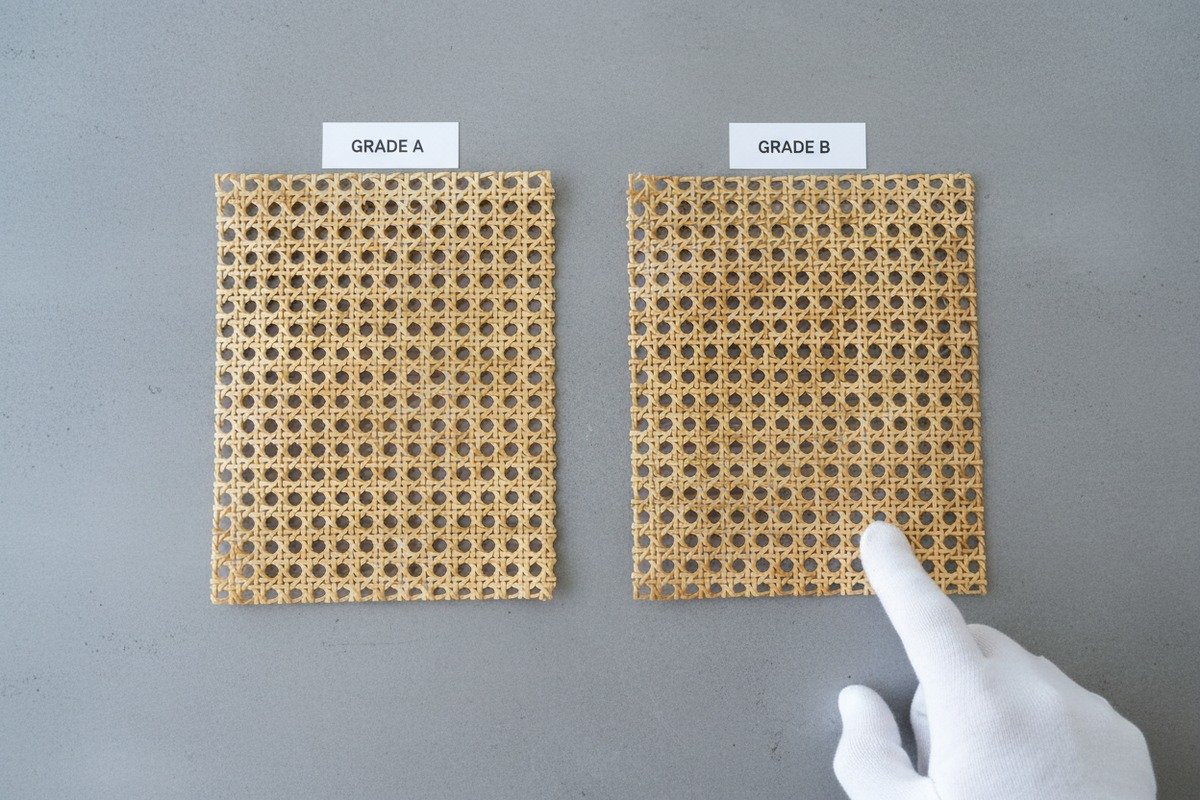
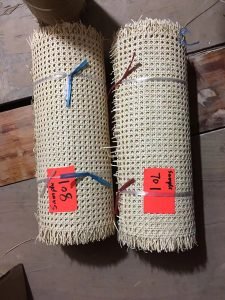
Grade A rattan cane webbing shows uniform strip width, smooth surfaces, consistent warm beige color, and tight weave patterns with no visible knots, cracks, or discoloration. Grade B displays minor irregularities including slight color variation, occasional rough spots, and less uniform strip sizing, though it remains structurally functional.
Start With Color and Tone
The first thing your eyes should catch is color. Grade A rattan has a rich, warm tone—think light honey or clean straw yellow. The color stays even across the entire sheet or roll. Grade B, on the other hand, may show patches of gray, dull spots, or uneven tanning. These color shifts happen because lower-grade strips come from different parts of the rattan palm or from mixed harvests.
Hold the webbing at arm's length under natural light. If you see blotchy areas or a washed-out look, that is a clear sign of Grade B or lower.
Check Strip Width and Uniformity
Grade A strips are cut to consistent widths. Every strand in the weave looks the same. Grade B strips may taper slightly. Some strands will be thinner than others. This inconsistency affects both the visual appeal and the structural performance of the final product.
Use a simple caliper or ruler. Measure at least 10 random strips across the sheet. If width variation exceeds 0.3mm, you are likely looking at Grade B.
Surface Texture and Defects
Run your hand across the surface. Grade A feels smooth and slightly waxy. You should not feel any snags, rough patches, or raised knots. Grade B may have small knots, minor surface cracks, or slight roughness along certain strips.
Look closely for these common defects:
- Fungus spots (dark dots or stains)
- Insect damage (tiny holes)
- Surface splits along the grain
- Uneven shaving of the rattan peel
Visual Grading Reference Table
| Caractéristique | Grade A (Premium) | Grade B (Standard) | Grade C (Économique) |
|---|---|---|---|
| Couleur | Even honey/straw | Légère variation | Noticeable patchiness |
| Strip width | Uniform (±0.2mm) | Minor taper (±0.5mm) | Irrégulier (±1 mm+) |
| Surface | Lisse, sans nœuds | Occasional rough spots | Knots, cracks visible |
| Serrage du tissage | Serré, sans espaces | Mostly tight, minor gaps | Loose in places |
| Flexibilité | Très souple | Moderately pliable | Tends toward brittle |
Weave Pattern Density
For pre-woven sheets, pay attention to the weave pattern. Common patterns include le nid d'abeille hexagonal ouvert 3 (radio weave), dense square basketweave, and diamond motifs. In Grade A, the pattern is crisp. Every hexagon or square is symmetrical. In Grade B, you might spot slight misalignment or uneven spacing between holes.
The most popular hole spacing for premium furniture is 1/2 inch (center to center). Check that this spacing remains consistent. Grab a ruler and measure at five random points across the sheet. Inconsistency here signals lower-grade material or poor weaving quality.
The Natural vs. Bleached Factor
Bleached rattan cane webbing can sometimes mask lower grades. The processus de blanchiment 4 evens out color, making Grade B look closer to Grade A on first glance. If your supplier offers bleached webbing, request both bleached and unbleached samples. Compare them side by side. The unbleached sample will reveal the true grade.
At our Indonesian processing facility, we always grade the raw cane before any treatment. This ensures the grade label reflects the actual material quality, not a cosmetic upgrade.
What specific quality checklists should I use to verify my supplier's rattan grade claims?
Over the past decade, our export team has shipped rattan to more than 15 countries. One lesson stands out: buyers who use a structured checklist catch problems early. quality checklists 5 Those who trust labels alone often face disputes later.
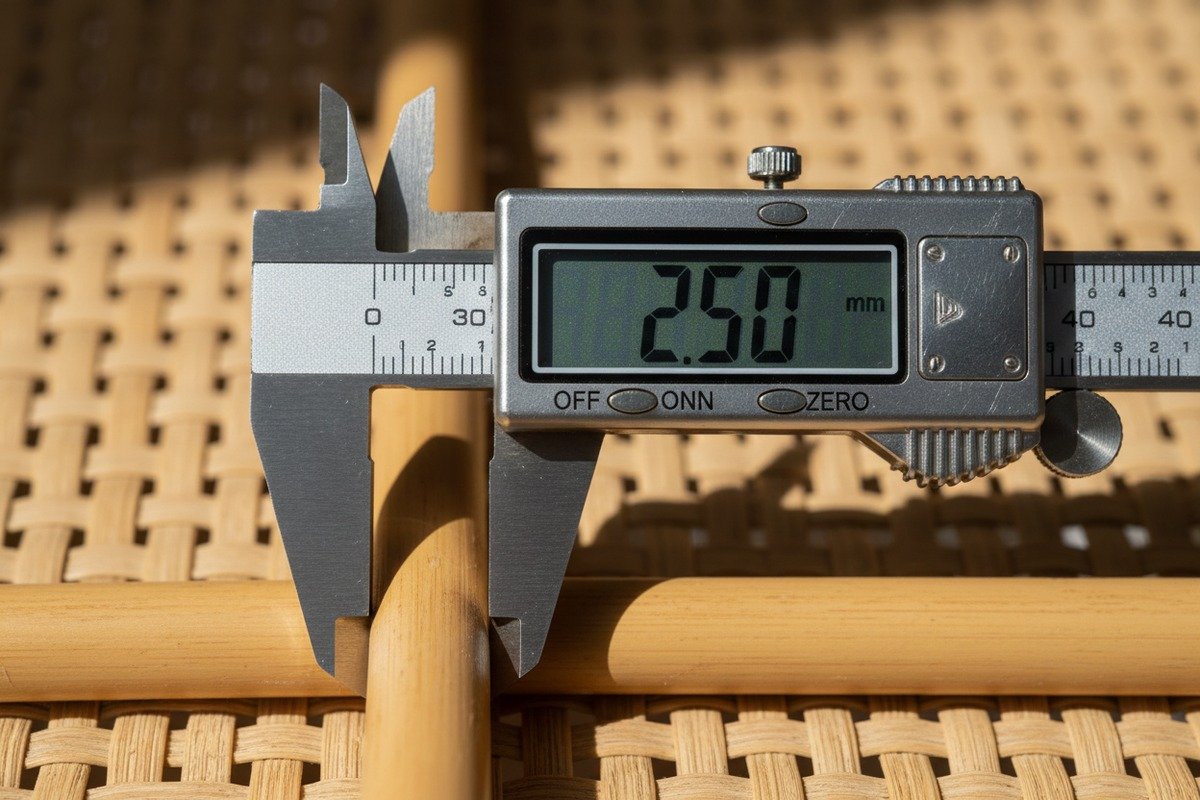
Use a multi-point checklist covering visual inspection (color, surface, weave), tactile tests (flexibility, density, edge quality), dimensional verification (strip width, thickness at 2.5–3mm, hole spacing), moisture measurement (target 8–12%), sample comparison against spec sheets, and supplier credential review including origin documentation and sustainability certifications.
Build Your Pre-Order Checklist
Before placing any bulk order, request small sample cuts—at least 12 inches or larger. Test these samples against every item on your checklist. Here is a practical checklist you can adapt:
The Complete Quality Verification Checklist
| Check Category | What to Test | Critères de réussite | Tool Needed |
|---|---|---|---|
| Cohérence des couleurs | Compare 5 spots on sheet | No gray patches, even tone | Natural daylight |
| Strip width | Measure 10 random strips | Within ±0.3mm of spec | Digital caliper 6 |
| Thickness | Measure cane strip cross-section | 2.5–3.0mm (or ~1/16 inch) | Digital caliper |
| Surface quality | Visual + touch scan | No knots, cracks, fungus | Magnifying glass |
| Serrage du tissage | Check pattern alignment | Symmetrical, no gaps | Règle |
| Espacement des trous | Measure center-to-center | Matches spec (1/2", 5/8", 3/4", or 1") | Règle |
| Flexibilité | Bend strip 90 degrees | No cracking or snapping | Hands |
| Teneur en humidité 7 | Test with meter | 8–12% range | Moisture meter |
| Finition des bords | Inspect cut edges | Clean, no fraying | Eyes |
| Odeur | Smell the material | Natural, no mold or chemical | Nose |
Dimensional Verification
Dimensions matter more than most buyers realize. Common widths for rattan cane webbing rolls range from 14 inches to 48 inches. Roll lengths typically run 15 meters for natural and up to 30 meters for synthetic options. Always confirm that the roll dimensions match your order specs before shipment.
Thickness is critical. Premium cane strips should measure approximately 2.5–3mm. Thinner strips indicate either a lower grade or an over-shaved peel, both of which reduce strength and lifespan.
Moisture Content Testing
This step is non-negotiable. Rattan with moisture above 12% will warp, shrink, or develop mold during transit or storage. Rattan below 8% becomes brittle and cracks easily. A handheld moisture meter costs very little and saves enormous headaches.
When we process rattan at our Indonesian facility, we dry it to 10% moisture before shipping. We recommend buyers re-test upon arrival, especially for shipments that cross climate zones.
Supplier Credential Verification
Do not just trust the grade label. Ask your supplier for:
- Origin documentation (where was the rattan harvested?)
- Processing facility details (where was it woven?)
- Sustainability certifications 8 (Global GreenTag or similar)
- Quality inspection reports from their own QC team
- Reference contacts from existing buyers
Established suppliers like us maintain traceability from the Indonesian forest to the finished roll. If a supplier cannot tell you where their rattan comes from, treat that as a red flag.
Cross-Referencing Grading Systems
One major source of confusion is that different suppliers use different grading systems. Honeywell uses A through D. Yeeyahome uses AAA through C. These systems do not align perfectly. Here is a rough equivalency guide:
| Honeywell System | Yeeyahome System | General Quality Level |
|---|---|---|
| Qualité A | AAA | Premium – finest peel, no defects |
| Qualité B | A | Good – minor imperfections, strong |
| Note C | B | Standard – visible defects, functional |
| Qualité D | C | Economy – rough, for hidden use |
Always ask your supplier which system they use. Then request their specific criteria for each grade. Compare those criteria against the checklist above. If their "Grade A" allows knots and color variation, it may actually be equivalent to Grade B in another system.
Drapeaux rouges à surveiller
Be cautious if a supplier shows any of these warning signs:
- They refuse to send physical samples
- Their grade labels change between communications
- Photos do not match the actual product
- They cannot provide origin or processing details
- They offer "Grade A" at prices typical of Grade C
- High moisture content claims (above 12%)
How will the rattan grade I select affect the long-term durability of my furniture?
From years of handling warranty feedback across our export markets—the Netherlands, Australia, the USA, and beyond—we have seen clear patterns. The grade you choose directly shapes how the furniture performs five, ten, or even twenty years later.
Premium Grade A or AAA rattan cane webbing can last 15 to 20 years indoors with proper care, thanks to tight weave density, high flexibility, and optimal moisture stability. Lower grades like C or D degrade faster, showing brittleness, sagging, and cracking within 3 to 5 years, especially in humid or sun-exposed environments.
Why Grade Affects Lifespan
The connection between grade and durability comes down to three core properties: fiber density, surface integrity, and moisture behavior.
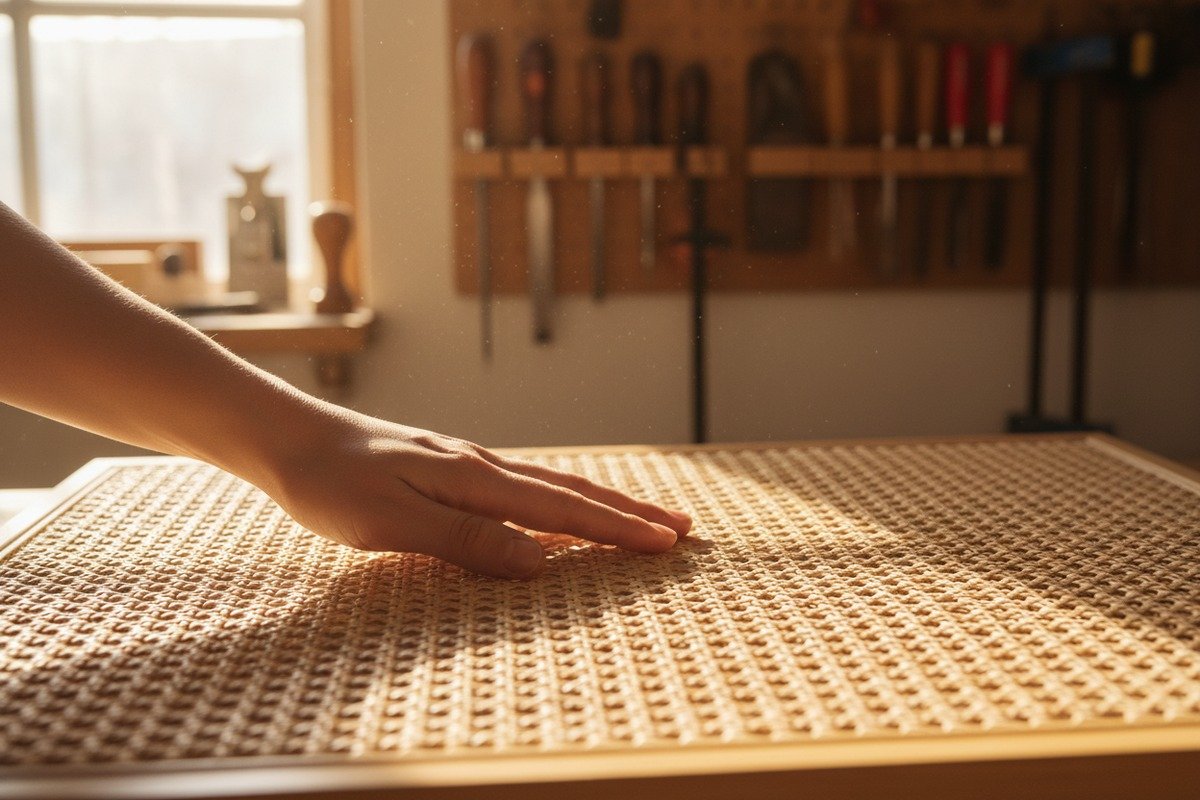
Grade A rattan comes from the outermost peel of mature cane. This part of the plant is the densest and most resistant to wear. It holds its shape under repeated stress—like sitting in a chair day after day. The surface is naturally smooth, which means fewer entry points for moisture, dirt, or mold.
Grade C or D rattan uses inner peels or strips from younger, less mature cane. These strips are softer, more porous, and less elastic. They absorb moisture faster and release it unevenly, leading to warping.
Indoor vs. Outdoor Performance
Rattan is primarily an indoor material. But even indoors, conditions vary. Furniture near windows gets UV exposure. Pieces in kitchens or bathrooms face higher humidity.
Grade A handles these stresses far better. Its tight fiber structure resists UV degradation and moisture swelling. Grade B holds up reasonably well in moderate indoor conditions but may show wear near windows within 5 to 7 years. Grade C is best reserved for areas with stable, dry environments or for components that are not load-bearing.
For outdoor use, natural rattan—regardless of grade—needs a protective finish or should be replaced with synthetic rattan webbing. Our synthetic options in chevron wave and basketweave patterns mimic the look of natural cane but resist weather, UV, and moisture far more effectively.
The Cost-Per-Year Calculation
Many buyers focus on upfront cost. But grade selection is really a cost-per-year decision. Grade A costs roughly 2 to 3 times more than Grade C. But it lasts 3 to 5 times longer. The math is simple:
If Grade A costs $8 per meter and lasts 18 years, that is about $0.44 per year. If Grade C costs $3 per meter and lasts 4 years, that is $0.75 per year. Over a furniture piece's lifetime, premium grade saves money.
Maintenance and Grade Interaction
Even the best grade needs care. Avoid direct sunlight for prolonged periods. Keep humidity levels moderate—ideally between 40% and 60% d'humidité relative 9. Dust regularly. Apply a light conditioning oil or beeswax every 12 to 18 months to keep the fibers supple.
Lower grades demand even more maintenance. Without regular conditioning, Grade B and C rattan dries out faster and becomes brittle. In our experience, buyers who skip maintenance on lower-grade webbing see failures within 2 to 3 years.
When Lower Grades Make Sense
Not every application demands Grade A. For budget furniture, hidden structural panels, or short-term displays, Grade B or C can be perfectly appropriate. The key is matching the grade to the use case. Use premium grades for visible, load-bearing, high-touch surfaces. Use economy grades for backs of cabinets, interior linings, or decorative elements with no structural role.
How can I ensure my bulk order maintains consistent quality standards across different rattan grades?
Consistency is the number one concern we hear from purchasing managers like those at furniture factories in Thailand, the Netherlands, and Australia. A single roll might look great. But when 500 rolls arrive and 10% are noticeably different, production lines halt and complaints pile up.
To maintain consistent quality in bulk rattan orders, implement a four-step system: require pre-production samples from the exact batch, set clear written specs with measurable tolerances, conduct random in-line inspections during production, and perform pre-shipment audits on a statistical sample of finished rolls using your verified checklist.
Pre-Production Samples Are Non-Negotiable
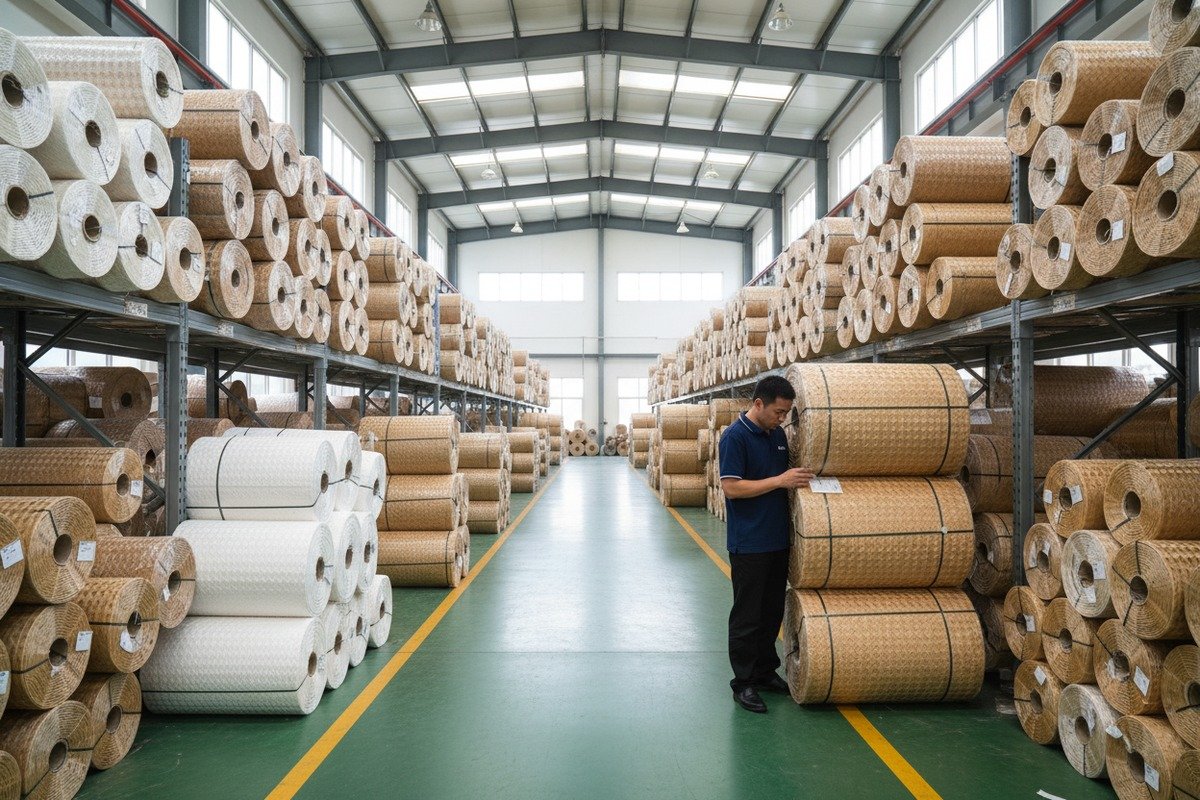
Never approve a bulk order based on a catalog sample alone. Catalog samples represent the best possible material. Production batches vary. Always request a pre-production sample—a piece cut from the actual batch of raw material that will be used for your order.
At our Foshan headquarters, we pull pre-production samples from the raw stock allocated to each customer's order. The customer approves that specific sample. Then we lock that stock for their production run. This eliminates the "bait and switch" risk.
Written Specifications With Tolerances
Verbal agreements are not enough. Your purchase order should include written specs with exact tolerances:
- Strip width: e.g., 3.5mm ±0.2mm
- Thickness: e.g., 2.8mm ±0.3mm
- Moisture content: 8–12%
- Color reference: attach an approved photo or Pantone swatch
- Hole spacing: e.g., 1/2 inch ±1mm
- Roll width: e.g., 24 inches ±0.5 inch
- Roll length: e.g., 15 meters ±0.3 meters
- Defect tolerance: e.g., maximum 2 minor knots per linear meter, zero fungus spots
These specs become your legal and operational reference. If the delivered product falls outside tolerance, you have clear grounds for a claim.
In-Line Quality Checks
For large orders, do not wait until everything is finished to check quality. Request in-line inspections at the 30% and 70% completion marks. This can be done by a third-party inspection service or by your own representative visiting the factory.
During in-line checks, pull random rolls and test them against your checklist. Measure strip widths. Check moisture. Flex the strips. Inspect the weave. If problems surface at 30%, there is still time to correct the production process.
Pre-Shipment Audit
Before the order ships, conduct a final audit. The standard approach is AQL (Acceptable Quality Level) sampling 10. For rattan webbing, AQL 2.5 is common for critical defects and AQL 4.0 for minor defects.
Pull a random sample based on the lot size. Inspect each sampled roll against every specification. Document results with photos. Only release the shipment once the sample passes.
Managing Multi-Grade Orders
Some buyers order multiple grades in a single shipment—Grade A for seat panels, Grade B for side panels, for example. This creates a packaging and labeling challenge. If rolls are not clearly labeled, factory workers may install the wrong grade in the wrong location.
We label every roll with a color-coded sticker and printed tag showing the grade, batch number, dimensions, and production date. We also pack different grades on separate pallets. This simple system prevents mix-ups at the buyer's end.
Batch-to-Batch Variation Management
Natural rattan is a plant-based material. No two harvests are identical. Climate, soil, season, and the age of the rattan palm all influence the raw material. This means some batch-to-batch variation is normal—even within the same grade.
The key is to define what level of variation is acceptable. Set this in your specs. For example, a ±0.5 shade variation on a 10-point color scale might be acceptable for Grade B but not for Grade A. Having these parameters written down prevents subjective disputes.
Building Long-Term Supplier Relationships
Consistency improves over time when you work with the same supplier. They learn your standards. They allocate better raw material to repeat customers. They invest in your success because you represent ongoing revenue.
We have clients who have ordered from us for over eight years. Their rejection rate is near zero—not because our rattan changed, but because we learned their exact requirements and built systems around them. That kind of partnership is the strongest quality assurance tool you can have.
Conclusion
Verifying rattan cane webbing grades takes effort, but it protects your investment and your reputation. Use structured checklists, test samples rigorously, and build long-term partnerships with transparent suppliers like Seafan Rattan at www.rattanwholesaler.com.
Notes de bas de page
1. Explains visual inspection methods relevant to material quality and uniformity. ↩︎
2. Provides an overview of the rattan industry, its global trading value, and various uses. ↩︎
3. Provides context on wicker and cane weaving techniques, including patterns. ↩︎
4. Explains the general chemical process of bleaching various materials. ↩︎
5. ASQ provides resources and best practices for creating quality control checklists. ↩︎
6. Provides a clear, step-by-step guide with illustrative pictures on how to use digital calipers for various measurements. ↩︎
7. Explains ideal moisture content for wood products, relevant to rattan. ↩︎
8. FSC provides widely recognized certifications for sustainable forestry and wood products. ↩︎
9. Smithsonian provides guidelines on ideal relative humidity for material preservation. ↩︎
10. Authoritative Wikipedia page offering a comprehensive explanation of Acceptable Quality Limit (AQL) and its role in quality control. ↩︎

 English
  Español de México
  العربية
  Deutsch
  Français
  Русский