
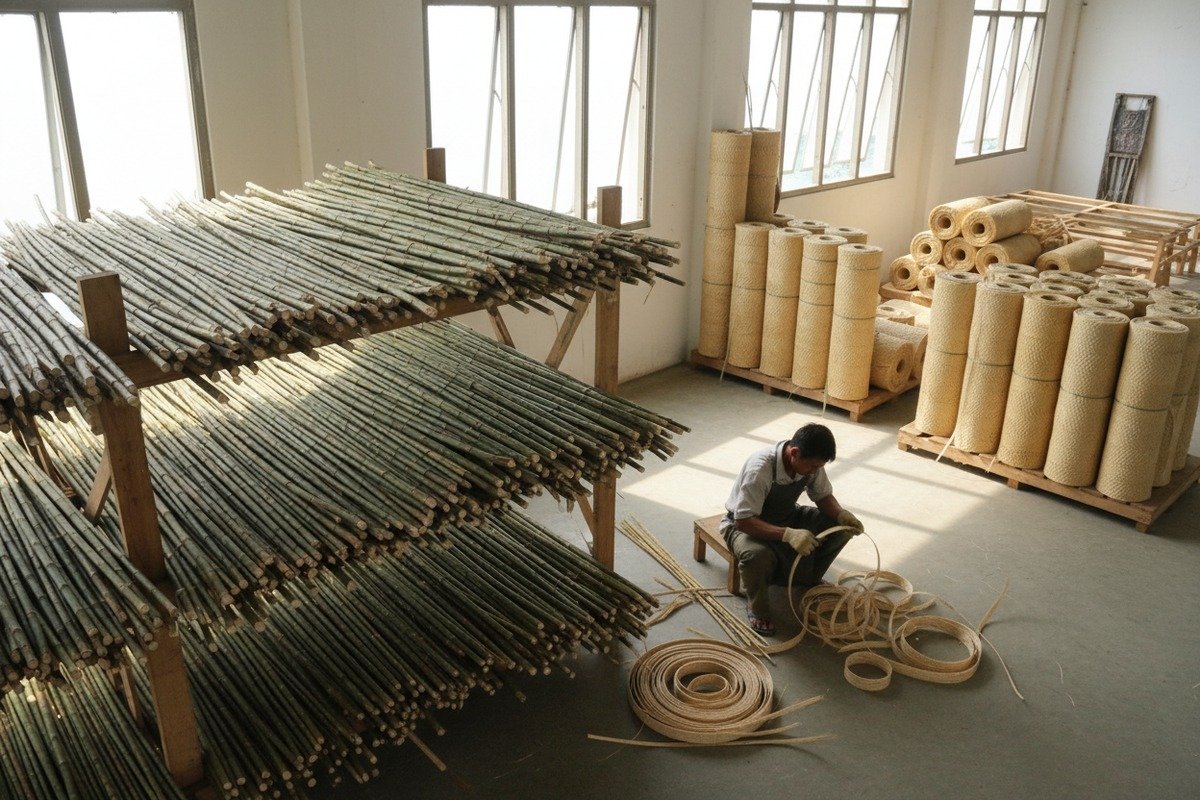
Every week, our Foshan warehouse ships out thousands of meters of rattan cane webbing to furniture factories across Europe, the Middle East, and Southeast Asia. Yet one question keeps coming back from new buyers: what exactly is this material made from? The answer is not as simple as most people think. Different raw materials, processing methods, and species of rattan create vastly different end products. Picking the wrong one can mean cracked panels, sagging seats, or angry end customers.
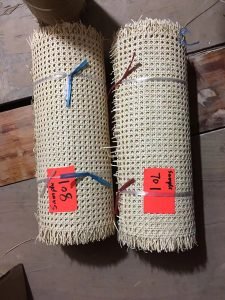
Rattan cane webbing for furniture is primarily manufactured from the outer peel (skin) of natural rattan palm stems, harvested mainly in Indonesia. The peel is stripped, dried, sorted by grade, and woven into sheets or rolls. Synthetic alternatives use high-density polyethylene (HDPE) to replicate the look with added weather resistance.
Understanding these raw materials is the first step to placing a smart wholesale order. Below, we break down the key decisions you will face — from choosing between natural and synthetic, to grading systems, durability testing, and why sourcing origin matters more than you might expect.
How do I choose between natural Indonesian rattan and synthetic PE materials for my furniture projects?
Our production lines in Indonesia and Foshan run both rotin naturel 1 and synthetic PE webbing side by side. Watching buyers struggle with this choice year after year taught us that the decision always comes down to three things: where the furniture will live, what the end customer expects, and how much maintenance they are willing to do.
Choose natural Indonesian rattan for indoor furniture that demands authentic texture, breathability, and a warm organic look. Choose synthetic PE (HDPE) webbing for outdoor furniture, high-humidity environments, or projects requiring zero maintenance and superior UV and mold resistance.
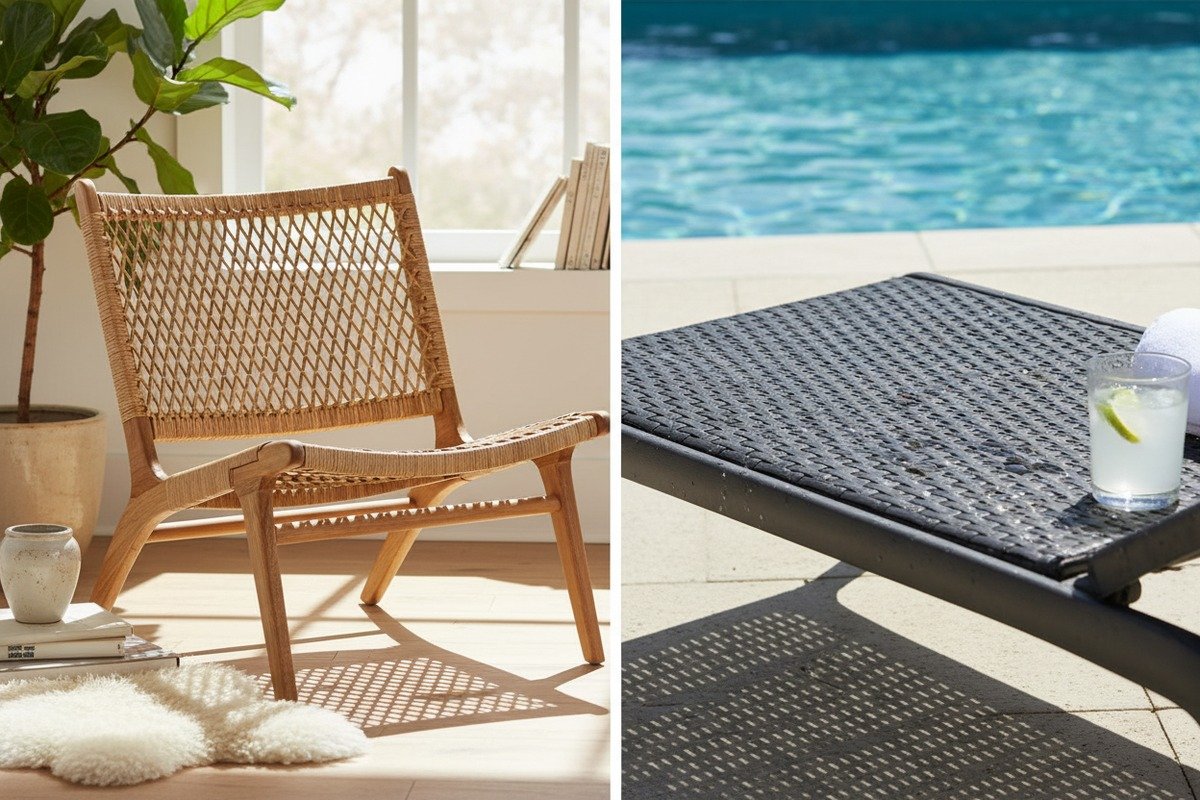
The Core Difference: Plant Fiber vs. Engineered Plastic
Natural rattan cane webbing comes from the outer epidermis of rattan palm vines. These vines grow wild or in managed plantations across the tropical rainforests of Indonesia, which supplies roughly 80% of the world's raw rattan. The outer peel contains a high concentration of silica, giving it a natural glassy luster and inherent scratch resistance. This is the material that has been used in cane chairs for centuries.
Synthetic webbing, on the other hand, is extruded from high-density polyethylene (HDPE) 2 pellets. Manufacturers melt the plastic, push it through molds shaped like rattan strands, and then weave it on industrial looms. The result looks similar from a distance but feels different up close.
Comparaison côte à côte
| Caractéristique | Natural Indonesian Rattan | Synthetic PE (HDPE) |
|---|---|---|
| Raw material | Outer peel of rattan palm vine | High-density polyethylene plastic |
| Meilleure utilisation | Meubles d'intérieur, panneaux décoratifs | Outdoor furniture, commercial seating |
| Résistance aux UV | Low — fades and dries in direct sun | High — engineered for UV stability |
| Moisture tolerance | Moderate — needs controlled humidity | Excellent — fully waterproof |
| Pest and mold risk | Susceptible without treatment | Immune |
| Texture et toucher | Chaud, organique, légèrement rugueux | Smooth, uniform, slightly plastic |
| Respirabilité | High — porous fiber structure | Low — solid plastic strands |
| Entretien | Periodic dusting, occasional oiling | Wipe clean with damp cloth |
| Environmental footprint | Renewable plant resource, biodegradable | Petroleum-based, recyclable but not biodegradable |
| Price range (wholesale) | Medium to high, depending on grade | Low to medium, depending on UV rating |
When Natural Rattan Wins
If your factory builds dining chairs, headboards, cabinet doors, or decorative wall panels destined for indoor use, natural rattan is almost always the better choice. The texture is impossible to fully replicate with plastic. Buyers in the Netherlands, Spain, and Australia consistently tell us their customers will pay a premium for authentic cane. The silica-rich surface catches light in a way that synthetic strands cannot match.
Natural rattan also breathes. In warm climates, a cane seat panel allows air circulation, which is why rattan furniture remains so popular across Southeast Asia and the Middle East.
When Synthetic PE Wins
For garden furniture, poolside loungers, or restaurant patios, synthetic HDPE webbing 3 is the practical choice. We have seen natural rattan panels installed outdoors crack within a single rainy season. HDPE resists mold, UV degradation, and temperature swings. It also requires no soaking before installation — you cut it, staple it, and forget it.
An emerging middle ground is "paper cane" webbing, which uses a polyester or nylon filament core wrapped in a paper or fiber sheath. This gives structural memory and sag resistance while maintaining a softer, more organic appearance than pure HDPE.
A Practical Decision Framework
Ask yourself three questions before ordering:
- Will this furniture live indoors or outdoors?
- Does the end customer value authentic material or low maintenance?
- What is the target price point of the finished piece?
If the answers are indoor, authentic, and mid-to-premium, go natural. If outdoor, low maintenance, and budget-friendly, go synthetic. Most of our factory clients end up ordering both and segmenting their product lines accordingly.
What are the different quality grades I should look for when sourcing rattan cane webbing?
When we first started supplying rattan webbing to furniture factories in Turkey and Greece, the most common complaint was inconsistency — one roll looked beautiful, the next had dark spots, uneven strand widths, or brittle patches. That frustration drove us to adopt and communicate a clear grading system to every buyer.
Rattan cane webbing is typically classified into three quality grades: A, B, and C. Grade A offers the highest tensile strength, most uniform color, fewest knots, and smoothest surface. Grade B shows minor color variation and occasional blemishes. Grade C is functional but visually inconsistent, best suited for hidden or painted applications.
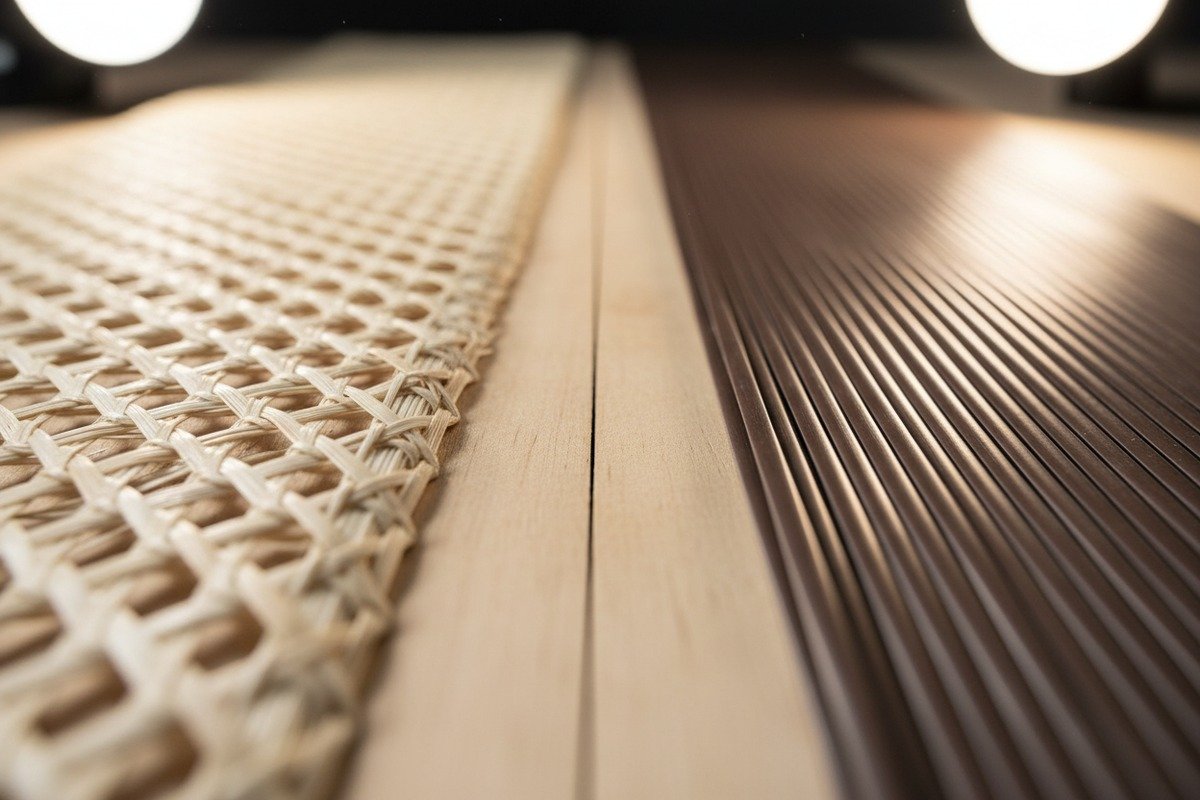
What Determines the Grade?
Grading happens at multiple stages: raw material selection, peel stripping, drying, and final roll inspection. The main factors include strand uniformity, color consistency, knot frequency, surface smoothness, and tensile strength.
Premium manufacturers specifically select certain rattan species for webbing. Calamus caesius 4 et Calamus optimus are favored because their exceptionally long internodes (the sections between nodes) produce fewer knots per meter of strip. Fewer knots mean a cleaner weave and stronger structural integrity.
Grade Breakdown Table
| Facteur de qualité | Qualité A | Qualité B | Note C |
|---|---|---|---|
| Uniformité de la couleur | Consistent light straw or honey tone | Minor tonal variation across roll | Noticeable dark and light patches |
| Knot frequency | Very few — long internode species used | Occasional knots, trimmed flush | Frequent knots, some raised |
| Strand width consistency | Uniform within ±0.2 mm | Slight variation within ±0.5 mm | Visible width differences |
| Finition de surface | Smooth, natural silica luster | Mostly smooth, minor rough spots | Rough patches, may need sanding |
| Résistance à la traction | Highest — withstands stretching and stapling | Good — suitable for standard furniture | Adequate for light-duty or decorative use |
| Meilleure application | Premium furniture, visible panels | Mid-range furniture, general use | Budget pieces, painted or stained panels |
| Price index | 1.0x (baseline premium) | 0.7x–0.8x | 0.4x–0.6x |
How Species Selection Affects Grade
Not all rattan is the same plant. There are over 600 species in the Calamus genus alone. Our Indonesian processing facility sorts incoming raw stems by species, diameter, and growing condition before any peel is stripped. Stems from managed forests or gardens tend to produce more uniform peel than wild-harvested stems because growing conditions are more controlled.
The key species for premium webbing are:
- Calamus caesius — Long internodes, flexible peel, excellent for Grade A weaving.
- Calamus optimus — Thick, strong peel with a pronounced natural sheen.
- Calamus trachycoleus — Fast-growing plantation species, good for Grade B production.
Why Grade Matters for Your Factory
If you are building furniture with exposed cane panels — like cane-back dining chairs or open-weave cabinet fronts — your customers will see every flaw. A Grade B roll might save you 20–30% on material cost 5, but a single dark patch in the center of a chair back can make the finished piece look defective. For painted or stained applications where the raw cane is covered, Grade C works perfectly well and keeps costs down.
We recommend that procurement managers request sample rolls of each grade before committing to bulk orders. Hold them up to light. Bend the strands. Check the edges of the roll for fraying. These simple tests reveal more than any specification sheet.
The Role of Weave Pattern in Perceived Quality
Even Grade A material can look poor if the weave is loose or uneven. The classic octagonal radio weave, the hexagonal star weave, and the simple open square grid each demand different levels of weaving precision. A "LaHua" hand-weaver producing hexagonal patterns typically completes one 16-inch-wide, 15-meter-long roll per day. Rushing this process leads to uneven hole sizes and crooked lines, which downgrade the perceived quality regardless of the raw material grade.
How can I ensure the raw materials in my rattan webbing are durable enough for my furniture factory?
One of our long-term buyers in Saudi Arabia once returned an entire container because the cane panels cracked during the stapling process at his factory. The root cause was not bad material — it was improper drying. That experience pushed us to build a multi-step quality assurance process that we now share openly with all our clients.
To ensure durability, verify the rattan species used, check the moisture content after drying (ideal range: 12–15%), request tensile strength test reports, soak natural cane for 30–60 minutes before installation, and confirm that the supplier uses sulfur drying or controlled kiln drying rather than uncontrolled sun drying alone.
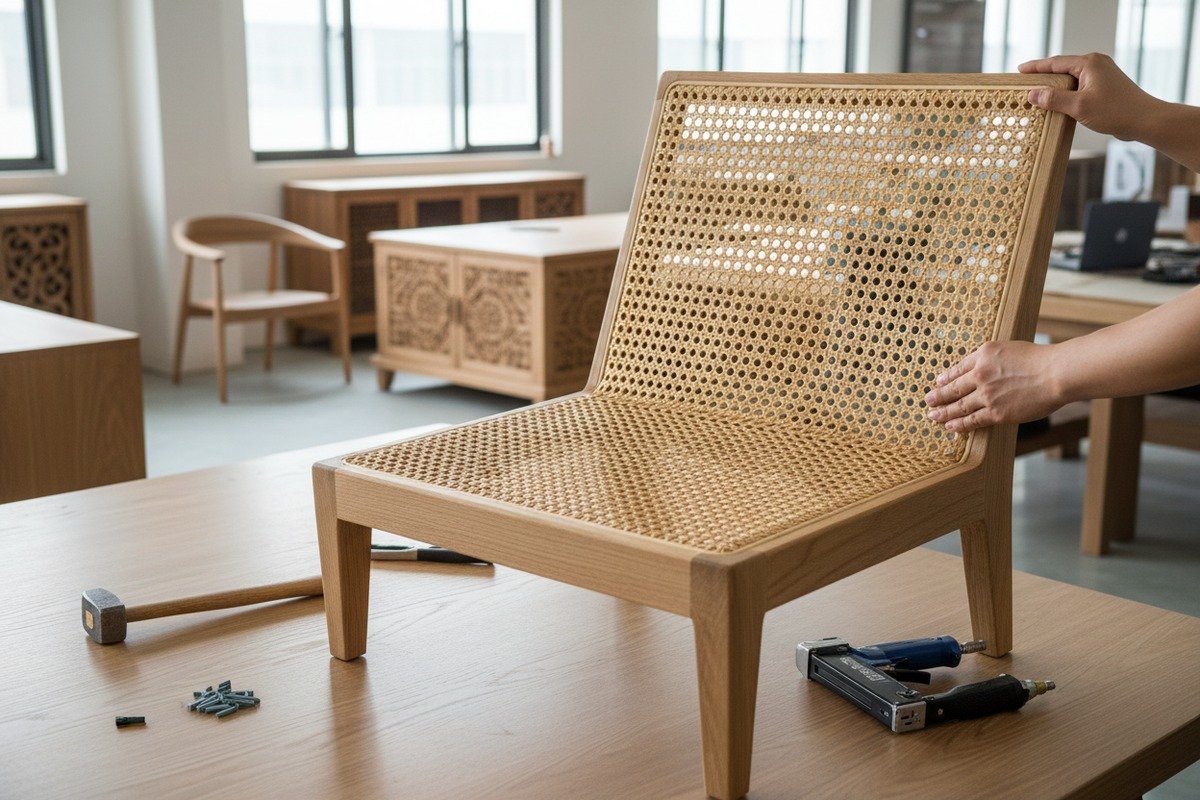
The Processing Chain That Determines Durability
Raw rattan arrives at our Indonesian facility as whole stems, often 20–30 meters long, covered in bark, thorns, and dirt. Durability is built — or destroyed — at every processing stage.
Step 1: Cleaning and Bark Removal. Workers strip the outer bark, remove thorns, and clean dirt and fiber residue from the shell. Leftover debris weakens the peel during stripping.
Step 2: Peel Stripping. Machines pull the outer skin away from the inner core. The peel becomes the weaving material. The core is repurposed for furniture frames, perfume sticks, or decorative items. If stripping is done too aggressively, the peel becomes too thin and tears during weaving.
Step 3: Sorting by Size. Stripped peel is sorted by width, thickness, and length. Uniform strips weave tighter and distribute stress more evenly across the finished panel.
Step 4: Polishing and Sanding. Nodules and rough patches are sanded smooth. This step is critical — unsanded nodules create stress points that crack under tension.
Step 5: Drying. This is where most durability failures originate. Rattan must be dried to a la teneur en humidité 6 of 12–15%. Under-dried rattan (above 18%) invites mold growth during shipping. Over-dried rattan (below 10%) becomes brittle and cracks when bent or stapled. We use a combination of initial sun drying followed by controlled sulfur drying. Sulfur drying also enhances color consistency and acts as a natural preservative.
Step 6: Bleaching and Finishing. Optional bleaching with le peroxyde d'hydrogène 7 creates the popular white or light straw color. Torch finishing darkens the surface slightly and adds a subtle antiqued look. Neither process should compromise the silica layer on the peel surface.
How to Test Durability Before You Buy
| Test | Method | Ce qu'il faut rechercher |
|---|---|---|
| Test de flexion | Take a single strand and bend it 180° | Should flex without snapping; if it cracks, moisture is too low |
| Test d'immersion | Submerge a 30 cm piece in water for 30 minutes | Should become pliable and regain flexibility; if it stays rigid, fibers are damaged |
| Test de traction | Grip both ends of a strand and pull firmly | Should stretch slightly before breaking; brittle snapping indicates poor species or over-drying |
| Color check | Lay 3 strands from different parts of the roll side by side | Color should be consistent; large variation suggests mixed batches |
| Surface scratch | Run a fingernail across the surface | Grade A should resist light scratching due to silica content |
| Moisture meter | Use a pin-type wood moisture meter on the roll edge | Reading should be 12–15% for optimal balance of flexibility and stability |
Installation Practices That Protect Durability
Even perfectly processed rattan can fail if installed incorrectly. Natural cane webbing must be soaked in warm water for 30 to 60 minutes before stretching into a frame. This softens the fibers and allows the webbing to be pulled taut without tearing. As the cane dries in the frame, it contracts and becomes drum-tight.
Cut panels with a 3–5 cm margin on each side for tucking or stapling. Use a pneumatic staple gun set to medium pressure — too much force splits the strands. For spline installations, use a hardwood or plastic spline that matches the groove width exactly.
Synthetic HDPE webbing does not require soaking. It can be cut and installed immediately, which saves factory time. However, it also does not contract after installation, so tension must be set manually during stapling.
Reconstituted Rattan: An Emerging Option
An interesting development in our industry is reconstituted rattan. Post-industrial fiber waste — offcuts, broken strands, and rejected peel — is ground down and bonded with bio-based resins to create uniform sheets. These sheets have high tensile strength and zero knots. They are not yet mainstream, but several European furniture brands are testing them as a sustainable alternative that reduces raw material waste.
Why does the origin of the rattan material matter for my bulk wholesale orders?
We operate our own rattan processing facility in Indonesia for one simple reason: controlling the origin of our raw material is the single most effective way to control quality at scale. Over the years, we have seen what happens when buyers source blindly — mixed species in one roll, inconsistent drying, and shipments that look fine on top but fall apart halfway through the container.
The origin of rattan material matters because Indonesia's volcanic soil and tropical climate produce rattan with superior density, flexibility, and natural silica content. Indonesian rattan accounts for approximately 80% of global supply, and sourcing directly from this region ensures species traceability, consistent quality, and competitive pricing for bulk orders.

Indonesia: The Global Epicenter
Indonesia dominates global rattan production for geological and biological reasons. The volcanic soil across Borneo, Sulawesi, and Sumatra provides mineral-rich growing conditions. The humid tropical climate supports rapid vine growth. And centuries of traditional harvesting knowledge ensure that rattan is collected at the right maturity — not too young (thin and weak) and not too old (stiff and prone to splitting).
When we source from managed forests and garden plantations in Kalimantan, we get stems with predictable diameter, consistent peel thickness, and long internodes. Wild-harvested rattan from primary forests can be excellent, but quality varies widely because growing conditions are uncontrolled.
China vs. Indonesia: A Common Sourcing Question
Many buyers find Chinese suppliers first on Alibaba or Google because Chinese companies are more visible in digital marketing. However, most Chinese rattan webbing manufacturers — including our Foshan operation — import raw or semi-processed rattan from Indonesia. The weaving, finishing, and packaging happen in China, but the plant material originates in Southeast Asia.
Some Chinese suppliers use domestically grown rattan from Hainan or Yunnan province. This rattan tends to have shorter internodes and thinner peel, which can affect the grade of the finished webbing. Buyers should always ask: where does your raw rattan come from?
Why Traceability Protects Your Business
For bulk wholesale orders — especially those going to Europe, Australia, or the US — material traceability 8 is increasingly important. EU timber regulations and sustainability frameworks are expanding to include non-timber forest products like rattan. Buyers who can document the origin of their rattan demonstrate compliance and build trust with eco-conscious end customers.
Our Indonesian facility maintains harvest records 9, species documentation, and processing logs for every batch. When a Dutch furniture brand asks us for a sustainability statement, we can provide it. Suppliers who buy rattan from anonymous middlemen cannot.
How Origin Affects Pricing and Lead Times
Sourcing directly from Indonesia means lower raw material cost but longer lead times. Rattan peel processed at origin and shipped to China for weaving takes 4–6 weeks from harvest to finished roll. Fully processed rolls shipped directly from Indonesia can save on labor costs but may require larger minimum order quantities.
Sourcing pre-woven rolls from Chinese warehouses offers faster delivery — sometimes within 1–2 weeks — but at a 15–25% markup to cover the Chinese manufacturer's import costs, warehousing, and margin.
Sustainability and Forest Management
Rattan is a renewable resource. Unlike hardwood trees 10 that take decades to mature, rattan vines can be harvested in 7–10 years. Managed rattan gardens in Indonesia replant continuously, ensuring a sustainable cycle. However, wild harvesting from primary forests raises concerns about overharvesting and habitat disruption.
As a wholesaler committed to long-term supply stability, we work with plantation growers and community-managed forests rather than relying solely on wild harvest. This approach costs slightly more per kilogram of raw stem but provides consistent volume, predictable quality, and a defensible sustainability story for our buyers.
The industry is also watching the development of reconstituted rattan and bio-resin composites as potential complements to virgin rattan supply. These innovations could reduce pressure on natural forests while maintaining the aesthetic and functional qualities that furniture makers need.
Conclusion
The materials behind rattan cane webbing — from Indonesian rattan peel to synthetic HDPE and emerging reconstituted fibers — directly determine the quality, durability, and market value of your finished furniture. Understanding species, grading, processing, and origin gives you the knowledge to make sourcing decisions that protect your business and satisfy your customers.
Notes de bas de page
1. Wikipedia is a preferred authoritative source, and the page provides a good overview of natural rattan. ↩︎
2. Encyclopedia entry for high-density polyethylene manufacturing and industrial applications. ↩︎
3. Background information on the properties and manufacturing of high-density polyethylene materials. ↩︎
4. Botanical classification and characteristics of the Calamus caesius rattan species. ↩︎
5. Merriam-Webster is an authoritative dictionary providing a clear definition of raw material, which is closely related to material cost in the context. ↩︎
6. Scientific reference for moisture levels in biological plant materials and fibers. ↩︎
7. This is a direct and current CDC page providing authoritative information on hydrogen peroxide. ↩︎
8. Official European Commission page on forest and timber traceability policies. ↩︎
9. FAO resource detailing best practices for rattan harvesting and management records. ↩︎
10. General reference for the growth cycles and characteristics of hardwood trees. ↩︎

 English
  Español de México
  العربية
  Deutsch
  Français
  Русский