
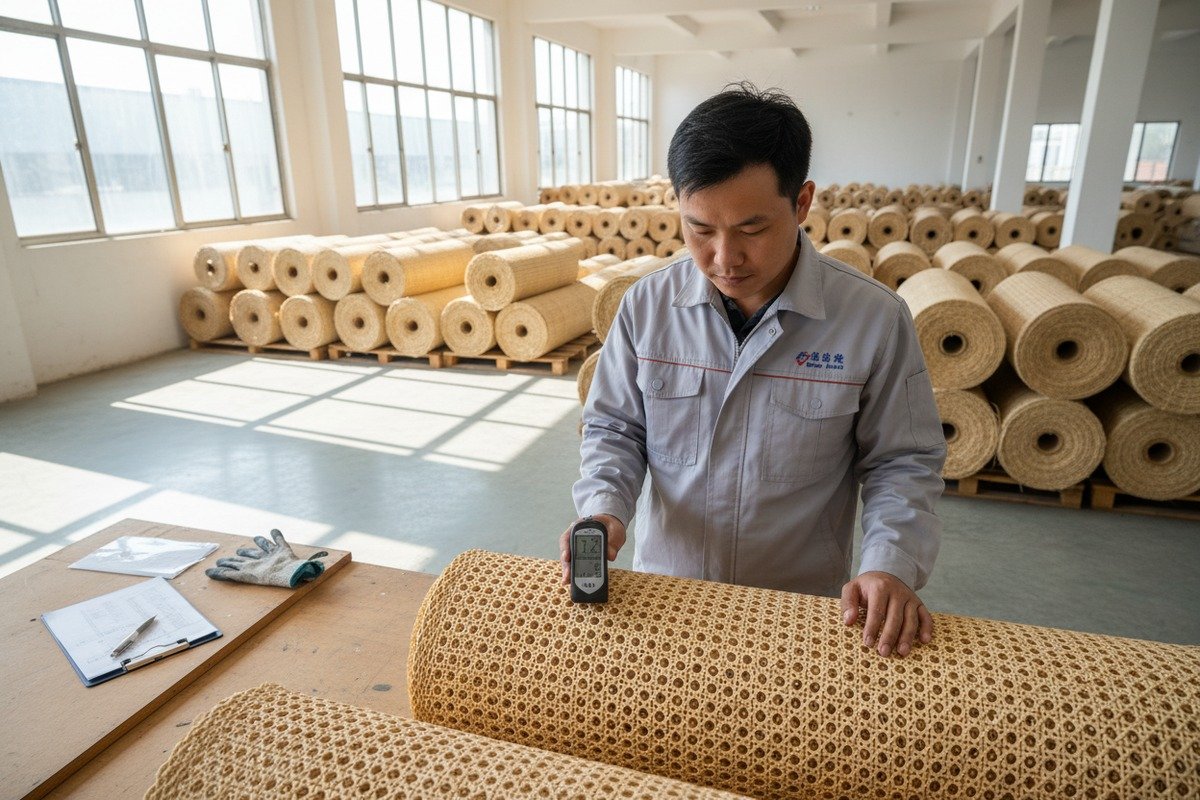
Every month, our quality control team rejects batches that would have caused serious problems for buyers overseas international quality compliance 1. Shipments arriving with mold, broken strands, or inconsistent color can destroy a business relationship fast. The cost of getting it wrong is not just financial—it’s your reputation on the line.
Rattan cane webbing requires inspections across raw material grading, surface defect screening, color consistency checks, moisture content verification below 12%, weave uniformity assessment, chemical residue testing, flexibility and durability stress tests, and packaging integrity evaluation before factory shipment to ensure international quality compliance.
Below, we break down each critical inspection stage so you know exactly what to ask your supplier and what to look for in your pre-shipment reports Grade A quality standards 2. Whether you are a furniture factory buyer or a material wholesaler, this guide gives you the tools to protect your investment.
How can I verify that my rattan cane webbing meets Grade A quality standards before it leaves the factory?
Over the years, we have shipped rattan cane webbing to markets in Europe, the Middle East, and Southeast Asia AQL-based inspection reports 3. One lesson stands out clearly: buyers who understand the grading process get better results. Without knowing what Grade A actually means, you cannot hold your supplier accountable.
To verify Grade A quality, request your supplier's AQL-based inspection reports covering raw material selection, weave consistency, strand flexibility, surface smoothness, and dimensional accuracy. Grade A rattan must show no splits, cracks, or insect damage, with uniform strand thickness and even tension throughout the webbing.
Qu'est-ce qui définit le rotin de qualité A ?
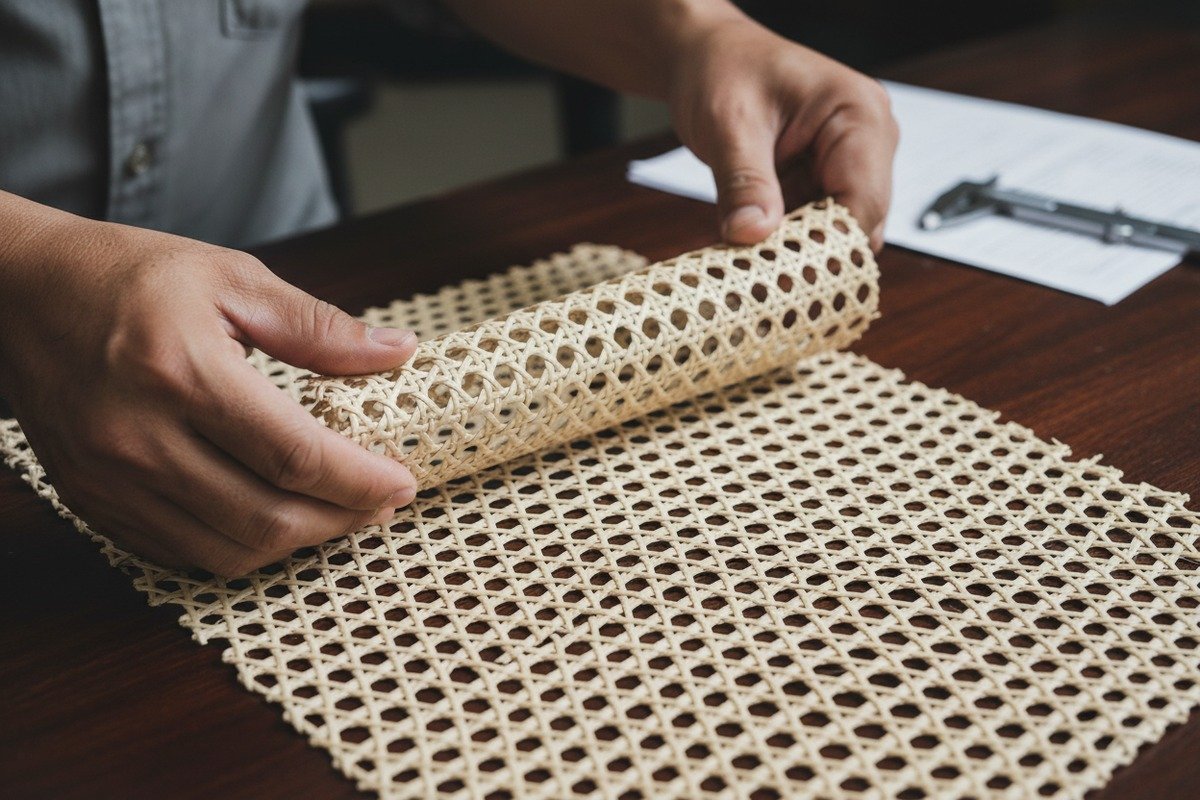
Grade A is the highest classification for rattan cane webbing. It means the material has passed every checkpoint from raw cane selection to final roll inspection. The rattan strands must be free of brittleness, decay, and pest infestation. Each strand should bend without cracking. The weave pattern must be tight, even, and free of loose ends.
At our processing facility in Indonesia, raw rattan canes go through a manual screening before they ever reach the production line. Workers check each cane for flexibility by bending it at a controlled angle. If it snaps or shows stress marks, it gets sorted out. This first gate matters because no amount of processing can fix a weak raw material.
The Four-Stage AQL Inspection Framework
Manufacturers who follow international best practices use a four-stage quality control system based on Acceptable Quality Level standards 4. Here is how each stage works:
| Stade | Nom | Ce qui est vérifié | When It Happens |
|---|---|---|---|
| IQC | Incoming Quality Control 5 | Raw cane flexibility, diameter consistency, absence of decay or infestation | Before production starts |
| IPQC | In-Process Quality Control | Weave tension, opening sizes, strand alignment, surface smoothness | During weaving |
| FQC | Final Quality Control | Color uniformity, dimensional accuracy, overall appearance | After production is complete |
| OQC | Outgoing Quality Control | Packaging integrity, labeling accuracy, documentation completeness | Before shipment |
Each stage uses statistical sampling 6. Not every single roll gets tested, but a representative sample from each batch is pulled and inspected against defined criteria. If the defect rate exceeds the AQL threshold, the entire batch gets flagged for rework or rejection.
How to Request Proof from Your Supplier
Ask for the following documents before you approve shipment:
- Raw material inspection certificates showing cane origin and species
- IPQC records with photos of weave uniformity checks
- FQC reports listing defect counts and pass/fail status
- Dimensional verification data showing roll width, length, and mesh opening sizes
If your supplier cannot provide these, that is a red flag. At our factories, every quality inspection is filed for reference and tracking. Reports are generated within 24 hours of testing completion. This is standard practice for any serious manufacturer.
Dimensional Tolerance Standards
Grade A webbing must meet tight dimensional standards. Dimensional Tolerance Standards 7 For standard radio weave, mesh openings typically measure half an inch with a tolerance of ±7.5 mm. Roll widths and lengths must match the purchase order specifications. Even small deviations can cause problems during furniture upholstery, leading to material waste and rework costs.
What specific surface defects and color consistency checks should I expect in my pre-shipment inspection report?
When our QC team reviews finished rattan webbing, they use a defect classification system 8 that separates critical issues from minor cosmetic variations. Understanding this system helps you read your inspection report with confidence instead of guessing what matters.
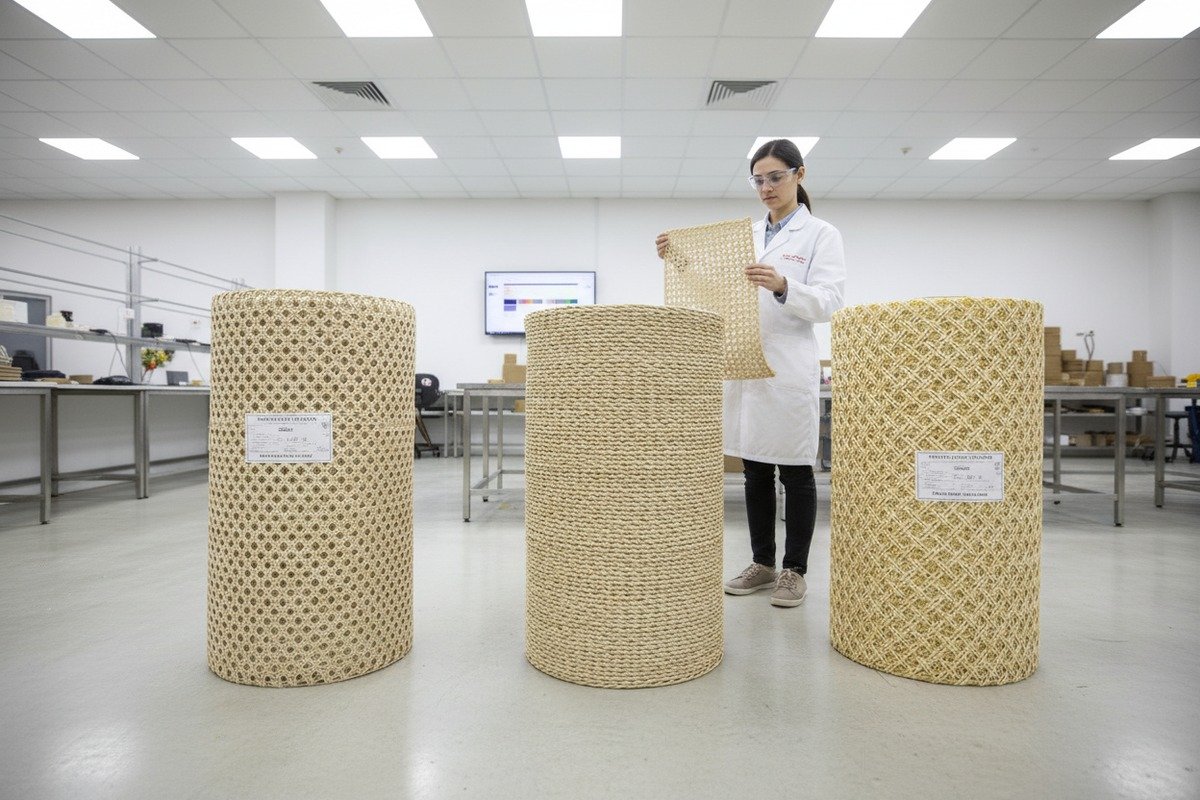
Your pre-shipment report should document checks for scratches, glue residue, strand breakage, uneven bleaching, and color variation between rolls. Inspectors compare color against approved samples under standardized lighting, measure surface smoothness, and flag any defects using a critical-major-minor classification system.
Common Surface Defects in Rattan Cane Webbing
Natural rattan is an organic material. Some variation is expected. But Grade A webbing should have minimal visible defects. Here are the most common surface problems and how they get classified:
| Defect Type | Classification | Description | Impact on Usability |
|---|---|---|---|
| Strand breakage | Critical | A broken strand within the weave pattern | Weakens structural integrity; cannot be used |
| Deep scratches | Major | Visible scratches on the rattan surface | Affects appearance; may catch fabric |
| Glue residue | Major | Adhesive visible on the webbing surface | Looks unprofessional; hard to remove after installation |
| Minor color spots | Minor | Small areas of slightly different shade | Usually not noticeable once installed |
| Light surface fuzz | Minor | Tiny fibers standing up from the strand | Normal for natural rattan; can be lightly sanded |
| Irregular weave gap | Major | Uneven spacing between strands | Creates visual inconsistency; affects tension |
How Color Consistency Is Measured
Color is one of the trickiest aspects of natural rattan quality. Because rattan is a plant-based material, each cane has slight natural variations. After weaving, the webbing goes through hydrogen peroxide baths to even out the color. This bleaching process must be carefully controlled. Too little treatment leaves dark spots. Too much treatment makes the rattan brittle and overly pale.
At our facility, we compare each batch against a master color sample under D65 daylight-simulating lamps. This removes the influence of warehouse lighting, which can make colors look different than they actually are. We check for consistency both within a single roll and across rolls in the same order.
If you are ordering multiple rolls for a single project—like a hotel furniture line—cross-roll color consistency is essential. Ask your supplier to confirm that all rolls in your order were processed in the same bleaching batch. Mixed batches almost always produce noticeable shade differences.
Microscopic and Hidden Defect Screening
Some defects are not visible to the naked eye. Microscopic screening catches hidden fungal spores or early-stage microbial contamination that could lead to mold growth during transit or storage. This step is especially important for shipments heading to humid climates or going through long sea voyages.
Our team also checks for chemical residue from the bleaching and anti-mildew treatment processes. These residues must comply with international safety standards, particularly for products entering the European Union market where chemical regulations are strict. Testing confirms that treatments are effective but do not leave harmful substances on the finished product.
Reading Your Inspection Report
A good pre-shipment report will include photographs of defects found, their classification, and the overall defect rate compared to the agreed AQL level. If the defect rate exceeds the threshold, you have grounds to request rework, replacement, or a price adjustment. Do not accept vague reports that say "quality is good" without data.
How do I ensure my rattan rolls have the correct moisture content to prevent mold during long-distance sea freight?
We learned this lesson the hard way years ago when a container of rattan webbing arrived in the Netherlands covered in mold. The shipment was perfectly woven and beautifully graded, but the la teneur en humidité 9 was too high when it was packed. Six weeks in a sealed container at sea turned those rolls into a total loss.
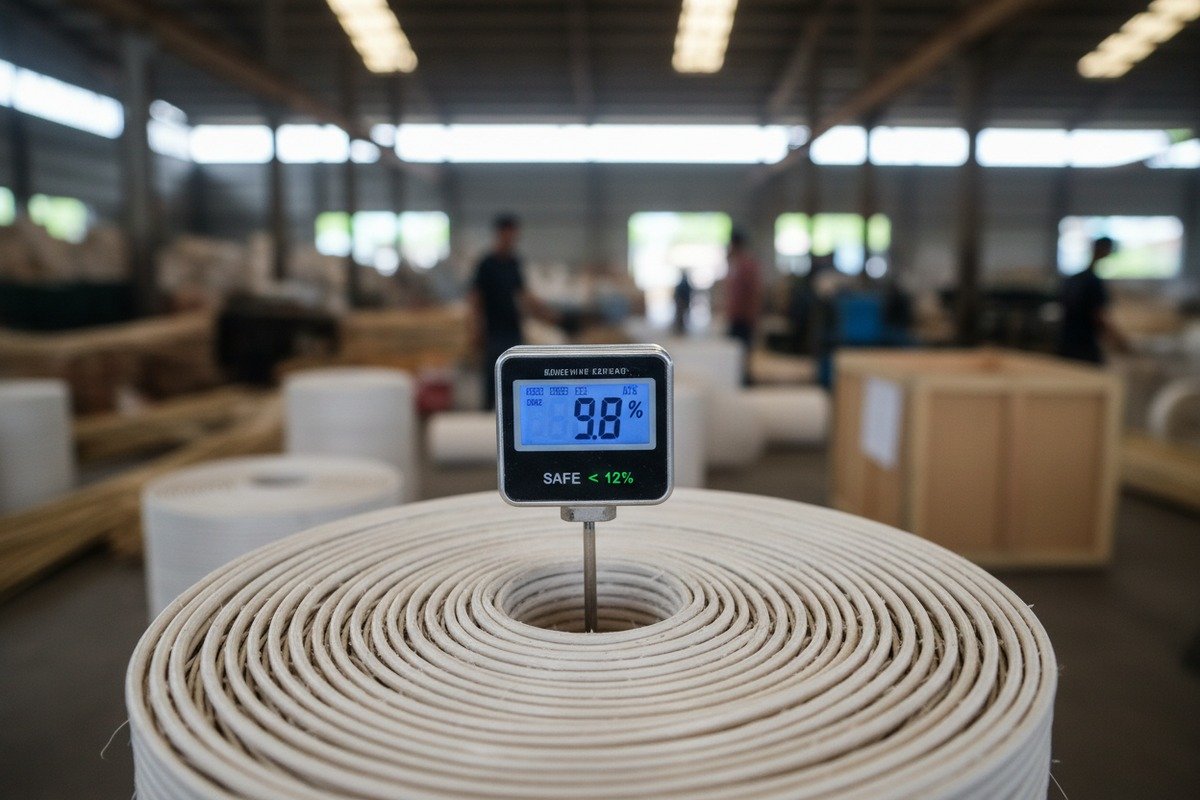
Rattan cane webbing must have moisture content below 12% before packing, verified with a calibrated pin-type or pinless moisture meter at multiple points across each roll. Rolls should be treated with anti-mildew agents, wrapped with desiccant packs inside, and stored in ventilated conditions before container loading.
Why Moisture Content Is the Silent Killer
Rattan is hygroscopic. It absorbs and releases moisture from the surrounding air. During sea freight, containers pass through different climate zones. Temperature swings cause condensation inside the container, known as "container rain." If the rattan already has high moisture content when packed, this extra moisture creates the perfect environment for mold and fungal growth.
The target moisture level is below 12%. At our drying facilities, we monitor this with calibrated moisture meters. We take readings at multiple points on each roll—not just the edges, but also the center where moisture tends to hide. Readings are recorded in the quality documentation that ships with your order.
The Drying and Conditioning Process
After weaving and chemical treatment, rattan webbing goes through controlled drying. This step is time-sensitive. Rushed drying at high temperatures can make the rattan brittle and prone to cracking. Slow drying at controlled temperatures preserves flexibility while bringing moisture to safe levels.
| Drying Parameter | Plage recommandée | Risk If Too Low | Risk If Too High |
|---|---|---|---|
| Température | 40–55°C | Drying takes too long; mold risk | Rattan becomes brittle and cracks |
| Durée | 24–72 heures | Moisture remains too high | Over-drying weakens fibers |
| Final moisture content | 8–12% | Excessive brittleness | Mold and fungal growth during transit |
| Ambient humidity during storage | Below 60% RH | Not typically a concern | Rattan reabsorbs moisture before packing |
Anti-Mildew Treatment Protocols
Drying alone is not enough for long-distance sea freight. We apply anti-mildew treatments to the finished webbing. These treatments create a protective barrier that inhibits fungal and bacterial growth even if some condensation occurs during transit.
The anti-mildew agents we use must pass safety testing for the destination market. For shipments to Europe and North America, treatments comply with REACH and RoHS regulations 10. We document the type and concentration of anti-mildew agent used in each batch.
Packing Precautions Against Moisture
Even with proper drying and treatment, packing practices matter enormously. Here are the steps we follow:
- Each roll is wrapped in breathable plastic, not fully sealed. Full sealing traps any residual moisture inside.
- Desiccant packs are placed inside the wrapping at regular intervals. These silica gel or calcium chloride packs absorb excess moisture during transit.
- Rolls are kept off the container floor using pallets or raised platforms to avoid contact with condensation that collects at the bottom.
- Container interiors are inspected for existing moisture or leaks before loading.
- Loading happens during dry weather whenever possible. Loading in rain introduces external moisture.
Dimensional Stability Under Humidity Changes
Beyond mold, moisture affects the physical dimensions of rattan webbing. High humidity causes expansion. Low humidity causes contraction. For buyers using the webbing in furniture frames, these dimensional changes can cause buckling or loosening. Testing the webbing under simulated humidity conditions before shipment gives you confidence that the material will perform as expected in its end-use environment.
What packaging and durability standards should my supplier follow to protect my bulk order during international transit?
Our warehouse team has unpacked containers from other suppliers and seen rattan rolls crushed, bent, and deformed beyond use. Good rattan webbing that fails because of poor packaging is a waste that nobody should accept. Packaging is the last line of defense between your product and the rough realities of international logistics.
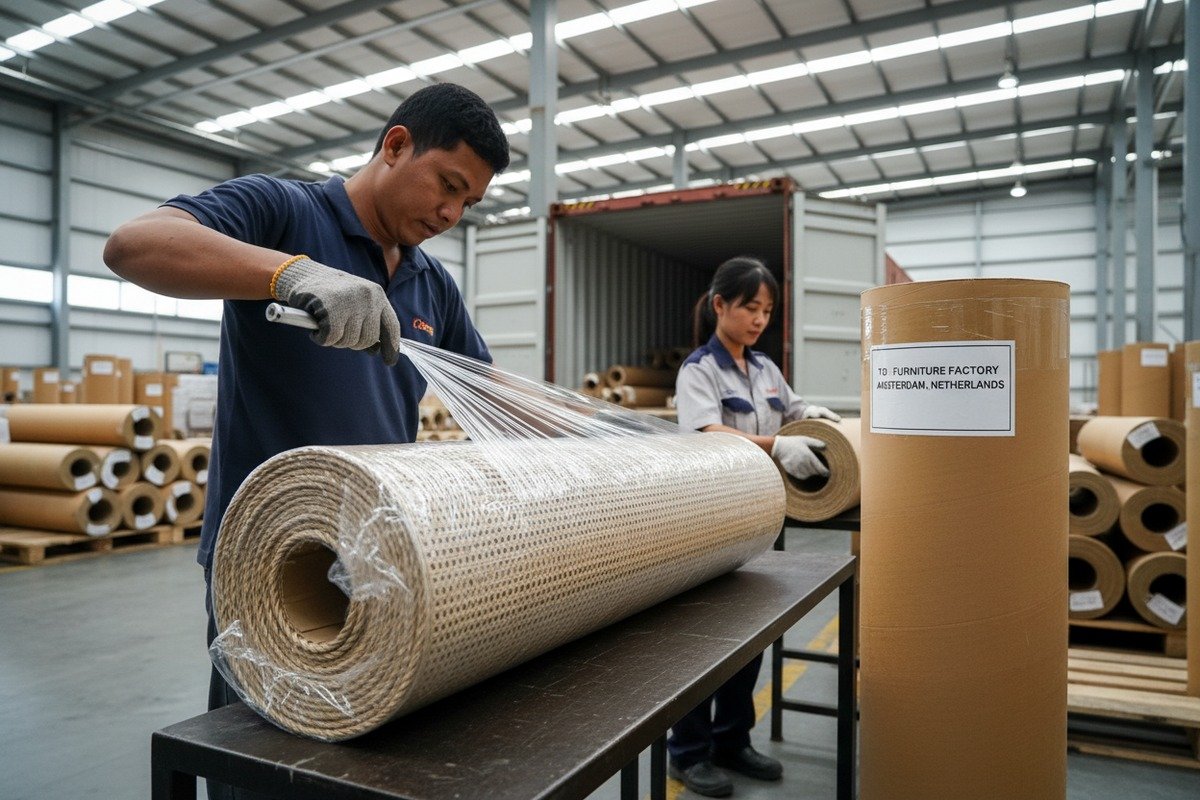
Your supplier should use rigid cardboard cores for rolling, double-layer corrugated carton boxes or wooden crates for outer protection, internal cushioning with foam or kraft paper, moisture-barrier wrapping with desiccant packs, clear handling labels, and strapping that prevents shifting during transit to protect rattan webbing in bulk shipments.
The Core Packaging Structure
Rattan cane webbing is flexible, which is an advantage during installation but a vulnerability during shipping. Without a rigid core, rolls can collapse, crease, or develop permanent bends. At our factories, every roll is wound around a sturdy cardboard or plastic tube core. The core diameter is selected based on the webbing type—thicker, stiffer weaves need larger cores to prevent cracking.
The outer packaging depends on order volume and destination. For smaller orders, double-wall corrugated cartons provide adequate protection. For large bulk orders or shipments going to distant markets, wooden crates or reinforced palletized packaging is standard.
Packaging Specifications by Order Type
| Taille de la commande | Outer Packaging | Inner Protection | Core Type | Recommended For |
|---|---|---|---|---|
| Sample / small | Single-wall carton | Kraft paper wrap | Cardboard tube | Air freight, courier |
| Medium (50–200 rolls) | Carton double paroi | Foam corner guards + kraft paper | Cardboard tube | Sea freight, short routes |
| Large bulk (200+ rolls) | Wooden crate on pallet | Foam sheets + stretch wrap | Reinforced plastic tube | Sea freight, long routes |
| Custom / fragile weave | Custom wooden crate | Bubble wrap + foam | Large-diameter plastic tube | High-value or delicate patterns |
Étiquetage et instructions de manipulation
Every package should carry clear labels with the following information:
- Product name, grade, and batch number
- Roll dimensions (width × length)
- Net and gross weight
- "Keep Dry" and "Handle With Care" symbols
- Stacking limit indicators
- Country of origin and destination
- Purchase order reference number
These labels serve two purposes. First, they guide logistics handlers who may not speak the same language. Second, they provide traceability if a quality claim arises after delivery. Without proper labeling, it becomes nearly impossible to trace a problem back to its source batch.
Durability Testing Before Shipment
Packaging durability is not just about materials. It is about testing. At our facility, we conduct drop tests and compression tests on packed units to simulate rough handling during loading, unloading, and stacking in containers. A packed roll should survive a drop from at least 80 cm without the webbing inside sustaining damage.
We also test stacking strength. Containers get loaded floor to ceiling. The boxes at the bottom must support the full weight of the stack above without crushing. This is why we specify maximum stacking heights on every carton and crate.
Strapping and Load Securing
Inside the container, packages must be secured to prevent shifting. We use heavy-duty strapping tape on pallets and fill gaps between packages with inflatable dunnage bags. Shifting cargo is one of the leading causes of transit damage. A single roll that slides and hits the container wall at an angle can crack the core, bend the webbing, and create a defect that makes the entire roll unusable.
What to Do When Packaging Fails
If you receive a shipment with packaging damage, document it immediately. Take photographs of the container condition, the external packaging, and the product inside before moving or unwrapping anything. This documentation is essential for insurance claims and supplier disputes. A responsible supplier will have packaging standards documented in the purchase contract, making it clear who bears responsibility for transit damage.
Conclusion
Quality inspections for rattan cane webbing protect your investment at every stage—from raw material grading through moisture control to final packaging. Demand full documentation, verify standards personally, and partner with suppliers who treat quality as non-negotiable.
Notes de bas de page
1. Explains the importance of meeting global quality standards. ↩︎
2. Defines what constitutes high-grade material quality. ↩︎
3. Explains the methodology for quality verification. ↩︎
4. Provides background on a key quality control methodology. ↩︎
5. Details the initial stage of quality inspection. ↩︎
6. Explains the method for inspecting batches efficiently. ↩︎
7. Replaced with a detailed explanation of engineering tolerances, including dimensional tolerances, from a manufacturing knowledge base. ↩︎
8. Describes how product flaws are categorized. ↩︎
9. Replaced with an authoritative Wikipedia link providing a general definition of moisture content (water content). ↩︎
10. Provides context on chemical safety compliance. ↩︎


 English
  Español de México
  العربية
  Deutsch
  Français
  Русский