

Sourcing the right width of cannage rotin 1 can make or break a furniture project. Over the years, our production teams in Indonesia and Foshan have seen countless buyers order the wrong width—leading to wasted material, delayed timelines, and frustrated end customers. The problem is simple: most buyers don’t know what standard widths exist or how to pick the right one.
Natural rattan cane webbing is commonly available in standard widths of 12, 14, 16, 18, 20, 22, 24, 30, and 36 inches. Metric equivalents include 45 cm, 60 cm, and 90 cm. The most popular widths for general furniture use are 18 inches and 24 inches, which suit most chair seat and cabinet panel applications.
Below, we break down each standard width option, explain when custom widths make sense, and share practical tips for keeping your shipments consistent imperial measurements 2. Whether you run a usine de meubles 3 or distribute rattan materials to local craftsmen, this guide will help you source smarter.
What are the standard widths available for my bulk rattan cane webbing orders?
When our warehouse teams pack bulk orders for export, the first question we always ask buyers is: "Which width do you need?" It sounds basic, but many purchasing managers confuse mesh size 4 with roll width—and that one mistake can derail an entire production run Metric equivalents 5.
Standard rattan cane webbing widths for bulk orders include 12", 14", 16", 18", 20", 22", 24", 30", and 36" in imperial measurements. In metric, the most common options are 30 cm, 45 cm, 48 cm, 50 cm, 60 cm, and 90 cm. Rolls are typically sold by the running foot or meter.

Breaking Down the Full Width Range
Not all widths serve the same purpose. Let's look at how each width fits into different furniture applications.
| Width (Imperial) | Width (Metric) | Application courante |
|---|---|---|
| 12" | 30 cm | Small chair seats, sample pieces |
| 14" | 35 cm | Narrow cabinet inserts, decorative panels |
| 16" | 40 cm | Dining chair seats, side panels |
| 18" | 45 cm | Standard chair seats, most restoration work |
| 20" | 50 cm | Wide chair seats, medium cabinet doors |
| 22" | 55 cm | Oversized chairs, custom cabinetry |
| 24" | 60 cm | Headboards, large cabinet panels, radiator covers |
| 30" | 75 cm | Cloisons, panneaux architecturaux |
| 36" | 90 cm | Large-scale decorative walls, commercial installations |
Why 18" and 24" Dominate the Market
From our experience shipping to the Netherlands, the US, and Australia, two widths account for the majority of orders: 18 inches and 24 inches. The reason is straightforward. Most standard dining chairs have seat openings between 12 and 16 inches. An 18-inch roll gives enough extra material for trimming and tucking into grooves. For larger projects—like headboard panels or kitchen cabinet doors—24 inches covers the span without needing to join two pieces.
If you are a wholesaler stocking rattan webbing for resale, these two widths should form the backbone of your inventory. They move the fastest and satisfy about 70% of end-user needs.
Width vs. Mesh Size: A Critical Distinction
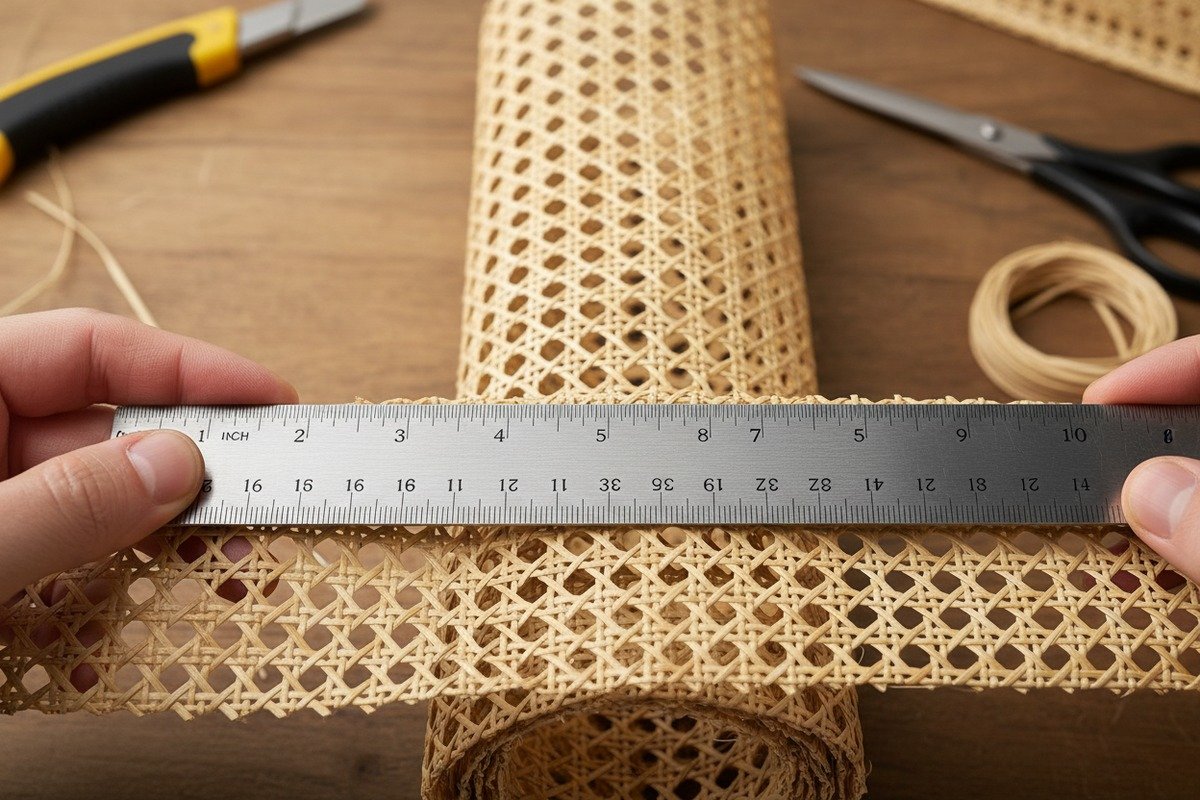
One of the most common sourcing errors we encounter is buyers confusing roll width with mesh size. Roll width is the overall measurement of the webbing from edge to edge. Mesh size is the spacing between holes in the weave pattern—typically measured from the center of one hole to the center of the next. Fine open cane webbing, for example, has a 1/2-inch mesh. But that same fine mesh can come in a 12-inch or 36-inch roll width.
Always specify both when placing an order. If you only say "I need 1/2-inch cane webbing," you might receive the right pattern in completely the wrong width.
Roll Length Standards
Width is only half the equation. Standard roll lengths range from 10 to 15 meters (roughly 33 to 49 feet). Some suppliers also offer shorter 10-foot rolls for smaller retailers or sample orders. When calculating your order, multiply the width by the roll length to determine total coverage area. This helps you estimate how many rolls you need for a production batch.
Can I customize the roll width to match my specific furniture design needs?
Our factory in Indonesia processes raw rattan cane daily, and one thing we hear often from furniture designers is: "Your standard widths don't quite fit my project." A 17-inch panel opening doesn't align neatly with a 16-inch or 18-inch roll. So, can you get exactly what you need?
Yes, many rattan cane webbing manufacturers offer custom-cut widths, typically within a range of 35 cm to 100 cm, with defined increment intervals. Custom widths reduce material waste and ensure a precise fit for unique furniture designs. However, custom orders usually require minimum order quantities and longer lead times.

How Custom Width Cutting Works
When we receive a custom width request, the process starts at the weaving stage. Our weavers in Indonesia can adjust the loom setup to produce webbing at a specific width. Alternatively, wider rolls can be trimmed down to narrower custom sizes after weaving. The first method is more precise and wastes less material. The second method is faster but may result in slightly frayed edges that need finishing.
When Custom Widths Make Sense
Custom widths are not always the best choice. Here is a quick comparison to help you decide.
| Facteur | Largeur standard | Largeur personnalisée |
|---|---|---|
| Délai de livraison | 3–7 jours | 14–30 days |
| Minimum order | Low (often 5–10 rolls) | Higher (often 50+ rolls) |
| Unit cost | Plus bas | 10–20% higher |
| Déchets de matériaux | Some trimming needed | Minimal waste |
| Fit precision | Approximate | Exact |
If your production volume is high and every centimeter of material matters, custom widths pay for themselves through reduced waste. For smaller batches or one-off projects, it usually makes more sense to buy the next standard width up and trim to fit.
Common Custom Requests We Fulfill
Based on orders we have shipped to Spain, Turkey, and the US over the past year, these are some of the most frequently requested custom widths:
- 35 cm (14"): For narrow Scandinavian-style cabinet inserts
- 42 cm (16.5"): For specific European dining chair models
- 55 cm (21.5"): For mid-century modern headboard panels
- 70 cm (27.5"): For architectural room divider panels
- 100 cm (39"): For large-scale wall paneling in hospitality projects
Tips for Ordering Custom Widths
First, always provide a technical drawing or at least a clear measurement sketch. Include the groove-to-groove measurement of your furniture piece, plus the extra material needed for tucking or stapling. Second, request a sample cut before committing to a full production run. Our team can send a 1-meter sample in your custom width so you can test the fit on your actual furniture frame. Third, plan ahead. Custom orders require more coordination between the weaving facility and the shipping team, so add at least two extra weeks to your timeline.
Communication is key here. Many sourcing problems arise not because the factory cannot produce the width you need, but because the specifications were unclear. Be specific. Use millimeters if possible. And always confirm whether you are measuring the finished webbing width or the total width including any selvedge edges.
How do I ensure the width measurements are consistent across my entire shipment?
Notre équipe de contrôle qualité 6 in Foshan inspects every roll before it ships, but we still get questions from buyers worried about width inconsistencies. The concern is valid. Rattan is a natural material—it swells with humidity and shrinks in dry conditions. So, how do you make sure every roll in your container meets spec?
To ensure consistent width measurements, request that your supplier measures each roll under standardized humidity conditions, uses calibrated measuring tools, and includes a quality inspection report with every shipment. Specifying an acceptable tolerance range (typically ±2–3 mm) in your purchase order prevents disputes and ensures usable material.

Why Width Variation Happens
La canne de rotin est une fibre naturelle 7. Unlike synthetic materials cut by machine to exact dimensions, natural rattan webbing can shift slightly in width depending on three main factors:
- Humidity during weaving: If the weaving facility is in a tropical climate 8 (as most Indonesian factories are), the rattan absorbs moisture and may measure slightly wider.
- Drying and storage conditions: Once the webbing is dried and stored, it can shrink by 1–3 mm in width.
- Tension during rolling: How tightly the webbing is rolled affects the measured width when unrolled. Over-tensioned rolls may measure narrower at the edges.
Setting Tolerance Standards
In our production contracts, we recommend buyers specify a tolerance range upfront. Here is a guideline we use for our export orders:
| Largeur du rouleau | Tolérance acceptable | Notes |
|---|---|---|
| Under 30 cm | ±1.5 mm | Tight tolerance for small panels |
| 30–60 cm | ±2 mm | Standard for most furniture webbing |
| Over 60 cm | ±3 mm | Wider material naturally varies more |
Including this in your purchase order creates a shared standard between you and your supplier. It also gives the quality team a clear benchmark during pre-shipment inspection.
Practical Steps to Verify Consistency
Here is what we recommend to our buyers, especially those placing their first bulk order:
Step 1: Request a pre-production sample. Ask your supplier to send a 1-meter sample from the same material batch that will be used for your full order. Measure it carefully under your own workshop conditions.
Step 2: Specify measurement points. Width should be measured at three points along every roll—the beginning, the middle, and the end. This catches any tapering that might occur during weaving.
Step 3: Ask for a QC report. A proper quality control report should include individual roll measurements, photos of the measuring process, and the ambient humidity level at the time of inspection. Our team provides this as standard for all export orders over 100 rolls.
Step 4: Conduct incoming inspection. When the shipment arrives at your warehouse, randomly sample 10–15% of rolls and measure them yourself. Compare against the QC report.
Handling Discrepancies
If you find rolls outside the agreed tolerance, document the issue immediately with photos and measurements. A reliable supplier will work with you on replacements or credit. At our facility, we keep reserve stock for exactly this purpose—so if a handful of rolls from a batch don't meet spec, we can ship replacements within days rather than weeks.
The key takeaway is this: consistency in natural materials requires proactive planning. You cannot assume every roll will be identical. But with the right tolerances, inspection protocols, and supplier communication, you can minimize variation to a level that does not affect your finished product quality.
Which widths should I prioritize to meet the demands of my local furniture market?
When we consult with new wholesale partners—whether in Dubai, the Netherlands, or Thailand—the conversation always starts the same way: "What should I stock first?" Buying every width sounds safe, but it ties up capital and warehouse space. The smarter move is to start focused and expand based on actual demand.
For most local furniture markets, prioritize stocking 18-inch (45 cm) and 24-inch (60 cm) rattan cane webbing first. These two widths cover the majority of chair seat restorations and cabinet panel projects. Add 36-inch (90 cm) rolls if your market includes architectural or large-scale decorative applications.
A Market-Based Approach to Width Selection
Different markets have different needs. A furniture restoration shop in the US will request different widths than a modern furniture factory in Thailand. Here is a breakdown based on what we see across our export markets.
Restoration and Repair Markets
Chair caning restoration is the most common end use for rattan webbing in North America and Europe. The typical dining chair seat measures 12–16 inches from groove to groove. After adding 2–4 inches on each side for tucking, an 18-inch roll covers most jobs perfectly. If you serve this market, 18-inch webbing in fine open (1/2-inch mesh) should be your top priority.
Modern Furniture Manufacturing
Contemporary furniture designs often use rattan webbing for headboards, sideboards, and accent panels. These applications demand wider material—usually 24 to 36 inches. If your customers are furniture factories producing mid-century modern or Scandinavian-inspired pieces, stock 24-inch and 30-inch widths as your core inventory.
Architectural and Commercial Projects
Hotels, restaurants, and commercial interiors increasingly use rattan webbing for wall panels, ceiling treatments, and room dividers. These large-scale installations favor the widest available rolls—36 inches or even custom 100 cm widths—to minimize visible seams. If you serve architects or interior designers, carry 36-inch rolls and offer custom cutting as a value-added service.
Recommended Starter Inventory by Market Type
| Market Type | Priority Width 1 | Priority Width 2 | Optional Width 3 |
|---|---|---|---|
| Restoration & repair | 18" (45 cm) | 24" (60 cm) | 16" (40 cm) |
| Modern furniture factories | 24" (60 cm) | 30" (75 cm) | 36" (90 cm) |
| Architectural/commercial | 36" (90 cm) | 24" (60 cm) | Largeurs personnalisées |
| General wholesaler | 18" (45 cm) | 24" (60 cm) | 36" (90 cm) |
Balancing Cost and Coverage
Stocking fewer widths reduces your warehousing costs and simplifies inventory management. But carrying too few widths means turning away customers who need something you don't have.
Our recommendation for new wholesalers is the "3-width start" strategy. Begin with 18-inch, 24-inch, and 36-inch rolls. This combination covers small restoration jobs, medium furniture panels, and large decorative applications. Track which width sells fastest over the first three months, then adjust your reorder quantities accordingly.
Finish and Color Considerations
Width is not the only variable. Natural and bleached finishes appeal to different buyers. Natural rattan has a warm, honey-toned look that suits rustic and bohemian interiors. Bleached rattan is lighter—almost white—and fits modern minimalist aesthetics. If your market leans heavily toward one style, stock your priority widths in that finish first. You can always add the other finish later as demand grows.
In our experience, natural finish outsells bleached by roughly 3 to 1 across most markets. But in Northern European countries like the Netherlands and Scandinavia, the ratio is closer to 50/50 because of the popularity of light, airy interior design.
The Sustainability Factor
Many furniture buyers today want to know that their materials are responsibly sourced. Rattan is inherently sustainable—it grows rapidly, requires no pesticides, and supports rural economies 9 in Southeast Asia. Highlighting this in your product descriptions and sales conversations can differentiate your business. Our rattan processing facility in Indonesia follows responsible harvesting practices 10, and we can provide sourcing documentation for buyers who need it.
When you choose which widths to stock, also think about the story you can tell your customers. A 24-inch roll of sustainably harvested natural rattan webbing is not just a material—it is a selling point for eco-conscious furniture brands.
Conclusion
Choosing the right standard widths for natural rattan cane webbing comes down to understanding your market, specifying clearly, and partnering with a reliable supplier who ensures consistency across every roll.
Notes de bas de page
1. Provides foundational information about the material. ↩︎
2. Explains the measurement system used. ↩︎
3. Contextualizes the industrial application of rattan. ↩︎
4. Clarifies a specific technical term in weaving. ↩︎
5. Defines the international standard of measurement. ↩︎
6. Provides insight into quality assurance practices. ↩︎
7. Describes the inherent characteristics of rattan. ↩︎
8. Explains the environmental context of rattan production. ↩︎
9. Replaced with a working Wikipedia URL providing a comprehensive overview of rural economies. ↩︎
10. Emphasizes ethical and sustainable sourcing. ↩︎

 English
  Español de México
  العربية
  Deutsch
  Français
  Русский