

Every week, our production team in Foshan handles orders where buyers miscalculate their rattan webbing needs Staple or glue method 1. Some order too little and face costly delays. Others over-order and waste budget on material sitting in storage organic material 2. The frustration is real, especially for purchasing managers working with tight margins and strict quality standards.
To calculate the area and quantity of natural rattan cane webbing, measure each opening’s length and width, add 2–4 inches per side for overlap and shrinkage, convert to square feet, then divide by the roll’s coverage area. Always add 10–15% extra for cutting waste, pattern matching, and natural contraction during drying.
This guide walks you through every step. From measuring a single chair seat to planning a bulk production run of hundreds of cabinet panels, you will find clear formulas, real examples, and practical tables below. Let’s get into it.
How do I accurately measure my furniture frames to calculate the total square footage of rattan webbing I need?
Getting measurements wrong is the number one reason orders come back short. Our export team has seen buyers in Thailand, Australia, and the Netherlands all make the same mistake: they measure the visible opening and forget about the overlap needed for installation.
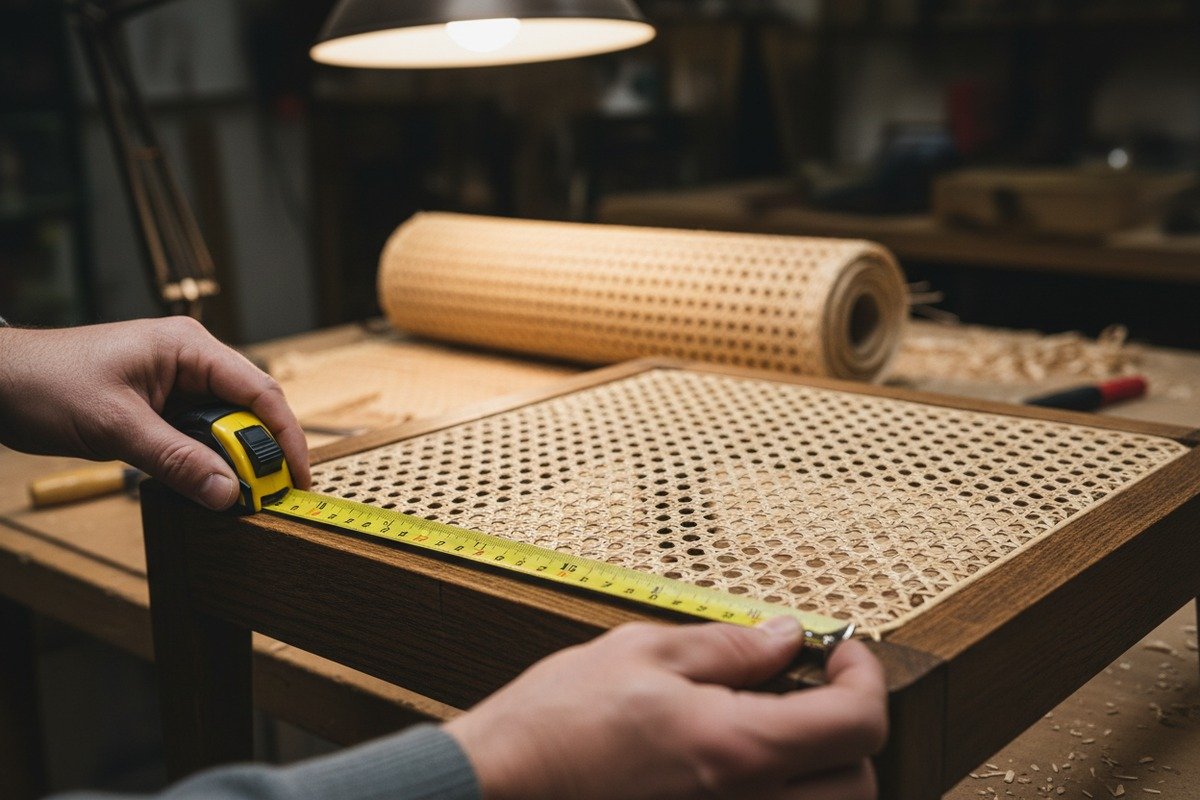
To accurately measure furniture frames, record the inside length and width of each opening, then add 2 inches per side for spline-groove chairs or 1 inch per side for stapled panels. Multiply adjusted length by adjusted width to get total area per piece, then sum all pieces for total square footage.
Understanding the Two Main Installation Methods
Your measurement approach depends entirely on how the webbing will be attached. There are two primary methods.
Spline-groove method is used on most chairs. A routed groove runs around the seat opening. The webbing is pressed into this groove and held in place by a spline (a thin reed strip 3). For this method, you measure groove-to-groove — the inside edge of the channel on one side to the inside edge on the opposite side. Then add 2 inches on each side, totaling 4 inches extra in both directions.
Staple or glue method is common for flat panels, cabinet doors, headboards, and decorative screens. Here, you measure the full opening from frame edge to frame edge. Then add 1 inch (roughly 2–3 cm) on each side for wrapping, trimming, and securing.
Step-by-Step Measurement Process
- Use a rigid tape measure 4, not a fabric one.
- Measure the horizontal span (width) at the widest point.
- Measure the vertical span (height or depth) at the tallest point.
- Record measurements in inches first, then convert to feet for ordering.
- Add the correct overhang based on your installation method.
- Multiply adjusted width × adjusted height = area per piece.
Quick Reference: Measurement Allowances
| Метод установки | Where to Measure | Extra Per Side | Total Extra (Both Directions) |
|---|---|---|---|
| Spline-groove (chairs) | Inside groove to inside groove | 2 inches | 4 inches width + 4 inches height |
| Staple/glue (panels) | Frame edge to frame edge | 1 inch (2–3 cm) | 2 inches width + 2 inches height |
| Wrap-around (screens) | Outer frame edge | 1.5–2 inches | 3–4 inches width + 3–4 inches height |
Пример из реальной жизни
Let's say you are re-caning a dining chair. The groove-to-groove measurement is 14 inches wide and 16 inches deep. You add 4 inches to each dimension: 18 inches wide × 20 inches deep. Now convert to feet: 1.5 ft × 1.67 ft = 2.5 square feet per chair. If you have 6 chairs, your base need is 15 square feet.
For a cabinet door panel measured at 24 inches × 36 inches (edge to edge), add 2 inches total to each dimension: 26 inches × 38 inches. That gives you 988 square inches, or roughly 6.86 square feet per door.
Always measure every opening individually. Even chairs from the same set can differ by half an inch. When we ship bulk webbing to furniture factories in Europe, we always recommend they send us a measurement sheet rather than a single sample dimension.
Handling Irregular Shapes
For arched or rounded frames, measure the widest horizontal point and the tallest vertical point. Treat the piece as a rectangle. You will have more trim waste, but this ensures full coverage. For complex shapes, make a paper template first and lay it over the webbing roll dimensions.
What percentage of extra material should I include in my order to account for cutting waste and stretching?
One of the most common questions we receive from purchasing managers — especially those ordering for the first time — is how much buffer material they actually need. Under-ordering by even 5% can halt a production line 5 for weeks while replacement stock ships.
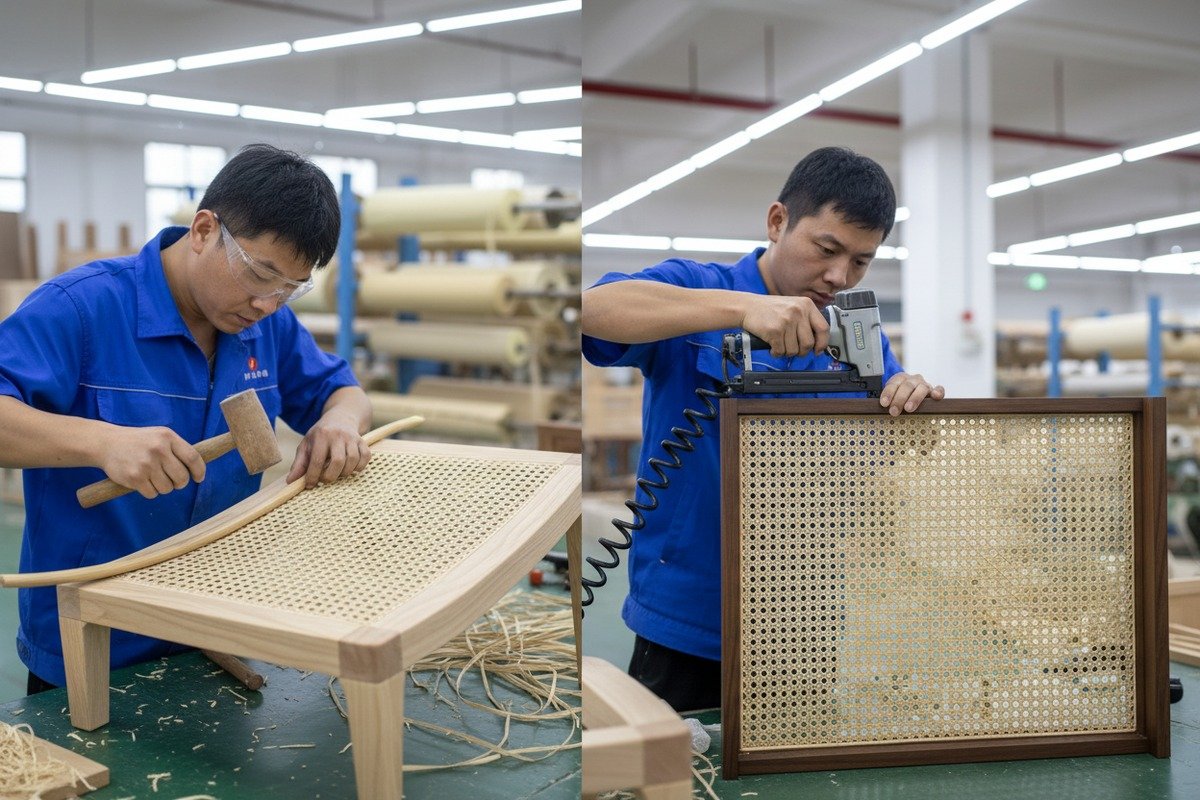
Include 10–15% extra material for standard rectangular projects to cover cutting waste, edge trimming, and minor defects. For irregularly shaped openings, pattern-matching across multiple panels, or first-time installations, increase the buffer to 15–20%. Natural rattan also contracts 10–15% as it dries after soaking, so always cut oversized.
Why You Need More Than You Think
Натуральная ротанговая циновка 6 is an organic material. It is not uniform like plywood or sheet metal. Each roll may have slight color variations, minor weave inconsistencies near the edges, or a small section where the cane strips overlap unevenly. When our quality inspectors 7 grade rolls at our Indonesia processing facility, even Grade A rolls have edge margins that buyers typically trim off.
Here's where the material goes:
- Edge trimming: The first and last inch of a roll's width often has loose or unfinished cane ends. Most buyers trim 0.5–1 inch per side.
- Cutting between pieces: Every cut wastes a small strip. If you are cutting 10 pieces from a roll, that is 9 cuts, each losing about 0.25–0.5 inches.
- Soaking shrinkage: Webbing must be soaked in warm water for 15–30 minutes before installation. Soaking shrinkage 8 As it dries, it contracts by roughly 10–15%. You must account for this before you cut.
- Mistakes and learning curve: Even experienced installers occasionally tear wet webbing or misalign a piece in the groove.
Waste Percentage by Project Type
| Тип проекта | Recommended Extra (%) | Reason |
|---|---|---|
| Standard rectangular chair seats | 10–15% | Clean cuts, minimal waste |
| Cabinet door panels (multiple identical) | 10–12% | Repetitive sizing, efficient roll use |
| Irregularly shaped frames (arched, curved) | 15–20% | More trim waste from rectangular cuts |
| Large decorative wall panels | 10–15% | Long continuous runs, fewer cuts |
| First-time DIY project | 20% | Learning curve, potential re-cuts |
| Pattern-matched multi-panel screens | 15–20% | Alignment waste between panels |
Shrinkage Is Not Optional — It Is Physics
When we discuss shrinkage with buyers, some assume it is negligible. It is not. A piece of webbing that measures 20 inches when dry and freshly cut will be slightly larger after soaking (fibers swell). Then, as it dries on the frame over 24–48 hours, it contracts and tightens. This self-tightening is actually desirable — it creates a taut, drum-like surface. But if you cut your piece to the exact opening size before soaking, it will shrink smaller than the opening after drying.
The practical rule: always cut your webbing to the adjusted measurement (opening + overlap) while it is dry. Soak it, install it, and let physics do the rest.
Bulk Orders: Rounding Up Is Always Smarter
When ordering rolls from a wholesaler, you cannot buy a fraction of a running foot. If your calculation says you need 47.3 feet of 24-inch-wide webbing, order 50 feet or even 55 feet. The cost difference for a few extra feet is negligible compared to the delay and shipping expense of a second order.
In our experience shipping to US and European furniture factories, buyers who round up to the nearest 5-foot increment almost never need a supplemental order. Those who try to calculate to the exact foot almost always do.
How do I determine the number of full rolls I should purchase from a wholesaler for my large-scale production run?
Scaling from a single chair repair to a production run of 500 cabinet doors changes the calculation completely. Our factory regularly works with furniture manufacturers who need to convert per-piece measurements into full-roll purchase orders. Getting this right saves thousands of dollars.
To determine full roll quantities, calculate total linear feet needed by dividing total webbing area by the roll width, then add 10–15% for waste. Divide total linear feet by the roll length to find the number of full rolls. Always round up to the next whole roll and confirm roll dimensions with your supplier before ordering.
Understanding Roll Specifications
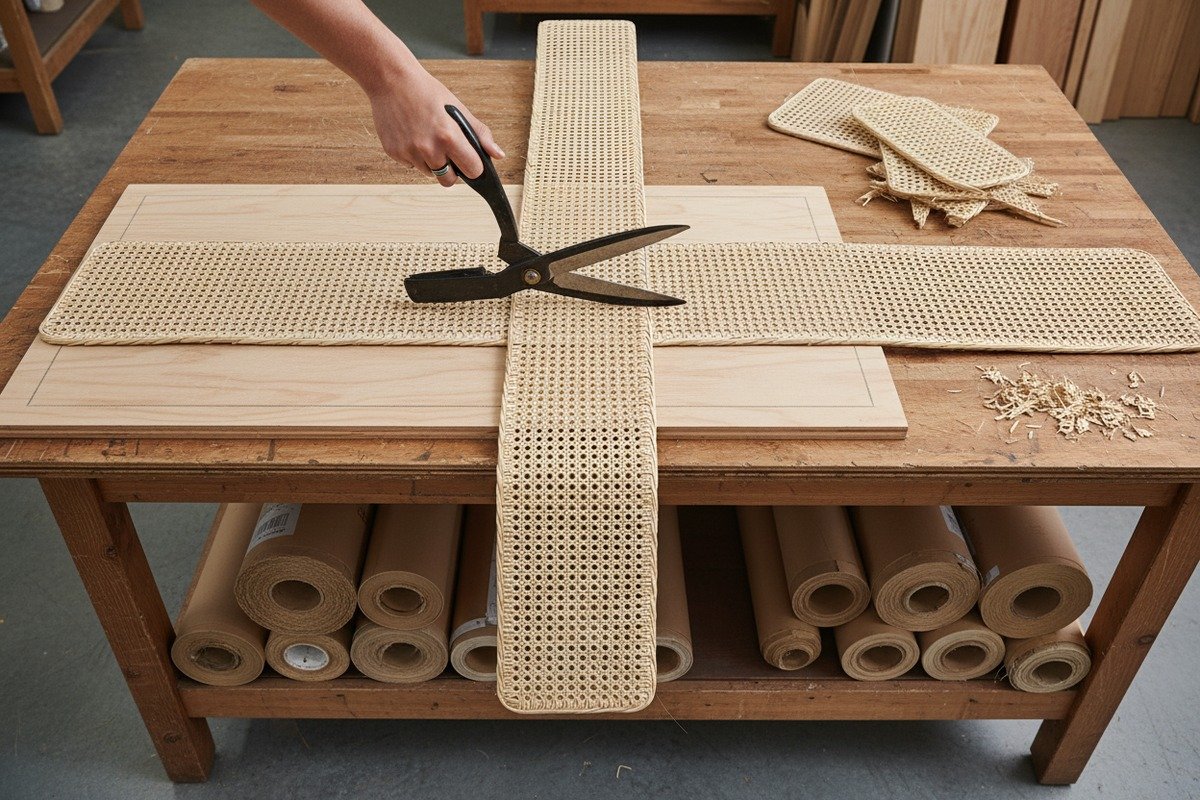
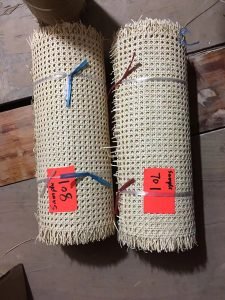
Rattan cane webbing is typically sold in rolls defined by two dimensions: width and length (running feet). Common roll widths 9 include 18 inches (45 cm), 24 inches (60 cm), 36 inches (90 cm), and occasionally 48 inches (120 cm). Roll lengths vary by supplier, but standard runs are 50 feet, 100 feet, or by-the-meter equivalents.
At our facilities, we offer both standard and custom roll widths. Choosing the right width is critical because it determines how many cuts you make and how much edge waste you generate.
Matching Roll Width to Your Project
Pick the narrowest roll width that still covers your largest dimension (after adding overlap). If your cabinet panel is 22 inches wide (including overlap), an 18-inch roll will not work — you need 24-inch. If your chair seat is 17 inches adjusted, an 18-inch roll is perfect.
The Full Calculation Formula
Here is the step-by-step formula for a production run:
- Per-piece adjusted dimensions: Opening + overlap on all sides.
- Pieces from one row across the roll width: Roll width ÷ piece width (adjusted) = pieces per row. Round down.
- Linear feet per piece: Piece height (adjusted) ÷ 12 = linear feet consumed per piece.
- Total linear feet for all pieces: (Total pieces ÷ pieces per row) × linear feet per piece.
- Add waste buffer: Total linear feet × 1.10 (for 10%) or × 1.15 (for 15%).
- Number of rolls: Buffered total linear feet ÷ roll length. Round up.
Worked Example: 200 Cabinet Door Panels
Suppose you need webbing for 200 cabinet door panels, each with an adjusted dimension of 14 inches wide × 20 inches tall.
| Шаг | Calculation | Result |
|---|---|---|
| Roll width selected | 36 inches | — |
| Pieces per row across roll | 36 ÷ 14 = 2.57 → round down | 2 pieces per row |
| Linear feet per piece | 20 ÷ 12 | 1.67 ft |
| Rows needed for 200 pieces | 200 ÷ 2 | 100 rows |
| Total linear feet (base) | 100 × 1.67 | 167 ft |
| Add 15% waste buffer | 167 × 1.15 | 192 ft |
| Roll length available | 50 ft per roll | — |
| Number of rolls needed | 192 ÷ 50 = 3.84 → round up | 4 rolls |
So you would order 4 rolls of 36-inch-wide × 50-foot-long webbing. That gives you 200 feet of material — an 8-foot safety margin beyond the buffered estimate.
Don't Forget Spline and Accessories
If your production uses the spline-groove method 10, you also need to order spline reed. The standard is one 6-foot coil per chair seat (average perimeter around 4.5–5.5 feet, with extra for mitered corners). For 200 chairs, that means 200 coils or equivalent bulk spline footage.
Communicate with Your Supplier Early
Before placing a large order, send your supplier three things: the per-piece dimensions, the total quantity, and a photo or drawing of the frame. At Seafan Rattan, we offer pre-production samples cut to size so buyers can verify fit, pattern orientation, and color before committing to a full run. This step alone eliminates 90% of mid-production issues.
How can I calculate my total material costs based on the specific grade and width of the rattan cane webbing I choose?
Cost control is where most purchasing managers spend their time — and it is where the grade, width, and pattern of rattan webbing create the biggest price swings. We have seen orders where switching from a premium hexagonal pattern to a standard open weave cut material costs by 30% with no loss in visual appeal.
To calculate total material costs, multiply the number of rolls needed by the per-roll price, which varies by grade (A, B, or C), weave pattern, and roll width. Add costs for spline, adhesive, and shipping. Grade A fine hexagonal webbing typically costs 30–50% more than Grade B standard open weave, so matching grade to project requirements is essential for budget control.
How Grade Affects Price
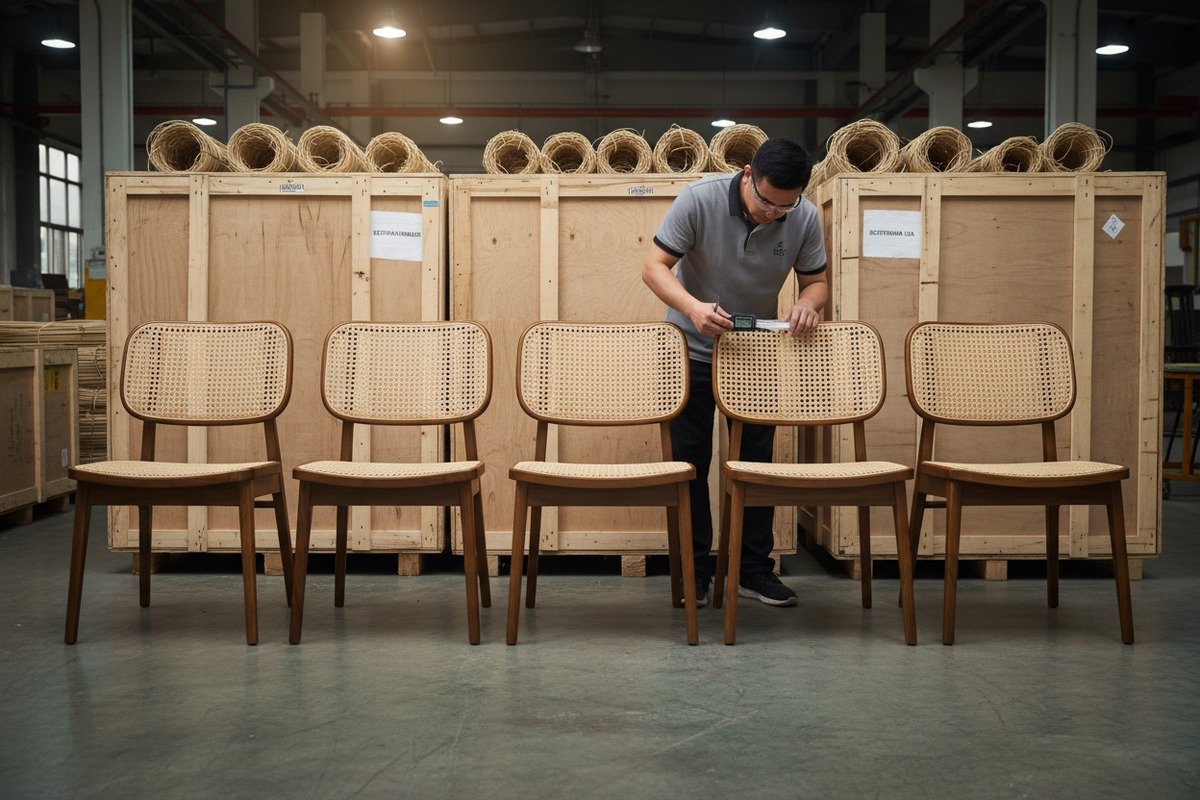
Rattan cane webbing grades reflect the quality of the raw cane peels, weave consistency, color uniformity, and defect rate. Here is how we classify them at our processing facility:
- Сорт А: Uniform color, tight weave, minimal knots, smooth surface. Ideal for high-end furniture and visible surfaces.
- Сорт B: Slight color variation, occasional minor knots, structurally sound. Good for mid-range furniture and painted/stained applications.
- Сорт C: Noticeable color variation, more frequent knots, some loose weave sections. Suitable for hidden panels, budget projects, or practice.
Price Ranges by Grade and Pattern
Prices fluctuate with raw material costs and season, but the following table gives you a general framework based on current market rates. These are wholesale FOB prices per square meter — retail will be higher.
| Сорт | Узор | Approx. Price per m² (USD, FOB) | Типичное применение |
|---|---|---|---|
| Сорт А | Fine ½" hexagonal/octagonal | $6.00–$9.00 | High-end dining chairs, designer cabinets |
| Сорт А | Close weave / radio weave | $7.00–$10.00 | Premium headboards, feature panels |
| Сорт B | Standard open hexagonal | $4.00–$6.50 | Mid-range chairs, cabinet inserts |
| Сорт B | Квадратная сетка открытого плетения | $3.50–$5.50 | Decorative screens, room dividers |
| Сорт C | Standard open hexagonal | $2.50–$4.00 | Budget furniture, hidden panels |
| Отбеленный | Fine ½" hexagonal | $7.00–$11.00 | Scandinavian-style furniture, light interiors |
Building a Full Cost Estimate
Your total material cost is not just webbing. Here is a complete cost formula:
Total Cost = (Rolls × Price per Roll) + (Spline × Price per Foot) + Adhesive + Shipping + Import Duties
For our 200-cabinet-door example from the previous section, let's run the numbers with Grade B standard open hexagonal at $5.00/m². Each 36-inch × 50-foot roll covers approximately 13.9 m² (36 in = 0.914 m width × 50 ft = 15.24 m length = 13.9 m²).
- 4 rolls × $5.00/m² × 13.9 m² = 4 × $69.50 = $278.00 for webbing
- Spline: 200 pieces × 6 ft = 1,200 ft at ~$0.15/ft = $180.00
- Wood glue: ~$25.00
- Shipping (varies by destination): estimate $150–$400 for a small shipment
Total estimate: approximately $633–$883 for 200 panels. That is roughly $3.15–$4.42 per panel for all materials.
Reducing Cost Without Sacrificing Quality
From working with buyers across 15+ countries, here are the most effective cost-saving strategies:
- Match grade to visibility: Use Grade A only where customers will see and touch the webbing. Use Grade B for secondary surfaces.
- Optimize roll width: As discussed, minimizing off-cut waste directly reduces cost per piece.
- Заказывайте оптом: Pricing drops significantly at 20+ roll quantities. Ask your supplier for tiered pricing.
- Combine shipments: If you need webbing, spline, and rattan poles, consolidate into one shipment to reduce per-item freight.
- Plan ahead: Rush orders cost more. Standard lead times of 2–4 weeks for production plus shipping give you the best pricing.
Pattern Selection Matters for Cost
The weave pattern affects both price and material efficiency. Fine ½" hexagonal (where the center-hole-to-center-hole distance is 0.5 inches) requires more cane strips per square meter than a large open square grid. More cane means more weight per roll and higher cost. However, denser patterns also tend to be more durable and premium-looking, which can justify a higher product price for your end customer.
When choosing a pattern, consider the weave direction as well. Fine ½" patterns are truly bidirectional — they look the same installed horizontally or vertically. Hexagonal with star inserts, however, has a clear visual grain. Misaligning these across adjacent panels is a common mistake that looks unprofessional and may require re-cutting.
Our recommendation: request a sample swatch of your chosen pattern and grade before committing. At Seafan Rattan, we ship sample sets free of charge to verified business buyers. This small step prevents expensive mid-production pattern changes.
Заключение
Calculating rattan cane webbing area and quantity comes down to accurate measurements, proper waste buffers, smart roll selection, and grade-matched costing. Use the formulas and tables in this guide to plan your next order with confidence.
Сноски
1. Found a guide detailing multiple fitting methods, including glue and staple. ↩︎
2. Provides context on rattan’s natural properties and biodegradability. ↩︎
3. Defines the component used to secure cane webbing in grooves. ↩︎
4. Highlights the importance of using the correct tool for accurate measurements. ↩︎
5. Offers a general definition and overview of a manufacturing production line. ↩︎
6. Provides general information about the material’s characteristics and uses. ↩︎
7. Details the role and responsibilities of quality control in manufacturing. ↩︎
8. Found an article explaining that rattan webbing shrinks and contracts as it dries after soaking. ↩︎
9. Lists standard dimensions for rattan cane webbing rolls. ↩︎
10. Explains a common rattan installation technique for furniture. ↩︎

 English
  Español de México
  العربية
  Deutsch
  Français
  Русский