
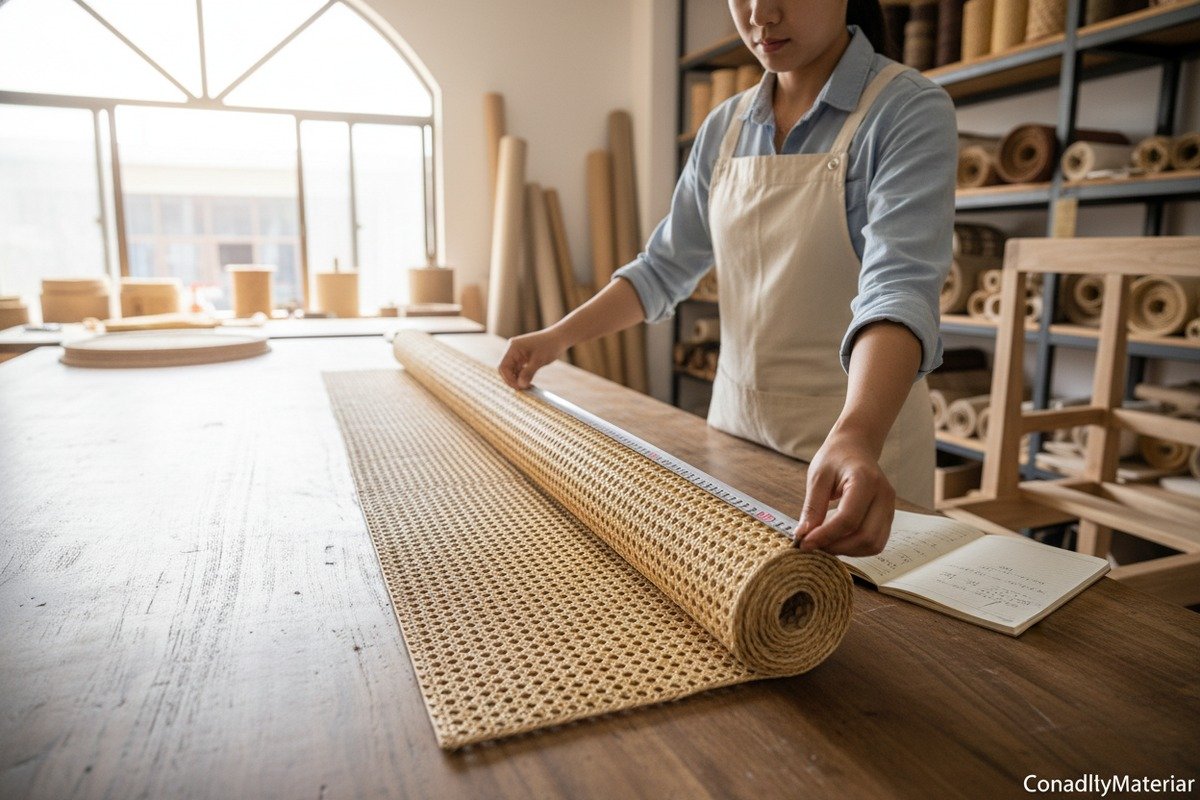
Every week, our production team in Foshan processes hundreds of orders where the biggest headache is always the same — customers order too little or too much ротанговая сетка 1.
To calculate rattan cane webbing usage, measure your furniture opening from groove to groove, add 2 to 4 inches of allowance on each side for spline installation, then select a roll width that covers the widest adjusted dimension. Divide adjusted measurements by 12 to convert to feet, and order by the running foot.
This guide walks you through the exact steps we use in our factories and share with our wholesale buyers spline installation 2. You will learn how to measure, how much extra to add, which roll width to pick, and how to estimate material for bulk runs. Let us get into the details.
How do I accurately measure my furniture frames to calculate the total rattan webbing I need?
We ship rattan webbing to furniture factories in over a dozen countries, and measurement errors cause more returns than any quality issue шпунта из тростника 3. Getting the numbers right at the start saves time, money, and frustration.
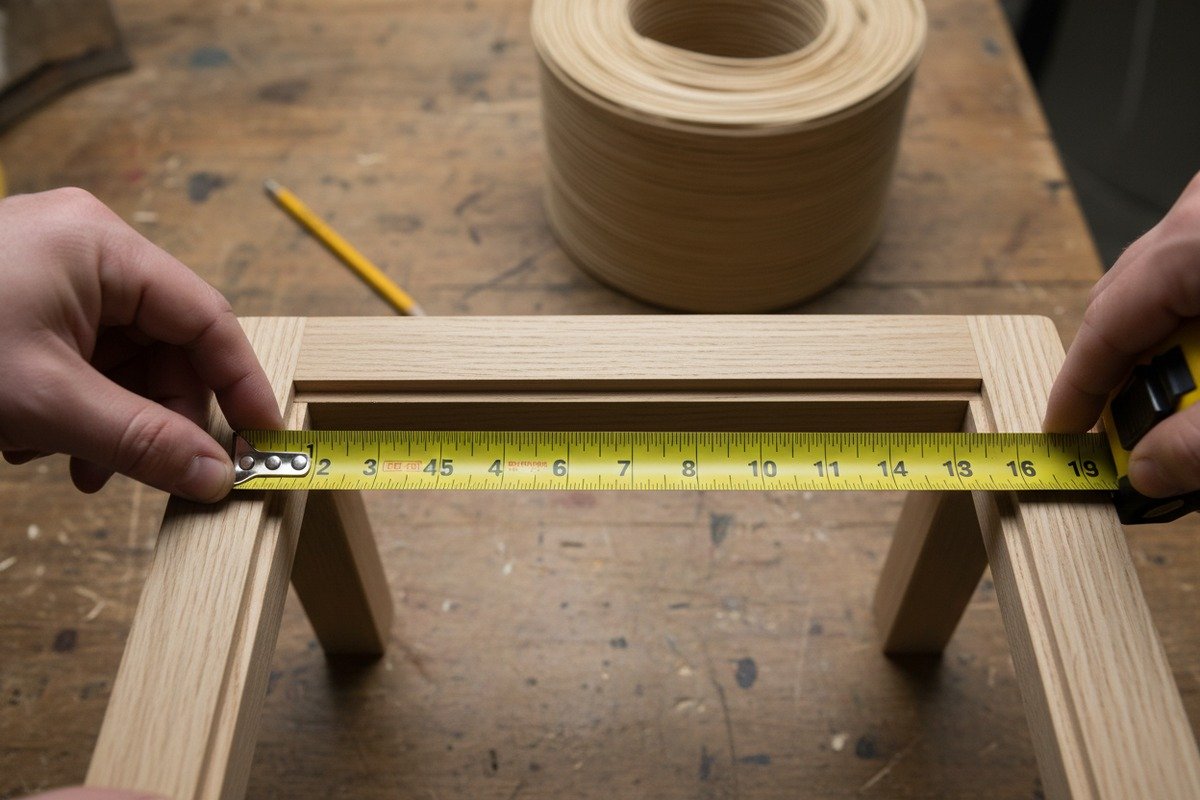
To accurately measure your furniture frames, use a tape measure to find the groove-to-groove or spline-to-spline distance for both width and length. These inside dimensions define the exact weaving area. Always measure at multiple points to account for frame irregularities.
Understanding What You Are Measuring
The first thing to know is that you are not measuring the outside of the chair frame. You are measuring the inside opening — the area where the webbing will actually sit. On most furniture pieces with pre-woven cane webbing 4, there is a groove (also called a channel) routed into the frame. This groove holds the spline that locks the webbing in place.
Your measurement goes from the inside edge of one groove to the inside edge of the opposite groove. This is your "groove-to-groove 5" dimension. Some guides call it "spline-to-spline." Both mean the same thing.
Where to Measure on Different Furniture Types
Different furniture pieces have different measurement points. Here is a quick reference:
| Furniture Type | Measurement Points | Common Opening Size |
|---|---|---|
| Сиденье обеденного стула | Inside groove on all four sides | 14" x 16" to 18" x 20" |
| Chair back panel | Inside groove top to bottom, side to side | 12" x 14" to 16" x 22" |
| Панель дверцы шкафа | Inside channel on door frame | 10" x 12" to 18" x 30" |
| Панель изголовья | Inside groove or rabbet edge 6 | 24" x 36" to 48" x 60" |
| Bench seat | Inside groove on frame | 16" x 36" to 20" x 48" |
Measure at Multiple Points
Frames are not always perfectly square. On a chair seat, the front edge is often wider than the back edge. Measure at the widest point and use that number. If the front is 18 inches and the back is 15 inches, use 18 inches as your width.
Also measure diagonally corner to corner. If the two diagonal measurements differ by more than 1/4 inch, the frame is out of square. You will need to cut the webbing slightly oversized to compensate.
Необходимые инструменты
A simple retractable tape measure works fine. For curved frames, a flexible sewing tape 7 helps. Mark your measurements directly on the frame with painter's tape and a pencil. Write down every dimension — width, length, and groove width 8. The groove width matters later when you select your spline size.
Our factory teams always double-check measurements before cutting. Once webbing is trimmed, you cannot add material back. This single habit prevents most waste.
Groove Dimensions Matter Too
The groove itself is typically 1/4 inch wide and 1/4 inch deep. Some larger furniture uses 5/16-inch grooves. Measure the groove width with a small ruler or caliper. This dimension determines the spline size you will need, which in turn affects how much webbing tucks into the groove.
Clean out old spline and glue from used grooves before measuring. Debris can give you a false reading and cause fitting problems during installation.
How much extra allowance should I add to my dimensions to ensure a perfect fit during installation?
When our wholesale buyers in the Netherlands and Australia first started ordering from us, the most common question was always about allowance. Too little, and the webbing pulls out. Too much, and you waste material.
Add 2 inches of allowance per side (4 inches total per dimension) for beginners and standard spline installations. Experienced installers can use 1 inch per side (2 inches total). This extra material tucks into the groove and gets locked in place by the reed spline.
The Two Schools of Thought
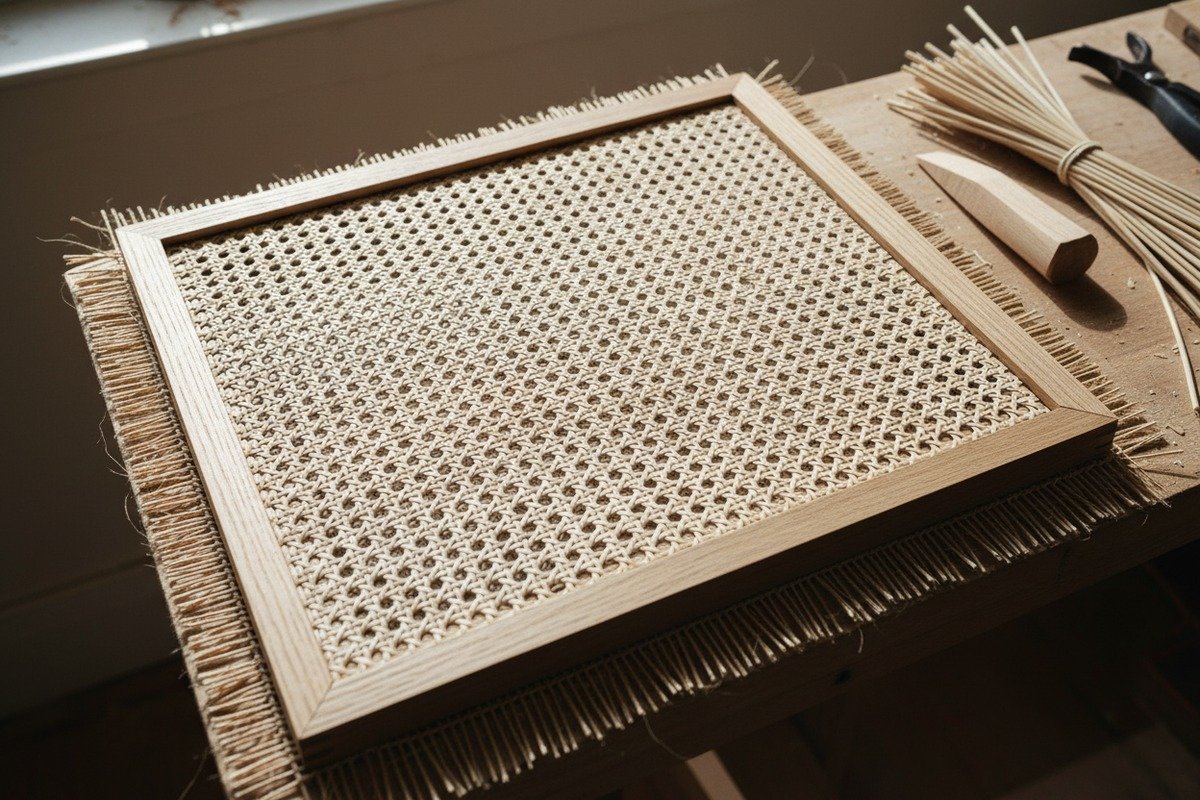
There is a genuine debate in the rattan furniture world about how much extra to add. Some professionals recommend 1 inch per side, giving you 2 inches total added to each dimension. Others recommend 2 inches per side, giving you 4 inches total.
Here is the practical difference: with 1 inch per side, you have just enough webbing to push into a standard 1/4-inch groove and hold it with the spline. There is very little room for error. With 2 inches per side, you have a comfortable working margin. You can adjust, re-position, and trim the excess after installation.
For our factory clients doing production runs, we recommend 1 inch per side because their workers are skilled and speed matters. For DIY customers and smaller workshops, we always suggest 2 inches per side.
How Allowance Affects Your Order
Let us walk through a real example. Say you have a dining chair seat that measures 14 inches wide by 18 inches long (groove to groove).
| Сценарий | Raw Width | Raw Length | Allowance Per Side | Adjusted Width | Adjusted Length |
|---|---|---|---|---|---|
| Tight fit (pro) | 14" | 18" | 1" per side | 16" | 20" |
| Standard fit (beginner) | 14" | 18" | 2" per side | 18" | 22" |
| Large panel (cabinet) | 24" | 36" | 1.5" per side | 27" | 39" |
The adjusted dimensions are what you use to select your roll width and calculate running feet needed.
Why You Should Never Cut Before Fitting
This is a rule we print on every packing slip we send out: do not trim the webbing until it is fully seated in the groove with the spline in place. Натуральная ротанговая циновка 9 shrinks slightly as it dries after soaking. If you cut it too early, you may end up short.
Soak the webbing in warm water for 30 minutes to 3 hours before installation. It becomes pliable and easier to push into grooves. As it dries, it tightens and becomes taut. Cutting before this process finishes can lead to gaps or the webbing pulling free from the spline.
Spline Allowance
Do not forget the spline itself. You need enough spline to go around the entire perimeter of the groove, plus about 1 to 2 inches of overlap where the ends meet. For a standard chair seat with a 14" x 18" opening, the groove perimeter is about 64 inches. Add 2 inches for overlap, so you need roughly 66 inches of spline.
Most spline is sold in coils. One coil typically covers one to two chairs. Match the spline diameter to your groove width — a 1/4-inch groove needs 1/4-inch spline. Using undersized spline will not hold. Using oversized spline will crack the groove.
Environmental Factors
If the furniture will live in a humid environment, install the webbing with slightly less tension. The cane will expand with moisture. In dry climates, install with a bit more tension because the cane may shrink further. This small adjustment prevents sagging or over-tightening over time.
Our clients in Saudi Arabia and Australia deal with very different humidity levels. We advise them differently on tension based on their local climate conditions.
Which rattan roll width should I choose to minimize waste based on my specific furniture sizes?
From our warehouse in Foshan, we stock five standard roll widths and ship them globally. Choosing the right width is where most cost savings happen — or where the most money gets wasted.
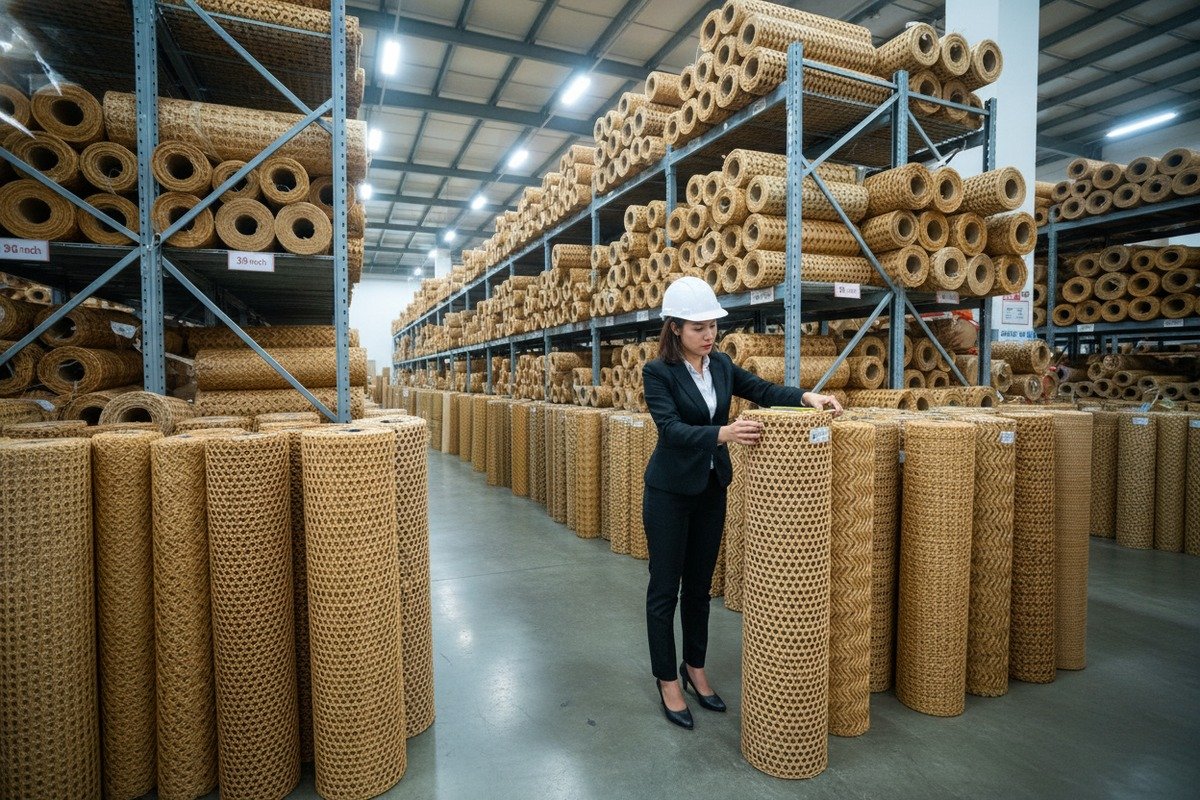
Choose a rattan roll width that matches or slightly exceeds your largest adjusted dimension. Standard widths are 18", 19", 20", 24", and 36". If your adjusted dimension is 22 inches, select the 24-inch roll. Choosing too wide wastes material; choosing too narrow means the webbing will not cover your opening.
Standard Roll Widths and Their Best Uses
Each roll width serves specific furniture types. Here is what we recommend based on years of production data:
| Ширина рулона | Лучше всего подходит для | Adjusted Dimension Range | Approx. Price Range (per ft) |
|---|---|---|---|
| 18" (1.5 ft) | Standard dining chair seats and backs | Up to 18" | $0.07 – $0.09 |
| 19" | Slightly wider chairs, vintage restorations | Up to 19" | $0.08 – $0.10 |
| 20" | Wider chair seats, small cabinet doors | Up to 20" | $0.08 – $0.11 |
| 24" (2 ft) | Large chairs, medium cabinet panels | Up to 24" | $0.10 – $0.14 |
| 36" (3 ft) | Headboards, bench seats, large panels | Up to 36" | $0.14 – $0.18 |
Prices vary by webbing pattern. Fine 1/2-inch open hexagonal mesh (the classic "radio weave") is the most popular and widely stocked. Dense square basketweave and diamond motifs may cost more due to the extra material in each weave.
The Width Selection Formula
Step 1: Take your adjusted width (raw measurement + allowance).
Step 2: Take your adjusted length (raw measurement + allowance).
Step 3: Identify which is larger.
Step 4: Select the roll width that matches or exceeds the larger number.
For example, if your adjusted dimensions are 18 inches wide and 22 inches long, your larger dimension is 22 inches. You need at least a 24-inch roll. You will then order enough running feet to cover the 18-inch dimension — that is 18 ÷ 12 = 1.5 feet of running length.
Cutting Orientation Matters
Here is a detail many people miss. Rattan webbing has a grain direction. The weave pattern runs along the length of the roll. For structural integrity and visual consistency, align the grain with the longest dimension of your furniture opening when possible.
This sometimes means rotating your cutting orientation. If you have a 16" x 22" opening, you could cut from a 24"-wide roll with 1.5 feet of running length (covering the 16" dimension). Or you could cut from an 18"-wide roll with about 2 feet of running length (covering the 22" along the roll length). The second option uses a narrower, cheaper roll but more running length.
Minimizing Waste on Multi-Piece Projects
When you are cutting multiple pieces from one roll, plan your cuts before you start. Lay out all your dimensions and see how they nest together. For instance, if you have six dining chairs with 16" x 20" openings, using a 24"-wide roll lets you cut pieces side by side with 4 inches of waste per cut versus using 36" rolls where you waste 16 inches of width per piece.
Digital templating or nesting software helps for large production runs. Our factory team uses simple spreadsheets for most projects. Even a hand-drawn layout on graph paper works well for small batches.
Natural vs. Synthetic Considerations
Natural rattan webbing (from rattan palm peel) is for indoor use. It needs soaking before installation and is sensitive to prolonged moisture. Синтетическая ротанговая тесьма 10 mimics the look with plastic materials. It is weather-resistant and does not require soaking.
Both come in the same standard widths. But synthetic tends to be slightly stiffer, so it may need a bit more allowance during installation. Factor this into your width selection if you are working with synthetic material.
How do I estimate the total material volume required for my bulk furniture production run?
Running production estimates is something we do daily for our B2B clients — furniture factories in the US, wholesalers in Spain, and builders in Turkey. Getting bulk estimates wrong means either production delays from shortages or capital tied up in excess inventory.
To estimate bulk material volume, multiply the adjusted running feet needed per piece by your total unit count, then add 10-15% for cutting waste, pattern alignment, and defective sections. Group pieces by required roll width and order each width separately for maximum efficiency.
The Bulk Estimation Formula
Here is the step-by-step process we walk our wholesale buyers through:
Step 1: Calculate the adjusted dimensions for one piece (groove-to-groove + allowance).
Step 2: Determine the roll width needed.
Step 3: Calculate running feet for one piece (smaller adjusted dimension ÷ 12).
Step 4: Multiply by total units.
Step 5: Add waste factor (10% for experienced cutters, 15% for new teams).
Worked Example: 200 Dining Chairs
Let us say a furniture factory needs webbing for 200 dining chair seats. Each seat measures 15 inches wide by 17 inches long, groove to groove. Using 1-inch-per-side allowance (production setting):
- Adjusted width: 15 + 2 = 17 inches
- Adjusted length: 17 + 2 = 19 inches
- Larger adjusted dimension: 19 inches → Select 20-inch roll
- Running feet per chair: 17 ÷ 12 = 1.42 feet → round up to 1.5 feet
- Subtotal for 200 chairs: 200 × 1.5 = 300 running feet
- Add 10% waste: 300 × 1.10 = 330 running feet
Order 330 running feet of 20-inch-wide rattan cane webbing.
Spline and Tool Requirements
For the same 200 chairs, calculate spline needs:
- Groove perimeter per chair: 2(17) + 2(19) = 72 inches = 6 feet
- Add 2 inches overlap: 74 inches per chair
- Total spline: 200 × 74 = 14,800 inches = 1,233 feet
- Add 5% waste: ~1,295 feet of spline
You will also need wedges, a rubber mallet, a chisel for groove cleaning, and white glue. Budget approximately $20-50 in tools per workstation for a production setup.
Multi-Product Estimation
Many of our clients produce different furniture types in the same production run. Group your products by the roll width they require:
| Продукт | Units | Adjusted Dims | Ширина рулона | Running Ft/Unit | Total Running Ft |
|---|---|---|---|---|---|
| Сиденье обеденного стула | 200 | 17" x 19" | 20" | 1.5 | 300 |
| Dining chair back | 200 | 14" x 20" | 20" | 1.2 | 240 |
| Панель дверцы шкафа | 50 | 16" x 28" | 18" | 2.4 | 120 |
| Панель изголовья | 20 | 28" x 50" | 36" | 2.4 | 48 |
Now apply waste factors to each group separately. The dining chairs can share 20-inch rolls. The cabinet doors use 18-inch rolls (the 16-inch adjusted width fits within 18 inches, and the 28-inch adjusted length runs along the roll). The headboard panels need 36-inch rolls.
Pattern Alignment for Consistency
When working with rattan webbing patterns — especially the hexagonal radio weave or diamond motifs — consistent pattern alignment across all pieces matters for visual quality. This means you may lose extra material at the start of each cut to align the pattern.
For hexagonal mesh with a 1/2-inch repeat, expect to lose up to 1 inch per cut for alignment. On a 200-unit run, that adds up to roughly 200 inches, or about 17 extra feet. Build this into your waste factor.
Цены и сроки выполнения заказа
Bulk orders get better pricing per foot. When we quote our wholesale clients, we tier pricing based on quantity:
- Under 100 feet: Standard retail price
- 100–500 feet: 5-10% discount
- 500–1,000 feet: 10-15% discount
- Over 1,000 feet: Custom quote with best rates
Lead times for standard webbing patterns are typically 7-14 days from our Foshan warehouse. Custom patterns or colors (like bleached or stained rattan) may need 3-4 weeks. Plan your orders accordingly, especially during peak furniture production seasons.
Quality Checks Before Cutting
Before starting a production run, inspect the first 3-5 feet of each roll. Look for broken strands, color inconsistency, or weave defects. Mark any defective sections and exclude them from your usable footage calculation. At our facility, we grade all webbing before shipping. Grade A material has fewer than 2 defects per 10 running feet. This is the standard our clients like Ranoo in Thailand expect.
Заключение
Calculating rattan cane webbing usage comes down to four clear steps: measure accurately, add proper allowance, choose the right roll width, and factor in waste for bulk orders.
Сноски
1. Defines rattan cane webbing as a pre-woven material from rattan’s outer skin. ↩︎
2. Provides a step-by-step guide on how to install cane webbing with spline. ↩︎
3. Defines reed spline as a wedge-shaped reed used to secure cane webbing. ↩︎
4. Found a relevant and authoritative replacement URL for pre-woven cane webbing. ↩︎
5. Explains the importance of groove-to-groove measurement for cane webbing kits. ↩︎
6. Defines a rabbet as a recess cut into a workpiece edge for joining. ↩︎
7. Explains the utility of flexible tape measures for curved measurements in sewing. ↩︎
8. Emphasizes matching spline size to groove width for proper cane webbing installation. ↩︎
9. Highlights the durability, flexibility, and sustainable aspects of natural rattan cane webbing. ↩︎
10. Describes synthetic rattan webbing as a durable, weather-resistant alternative to natural rattan. ↩︎

 English
  Español de México
  العربية
  Deutsch
  Français
  Русский