
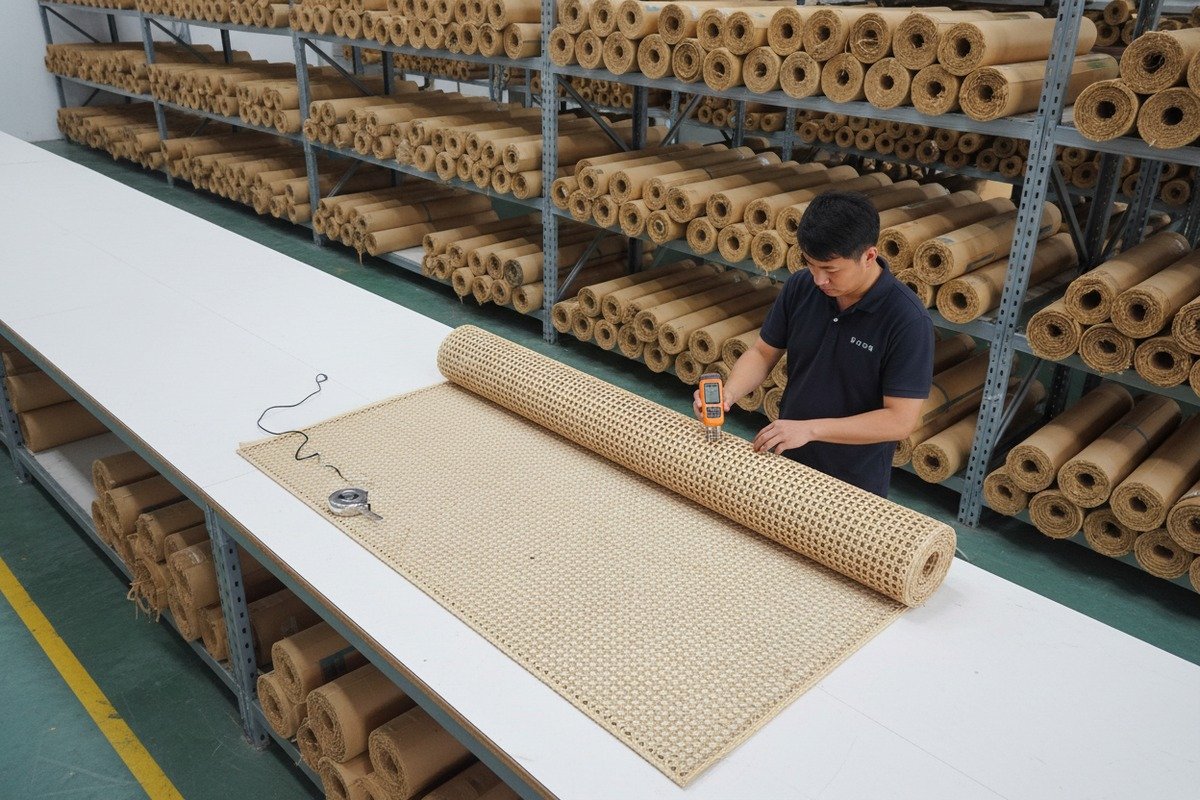
Every week at our Foshan warehouse, we unload containers of rattan cane webbing from our Indonesian processing facility — and every week, we catch issues that could have cost our buyers thousands.
To conduct sampling inspections for bulk natural rattan cane webbing, select 5–10% of rolls from different positions in the shipment. Check each sampled roll at three points — beginning, middle, and end — for weave consistency, surface defects, moisture content below 12%, dimensional accuracy, and correct quality grading.
This guide walks you through each step of a proper sampling inspection. Whether you are a furniture factory procurement manager or a materials wholesaler, these methods will help you accept shipments with confidence and avoid costly surprises.
How do I verify the quality grade of my bulk rattan cane webbing?
One lesson we learned early on when shipping to buyers in the Netherlands and Australia is that "Grade A" means different things to different people. Without a shared grading framework, disputes become inevitable.
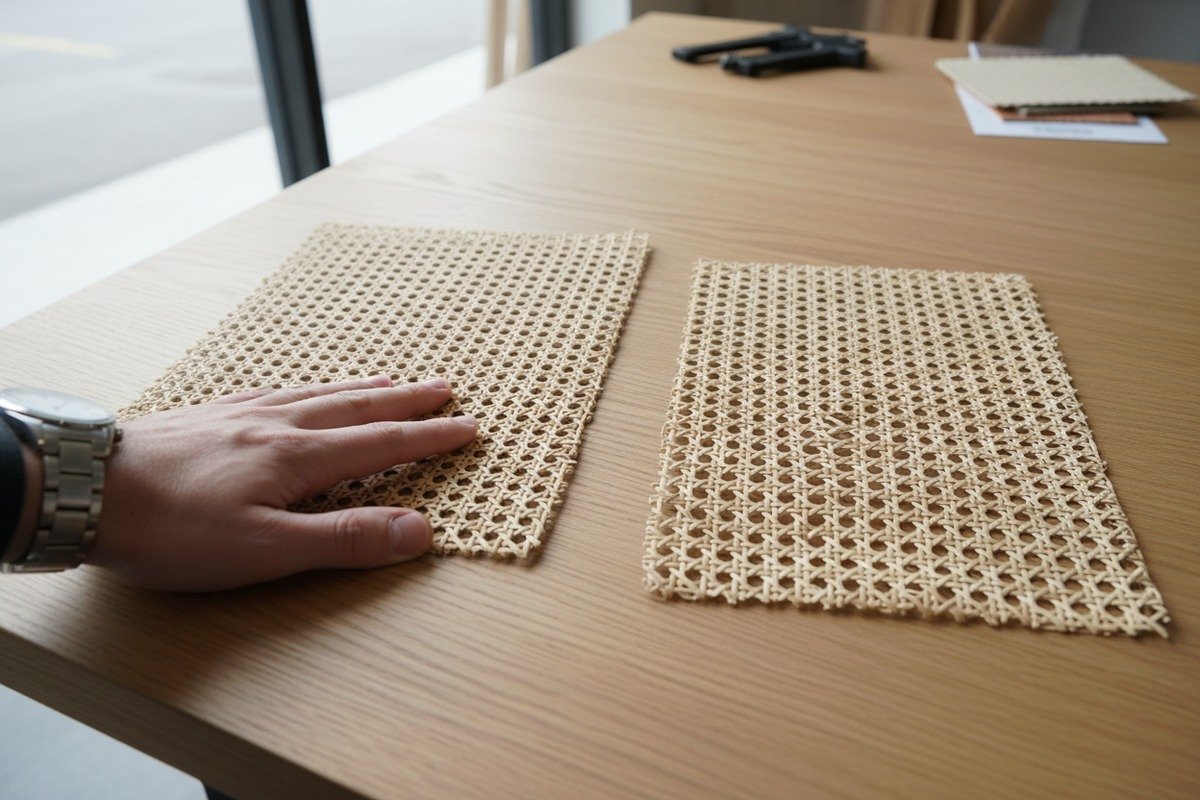
Verify the quality grade by comparing sampled rolls against a pre-agreed reference standard. Check fiber texture, elasticity, surface smoothness, color uniformity, and splice frequency. Grade A rattan should have fine texture, high elasticity, minimal splices, and consistent color throughout the roll.
Understanding the Four-Tier Grading System
Most rattan cane webbing manufacturers use a four-tier grading system: A, B, C, and D. Each grade reflects the quality of the raw rattan peel 1 before and after weaving. Here is what separates each grade in practice.
| Сорт | Fiber Texture | Эластичность | Гладкая поверхность | Splice Frequency | Типичное использование |
|---|---|---|---|---|---|
| A | Fine, uniform | Высокий | Very smooth | Minimal (1–2 per meter) | Premium furniture, visible panels |
| B | Slightly varied | Хорошая | Smooth with minor rough spots | Moderate (3–5 per meter) | Standard furniture, cabinet inserts |
| C | Noticeable variation | Умеренная | Some rough areas | Frequent (6–10 per meter) | Budget furniture, hidden panels |
| D | Coarse, uneven | Низкий | Местами шероховатая | Very frequent (10+ per meter) | Craft projects, non-structural use |
How to Match Grade to Your Order
Start by pulling your purchase order 2. It should state the agreed grade. Then take 5–10 rolls from different parts of the shipment. Do not just grab rolls from the top or front — quality can vary within a single batch because the final inspection and repair step at the factory is labor-intensive. At our Indonesian facility, one worker completes just one roll per day during the repair phase. This means rolls finished at the end of a production run may receive less attention.
Practical Steps for Grade Verification
First, lay out a one-meter section from each sampled roll on a clean, flat surface. Run your hand across it. Grade A should feel uniformly smooth. Count the splices in that one-meter section. Each splice is where two strips of rattan peel were joined during weaving. More splices mean lower grade.
Second, test elasticity. Gently bend a section of the webbing. Grade A rattan should flex without cracking or splitting. If you hear a snap or see white stress lines, the grade is likely lower than stated.
Third, check color consistency. Natural rattan ranges from light beige to straw yellow. Indonesian rattan tends to be lighter and smoother, while Vietnamese rattan runs darker and rougher. If the stated origin is Indonesian but the color and texture suggest otherwise, flag it.
Finally, document everything. Take photos of each sampled roll with a ruler for scale. Note the splice count, any surface defects, and your elasticity test results. This creates a baseline you can reference for future shipments from the same supplier.
When Grade Disputes Happen
We always recommend that buyers request a physical sample swatch before placing a bulk order. Keep that swatch as your reference standard. When the bulk shipment arrives, compare it side by side. This simple step has prevented dozens of disputes for our clients in Spain, Turkey, and the USA.
What specific defects should I look for during my sampling inspection?
Over the years, our quality team has built a defect library from returns and complaints across more than a dozen export markets. The patterns are clear — most defects fall into a handful of categories, and catching them early saves everyone time and money.
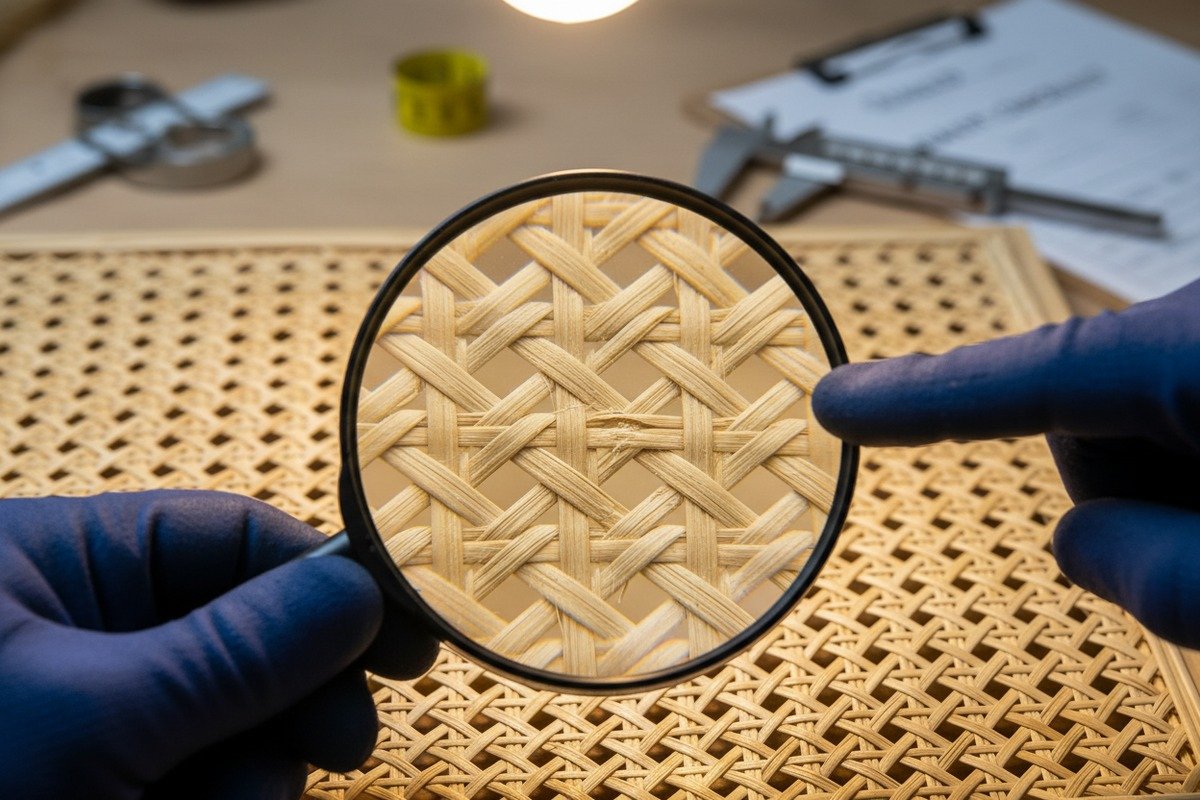
During sampling inspections, look for loose or broken strands, inconsistent weave patterns, surface cracks, rough or unsanded areas, mold or mildew spots, insect damage, excessive or poorly executed splices, color inconsistencies, and frayed or uneven roll edges. Each defect type affects the webbing's structural integrity and visual appeal differently.
Categorizing Defects by Severity
Not all defects are equal. Some are cosmetic and acceptable within tolerances. Others are structural and should trigger rejection. Here is how we classify them at our facilities.
| Тип дефекта | Категория | Серьезность | Действие |
|---|---|---|---|
| Loose strands | Structural | Высокий | Reject roll or request repair credit |
| Сломанные пряди | Structural | Высокий | Reject roll |
| Inconsistent weave pattern | Structural/Visual | Medium–High | Reject if pattern integrity is compromised |
| Surface cracks | Visual/Structural | Средний | Accept with discount or reject based on frequency |
| Rough or unsanded spots | Visual | Низкий – Средний | Accept if isolated; reject if widespread |
| Mold or mildew spots 5 | Structural/Health | Высокий | Reject immediately |
| Insect holes or damage | Structural | Высокий | Reject immediately |
| Poorly executed splices | Structural | Средний | Accept if infrequent; reject if splices pull apart |
| Color inconsistency | Visual | Низкий – Средний | Accept within agreed tolerance |
| Frayed roll edges | Visual | Низкий | Accept if trim-able; reject if extends into usable area |
How to Inspect for Structural Defects
Structural defects compromise the webbing's ability to perform in furniture or architectural applications. These are the ones that matter most.
Pull a sampled roll open and examine it section by section. At each checkpoint — beginning, middle, and end of the roll — look for loose weaving. During the machine weaving phase, what manufacturers call the "Flying Thread" step, strands can slip out of alignment. This creates gaps or raised threads that weaken the overall structure.
Try a gentle pull test. Grip two intersecting strands and pull them apart lightly. On quality webbing, they should resist separation. If strands slide easily or separate, the weave tension was insufficient during production.
Surface and Visual Defects
Surface defects are easier to spot but often overlooked in the rush to clear incoming shipments. Lay the webbing flat under good lighting — natural daylight is best. Tilt the surface at different angles to catch rough spots, cracks, and color variations.
For mold and mildew, use both your eyes and your nose. Mold appears as dark spots or fuzzy patches, often near roll edges where moisture can accumulate. If the rattan smells musty, investigate further even if you cannot see visible mold. Влажность 6 should be below 12%. A simple pin-type moisture meter can confirm this in seconds.
Chemical Residue Concerns
Some rattan webbing undergoes bleaching or anti-mildew treatment. If your order specifies natural, untreated rattan, check for chemical residues. Semi-bleached rattan should be uniformly lighter. Fully bleached rattan should be consistent in its pale tone. Uneven bleaching suggests poor process control. For buyers supplying to markets with strict safety regulations — like the EU or Australia — consider requesting test certificates for chemical residue levels.
Documenting Defects Effectively
Create a simple defect log for each sampled roll. Record the roll number, the defect type, its location on the roll, and its severity. Take close-up photographs with a reference object like a coin or ruler. This documentation becomes invaluable during claims, negotiations, or when building a supplier scorecard over time.
How can I ensure the dimensions and roll lengths match my order specifications?
When we prepare shipments for furniture factories in Greece or material wholesalers in Saudi Arabia, dimensional accuracy 7 is always in the top three concerns. A roll that is two inches too narrow or five feet too short disrupts entire production schedules downstream.
Ensure dimensional accuracy by measuring webbing width, mesh size, and roll length at three points per sampled roll. Use a calibrated tape measure for width and length. Compare results against your purchase order specifications. Acceptable tolerance for natural rattan is typically ±5mm on width and ±2% on roll length.
Key Dimensions to Measure
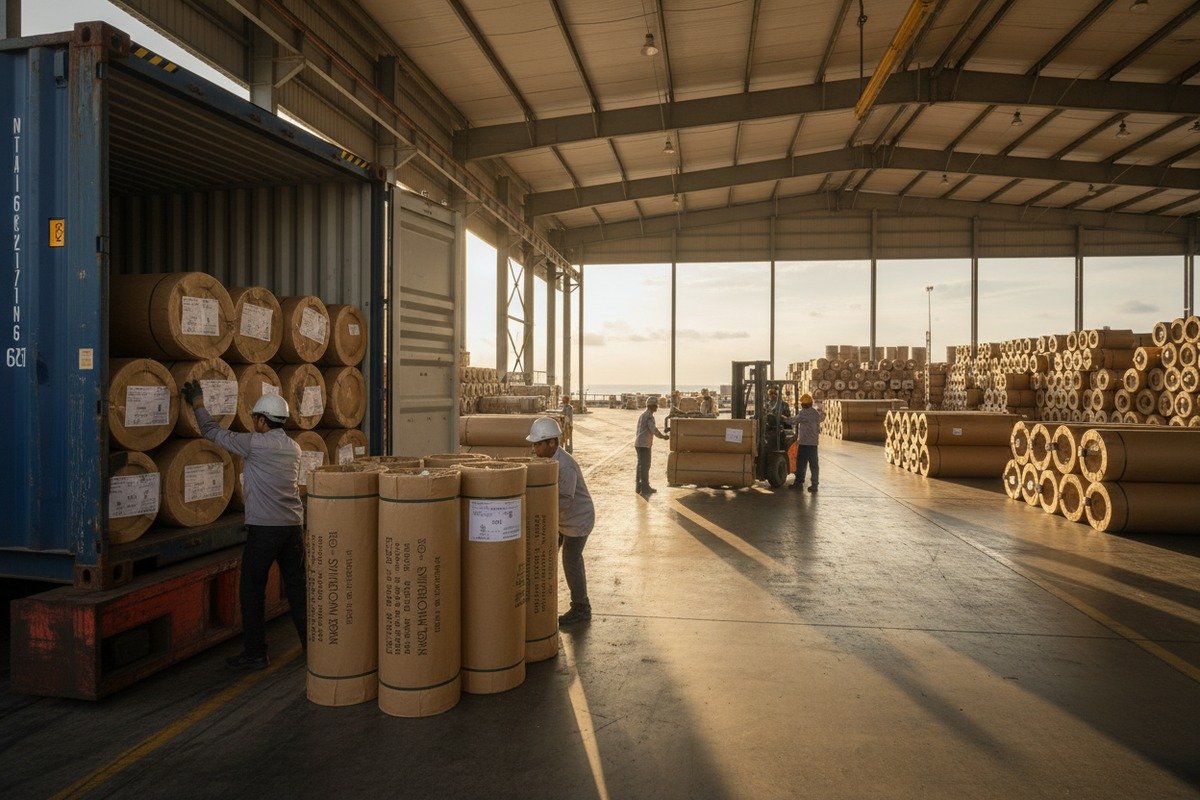
Natural rattan cane webbing has several critical dimensions. Each must be verified during sampling.
Ширина: Measure the full width of the webbing at the beginning, middle, and end of each sampled roll. Natural rattan can shrink or expand slightly depending on moisture content, so minor variation is expected. But the variation should stay within ±5mm of the specified width.
Mesh size: This is the size of the individual openings in the weave pattern. For the standard half-inch open weave, measure at least five mesh openings per checkpoint. Use a small ruler or caliper. Consistent mesh size ensures the webbing looks uniform when installed on furniture panels or cabinet doors.
Roll length: This is where disputes most often arise. Standard rolls are typically 50 feet (15.24 meters), but custom lengths are common. Unroll a few sampled rolls completely and measure. This is time-consuming but necessary, especially with a new supplier.
Thickness: Use a caliper to measure the thickness of the woven webbing at multiple points. Uneven thickness can cause problems during installation — thicker areas may not sit flush in routed channels.
Common Dimensional Issues
| Issue | Причина | How to Detect | Impact |
|---|---|---|---|
| Width variation within a roll | Uneven tension during weaving | Measure at three points per roll | Poor fit in furniture frames |
| Short roll length | Material waste during repair, or intentional short-rolling | Unroll and measure completely | Insufficient material for production |
| Inconsistent mesh size | Machine calibration drift | Measure five openings per checkpoint | Uneven appearance on finished product |
| Uneven thickness | Variation in rattan peel thickness | Caliper measurement at edges and center | Installation difficulties |
| Uneven edges | Poor trimming after weaving | Visual inspection along roll edge | Extra trimming labor required |
Splice Quality and Spacing
Since natural rattan peel varies in length, splicing is unavoidable. But splice quality directly affects both appearance and strength. Inspect each splice point in your sampled sections. A good splice should be tight, flat, and nearly invisible from the front side. Pull gently on each splice to confirm it holds.
Also check splice spacing. If splices cluster too closely together — say three within a 30-centimeter span — that section is structurally weaker and visually distracting. In Grade A webbing, splices should be well spaced and evenly distributed.
Working with Your Supplier on Tolerances
We always recommend that buyers discuss acceptable dimensional tolerances before placing orders. Put these tolerances in writing on the purchase order or in a quality agreement document. For example, specify "roll width 24 inches ±5mm" and "roll length 50 feet ±2%." This gives both parties a clear standard and reduces room for disagreement at the inspection stage.
If you find rolls outside tolerance during sampling, calculate what percentage of the sampled rolls fail. If more than 10–15% of sampled rolls exceed tolerance, this suggests a systemic issue rather than random variation, and the shipment may warrant broader inspection or negotiation.
What are the signs that my bulk rattan shipment has been packaged correctly for export?
From our experience shipping to over a dozen countries — from humid climates in Thailand and the Philippines to dry environments in Iran and Saudi Arabia — we have seen firsthand how packaging failures destroy otherwise perfect rattan webbing during transit.
Correctly packaged bulk rattan shipments feature rolls individually wrapped in moisture-resistant plastic or kraft paper, secured with non-abrasive ties, placed upright or in protective cardboard tubes, and packed in sturdy export cartons or palletized with stretch wrap. Silica gel desiccants should be included to control humidity during ocean freight.

Why Packaging Matters for Natural Rattan
Natural rattan is sensitive to moisture, temperature, and physical impact. During ocean freight 8, containers can experience temperature swings that cause condensation — what the industry calls "container rain." If the webbing is not properly protected, this moisture triggers mold growth, warping, and discoloration. At the same time, rough handling during loading and unloading can crush or deform rolls if packaging lacks adequate structural support.
What to Check on Each Roll
Start with the individual roll wrapping. Each roll should be wrapped in plastic film, wax paper, or kraft paper that creates a moisture barrier. Check that the wrapping is sealed — not just loosely folded around the roll. Open one or two wrapped rolls from the sampled batch to confirm the rattan inside is dry and undamaged.
Look for silica gel packets or desiccant sachets inside the wrapping or inside the outer carton. These absorb ambient moisture during transit. For ocean freight shipments, desiccants are essential, not optional. If they are missing, the risk of mold increases significantly.
Outer Packaging Standards
Examine the outer cartons or packaging. Export-grade cartons should be double-walled corrugated cardboard at minimum. Single-wall cartons are inadequate for ocean freight — they collapse under stacking pressure and offer poor moisture resistance.
If the shipment is palletized, check that rolls are stacked vertically (standing upright) rather than lying flat. Flat-stacked rolls at the bottom of a pallet bear the weight of everything above them and can deform. Stretch wrap should cover the entire pallet with multiple layers, and corner protectors should be in place.
Labeling and Identification
Every carton or pallet should be clearly labeled with the product description, grade, dimensions, roll count, gross weight, and net weight. This is not just good practice — it is a requirement for customs clearance in many markets. Missing or inaccurate labels create delays and additional costs.
Signs of Poor Packaging
Watch for these red flags during your inspection:
- Plastic wrap that is torn, punctured, or missing entirely
- No desiccants inside roll wrapping or cartons
- Single-wall cartons showing signs of crush or water damage
- Rolls stacked horizontally without separators
- Cartons with no labels or labels that do not match the packing list
- Tape or ties that have cut into the rattan surface, causing damage
- Musty or damp smell when opening cartons
The Cost of Getting Packaging Wrong
We have seen buyers lose entire container loads to mold because of inadequate packaging. Replacing a damaged shipment costs far more than investing in proper packaging upfront. When evaluating a new supplier, always ask for photos and specifications of their export packaging before the first order ships. Better yet, include packaging requirements in your purchase agreement alongside the product specifications.
If you are working with a supplier for the first time, request that they send a small trial shipment before committing to a full container. This lets you evaluate not just the product quality but also the packaging quality under real shipping conditions.
Заключение
Sampling inspections protect your investment and your production schedules. By verifying quality grade 10s, checking for specific defects, confirming dimensions, and assessing packaging, you can accept bulk rattan shipments with confidence and build stronger, more transparent supplier relationships.
Сноски
1. Explains that cane webbing is made from the outer skin of the rattan plant. ↩︎
2. Wikipedia provides an authoritative and comprehensive definition of a purchase order. ↩︎
3. Describes the material and its characteristics. ↩︎
4. Explains the purpose and process of random sampling inspection in quality control. ↩︎
5. Provides a comprehensive guide to preventing mold on rattan furniture. ↩︎
6. Discusses the importance of proper drying and moisture content for rattan quality. ↩︎
7. Explains dimensional inspection and its importance in manufacturing quality control. ↩︎
8. Provides an overview of ocean freight as a method of international shipping. ↩︎
9. Details the use of silica gel desiccants for cargo protection in shipping containers. ↩︎
10. Details the classification and key factors in rattan grading. ↩︎

 English
  Español de México
  العربية
  Deutsch
  Français
  Русский