
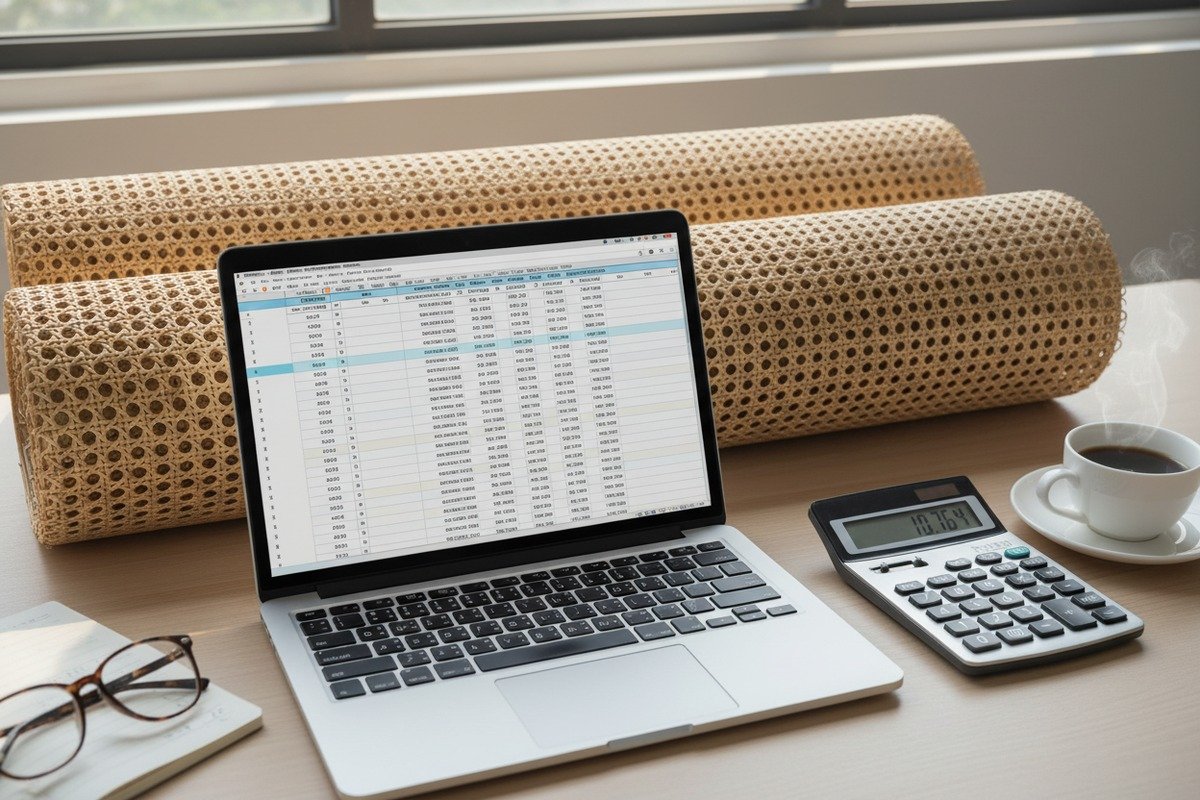
Every week, our sales team fields calls from buyers confused by mismatched pricing units on ротанговая сетка 1 quotes. One supplier lists per square foot. Another quotes per linear meter 2. A third gives a flat roll price. The frustration is real, and it costs businesses money when comparisons go wrong.
To convert rattan cane webbing prices from square foot to square meter, multiply the per-square-foot price by 10.764, since one square meter equals 10.764 square feet. For example, a price of $2.00 per square foot becomes approximately $21.53 per square meter using this simple conversion factor.
This guide walks you through the exact formulas, real-world price examples, and practical tips we use daily at our facilities to help global buyers compare quotes accurately shipping manifests 3. Let us break it down step by step.
How do I calculate the exact conversion from square feet to square meters for my rattan cane webbing order?
When we process orders from our warehouses in Foshan for buyers across 15+ countries, unit confusion is the single biggest source of quoting errors customs declarations 4. A small miscalculation can mean overpaying by hundreds of dollars on a bulk rattan webbing shipment.
To calculate the exact conversion, use the factor 1 square meter = 10.76391 square feet. Divide your total area in square feet by 10.764 to get square meters. For price conversion, multiply the per-square-foot price by 10.764 to obtain the equivalent per-square-meter price.
Understanding the Core Conversion Factor
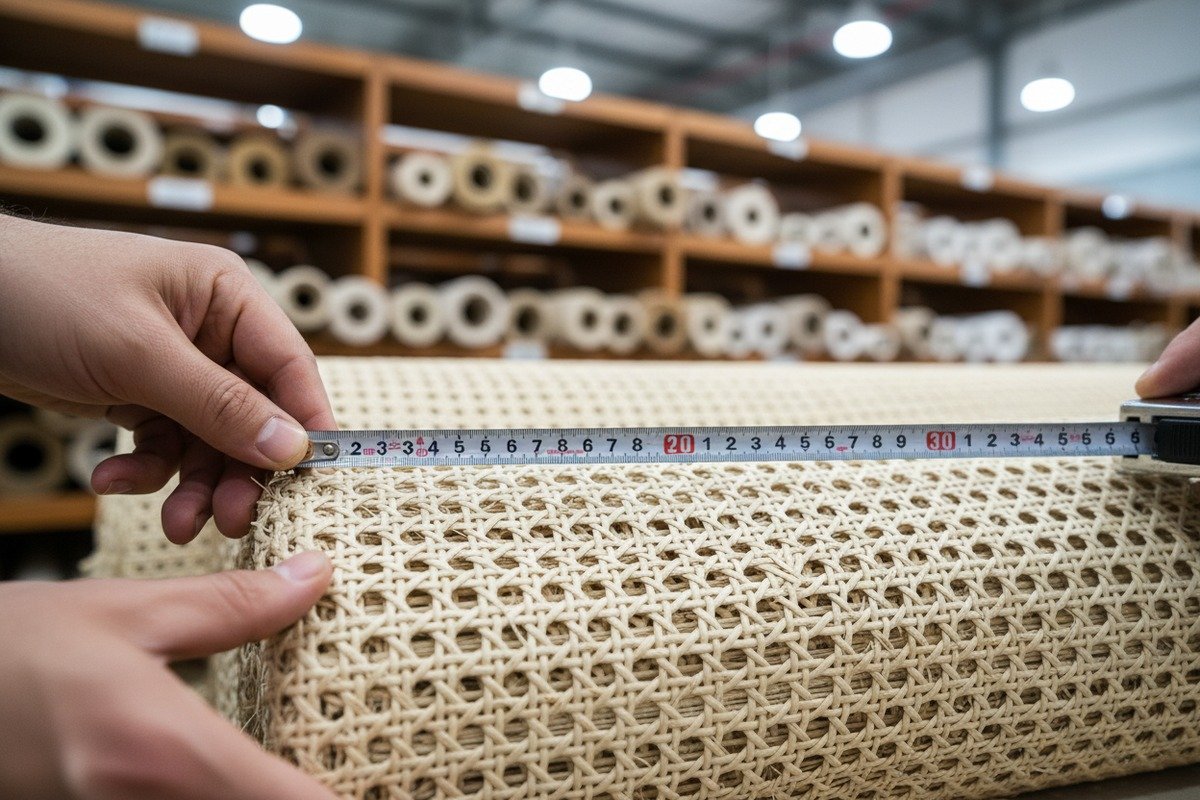
The relationship between square feet and square meter 5s is fixed. One square meter equals exactly 10.76391 square feet. For everyday business calculations, rounding to 10.764 is perfectly accurate. conversion factor 6 This means a square meter is roughly 10.8 times larger than a square foot 7. So when you convert a price from per square foot to per square meter, the number gets bigger—not smaller.
Many buyers make the mistake of dividing the price by 10.764 instead of multiplying. This gives you a number that is far too low and leads to serious budgeting errors.
Step-by-Step Conversion Process
Here is how to do it correctly:
- Identify the price per square foot. For example, ₹200 per sq ft from an Indian supplier.
- Multiply by 10.764. So ₹200 × 10.764 = ₹2,152.80 per sq m.
- Verify. A square meter is a bigger area, so the per-square-meter price should always be larger than the per-square-foot price.
If you need to go the other direction—from square meters to square feet—simply divide the per-square-meter price by 10.764. Or multiply the per-square-meter price by 0.09290304 for the same result.
Real-World Price Conversion Examples
Let me show you how this works with actual market prices we encounter regularly.
| Source | Price Per Sq Ft | × 10.764 | Price Per Sq Meter |
|---|---|---|---|
| Indian Supplier A (West Woods) | ₹200 | ₹200 × 10.764 | ₹2,152.80 |
| Indian Supplier B (Globus) | ₹214 | ₹214 × 10.764 | ₹2,303.50 |
| Indian Supplier C (Meraki) | ₹230 | ₹230 × 10.764 | ₹2,475.72 |
| US Etsy Seller (premium weave) | $0.25/lin ft (at 1ft width) | $0.25 × 10.764 | $2.69/sq m equiv. |
| Bulk Alibaba Listing | $1.80 | $1.80 × 10.764 | $19.38 |
Notice how the Indian prices, when converted, range from roughly ₹2,153 to ₹2,476 per square meter. This gives you a clear benchmark to compare against Chinese or Southeast Asian suppliers who may already quote in metric units 8.
Watch Out for Linear Meter vs. Square Meter
This is where things get tricky. Some suppliers—especially those selling rolls—quote "per meter," meaning per linear meter at a fixed width. A roll of rattan cane webbing that is 60 cm wide and priced at ₹190 per linear meter does not cost ₹190 per square meter. You must divide the price by the width in meters first.
For that example: ₹190 ÷ 0.60 m = ₹316.67 per square meter. That is a very different number. Always ask: "Is this price per linear meter or per square meter?" Our team always clarifies this upfront with every client to avoid misunderstandings.
Why should I use square meter pricing to compare different rattan material quotes for my business?
From our experience exporting rattan cane webbing to over a dozen countries—from the Netherlands to Saudi Arabia—we see firsthand how mixed pricing units create chaos in procurement spreadsheets. Buyers end up comparing apples to oranges without realizing it.
Using square meter pricing as a standard unit allows you to normalize all supplier quotes into one consistent measurement, regardless of whether the original price was listed per square foot, per linear meter, or per roll. This eliminates comparison errors and reveals the true cost per unit area.
The Problem With Mixed Units
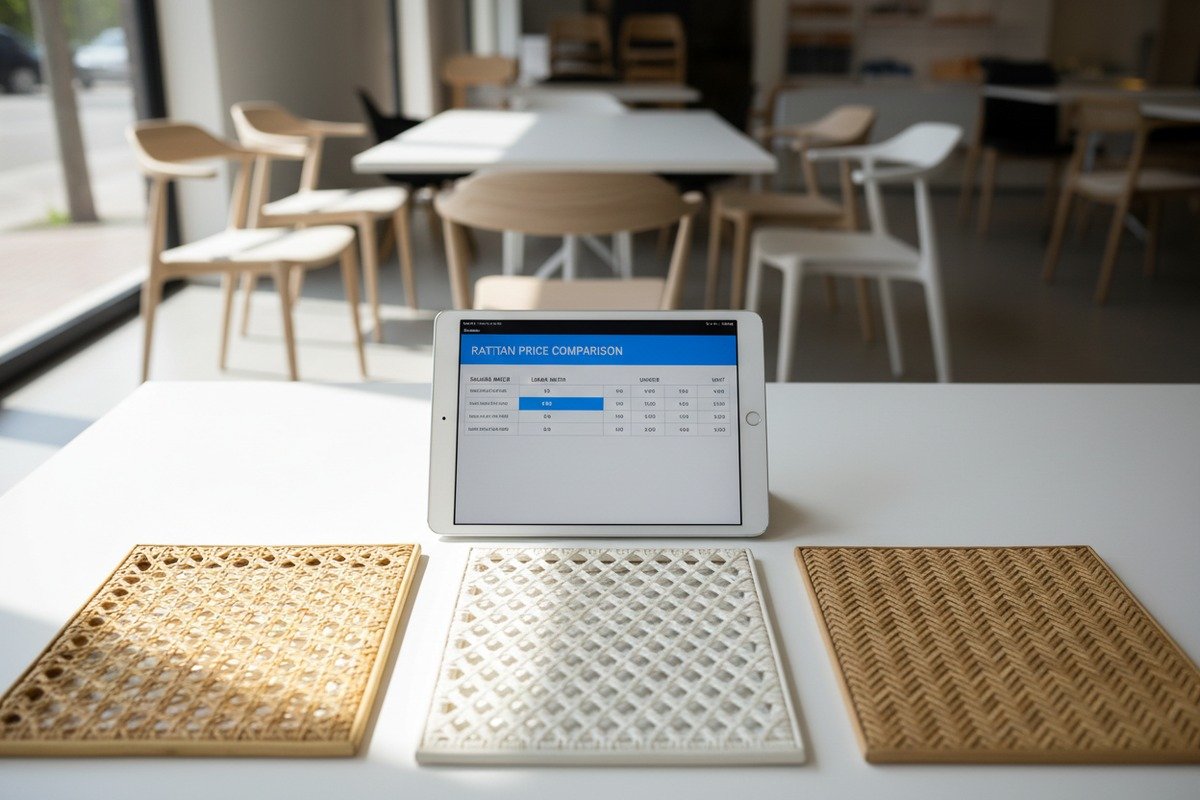
Imagine you receive three quotes for natural rattan cane webbing with a hexagonal open-mesh weave:
- Supplier A (India): ₹214 per square foot
- Supplier B (China): ¥55 per linear meter, 60 cm wide roll
- Supplier C (Indonesia): $18.50 per roll, 1 m × 3 m
These three numbers look completely unrelated. You cannot compare them directly. But once you convert all three to price per square meter in a single currency, the picture becomes clear.
Normalizing All Quotes to Square Meters
Let us convert each quote to USD per square meter, using approximate exchange rates (₹1 = $0.012; ¥1 = $0.14):
Supplier A: ₹214/sq ft × 10.764 = ₹2,303.50/sq m → $27.64/sq m
Supplier B: ¥55/linear meter ÷ 0.60 m width = ¥91.67/sq m → $12.83/sq m
Supplier C: $18.50 ÷ (1 m × 3 m) = $18.50 ÷ 3 sq m = $6.17/sq m
| Supplier | Original Quote | Converted to USD/Sq M | Ranking |
|---|---|---|---|
| Supplier A (India) | ₹214/sq ft | $27.64/sq m | Most Expensive |
| Supplier B (China) | ¥55/linear m (60cm wide) | $12.83/sq m | Mid-Range |
| Supplier C (Indonesia) | $18.50/roll (1m × 3m) | $6.17/sq m | Least Expensive |
Without this conversion, a buyer might have assumed Supplier A was cheapest because ₹214 "sounds low." In reality, it is the most expensive option per square meter.
Why Metric Beats Imperial for Global Trade
Most international trade documents 9, shipping manifests, and customs declarations use metric units. When you standardize your internal pricing to square meters, you align your procurement data with your logistics data. This reduces errors at every step—from purchase orders to inventory counts to final invoicing.
Additionally, the majority of rattan cane webbing producers in Southeast Asia and China already think in metric. When our production team in Indonesia cuts rolls, they measure in centimeters and meters. Quoting in square meters reflects the actual production reality and removes one layer of translation from the process.
Quality Considerations Beyond Price
Price per square meter is the starting point, not the finish line. The cheapest quote might use thinner cane strands, inconsistent weave tension, or poorly bleached material that yellows within months. In our experience, buyers who focus only on the lowest per-square-meter price often face quality complaints from their own customers down the line.
We always recommend requesting a sample swatch—at least 30 cm × 30 cm—before placing a bulk order. Check for strand uniformity, weave tightness, and color consistency. A slightly higher per-square-meter price for Grade A webbing almost always saves money compared to returns and rework from substandard material.
How can I ensure I am getting the best wholesale price when switching between imperial and metric measurements?
Over the years, we have seen purchasing managers lose significant margins simply because they did not account for waste, shipping costs, or hidden fees during unit conversion. Getting the best wholesale price is not just about the conversion math—it is about the full landed cost picture.
To get the best wholesale price, first convert all quotes to the same unit (price per square meter), then add 10–15% for cutting waste, factor in shipping and import duties per square meter, and compare the total landed cost rather than the raw material price alone.

Factor in Cutting Waste
Rattan cane webbing is a natural material. It does not come in perfectly uniform sheets. Edges may be uneven. Patterns need alignment. In our factories, we typically advise buyers to add 10–15% extra material to their order to account for trimming and fitting losses.
If your project needs 50 square meters of webbing, order 55–57.5 square meters. When you calculate cost per square meter, divide your total spend by the usable area (50 sq m), not the total ordered area. This gives you the true effective cost.
Shipping and Duty Calculations
A roll of rattan cane webbing from China might cost $8.00 per square meter at the factory gate. But by the time it arrives at a warehouse in the US or Europe, the landed cost could be $11–$14 per square meter after adding:
- Ocean freight (typically $0.50–$2.00/sq m depending on volume)
- Import duty (varies by country; US duty on rattan products is generally 3.3–6.5%)
- Customs brokerage fees
- Local delivery charges
Regional Price Benchmarks for Wholesale Buyers
Here is a comparison table we share with our clients to help them benchmark wholesale rattan cane webbing prices across key sourcing regions:
| Region | Typical Wholesale Price (Per Sq M) | Common Unit Quoted | Notes |
|---|---|---|---|
| China (Foshan/Guangdong) | $6.00–$14.00 | Per square meter or per roll | Wide product range; high-end to budget |
| Indonesia | $4.50–$10.00 | Per linear meter (fixed width) | Raw material hub; lower processing cost |
| India (Moradabad/Bareilly) | $5.50–$12.00 (₹460–₹1,000) | Per square foot or per piece | Strong in handicraft-grade weaves |
| Vietnam | $5.00–$11.00 | Per square meter or per roll | Growing export capacity |
| US Retail (Etsy/Amazon) | $18.00–$45.00 | Per linear foot or per roll | High markup; small-quantity sales |
Negotiation Tips From the Supply Side
Here are practical strategies that work when negotiating with suppliers like us:
- Order full rolls. Custom cuts cost more per square meter because of setup time and waste. Standard rolls (15 m × 60 cm or 10 m × 90 cm) give you the best unit price.
- Combine weave types. If you need both square mesh and radio weave, placing one combined order often triggers a better volume discount than two separate small orders.
- Ask for FOB and CIF quotes. FOB (Free on Board) 10 tells you the factory-gate price. CIF (Cost, Insurance, Freight) includes shipping to your port. Comparing CIF quotes from different suppliers is the most accurate way to evaluate total cost.
- Lock in currency. If you are buying from India in rupees or from China in yuan, agree on the exchange rate at the time of order confirmation. Currency swings of even 2–3% can wipe out your price advantage.
Clarify What "Per Square Foot" Actually Covers
Always confirm whether the quoted price per square foot refers to the net usable area or includes selvage (the unfinished edge). Some suppliers include 1–2 inches of selvage on each side that you will trim off. If you pay per square foot including selvage, your effective cost per usable square foot is higher than the quoted number. This small detail can add 5–8% to your real material cost.
What formula can I use to quickly verify my total rattan webbing costs in square meters?
When we prepare cost sheets for our clients—furniture factories in Australia, material wholesalers in the Netherlands, construction suppliers in the Middle East—we always include a simple verification formula. It takes 30 seconds and catches errors before they become expensive mistakes.
Use this formula: Total Cost = (Area in sq ft ÷ 10.764) × Price per sq m, or equivalently, Total Cost = Area in sq ft × Price per sq ft. Cross-check both calculations. If the results match, your conversion is correct. For linear meter quotes, first calculate total square meters as length × width before applying the unit price.
The Master Conversion Formula
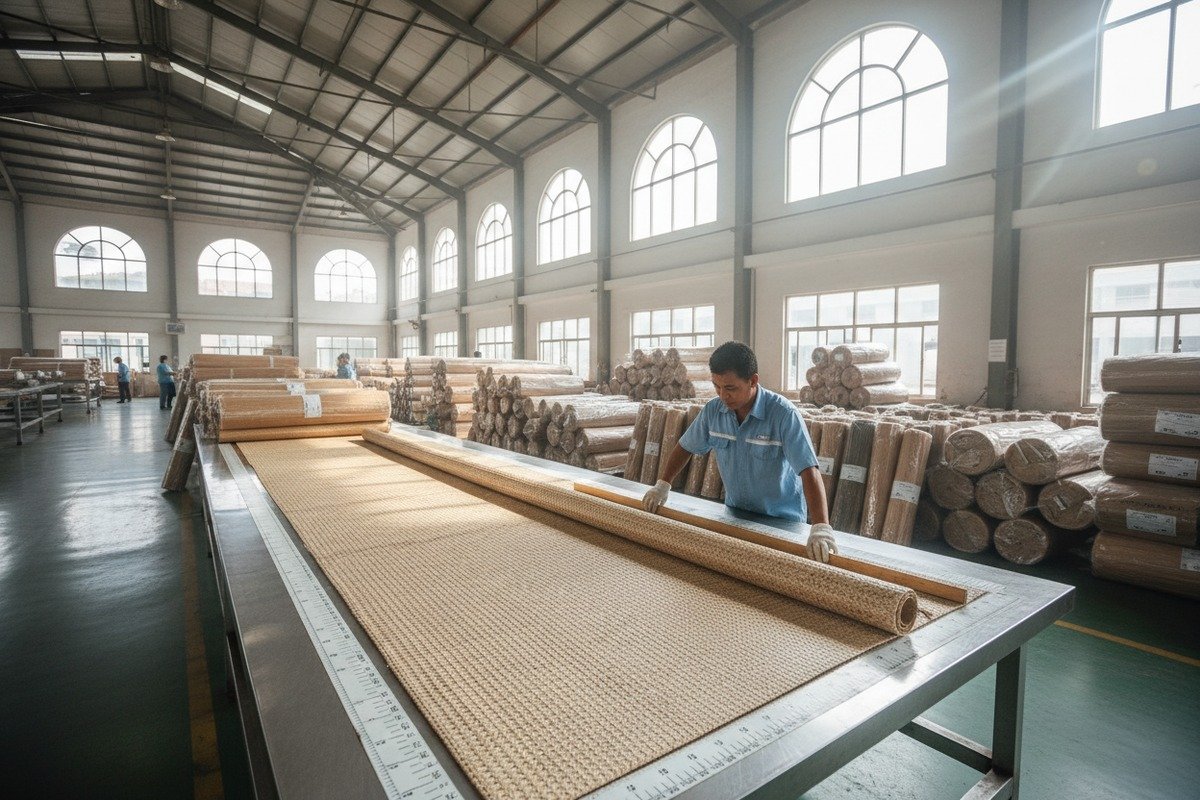
Here is the complete set of formulas you need. Save these in a spreadsheet or print them for your procurement desk.
Price conversion (sq ft → sq m):
Price per sq m = Price per sq ft × 10.764
Price conversion (sq m → sq ft):
Price per sq ft = Price per sq m × 0.0929
Area conversion (sq ft → sq m):
Area in sq m = Area in sq ft ÷ 10.764
Linear meter to square meter (for rolls):
Area in sq m = Length (m) × Width (m)
Price per sq m = Price per linear meter ÷ Width (m)
Quick Verification Example
Say you need 200 square feet of rattan cane webbing priced at $2.10 per square foot.
Method 1 (Imperial): 200 sq ft × $2.10 = $420.00 total
Method 2 (Metric cross-check):
- Convert area: 200 ÷ 10.764 = 18.58 sq m
- Convert price: $2.10 × 10.764 = $22.60 per sq m
- Total: 18.58 × $22.60 = $419.91
The tiny difference ($0.09) is a rounding artifact. Both methods confirm the total is approximately $420. If your two answers differ by more than 1%, you have a conversion error somewhere.
Excel and Google Sheets Formulas
For buyers who manage procurement in spreadsheets—which is most of our wholesale clients—here are ready-to-use formulas:
| Задача | Excel/Sheets Formula | Example |
|---|---|---|
| Convert sq ft price to sq m price | =A1*10.764 | =$2.10*10.764 → $22.60 |
| Convert sq m price to sq ft price | =A1*0.0929 | =$22.60*0.0929 → $2.10 |
| Convert area sq ft to sq m | =A1/10.764 | =200/10.764 → 18.58 |
| Linear meter price to sq m price | =A1/B1 (B1 = width in meters) | =¥55/0.6 → ¥91.67 |
| Total cost from sq ft area + sq m price | =(A1/10.764)*B1 | =(200/10.764)*$22.60 → $419.91 |
Mobile Apps and Online Tools
If you are on a factory floor or at a trade show, you may not have a spreadsheet handy. Several free tools can help:
- Google search: Simply type "200 sq ft to sq m" and Google returns the answer instantly.
- Unit converter apps: Apps like "Unit Converter" (available on iOS and Android) handle area and price conversions offline.
- Custom calculator bookmarks: Some buyers create a simple bookmark on their phone browser linking to an online converter with their default values pre-filled.
Putting It All Together: A Full Order Scenario
Let us walk through a complete order scenario from start to finish.
You are a furniture factory purchasing manager in Thailand. You need rattan cane webbing for 300 chair backs, each requiring 0.15 square meters of material. Your shortlisted supplier quotes $9.50 per square meter, FOB Foshan.
- Total material needed: 300 × 0.15 = 45 sq m (net)
- Add 12% waste: 45 × 1.12 = 50.4 sq m → round up to 51 sq m
- Material cost: 51 × $9.50 = $484.50
- Shipping estimate (CIF Bangkok): $1.20/sq m → 51 × $1.20 = $61.20
- Import duty (Thailand, ~5%): ($484.50 + $61.20) × 0.05 = $27.29
- Total landed cost: $484.50 + $61.20 + $27.29 = $572.99
- Effective cost per chair back: $572.99 ÷ 300 = $1.91
This is the number that matters for your product costing. Not the raw $9.50 per square meter. Not the per-square-foot equivalent. The landed cost per finished unit.
By mastering these simple formulas and building them into your workflow, you remove guesswork from every rattan cane webbing purchase. Our clients who adopt this approach consistently report fewer order errors and better profit margins.
Заключение
Converting rattan cane webbing prices from square foot to square meter is straightforward once you know the factor: multiply by 10.764. Standardize all quotes to one unit, factor in waste and shipping, and verify with a cross-check formula to make confident, cost-effective purchasing decisions.
Сноски
1. Provides general information about rattan, the material for cane webbing. ↩︎
2. Explains the one-dimensional measure of length, linear meter. ↩︎
3. Explains documentation required for shipping goods internationally. ↩︎
4. Details the required declarations for goods entering a country. ↩︎
5. Wikipedia provides a comprehensive definition of a square meter as a unit of area in the International System of Units (SI). ↩︎
6. Authoritative source on SI units and their relationships, including conversion. ↩︎
7. Defines the imperial unit of area, square foot. ↩︎
8. The National Institute of Standards and Technology (NIST) provides authoritative information on SI units, which represent the modern form of the metric system and are the international standard for measurement. ↩︎
9. Provides information on essential documents for international trade. ↩︎
10. Defines the Incoterm Free on Board for international trade. ↩︎

 English
  Español de México
  العربية
  Deutsch
  Français
  Русский