

Ordering the wrong width of ротанговая сетка 1 can cost you thousands in wasted material and delayed production schedules.
Standard widths for rattan cane webbing typically range from 12 inches (30 cm) to 100 cm (39 inches). The most common widths sourced in bulk are 18 inches (45 cm), 24 inches (60 cm), and 36 inches (90 cm), though suppliers also stock 20-inch (50 cm) and intermediate sizes depending on region and weave type.
Knowing which widths are truly “standard” across global suppliers saves you time, money, and headaches. Let’s break down everything you need to know before placing your next order.
What are the most common standard widths available for my bulk rattan webbing orders?
Every year, our export team handles width-related inquiries from мебельных фабрик 2 across more than a dozen countries, and the same confusion keeps coming up — what counts as "standard" depends heavily on where you source from.
The most common standard widths for bulk rattan cane webbing orders are 45 cm (18"), 50 cm (20"), 60 cm (24"), 90 cm (36"), and 100 cm (39"). Natural rattan rolls typically come in 15-meter lengths, while PE synthetic rattan rolls often reach 30 meters, with widths starting as narrow as 35 cm from some Asian suppliers.
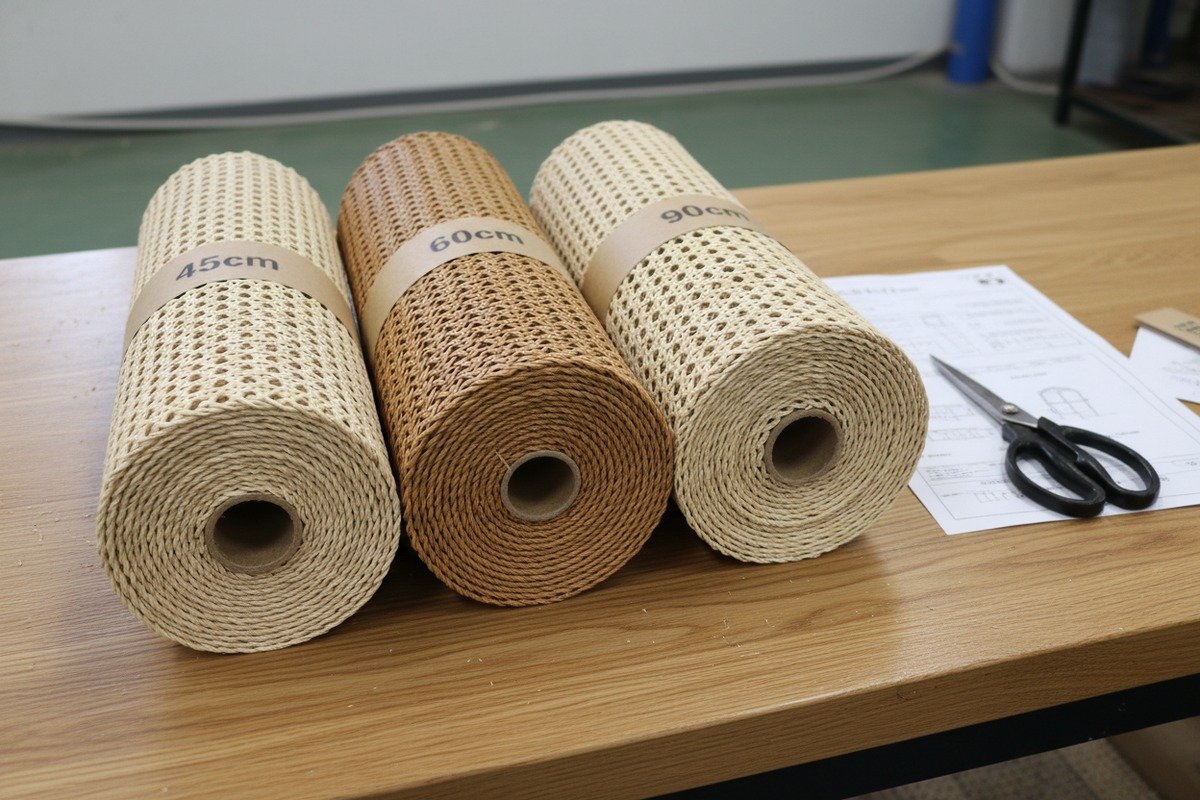
Understanding the landscape of available widths is the first step toward efficient sourcing. The reality is that "standard" is a relative term. A supplier in the US may stock widths from 12 inches to 30 inches for fine cane webbing 3, while an Australian or Southeast Asian supplier offers 600 mm and 910 mm rolls as their baseline. This regional difference causes real confusion for procurement managers comparing quotes across suppliers.
Width Standards by Region
The US market historically favors имперские измерения 4. Fine cane webbing suppliers like HH Perkins offer widths in 12", 14", 16", 18", 20", 22", 24", and 30" — sold by the running inch or foot. These narrower widths suit chair seat replacements, cabinet door inserts, and detailed restoration work.
In contrast, Asian and Australian suppliers work in metric. Our own production lines run widths from 35 cm up to 100 cm. The sweet spot for bulk furniture manufacturing sits between 45 cm and 60 cm, since most chair seats and cabinet panels fall within this range.
Standard Width Comparison Table
| Width (cm) | Width (inches) | Область применения | Типичная длина рулона | Лучше всего подходит для |
|---|---|---|---|---|
| 35 см | 14" | Small panels, accents | 15 m | Decorative inserts |
| 45 см | 18" | Chair seats, small doors | 15 m | Dining chair restoration |
| 50 см | 20" | Chair backs, side panels | 15 m | General furniture use |
| 60 см | 24" | Cabinet doors, headboards | 15 m | Mid-size panels |
| 70 cm | 28" | Wide panels, screens | 15 m | Разделители для комнаты |
| 90 см | 36" | Large headboards, partitions | 15 m | Statement furniture |
| 100 cm | 39" | Architectural panels | 15 m / 30 m | Commercial projects |
Weave Type Matters Too
Width availability also depends on the weave pattern. Hexagonal open weave 5 (sometimes called radio weave) is the most popular and comes in the widest range of widths — typically 45 cm to 100 cm. Closed weave and herringbone patterns may have more limited width options because the tighter weave demands more material and production precision. Grid patterns and diamond motifs often top out at 60–70 cm.
When placing bulk orders, always confirm both the width and the weave pattern. A 60 cm hexagonal weave roll is a very different product from a 60 cm closed weave roll in terms of weight, rigidity, and cost per square meter.
Thickness and Weight Considerations
Standard rattan webbing thickness runs between 2 mm and 4 mm. Roll weights range from about 3.4 kg to 7.2 kg depending on width, length, and weave density. Heavier rolls generally indicate a tighter weave or thicker cane strands, both of which affect the final product's look and feel.
Can I customize the width of my rattan cane webbing to fit my specific furniture designs?
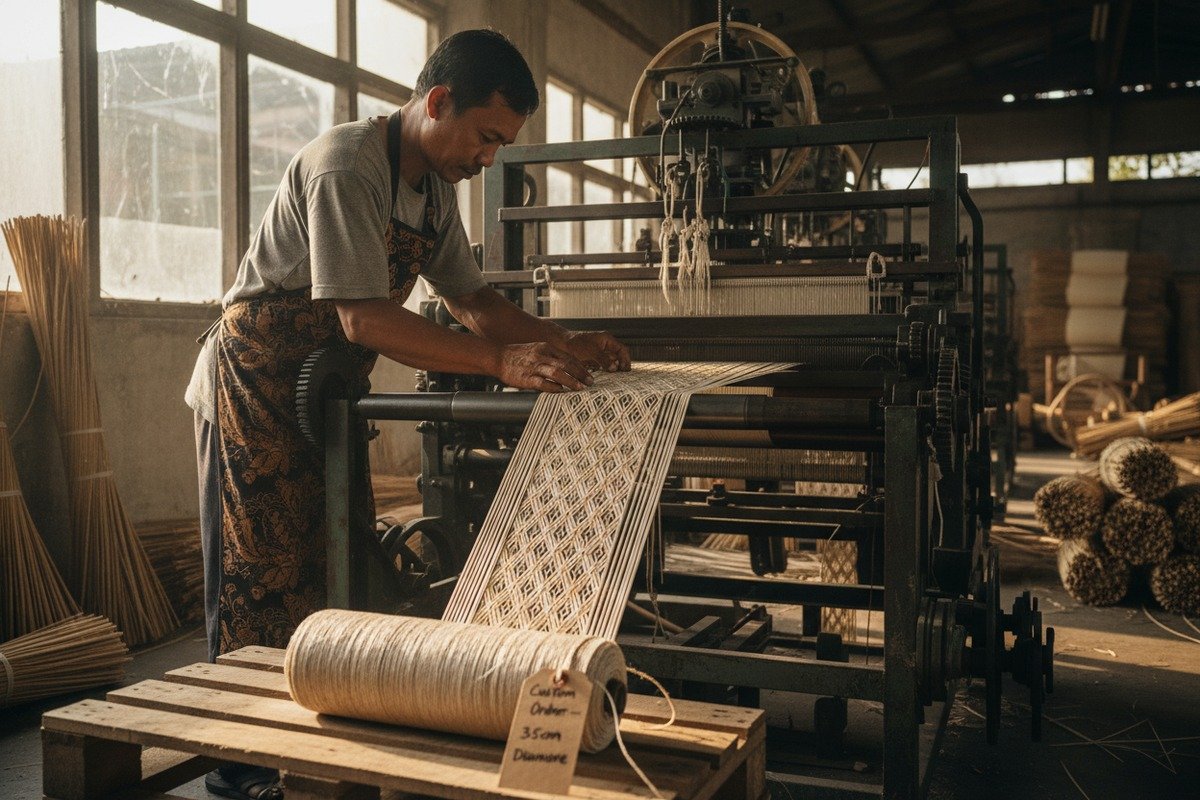
Our factory in Indonesia processes raw rattan from harvest to finished webbing, so we see firsthand how custom width requests move through the production pipeline — and why some customizations are easier than others.
Yes, most established rattan cane webbing suppliers offer width customization, typically starting from a minimum of 35 cm. Custom widths require minimum order quantities (MOQs) and may add 10–20% to the unit cost. Lead times usually extend by 1–3 weeks compared to stock sizes, depending on the weave complexity and order volume.
Customization is not a luxury — it is often a necessity. If you manufacture a line of chairs with 17-inch seat frames, buying 18-inch webbing means trimming every piece. Buying 16-inch means the material is too narrow. A custom 17-inch (43 cm) width eliminates waste and speeds up your assembly line.
Когда индивидуальные ширины имеют смысл
Custom widths pay for themselves in three scenarios. First, when your furniture line uses a non-standard frame size and you produce more than 500 units per order. Second, when material waste from trimming standard widths exceeds 10% of your total webbing purchase. Third, when you need an unusually wide panel — say 80 cm or 95 cm — that falls between common stock sizes.
Custom vs. Standard: Cost and Lead Time
| Фактор | Стандартная ширина | Индивидуальная ширина |
|---|---|---|
| Price per meter | Базовая цена | +10–20% |
| Минимальный объем заказа | Often 1 roll | 50–200 rolls typical |
| Срок выполнения | Ships from stock (3–7 days) | 2–5 weeks production |
| Width tolerance | ±2 мм | ±3–5 mm |
| Waste in production | Varies (5–15%) | Minimal (<3%) |
| Pattern availability | All patterns | May be limited |
Natural vs. Synthetic Customization
Natural rattan webbing 6 is woven on manual or semi-automatic looms. Changing the loom width takes setup time, which is why MOQs exist for custom sizes. Typical setup means adjusting the frame and re-threading, a process that can take half a day. This cost gets amortized across your order.
PE synthetic rattan 7, on the other hand, offers more flexibility. Since the synthetic strands are extruded to consistent dimensions, loom adjustments are faster. Synthetic rolls also come in longer lengths — 30 meters versus 15 meters for natural — which means fewer rolls to handle for large orders.
How to Request Custom Widths
When reaching out to a supplier for a custom width quote, include these details: desired width in both cm and inches, weave pattern, material type (natural or PE), estimated annual volume, and the application (chair seat, cabinet panel, headboard, etc.). This helps the supplier assess feasibility and provide accurate pricing. Some suppliers, including our own team at Seafan Rattan, offer sample rolls at custom widths so you can test fit and finish before committing to a full order.
One important note: bleached rattan webbing may shrink slightly after the bleaching and drying process. If you order custom widths in bleached material, discuss shrinkage tolerance with your supplier upfront. A 2–3% shrinkage is normal and should be factored into your specified width.
How do I choose the right width to minimize material waste in my manufacturing process?
We have worked with furniture factories in the Netherlands, Spain, and Australia that cut their material waste by over 30% simply by switching to a better-matched webbing width — no other process change needed. manufacturing process 8
To minimize waste, measure your frame's interior opening and add 2–4 inches (5–10 cm) for overlap and attachment. Then select the standard width closest to this total dimension. If multiple furniture models share similar widths, standardize on one width across your line to increase bulk order volume and reduce per-unit cost.

Material waste in rattan webbing comes from two sources: width mismatch and length mismatch. Width mismatch is the bigger problem because trimmed strips of webbing are rarely usable for other products. Length mismatch is easier to manage since you cut pieces sequentially from a roll.
Step-by-Step Width Selection
Start by listing every product in your furniture line that uses rattan webbing. Record the interior frame width for each product. Add your required overlap — typically 1–2 inches on each side for stapling or gluing into a groove. This gives you the total webbing width needed per product.
Next, sort these totals and look for clusters. If you have chairs that need 46 cm, 48 cm, and 50 cm, a standard 50 cm width covers all three with acceptable waste levels. Buying one width instead of three gives you better pricing and simpler inventory.
Width Selection Decision Matrix
| Frame Interior Width | Add Overlap (2" each side) | Total Needed | Recommended Standard Width | Waste % |
|---|---|---|---|---|
| 35 см | +10 cm = 45 cm | 45 см | 45 см | ~0% |
| 40 см | +10 cm = 50 cm | 50 см | 50 см | ~0% |
| 48 cm | +10 cm = 58 cm | 58 cm | 60 см | ~3% |
| 55 см | +10 cm = 65 cm | 65 cm | 70 cm | ~7% |
| 75 см | +10 cm = 85 cm | 85 cm | 90 см | ~6% |
Nesting and Cutting Optimization
For rectangular panels like cabinet doors, you can sometimes cut two narrower pieces side by side from a wider roll. For example, if your cabinet insert needs 28 cm of webbing width, you can cut two pieces from a 60 cm roll (28 + 28 = 56 cm) with only 4 cm of waste. This approach works well when the weave pattern is symmetrical and does not have a directional grain.
Soaking and Shrinkage Factors
Natural rattan webbing must be soaked in warm water for 15–30 minutes before installation to make it pliable. During soaking, the material expands slightly. After drying and tightening on the frame, it contracts. This expansion-contraction cycle means your cut piece should start slightly larger than the exact frame size. The 2–4 inch overlap accounts for both the attachment area and this natural movement.
If you skip soaking, the dry webbing is brittle and cracks during stretching. If you over-soak, the fibers weaken and may not tighten properly. Test your specific material batch with a small sample before committing to a production run.
Working with Your Supplier
Share your frame dimensions and production volumes with your webbing supplier. A good supplier will recommend the most cost-effective standard width and flag whether a custom width would save you money at your volume level. At Seafan Rattan, we regularly run these calculations for our B2B clients and have helped factories reduce annual webbing costs by 8–15% through smarter width selection alone.
Does the width of the rattan webbing affect the overall durability and quality of my final product?
Through years of testing materials on our own production floor and gathering feedback from furniture makers across Europe and the Middle East, we have observed clear patterns in how width interacts with durability.
Width alone does not determine durability — but it influences it indirectly. Wider webbing panels experience more tension across the center, which can cause sagging if the weave is too open or the cane too thin. For panels wider than 60 cm, use a closed or herringbone weave with 3–4 mm thickness to ensure long-term structural integrity.
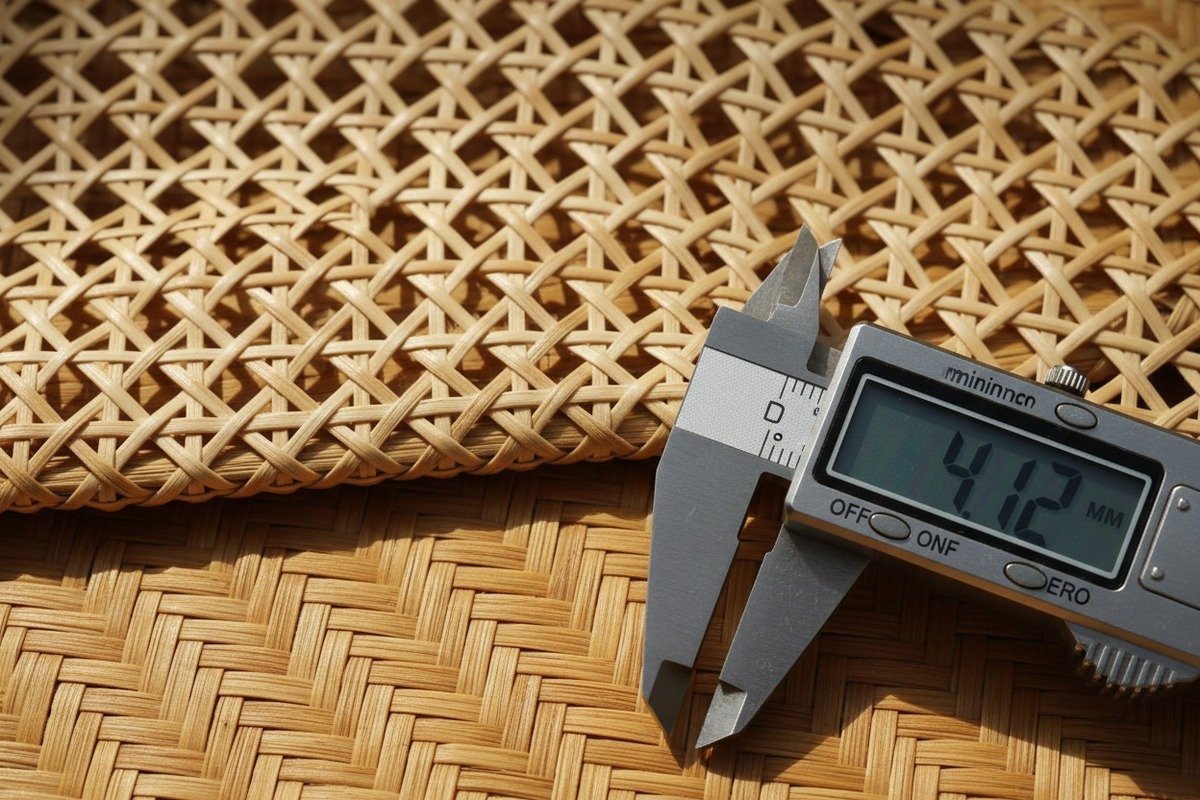
The relationship between width, weave pattern, and durability is more nuanced than most sourcing guides admit. Let's unpack it.
Width and Tension Distribution
Think of rattan webbing as a woven membrane stretched across a rigid frame. The wider the membrane, the greater the unsupported span at its center. Gravity and body weight (in the case of a chair seat) pull down on this center point. A 45 cm wide seat panel handles this stress well because the edges provide support close to the center. A 90 cm headboard panel, under less direct load, also performs fine. But a 90 cm seat — rare, but seen in some bench designs — needs reinforcement or a center support bar.
Weave Pattern and Structural Strength
Open hexagonal weave is beautiful but structurally weaker per square centimeter than closed weave. The hexagonal holes create flex points where the cane can stretch and deform over time. For high-load applications like chair seats, closed weave or herringbone patterns offer more resistance to sagging.
Here is a practical comparison:
| Weave Type | Best Width Range | Load Capacity | Durability Rating | Ideal Application |
|---|---|---|---|---|
| Hexagonal open | 35–60 cm | Умеренная | ★★★☆☆ | Дверцы шкафов, декоративные панели |
| Closed / herringbone | 35–100 cm | Высокий | ★★★★★ | Chair seats, heavy-use furniture |
| Квадратное плетение "корзинка" | 40–80 cm | Moderate-High | ★★★★☆ | Versatile, headboards, benches |
| Ромбовидный геометрический узор | 35–70 cm | Умеренная | ★★★☆☆ | Accent panels, screens |
Material Quality Matters More Than Width
A 60 cm panel made from Grade A outer-core rattan 9 will outlast a 45 cm panel made from low-grade inner-core rattan every time. The thickness (2 mm vs. 4 mm), the harvesting maturity of the rattan palm, and the curing process all have a bigger impact on durability than width alone.
When sourcing, ask your supplier about the rattan grade, the cane origin, and whether the material is inner core or outer core. Outer core rattan — the bark side of the stem — is denser and more resistant to wear. Inner core is softer, more flexible, but less durable.
Maintenance and Longevity
Regardless of width, rattan webbing lasts longer with proper care. Apply льняное масло 10 or a rattan-specific conditioner every 6–12 months to prevent drying and cracking. Avoid sealing rattan with polyurethane or varnish — this traps moisture and promotes mold growth beneath the coating.
For PE synthetic rattan, width has even less effect on durability. The synthetic strands maintain consistent tensile strength regardless of panel size. This is one reason PE rattan is gaining traction for outdoor furniture and commercial applications where weather resistance and low maintenance are priorities.
Sustainability and Sourcing Ethics
The sustainability conversation is closely tied to quality. Responsibly harvested rattan — sourced from managed forests in Indonesia, Malaysia, or the Philippines — tends to be higher quality because the plants are allowed to mature fully before cutting. Rushed or overharvested rattan produces thinner, weaker cane. Certifications like Global GreenTag provide third-party verification of sustainable practices.
At our processing facility in Indonesia, we work directly with local rattan farmers who follow sustainable harvesting cycles. This supply chain transparency gives our clients confidence in both the ethical and structural quality of the material, no matter what width they order.
Заключение
Choosing the right rattan cane webbing width comes down to knowing your frame dimensions, matching regional standards, and balancing cost against waste — smart sourcing starts here.
Сноски
1. Объясняет, что такое ротанговая сетка и ее применение. ↩︎
2. Provides an overview of the furniture manufacturing industry. ↩︎
3. Describes a specific type of cane webbing and its characteristics. ↩︎
4. Authoritative Wikipedia article providing a comprehensive overview of imperial and US customary measurement systems. ↩︎
5. Directly describes ‘Open Hexagonal Webbing’ with relevant details and images. ↩︎
6. Provides information and product offerings for natural rattan webbing from a supplier. ↩︎
7. Explains what PE synthetic rattan is and its properties. ↩︎
8. Outlines the general steps involved in a manufacturing process. ↩︎
9. Explains the distinction and properties of outer-core rattan. ↩︎
10. Describes linseed oil as a wood finish and its benefits. ↩︎
 English
  Español de México
  العربية
  Deutsch
  Français
  Русский