
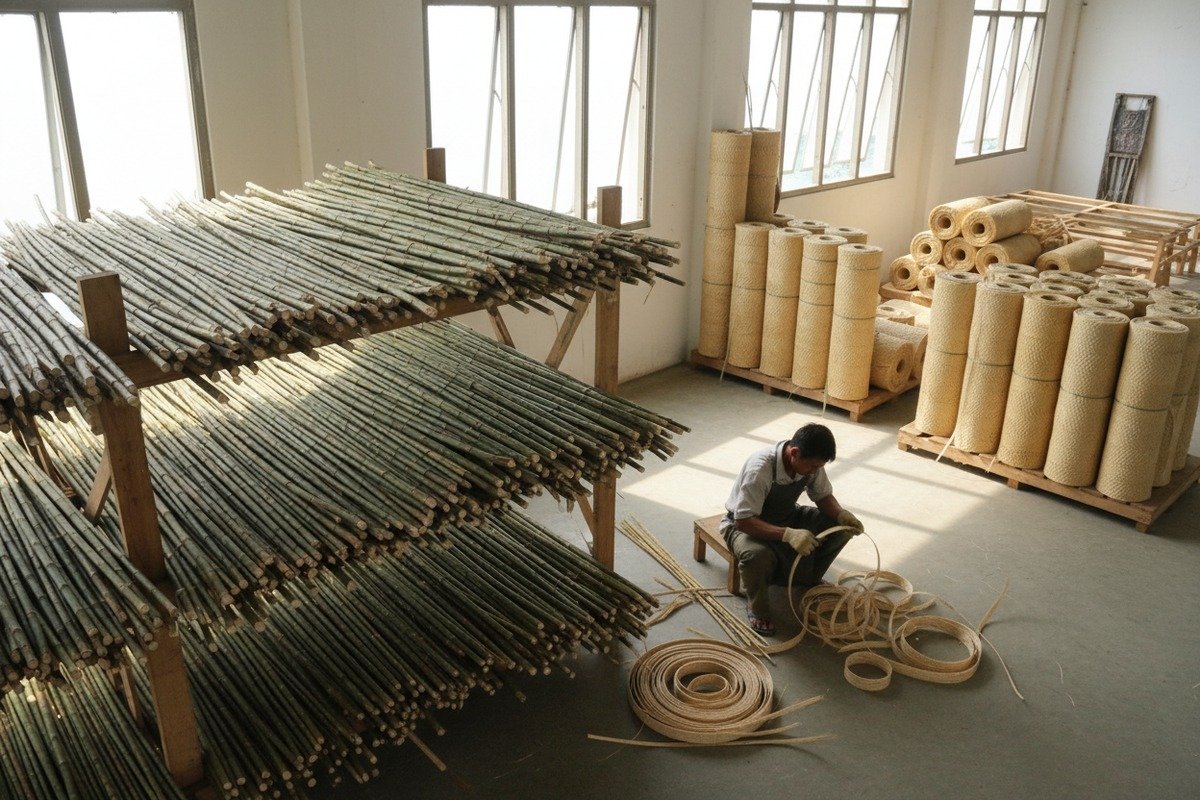
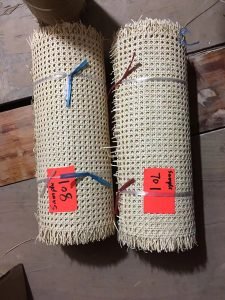
Chaque semaine, notre entrepôt de Foshan expédie des milliers de mètres de cannage en rotin vers des usines de meubles dans toute l'Europe, le Moyen-Orient et l'Asie du Sud-Est. Pourtant, une question revient sans cesse de la part des nouveaux acheteurs : de quoi ce matériau est-il exactement fait ? La réponse n'est pas aussi simple que la plupart des gens ne le pensent. Différentes matières premières, méthodes de traitement et espèces de rotin créent des produits finis très différents. Choisir le mauvais peut signifier des panneaux fissurés, des sièges affaissés ou des clients finaux mécontents.
Le cannage en rotin pour meubles est principalement fabriqué à partir de l'écorce extérieure (peau) des tiges de palmier rotin naturel, récolté principalement en Indonésie. L'écorce est pelée, séchée, triée par qualité et tissée en feuilles ou en rouleaux. Les alternatives synthétiques utilisent du polyéthylène haute densité (PEHD) pour reproduire l'aspect avec une résistance accrue aux intempéries.
Comprendre ces matières premières est la première étape pour passer une commande de gros intelligente. Ci-dessous, nous détaillons les décisions clés auxquelles vous serez confronté – du choix entre le naturel et le synthétique, aux systèmes de classement, aux tests de durabilité, et pourquoi l'origine de l'approvisionnement est plus importante que vous ne pourriez vous y attendre.
Comment choisir entre le rotin indonésien naturel et les matériaux synthétiques en PE pour mes projets de mobilier ?
Nos lignes de production en Indonésie et à Foshan fonctionnent à la fois rotin naturel 1 et des cannages synthétiques en PE côte à côte. Voir les acheteurs lutter avec ce choix année après année nous a appris que la décision se résume toujours à trois choses : où le meuble sera utilisé, ce qu'attend le client final, et quelle quantité d'entretien il est prêt à faire.
Choisissez du rotin indonésien naturel pour les meubles d'intérieur qui exigent une texture authentique, une bonne respirabilité et un aspect organique chaleureux. Choisissez du webbing synthétique en PE (HDPE) pour les meubles d'extérieur, les environnements à forte humidité ou les projets nécessitant un entretien nul et une résistance supérieure aux UV et à la moisissure.
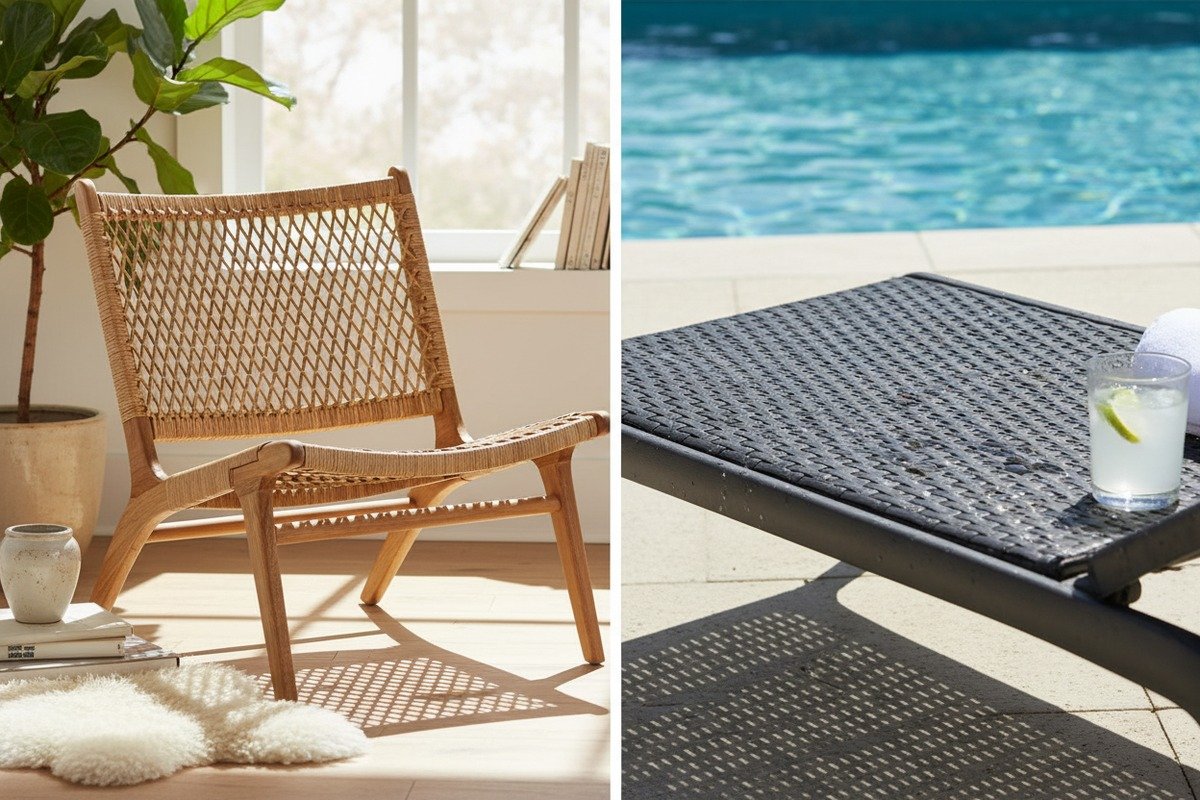
La différence fondamentale : fibre végétale contre plastique conçu
Le cannage naturel en rotin provient de l'épiderme externe des lianes de palmier rotin. Ces lianes poussent à l'état sauvage ou dans des plantations gérées à travers les forêts tropicales humides d'Indonésie, qui fournissent environ 80 % du rotin brut mondial. L'écorce extérieure contient une forte concentration de silice, lui conférant un lustre vitreux naturel et une résistance intrinsèque aux rayures. C'est le matériau utilisé dans les chaises en cannage depuis des siècles.
Le cannage synthétique, quant à lui, est extrudé à partir de polyéthylène haute densité (PEHD) 2 granulés. Les fabricants font fondre le plastique, le font passer à travers des moules en forme de brins de rotin, puis le tissent sur des métiers à tisser industriels. Le résultat ressemble de loin mais se sent différemment de près.
Comparaison côte à côte
| Caractéristique | Rotin naturel indonésien | PE synthétique (PEHD) |
|---|---|---|
| Matière première | Écorce extérieure de la liane de palmier rotin | Plastique polyéthylène haute densité |
| Meilleure utilisation | Meubles d'intérieur, panneaux décoratifs | Meubles d'extérieur, sièges commerciaux |
| Résistance aux UV | Faible – se décolore et sèche en plein soleil | Élevée – conçue pour la stabilité aux UV |
| Tolérance à l'humidité | Modérée — nécessite une humidité contrôlée | Excellente — entièrement étanche |
| Risque de parasites et de moisissures | Susceptible sans traitement | Immunisé |
| Texture et toucher | Chaud, organique, légèrement rugueux | Lisse, uniforme, légèrement plastique |
| Respirabilité | Élevé — structure fibreuse poreuse | Faible — brins de plastique solides |
| Entretien | Dépoussiérage périodique, huilage occasionnel | Nettoyer avec un chiffon humide |
| Empreinte environnementale | Ressource végétale renouvelable, biodégradable | À base de pétrole, recyclable mais non biodégradable |
| Fourchette de prix (en gros) | Moyen à élevé, selon la qualité | Faible à moyen, selon l'indice UV |
Quand le rotin naturel l'emporte
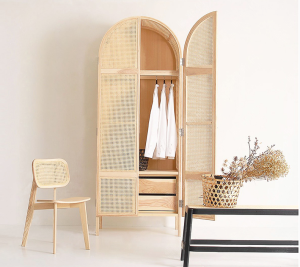
Si votre usine fabrique des chaises de salle à manger, des têtes de lit, des portes d'armoire ou des panneaux muraux décoratifs destinés à un usage intérieur, le rotin naturel est presque toujours le meilleur choix. La texture est impossible à reproduire entièrement avec du plastique. Les acheteurs aux Pays-Bas, en Espagne et en Australie nous disent constamment que leurs clients paieront un supplément pour du vrai cannage. La surface riche en silice capte la lumière d'une manière que les brins synthétiques ne peuvent égaler.
Le rotin naturel respire aussi. Dans les climats chauds, un panneau de siège en cannage permet la circulation de l'air, c'est pourquoi les meubles en rotin restent si populaires en Asie du Sud-Est et au Moyen-Orient.
Quand le PE synthétique l'emporte
Pour les meubles de jardin, les chaises longues au bord de la piscine ou les patios de restaurant, la sangle synthétique en HDPE 3 est le choix pratique. Nous avons vu des panneaux de rotin naturel installés à l'extérieur se fissurer au cours d'une seule saison des pluies. Le HDPE résiste à la moisissure, à la dégradation par les UV et aux variations de température. Il ne nécessite pas non plus de trempage avant l'installation – vous le coupez, l'agrafez et l'oubliez.
Un terrain d'entente émergent est la sangle "papier cannage", qui utilise un noyau en filament de polyester ou de nylon enveloppé dans une gaine en papier ou en fibre. Cela lui confère une mémoire structurelle et une résistance à l'affaissement tout en conservant un aspect plus doux et plus organique que le HDPE pur.
Un cadre de décision pratique
Posez-vous trois questions avant de commander :
- Ces meubles seront-ils utilisés à l'intérieur ou à l'extérieur ?
- Le client final privilégie-t-il le matériau authentique ou un entretien minimal ?
- Quel est le prix cible de la pièce finie ?
Si les réponses sont intérieur, authentique et milieu à haut de gamme, optez pour le naturel. Si extérieur, entretien minimal et économique, optez pour le synthétique. La plupart de nos clients usines finissent par commander les deux et segmentent leurs gammes de produits en conséquence.
Quels sont les différents grades de qualité que je devrais rechercher lors de l'approvisionnement en cannage en rotin ?
Lorsque nous avons commencé à fournir du cannage en rotin aux usines de meubles en Turquie et en Grèce, la plainte la plus fréquente était l'incohérence : un rouleau était beau, le suivant présentait des taches sombres, des largeurs de brin inégales ou des zones cassantes. Cette frustration nous a poussés à adopter et à communiquer un système de classement clair à chaque acheteur.
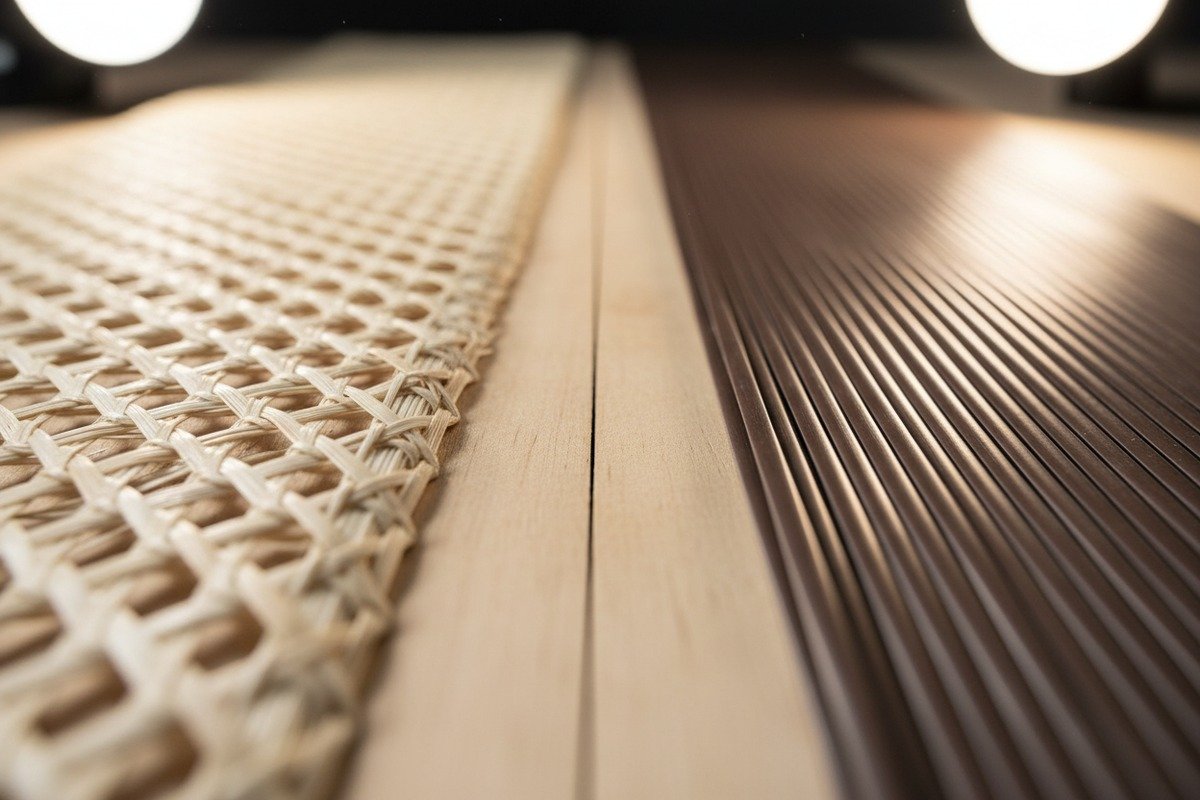
Le cannage en rotin est généralement classé en trois qualités : A, B et C. La qualité A offre la plus haute résistance à la traction, une couleur plus uniforme, moins de nœuds et une surface plus lisse. La qualité B présente de légères variations de couleur et des imperfections occasionnelles. La qualité C est fonctionnelle mais visuellement incohérente, mieux adaptée aux applications cachées ou peintes.
Qu'est-ce qui détermine la qualité ?
Le classement se fait à plusieurs étapes : sélection des matières premières, pelage, séchage et inspection finale du rouleau. Les principaux facteurs comprennent l'uniformité des brins, la constance de la couleur, la fréquence des nœuds, la douceur de la surface et la résistance à la traction.
Les fabricants haut de gamme sélectionnent spécifiquement certaines espèces de rotin pour le cannage. Calamus caesius 4 et Calamus optimus sont privilégiés car leurs entrenœuds exceptionnellement longs (les sections entre les nœuds) produisent moins de nœuds par mètre de bande. Moins de nœuds signifient un tressage plus propre et une intégrité structurelle plus solide.
Tableau de classement
| Facteur de qualité | Qualité A | Qualité B | Note C |
|---|---|---|---|
| Uniformité de la couleur | Ton clair et uniforme de paille ou de miel | Légère variation tonale sur le rouleau | Taches sombres et claires notables |
| Fréquence des nœuds | Très peu — espèces à entrenœuds longs utilisées | Nœuds occasionnels, coupés à ras | Nœuds fréquents, certains en relief |
| Cohérence de la largeur des brins | Uniforme dans ±0,2 mm | Légère variation dans ±0,5 mm | Différences de largeur visibles |
| Finition de surface | Lustre de silice lisse et naturel | Principalement lisse, quelques aspérités mineures | Zones rugueuses, peut nécessiter un ponçage |
| Résistance à la traction | Le plus élevé — résiste à l'étirement et à l'agrafage | Bon — convient aux meubles standard | Adéquat pour une utilisation légère ou décorative |
| Meilleure application | Meubles haut de gamme, panneaux visibles | Meubles de milieu de gamme, usage général | Pièces économiques, panneaux peints ou teints |
| Indice de prix | 1.0x (prime de référence) | 0,7x–0,8x | 0,4x–0,6x |
Comment la sélection des espèces affecte la qualité
Tout rotin n'est pas la même plante. Il existe plus de 600 espèces dans le genre Calamus seul. Notre installation de transformation indonésienne trie les tiges brutes entrantes par espèce, diamètre et conditions de croissance avant que toute écorce ne soit retirée. Les tiges provenant de forêts gérées ou de jardins ont tendance à produire une écorce plus uniforme que les tiges récoltées à l'état sauvage, car les conditions de croissance sont plus contrôlées.
Les espèces clés pour le tressage de qualité supérieure sont :
- Calamus caesius — Longs entrenœuds, écorce souple, excellent pour le tressage de qualité A.
- Calamus optimus — Écorce épaisse et solide avec un lustre naturel prononcé.
- Calamus trachycoleus — Espèce de plantation à croissance rapide, bonne pour la production de qualité B.
Pourquoi la qualité est importante pour votre usine
Si vous fabriquez des meubles avec des panneaux en rotin apparents — comme des chaises de salle à manger à dossier en rotin ou des façades d'armoires à tissage ouvert — vos clients verront chaque défaut. Un rouleau de qualité B pourrait vous faire économiser 20 à 30 % sur le coût des matériaux 5, mais une seule tache sombre au centre du dossier d'une chaise peut donner l'impression que la pièce finie est défectueuse. Pour les applications peintes ou teintes où le rotin brut est recouvert, la qualité C fonctionne parfaitement et permet de réduire les coûts.
Nous recommandons aux responsables des achats de demander des rouleaux d'échantillons de chaque qualité avant de s'engager dans des commandes en gros. Tenez-les à la lumière. Pliez les brins. Vérifiez les bords du rouleau pour voir s'ils s'effilochent. Ces tests simples révèlent plus que toute fiche technique.
Le rôle du motif de tissage dans la qualité perçue
Même un matériau de qualité A peut paraître médiocre si le tissage est lâche ou inégal. Le tissage classique octogonal radio, le tissage hexagonal en étoile et la simple grille carrée ouverte exigent chacun différents niveaux de précision de tissage. Un artisan "LaHua" produisant des motifs hexagonaux termine généralement un rouleau de 16 pouces de large et 15 mètres de long par jour. Se précipiter dans ce processus entraîne des tailles de trous inégales et des lignes de travers, ce qui dégrade la qualité perçue, quelle que soit la qualité de la matière première.
Comment puis-je m'assurer que les matières premières de mon cannage en rotin sont suffisamment durables pour mon usine de meubles ?
L'un de nos acheteurs de longue date en Arabie saoudite a un jour retourné un conteneur entier car les panneaux de rotin se sont fissurés pendant le processus d'agrafage dans son usine. La cause profonde n'était pas un mauvais matériau, mais un séchage inapproprié. Cette expérience nous a poussés à construire un processus d'assurance qualité en plusieurs étapes que nous partageons maintenant ouvertement avec tous nos clients.
Pour assurer la durabilité, vérifiez les espèces de rotin utilisées, contrôlez la teneur en humidité après séchage (plage idéale : 12–15 %), demandez des rapports de test de résistance à la traction, faites tremper le rotin naturel pendant 30 à 60 minutes avant l'installation et confirmez que le fournisseur utilise un séchage au soufre ou un séchage en étuve contrôlé plutôt qu'un séchage au soleil non contrôlé seul.
La chaîne de traitement qui détermine la durabilité
Le rotin brut arrive dans notre usine indonésienne sous forme de tiges entières, souvent longues de 20 à 30 mètres, recouvertes d'écorce, d'épines et de saleté. La durabilité est construite — ou détruite — à chaque étape du traitement.
Étape 1 : Nettoyage et retrait de l'écorce. Les ouvriers retirent l'écorce extérieure, enlèvent les épines et nettoient la saleté et les résidus de fibres de la coque. Les débris restants affaiblissent la peau lors du décorticage.
Étape 2 : Décorticage. Des machines retirent la peau extérieure du noyau intérieur. La peau devient le matériau de tissage. Le noyau est réutilisé pour les cadres de meubles, les bâtons de parfum ou les objets décoratifs. Si le décorticage est effectué trop agressivement, la peau devient trop fine et se déchire pendant le tissage.
Étape 3 : Tri par taille. La peau décortiquée est triée par largeur, épaisseur et longueur. Des bandes uniformes tissent plus serré et répartissent la contrainte plus uniformément sur le panneau fini.
Étape 4 : Polissage et ponçage. Les nodules et les surfaces rugueuses sont poncés pour les lisser. Cette étape est essentielle : les nodules non poncés créent des points de contrainte qui se fissurent sous tension.
Étape 5 : Séchage. C'est là que la plupart des défaillances de durabilité prennent naissance. Le rotin doit être séché à un taux d'humidité de la teneur en humidité 6 12–15 %. Un rotin sous-séché (supérieur à 18 %) favorise la croissance de moisissures pendant le transport. Un rotin sur-séché (inférieur à 10 %) devient cassant et se fissure lorsqu'il est plié ou agrafé. Nous utilisons une combinaison de séchage initial au soleil suivi d'un séchage contrôlé au soufre. Le séchage au soufre améliore également la cohérence de la couleur et agit comme un conservateur naturel.
Étape 6 : Blanchiment et finition. Le blanchiment facultatif avec le peroxyde d'hydrogène 7 crée la couleur populaire blanc cassé ou paille claire. La finition à la torche assombrit légèrement la surface et ajoute un subtil aspect vieilli. Aucun des deux procédés ne doit compromettre la couche de silice à la surface de la natte.
Comment tester la durabilité avant d'acheter
| Test | Method | Ce qu'il faut rechercher |
|---|---|---|
| Test de flexion | Prenez une seule mèche et pliez-la à 180° | Elle doit fléchir sans casser ; si elle se fissure, l'humidité est trop faible |
| Test d'immersion | Submergez un morceau de 30 cm dans l'eau pendant 30 minutes | Elle doit devenir souple et retrouver sa flexibilité ; si elle reste rigide, les fibres sont endommagées |
| Test de traction | Saisissez les deux extrémités d'une mèche et tirez fermement | Elle doit s'étirer légèrement avant de casser ; une rupture cassante indique une mauvaise espèce ou un sur-séchage |
| Vérification de la couleur | Posez 3 mèches de différentes parties du rouleau côte à côte | La couleur doit être uniforme ; une grande variation suggère des lots mélangés |
| Éraflure de surface | Passez un ongle sur la surface | La qualité A doit résister aux rayures légères grâce à sa teneur en silice |
| Humidimètre | Utilisez un humidimètre à broches sur le bord du rouleau | La lecture doit être de 12 à 15 % pour un équilibre optimal entre flexibilité et stabilité |
Pratiques d'installation qui protègent la durabilité
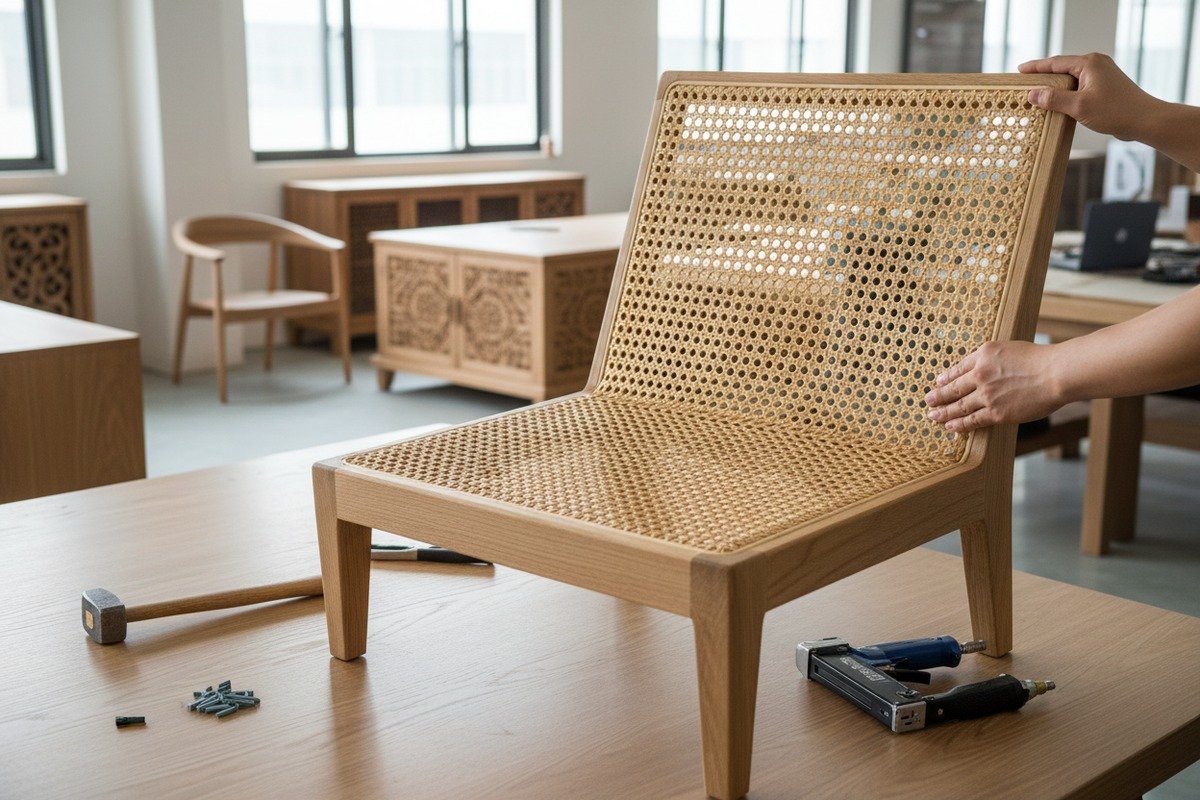
Même le rotin parfaitement traité peut échouer s'il est mal installé. Le cannage naturel doit être trempé dans de l'eau tiède pendant 30 à 60 minutes avant d'être tendu sur un cadre. Cela ramollit les fibres et permet de tendre le cannage sans le déchirer. Au fur et à mesure que le cannage sèche dans le cadre, il se contracte et devient tendu comme un tambour.
Coupez les panneaux avec une marge de 3 à 5 cm de chaque côté pour le rentrage ou l'agrafage. Utilisez un pistolet à agrafeuse pneumatique réglé sur une pression moyenne — trop de force fend les brins. Pour les installations avec jonc, utilisez un jonc en bois dur ou en plastique qui correspond exactement à la largeur de la rainure.
Le cannage synthétique en PEHD ne nécessite pas de trempage. Il peut être coupé et installé immédiatement, ce qui permet de gagner du temps en usine. Cependant, il ne se contracte pas non plus après l'installation, la tension doit donc être réglée manuellement lors de l'agrafage.
Rotin reconstitué : une option émergente
Une évolution intéressante dans notre industrie est le rotin reconstitué. Les déchets de fibres post-industrielles — chutes, brins cassés et écorces rejetées — sont broyés et liés avec des résines biosourcées pour créer des feuilles uniformes. Ces feuilles ont une résistance à la traction élevée et aucun nœud. Elles ne sont pas encore courantes, mais plusieurs marques de meubles européennes les testent comme alternative durable qui réduit les déchets de matières premières.
Pourquoi l'origine du matériau en rotin est-elle importante pour mes commandes en gros ?
Nous exploitons notre propre installation de traitement du rotin en Indonésie pour une raison simple : contrôler l'origine de notre matière première est le moyen le plus efficace de contrôler la qualité à grande échelle. Au fil des ans, nous avons vu ce qui arrive lorsque les acheteurs s'approvisionnent à l'aveugle — espèces mélangées dans un rouleau, séchage incohérent et expéditions qui semblent bien en surface mais se désagrègent à mi-chemin du conteneur.
L'origine du rotin est importante car le sol volcanique et le climat tropical de l'Indonésie produisent un rotin d'une densité, d'une flexibilité et d'une teneur en silice naturelle supérieures. Le rotin indonésien représente environ 80% de l'approvisionnement mondial, et l'approvisionnement direct auprès de cette région garantit la traçabilité des espèces, une qualité constante et des prix compétitifs pour les commandes en gros.

Indonésie : l'épicentre mondial
L'Indonésie domine la production mondiale de rotin pour des raisons géologiques et biologiques. Les sols volcaniques de Bornéo, Sulawesi et Sumatra offrent des conditions de croissance riches en minéraux. Le climat tropical humide favorise une croissance rapide des lianes. Et des siècles de savoir-faire traditionnel en matière de récolte garantissent que le rotin est collecté à la bonne maturité — ni trop jeune (fin et faible) ni trop vieux (rigide et sujet aux fissures).
Lorsque nous nous approvisionnons dans des forêts gérées et des plantations de jardin en Kalimantan, nous obtenons des tiges avec un diamètre prévisible, une épaisseur d'écorce constante et de longs entre-nœuds. Le rotin récolté à l'état sauvage dans les forêts primaires peut être excellent, mais la qualité varie considérablement car les conditions de croissance sont incontrôlées.
Chine vs. Indonésie : une question d'approvisionnement courante
De nombreux acheteurs trouvent d'abord des fournisseurs chinois sur Alibaba ou Google, car les entreprises chinoises sont plus visibles en marketing numérique. Cependant, la plupart des fabricants chinois de rotin tressé — y compris notre usine de Foshan — importent du rotin brut ou semi-transformé d'Indonésie. Le tressage, la finition et l'emballage ont lieu en Chine, mais le matériau végétal provient d'Asie du Sud-Est.
Certains fournisseurs chinois utilisent du rotin cultivé localement dans les provinces du Hainan ou du Yunnan. Ce rotin a tendance à avoir des entre-nœuds plus courts et une écorce plus fine, ce qui peut affecter la qualité du tressage fini. Les acheteurs devraient toujours demander : d'où vient votre rotin brut ?
Pourquoi la traçabilité protège votre entreprise
Pour les commandes en gros — en particulier celles destinées à l'Europe, à l'Australie ou aux États-Unis — la traçabilité des matériaux 8 est de plus en plus importante. Les réglementations de l'UE sur le bois et les cadres de durabilité s'étendent pour inclure les produits forestiers non ligneux comme le rotin. Les acheteurs qui peuvent documenter l'origine de leur rotin démontrent leur conformité et renforcent la confiance des clients finaux soucieux de l'environnement.
Notre usine indonésienne conserve les registres de récolte 9, la documentation des espèces et les journaux de traitement pour chaque lot. Lorsqu'une marque de meubles néerlandaise nous demande une déclaration de durabilité, nous pouvons la fournir. Les fournisseurs qui achètent du rotin auprès d'intermédiaires anonymes ne le peuvent pas.
Comment l'origine affecte les prix et les délais de livraison
L'approvisionnement direct en Indonésie signifie un coût de matière première plus bas mais des délais de livraison plus longs. L'écorce de rotin traitée à l'origine et expédiée en Chine pour le tressage prend 4 à 6 semaines de la récolte au rouleau fini. Les rouleaux entièrement traités expédiés directement d'Indonésie peuvent permettre d'économiser sur les coûts de main-d'œuvre, mais peuvent nécessiter des quantités minimales de commande plus importantes.
L'approvisionnement en rouleaux pré-tressés dans les entrepôts chinois offre une livraison plus rapide — parfois en 1 à 2 semaines — mais avec une majoration de 15 à 25 % pour couvrir les coûts d'importation, d'entreposage et la marge du fabricant chinois.
Durabilité et gestion forestière
Le rotin est une ressource renouvelable. Contrairement aux arbres à bois dur 10 qui mettent des décennies à mûrir, les lianes de rotin peuvent être récoltées en 7 à 10 ans. Les jardins de rotin gérés en Indonésie replantent en continu, assurant un cycle durable. Cependant, la récolte sauvage dans les forêts primaires soulève des préoccupations quant à la surexploitation et à la perturbation de l'habitat.
En tant que grossiste engagé dans la stabilité d'approvisionnement à long terme, nous travaillons avec des producteurs de plantations et des forêts gérées par les communautés plutôt que de nous fier uniquement à la récolte sauvage. Cette approche coûte légèrement plus cher par kilogramme de tige brute, mais offre un volume constant, une qualité prévisible et une histoire de durabilité défendable pour nos acheteurs.
L'industrie surveille également le développement du rotin reconstitué et des composites de bio-résine comme compléments potentiels à l'approvisionnement en rotin vierge. Ces innovations pourraient réduire la pression sur les forêts naturelles tout en maintenant les qualités esthétiques et fonctionnelles dont les fabricants de meubles ont besoin.
Conclusion
Les matériaux derrière la vannerie en rotin – de l'écorce de rotin indonésien aux fibres synthétiques en HDPE et aux fibres reconstituées émergentes – déterminent directement la qualité, la durabilité et la valeur marchande de vos meubles finis. Comprendre les espèces, le classement, le traitement et l'origine vous donne les connaissances nécessaires pour prendre des décisions d'approvisionnement qui protègent votre entreprise et satisfont vos clients.
Notes de bas de page
1. Wikipédia est une source faisant autorité privilégiée, et la page offre un bon aperçu du rotin naturel. ↩︎
2. Entrée encyclopédique sur la fabrication du polyéthylène haute densité et ses applications industrielles. ↩︎
3. Informations de fond sur les propriétés et la fabrication des matériaux en polyéthylène haute densité. ↩︎
4. Classification botanique et caractéristiques de l'espèce de rotin Calamus caesius. ↩︎
5. Merriam-Webster est un dictionnaire faisant autorité fournissant une définition claire de matière première, ce qui est étroitement lié au coût des matériaux dans ce contexte. ↩︎
6. Référence scientifique sur les niveaux d'humidité dans les matières végétales et les fibres biologiques. ↩︎
7. Il s'agit d'une page directe et actuelle du CDC fournissant des informations faisant autorité sur le peroxyde d'hydrogène. ↩︎
8. Page officielle de la Commission européenne sur les politiques de traçabilité des forêts et du bois. ↩︎
9. Ressource de la FAO détaillant les meilleures pratiques pour la récolte et la gestion du rotin. ↩︎
10. Référence générale pour les cycles de croissance et les caractéristiques des arbres feuillus. ↩︎
 English
  Español de México
  العربية
  Deutsch
  Français
  Русский