
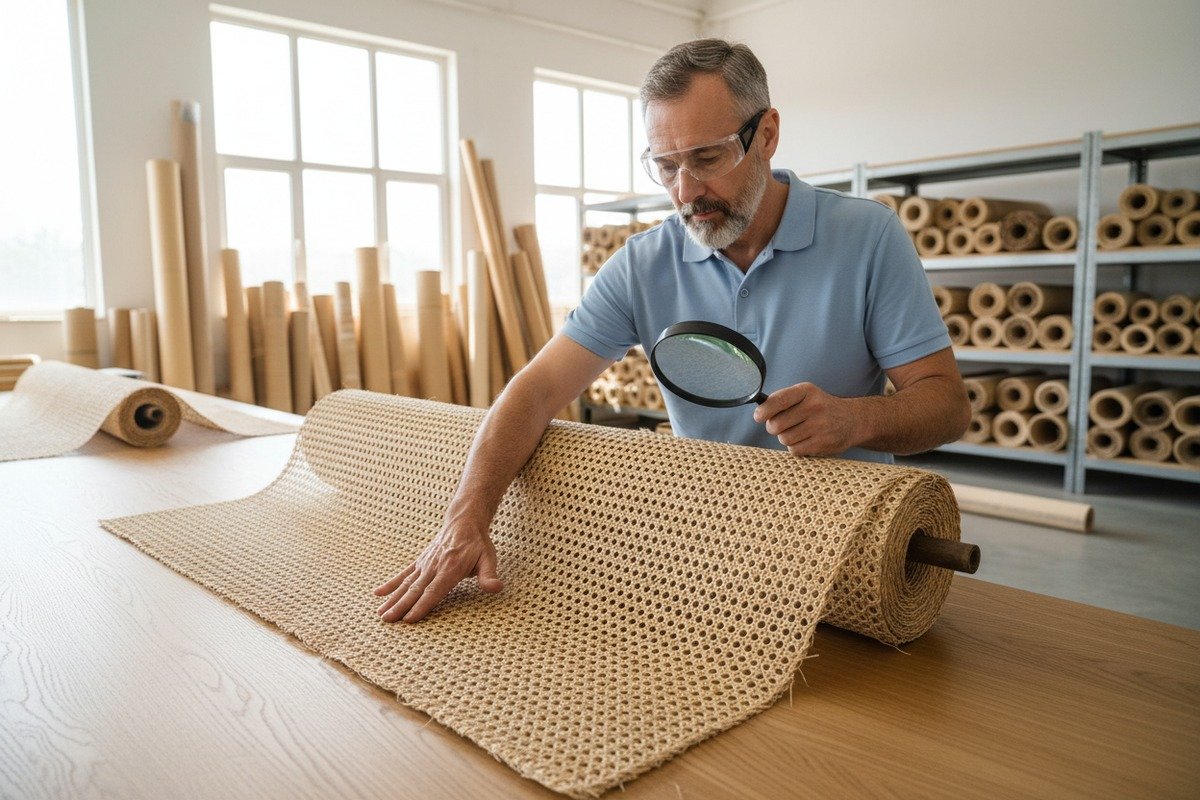
Chaque semaine, notre équipe de service client reçoit des appels d'usines de meubles qui ont reçu cannage rotin 1 des rouleaux qui semblaient corrects à l'extérieur mais cachaient des défauts à l'intérieur.
Pour inspecter la qualité du cannage en rotin naturel à la réception, vérifiez l'uniformité du tissage, l'intégrité des brins, la régularité de la taille des mailles, le taux d'humidité, l'uniformité de la couleur et l'état de l'emballage. Une inspection visuelle et tactile systématique permet de détecter les défauts avant qu'ils n'atteignent votre chaîne de production et n'entraînent des retouches coûteuses.
Ce guide détaille les étapes exactes à suivre dès l'arrivée de votre expédition de rotin uniformité du tissage 2. Chaque section couvre un domaine d'inspection spécifique afin que vous puissiez établir un processus d'assurance qualité fiable et reproductible processus d'assurance qualité 3.
Comment puis-je identifier si la natte en rotin que j'ai reçue est de vraie qualité Grade A ?
Quand nous expédions Cannage en rotin de qualité A 4 de nos installations, il a passé plusieurs points de contrôle internes. Mais une fois qu'il a parcouru des milliers de kilomètres, les choses peuvent changer blanchiment uniforme 5. La vraie question est : comment vérifier cette qualité à votre porte ?
Le rotin de qualité A véritable présente une épaisseur de brin uniforme, une tension de tissage constante, aucun brin cassé ou effiloché, une couleur uniforme sur toute la surface, et une surface propre, exempte de poussière, de moisissure ou de résidus chimiques. Toute déviation par rapport à ces indicateurs signale une qualité inférieure.
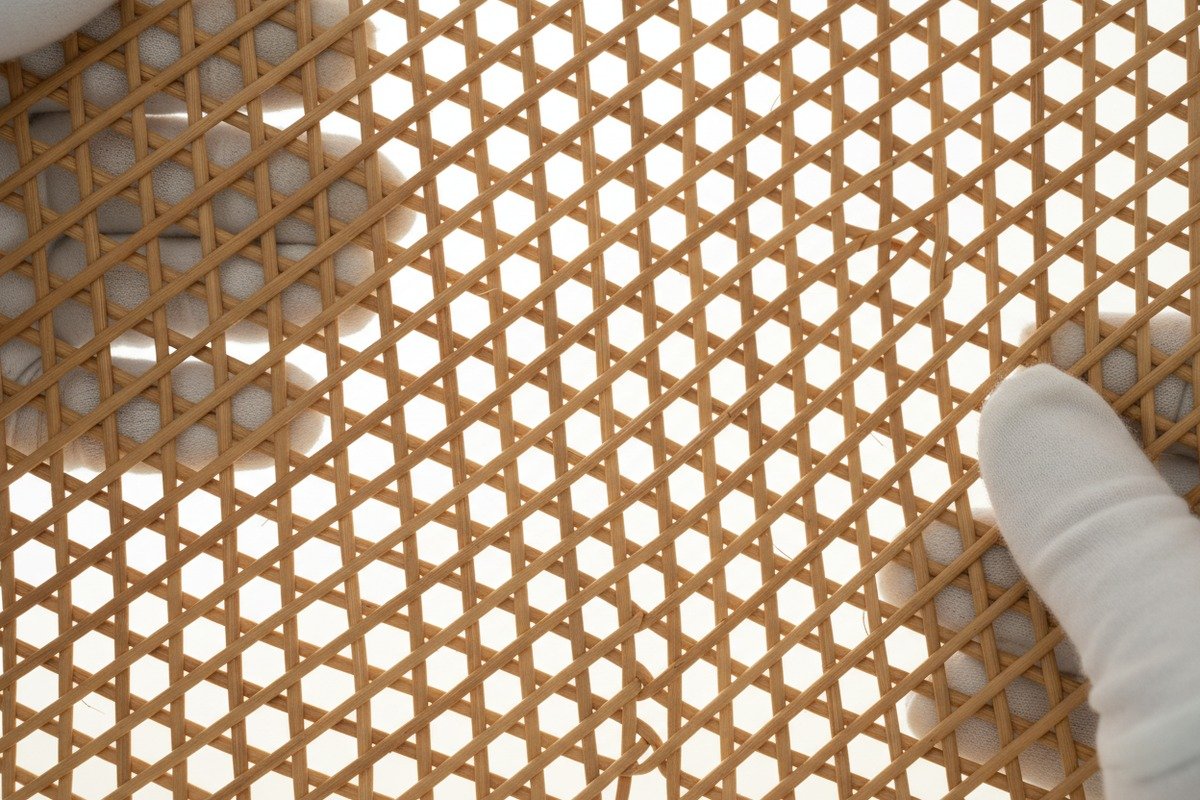
La qualité A n'est pas juste une étiquette. C'est un ensemble de caractéristiques mesurables. Laissez-moi vous guider à travers chacune d'elles afin que vous puissiez repérer la différence entre le véritable Grade A et un matériau qui n'est pas à la hauteur.
Épaisseur et profil des brins
Prenez la sangle et regardez attentivement les brins individuels. Les brins de Grade A sont uniformes en largeur et en épaisseur. Ils ne doivent pas être aplatis d'un côté ou bombés de l'autre. Passez vos doigts le long d'un brin. Il doit être lisse et rond, pas rugueux ou échardé.
Si vous voyez des brins dont l'épaisseur varie sensiblement au sein du même rouleau, c'est un signal d'alarme. Cela signifie que le rotin brut n'a pas été correctement trié avant le tissage.
Tension du tissage et régularité du motif
Tenez la sangle à la lumière. Les ouvertures du motif de tissage doivent être uniformes en taille et en forme. Pour une sangle en canne hexagonale standard sangle en canne hexagonale 6, l'ouverture du maillage est généralement d'environ un demi-pouce, mesurée de centre de trou à centre de trou.
Recherchez les endroits où le tissage semble groupé ou étiré. Une tension inégale cause des problèmes lors de l'installation car la sangle ne sera pas à plat contre le cadre.
État de surface
La sangle de qualité A a une surface propre et lisse. Il ne doit y avoir aucun résidu collant, sciure de bois ou débris de fabrication pris dans le maillage. Vérifiez les deux côtés. Certains défauts se cachent sur la face arrière.
Comparaison rapide des grades
| Caractéristique | Qualité A | Qualité B | Note C |
|---|---|---|---|
| Uniformité des brins | Très cohérent | Variations mineures | Incohérences visibles |
| Tension du tissage | Uniforme partout | 1 à 2 zones lâches par rouleau | Sections inégales multiples |
| Finition de surface | Lisse, propre | Points rugueux occasionnels | Points rugueux ou échardes fréquents |
| Cohérence des couleurs | Ton uniforme | Légers changements de teinte | Taches ou points sombres notables |
| Brins cassés | Aucun | 1 à 2 réparations mineures | Réparations multiples ou extrémités lâches |
| Taille du maillage | Constant ±1mm | Constant ±2mm | Inconstant au-delà de ±2mm |
Le test de trempage
Voici un test pratique que nous recommandons à nos clients. Coupez un petit échantillon, d'environ 15 cm sur 15 cm. Trempez-le dans de l'eau à température ambiante pendant 20 à 30 minutes. Le rotin de qualité A absorbe l'eau uniformément et devient souple de manière homogène. Si certaines lianes restent rigides tandis que d'autres deviennent molles, la qualité de la fibre est inconstante. Après le trempage, les lianes ne doivent pas se fendre ni s'effilocher. Si c'est le cas, le rotin a été soit sur-traité, soit issu de cannes immatures.
Ce test prend un minimum de temps mais vous renseigne beaucoup sur la santé de la fibre. Il est particulièrement utile lorsque vous évaluez un nouveau fournisseur pour la première fois.
Quels défauts spécifiques dois-je rechercher lors de la vérification de la cohérence du tissage et des dimensions du rouleau ?
Notre équipe de contrôle qualité inspecte chaque rouleau avant qu'il ne quitte l'entrepôt. Néanmoins, nous encourageons toujours les acheteurs à effectuer leur propre inspection. Détecter les défauts tôt fait gagner du temps et de l'argent à tout le monde.
Lors de la vérification de la cohérence du tissage, recherchez les espaces irréguliers, les fils lâches ou cassés, les décalages de motifs et les bords effilochés. Pour les dimensions des rouleaux, mesurez la largeur à trois points et vérifiez la longueur totale par rapport à la commande. Les écarts supérieurs à 2 mm en largeur ou à 5% en longueur justifient une réclamation.
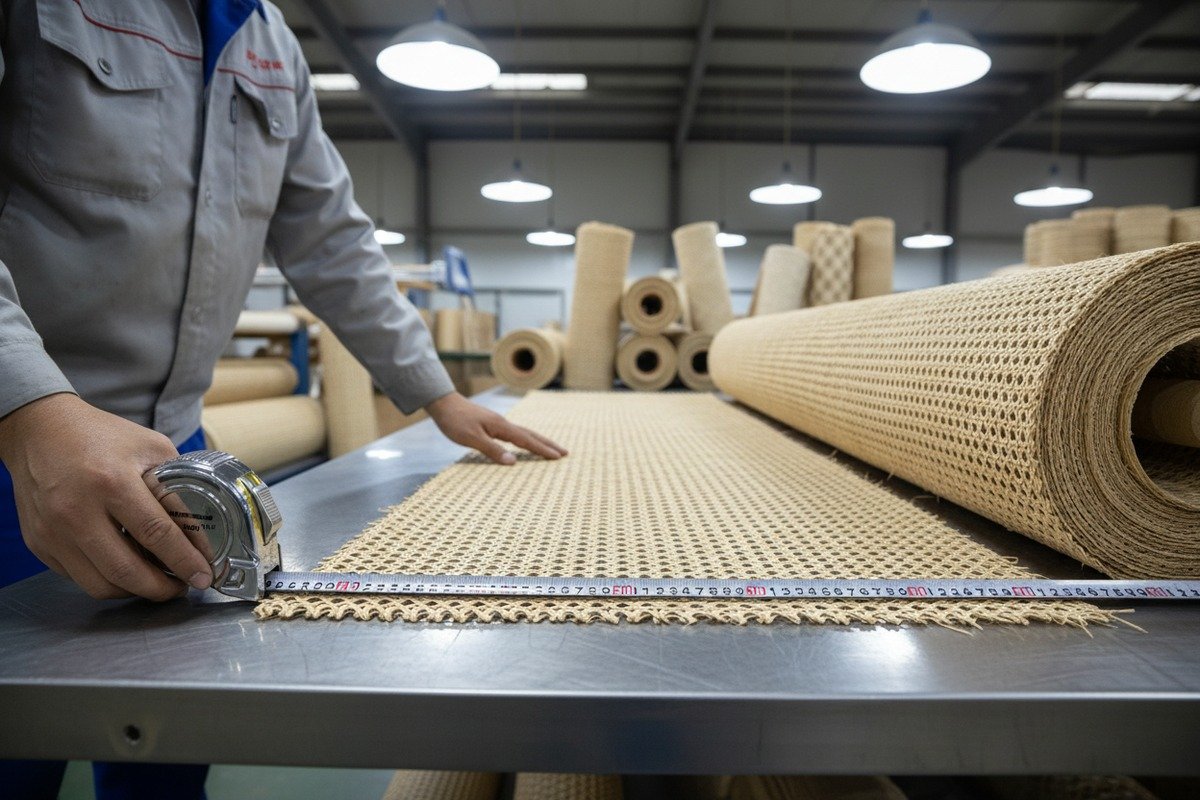
Les défauts dans la toile de rotin se répartissent en deux catégories : les défauts de tissage et les défauts dimensionnels 7. Les deux peuvent perturber votre production de meubles. Voici comment vérifier systématiquement chacun d'eux.
Défauts de tissage courants
Posez la toile à plat sur une surface propre et bien éclairée. Marchez le long de sa longueur et recherchez ces problèmes :
- Lianes lâches : Brins qui ne sont pas tissés serrés dans le motif. Ils dépassent ou peuvent être retirés facilement.
- Brins cassés : Morceaux de rotin cassés dans le tissage. Ceux-ci créent des points faibles.
- Changements de motif : Zones où le motif de tissage change de direction ou devient irrégulier. Cela se produit souvent lorsqu'une machine à tisser était mal calibrée ou lorsque des tisserands manuels ont perdu la tension.
- Bords qui se défont : Les bords du rouleau doivent être nets ou liés. Si des brins se détachent sur les bords, la finition était médiocre.
- Nœuds ou chevauchements : Endroits où un brin se termine et un autre commence. Dans la sangle de qualité A, ces transitions doivent être minimales et bien cachées.
Vérifications dimensionnelles
Utilisez un mètre ruban ou une règle. Mesurez la largeur à trois points : les deux extrémités et le milieu. La largeur doit correspondre aux spécifications de votre commande. Les largeurs courantes comprennent 16 pouces, 18 pouces et 24 pouces.
Pour la longueur, déroulez et mesurez la pièce entière si c'est pratique. Pour les grosses commandes, mesurez un échantillon représentatif de rouleaux.
Tableau de tolérance des défauts
| Defect Type | Acceptable (Grade A) | Marginal (Grade B) | Inacceptable |
|---|---|---|---|
| Brins lâches par mètre | 0 | 1–2 | 3 ou plus |
| Brins cassés par rouleau | 0 | 1 (réparé proprement) | 2 ou plus |
| Écart de largeur | ±1mm | ±2mm | Au-delà de ±2mm |
| Écart de longueur | Dans les 2% | 2–5% | Au-delà de 5% |
| Effilochage des bords | Aucun | Effilochage mineur (< 5mm) | Brins se détachant |
| Irrégularités du motif | Aucun visible | 1 décalage mineur | Multiple ou évident |
Comment documenter les défauts
Si vous trouvez des défauts, photographiez-les immédiatement. Incluez une règle sur la photo pour l'échelle. Notez l'emplacement sur le rouleau — distance par rapport au début et position sur la largeur. Cette documentation est utile lors du dépôt de réclamations de qualité. Elle aide également votre fournisseur à retracer le problème jusqu'à un lot de production spécifique.
Dans nos usines, nous suivons chaque plainte et la relions à la station de tissage ou au numéro de lot. Les rapports détaillés sur les défauts de nos clients nous aident à nous améliorer. N'hésitez donc pas à partager ces informations avec votre fournisseur.
Pourquoi la qualité des bords est importante
De nombreux acheteurs négligent les bords. Mais si vous coupez la sangle pour l'adapter aux cadres, des bords propres permettent d'économiser de la main-d'œuvre. Des bords effilochés ou qui s'effilochent signifient que vos ouvriers passent plus de temps à couper et à sécuriser les fils lâches. Sur des centaines de chaises, cela s'accumule rapidement.
Comment puis-je évaluer si l'emballage était suffisamment résistant pour protéger mon rotin de l'humidité ou de la casse ?
Nous avons expédié de la sangle en rotin dans plus de 20 pays. Grâce à des années d'expérience, nous avons appris que même une sangle parfaite peut arriver endommagée si l'emballage échoue pendant le transport.
Évaluez la durabilité de l'emballage en recherchant des taches d'eau, des déchirures, des sections écrasées et de la condensation à l'intérieur de l'emballage. Ouvrez la couche extérieure et inspectez la présence de moisissures, d'odeurs de moisi ou de plis permanents dans la sangle. Un bon emballage utilise des barrières contre l'humidité, des tubes ou des mandrins rigides et des couches extérieures protectrices.
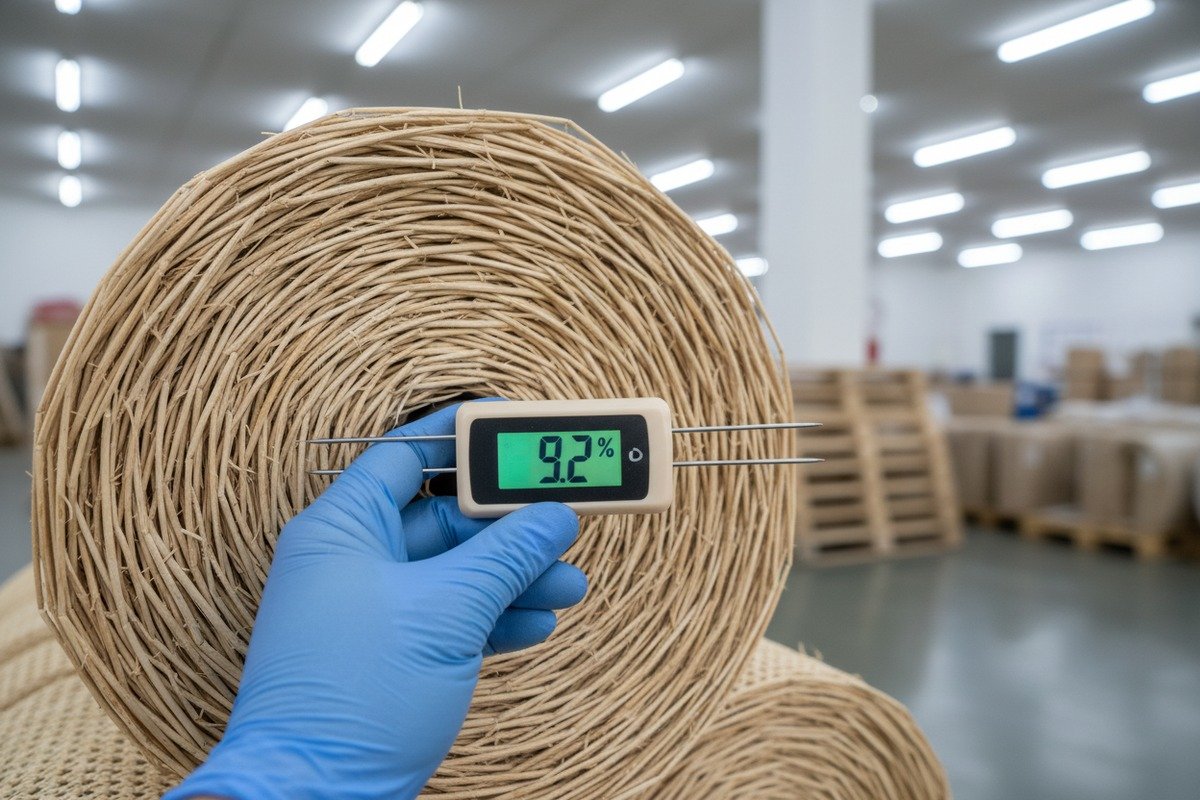
L'emballage est la première chose que vous voyez, et il raconte une histoire sur ce qui est arrivé à votre commande pendant l'expédition. Voici comment lire cette histoire.
Inspection de l'emballage extérieur
Avant d'ouvrir quoi que ce soit, regardez l'extérieur du colis. Vérifiez :
- Taches d'eau ou décoloration sur le carton ou l'emballage
- Coins écrasés ou bosses qui suggèrent une manipulation brutale
- Déchirures ou perforations qui ont pu exposer la sangle à l'air, à la poussière ou à l'humidité
- Intégrité du ruban adhésif—si le ruban adhésif se décolle ou a été réappliqué, le colis a pu être ouvert
Si vous constatez l'un de ces signes, photographiez-les avant d'ouvrir. Cette documentation est essentielle pour le dépôt de réclamations pour dommages d'expédition 8.
Évaluation de l'emballage intérieur
Ouvrez le colis avec précaution. Vérifiez la présence de :
- Condensation ou humidité à l'intérieur de l'emballage plastique
- Taches de moisissure ou de mildiou sur la sangle ou le matériel d'emballage
- Odeurs de moisi ou de produits chimiques—les odeurs de moisi indiquent une exposition à l'humidité ; les odeurs de produits chimiques agressifs suggèrent un traitement inapproprié
- Plis permanents ou froissures dans la toile causée par la compression
À quoi ressemble un bon emballage
Les fournisseurs de qualité utilisent des systèmes d'emballage multicouches. Voici ce à quoi vous attendre :
- Couche intérieure : Film plastique ou film barrière contre l'humidité 9 directement autour du rouleau de toile
- Support de noyau : Un tube en carton ou en plastique à l'intérieur du rouleau pour maintenir sa forme
- Rembourrage : Mousse, papier bulle ou carton ondulé autour du rouleau
- Couche extérieure : Un carton solide ou une caisse en bois pour une protection structurelle
Si vos rouleaux arrivent sans tube central, ils peuvent s'être effondrés pendant le transport. Les rouleaux effondrés développent des aplatissements et des plis qui affectent la façon dont la toile se pose pendant l'installation.
Le test olfactif
C'est simple mais efficace. Déballez la toile et sentez-la. Le rotin de qualité a une odeur douce et naturelle, légèrement boisée ou herbacée. Une odeur de moisi ou aigre signifie que l'humidité a été piégée dans l'emballage. Une forte odeur chimique peut indiquer un blanchiment excessif ou un traitement anti-moisissure. Aucun des deux n'est acceptable pour un matériau de qualité A.
Stockage après réception
Même après que la toile ait passé votre inspection d'emballage, stockez-la correctement. Gardez-la dans une pièce sèche avec une bonne circulation d'air. Évitez la lumière directe du soleil. Ne pas empiler d'objets lourds sur les rouleaux de toile. Maintenir 40–60% d'humidité relative 10 est idéal. Trop sec, et le rotin devient cassant. Trop humide, et de la moisissure peut se développer en quelques jours.
Quelle est ma liste de contrôle pour m'assurer que la couleur et la texture correspondent aux normes de production de mes meubles ?
D'après notre expérience d'exportation vers des usines de meubles aux Pays-Bas, aux États-Unis et en Australie, les divergences de couleur et de texture sont la principale raison des expéditions rejetées. Obtenir cela correctement est non négociable.
Pour garantir que la couleur et la texture correspondent à vos normes, comparez la sangle reçue à un échantillon pré-approuvé à la lumière naturelle du jour. Vérifiez le blanchiment uniforme, le niveau de brillance constant, la douceur des surfaces des brins et l'absence de zones tachetées ou jaunies. Conservez toujours un échantillon de référence de chaque lot approuvé.

La couleur et la texture sont les points où la variabilité naturelle du rotin pose des défis à la cohérence de la production. Voici comment gérer ce défi.
Pourquoi un échantillon de référence est essentiel
Avant de passer une commande en gros, demandez et approuvez un échantillon. Conservez cet échantillon dans un endroit sombre et sec. Lorsque l'expédition en gros arrive, comparez le nouveau matériau directement à l'échantillon. Faites-le à la lumière naturelle du jour – l'éclairage artificiel peut masquer de subtiles différences de couleur.
Si votre fournisseur vous envoie un échantillon qui a une apparence et que la commande en gros en a une autre, vous avez des motifs pour une réclamation de qualité. Mais sans l'échantillon à portée de main, vous perdez ce levier.
Étapes d'inspection de la couleur
- Déroulez le cannage sur une surface blanche propre
- Examinez la couleur à la lumière naturelle du jour, pas à la lumière fluorescente ou LED
- Vérifiez trois zones : les deux extrémités et le milieu du rouleau
- Recherchez le jaunissement, les taches sombres ou le blanchiment inégal
- Comparez avec votre échantillon de référence
Pour le rotin blanchi, la couleur doit être une teinte uniforme de paille claire ou de crème. Pour le rotin non blanchi, attendez-vous à une nuance plus chaude de beige ou d'or. Quoi qu'il en soit, la teinte doit être uniforme sur tout le rouleau.
Évaluation de la texture
Passez votre main sur la surface. Le rotin de qualité A est lisse et uniforme. Vous ne devriez pas sentir d'échardes ou de zones rugueuses. Les surfaces des brins doivent avoir un fini mat ou semi-mat constant. Les zones brillantes ou ternes suggèrent un revêtement ou un traitement inégal.
Vérifiez également la fermeté des brins. Pressez légèrement une section. Les brins doivent être fermes mais pas rigides. Des brins trop mous peuvent indiquer des dommages dus à l'eau ou un mauvais séchage.
Tableau de correspondance couleur et texture
| Caractéristique | Acceptable | Inacceptable |
|---|---|---|
| Uniformité de la couleur | Ton uniforme sur tout le rouleau | Coloration tachetée, striée ou inégale |
| Cohérence du blanchiment | Crème claire/paille uniforme | Taches sombres, jaunissement ou zones brunes |
| Douceur de surface | Lisse au toucher, sans échardes | Brins rugueux, échardés ou feuilletés |
| Niveau de brillance | Mat ou semi-mat constant | Zones brillantes et ternes mélangées |
| Fermeté des brins | Ferme mais légèrement souple | Trop mou, pâteux, ou rigide et cassant |
| Correspondance avec l'échantillon | Dans la plage naturelle acceptable | Nuance ou texture clairement différente |
Gérer la variation naturelle
Le rotin naturel n'est pas du plastique. Il y aura toujours des variations mineures entre les lots. La clé est de définir votre tolérance. Certains fabricants de meubles acceptent une variation de ±1 nuance sur un nuancier standard. D'autres exigent des correspondances quasi exactes.
Communiquez clairement votre tolérance à votre fournisseur avant de commander. Dans notre usine de traitement, nous trions le rotin par grade de couleur avant le tressage. Cela minimise les variations entre les lots. Mais nous ne pouvons correspondre à vos attentes que si nous les connaissons.
Quand rejeter une expédition
Si la couleur est manifestement erronée – par exemple, vous avez commandé du blanc décoloré et reçu une sangle jaunâtre – rejetez-la immédiatement et contactez votre fournisseur avec des photos et votre échantillon de référence pour comparaison. Les différences de tons naturels mineures sont normales. Les changements majeurs ne le sont pas.
Si la texture est incohérente au sein d'un même rouleau – lisse par endroits et rugueuse par d'autres – cela indique un échec de traitement. Le rouleau doit être remplacé.
Conclusion
Une inspection de réception disciplinée protège votre chaîne de production, votre réputation et vos bénéfices. Utilisez ce guide comme votre processus standard chaque fois qu'une expédition de rotin arrive.
Notes de bas de page
1. Fournit un aperçu général de la sangle en rotin et de son utilisation dans le mobilier. ↩︎
2. Explique comment maintenir une tension constante et éviter les défauts pendant le processus de tissage. ↩︎
3. Fournit un guide complet pour la mise en œuvre d'un processus de contrôle qualité systématique dans la fabrication. ↩︎
4. Trouvé un article détaillé sur les grades de qualité du cannage en rotin, y compris le Grade A. ↩︎
5. Discute de l'importance d'un traitement de couleur cohérent et de contrôles de qualité dans le rotin. ↩︎
6. Décrit le motif hexagonal courant et ses caractéristiques dans le cannage. ↩︎
7. Explique ce que sont les défauts dimensionnels, leurs causes et leur impact dans la fabrication. ↩︎
8. Fournit un guide étape par étape sur la manière de déposer des réclamations pour les expéditions endommagées. ↩︎
9. Définit l'emballage barrière contre l'humidité et sa fonction dans la protection des produits sensibles. ↩︎
10. Trouvé une explication claire et concise de l'humidité relative. ↩︎

 English
  Español de México
  العربية
  Deutsch
  Français
  Русский