
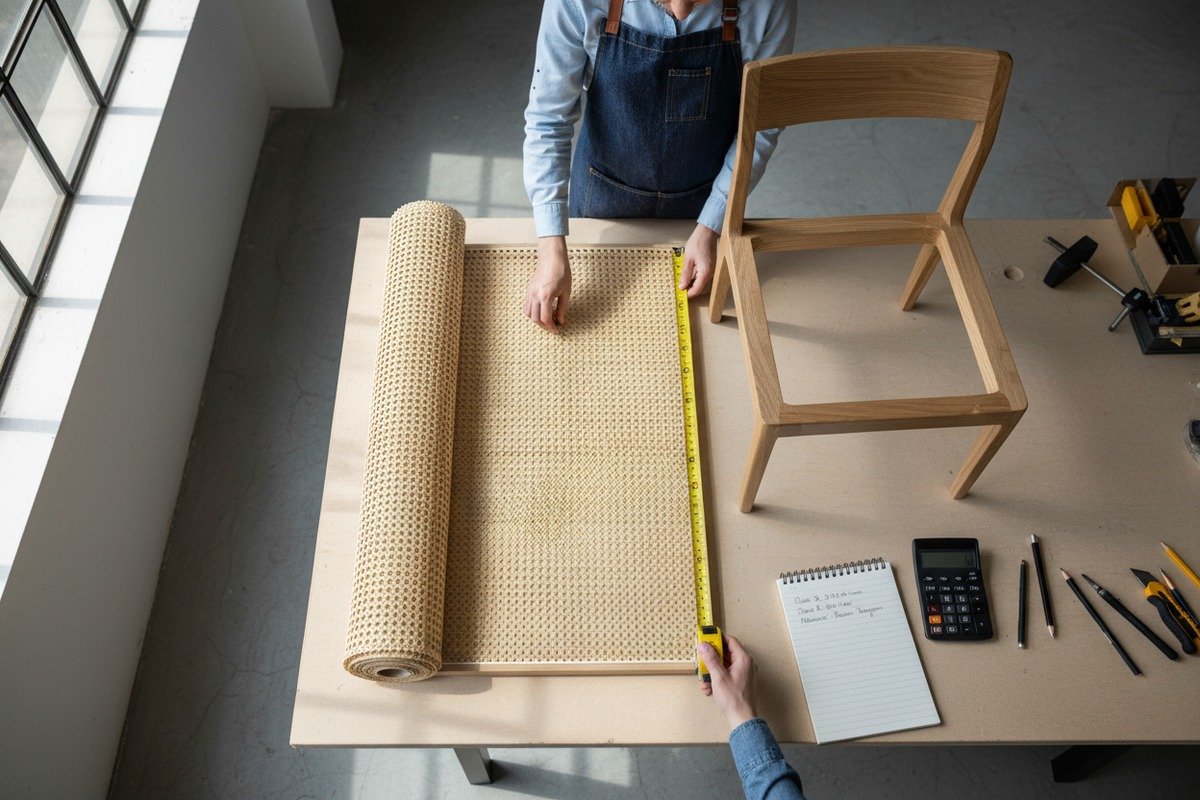
Chaque semaine, notre équipe commerciale chez Seafan Rattan reçoit des dizaines de demandes d'usines de meubles posant la même question : quelle quantité de cannage dois-je réellement commander ? Cela semble simple, mais nous avons vu d'innombrables commandes échouer en raison de mesures de siège inexactes. Les acheteurs se retrouvent avec trop peu de matériel et font face à des retards de production, ou ils en commandent trop et gaspillent de l'argent en stock excédentaire. Dans tous les cas, cela nuit à la rentabilité. Après des années d'expéditions cannage rotin 1 vers des usines aux États-Unis, en Europe et en Asie du Sud-Est, nous avons développé une méthode claire et reproductible qui élimine les conjectures.
Pour calculer les besoins en cannage de rotin, mesurez votre siège de chaise de rainure à rainure en largeur et en longueur, ajoutez 4 pouces à chaque dimension pour la marge d'installation, puis convertissez en pieds linéaires et commandez le cannage dans la largeur de rouleau appropriée pour couvrir les mesures ajustées.
Cet article vous guide à travers chaque étape du processus de calcul. Nous couvrirons comment mesurer votre cadre de chaise 2, quelle quantité de matériel supplémentaire ajouter, quelle largeur de rouleau vous permet d'économiser le plus d'argent, et comment adapter les commandes pour des commandes en gros. Entrons dans les détails.
Comment mesurer précisément le cadre de ma chaise pour trouver la bonne taille de rotin ?
L'une des erreurs les plus courantes que nous constatons chez nos acheteurs étrangers est de mesurer le mauvais point de référence sur le cadre de la chaise. L'ouverture visible du siège n'est pas la même que la mesure dont vous avez besoin pour commander le cannage. Cette petite erreur entraîne de gros problèmes lors de l'installation.
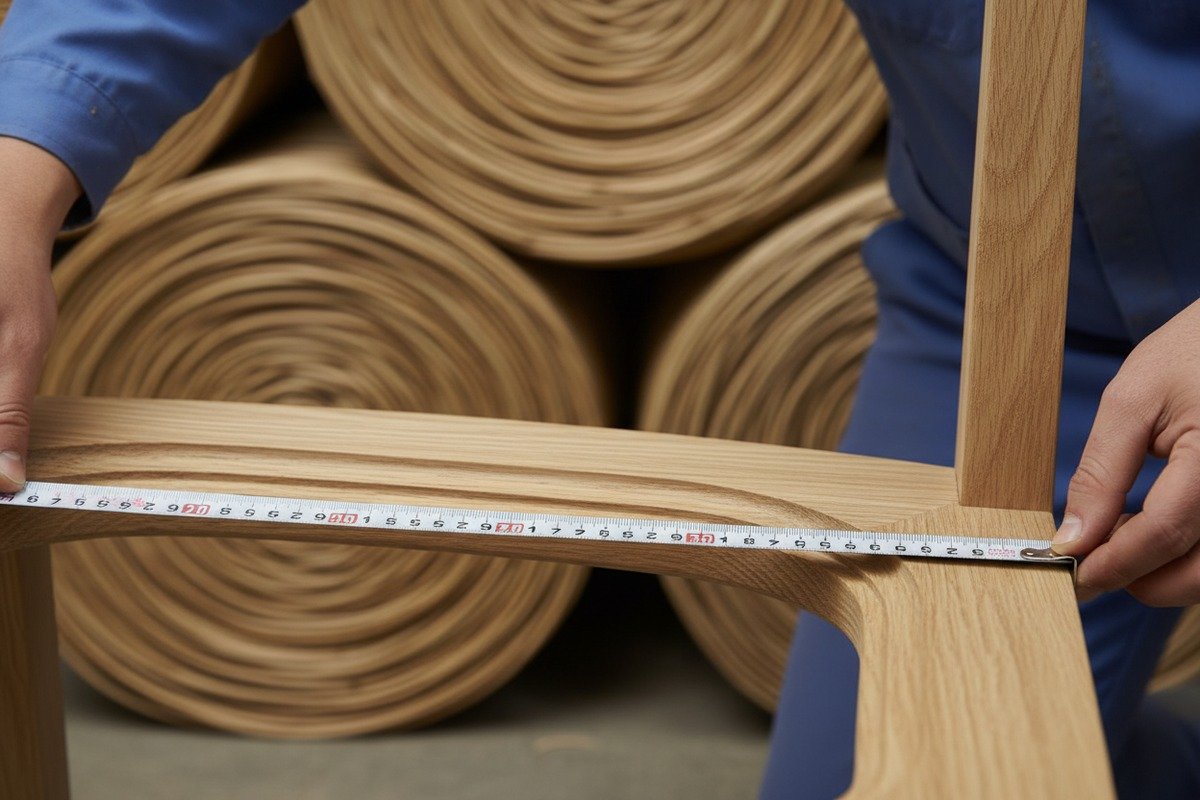
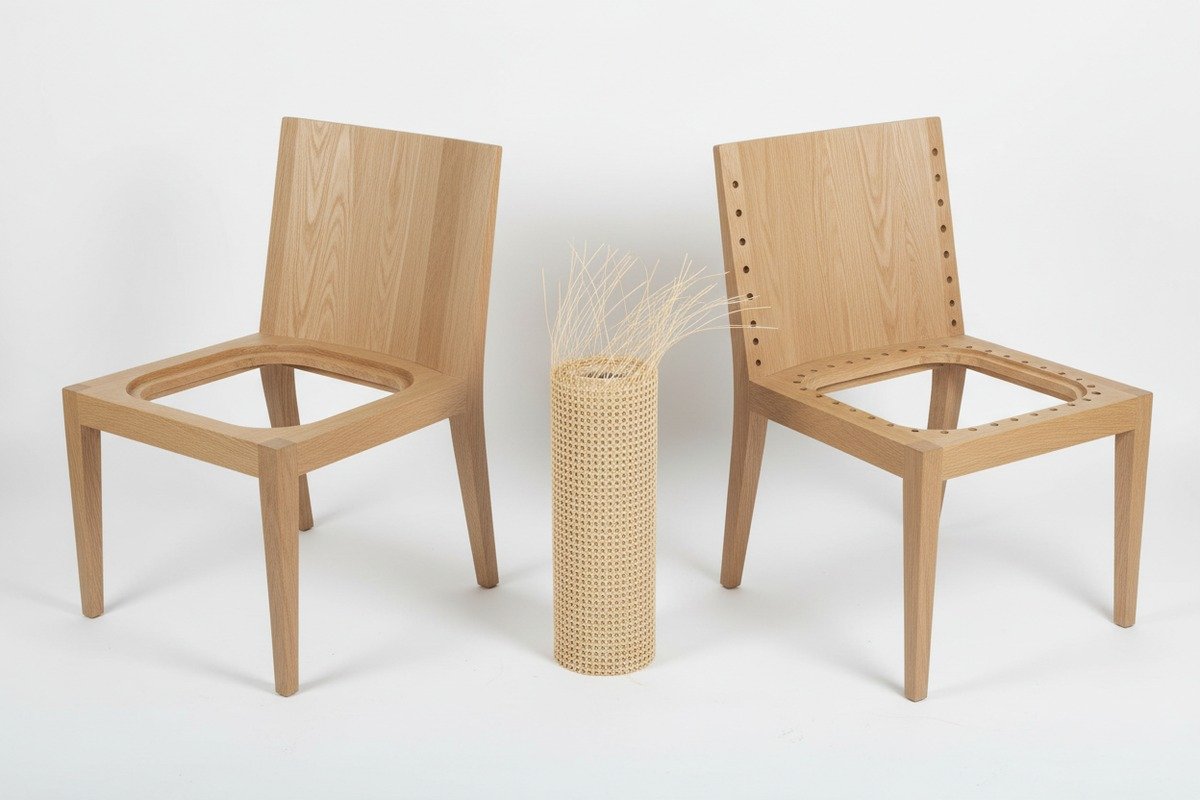
Pour mesurer avec précision le cadre de votre chaise, localisez la rainure creusée autour du périmètre du siège et mesurez du centre de la rainure d'un côté au centre de la rainure du côté opposé, en capturant séparément les dimensions de largeur et de longueur.
Comprendre la méthode de rainure à rainure
La rainure est le canal creusé dans le cadre de la chaise où le cannage est inséré et fixé avec une baguette. Vous ne mesurez pas le bord extérieur du cadre. Vous ne mesurez pas l'ouverture visible. Vous mesurez du centre d'une rainure au centre de la rainure opposée. Cela vous donne la véritable zone de couverture.
Utilisez un mètre ruban souple 3 pour les cadres incurvés. Pour les cadres droits, une règle rigide convient. Mesurez toujours d'abord en pouces. Prenez la mesure de la largeur (d'un côté à l'autre) et la mesure de la longueur (d'avant en arrière) séparément. Notez les deux chiffres.
Pourquoi plusieurs mesures sont importantes
Tous les cadres de chaise ne sont pas parfaitement symétriques. Notre équipe de production a inspecté des milliers de cadres de chaise au fil des ans, et nous pouvons confirmer que de légères irrégularités sont courantes. L'avant d'un siège peut être plus large que l'arrière. Le côté gauche peut différer du côté droit d'une fraction de pouce.
Prenez des mesures à plusieurs points. Pour la largeur, mesurez à l'avant, au milieu et à l'arrière du siège. Pour la longueur, mesurez sur le côté gauche, au centre et sur le côté droit. Utilisez la plus grande mesure dans chaque direction. Cela garantit que votre cannage couvre toute l'ouverture sans être trop court.
Différencier les sièges à rainure et les sièges à trous percés
Avant de mesurer, confirmez que votre chaise utilise un cannage avec un système de rainure et de baguette. Certaines chaises plus anciennes ou faites à la main ont des trous percés autour du périmètre à la place. Celles-ci nécessitent du rotin de siège en brin 4 et une approche de mesure complètement différente. Si vous voyez un canal continu autour du siège, vous avez besoin de cannage en nappe. Si vous voyez des trous individuels, vous avez besoin de cannage en brin.
| Point de mesure | Ce qu'il faut mesurer | Outil recommandé |
|---|---|---|
| Largeur (d'un côté à l'autre) | Centre de la rainure gauche au centre de la rainure droite | Mètre ruban souple |
| Longueur (avant vers arrière) | Centre de la rainure avant au centre de la rainure arrière | Mètre ruban souple |
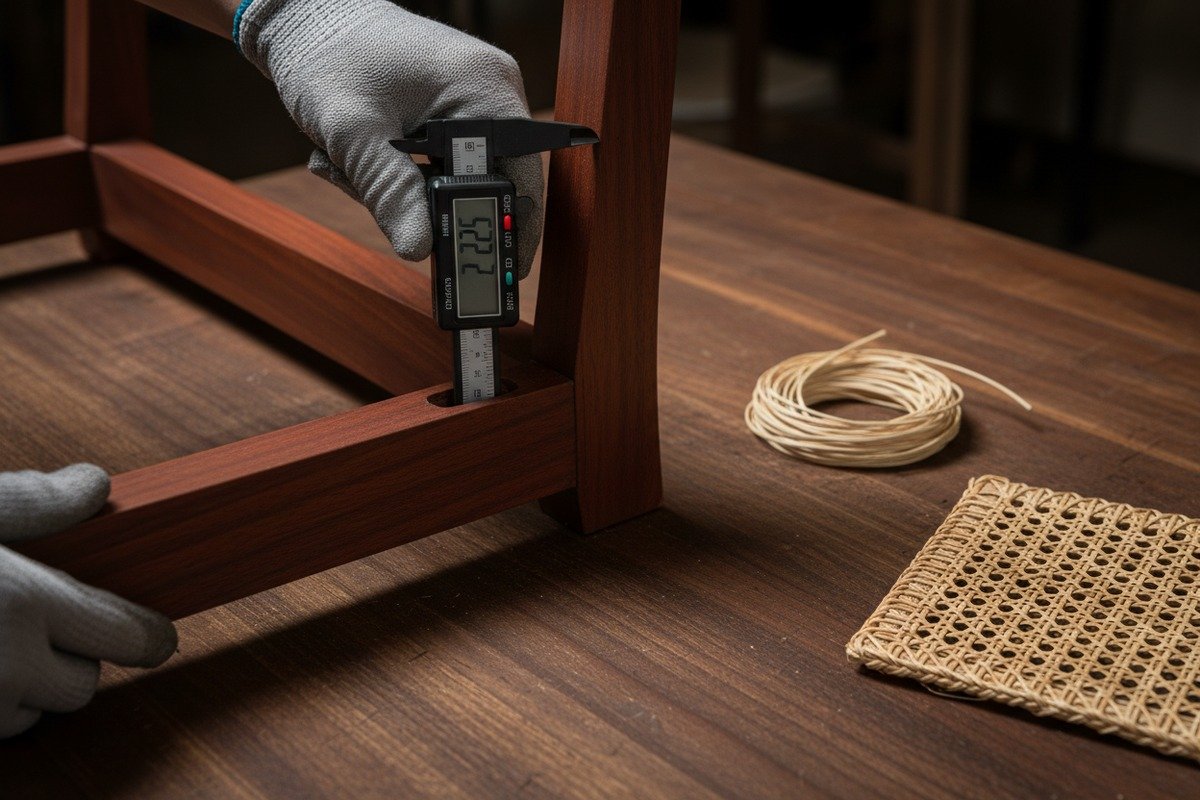
| Largeur de la rainure 5 | Paroi intérieure à paroi intérieure du canal | Pied à coulisse ou petite règle |
| Profondeur de la rainure | Surface supérieure du cadre au fond du canal | Règle fine ou cure-dent |
Mesurer la rainure elle-même
Vous devez également mesurer la largeur de la rainure. Cela détermine la taille du jonc dont vous aurez besoin. Les largeurs de rainure courantes vont de 5/32 pouce à 1/4 pouce. Utilisez un pied à coulisse pour la précision 6. Ne mesurez pas votre ancien jonc pour déterminer la taille de la rainure. Les anciens joncs se compriment avec le temps et donnent des mesures inexactes. Mesurez la rainure réelle.
Création de gabarits pour formes irrégulières
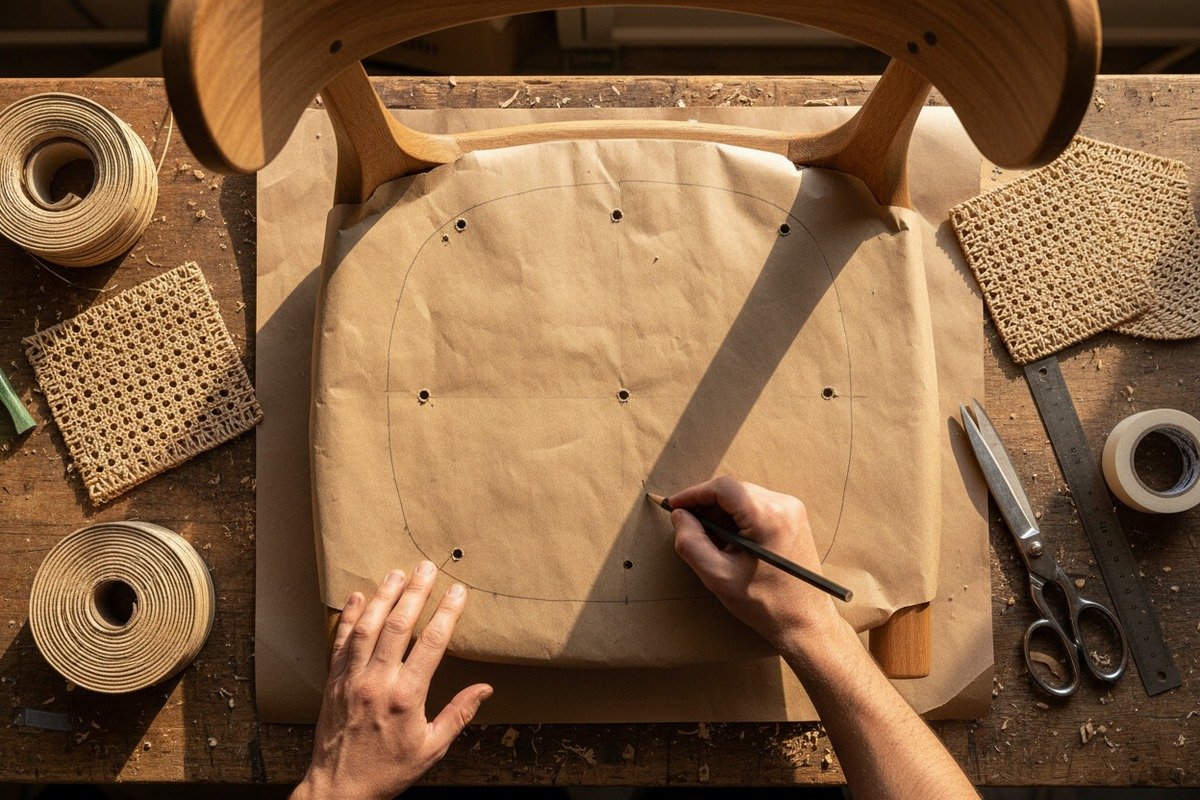
Certaines chaises ont des sièges de forme incurvée, trapézoïdale ou autrement irrégulière. Dans ces cas, posez un morceau de papier kraft 7 ou de carton sur l'ouverture du siège. Tracez la ligne de la rainure sur le papier. Découpez-le. Ce gabarit vous donne une forme exacte avec laquelle travailler. Vous pouvez le poser sur la sangle lors de la découpe pour minimiser les déchets. Nous recommandons cette approche en particulier pour les projets de restauration haut de gamme ou vintage où la précision est primordiale.
Quelle marge supplémentaire dois-je inclure dans mes calculs de cannage en rotin pour l'installation ?
Lorsque notre équipe d'entrepôt découpe des sangles pour les commandes des clients, nous ajoutons toujours une marge. Couper la sangle à la mesure exacte de rainure à rainure est un moyen garanti d'échouer l'installation. Le matériau doit dépasser de la rainure de chaque côté afin que vous puissiez le saisir, l'étirer et l'enfoncer correctement.
Ajoutez 4 pouces aux mesures de largeur et de longueur de vos dimensions de rainure à rainure. Ce surplomb de 2 pouces de chaque côté fournit suffisamment de matière pour saisir, étirer, couper et presser la sangle dans la rainure pendant l'installation.
La règle des 4 pouces expliquée
La pratique standard de l'industrie consiste à ajouter 4 pouces au total à chaque dimension. Cela signifie 2 pouces de matériau supplémentaire de chaque côté. Donc, si votre largeur de rainure à rainure est de 14 pouces, votre largeur de coupe devrait être de 18 pouces. Si votre longueur de rainure à rainure est de 16 pouces, votre longueur de coupe devrait être de 20 pouces.
Ce matériau supplémentaire sert à plusieurs fins. Premièrement, il vous donne quelque chose à tenir lorsque vous étirez la sangle trempée sur le cadre. Deuxièmement, il vous permet d'utiliser des coins de cannage 8 pour maintenir temporairement la sangle dans la rainure pendant que vous travaillez sur le périmètre. Troisièmement, il offre une marge d'erreur pour un léger désalignement lors de l'installation.
Que se passe-t-il si vous sautez la marge
Nous avons entendu des acheteurs qui ont essayé d'économiser du matériau en coupant trop près de la mesure de la rainure. Le résultat est presque toujours le même. La sangle sort de la rainure d'un côté pendant que vous l'enfoncez de l'autre. Vous ne pouvez pas obtenir une tension correcte. Le siège fini s'affaisse ou a une tension inégale. Dans certains cas, la sangle se déchire au bord de la rainure car il n'y a pas assez de matériau pour absorber le stress de l'installation.
Considérations relatives au trempage et au rétrécissement
La cannage en rotin naturel doit être trempé dans de l'eau tiède avant l'installation. Le temps de trempage varie de 30 minutes à 4 heures selon l'épaisseur et la densité du tissage. Une fois mouillé, le cannage devient souple et extensible. Après l'installation, le cannage sèche et se contracte, se tendant sur le cadre du siège.
Ce rétrécissement est votre allié. Il crée une surface tendue, semblable à un tambour. Mais cela signifie également que vous avez besoin de matériau supplémentaire pour tenir compte des légers changements dimensionnels pendant le processus de séchage. Bande de rotin synthétique 9 ne nécessite pas de trempage et ne rétrécit pas, mais la marge de 4 pouces s'applique toujours pour des raisons de manipulation.
| Scénario | Rainure à rainure (pouces) | Ajouter une marge | Taille de coupe finale (pouces) |
|---|---|---|---|
| Petite chaise de salle à manger (largeur) | 12 | +4 | 16 |
| Petite chaise de salle à manger (longueur) | 14 | +4 | 18 |
| Chaise de salle à manger standard (largeur) | 15 | +4 | 19 |
| Chaise de salle à manger standard (longueur) | 17 | +4 | 21 |
| Fauteuil large (largeur) | 20 | +4 | 24 |
| Fauteuil large (longueur) | 22 | +4 | 26 |
N'oubliez pas la marge pour la baguette
Au-delà du cannage lui-même, vous devez calculer la longueur de la baguette séparément. Mesurez la circonférence totale de la rainure. Ajoutez 1 pied à ce nombre. Ce pied supplémentaire couvre le chevauchement à la jonction et vous donne de la marge pour l'ajustement. La baguette n'a besoin que d'un bref trempage avant utilisation, vous pouvez donc la tremper dans l'eau juste au moment où vous commencez à l'enfoncer dans la rainure.
Humidité et facteurs environnementaux
Si vous installez dans un climat humide, gardez à l'esprit que le cannage naturel absorbera l'humidité ambiante au fil du temps. Dans des environnements très secs, il peut rétrécir plus que prévu. Notre expérience d'expédition à des clients au Moyen-Orient par rapport à l'Asie du Sud-Est a montré que les conditions environnementales affectent la tension à long terme. Assurer une tension initiale suffisante et une marge appropriée lors de l'installation aide à compenser ces fluctuations.
Quelle largeur de rouleau de rotin m'aidera à minimiser le gaspillage de matériaux pour les dimensions spécifiques de ma chaise ?
De notre chaîne de production à Foshan, nous fabriquons du cannage en rotin en deux largeurs de rouleau standard. Choisir la bonne n'est pas seulement une question de couvrir le siège. Il s'agit de réduire les chutes et de maintenir vos coûts de matériaux par unité aussi bas que possible. Lorsque vous produisez des centaines ou des milliers de chaises, même un petit pourcentage de gaspillage s'accumule rapidement.
La cannage en rotin est généralement disponible en rouleaux de 18 pouces (1,5 pied) et de 24 pouces (2 pieds) de largeur. Choisissez la largeur de 18 pouces pour les chaises de salle à manger standard dont les dimensions ajustées sont inférieures à 18 pouces, et la largeur de 24 pouces pour les sièges plus grands, les bancs ou les projets dont la dimension ajustée dépasse 18 pouces.
Faire correspondre la largeur du rouleau à vos dimensions ajustées
Après avoir ajouté la marge de 4 pouces à vos mesures, comparez la largeur ajustée aux largeurs de rouleau disponibles. Si votre largeur ajustée est de 16 pouces, un rouleau de 18 pouces vous donne seulement 2 pouces de gaspillage d'un côté. Si votre largeur ajustée est de 20 pouces, vous devez utiliser un rouleau de 24 pouces, ce qui laisse 4 pouces de gaspillage.
Le principe clé est simple : choisissez la plus petite largeur de rouleau qui couvre toujours votre dimension ajustée. Cela minimise la bande de matériau inutilisé à chaque coupe.
L'orientation compte
Voici une astuce que de nombreux acheteurs négligent. Vous pouvez orienter la cannage dans les deux sens. Si votre largeur ajustée est de 20 pouces mais que votre longueur ajustée n'est que de 17 pouces, envisagez de faire pivoter la cannage de 90 degrés. Utilisez la largeur de rouleau de 18 pouces pour couvrir la dimension de 17 pouces, et coupez votre longueur du rouleau pour couvrir la dimension de 20 pouces. Cela peut permettre d'économiser une quantité importante de matériaux sur une grande série de production.
Cependant, sachez que le motif de tissage 10 peut avoir un aspect différent lorsqu'il est tourné. Les motifs de tissage carré sont généralement symétriques et ont le même aspect dans les deux orientations. Les motifs hexagonaux ou octogonaux peuvent avoir un aspect directionnel. Vérifiez auprès de votre équipe de conception avant de faire pivoter.
Exemple de calcul de gaspillage
Disons que vous produisez 500 chaises de salle à manger. Chaque chaise a une dimension de siège ajustée de 17 pouces de large par 19 pouces de long.
Utilisation d'un rouleau de 18 pouces : la largeur de 18 pouces couvre la largeur ajustée de 17 pouces avec 1 pouce de gaspillage. Vous avez besoin de 19 pouces de matériau linéaire par chaise. Pour 500 chaises, cela représente 9 500 pouces linéaires, soit environ 791,7 pieds linéaires.
Utilisation d'un rouleau de 24 pouces : la largeur de 24 pouces couvre la largeur ajustée de 17 pouces avec 7 pouces de gaspillage par chaise. Cela représente 3 500 pouces de largeur de matériau gaspillée sur 500 chaises. Clairement, le rouleau de 18 pouces est le meilleur choix ici.
| Largeur ajustée (pouces) | Meilleure largeur de rouleau | Déchets par coupe (pouces) | Déchets sur 500 chaises (pouces) |
|---|---|---|---|
| 14 | 18 pouces | 4 | 2,000 |
| 16 | 18 pouces | 2 | 1,000 |
| 17 | 18 pouces | 1 | 500 |
| 19 | 24 pouces | 5 | 2,500 |
| 22 | 24 pouces | 2 | 1,000 |
| 24 | 24 pouces | 0 | 0 |
Considérations sur le motif et la taille du maillage
Lors de la sélection de la largeur du rouleau, tenez également compte de la taille du maillage du tissage. Un maillage fin et ouvert (espacement des trous de 1/2 pouce) a une apparence plus délicate et convient bien aux chaises plus petites et raffinées. Un maillage moyen (espacement des trous de 5/8 pouce) est plus durable et convient aux chaises de salle à manger standard et aux meubles de tous les jours. La taille du maillage ne modifie pas les options de largeur de rouleau, mais elle affecte le résultat visuel et la qualité perçue du siège fini.
Les motifs à tissage carré (rotin radio) et hexagonal (tissage ouvert) sont disponibles dans les deux largeurs de rouleau. Le tissage carré est plus traditionnel et polyvalent. Le tissage hexagonal offre un motif décoratif en forme d'étoile qui convient aux esthétiques bohèmes et modernes du milieu du siècle. Notre usine produit les deux dans des variétés naturelles, blanchies et synthétiques pour correspondre à n'importe quel cahier des charges.
Naturel vs. Synthétique : Une brève note
Le cannage en rotin naturel présente des variations de couleur organiques dans des tons beige clair, jaune paille et crème. Il est biodégradable et a un aspect artisanal authentique. Le cannage en rotin synthétique imite cet aspect dans du plastique durable et est mieux adapté à une utilisation en extérieur. Le synthétique ne nécessite pas de trempage et résiste aux dommages causés par l'humidité. Les deux types sont disponibles dans les mêmes largeurs de rouleau standard et sont calculés de la même manière.
Comment calculer le nombre total de rouleaux de rotin dont j'ai besoin pour ma commande de meubles en gros ?
Passer d'une seule chaise à une commande d'usine de 500 ou 5 000 unités nécessite un calcul systématique. Lorsque nos clients aux Pays-Bas ou en Australie nous envoient des demandes d'approvisionnement, nous les guidons à travers ce processus exact pour nous assurer qu'ils commandent la bonne quantité du premier coup. Les réapprovisionnements en cours de production coûtent du temps et de l'argent, surtout avec les délais de livraison internationaux.
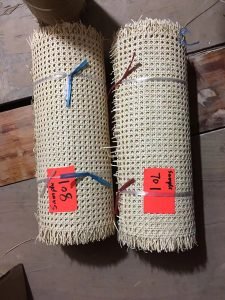
Pour calculer le nombre total de rouleaux nécessaires, multipliez la longueur ajustée par chaise par le nombre total de chaises pour obtenir les pouces linéaires totaux, convertissez en pieds linéaires, puis divisez par la longueur du rouleau (communément 50 pieds pour les rouleaux en vrac), et arrondissez au rouleau entier supérieur pour assurer une couverture complète.
Calcul en vrac étape par étape
Travaillons sur un exemple concret. Vous êtes une usine de meubles produisant 300 chaises de salle à manger. Chaque assise de chaise mesure 15 pouces de large sur 17 pouces de long, rainure à rainure.
Étape 1 : Ajoutez une marge de 4 pouces. Largeur ajustée : 19 pouces. Longueur ajustée : 21 pouces.
Étape 2 : Choisissez la largeur du rouleau. La largeur ajustée est de 19 pouces, vous avez donc besoin du rouleau de 24 pouces.
Étape 3 : Calculez le matériau linéaire par chaise. Vous avez besoin de 21 pouces de sangle linéaire par chaise sur le rouleau.
Étape 4 : Multipliez par le nombre de chaises. 21 pouces × 300 chaises = 6 300 pouces linéaires.
Étape 5 : Convertissez en pieds linéaires. 6 300 ÷ 12 = 525 pieds linéaires.
Étape 6 : Divisez par la longueur du rouleau. Les rouleaux en vrac standard mesurent 50 pieds. 525 ÷ 50 = 10,5 rouleaux.
Étape 7 : Arrondissez. Vous avez besoin de 11 rouleaux de rotin de 24 pouces de large, chacun de 50 pieds de long.
Ajout d'une marge de sécurité pour les commandes en vrac
Nous recommandons toujours d'ajouter 5 à 10 % de matériau supplémentaire aux commandes en vrac. Cela couvre les coupes défectueuses, les erreurs d'installation, les pièces endommagées pendant le transport et les rejets de contrôle qualité. Pour 300 chaises nécessitant 525 pieds linéaires, une marge de 10 % ajoute 52,5 pieds. Votre commande totale devient 577,5 pieds, ce qui équivaut à 12 rouleaux.
Calcul du jonc pour les commandes en vrac
N'oubliez pas le jonc. Mesurez la circonférence de la rainure d'une chaise. Une chaise de salle à manger typique peut avoir une circonférence de rainure d'environ 52 pouces. Ajoutez 12 pouces (1 pied) pour le chevauchement. Cela vous donne 64 pouces par chaise, soit environ 5,33 pieds.
Pour 300 chaises : 5,33 × 300 = 1 600 pieds de rotin. Le rotin est généralement vendu en bobines de 250 ou 500 pieds. Il vous faudrait 4 bobines de 500 pieds, ou vous pourriez commander 7 bobines de 250 pieds.
Exemple de nomenclature complète
| Article | Par chaise | Pour 300 chaises | Avec tampon 10% | Quantité commandée |
|---|---|---|---|---|
| Toile de rotin de 24 pouces | 21 pouces linéaires | 525 pieds linéaires | 577,5 pieds linéaires | 12 rouleaux (50 pieds chacun) |
| Rotin (#8) | 64 pouces linéaires | 1 600 pieds linéaires | 1 760 pieds linéaires | 4 bobines (500 pieds chacune) |
| Coins de cannage | 8 pièces | Réutilisable | N/A | 2 paquets (réutilisable) |
| Colle à bois | 10 ml | 3 000 ml (3 litres) | 3,3 litres | 4 bouteilles (1 litre chacune) |
Tarification par volume et optimisation des commandes
De nombreux fournisseurs, y compris notre exploitation à Seafan Rattan, offrent des remises automatiques à certains seuils de volume. Un point de rupture courant est de 10 pieds, où vous pourriez recevoir 10% de réduction. Les rouleaux en vrac de 50 pieds offrent un meilleur prix par pied que l'achat au pied courant. Lors du calcul de votre commande, vérifiez si l'arrondi au niveau de prix supérieur permet réellement d'économiser de l'argent au total.
Pour les très grosses commandes, envisagez de commander des chargements de conteneurs complets. Un conteneur de 20 pieds peut contenir une quantité substantielle de rouleaux de sangle en rotin. Nous aidons nos clients à optimiser le chargement des conteneurs pour maximiser la quantité de matériaux expédiés par conteneur et réduire les coûts de fret par unité.
Commandes de produits mixtes
Si votre chaîne de production fabrique plusieurs modèles de chaises avec différentes dimensions de siège, calculez chaque modèle séparément, puis combinez les totaux. Regroupez les modèles par largeur de rouleau. Toutes les chaises nécessitant une sangle de 18 pouces vont dans un calcul. Toutes les chaises nécessitant une sangle de 24 pouces vont dans un autre. Cela évite la confusion et aide votre équipe d'entrepôt à allouer correctement les matériaux.
Planification des délais
Le rotin naturel est une matière première saisonnière. Notre usine de traitement du rotin en Indonésie fonctionne toute l'année, mais l'approvisionnement peut fluctuer en fonction des cycles de récolte et des conditions météorologiques. Nous recommandons de passer des commandes en vrac 4 à 8 semaines avant votre date de début de production. Cela laisse suffisamment de temps pour la fabrication, l'inspection de la qualité et l'expédition internationale.
Conclusion
Le calcul des besoins en sangle en rotin se résume à des mesures précises de rainure à rainure, une allocation constante de 4 pouces, une sélection intelligente de la largeur du rouleau et une mise à l'échelle systématique en vrac avec une marge de sécurité.
Notes de bas de page
1. Donne un aperçu de la sangle en rotin et de ses types. ↩︎
2. Explique les composants et la fonction d'un cadre de chaise. ↩︎
3. Définit ce qu'est un mètre ruban souple et ses utilisations. ↩︎
4. A trouvé un guide complet qui discute de la canne en brin et de la taille de la canne pour le cannage de chaises. ↩︎
5. Explique comment la largeur de la rainure est liée à la taille de l'éclisse. ↩︎
6. Définit les pieds à coulisse comme des instruments de mesure de précision. ↩︎
7. Wikipédia fournit une définition faisant autorité et un aperçu du papier kraft. ↩︎
8. Explique le but et l'utilisation des coins de cannage dans l'installation. ↩︎
9. Décrit les propriétés et les avantages de la sangle en rotin synthétique. ↩︎
10. Illustre différents types de motifs de tissage de canne. ↩︎
 English
  Español de México
  العربية
  Deutsch
  Français
  Русский