
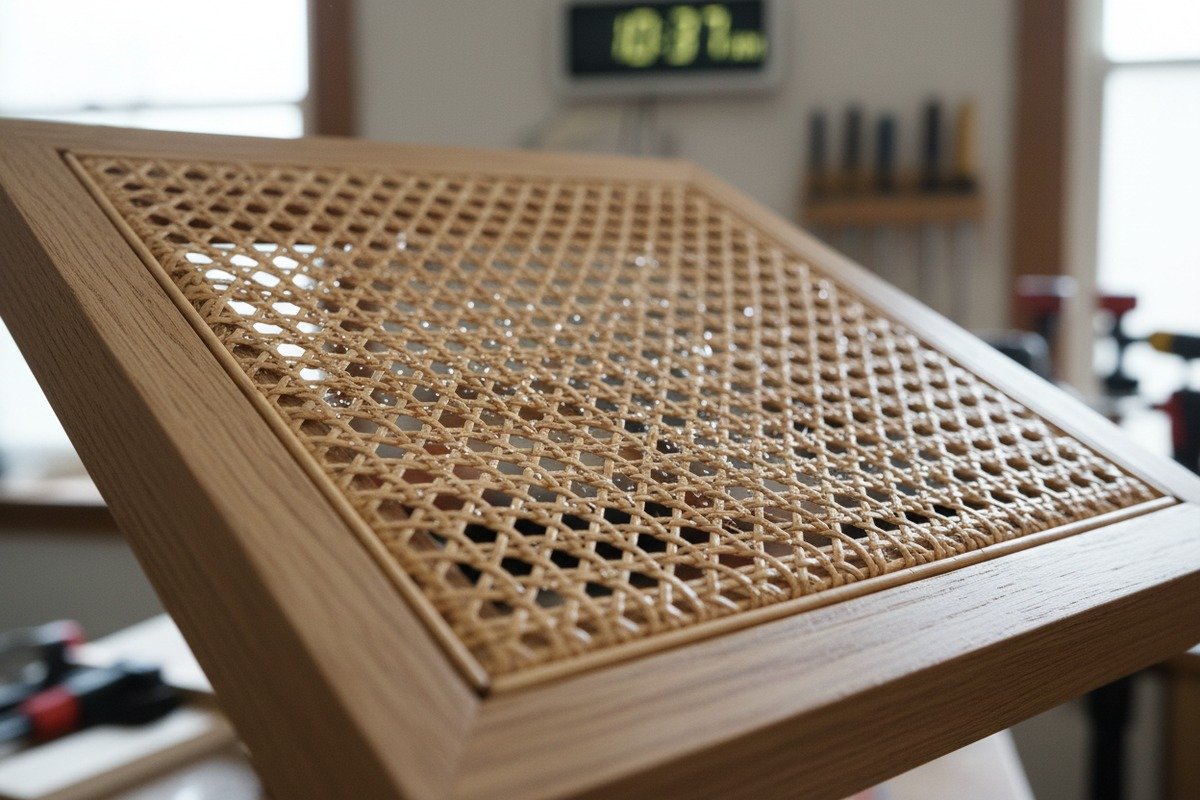
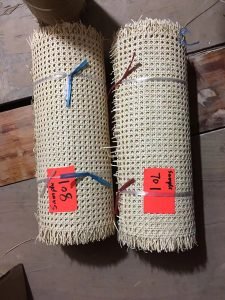
Années d'expédition cannage rotin 1 nos expéditions depuis notre entrepôt de Foshan vers les fabricants de meubles du monde entier nous ont appris une leçon récurrente : un séchage précipité ruine de bonnes installations. Les clients nous écrivent frustrés — leur cannage fraîchement installé s'affaisse, se déforme ou se fissure. Le problème n'est presque jamais le matériau lui-même. Il s'agit presque toujours de la manière dont la phase de séchage a été gérée.
La cannage en rotin naturel nécessite généralement 24 à 72 heures pour sécher complètement après l'installation. Le cannage se rétracte et se tend à mesure que l'humidité s'évapore, créant une surface tendue. Le délai exact dépend de l'humidité ambiante, de la température, de la circulation de l'air et de la méthode adhésive utilisée lors de l'installation.
Ce guide détaille tout ce que vous devez savoir sur le séchage correct du cannage en rotin. Nous aborderons le calendrier, les facteurs environnementaux, pourquoi un séchage complet est important avant la finition, et comment vérifier si votre installation est vraiment prête. Passons en revue chaque étape.
Combien de temps dois-je attendre pour que mon cannage en rotin naturel sèche après l'installation ?
C'est la question la plus fréquente que notre équipe d'exportation reçoit des usines de meubles aux États-Unis, en Australie et en Europe. Les clients veulent un chiffre. Ils veulent de la certitude. Mais le séchage du rotin n'est pas si simple.
Après l'installation, le cannage en rotin naturel nécessite généralement 24 à 72 heures pour sécher complètement. Dans des conditions fraîches, sèches et bien ventilées, la partie inférieure de cette fourchette est réaliste. Dans les climats humides ou les espaces clos, le séchage peut prendre les 72 heures complètes, voire plus.

Pourquoi la plage est si large
Le rotin est un matériau naturel, matériau hygroscopique 2. Il absorbe et libère l'humidité de l'air ambiant. Cela signifie qu'il n'y a pas de temps de séchage universel unique. Un atelier de meubles dans l'Arizona sec verra des résultats beaucoup plus rapides qu'un atelier dans le Bangkok humide.
Avant l'installation, le cannage naturel est trempé dans de l'eau tiède pendant environ 30 minutes. Cela rend les fibres souples et faciles à étirer sur les cadres. Une fois que vous avez agrafé ou collé le cannage en place, toute l'eau absorbée doit s'évaporer. Ce faisant, le cannage se contracte. Cette contraction est ce qui vous donne la surface tendue, semblable à un tambour, que vous désirez.
Calendrier de séchage par méthode d'installation
La manière dont vous fixez le cannage affecte le temps de séchage total. La fixation mécanique (agrafes) signifie que vous attendez seulement que le cannage lui-même sèche. Les méthodes adhésives ajoutent un temps de durcissement en plus.
| Méthode d'installation | Temps de séchage du cannage | Temps de durcissement de l'adhésif | Temps d'attente total |
|---|---|---|---|
| Agrafage uniquement | 24–48 heures | N/A | 24–48 heures |
| Colle à bois PVA 3 + jonc | 24–48 heures | 12–24 heures par couche | 36–72 heures |
| Adhésif de contact 4 | 24–48 heures | 1–4 heures | 25–52 heures |
| Agrafe combinée + PVA | 24–48 heures | 12–24 heures | 36–72 heures |
Que se passe-t-il si vous vous précipitez ?
Nous avons vu cela de nombreuses fois avec nos clients grossistes. Une usine installe la toile, attend six heures, puis applique de la laque ou de l'huile. L'humidité reste piégée à l'intérieur des fibres. En quelques semaines, de la moisissure se forme 5 entre le tissage, ou le fini bulle et s'écaille. Parfois, la toile se détend car le rotin n'a jamais eu la chance de se contracter complètement.
La patience pendant cette phase vous fait gagner du temps et de l'argent plus tard. Nous disons toujours à nos clients : la période de séchage n'est pas du temps perdu. C'est une partie du processus d'installation.
Une astuce pratique de notre atelier de production
Dans notre usine de traitement du rotin en Indonésie, nous suspendons les feuilles fraîchement tissées sur des séchoirs à ciel ouvert avec une bonne ventilation transversale 6. Nous n'utilisons jamais de ventilateurs dirigés directement sur le rotin. Une circulation d'air douce et naturelle fonctionne le mieux. Vous pouvez reproduire cela dans n'importe quel atelier en ouvrant les fenêtres et en gardant la pièce surélevée pour que l'air circule en dessous.
Quels facteurs environnementaux influenceront la vitesse de séchage de mon rotin ?
Lorsque nous expédions de la toile de rotin à des clients dans plus d'une douzaine de pays, nous leur rappelons toujours : votre climat local change tout dans le processus de séchage. Un rouleau de rotin de qualité A de notre entrepôt de Foshan se comporte très différemment dans un Istanbul humide par rapport à un Madrid sec.
Trois facteurs environnementaux principaux contrôlent la vitesse de séchage du rotin : l'humidité ambiante, la température de l'air et la circulation de l'air. Une humidité élevée ralentit considérablement le séchage, tandis qu'une chaleur modérée et une bonne ventilation l'accélèrent. Évitez les sources de chaleur directes et la lumière directe du soleil, qui provoquent des fissures et de la fragilité.
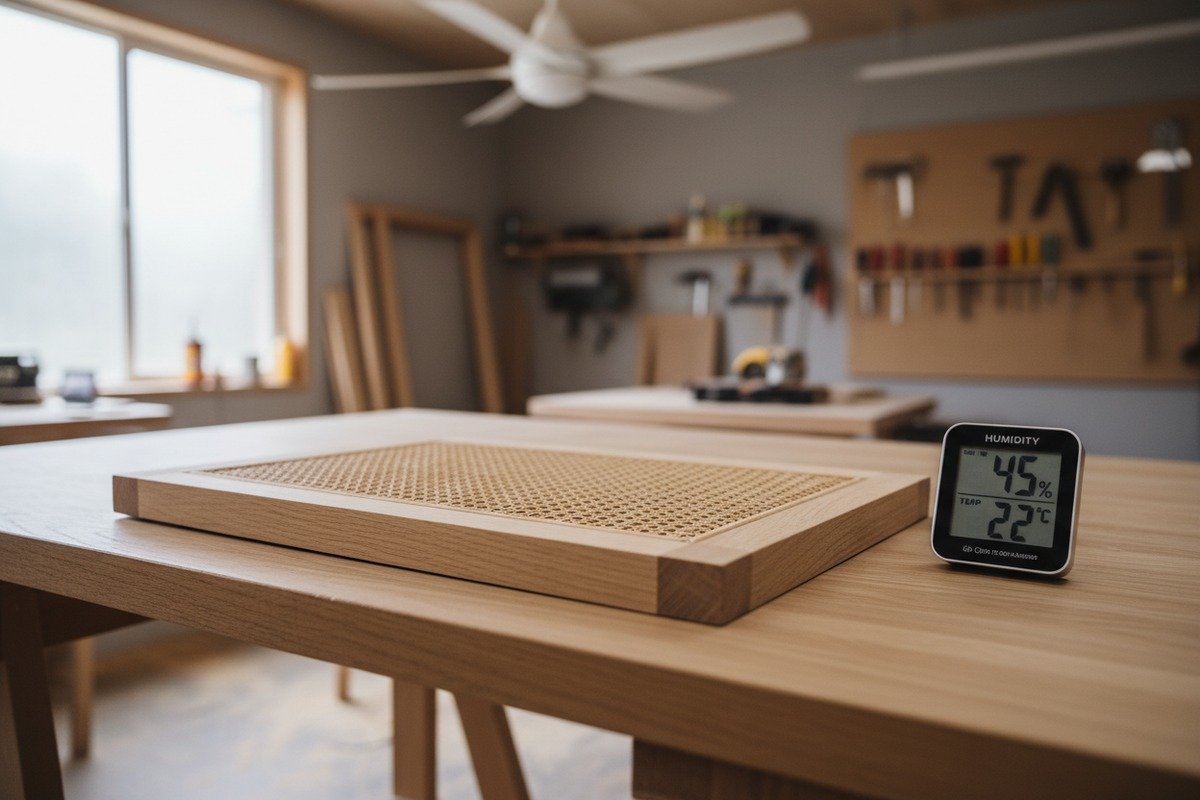
Humidité : la plus grande variable
Le rotin est hygroscopique. Il échange constamment de l'humidité avec l'air ambiant. Si votre atelier a une humidité relative de 80%, le rotin aura du mal à libérer son humidité interne car l'air est déjà saturé. En revanche, à une humidité relative de 40%, le rotin sèche rapidement et se tend bien.
C'est aussi pourquoi les meubles en rotin peuvent se desserrer légèrement pendant les saisons des pluies et se resserrer par temps sec. Ce n'est pas un défaut. C'est la nature du matériau.
Température : Utile mais dangereuse
Une chaleur modérée aide. Une température ambiante de 20–25°C (68–77°F) est idéale. Mais c'est là que de nombreux installateurs font une erreur : ils essaient d'accélérer les choses avec des pistolets thermiques, des sèche-cheveux ou en plaçant la pièce près d'un radiateur. Cela force les fibres extérieures à sécher et à se contracter beaucoup plus rapidement que les fibres intérieures. Le résultat est des fissures, des éclats ou une déformation.
Nous avons eu des clients en Russie qui nous ont interrogés sur l'utilisation de pièces chauffées pendant les installations hivernales. Notre conseil est toujours le même : maintenez la pièce à une température confortable, mais ne dirigez jamais de chaleur directement sur le rotin.
Circulation de l'air : Le facteur sous-estimé
Une bonne ventilation croisée est plus importante que la température. L'air en mouvement emporte l'humidité qui s'évapore de la surface du rotin, créant ainsi de l'espace pour que davantage d'humidité quitte les fibres. L'air stagnant piège l'humidité autour du tressage et ralentit considérablement le séchage.
| Facteur environnemental | Condition idéale | Condition médiocre | Impact sur le temps de séchage |
|---|---|---|---|
| Humidité relative | 30–50% | Supérieure à 70% | Peut doubler le temps de séchage |
| Température ambiante | 20–25°C (68–77°F) | En dessous de 10°C ou au-dessus de 35°C | Le froid ralentit l'évaporation ; la chaleur provoque des fissures |
| Circulation de l'air | Ventilation transversale douce | Espace clos et stagnant | Une mauvaise circulation de l'air ajoute 12 à 24 heures |
| Lumière directe du soleil | Aucun | Exposition prolongée | Provoque un séchage inégal et de la fragilité |
| Saison | Saison sèche / hiver (chauffé, faible humidité) | Saison des pluies / été (forte humidité) | Les variations d'humidité saisonnières affectent le calendrier |
Considérations régionales pour nos clients
Nos acheteurs aux Pays-Bas et en Espagne travaillent souvent dans des ateliers climatisés, le séchage est donc prévisible. Nos clients en Thaïlande et aux Philippines sont confrontés à des conditions beaucoup plus élevées l'humidité ambiante 7. Pour ces régions, nous recommandons d'utiliser un déshumidificateur dans la pièce de séchage — non pas pour projeter de l'air sur le rotin, mais pour abaisser l'humidité de la pièce à un niveau gérable.
L'un de nos acheteurs de longue date, un grossiste de matériaux de meubles à Dubaï, nous a dit un jour qu'il obtenait des résultats parfaits car l'air du désert est si sec. Ses installations se resserrent en 18 heures. C'est le pouvoir de l'environnement.
Pourquoi est-il essentiel de laisser le rotin sécher complètement avant d'appliquer une finition ?
D'après notre expérience d'exportation vers des usines de meubles en Europe et au Moyen-Orient, nous avons vu de belles installations ruinées par une erreur simple : finir trop tôt. Une usine applique du vernis ou de l'huile alors que le cannage est encore humide à l'intérieur. Cela semble bien pendant une semaine. Puis des problèmes apparaissent.
Le séchage complet avant la finition est essentiel car l'humidité piégée provoque la croissance de moisissures, la défaillance de la finition et un affaiblissement structurel. Les finitions comme la laque, le vernis ou l'huile scellent la surface du rotin, empêchant toute humidité interne restante de s'échapper. Cela entraîne des bulles, un décollement, une décoloration et une détérioration prématurée.
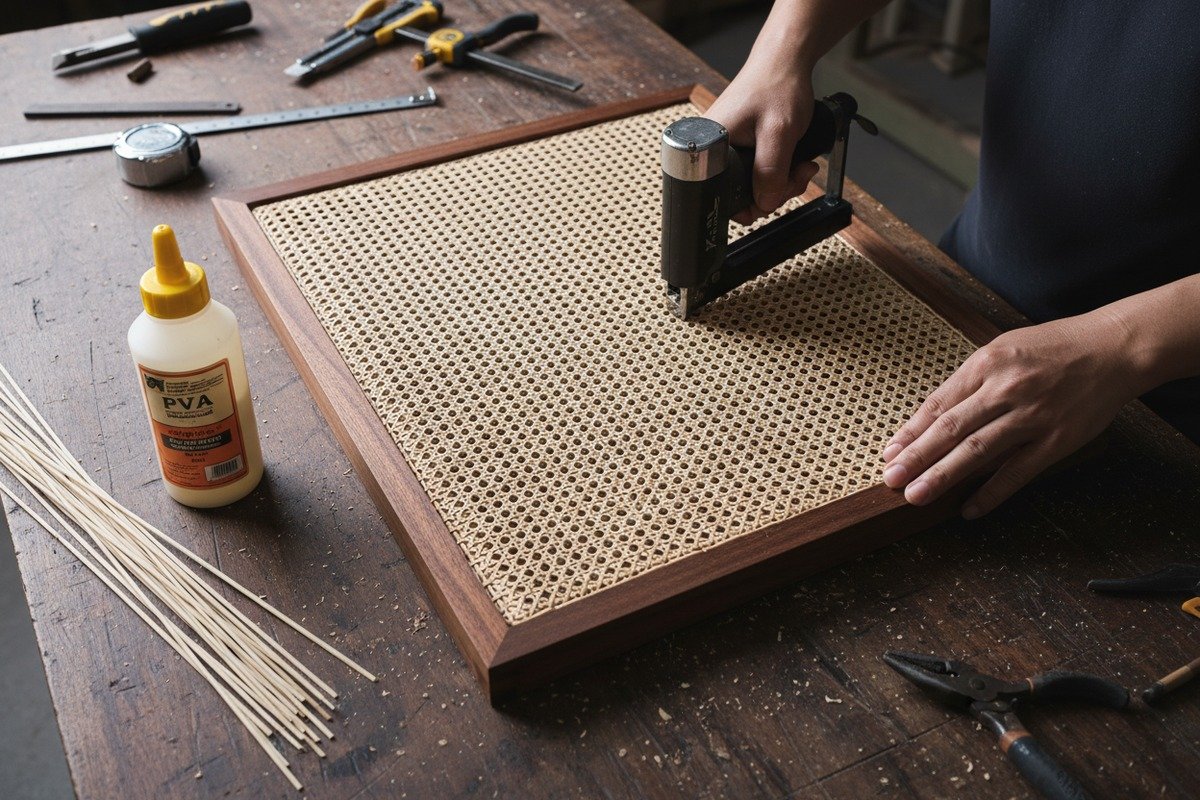
La science derrière le problème
Le cannage naturel en rotin est composé de fibres végétales 8 avec de minuscules canaux internes. Lorsque vous trempez le cannage avant l'installation, l'eau remplit ces canaux. Pendant le séchage, cette eau migre lentement vers la surface et s'évapore. Si vous scellez la surface avec une finition avant que ce processus ne soit terminé, l'eau n'a nulle part où aller.
L'humidité piégée crée plusieurs problèmes :
- Moisissures et mildiou: Les conditions chaudes, humides et scellées sont parfaites pour la croissance fongique. La moisissure peut apparaître entre les brins du tissage, où il est presque impossible de l'enlever.
- Défaillance de la finition: La vapeur d'eau pousse la finition de l'intérieur, provoquant des bulles, un voile ou un décollement.
- Dégradation des fibres: L'humidité interne prolongée affaiblit les fibres végétales, réduisant la durée de vie du cannage.
- Odeur: L'humidité piégée dans la matière organique peut produire une odeur de moisi désagréable.
Temps d'attente recommandés avant la finition
Le type de finition que vous prévoyez d'appliquer est également important. Certaines finitions tolèrent mieux l'humidité résiduelle que d'autres.
| Type de finition | Temps de séchage minimum avant application | Notes |
|---|---|---|
| L'huile de tung 9 / Huile de lin | 48 heures après l'installation | L'huile pénètre les fibres ; l'humidité piégée provoque un trouble |
| Laque à base d'eau | 48–72 heures après l'installation | Sensible à l'humidité ; forme des bulles facilement |
| Vernis polyuréthane 10 | 72 heures après l'installation | Crée un joint dur ; toute humidité piégée est permanente |
| Cire | 48 heures après l'installation | Plus tolérante mais piège quand même une partie de l'humidité |
| Aucune finition (canne brute) | 24 heures minimum avant utilisation | Permet un échange d'humidité continu avec l'environnement |
Ce que nos clients ont appris
Une usine de meubles en Australie qui achète notre cannage de rotin blanchi en gros nous a fait part d'une leçon importante. Ils avaient l'habitude d'appliquer une couche rapide de laque dans les 12 heures suivant l'installation. Leur taux de rejet par les détaillants était d'environ 8% — tout cela en raison de défauts de finition. Après leur avoir conseillé d'attendre 72 heures complètes avant de finir, leur taux de rejet est tombé à moins de 1%.
Ce n'est pas juste de la théorie. Cela a des conséquences financières directes pour les fabricants et les revendeurs.
Le cas particulier de la colle PVA
Si vous avez utilisé de la colle à bois PVA lors de l'installation, rappelez-vous que le PVA lui-même a besoin de 12 à 24 heures pour sécher entre les couches. Si vous avez appliqué plusieurs couches de colle, votre adhésif peut ne pas être complètement sec avant 48 heures après l'installation. L'application d'une finition sur de la colle non sèche crée une autre couche de défaillance potentielle. Tenez toujours compte du temps de séchage du cannage et du temps de prise de l'adhésif avant de finir.
Après l'application d'huile sur une pièce finie, nous recommandons d'attendre encore quelques heures avant de mettre le meuble en service. Cela donne à l'huile le temps de s'absorber et de se fixer sans être dérangée.
Comment puis-je savoir si mon cannage en rotin installé est suffisamment sec pour rester tendu ?
Lorsque nous guidons nos acheteurs en gros lors de leur première installation de cannage en rotin, c'est la question qui importe le plus en pratique. Vous ne pouvez pas simplement regarder un calendrier. Vous devez savoir comment tester le matériau lui-même.
Pour vérifier si le cannage en rotin est complètement sec, appuyez fermement au centre avec votre doigt — il doit sembler tendu et résister à la pression sans rebondir ni céder. La surface doit être fraîche et sèche au toucher, pas moite. Il ne doit y avoir aucun affaissement visible nulle part sur la zone installée.
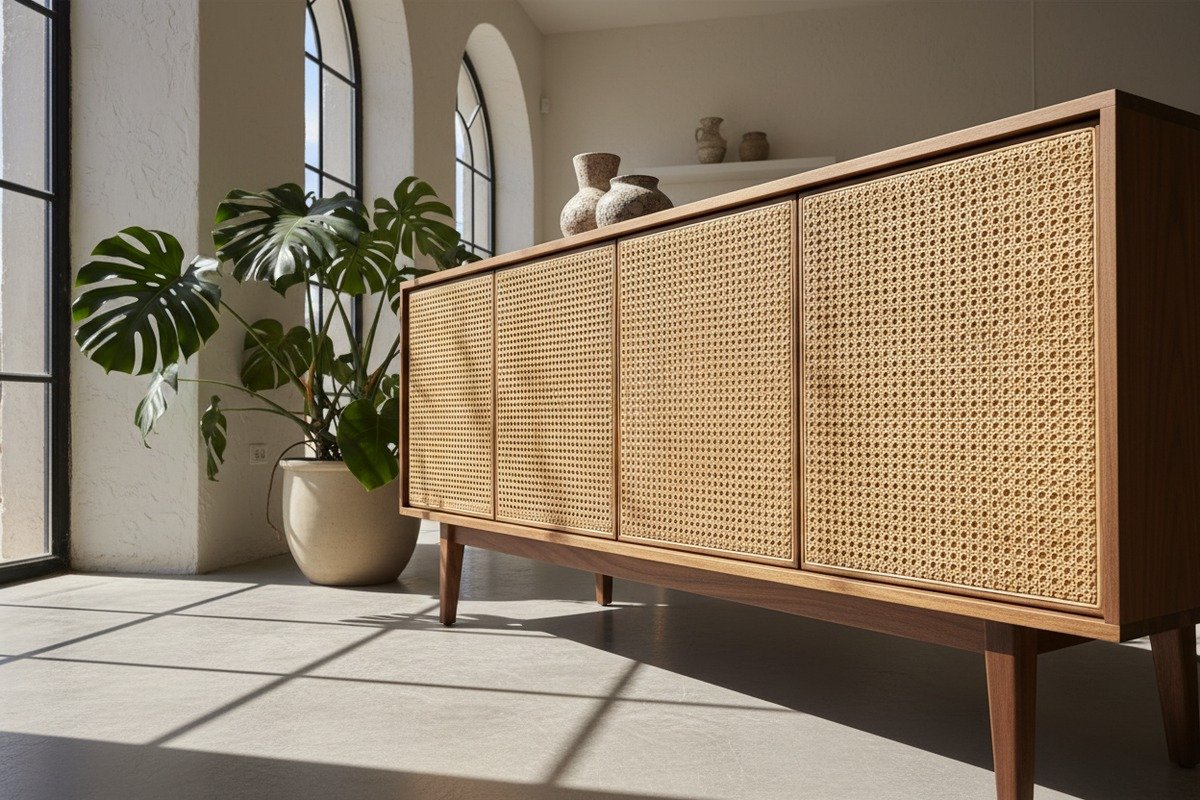
Le test de fermeté
C'est la vérification la plus simple et la plus fiable. Appuyez doucement la paume de votre main au centre du cannage installé. Le cannage complètement sec est ferme, presque comme une peau de tambour. Si le cannage fléchit vers l'intérieur avec peu de résistance ou semble mou et élastique, il contient encore de l'humidité.
Vous pouvez également tapoter légèrement la surface. Le rotin sec produit un son léger et net. Le rotin humide sonne sourd et étouffé. Ce test audio est quelque chose que nos ouvriers de production en Indonésie utilisent tous les jours, et il est étonnamment précis une fois que vous avez entraîné votre oreille.
Le test tactile
Passez le bout de vos doigts sur les brins de cannage. Le rotin sec est lisse, légèrement chaud et complètement sec au toucher. Si vous ressentez une fraîcheur ou une humidité — même légèrement — le cannage libère encore de l'humidité. La fraîcheur provient du refroidissement par évaporation, le même principe qui fait qu'une serviette mouillée est froide.
L'inspection visuelle
Regardez la toile sous un angle bas, avec une source de lumière derrière si possible. Une toile complètement sèche repose à plat et uniformément sur le cadre. Tout affaissement, affaissement ou ondulation signifie que le rotin n'a pas fini de se contracter. Vérifiez également les bords où la toile rencontre le cadre ou la latte. Si ces bords semblent légèrement gonflés ou bouffis, de l'humidité est encore présente.
Le test de couleur
Le rotin fraîchement trempé est sensiblement plus foncé que le rotin sec. En séchant, la couleur s'éclaircit pour retrouver sa teinte d'origine. Comparez votre toile installée à un morceau sec et non trempé du même rouleau. Si le morceau installé est encore visiblement plus foncé, il a besoin de plus de temps.
Liste de contrôle d'inspection post-séchage
Après avoir déterminé que le rotin est sec, effectuez une inspection finale avant d'appliquer une finition ou de mettre la pièce en service.
- Vérifiez les points lâches le long des bords
- Vérifiez que la latte (si utilisée) est toujours bien en place
- Confirmez que la toile est uniformément tendue sans tension inégale
- Recherchez les fils qui auraient pu se déplacer pendant le séchage
- Assurez-vous que l'adhésif (si utilisé) ne présente pas de zones humides ou molles
Des ajustements mineurs au placement de la latte ou à l'agrafage des bords peuvent encore être possibles à ce stade. Une fois que vous appliquez une finition, les corrections deviennent beaucoup plus difficiles.
Qu'en est-il du rotin synthétique ?
Il est à noter que la toile en rotin synthétique – que nous fournissons également – ne nécessite pas de trempage et n'a donc pas de phase de séchage. Si votre projet nécessite un délai d'exécution plus rapide et que vous travaillez dans un environnement humide, le rotin synthétique peut être une alternative pratique. Cependant, il n'offre pas le même aspect naturel et le même caractère de vieillissement que nos clients d'usines de meubles préfèrent généralement pour les pièces haut de gamme.
Pour le rotin naturel, il n'y a pas de substitut à la patience. La phase de séchage est ce qui transforme une installation lâche et humide en un résultat tendu et professionnel.
Conclusion
Un séchage approprié n'est pas facultatif — c'est la base de toute installation réussie de cannage en rotin. Donnez à votre canne naturelle 24 à 72 heures, contrôlez votre environnement, testez avant de finir, et vos résultats dureront des années.
Notes de bas de page
1. Trouvé une URL de remplacement fonctionnelle sur le même domaine qui définit le cannage. ↩︎
2. Définit l'hygroscopie et liste des exemples de matériaux hygroscopiques. ↩︎
3. Explique ce qu'est la colle à bois PVA et ses utilisations dans le travail du bois. ↩︎
4. Explique ce qu'est la colle de contact et comment elle fonctionne. ↩︎
5. Explique les causes et les conditions de croissance des moisissures intérieures. ↩︎
6. Explique ce qu'est la ventilation transversale et ses avantages pour la circulation de l'air. ↩︎
7. Définit l'humidité ambiante et ses types pour le contexte environnemental. ↩︎
8. Décrit les fibres végétales, leurs types et leurs propriétés. ↩︎
9. Explique ce qu'est l'huile de tung, ses propriétés et ses utilisations traditionnelles. ↩︎
10. Explique ce qu'est le vernis polyuréthane, ses avantages et ses utilisations. ↩︎

 English
  Español de México
  العربية
  Deutsch
  Français
  Русский