

Chaque saison de mousson, notre équipe d'entrepôt à Foshan inspecte des milliers de rouleaux de cannage en rotin avant expédition humidité excessive et humidité 1. Le problème que nous rencontrons le plus souvent ? Des taches noires et de la moisissure duveteuse qui se propagent sur le beau rotin naturel. Si vous avez remarqué cela sur vos matériaux en rotin, vous n'êtes pas seul — et cela peut être alarmant.
La moisissure et le noircissement sur le cannage en rotin naturel résultent d'un excès d'humidité et de condensation. Le traitement consiste à brosser les spores lâches, à nettoyer avec du vinaigre dilué ou du peroxyde d'hydrogène, à rincer abondamment, à sécher complètement au soleil, et à conditionner avec de l'huile pour restaurer la souplesse et prévenir la croissance future.
Ce guide vous présente les causes exactes, les méthodes de nettoyage, les précautions d'expédition et les stratégies d'entretien à long terme que nous utilisons et recommandons à nos clients de gros dans plus de 30 pays. vinaigre dilué ou peroxyde d'hydrogène 2. Faisons en sorte que votre rotin soit propre et dure plus longtemps.
Pourquoi ma cannage en rotin naturel développe-t-il des taches noires et de la moisissure ?
Au fil des ans, notre équipe de production a suivi les plaintes de moisissure de la part d'acheteurs dans des régions humides comme la Thaïlande, les Philippines et les Pays-Bas. Le schéma est toujours le même : l'humidité reste piégée et la moisissure suit rapidement.
Le rotin naturel développe des taches noires et de la moisissure car ses fibres végétales organiques absorbent facilement l'humidité. Une humidité élevée, un séchage incomplet après le nettoyage, une mauvaise ventilation pendant le stockage et une exposition à l'extérieur sans protection créent des conditions idéales pour la croissance de colonies de mildiou à la surface du rotin.
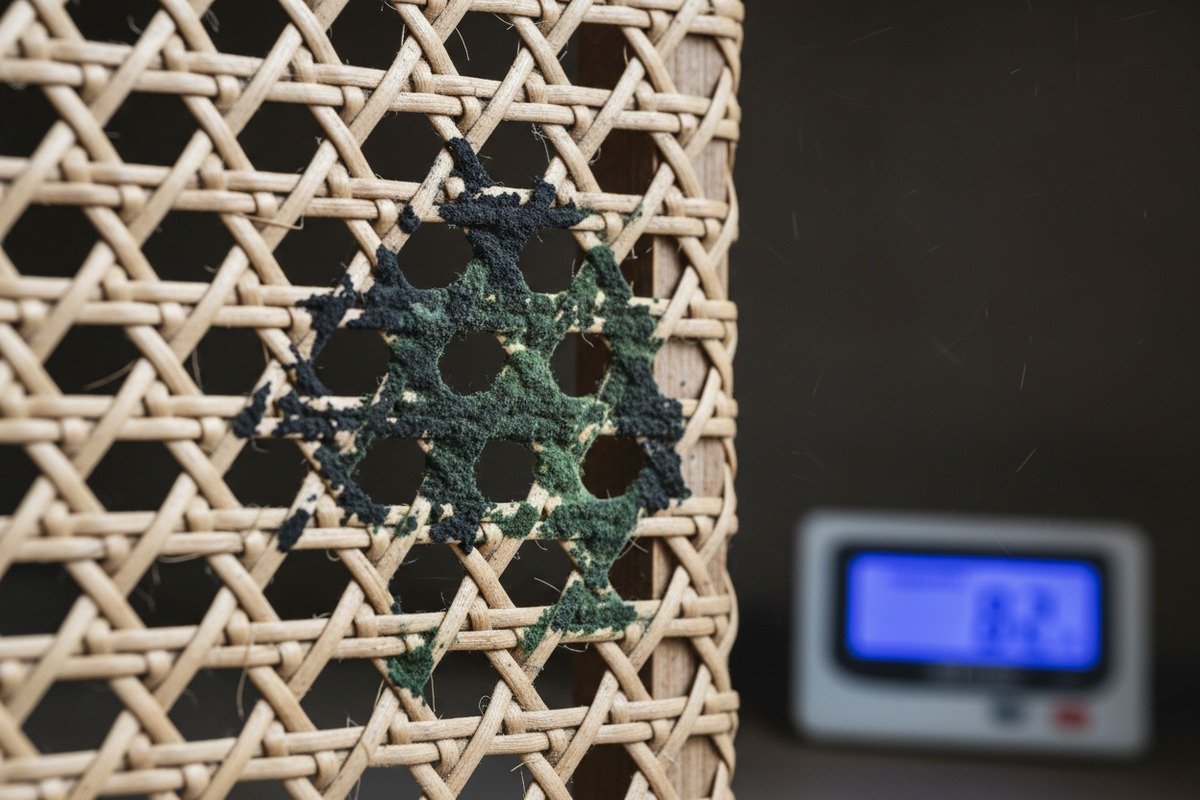
La cause profonde : la fibre organique rencontre l'humidité
Le rotin est une liane à base de palmier. Il est 100% naturel. Contrairement au rotin synthétique PE 3 ou au rotin synthétique, le rotin naturel n'a pas d'additifs chimiques pour résister à l'humidité. Lorsque l'eau stagne à la surface ou que l'humidité reste supérieure à 60% pendant des périodes prolongées, les spores de moisissure — qui existent partout dans l'air — se déposent sur les fibres et commencent à se développer.
Nous constatons cela le plus souvent dans trois scénarios :
- Humidité post-nettoyage. Un acheteur lave un meuble ou un cannage en rotin et ne le sèche pas complètement. En 48 heures, des taches noires apparaissent.
- Conditions de stockage humides. Les rouleaux de cannage stockés dans un entrepôt fermé sans circulation d'air commencent à développer des odeurs de moisi en quelques semaines.
- Utilisation en extérieur sans scellant. Les chaises ou panneaux en rotin utilisés sur les porches couverts absorbent toujours l'humidité ambiante de la pluie et de la rosée.
Comment distinguer la moisissure du noircissement naturel
Tout noircissement n'est pas de la moisissure. Le rotin fonce naturellement avec le temps en raison de l'oxydation et de l'exposition aux UV. C'est un vieillissement normal. Mais la moisissure est différente.
| Caractéristique | Assombrissement naturel | Moisissure / Mildiou |
|---|---|---|
| Apparence | Changement de couleur uniforme et graduel vers l'ambre ou le brun | Taches noires ou vertes irrégulières |
| Texture | Lisse, inchangé | Pelucheux, poudreux ou visqueux |
| Odeur | Neutre ou légèrement boisé | Moisi, humide, aigre |
| Réponse au nettoyage | Ne s'enlève pas avec de l'eau et du savon | S'enlève partiellement mais revient |
| Impact structurel | Minimal — la fibre reste souple | Provoque la fragilité et la pourriture avec le temps |
Si vous voyez des zones floues et sentez une odeur de moisi, c'est de la moisissure. Agissez rapidement. Plus la moisissure reste longtemps, plus elle pénètre profondément dans la fibre, et plus il devient difficile de l'enlever sans endommager le cannage.
Pourquoi le rotin synthétique n'a pas ce problème
Notre usine produit à la fois du cannage naturel et du nattage en rotin synthétique PE. Les versions synthétiques sont extrudées à partir de résine de polyéthylène 4. Elles n'absorbent pas l'eau. Elles ne nourrissent pas la moisissure. C'est pourquoi de nombreux fabricants de meubles d'extérieur choisissent le synthétique.
Mais le rotin naturel a un charme irremplaçable. Sa texture chaleureuse et organique et son esthétique rustique plaisent aux marques de meubles haut de gamme et aux designers d'intérieur du monde entier. Le compromis est qu'il nécessite plus d'entretien. Comprendre ce compromis aide les acheteurs à prendre des décisions éclairées concernant la sélection des matériaux et l'investissement en entretien.
Quelles mesures dois-je prendre pour nettoyer en toute sécurité la moisissure sur les matériaux de mes meubles en rotin ?
Lorsque les clients nous envoient des photos de cannage moisi, nous les guidons à travers un processus de nettoyage éprouvé. Notre équipe de contrôle qualité 6 a développé ce protocole après avoir testé plusieurs méthodes sur différents motifs de tissage et épaisseurs de fibres.
Pour nettoyer en toute sécurité la moisissure sur le rotin, commencez par aspirer ou brosser les spores lâches. Appliquez ensuite une solution diluée de vinaigre, de peroxyde d'hydrogène ou d'eau de Javel douce à l'aide d'un chiffon doux. Frottez doucement les zones affectées, rincez à l'eau claire, séchez complètement au soleil ou à l'ombre ventilée, et terminez par un léger conditionnement à l'huile.
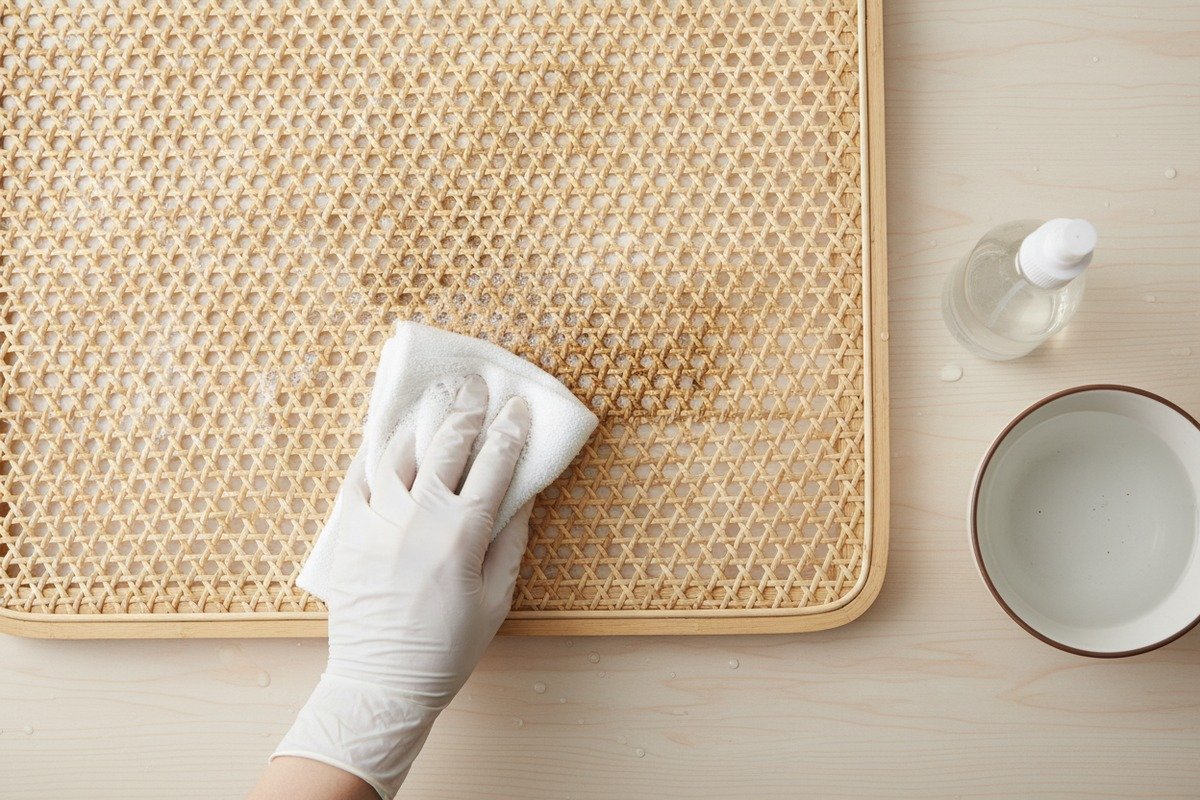
Étape 1 : Nettoyer à sec d'abord
Avant que tout liquide ne touche le rotin, retirez les spores de moisissure lâches. Utilisez une brosse douce ou un aspirateur avec un embout brosse. Travaillez à l'extérieur si possible. Les spores de moisissure deviennent facilement aéroportées, alors portez un masque anti-poussière. Cette étape empêche la propagation des spores plus profondément dans le tissage pendant le nettoyage humide.
Étape 2 : Choisissez votre solution de nettoyage
C'est là que les avis divergent au sein de la communauté des soins du rotin. Voici une comparaison des options les plus courantes :
| Solution | Ratio | Idéal pour | Avantages | Inconvénients |
|---|---|---|---|---|
| Vinaigre blanc + eau | 1:1 ou 1:3 | Moisissure légère à modérée | Naturel, sûr, écologique, ne décolore pas les fibres | Odeur légère, peut nécessiter des applications répétées |
| Peroxyde d'hydrogène (3%) | Non dilué ou 1:1 avec de l'eau | Traitement de petites taches | Doux, sans résidus, tue efficacement la moisissure | Action lente sur la moisissure importante |
| Eau de Javel diluée | 1 tasse par gallon d'eau | Moisissure sévère et généralisée | Puissant destructeur de moisissure | Peut décolorer les fibres, affaiblir le rotin en cas d'utilisation excessive |
| Pâte de bicarbonate de soude | 2 cuillères à soupe par tasse d'eau | Taches de surface avec frottement | Non toxique, légèrement abrasif | Nécessite un rinçage, pas un désinfectant seul |
| Savon de Castille / Savon à l'huile Murphy | 1 cuillère à soupe par litre d'eau tiède | Nettoyage général avec conditionnement | Nettoie et hydrate simultanément | Ne tuera pas la moisissure profonde sans vinaigre ou peroxyde |
Notre recommandation pour la plupart des clients de gros : commencez par de l'eau vinaigrée. Elle résout 80% des cas sans risque. Réservez l'eau de Javel pour les situations extrêmes uniquement.
Étape 3 : Appliquer et frotter doucement
Trempez un chiffon doux ou une éponge dans votre solution. Essorez-la bien – le chiffon doit être humide, pas dégoulinant. Pour les motifs à tissage serré comme notre cannage hexagonal ouvert, utilisez une brosse à dents souple ou un coton-tige pour atteindre les crevasses. Frottez dans le sens du tissage. Évitez de frotter agressivement, ce qui pourrait effilocher ou casser les brins individuels.
Pour les taches noires tenaces, laissez la solution agir sur la surface pendant 5 à 10 minutes avant de frotter. Certains restaurateurs font tremper de petits morceaux dans de l'eau savonneuse jusqu'à 5 minutes. Cependant, nous conseillons la prudence avec le trempage. Une exposition excessive à l'eau peut déformer la toile et desserrer les joints des cadres de meubles.
Étape 4 : Rincer et sécher soigneusement
Rincez avec un chiffon propre et humide. Retirez tous les résidus de nettoyage. Puis séchez immédiatement le rotin. Placez-le en plein soleil pendant 1 à 2 heures. Le soleil remplit deux objectifs : il sèche rapidement les fibres et assure une désinfection UV naturelle qui tue les spores de moisissure restantes.
Cependant, ne laissez pas le rotin en plein soleil pendant plus de 2 à 3 heures. Une exposition prolongée aux UV décolore la couleur naturelle et provoque des craquelures. Si le soleil est trop intense, utilisez une zone ombragée avec une bonne circulation d'air. Un ventilateur dirigé vers la pièce fonctionne bien à l'intérieur.
Étape 5 : Conditionner avec de l'huile
Après que le rotin soit complètement sec, appliquez une fine couche d'huile de conditionnement. Utilisez de l'huile minérale, de l'huile de citron ou de l'huile de lin 7 sur un chiffon doux. Frottez doucement le long du tissage. Concentrez-vous sur le dessous et les bords où le séchage a tendance à causer de la fragilité. Laissez l'huile absorber pendant 2 à 3 heures avant de manipuler ou d'installer la sangle.
Cette étape de conditionnement est essentielle. Le nettoyage élimine les huiles naturelles de la fibre de rotin. Sans réhydratation, le rotin devient cassant et se fissure en quelques semaines.
Option avancée : Nettoyants à base d'enzymes
Pour les moisissures incrustées qui ont pénétré sous la surface, les nettoyants à base d'enzymes offrent une alternative plus douce à l'eau de Javel. Ces produits décomposent la moisissure organique au niveau moléculaire. Ils sont plus chers, mais ils préservent mieux l'intégrité des fibres que les produits chimiques agressifs. Recherchez des produits étiquetés pour l'élimination des taches organiques sur les matériaux naturels.
Comment puis-je empêcher mes commandes de cannage en rotin en vrac de moisir pendant l'expédition internationale ?
Cette question revient dans presque toutes les conversations avec de nouveaux clients en gros. Nous expédions des chargements de conteneurs de sangle de rotin naturelle de notre usine de transformation en Indonésie vers les ports de Rotterdam, Los Angeles, Melbourne et Istanbul. Un voyage maritime de 30 jours à travers les eaux tropicales crée des conditions parfaites pour la moisissure si l'emballage n'est pas fait correctement.
Pour éviter la moisissure pendant l'expédition internationale, assurez-vous que la cannage en rotin est entièrement séché au four avant l'emballage, enveloppez les rouleaux dans du plastique barrière à l'humidité avec des sachets de gel de silice déshydratant à l'intérieur, utilisez des cartons ventilés et demandez des sacs déshydratants pour conteneur. Une teneur en humidité appropriée inférieure à 12% à l'emballage est essentielle.
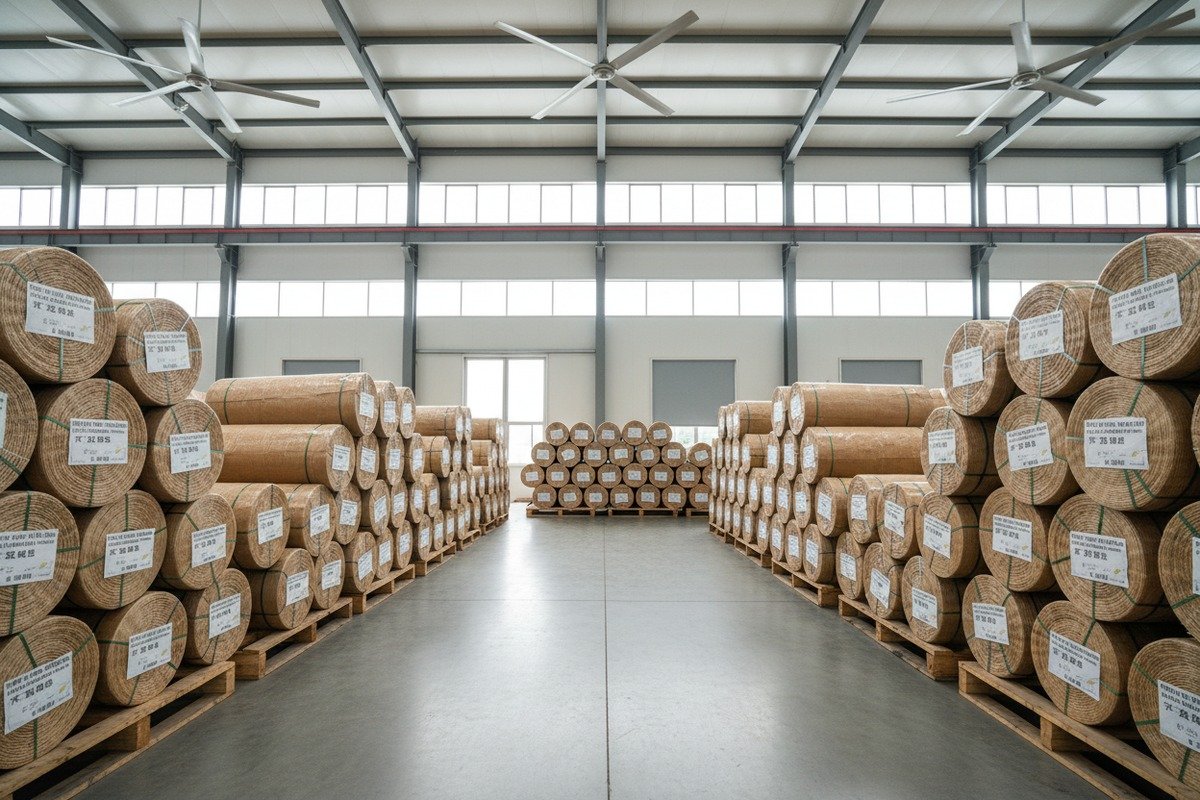
Normes de séchage avant expédition
Le facteur le plus important est la teneur en humidité 9 au moment de l'emballage. Dans notre usine de transformation de rotin en Indonésie, nous séchons au four toutes les sangles de rotin naturelles jusqu'à ce qu'elles atteignent une teneur en humidité de 10 à 12%. Nous mesurons cela avec un humidimètre à pointe avant que chaque rouleau n'entre dans la chaîne d'emballage.
Si le rotin est emballé à 15% d'humidité ou plus, la moisissure est presque garantie lors d'un transit maritime de 25 à 30 jours via les routes maritimes équatoriales où les températures des conteneurs peuvent atteindre 50°C et l'humidité à l'intérieur du conteneur monte en flèche.
Protocole d'emballage que nous suivons
Voici le protocole d'emballage exact que nous utilisons pour toutes les expéditions d'exportation :
| Étape | Action | Objectif |
|---|---|---|
| 1 | Séchage au four à 10-12% d'humidité | Élimine l'excès d'eau des fibres |
| 2 | Refroidir les rouleaux à température ambiante | Empêche la condensation à l'intérieur de l'emballage |
| 3 | Envelopper chaque rouleau dans un film rétractable en PE | Crée une barrière d'humidité autour du produit |
| 4 | Insérer des sachets de gel de silice de 50g (1 par rouleau) des sachets de gel de silice déshydratant 10 | Absorbe l'humidité résiduelle à l'intérieur de l'emballage |
| 5 | Emballer les rouleaux enveloppés dans des cartons ventilés | Permet un flux d'air minimal, évite l'écrasement |
| 6 | Placer des sacs déshydratants pour conteneur (2-4 par conteneur) | Absorbe l'humidité dans l'espace aérien du conteneur |
| 7 | Charger les cartons à l'écart des parois du conteneur | Réduit le transfert de condensation des parois métalliques |
Ce que les acheteurs peuvent faire de leur côté
Même avec un emballage parfait, des problèmes peuvent survenir à destination. Les conteneurs restent parfois des jours au port sous le soleil. Les inspections douanières peuvent ouvrir le sceau. Voici ce que nous conseillons à nos clients :
- Inspectez immédiatement à l'arrivée. Ouvrez les cartons dans les 24 heures suivant la réception du conteneur. Ne stockez pas les cartons scellés dans un entrepôt chaud pendant des jours.
- Aérez les rouleaux. Déballez et placez les rouleaux debout dans un espace ventilé et sec pendant au moins 4 à 6 heures. Cela libère toute humidité piégée pendant le transit.
- Vérifiez les premiers signes. Recherchez toute odeur de moisi ou des gouttelettes de condensation à l'intérieur du film PE. Si vous repérez de l'humidité, étalez la toile à plat et séchez-la avec des ventilateurs avant de la réempiler.
- Stockez dans des espaces à climat contrôlé. Le stockage idéal est en dessous de 60 % d'humidité relative et entre 15 et 25 °C. Un simple hygromètre dans votre entrepôt coûte très peu cher mais permet d'économiser beaucoup de produit.
Exemple concret
L'un de nos clients de longue date aux Pays-Bas — un grossiste en matériaux d'ameublement — a rencontré un problème de moisissure lors de sa première expédition il y a des années. Le conteneur a été retardé au port de Rotterdam pendant 11 jours en été. Nous avons ajouté des sachets de dessicant supplémentaires à toutes les expéditions ultérieures et sommes passés à un double emballage PE. Ils n'ont plus eu de plainte concernant la moisissure depuis. De petits ajustements dans l'emballage font une différence mesurable.
Quels sont les meilleurs conseils d'entretien pour éviter que mes produits en rotin ne noircissent avec le temps ?
D'après les conversations avec des acheteurs qui revendent des meubles et des panneaux en rotin sur les marchés de détail, nous savons que le client final manque souvent de connaissances sur l'entretien du rotin. Fournir un guide d'entretien simple avec vos produits réduit les plaintes, les retours et les dommages à la réputation. Voici ce que nous partageons.
Les meilleurs conseils d'entretien pour éviter le noircissement du rotin comprennent le garder à l'intérieur ou à l'abri, l'essuyer mensuellement avec un chiffon sec, le conditionner avec du citron ou de l'huile minérale tous les 3 à 6 mois, maintenir l'humidité intérieure en dessous de 60 %, éviter l'exposition prolongée au soleil et appliquer un scellant antifongique respirant pour une protection supplémentaire.
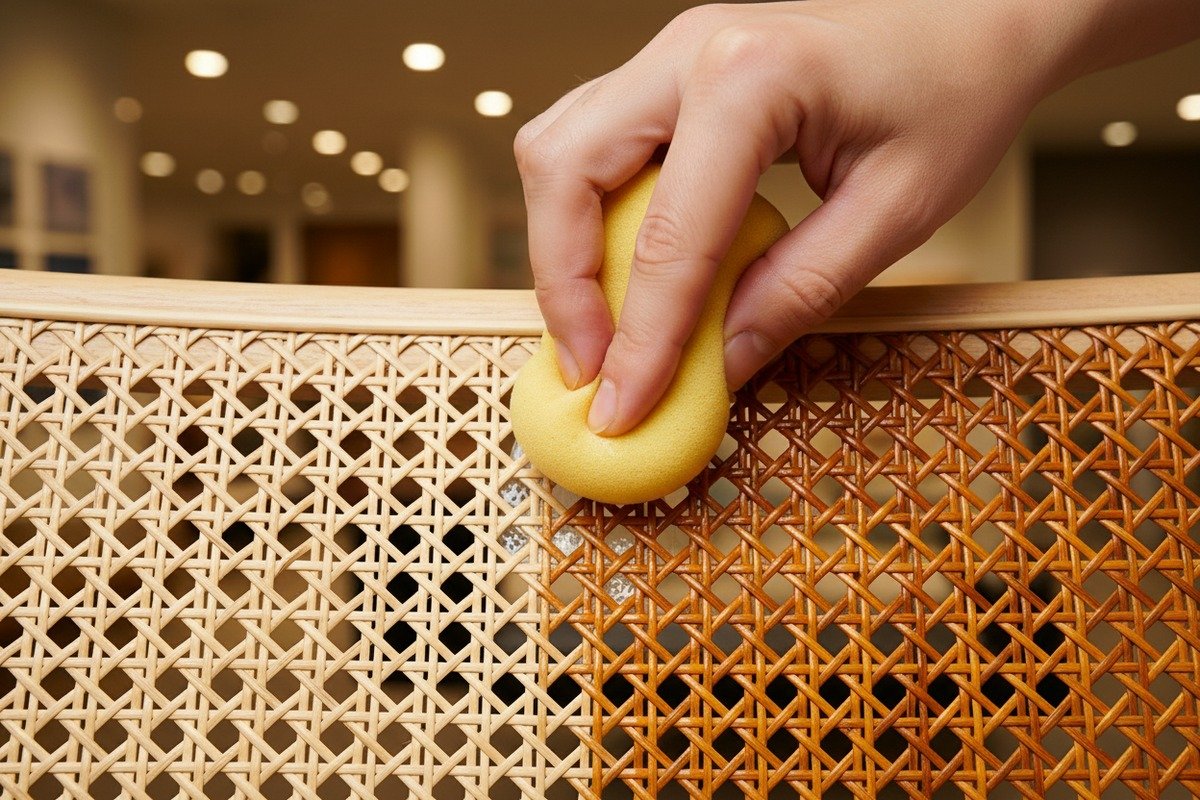
Routine d'entretien hebdomadaire et mensuelle
La régularité compte plus que l'intensité. Une routine simple prévient 90% des problèmes de moisissure et de noircissement. Voici un calendrier pratique que nous recommandons aux fabricants de meubles qui utilisent notre cannage :
- Hebdomadaire : Dépoussiérez avec un chiffon en microfibre sec ou une brosse douce. Retirez les miettes, les poils d'animaux et les débris qui retiennent l'humidité.
- Mensuel : Essuyez avec un chiffon légèrement humide (eau uniquement). Séchez immédiatement avec une serviette. Ne jamais laisser humide.
- Tous les 3-6 mois : Appliquez une fine couche d'huile de conditionnement. Utilisez de l'huile de citron, de l'huile minérale ou une solution diluée de Murphy's Oil Soap (1 cuillère à soupe par litre d'eau tiède). Appliquez avec un chiffon doux. Concentrez-vous sur le dessous et les joints. Laissez absorber pendant 2-3 heures. Lustrez doucement.
- Annuel : Inspectez toutes les surfaces en rotin pour détecter les premiers signes de moisissure, de fissures ou de desserrage. Traitez les problèmes immédiatement.
Contrôle de l'environnement
Le rotin prospère dans des environnements stables et modérés. Les changements extrêmes d'humidité et de température sont son ennemi.
- Maintenez l'humidité intérieure entre 40 et 60 %. Utilisez un déshumidificateur dans les climats tropicaux ou côtiers.
- Évitez de placer le rotin directement à côté des bouches de chauffage, des radiateurs ou des unités de climatisation. Le séchage rapide fissure les fibres.
- Si le rotin doit être placé à l'extérieur, placez-le sous un porche couvert ou une pergola. Ne le laissez jamais exposé à la pluie directe.
Scellants et revêtements protecteurs
Pour les clients qui vendent des produits en rotin pour un usage semi-extérieur, nous recommandons d'appliquer un scellant respirant et antifongique après l'installation. Ces scellants créent une barrière invisible contre l'humidité et les rayons UV. Ils ne modifient pas l'aspect ou le toucher du cannage naturel. Recherchez des produits conçus spécifiquement pour les fibres naturelles — les vernis à bois standard peuvent sceller trop hermétiquement et piéger l'humidité en dessous.
Une fine couche de cire pour meubles sur du rotin huilé ajoute également une couche protectrice. Les produits à base de cire d'abeille fonctionnent bien. Ils repoussent l'eau tout en laissant la fibre respirer.
Quand l'entretien ne suffit pas : Remplacement
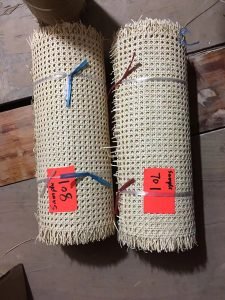
Parfois, la cannage en rotin est trop abîmé. Si le rotin est devenu uniformément noir, qu'il est cassant et se brise facilement, ou qu'il dégage une odeur de moisi persistante même après traitement, il est temps de le remplacer. Les feuilles de cannage pré-tissées – comme les rouleaux que nous fournissons en largeurs standard – rendent le remplacement simple. Elles peuvent être coupées à la taille désirée et pressées ou agrafées dans les cadres de meubles existants.
Nos options de cannage en rotin blanchi sont également populaires pour les projets de restauration. Le rotin blanchi commence avec une couleur plus claire et vieillit plus gracieusement que les variétés non blanchies.
Calendrier d'entretien saisonnier
| Saison | Niveau de risque | Action clé |
|---|---|---|
| Printemps | Modérée — humidité croissante | Nettoyage en profondeur, application d'huile, inspection des dommages hivernaux |
| Été | Élevée — pic de chaleur et d'humidité | Déplacer les pièces extérieures à l'abri, utiliser un déshumidificateur, vérifier chaque semaine |
| Automne | Faible à modéré | Nettoyage léger, application d'un scellant avant l'hiver |
| Hiver | Faible (sauf si le chauffage intérieur assèche l'air) | Maintenir l'humidité, éviter de placer près des sources de chaleur, conditionner si sec |
Suivre ce calendrier permet au rotin naturel de conserver son meilleur aspect pendant des années. Bon nombre de nos clients incluent une version simplifiée de ce guide sous forme d'encart imprimé avec leurs produits finis. Cela ajoute de la valeur et réduit les problèmes après-vente.
Conclusion
Les moisissures et le noircissement sur le cannage de rotin naturel sont des problèmes évitables. Avec un séchage approprié, un nettoyage doux, un emballage intelligent et un entretien constant, vos matériaux en rotin resteront beaux et fonctionnels pendant des années.
Notes de bas de page
1. Explique comment l'humidité élevée et l'humidité créent des conditions idéales pour la croissance des moisissures dans les environnements intérieurs. ↩︎
2. Trouvé une source faisant autorité (Healthline) discutant du peroxyde d'hydrogène et du vinaigre pour l'élimination des moisissures, y compris des précautions de sécurité comme ne pas les mélanger. ↩︎
3. Explique les propriétés matérielles du polyéthylène (PE) utilisé dans les meubles en rotin synthétique. ↩︎
4. Fournit une définition et des applications courantes de la résine de polyéthylène en tant que plastique polyvalent. ↩︎
5. Fournit des informations générales sur le rotin, son origine et ses utilisations traditionnelles dans le mobilier. ↩︎
6. Définit le rôle et l'importance des processus de contrôle qualité dans la fabrication et la production. ↩︎
7. Discute des avantages de diverses huiles pour le conditionnement et la protection du bois et des fibres naturelles. ↩︎
8. Décrit la composition naturelle et les caractéristiques du rotin en tant que fibre végétale organique. ↩︎
9. Met en évidence le rôle essentiel de la teneur en humidité dans la prévention de la pourriture et des moisissures dans les produits en bois. ↩︎
10. Explique les propriétés chimiques et la fonction du gel de silice en tant que déshydratant pour le contrôle de l'humidité. ↩︎

 English
  Español de México
  العربية
  Deutsch
  Français
  Русский