
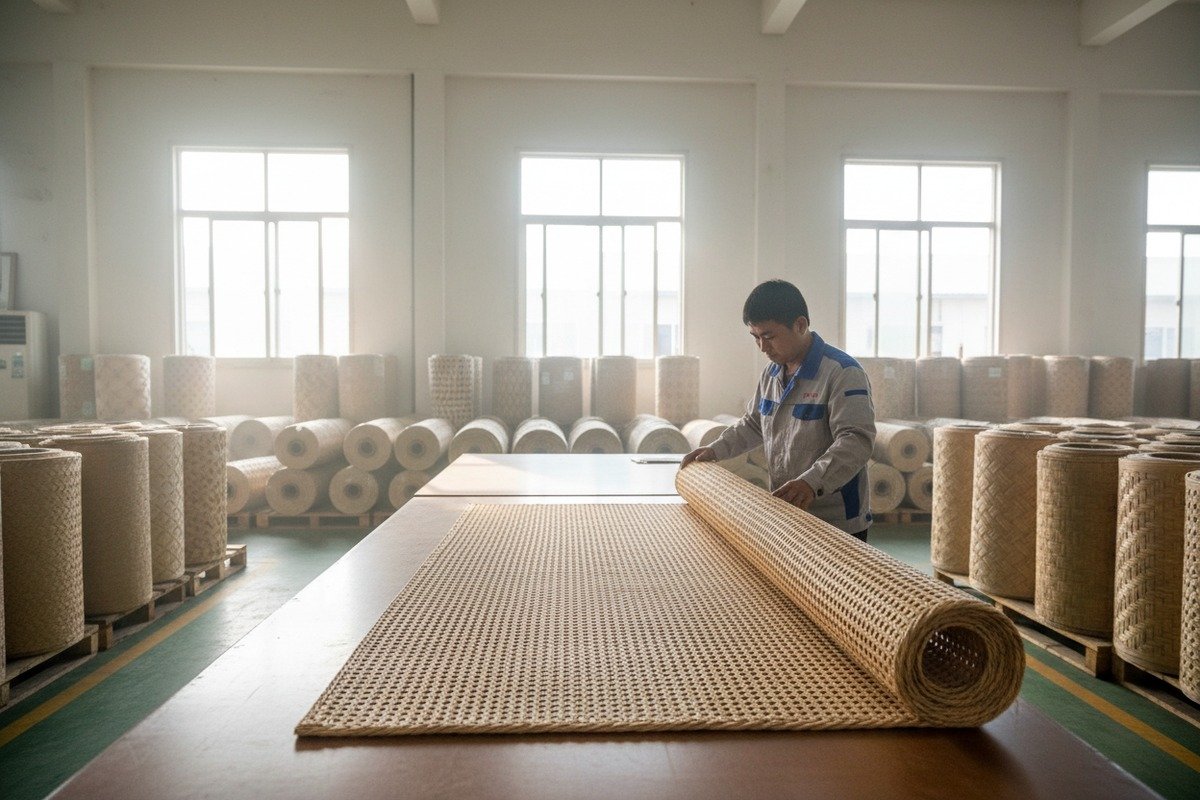
Chaque semaine, notre équipe d'entrepôt à Foshan reçoit des appels d'acheteurs qui viennent d'ouvrir leur expédition de rotin et remarquent une odeur inattendue les fibres végétales organiques 1. Certains la décrivent comme terreuse. D'autres disent qu'elle leur rappelle du bois humide ou même quelque chose de plus âcre. La préoccupation est toujours la même : est-ce normal, ou quelque chose s'est-il mal passé ?
Les odeurs dans le cannage de rotin naturel proviennent de quatre sources principales : les composés organiques inhérents à la plante, les traitements chimiques appliqués lors du traitement, la moisissure ou le mildiou liés à l'humidité, et l'absorption environnementale pendant le stockage ou le transport. La plupart des odeurs de nouveaux produits sont inoffensives et disparaissent en une à quatre semaines avec une ventilation adéquate.
Comprendre d'où viennent ces odeurs vous aide à faire la différence entre une odeur inoffensive de nouveau produit et un véritable signal d'alarme de qualité une croissance de moisissures ou de mildiou 2. Ci-dessous, nous détaillons chaque cause, vous montrons comment la résoudre et expliquons ce qu'il faut exiger de votre fournisseur.
Pourquoi ma cannage en rotin naturel a-t-il une forte odeur de terre ou de moisi ?
Lorsque nous récoltons et traitons le rotin dans notre usine en Indonésie, le cannage fraîchement coupé dégage une odeur végétale distincte Fumigation au dioxyde de soufre 3. Les acheteurs qui manipulent la matière première pour la première fois confondent souvent cette odeur naturelle avec un défaut. Elle surprend les gens, mais elle n'indique rarement un problème.
Le cannage en rotin naturel sent la terre car il est fabriqué à partir de fibres végétales organiques qui retiennent la sève résiduelle, la résine et les composés cellulosiques après la récolte. Cette odeur est normale dans le rotin fraîchement traité et disparaît généralement en deux à quatre semaines lorsqu'il est stocké dans un endroit sec et ventilé.

La biologie derrière l'odeur
Le rotin est un palmier grimpant 4. Ses tiges sont denses en huiles naturelles, résines et sucres. Lorsque nous dépouillons, faisons bouillir et séchons le cannage, la plupart des composés volatils 5 s'évaporent. Mais certains restent piégés dans la structure fibreuse poreuse. Ces matières organiques résiduelles produisent une odeur douce, boisée ou terreuse.
L'odeur est plus forte dans certaines espèces. Le cannage provenant des forêts tropicales humides de Kalimantan ou de Sulawesi a tendance à contenir plus de résine que le cannage provenant de régions plus sèches. Le cannage plus épais dégage également plus d'odeur car le cœur retient l'humidité plus longtemps pendant le séchage.
Quand le terreux devient moisi
Il y a une ligne claire entre "terreux" et "moisi". Les odeurs terreuses sont légères et végétales. Les odeurs moisies sont lourdes, humides et stagnantes. Si votre cannage de rotin sent le moisi, l'humidité est le coupable. Cela peut se produire pendant le transport lorsque les conteneurs restent au port pendant des semaines, ou dans des entrepôts avec une mauvaise circulation de l'air.
Guide rapide du test olfactif
| Ce que vous sentez | Cause probable | Action requise |
|---|---|---|
| Odeur légère de bois ou d'herbe | Résine végétale naturelle | Aucune — disparaîtra en 1 à 4 semaines |
| Odeur humide, rance, de sous-sol | Absorption d'humidité ou début de moisissure | Aérer immédiatement ; inspecter les taches |
| Odeur piquante, chimique ou de peinture | Traitements de transformation (vernis, pesticide) | Ventiler pendant 3 à 7 jours ; généralement inoffensif |
| Forte odeur d'ammoniac ou d'urine | Moisissure/mildiou ou contamination biologique | Nettoyer en profondeur ou rejeter le lot |
Pourquoi les fibres poreuses retiennent les odeurs
Les fibres de rotin fonctionnent comme de minuscules éponges. Leur structure cellulaire est remplie de canaux microscopiques. Ces canaux absorbent les particules en suspension dans l'air, l'humidité et les gaz de l'environnement environnant. Une fois absorbées, les odeurs restent profondément dans la fibre et se libèrent lentement. C'est pourquoi un rouleau stocké dans un entrepôt enfumé conservera cette odeur pendant des semaines.
D'après notre expérience d'expédition dans plus de 15 pays, la plainte la plus fréquente provient des acheteurs qui stockent les rouleaux dans des sous-sols ou des garages avant utilisation. Le rotin absorbe l'humidité ambiante et les odeurs de ces espaces en quelques jours. Nous conseillons toujours de stocker les rouleaux dans des pièces à température contrôlée, surélevés au-dessus des sols en béton.
Le point essentiel est simple. Une légère odeur terreuse fait partie de l'identité du matériau. Ce n'est pas un défaut. Mais si l'odeur est forte, humide ou piquante, vous devez enquêter davantage avant d'utiliser la sangle.
L'odeur dans mon envoi de rotin est-elle un signe de mauvaise qualité ou de séchage inapproprié ?
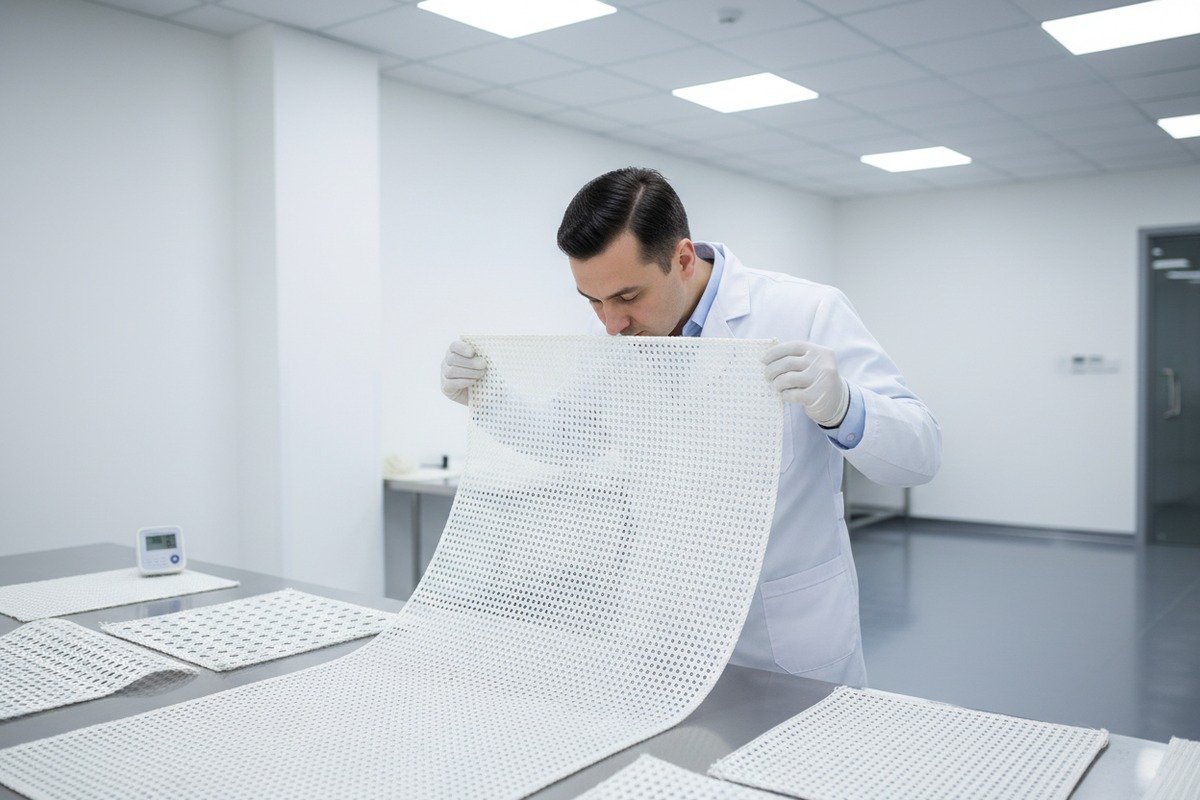
Notre équipe de contrôle qualité inspecte chaque lot avant qu'il ne quitte l'usine, et l'un des contrôles qu'elle effectue est un simple test olfactif. Nous avons appris il y a des années que certaines odeurs révèlent exactement ce qui s'est mal passé — et quand — pendant la production ou le stockage.
L'odeur seule n'indique pas toujours une mauvaise qualité. Les légères odeurs végétales ou chimiques dans le rotin neuf sont normales et disparaissent rapidement. Cependant, les odeurs persistantes de moisi ou aigres signalent souvent un séchage inapproprié, une ventilation insuffisante pendant le stockage, ou une croissance de moisissures – tout cela peut affaiblir le matériau et raccourcir sa durée de vie.
Comment le séchage affecte l'odeur
Un séchage approprié est l'étape la plus importante dans le traitement du rotin. Dans notre usine indonésienne, nous séchons le rotin sur des étagères à l'air libre pendant plusieurs jours, puis nous le plaçons dans des chambres de séchage contrôlées. Si le la teneur en humidité 7 reste supérieur à 14–16%, le rotin devient un terrain propice à la moisissure.
Le rotin sous-séché sent différemment du rotin correctement séché. L'odeur est plus lourde, plus humide et plus aigre. Lorsque vous pliez du rotin sous-séché, il est légèrement mou ou souple d'une manière caoutchouteuse, plutôt que ferme et élastique.
Traitements chimiques et dégagement gazeux
De nombreux fabricants appliquent des traitements chimiques 8 au rotin. Ceux-ci comprennent :
- Fumigation au dioxyde de soufre — utilisé pour blanchir et conserver le rotin, laisse une légère odeur de soufre.
- Trempages insecticides ou pesticides — protège contre les xylophages, peut sentir le chimique ou le médicinal.
- Revêtements de vernis ou de laque — scelle la surface, produit une odeur de peinture lorsqu'il est neuf.
- Huiles de préservation — empêche le craquellement, peut sentir l'huile ou légèrement le rance.
Ces odeurs sont plus fortes lorsque les rouleaux sont étroitement emballés dans du plastique pour l'expédition. Les composés volatils ne peuvent pas s'échapper, ils se concentrent donc à l'intérieur de l'emballage. Une fois que vous ouvrez les rouleaux et les laissez respirer, la plupart des odeurs chimiques se dissipent en trois à sept jours.
Drapeaux rouges vs signes normaux
| Indicateur | Normal | Drapeau rouge |
|---|---|---|
| Intensité de l'odeur après 48 heures d'aération | Faible ou disparu | Toujours fort ou s'aggravant |
| Taches de moisissure visibles (blanches, vertes, noires) | Aucun | Visible en surface ou entre les tissages |
| Flexibilité des fibres | Ferme, élastique | Mou, cassant ou friable |
| Décoloration de surface | Couleur uniforme | Taches sombres, traces d'eau |
| État de l'emballage à l'arrivée | Sec, intact | Humide, déchiré, condensation à l'intérieur |
La question de la moisissure
La moisissure est la plus grande préoccupation. Elle prospère dans des conditions chaudes, humides et mal ventilées. La composition organique du rotin fournit une source de nourriture idéale pour les spores de moisissure. Une fois que la moisissure colonise les fibres, elle produit des sous-produits métaboliques qui sentent le moisi ou parfois l'urine.
Voici ce que beaucoup d'acheteurs ne réalisent pas : la moisissure peut se développer à l'intérieur du cœur de la fibre sans apparaître en surface. C'est parce que l'action capillaire 9 aspire l'humidité profondément dans le rotin. Au moment où vous voyez des taches à l'extérieur, l'intérieur peut déjà être compromis.
Nous avons vu des lots d'autres fournisseurs arriver sans moisissure visible mais avec une forte odeur de moisi. Lorsque notre équipe a coupé des sections transversales du rotin, ils ont trouvé des cœurs sombres et ramollis. C'est la pourriture du cœur. C'est irréversible. Aucun nettoyage ne pourra y remédier.
Quand accepter et quand refuser
Si vous êtes un grossiste ou une usine de meubles recevant une grande expédition, faites une évaluation rapide. Ouvrez trois à cinq rouleaux de différentes positions dans le conteneur. Sentez-les. Inspectez les surfaces. Pliez quelques brins. Si l'odeur est légère et que le matériau semble sain au toucher, vous êtes tranquille. Si l'odeur est intense et que vous voyez une décoloration ou une ramollissement, documentez-le immédiatement et contactez votre fournisseur.
Comment puis-je éliminer en toute sécurité les odeurs de mes rouleaux en rotin sans endommager le matériau ?
Au fil des ans, nous avons testé des dizaines de méthodes d'élimination des odeurs dans notre usine de Foshan et partagé les résultats avec des acheteurs aux Pays-Bas, en Australie et aux États-Unis. Certaines méthodes fonctionnent à merveille. D'autres ruinent le cannage. Voici ce qui fonctionne réellement.
Pour retirer en toute sécurité les odeurs des rouleaux de rotin, commencez par les déballer et les aérer dans un endroit sec et ventilé, à l'abri de la lumière directe du soleil, pendant deux à cinq jours. Pour les odeurs tenaces, essuyez les surfaces avec une solution diluée de vinaigre blanc, saupoudrez du bicarbonate de soude entre les couches, ou placez du charbon actif à proximité pour absorber les odeurs résiduelles sans mouiller les fibres.
Étape 1 : Ventilation d'abord
La méthode la plus simple et la plus sûre est l'air frais. Déroulez le cannage ou au moins desserrez les rouleaux. Placez-les dans une pièce bien ventilée ou un espace extérieur couvert. Évitez la lumière directe du soleil, qui peut décolorer et sécher le rotin trop rapidement, provoquant des fissures.
La plupart des odeurs des nouveaux produits – d'origine végétale et chimique – disparaîtront en deux à cinq jours d'aération. Si l'odeur persiste après cinq jours, passez au niveau suivant.
Étape 2 : Absorbants naturels
Les absorbeurs d'odeurs naturels sont efficaces et sans danger pour le rotin. Ils agissent en piégeant les molécules odorantes sans introduire d'humidité.
| Method | Comment appliquer | Temps d'action | Idéal pour |
|---|---|---|---|
| Bicarbonate de soude | Saupoudrer entre les couches de cannage roulé | 24–48 heures | Odeurs végétales ou de moisi légères à modérées |
| Charbon actif | Placer des sacs ou du charbon en vrac près des rouleaux | 48–72 heures | Dégazage chimique, odeurs tenaces |
| Lingettes au vinaigre blanc | Mélanger 1:1 avec de l'eau, essuyer la surface, laisser sécher à l'air | 12–24 heures | Moisissures de surface, mildiou, odeurs aigres |
| Marc de café | Placer dans un récipient ouvert près des rouleaux | 24–48 heures | Masquage et absorption générale des odeurs |
| Exposition au soleil | 1 à 2 heures de lumière indirecte par jour | 3–5 jours | Odeurs légères de moisi ou d'humidité |
Étape 3 : Nettoyage ciblé pour les moisissures ou le mildiou
Si vous voyez des taches de moisissure ou si l'odeur de moisi persiste après ventilation, vous devez nettoyer directement le cannage. Voici un processus sûr :
- Mélanger une solution de nettoyage. Combiner une cuillère à soupe de savon à vaisselle doux et deux cuillères à soupe de vinaigre blanc dans un litre d'eau tiède.
- Essuyer, ne pas tremper. Utiliser un chiffon doux ou une éponge. Bien l'essorer. Essuyer délicatement les zones affectées. Ne jamais immerger les rouleaux en rotin dans l'eau.
- Séchez immédiatement. Sécher en tapotant avec une serviette propre. Placer ensuite le cannage dans un endroit ventilé. Utiliser un ventilateur pour accélérer le séchage. L'objectif est d'éliminer toute humidité en quelques heures.
- Appliquez de l'huile de lin ou de l'huile minérale. Une fois complètement sec, une fine couche d'huile conditionne les fibres et aide à prévenir l'absorption future d'humidité.
Ce qu'il faut éviter
Certains produits de nettoyage courants endommageront le rotin. Évitez :
- L'eau de Javel à pleine concentration. Elle élimine les huiles naturelles et affaiblit les fibres. Si vous devez utiliser de l'eau de Javel, diluez-la fortement — une cuillère à café par litre d'eau, maximum.
- Les nettoyeurs à vapeur. L'humidité et la chaleur concentrées poussent l'eau profondément dans le cœur, favorisant la moisissure cachée.
- Les nettoyeurs haute pression. Ils détruisent la structure du tissage et forcent l'eau dans chaque crevasse.
- Les nettoyants à base d'ammoniaque. Ils réagissent avec les tanins naturels du rotin et peuvent provoquer une décoloration.
Prévenir les odeurs avant qu'elles ne commencent
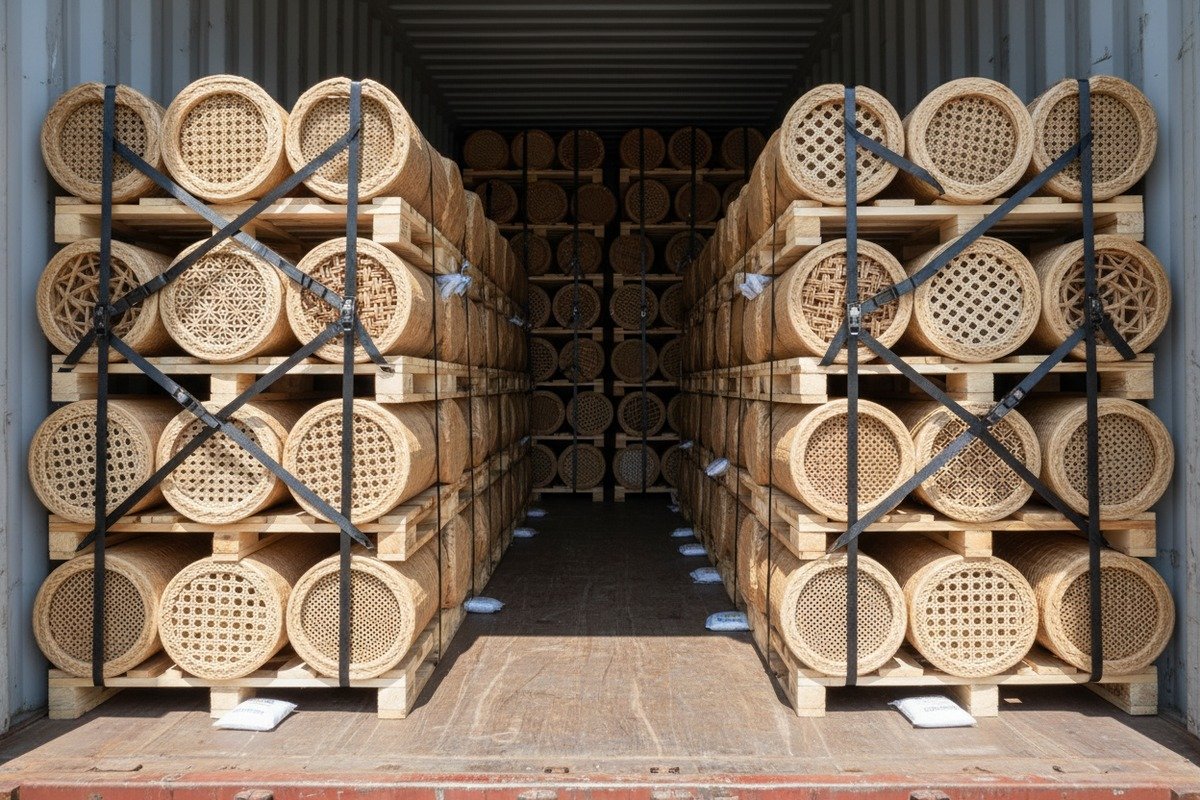
La prévention bat toujours le traitement. Lorsque nous emballons des rouleaux pour l'exportation, nous incluons sachets de gel de silice 10 à l'intérieur de l'emballage pour absorber l'humidité de transit. Nous conseillons également aux acheteurs d'ouvrir les expéditions dans les 48 heures suivant leur arrivée et de laisser les rouleaux respirer avant de les stocker à long terme.
Pour les acheteurs qui stockent du rotin dans des entrepôts, maintenez l'humidité en dessous de 60 %. Utilisez des déshumidificateurs si nécessaire. Stockez les rouleaux sur des étagères, pas directement sur des sols en béton. Et ne jamais empiler des produits humides ou mouillés à côté de rotin sec — l'humidité se transfère rapidement entre les rouleaux.
Que dois-je rechercher chez un grossiste pour m'assurer que mon rotin arrive frais et sans odeur ?
Lorsque nous avons commencé à exporter du rotin il y a plus de dix ans, nous avons rapidement appris que la qualité du produit ne signifie rien si le matériau arrive avec une odeur de sous-sol humide. La chaîne d'approvisionnement – du séchage à l'emballage en passant par l'expédition – détermine si votre rotin vous parvient en parfait état ou avec des problèmes.
Pour garantir un rotin sans odeur, choisissez un grossiste qui contrôle son propre processus de séchage, utilise un emballage résistant à l'humidité avec des dessicants, fournit des lectures documentées de la teneur en humidité inférieures à 14% et expédie par des canaux logistiques fiables avec des retards portuaires minimaux. Demandez des rouleaux d'échantillons avant de passer des commandes en gros.

Questions clés à poser à votre fournisseur
Avant de vous engager dans une commande importante, posez ces questions spécifiques :
- Quelle est la teneur en humidité de votre cannage au moment de l'emballage ? La réponse devrait être comprise entre 10% et 14%. Tout ce qui dépasse 14% présente un risque de moisissure.
- Contrôlez-vous votre propre installation de séchage ? Les fournisseurs qui externalisent le séchage ont moins de contrôle sur la qualité. Nous exploitons nos propres salles de séchage en Indonésie spécifiquement pour éviter ce problème.
- Quels traitements appliquez-vous ? Vous avez le droit de savoir si le cannage a été fumigé, blanchi ou enduit. Cela vous aide à prédire l'odeur à attendre.
- Comment emballez-vous les rouleaux pour l'exportation ? Recherchez des fournisseurs qui utilisent des matériaux d'emballage respirants, incluent des sachets de gel de silice ou de dessicant, et évitent de sceller les rouleaux dans du plastique hermétique pendant de longues périodes.
- Quel est votre temps d'expédition moyen ? Un transit plus long signifie plus de temps pour l'accumulation d'humidité à l'intérieur des conteneurs. Les fournisseurs ayant des itinéraires d'expédition établis et des partenaires de fret fiables minimisent ce risque.
Qu'est-ce qui distingue les bons fournisseurs des excellents ?
| Facteur | Fournisseur moyen | Fournisseur de premier ordre |
|---|---|---|
| Processus de séchage | Externalisé, non contrôlé | Interne, suivi de l'humidité |
| Documentation de l'humidité | Non fourni | Inclus avec chaque expédition |
| Emballage | Emballage plastique de base | Emballage respirant + dessicants |
| Disponibilité des échantillons | Réticent ou lent | Échantillons prêts expédiés en quelques jours |
| Gestion des plaintes | Retardé, défensif | Proactif, documenté, orienté solution |
| Gamme de produits | Motifs limités | Gamme complète : tissage ouvert, tissage serré, blanchi, naturel |
Le rôle de l'emballage dans la prévention des odeurs
L'emballage est là où de nombreux fournisseurs font des économies. Un film plastique serré retient l'humidité et les composés volatils des traitements. Si le conteneur chauffe pendant le transport — ce qui arrive régulièrement sur les routes traversant les eaux tropicales — cette humidité piégée se condense à l'intérieur de l'emballage. Cela crée un effet de mini-serre. La moisissure peut commencer à se développer en seulement 72 heures dans ces conditions.
Chez Seafan Rattan, nous sommes passés à une approche d'emballage hybride il y a plusieurs années. Nous enveloppons les rouleaux dans une couche intérieure respirante, puis ajoutons une couche extérieure barrière contre l'humidité avec des canaux de ventilation. Nous plaçons également des sachets déshydratants à plusieurs endroits à l'intérieur de l'emballage. Le résultat est une diminution spectaculaire des plaintes d'odeurs de la part de nos acheteurs.
Certifications et documentation
Les fournisseurs réputés fournissent une documentation qui va au-delà d'une simple facture. Recherchez :
- Certificats phytosanitaires — confirment que le rotin a été traité selon les normes internationales en matière de parasites.
- Rapports de test d'humidité — indiquent les relevés exacts au moment de l'emballage.
- Fiches de données de sécurité des matériaux (FDS) — pour tout traitement chimique appliqué.
- Photos des conditions de stockage et d'emballage — la transparence renforce la confiance.
Construire une relation à long terme
La meilleure façon d'assurer un rotin constant et sans odeur est d'établir une relation à long terme avec un fournisseur fiable. Lorsque nous travaillons avec des acheteurs réguliers — comme nos clients aux Pays-Bas et en Australie — nous apprenons leurs normes de qualité exactes au fil du temps. Nous savons quels motifs ils préfèrent, quel taux d'humidité leur climat exige, et comment ils souhaitent que les rouleaux soient emballés. Ce type de partenariat élimine les surprises.
Si vous vous approvisionnez en rotin pour la première fois, commencez par une petite commande d'essai. Inspectez-la minutieusement. Testez l'odeur, la flexibilité et la qualité visuelle. Si tout est conforme, augmentez progressivement. Cette approche protège votre investissement et vous donne un levier pour négocier de meilleures conditions à mesure que les volumes augmentent.
Conclusion
Les odeurs dans le cannage de rotin naturel proviennent généralement de composés végétaux, de traitements chimiques, d'humidité ou de moisissures. La plupart des odeurs de nouveaux produits s'estompent avec la ventilation. Les odeurs persistantes signalent des problèmes plus profonds. Choisissez un fournisseur qui contrôle le séchage, l'emballage et la documentation pour protéger votre investissement.
Notes de bas de page
1. Explique la composition fondamentale et les caractéristiques des fibres végétales comme le rotin. ↩︎
2. Source faisant autorité sur les causes et les bases de la croissance des moisissures et des mildious. ↩︎
3. Fournit des informations sur le dioxyde de soufre, un produit chimique utilisé dans la fumigation et la conservation. ↩︎
4. Remplacé le lien HTTP 404 par une page Wikipedia faisant autorité sur le rotin, qui le décrit clairement comme un palmier grimpant. ↩︎
5. Explique la nature et l'origine des composés organiques volatils émis par les plantes. ↩︎
6. Fournit des informations générales sur le rotin, le matériau de base de l'article. ↩︎
7. Discute de l'importance de la teneur en humidité du bois et de son impact sur la qualité du matériau. ↩︎
8. Détaille les procédés industriels courants et les applications chimiques pour le rotin et les matériaux similaires. ↩︎
9. Explique le phénomène physique de l'action capillaire dans les matériaux poreux. ↩︎
10. Décrit le gel de silice, un dessiccant courant utilisé pour absorber l'humidité dans les emballages. ↩︎

 English
  Español de México
  العربية
  Deutsch
  Français
  Русский