

Chaque année, notre équipe de contrôle qualité à Foshan rejette des lots que les fournisseurs ont étiquetés comme “ Grade A ” mais qui sont clairement insuffisants. uniformité des bandes 1. Le problème est réel : des systèmes de classement incohérents à travers le monde industrie du rotin 2 laissent les acheteurs confus, paient trop cher ou se retrouvent avec des matériaux de qualité inférieure. Si vous avez déjà ouvert une expédition pour y trouver du cannage terne et cassant qui ne ressemble en rien à l'échantillon que vous avez approuvé, vous connaissez la frustration de première main.
Pour vérifier les normes de qualité du cannage en rotin, demandez des échantillons physiques avant les commandes en gros, effectuez des inspections visuelles et tactiles pour l'uniformité des lanières, la cohérence des couleurs et la flexibilité, vérifiez la teneur en humidité (idéalement 8–12%), et comparez les affirmations de classement du fournisseur aux critères standardisés couvrant la texture, la densité, la tension du tissage et les niveaux de défauts.
Ce guide détaille chaque étape du processus de vérification. Vous apprendrez à inspecter les grades visuellement, à établir une liste de contrôle qualité, à comprendre comment les grades affectent la durabilité et à maintenir la cohérence sur les commandes en gros. Plongeons dans le vif du sujet.
Comment puis-je distinguer visuellement entre le cannage de rotin de qualité A et de qualité B lors de l'inspection ?
Lorsque nous préparons les expéditions dans notre entrepôt de Foshan, la différence entre le Grade A et le Grade B est souvent évidente en quelques secondes, si vous savez quoi chercher. Mais de nombreux acheteurs se fient uniquement aux photos des fournisseurs, et c'est là que commencent les erreurs coûteuses.
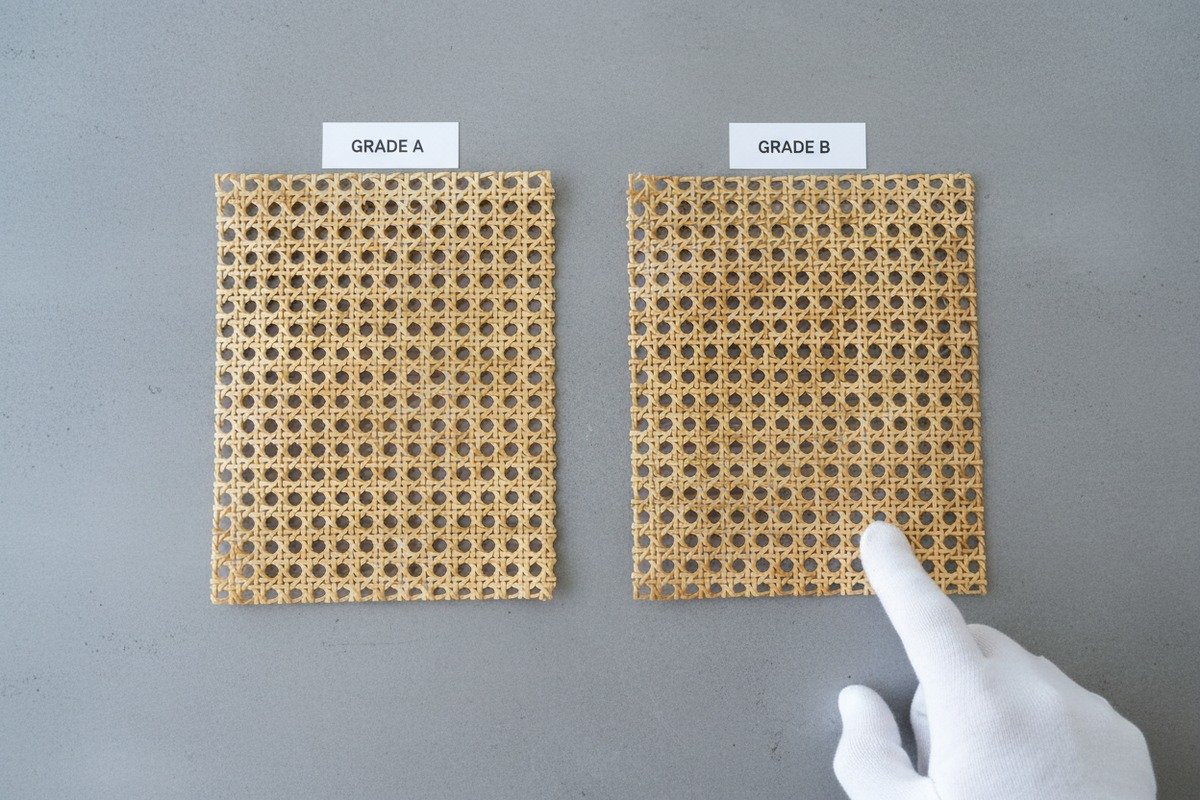
Le cannage en rotin de qualité A présente une largeur de bande uniforme, des surfaces lisses, une couleur beige chaud constante et des motifs de tissage serrés sans nœuds, fissures ou décolorations visibles. La qualité B présente des irrégularités mineures, notamment de légères variations de couleur, des zones rugueuses occasionnelles et une taille de bande moins uniforme, bien qu'elle reste structurellement fonctionnelle.
Commencez par la couleur et la teinte
La première chose que vos yeux devraient remarquer est la couleur. Le rotin de Grade A a une teinte riche et chaude, pensez à du miel clair ou à du jaune paille propre. La couleur reste uniforme sur toute la feuille ou le rouleau. Le rotin de Grade B, en revanche, peut présenter des zones grises, des taches ternes ou un tannage inégal. Ces changements de couleur se produisent parce que les bandes de qualité inférieure proviennent de différentes parties du palmier rotin ou de récoltes mélangées.
Tenez le cannage à bout de bras sous la lumière naturelle. Si vous voyez des zones tachetées ou un aspect délavé, c'est un signe clair de Grade B ou inférieur.
Vérifiez la largeur et l'uniformité des bandes
Les bandes de Grade A sont coupées à des largeurs constantes. Chaque brin de la tresse a le même aspect. Les bandes de Grade B peuvent s'effiler légèrement. Certaines bandes seront plus fines que d'autres. Cette incohérence affecte à la fois l'attrait visuel et la performance structurelle du produit final.
Utilisez un pied à coulisse ou une règle simple. Mesurez au moins 10 bandes aléatoires sur la feuille. Si la variation de largeur dépasse 0,3 mm, vous regardez probablement du Grade B.
Texture de surface et défauts
Passez votre main sur la surface. Le Grade A est lisse et légèrement cireux. Vous ne devriez sentir aucune accroche, aucune rugosité ou aucun nœud saillant. Le Grade B peut présenter de petits nœuds, de légères fissures de surface ou une légère rugosité le long de certaines bandes.
Recherchez attentivement ces défauts courants :
- Taches de moisissure (points ou taches sombres)
- Dommages causés par les insectes (petits trous)
- Fentes de surface le long du fil
- Ébarbage inégal de la peau de rotin
Tableau de référence pour la classification visuelle
| Caractéristique | Grade A (Premium) | Grade B (Standard) | Grade C (Économique) |
|---|---|---|---|
| Couleur | Miel/paille uniforme | Légère variation | Patchiness notable |
| Largeur de bande | Uniforme (±0,2 mm) | Cône mineur (±0,5 mm) | Irrégulier (±1 mm+) |
| Surface | Lisse, sans nœuds | Points rugueux occasionnels | Nœuds, fissures visibles |
| Serrage du tissage | Serré, sans espaces | Principalement serré, petits espaces | Lâche par endroits |
| Flexibilité | Très souple | Modérément souple | Tendance à être cassant |
Densité du motif de tissage
Pour les feuilles pré-tissées, faites attention au motif de tissage. Les motifs courants comprennent le nid d'abeille hexagonal ouvert 3 (tissage radio), un tissage panier carré dense et des motifs en losange. En Grade A, le motif est net. Chaque hexagone ou carré est symétrique. En Grade B, vous pourriez remarquer un léger désalignement ou un espacement inégal entre les trous.
L'espacement de trous le plus populaire pour les meubles haut de gamme est de 1/2 pouce (centre à centre). Vérifiez que cet espacement reste constant. Prenez une règle et mesurez à cinq points aléatoires sur la feuille. L'incohérence ici signale un matériau de qualité inférieure ou une mauvaise qualité de tissage.
Le facteur Naturel vs Blanchi
La canne de rotin blanchie peut parfois masquer les qualités inférieures. Le processus de blanchiment 4 uniformise la couleur, faisant paraître le Grade B plus proche du Grade A à première vue. Si votre fournisseur propose de la canne blanchie, demandez des échantillons blanchis et non blanchis. Comparez-les côte à côte. L'échantillon non blanchi révélera la vraie qualité.
Dans notre usine de traitement indonésienne, nous classons toujours la canne brute avant tout traitement. Cela garantit que l'étiquette de qualité reflète la qualité réelle du matériau, et non une amélioration cosmétique.
Quelles listes de contrôle de qualité spécifiques dois-je utiliser pour vérifier les affirmations de mon fournisseur concernant la qualité du rotin ?
Au cours de la dernière décennie, notre équipe d'exportation a expédié du rotin dans plus de 15 pays. Une leçon ressort : les acheteurs qui utilisent une liste de contrôle structurée détectent les problèmes tôt. listes de contrôle de qualité 5 Ceux qui font confiance aux étiquettes seules font souvent face à des litiges plus tard.
Utilisez une liste de contrôle à plusieurs points couvrant l'inspection visuelle (couleur, surface, tissage), les tests tactiles (flexibilité, densité, qualité des bords), la vérification dimensionnelle (largeur de bande, épaisseur à 2,5–3 mm, espacement des trous), la mesure de l'humidité (cible 8–12 %), la comparaison d'échantillons avec les fiches techniques et l'examen des références du fournisseur, y compris la documentation d'origine et les certifications de durabilité.
Créez votre liste de contrôle de pré-commande
Avant de passer toute commande en gros, demandez de petites coupes d'échantillons, d'au moins 12 pouces ou plus. Testez ces échantillons par rapport à chaque élément de votre liste de contrôle. Voici une liste de contrôle pratique que vous pouvez adapter :
La liste de contrôle complète de vérification de la qualité
| Catégorie de vérification | Que tester | Critères de réussite | Outil nécessaire |
|---|---|---|---|
| Cohérence des couleurs | Comparer 5 points sur la feuille | Pas de taches grises, ton uniforme | Lumière naturelle du jour |
| Largeur de bande | Mesurer 10 bandes aléatoires | Dans la limite de ±0,3 mm par rapport aux spécifications | Pied à coulisse numérique 6 |
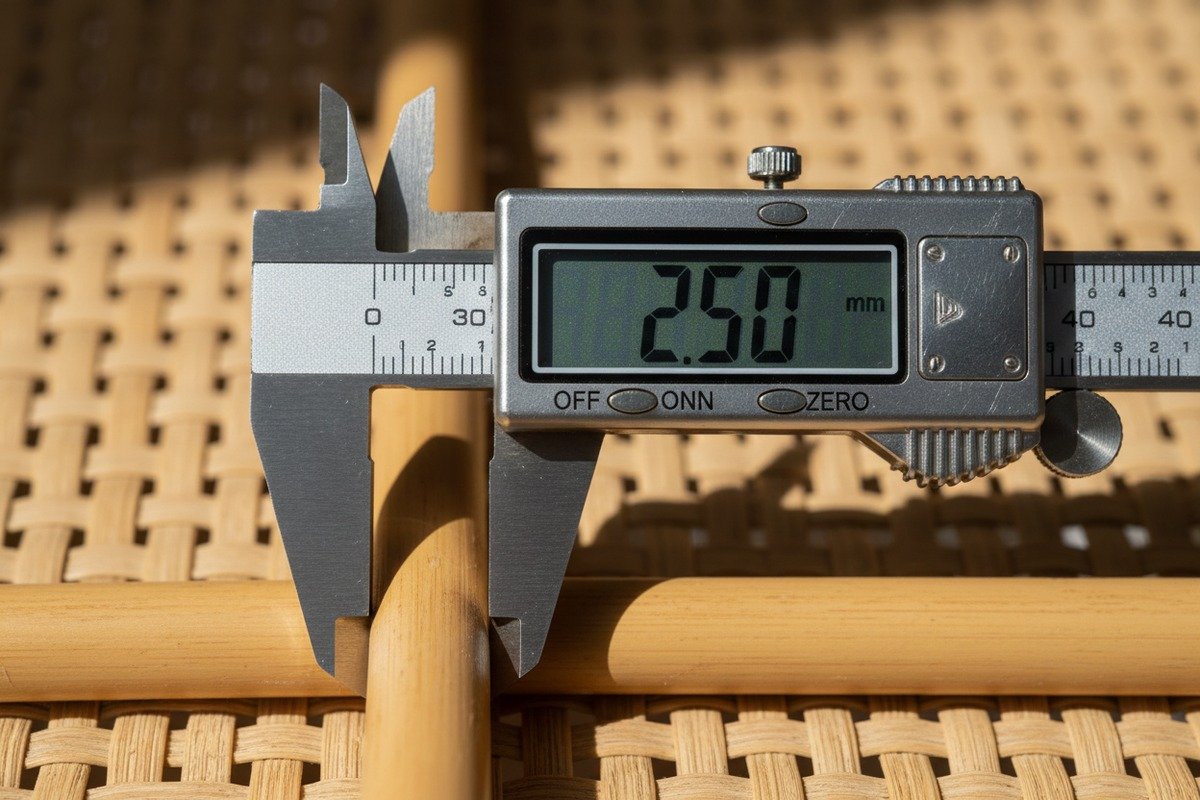
| Épaisseur | Mesurer la section transversale de la bande de canne | 2,5–3,0 mm (ou ~1/16 pouce) | Pied à coulisse numérique |
| Qualité de surface | Balayage visuel + tactile | Pas de nœuds, fissures, champignons | Loupe |
| Serrage du tissage | Vérifier l'alignement du motif | Symétrique, pas d'espaces | Règle |
| Espacement des trous | Mesurer centre à centre | Correspond aux spécifications (1/2", 5/8", 3/4" ou 1") | Règle |
| Flexibilité | Plier la bande à 90 degrés | Pas de craquement ni de casse | Mains |
| Teneur en humidité 7 | Tester avec un multimètre | Plage 8–12% | Humidimètre |
| Finition des bords | Inspecter les bords coupés | Propre, pas d'effilochage | Yeux |
| Odeur | Sentir le matériau | Naturel, pas de moisissure ni de produit chimique | Nez |
Vérification dimensionnelle
Les dimensions sont plus importantes que ce que la plupart des acheteurs réalisent. Les largeurs courantes pour les rouleaux de cannage en rotin varient de 14 pouces à 48 pouces. Les longueurs de rouleaux sont généralement de 15 mètres pour le naturel et jusqu'à 30 mètres pour les options synthétiques. Confirmez toujours que les dimensions du rouleau correspondent aux spécifications de votre commande avant l'expédition.
L'épaisseur est critique. Les bandes de cannage de première qualité doivent mesurer environ 2,5 à 3 mm. Des bandes plus fines indiquent soit une qualité inférieure, soit une écorce trop rasée, deux facteurs qui réduisent la résistance et la durée de vie.
Test de teneur en humidité
Cette étape est non négociable. Le rotin dont l'humidité dépasse 12 % se déformera, rétrécira ou développera de la moisissure pendant le transport ou le stockage. Le rotin en dessous de 8 % devient cassant et se fissure facilement. Un humidimètre portable coûte très peu cher et évite d'énormes maux de tête.
Lorsque nous traitons le rotin dans notre usine indonésienne, nous le séchons à 10 % d'humidité avant l'expédition. Nous recommandons aux acheteurs de refaire le test à l'arrivée, en particulier pour les expéditions qui traversent différentes zones climatiques.
Vérification des références du fournisseur
Ne vous contentez pas de faire confiance à l'étiquette de qualité. Demandez à votre fournisseur :
- Documentation d'origine (où le rotin a-t-il été récolté ?)
- Détails de l'installation de traitement (où a-t-il été tissé ?)
- Certifications de durabilité 8 (Global GreenTag ou similaire)
- Rapports d'inspection de qualité de leur propre équipe de contrôle qualité
- Contacts de référence d'acheteurs existants
Les fournisseurs établis comme nous maintiennent la traçabilité de la forêt indonésienne au rouleau fini. Si un fournisseur ne peut pas vous dire d'où vient son rotin, considérez cela comme un signal d'alarme.
Croisement des systèmes de classement
Une source majeure de confusion est que différents fournisseurs utilisent différents systèmes de classement. Honeywell utilise de A à D. Yeeyahome utilise de AAA à C. Ces systèmes ne correspondent pas parfaitement. Voici un guide d'équivalence approximatif :
| Système Honeywell | Système Yeeyahome | Niveau de qualité général |
|---|---|---|
| Qualité A | AAA | Premium – écorce la plus fine, sans défauts |
| Qualité B | A | Bon – imperfections mineures, solide |
| Note C | B | Standard – défauts visibles, fonctionnel |
| Qualité D | C | Économique – rugueux, pour usage caché |
Demandez toujours à votre fournisseur quel système il utilise. Demandez ensuite ses critères spécifiques pour chaque qualité. Comparez ces critères à la liste de contrôle ci-dessus. Si leur "Qualité A" autorise les nœuds et les variations de couleur, elle peut en fait être équivalente à la Qualité B d'un autre système.
Drapeaux rouges à surveiller
Soyez prudent si un fournisseur présente l'un de ces signes avant-coureurs :
- Ils refusent d'envoyer des échantillons physiques
- Leurs étiquettes de qualité changent entre les communications
- Les photos ne correspondent pas au produit réel
- Ils ne peuvent pas fournir de détails sur l'origine ou le traitement
- Ils proposent la "Qualité A" à des prix typiques de la Qualité C
- Allégations de teneur en humidité élevée (supérieure à 12 %)
Comment la qualité du rotin que je sélectionne affectera-t-elle la durabilité à long terme de mes meubles ?
D'après des années de gestion des retours de garantie sur nos marchés d'exportation — les Pays-Bas, l'Australie, les États-Unis et au-delà — nous avons constaté des tendances claires. La qualité que vous choisissez façonne directement la performance du meuble cinq, dix, voire vingt ans plus tard.
Le cannage en rotin de qualité supérieure A ou AAA peut durer de 15 à 20 ans à l'intérieur avec des soins appropriés, grâce à une densité de tissage serrée, une grande flexibilité et une stabilité optimale de l'humidité. Les qualités inférieures comme C ou D se dégradent plus rapidement, montrant de la fragilité, un affaissement et des fissures en 3 à 5 ans, surtout dans les environnements humides ou exposés au soleil.

Pourquoi la qualité affecte la durée de vie
Le lien entre la qualité et la durabilité repose sur trois propriétés fondamentales : la densité des fibres, l'intégrité de la surface et le comportement face à l'humidité.
Le rotin de qualité A provient de l'écorce la plus externe du rotin mature. Cette partie de la plante est la plus dense et la plus résistante à l'usure. Elle conserve sa forme sous des contraintes répétées — comme s'asseoir dans une chaise jour après jour. La surface est naturellement lisse, ce qui signifie moins de points d'entrée pour l'humidité, la saleté ou la moisissure.
Le rotin de qualité C ou D utilise des écorces intérieures ou des bandes de rotin plus jeune et moins mature. Ces bandes sont plus souples, plus poreuses et moins élastiques. Elles absorbent l'humidité plus rapidement et la libèrent de manière inégale, ce qui entraîne une déformation.
Performance intérieure vs. extérieure
Le rotin est principalement un matériau d'intérieur. Mais même à l'intérieur, les conditions varient. Les meubles près des fenêtres sont exposés aux UV. Les pièces dans les cuisines ou les salles de bains font face à une humidité plus élevée.
La qualité A gère beaucoup mieux ces contraintes. Sa structure fibreuse dense résiste à la dégradation par les UV et au gonflement dû à l'humidité. La qualité B résiste raisonnablement bien dans des conditions intérieures modérées, mais peut montrer des signes d'usure près des fenêtres dans les 5 à 7 ans. La qualité C est mieux réservée aux environnements stables et secs ou aux composants qui ne supportent pas de charge.
Pour une utilisation en extérieur, le rotin naturel — quelle que soit sa qualité — nécessite une finition protectrice ou doit être remplacé par du cannage synthétique. Nos options synthétiques dans les motifs chevron vague et osier imitent l'aspect du rotin naturel mais résistent beaucoup plus efficacement aux intempéries, aux UV et à l'humidité.
Le calcul du coût par an
De nombreux acheteurs se concentrent sur le coût initial. Mais la sélection de la qualité est en réalité une décision de coût par an. La qualité A coûte environ 2 à 3 fois plus cher que la qualité C. Mais elle dure 3 à 5 fois plus longtemps. Le calcul est simple :
Si la qualité A coûte $8 par mètre et dure 18 ans, cela représente environ $0,44 par an. Si la qualité C coûte $3 par mètre et dure 4 ans, cela représente $0,75 par an. Sur la durée de vie d'un meuble, la qualité supérieure permet d'économiser de l'argent.
Entretien et interaction avec la qualité
Même la meilleure qualité nécessite des soins. Évitez la lumière directe du soleil pendant de longues périodes. Maintenez des niveaux d'humidité modérés — idéalement entre 40% et 60% d'humidité relative 9. Dépoussiérez régulièrement. Appliquez une légère huile de conditionnement ou de la cire d'abeille tous les 12 à 18 mois pour maintenir la souplesse des fibres.
Les qualités inférieures exigent encore plus d'entretien. Sans conditionnement régulier, le rotin de qualité B et C se dessèche plus rapidement et devient cassant. D'après notre expérience, les acheteurs qui négligent l'entretien des cannages de qualité inférieure constatent des défaillances dans les 2 à 3 ans.
Quand les qualités inférieures sont justifiées
Toutes les applications ne nécessitent pas la qualité A. Pour les meubles économiques, les panneaux structurels cachés ou les présentoirs de courte durée, les qualités B ou C peuvent être tout à fait appropriées. L'essentiel est de faire correspondre la qualité à l'usage prévu. Utilisez les qualités premium pour les surfaces visibles, porteuses, et fréquemment touchées. Utilisez les qualités économiques pour le dos des armoires, les doublures intérieures ou les éléments décoratifs sans rôle structurel.
Comment puis-je m'assurer que ma commande en gros maintient des normes de qualité constantes entre les différentes qualités de rotin ?
La cohérence est la principale préoccupation que nous entendons de la part des responsables des achats, comme ceux des usines de meubles en Thaïlande, aux Pays-Bas et en Australie. Un seul rouleau peut être superbe. Mais lorsque 500 rouleaux arrivent et que 10% sont sensiblement différents, les chaînes de production s'arrêtent et les plaintes s'accumulent.
Pour maintenir une qualité constante dans les commandes de rotin en vrac, mettez en place un système en quatre étapes : exigez des échantillons de pré-production provenant du lot exact, définissez des spécifications écrites claires avec des tolérances mesurables, effectuez des inspections aléatoires en ligne pendant la production et réalisez des audits avant expédition sur un échantillon statistique de rouleaux finis en utilisant votre liste de contrôle vérifiée.
Les échantillons de pré-production sont non négociables
N'approuvez jamais une commande en gros sur la seule base d'un échantillon de catalogue. Les échantillons de catalogue représentent le meilleur matériau possible. Les lots de production varient. Demandez toujours un échantillon de pré-production, c'est-à-dire une pièce découpée dans le lot réel de matière première qui sera utilisé pour votre commande.
À notre siège de Foshan, nous prélevons des échantillons de pré-production sur le stock brut alloué à la commande de chaque client. Le client approuve cet échantillon spécifique. Ensuite, nous réservons ce stock pour sa série de production. Cela élimine le risque de "leurre et changement".
Spécifications écrites avec tolérances
Les accords verbaux ne suffisent pas. Votre bon de commande doit inclure des spécifications écrites avec des tolérances exactes :
- Largeur de bande : par exemple, 3,5 mm ±0,2 mm
- Épaisseur : par exemple, 2,8 mm ±0,3 mm
- Teneur en humidité : 8–12%
- Référence couleur : joindre une photo approuvée ou un échantillon Pantone
- Espacement des trous : par exemple, 1/2 pouce ±1 mm
- Largeur du rouleau : par exemple, 24 pouces ±0,5 pouce
- Longueur du rouleau : par exemple, 15 mètres ±0,3 mètre
- Tolérance aux défauts : par exemple, maximum 2 nœuds mineurs par mètre linéaire, zéro tache de moisissure
Ces spécifications deviennent votre référence légale et opérationnelle. Si le produit livré sort des tolérances, vous avez des motifs clairs pour une réclamation.
Contrôles qualité en ligne
Pour les grosses commandes, n'attendez pas que tout soit terminé pour vérifier la qualité. Demandez des inspections en ligne aux points de finition de 30 % et 70 %. Cela peut être effectué par un service d'inspection tiers ou par votre propre représentant visitant l'usine.
Lors des contrôles en ligne, prélevez des rouleaux aléatoires et testez-les par rapport à votre liste de contrôle. Mesurez les largeurs des bandes. Vérifiez l'humidité. Pliez les bandes. Inspectez le tissage. Si des problèmes apparaissent à 30 %, il est encore temps de corriger le processus de production.
Audit avant expédition
Avant l'expédition de la commande, effectuez un audit final. L'approche standard est l'échantillonnage AQL (Niveau de Qualité Acceptable) 10. Pour la sangle en rotin, un AQL de 2,5 est courant pour les défauts critiques et un AQL de 4,0 pour les défauts mineurs.
Prélevez un échantillon aléatoire en fonction de la taille du lot. Inspectez chaque rouleau échantillonné par rapport à chaque spécification. Documentez les résultats avec des photos. Ne libérez l'expédition qu'une fois l'échantillon approuvé.
Gestion des commandes multi-grades
Certains acheteurs commandent plusieurs grades dans une seule expédition — par exemple, Grade A pour les panneaux de siège, Grade B pour les panneaux latéraux. Cela crée un défi d'emballage et d'étiquetage. Si les rouleaux ne sont pas clairement étiquetés, les ouvriers de l'usine peuvent installer le mauvais grade au mauvais endroit.
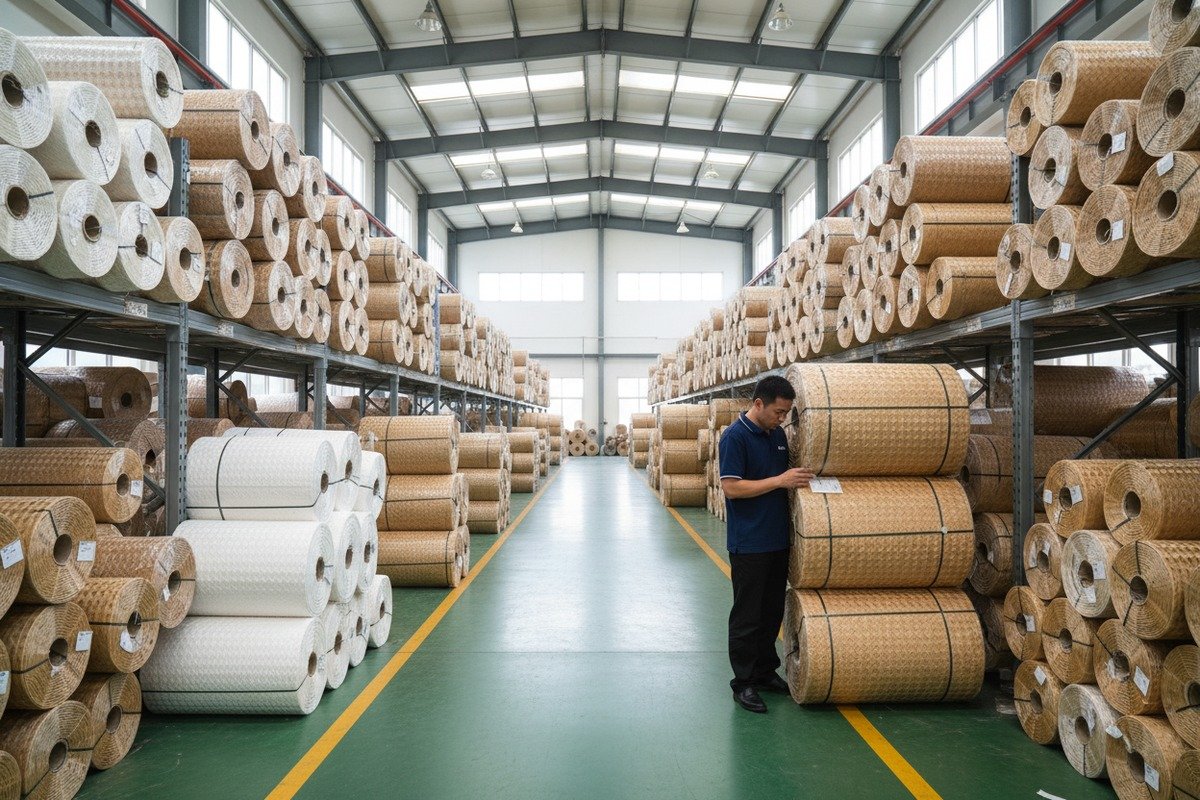
Nous étiquetons chaque rouleau avec un autocollant codé par couleur et une étiquette imprimée indiquant la qualité, le numéro de lot, les dimensions et la date de production. Nous emballons également différentes qualités sur des palettes séparées. Ce système simple évite les erreurs chez l'acheteur.
Gestion de la variation d'un lot à l'autre
Le rotin naturel est un matériau d'origine végétale. Deux récoltes ne sont jamais identiques. Le climat, le sol, la saison et l'âge du palmier rotin influencent tous la matière première. Cela signifie qu'une certaine variation d'un lot à l'autre est normale, même au sein de la même qualité.
L'essentiel est de définir le niveau de variation acceptable. Spécifiez-le dans vos cahiers des charges. Par exemple, une variation de ±0,5 teinte sur une échelle de couleur de 10 points peut être acceptable pour la qualité B, mais pas pour la qualité A. Avoir ces paramètres par écrit évite les litiges subjectifs.
Établir des relations fournisseurs à long terme
La cohérence s'améliore avec le temps lorsque vous travaillez avec le même fournisseur. Il apprend vos normes. Il alloue de meilleures matières premières aux clients fidèles. Il investit dans votre succès car vous représentez un revenu continu.
Nous avons des clients qui commandent chez nous depuis plus de huit ans. Leur taux de rejet est proche de zéro, non pas parce que notre rotin a changé, mais parce que nous avons appris leurs exigences exactes et avons mis en place des systèmes pour y répondre. Ce type de partenariat est l'outil d'assurance qualité le plus solide que vous puissiez avoir.
Conclusion
La vérification des qualités de cannage en rotin demande des efforts, mais elle protège votre investissement et votre réputation. Utilisez des listes de contrôle structurées, testez rigoureusement les échantillons et établissez des partenariats à long terme avec des fournisseurs transparents comme Seafan Rattan à www.rattanwholesaler.com.
Notes de bas de page
1. Explique les méthodes d'inspection visuelle pertinentes pour la qualité et l'uniformité du matériau. ↩︎
2. Donne un aperçu de l'industrie du rotin, de sa valeur commerciale mondiale et de ses diverses utilisations. ↩︎
3. Fournit un contexte sur les techniques de tissage du vannerie et du cannage, y compris les motifs. ↩︎
4. Explique le processus chimique général de blanchiment de divers matériaux. ↩︎
5. L'ASQ fournit des ressources et des meilleures pratiques pour la création de listes de contrôle de contrôle qualité. ↩︎
6. Fournit un guide clair, étape par étape, avec des illustrations sur la façon d'utiliser des pieds à coulisse numériques pour diverses mesures. ↩︎
7. Explique la teneur en humidité idéale pour les produits en bois, pertinente pour le rotin. ↩︎
8. Le FSC fournit des certifications largement reconnues pour la foresterie durable et les produits en bois. ↩︎
9. Le Smithsonian fournit des directives sur l'humidité relative idéale pour la préservation des matériaux. ↩︎
10. Page Wikipedia faisant autorité offrant une explication complète de la Limite de Qualité Acceptable (AQL) et de son rôle dans le contrôle qualité. ↩︎

 English
  Español de México
  العربية
  Deutsch
  Français
  Русский