
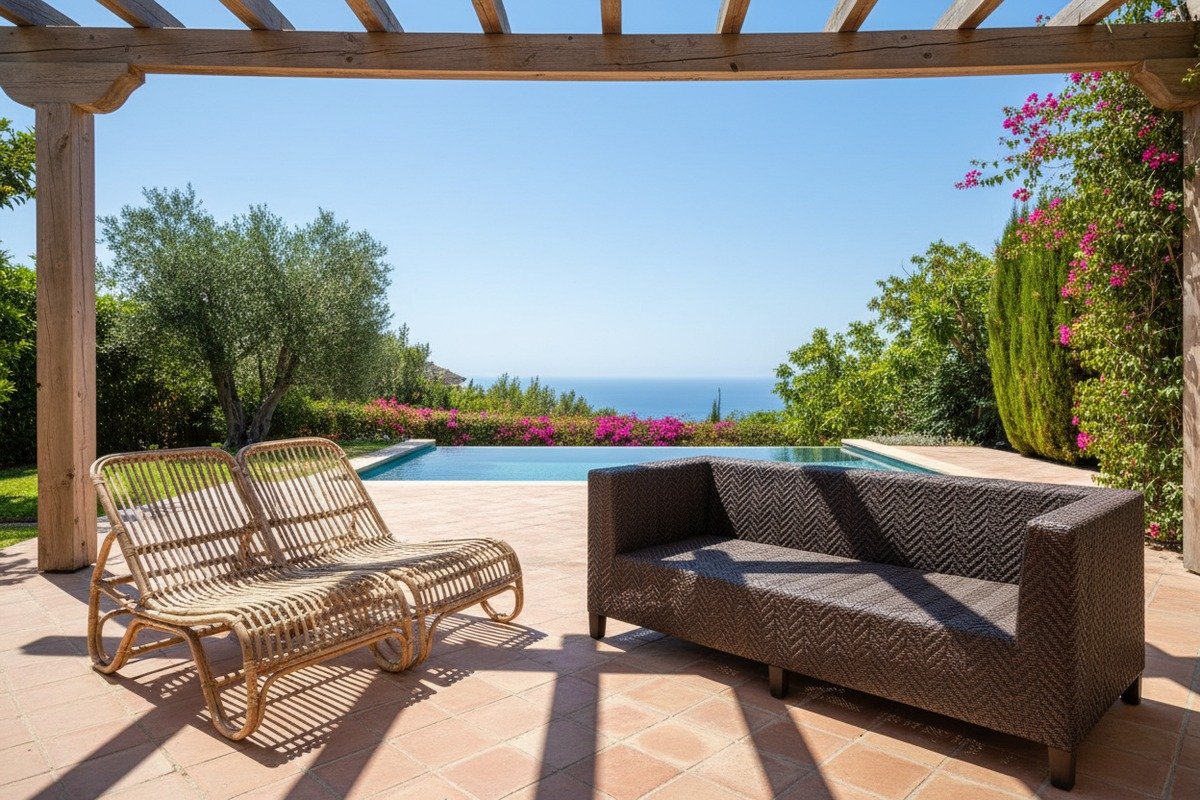
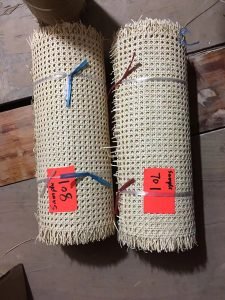
Chaque année, notre équipe de service client reçoit des dizaines d'appels de clients dont les belles cannage rotin 1 pièces sont devenues pâles et cassantes après un été sur la terrasse.
Le cannage en rotin naturel ne peut pas résister de manière fiable à une exposition prolongée au soleil direct. Les rayons UV le font décolorer, sécher, craquer et finir par se dégrader. Le cannage en rotin synthétique, conçu avec des stabilisateurs UV, offre de bien meilleures performances en extérieur et résiste aux dommages causés par le soleil pendant cinq à dix ans avec un entretien approprié.
Ci-dessous, nous détaillons exactement combien de temps le rotin naturel et synthétique dure au soleil, quels dommages attendre, comment protéger vos pièces et quel grade de rotin résiste le mieux. Que vous soyez une usine de meubles s'approvisionnant en matériaux ou un grossiste conseillant vos propres clients, ce guide vous aidera à prendre des décisions plus éclairées.
Combien de temps durera mon mobilier en cannage de rotin si je le laisse en plein soleil ?
Lorsque nous expédions des rouleaux de rotin naturel à des fabricants de meubles en Espagne ou en Australie, la première question concerne toujours la durabilité en extérieur sous un soleil d'été intense.
Le cannage en rotin naturel laissé en plein soleil montrera une décoloration et une rigidité visibles en quelques mois. Sans protection, il peut se fissurer et se casser en un à deux ans. Le cannage en rotin synthétique, en revanche, peut durer de cinq à dix ans à l'extérieur avec un minimum d'entretien.
Rotin Naturel : Une horloge tourne au soleil
Le rotin naturel est fabriqué à partir de l'écorce extérieure des palmiers grimpants 2. C'est un matériau beau et organique. Mais il n'a jamais été conçu pour être exposé aux rayons UV ardents jour après jour.
Voici ce qui se passe avec le temps. Dans les premières semaines, la surface commence à perdre son éclat. Au bout de trois mois, vous remarquerez que la couleur miel chaude s'estompe pour devenir une teinte terne et délavée. Après six mois à un an d'exposition constante au soleil, les fibres se dessèchent. Elles perdent leur souplesse. Les brins tressés deviennent rigides et commencent à casser lorsque vous appuyez dessus.
Nous l'avons constaté de visu sur des échantillons retournés de clients du Moyen-Orient et d'Australie. Des pièces qui semblaient magnifiques dans la salle d'exposition sont devenues crayeuses et fragiles après une seule saison d'été en extérieur. La tension du tissage se relâche à mesure que les fibres se contractent et se dilatent avec les variations de température quotidiennes, entraînant un affaissement irréversible.
Rotin Synthétique : Conçu pour les éléments
Le rotin synthétique, généralement fabriqué à partir de plastique PE ou de résine, est conçu pour une utilisation en extérieur. Des stabilisateurs UV 3 sont mélangés au matériau pendant la fabrication. Cela signifie que la couleur est intégrée dans toute la masse, pas seulement en surface. Il résiste à la décoloration beaucoup plus longtemps.
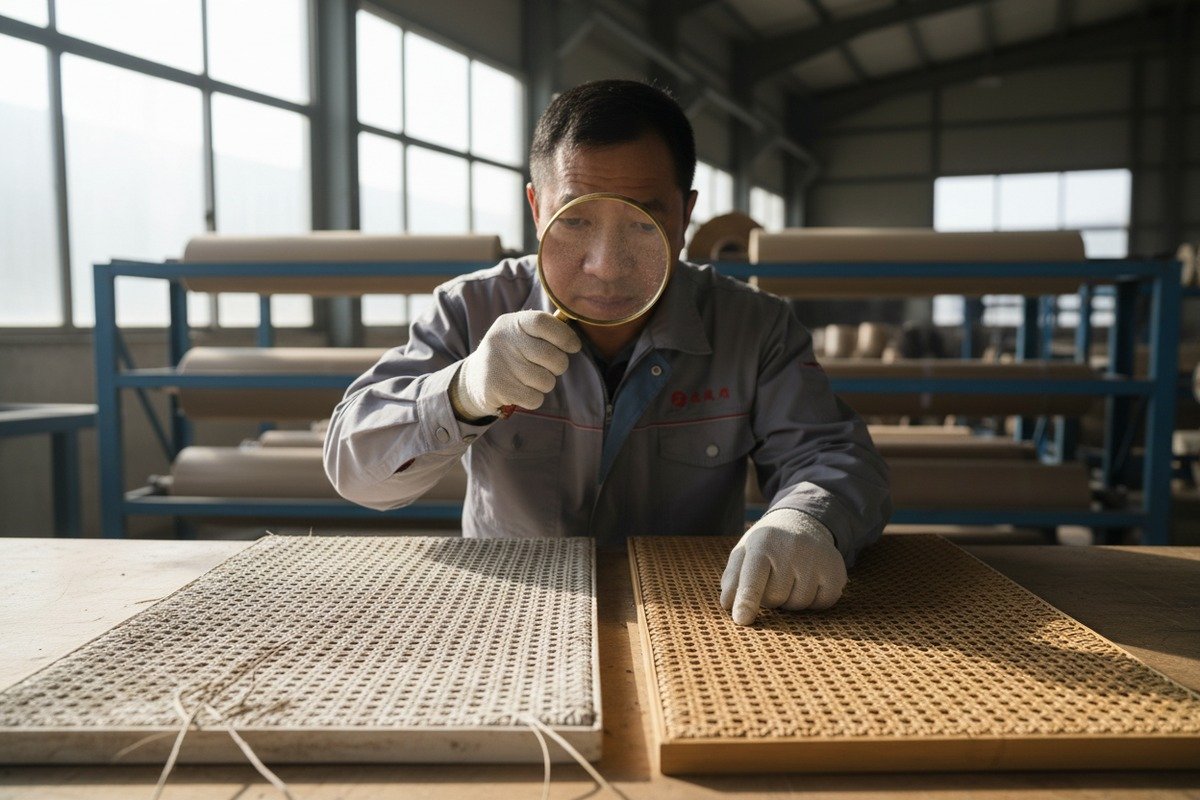
Dans notre usine de production, nous testons des panneaux de rotin synthétique sous une exposition UV accélérée 4. Les fibres synthétiques de qualité conservent leur couleur et leur souplesse pendant des années. Avec un nettoyage de base et une ombre occasionnelle, cinq à dix ans d'utilisation en extérieur sont réalistes.
Tableau comparatif de la durée de vie
| Facteur | Cannage en rotin naturel | Sangle en rotin synthétique |
|---|---|---|
| Début de la décoloration visible | 1 à 3 mois en plein soleil | 3 à 5 ans en plein soleil |
| Fragilité et craquellement | 6 à 12 mois | 5–8 ans |
| Durée de vie totale en extérieur | 1 à 2 ans (sans protection) | 5–10 ans |
| Durée de vie en intérieur | Des décennies avec soin | Des décennies avec soin |
| Fréquence d'entretien | Huilage mensuel recommandé | Nettoyage saisonnier suffisant |
Pourquoi les pièces historiques en rotin survivent des siècles
Vous avez peut-être vu des chaises anciennes en rotin dans des musées qui ont plus de cent ans. Cela semble contredire tout ce qui précède. Mais regardez de plus près. Ces pièces étaient conservées à l'intérieur. Elles étaient protégées du soleil direct et de la pluie. Dans des conditions intérieures contrôlées, le rotin naturel est remarquablement durable. L'ennemi principal n'est pas le temps. Ce sont l'exposition aux UV et les cycles d'humidité.
La réponse est donc simple. Si vos meubles en rotin tressé vivent à l'intérieur, ils peuvent durer toute une vie. S'ils sont exposés à la lumière directe du soleil, attendez-vous à un déclin rapide, à moins que vous ne choisissiez du synthétique ou que vous ne preniez des mesures de protection sérieuses.
Le soleil fera-t-il décolorer ou rendre cassant mon cannage en rotin avec le temps ?
Au cours de nos années d'exportation de cannage en rotin dans plus d'une douzaine de pays, nous avons recueilli des commentaires directs sur la façon dont les dommages causés par le soleil se déroulent dans différents climats.
Oui, la lumière directe du soleil fera pâlir visiblement le cannage en rotin naturel et le rendra de plus en plus cassant avec le temps. Les rayons UV dégradent les fibres organiques, éliminant la couleur et l'humidité. Le matériau devient rigide, se fissure sous la pression et finit par se désintégrer s'il est laissé sans protection.
Comment les rayons UV attaquent le rotin naturel
Lumière ultraviolette 5 est invisible, mais ses effets sur le rotin sont très visibles. Les rayons UV pénètrent la surface des fibres de cannage naturelles et brisent les liaisons chimiques qui maintiennent le matériau ensemble. Ce processus est appelé photodégradation 6.
Le premier signe est le changement de couleur. Le rotin naturel commence avec une teinte dorée ou miel chaude. L'exposition aux UV décolore ce pigment. Vous verrez un passage progressif à un jaune pâle, puis à un blanc grisâtre. Le cannage en rotin de couleur claire montre cette décoloration encore plus rapidement car il y a moins de pigment naturel à perdre.
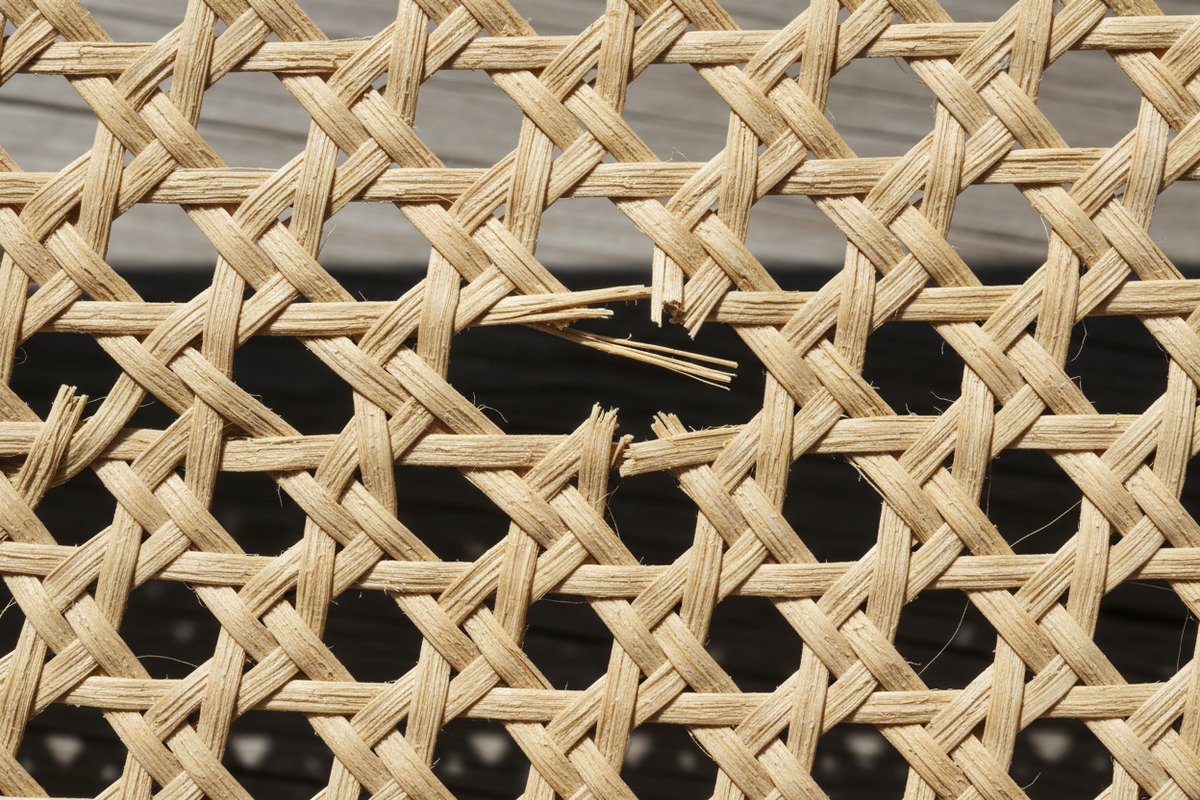
Le deuxième signe est le changement de texture. Le rotin sain est lisse et légèrement flexible. Le rotin endommagé par le soleil est rugueux et sec. Passez votre main dessus et vous pourriez sentir des échardes. Les fibres ont perdu leur humidité et leurs huiles naturelles. Elles se rétractent de manière inégale, ce qui fait que le tressage se déforme et s'affaisse.
Fragilité : le tueur silencieux
La décoloration est cosmétique. La fragilité est structurelle. Lorsque le rotin se dessèche sous l'effet du soleil et de la chaleur, il perd sa capacité à fléchir. C'est essentiel car le cannage repose sur la tension. Chaque brin doit conserver sa forme sous le poids d'une personne assise sur une chaise ou appuyée contre une porte de meuble.
Une fois la fragilité installée, les brins se cassent. D'abord un, puis plusieurs. Le tressage se défait. La réparation est possible mais coûteuse et longue. La prévention est toujours moins chère.
Le cycle de température aggrave les dommages
La lumière directe du soleil n'émet pas seulement des rayons UV. Elle crée aussi de la chaleur. Pendant la journée, le rotin se dilate en se réchauffant. La nuit, il se contracte en refroidissant. Ce cycle quotidien d'expansion et de contraction sollicite le tressage. Au fil des semaines et des mois, la tension se relâche. La toile s'affaisse et ne peut plus conserver son aspect tendu et net d'origine.
Signes de dommages causés par le soleil à chaque étape
| Stade | Période (soleil direct) | Signes visuels | Signes structurels |
|---|---|---|---|
| Précoce | 1 à 3 mois | Légère décoloration, ternissement | Aucun changement structurel visible |
| Modéré | 3 à 6 mois | Décoloration notable, ton inégal | Raideur au toucher, léger affaissement |
| Sévère | 6 à 12 mois | Décoloration grise ou blanche | Fissures, bris de brins, tressage lâche |
| Critique | 12 mois et plus | Surface crayeuse, fibres qui s'écaillent | Défaillance structurelle, dommages irréversibles |
Qu'en est-il du cannage synthétique ?
Le cannage synthétique se décolore beaucoup plus lentement car des stabilisateurs UV sont mélangés directement dans le matériau. Cependant, il n'est pas éternellement immunisé. Une chaleur extrême sur de nombreuses années peut provoquer la dégradation des plastifiants. Le matériau devient progressivement plus rigide. Les fibres synthétiques de qualité supérieure résistent beaucoup plus longtemps que les options économiques. Lorsque nous conseillons des clients qui fabriquent des lignes de meubles d'extérieur, nous recommandons toujours d'investir dans des synthétiques de meilleure qualité pour éviter les réclamations de garantie à l'avenir.
Comment puis-je protéger mes meubles en rotin des dommages causés par les UV et la chaleur ?
Notre équipe technique travaille en étroite collaboration avec des usines de meubles en Europe et au Moyen-Orient, les aidant à développer des guides d'entretien qui sont expédiés avec leurs produits finis. La protection est toujours plus facile que la réparation.
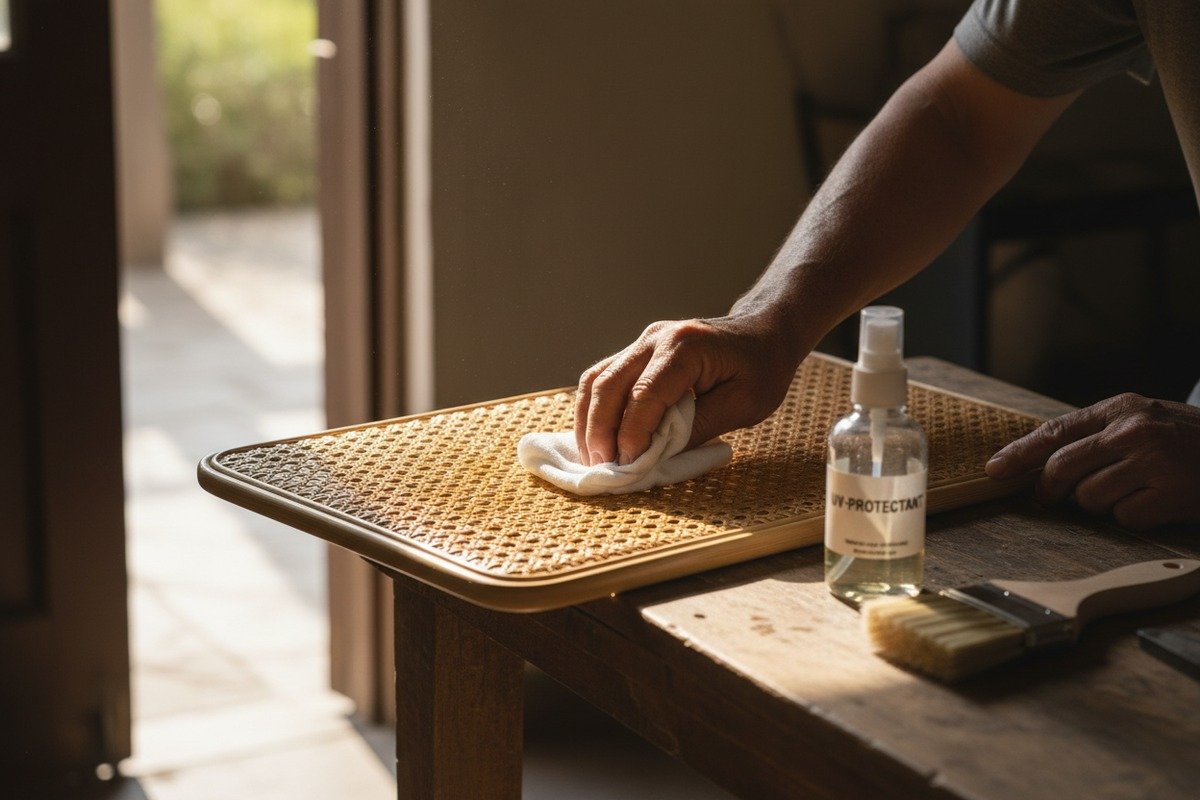
Pour protéger les meubles en rotin des dommages causés par les UV et la chaleur, gardez-les à l'ombre ou à la lumière indirecte, appliquez régulièrement un vernis protecteur UV ou des huiles naturelles comme l'huile de lin, utilisez des housses de meubles lorsqu'ils ne sont pas utilisés, et faites pivoter les pièces périodiquement pour assurer une exposition uniforme et prévenir la décoloration ou l'affaiblissement localisé.
L'ombre est votre première ligne de défense
La protection la plus efficace pour le cannage de rotin est l'ombre. Si vous pouvez positionner vos meubles sous une pergola, un auvent, un porche couvert ou un grand parasol, vous prolongerez considérablement leur durée de vie. Même une ombre partielle fait une différence significative. Déplacer un meuble du plein soleil à la lumière mouchetée peut doubler ou tripler sa durée de vie en extérieur.
Pour les pièces d'intérieur près de grandes fenêtres, envisagez un film pour fenêtre filtrant les UV ou des rideaux voilages. Les fenêtres orientées au sud et à l'ouest reçoivent le soleil le plus intense. Déplacer simplement une chaise en rotin à un mètre de la vitre peut réduire considérablement l'exposition aux UV.
Revêtements et huiles protecteurs
Pour le cannage de rotin naturel, les traitements de surface créent une barrière contre les UV et la perte d'humidité. Mastic de qualité marine 7 Voici les options les plus courantes que nous recommandons à nos acheteurs :
- Huile de lin: Un choix traditionnel. Il pénètre les fibres, restaure l'humidité et ajoute un léger éclat. Appliquer tous les deux à trois mois pour les pièces d'extérieur ou exposées au soleil.
- L'huile de tung: Similaire à l'huile de lin mais sèche plus dur. Bon pour les pièces qui sont plus manipulées.
- Vernis ou laque anti-UV: Crée une coque dure sur la surface. Offre un fort blocage des UV. Doit être réappliqué annuellement car il peut se fissurer et s'écailler avec le temps.
- Mastic de qualité marine: L'option la plus solide. Conçu pour les bateaux et l'usage extérieur. Cher mais très efficace.
Routine d'entretien pour une durée de vie maximale
Un entretien régulier évite les petits problèmes qui mènent à de grandes défaillances. Voici un calendrier simple :
| Tâche | Fréquence | Détails |
|---|---|---|
| Dépoussiérer avec un chiffon doux ou une brosse | Hebdomadaire | Élimine les débris qui retiennent l'humidité |
| Essuyer avec un chiffon humide (pas trempé) | Toutes les deux semaines | Empêche l'accumulation de saleté dans les interstices du tissage |
| Appliquer de l'huile de lin ou huile de tung 8 | Tous les 2 à 3 mois | Maintient la souplesse et l'hydratation des fibres |
| Inspecter les fissures ou les fils lâches | Mensuel | Détecter les dommages tôt avant qu'ils ne s'étendent |
| Appliquer un vernis ou un scellant anti-UV | Annuellement | Rafraîchit la barrière protectrice |
| Utilisez des housses de meubles lorsqu'ils ne sont pas utilisés | Toujours (à l'extérieur) | Bloque simultanément le soleil, la pluie et la poussière |
| Faites pivoter la position des meubles | Mensuel | Assure une exposition uniforme au soleil sur tous les côtés |
Housses de meubles et tissus anti-UV
Ne sous-estimez pas une bonne housse de meuble. Les housses modernes en tissu anti-UV peuvent protéger votre rotin tressé de quatre-vingt-dix pour cent ou plus des rayons nocifs. Recherchez des housses certifiées UPF 50+ 9. Lorsque nous fournissons des panneaux de rotin tressé à des marques de meubles d'extérieur aux Pays-Bas et en Australie, beaucoup d'entre elles regroupent des housses assorties avec le produit fini. C'est un ajout facile qui protège l'investissement.
Une note sur l'humidité
La protection solaire seule ne suffit pas si vous vivez dans un climat humide. Le rotin absorbe l'humidité de l'air. Trop d'humidité provoque des moisissures et des mildious. Trop peu provoque le dessèchement et la fissuration. L'environnement idéal est une humidité modérée, autour de quarante à soixante pour cent. Si vos meubles en rotin passent d'intérieurs climatisés à des espaces extérieurs humides, le changement constant peut stresser le matériau. Essayez de maintenir les conditions aussi stables que possible.
Dois-je choisir un type de rotin spécifique pour mieux résister au soleil ?
Lorsque des clients de Turquie ou d'Arabie saoudite demandent du cannage en rotin pour des installations de vérandas ou des cafés semi-extérieurs, notre équipe commerciale commence toujours la conversation par la qualité du matériau et l'emplacement prévu.
Oui, la qualité du cannage en rotin que vous choisissez affecte considérablement sa résistance au soleil. Le rotin naturel de qualité A est plus dense et plus uniforme, offrant une durabilité légèrement meilleure, mais aucune qualité naturelle ne résiste vraiment aux UV prolongés. Pour les applications exposées au soleil, le cannage en rotin synthétique de qualité supérieure avec des stabilisateurs UV intégrés est le choix le plus fiable.

Comprendre les grades de rotin
Tout le cannage en rotin n'est pas égal. La classification dépend de plusieurs facteurs : l'épaisseur et l'uniformité des brins de rotin, la densité du tissage, la présence de défauts tels que des nœuds ou une décoloration, et la teneur en humidité au moment du traitement.
Le rotin de qualité A provient des meilleures sections du palmier rotin. Les brins sont de largeur constante, de texture lisse et exempts de défauts. Ce matériau conserve mieux sa forme et résiste légèrement plus longtemps au craquellement que les qualités inférieures. Mais même le rotin naturel de qualité A se décolorera et se desséchera au soleil direct. L'avantage est le temps, pas l'immunité.
Le rotin de qualité B et C peut présenter des imperfections mineures. Les brins peuvent être inégaux. Le tissage peut être légèrement plus lâche. Ces qualités conviennent parfaitement à une utilisation en intérieur où l'exposition au soleil est minimale. Mais à l'extérieur, leurs points faibles cèdent en premier. Des fissures se forment aux nœuds. Les brins fins cassent avant les brins épais. Les dommages apparaissent inégaux et parsemés.
Naturel vs. Synthétique : La qualité qui compte le plus
Pour toute application impliquant une exposition régulière au soleil, le choix le plus important n'est pas la qualité du rotin naturel à acheter. C'est de savoir s'il faut utiliser un matériau naturel ou synthétique. Voici comment nous l'expliquons à nos acheteurs en gros :
| Critères | Rotin naturel de qualité A | Rotin naturel de qualité B/C | Rotin synthétique haut de gamme | Rotin synthétique économique |
|---|---|---|---|---|
| Résistance aux UV | Faible | Très faible | Élevé | Modéré |
| Chronologie de la décoloration (soleil direct) | 2–4 mois | 1–2 mois | 4–6 ans | 2–3 ans |
| Rétention de la flexibilité | Modéré | Faible | Élevé | Modéré |
| Authenticité esthétique | Excellent | Bon | Bon | Moyen |
| Coût par mètre carré | Moyen | Faible | Élevé | Moyen |
| Utilisation recommandée | Intérieur, zones ombragées | Intérieur uniquement | Extérieur, vérandas, patios | Semi-extérieur, zones couvertes |
Le motif de tissage compte aussi
Le motif de tissage affecte également la façon dont la rotin tressé se comporte au soleil. Les motifs à mailles ouvertes, tels que le tissage hexagonal classique "radio", permettent à l'air de circuler à travers le matériau. Cela aide à réduire l'accumulation de chaleur et ralentit le stress de dilatation thermique. Les motifs denses de panier carré piègent plus de chaleur à la surface, ce qui accélère le séchage.
Lorsque nous conseillons les fabricants de meubles concevant des gammes de produits d'extérieur, nous suggérons souvent des panneaux synthétiques à tissage ouvert. Ils sont élégants, respirent bien et résistent mieux à l'exposition au soleil que les alternatives à tissage serré.
Panneaux rigides et traités
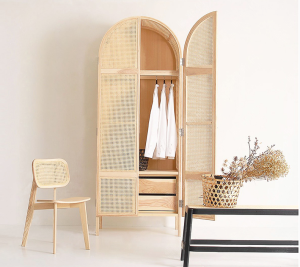
Une tendance croissante que nous observons dans nos commandes à l'exportation est celle des panneaux de rotin tressé rigides. Il s'agit de panneaux naturels ou synthétiques prétraités, infusés de résines ou d'adhésifs qui ajoutent de la rigidité et une certaine résistance aux UV. Ils sont populaires dans les projets de bricolage, les portes d'armoires et les luminaires. Bien que le traitement aide, il ne rend pas le rotin naturel résistant au soleil. Considérez cela comme un ajout de quelques mois de protection supplémentaires, pas d'années.
Pour une véritable durabilité en extérieur, nous orientons nos clients vers des sangles synthétiques avec des revêtements UV appliqués en usine. Ces produits quittent notre usine prêts pour l'exposition au soleil sans aucun traitement supplémentaire par l'utilisateur final.
Conseil d'approvisionnement pour les acheteurs
Si vous êtes un grossiste de matériaux pour meubles ou un responsable des achats, demandez toujours à votre fournisseur des données de test UV. Les fabricants réputés, y compris notre propre usine, peuvent fournir des résultats de tests de vieillissement accéléré. Ces tests simulent des années d'exposition au soleil dans des conditions contrôlées. Ils vous donnent une image réaliste de la façon dont le matériau se comportera. Ne vous fiez pas uniquement à l'apparence. Un beau rouleau de rotin naturel peut sembler identique à un rouleau traité aux UV jusqu'à ce que les deux soient placés au soleil.
Conclusion
Le choix entre le rotin naturel et le rotin synthétique dépend de l'endroit où se trouveront vos meubles. Gardez le rotin naturel à l'intérieur ou à l'ombre, investissez dans le synthétique pour les espaces exposés au soleil, et entretenez l'un ou l'autre avec des soins réguliers.
Notes de bas de page
1. Explique ce qu'est le cannage en rotin et son origine. ↩︎
2. Donne un aperçu général des palmiers grimpants. ↩︎
3. Décrit comment les stabilisateurs UV protègent les plastiques des dommages causés par le soleil. ↩︎
4. Explique la norme pour simuler l'exposition aux UV en laboratoire. ↩︎
5. Remplacé par un lien Wikipédia pour une explication complète de la lumière ultraviolette. ↩︎
6. Remplacé par un lien Wikipédia pour une définition faisant autorité de la photodégradation. ↩︎
7. Explique les propriétés et les applications des scellants de qualité marine. ↩︎
8. Compare l'huile de tung à l'huile de lin et son aptitude pour le bois. ↩︎
9. Définit la classification UPF 50+ et son importance pour la protection UV des tissus. ↩︎
10. Décrit les propriétés et les utilisations de l'huile de lin pour la finition du bois. ↩︎
 English
  Español de México
  العربية
  Deutsch
  Français
  Русский