

Every week, our customer service team fields questions from buyers who struggle to match weight data on invoices with actual roll dimensions they need for production planning.
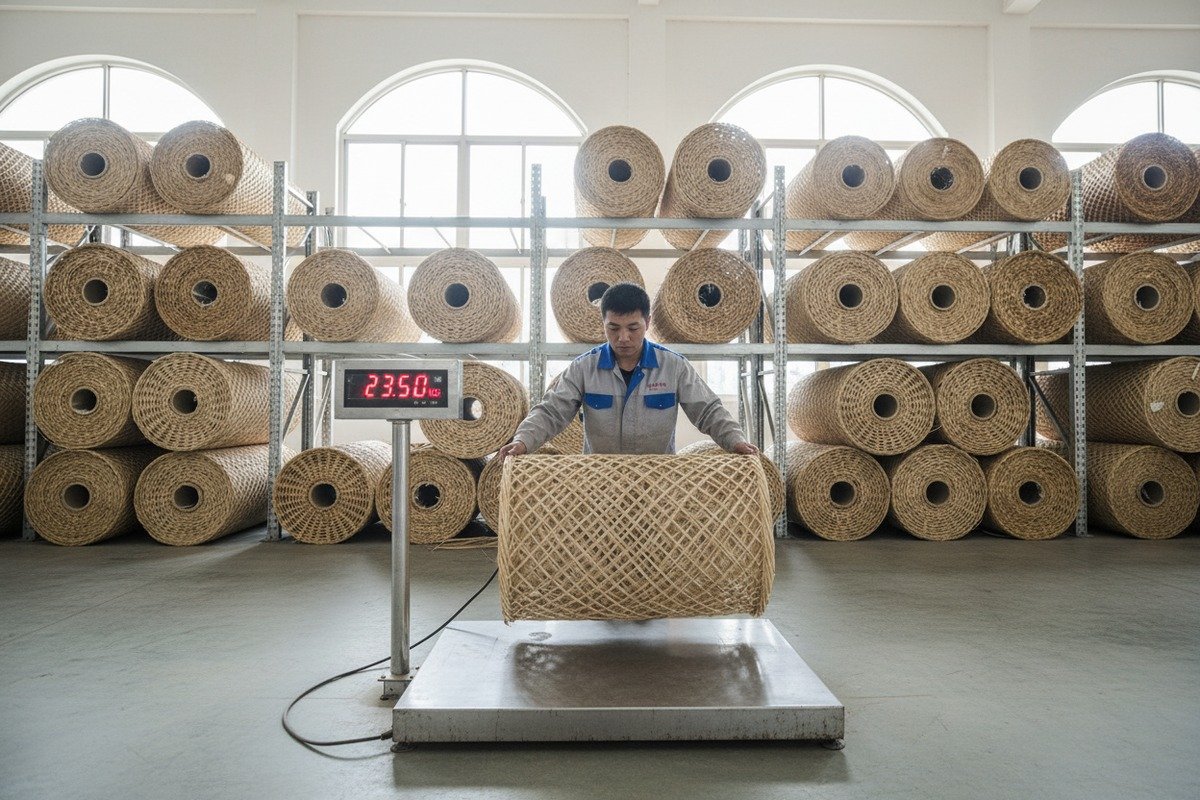
To convert weight specifications for natural rattan cane webbing, you need to know the webbing’s weight per square meter (GSM), then multiply by the total area of your roll (width × length). Different weave patterns, strand thicknesses, and moisture levels all change this base density figure, so always request GSM data from your supplier.
This guide breaks down the exact steps, formulas, and pitfalls involved in converting rattan cane webbing weight specs. Whether you are estimating shipping costs, verifying supplier claims, or planning inventory, the sections below give you the tools to work with confidence.
How do I convert the weight of my rattan webbing rolls into square meters?
When we pack orders in our Foshan warehouse, buyers often receive a total weight figure but need to know how many square meters of webbing that represents for their furniture projects.
To convert roll weight into square meters, divide the total weight of the roll by the webbing's weight per square meter (GSM). For example, if a roll weighs 3 kg and the GSM is 600 g/m², you have 5 square meters. Always confirm the GSM value with your specific supplier and weave pattern.
Understanding GSM: The Key Metric
GSM stands for grams per square meter. It is the single most important number for converting between weight and area. weight per square meter (GSM) 1 Think of it as the density of your webbing laid flat.
Every weave pattern has a different GSM. An open hexagonal weave uses less material per square meter than a tight close weave. So the same weight of webbing can cover very different areas depending on the pattern you ordered.
Here is a simple formula:
Area (m²) = Total Weight (g) ÷ GSM (g/m²)
Let's say you received a shipment of 15 kg of open weave rattan webbing. Your supplier told you the GSM is 500 g/m². The calculation looks like this:
15,000 g ÷ 500 g/m² = 30 m²
You have 30 square meters of usable webbing.
Processus de conversion étape par étape
- Get the GSM from your supplier. Do not guess. Ask for the tested GSM value for the exact weave pattern and strand width you ordered.
- Weigh the roll. Use a calibrated scale. Remove any packaging or cardboard cores before weighing.
- Divide. Use the formula above.
- Account for moisture. If the rattan was stored in a humid environment, it may weigh 5–10% more than its dry weight. Adjust accordingly.
Common GSM Ranges by Weave Type
| Motif de tissage | Typical GSM Range (g/m²) | Coverage per 1 kg |
|---|---|---|
| Hexagonal ouvert | 400 – 550 | 1.8 – 2.5 m² |
| Grille carrée ouverte | 450 – 600 | 1.7 – 2.2 m² |
| Close Weave (Chevron) | 650 – 850 | 1.2 – 1.5 m² |
| Motif diamant dense | 700 – 900 | 1.1 – 1.4 m² |
| Tissage serré en panier | 750 – 950 | 1.1 – 1.3 m² |
These numbers come from measurements across different production runs at our facilities. Natural material variation means your specific batch may differ by ±10%. Always measure a sample piece if precision matters for your project.
Un exemple concret
One of our Australian buyers ordered 50 rolls of open hexagonal rattan cane webbing. Each roll measured 60 cm wide by 15 meters long. The total shipment weighed 420 kg.
Using the roll dimensions: 0.6 m × 15 m = 9 m² per roll. Fifty rolls = 450 m².
Using the weight: 420,000 g ÷ 480 GSM = 875 m². That number seemed too high. The discrepancy came from the buyer including the weight of cardboard cores and plastic wrapping. After subtracting 204 kg of packaging weight, the net rattan weight was 216 kg, giving 216,000 ÷ 480 = 450 m². The numbers matched.
Always weigh net product, not gross shipment weight.
Why does the weight of my natural rattan webbing change based on the material grade?
Our quality control team sorts rattan raw materials 4 into different grades before weaving begins, and this grading directly impacts the final weight of your webbing rolls.
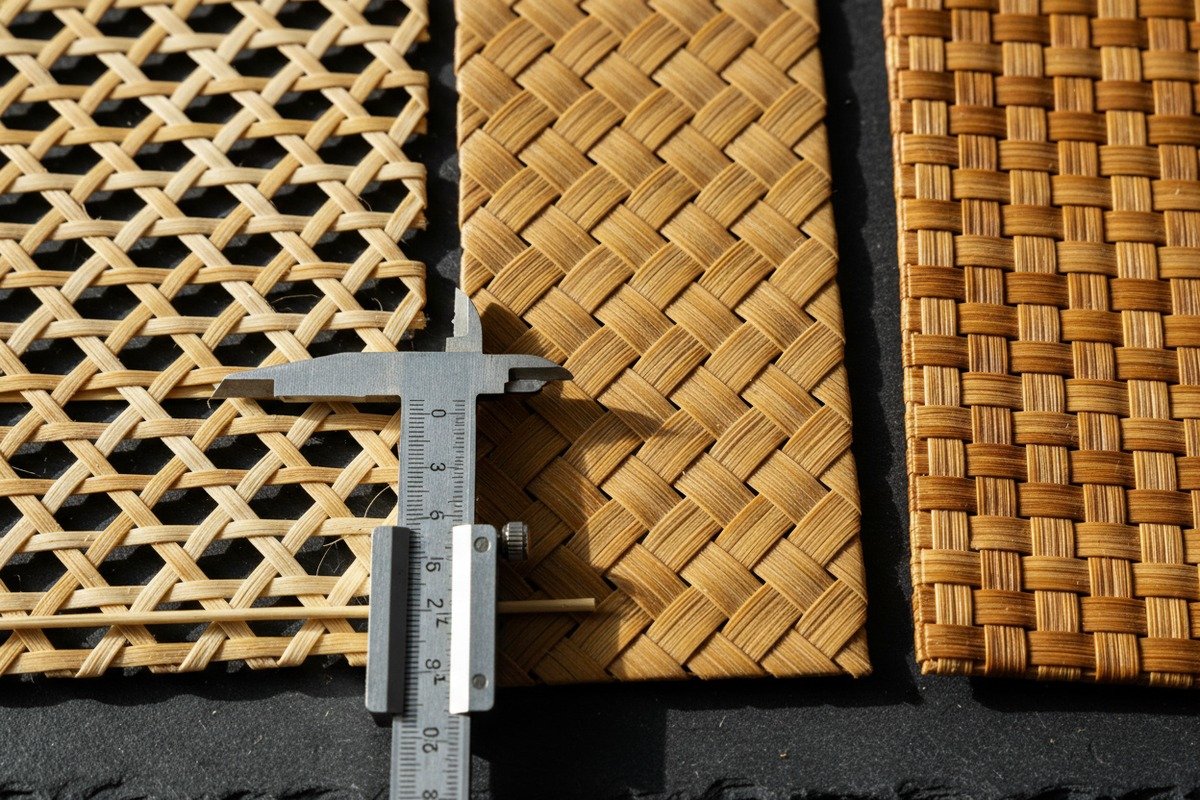
Higher-grade natural rattan uses thicker, denser cortex strips with uniform width, resulting in heavier webbing per square meter. Lower grades use thinner or mixed-source strips that weigh less. A Grade A close weave can be 15–20% heavier than a Grade C equivalent of the same dimensions due to material density differences.
What Determines Rattan Grade?
Rattan grading is not standardized globally. Different suppliers use different systems. However, most grading evaluates three main factors:
- Uniformité des brins. Are all strips the same width and thickness?
- Surface quality. Are there cracks, discoloration, or knots?
- Source position. Strips from the outer cortex of the rattan vine are denser than inner core strips.
At our processing facility in Indonesia, we sort raw rattan before it goes to the weaving floor. The outer cortex strips are naturally harder and heavier. They produce webbing that feels stiffer and weighs more. Inner core strips are softer, lighter, and more flexible.
How Grade Affects Weight
When you order Grade A rattan cane webbing, you get strips that are consistently thick. This means more material per weave intersection, and more material means more weight.
Grade B might mix some thinner strips with standard ones. Grade C could include strips from the inner core or younger vines that have lower density.
| Note | Typical Strand Thickness | Relative Weight (vs. Grade A) | Qualité de surface |
|---|---|---|---|
| Qualité A | 0.8 – 1.0 mm | 100% (de référence) | Smooth, uniform color |
| Qualité B | 0.6 – 0.9 mm | 85 – 92% | Variation mineure de couleur |
| Note C | 0.4 – 0.7 mm | 70 – 82% | Visible knots, mixed color |
Rattan Species and Density
Not all rattan comes from the same species. There are over 600 species of rattan worldwide, and the ones commonly used for cane webbing include Calamus caesius, Calamus trachycoleus, and Calamus manan 5. Each has a different natural density.
Calamus manan, for example, produces thicker canes with denser fibers. Webbing made from this species will weigh more than webbing from a lighter species like Calamus caesius. When your supplier switches species without telling you, the weight changes even if the weave pattern stays the same.
Moisture Content and Grade Interaction
Higher-grade rattan tends to have more consistent la teneur en humidité 6 because it goes through better drying and treatment processes. Lower-grade rattan may have uneven moisture distribution, which creates unpredictable weight fluctuations.
In our experience shipping to the Netherlands and Spain, European buyers notice weight differences between summer and winter shipments. This is partly because ambient humidity in our Indonesian facility changes with the season. We now kiln-dry all Grade A material to a target moisture content of 10–12% to minimize this variation.
A practical tip: if your supplier quotes weight specs, ask what moisture content those specs assume. A 2% difference in moisture content can mean a 1.5–2% difference in total roll weight. For a 500 kg shipment, that is 7.5 to 10 kg — enough to affect your cost calculations.
How can I use weight specifications to calculate my total shipping and import costs?
When we prepare export documentation for buyers in the USA, Turkey, or Australia, we always include detailed weight breakdowns because shipping costs, customs duties, and freight charges all depend on accurate weight data.
To calculate total shipping and import costs, multiply your net rattan webbing weight by the freight rate per kilogram, then add packaging weight for gross shipping weight. For customs duties, use the net weight combined with your CIF value. Factor in a 5–10% weight buffer for moisture absorption during ocean transit.
Breaking Down the Cost Components
Shipping costs for rattan cane webbing depend on two weight figures: gross weight and poids volumétrique 7. Freight carriers charge based on whichever is higher. This is called the chargeable weight.
Rattan webbing is relatively light for its volume. A pallet of rattan rolls takes up a lot of space but does not weigh as much as a pallet of, say, ceramic tiles. This means your volumetric weight is often higher than your actual weight, and that is the number the carrier will use.
How to Calculate Volumetric Weight
For ocean freight (LCL), volumetric weight is usually calculated as:
Volumetric Weight (kg) = Length (cm) × Width (cm) × Height (cm) ÷ 5,000
For air freight, the divisor is typically 6,000.
Let's say you have a pallet of rattan webbing that measures 120 cm × 100 cm × 150 cm and actually weighs 180 kg.
Volumetric weight: 120 × 100 × 150 ÷ 5,000 = 360 kg.
The carrier charges you for 360 kg, not 180 kg. This is why packing efficiency matters enormously for rattan products.
Practical Cost Estimation Table
| Composant du coût | How Weight Applies | Example Calculation |
|---|---|---|
| Ocean Freight (LCL) | Chargeable weight × rate/kg | 360 kg × $0.45/kg = $162 |
| Customs Duty | CIF value 8 × duty rate (varies by country) | $2,000 CIF × 3% = $60 |
| Assurance | Based on CIF value, not weight | $2,000 × 0.3% = $6 |
| Local Delivery | Gross weight or pallet count | 1 pallet × $80 = $80 |
| Moisture Buffer (5–10%) | Add to net weight for planning | 180 kg × 1.08 = 194.4 kg |
Why Moisture Matters for Shipping
Rattan is hygroscopic. It absorbs moisture from the air. During a 25-day ocean shipment from Foshan to Los Angeles, the humidity inside a container can fluctuate significantly. We have measured weight increases of 6–8% on rattan shipments arriving during humid summer months.
This matters for two reasons. First, if you are paying by weight, you pay more. Second, if your purchase order specifies a net weight and the arrival weight is higher, you need to understand why before disputing the invoice.
Our recommendation is simple: agree on a standard moisture content with your supplier. We typically specify 10–12% moisture content at the time of packing. If the buyer's receiving warehouse measures a higher moisture content, both parties understand the weight difference is due to transit conditions, not short-shipping.
HS Code and Weight-Based Duties
For rattan cane webbing, the code SH 9 is typically 4601.22 or 4601.29, depending on the country. Some customs authorities calculate duties based on weight, while others use CIF value. In the USA, rattan webbing imports under HTS 4601.22.4000 carry specific duty rates. Knowing your accurate net weight helps you avoid overpaying duties or triggering audits from underdeclaring.
Always separate rattan net weight from packaging weight on your commercial invoice. Mixed figures create confusion at customs and can delay your shipment.
What is the best way to verify if my supplier's weight specifications are accurate?
Over the years, we have seen buyers accept weight specs at face value and then discover discrepancies when the goods arrive — sometimes losing money, sometimes gaining distrust in a perfectly honest supplier because they did not understand natural material variation.
The best way to verify supplier weight specifications is to request a sample piece of known dimensions, weigh it yourself on a calibrated scale, calculate the GSM, and compare it against the supplier's stated figure. Allow a ±10% tolerance for natural rattan variation and always test at a controlled moisture level.

The Sample Testing Method
Before placing a large order, ask your supplier to send a sample piece — ideally 30 cm × 30 cm or larger. When it arrives:
- Let the sample acclimatize in your environment for 48 hours.
- Weigh it on a digital scale accurate to 0.1 grams.
- Measure the exact length and width in centimeters.
- Calculate GSM: Weight (g) ÷ (Length in m × Width in m).
Compare your calculated GSM with the supplier's stated GSM. If the difference is within 10%, the specs are reliable. If it exceeds 15%, ask questions.
Why ±10% Tolerance Is Normal
Natural rattan is not an engineered material. Every vine is slightly different. The strips cut from one section of a vine may be marginally thicker or thinner than strips from another section. Hand-weaving adds another layer of variation — one artisan may pull the weave tighter than another.
In our production facility, we test GSM on random samples from each batch. Here is what our quality control data typically shows:
| Batch Sample | Stated GSM | Measured GSM | Deviation |
|---|---|---|---|
| Batch A – Sample 1 | 520 | 508 | -2.3% |
| Batch A – Sample 2 | 520 | 537 | +3.3% |
| Batch A – Sample 3 | 520 | 515 | -1.0% |
| Batch B – Sample 1 | 520 | 548 | +5.4% |
| Batch B – Sample 2 | 520 | 496 | -4.6% |
All of these are within normal range. If a sample showed 620 GSM against a stated 520, that would indicate a problem — possibly the wrong weave pattern, the wrong material grade, or significantly elevated moisture content.
Using a Moisture Meter
A wood moisture meter can be used on rattan. Press the pins into the webbing and take a reading. Standard dry rattan should read between 8–14% moisture content. If your sample reads 18% or higher, the weight is inflated by excess moisture.
Dry the sample in an oven at 60°C for 24 hours, then reweigh. The difference tells you exactly how much moisture weight is present. Subtract that from the total to get the true dry weight, and recalculate your GSM.
Drapeaux rouges à surveiller
- Supplier refuses to provide GSM data. This may mean they have not tested it, or the specs are inconsistent.
- Weight specs seem too precise. If a supplier claims their rattan webbing weighs exactly 500.0 g/m² with no tolerance, be skeptical. Natural materials always have a range.
- Large batch-to-batch variation. If GSM swings by more than 15% between orders, the supplier may be sourcing from inconsistent raw material sources.
- No mention of moisture content. Professional suppliers specify the moisture content at which their weight specs were measured. If this detail is missing, the numbers are incomplete.
Inspection par un tiers
For large orders — especially first-time purchases from a new supplier — consider hiring a une inspection par un tiers 10 company. SGS, Bureau Veritas, and TÜV all offer pre-shipment inspection services in China and Southeast Asia. They can weigh random samples, measure dimensions, and verify that the specs on the commercial invoice match the physical product.
The cost is typically $200–$400 per inspection. For a $10,000+ order, that is cheap insurance. We welcome third-party inspections at our facilities because they build trust and reduce disputes down the line.
Conclusion
Converting weight specifications for natural rattan cane webbing comes down to knowing your GSM, understanding grade and moisture variables, and verifying data with simple sample tests before committing to large orders.
Notes de bas de page
1. Explains the definition and importance of grams per square meter (GSM) as a measurement. ↩︎
2. Details various rattan weave types and their functional and aesthetic purposes. ↩︎
3. Defines natural rattan cane webbing and its characteristics. ↩︎
4. Discusses the sourcing and sustainable aspects of rattan as a raw material. ↩︎
5. Provides information on Calamus manan, a specific rattan species. ↩︎
6. Explains how moisture content affects wood and hygroscopic materials like rattan. ↩︎
7. Defines volumetric weight and its calculation for freight shipping. ↩︎
8. Clarifies the meaning and responsibilities of the CIF Incoterm in international trade. ↩︎
9. This link from the International Trade Administration (.gov) offers an authoritative explanation of Harmonized System (HS) codes, their purpose, and international use in import/export. ↩︎
10. Explains the role and benefits of third-party inspection services in supply chain quality control. ↩︎

 English
  Español de México
  العربية
  Deutsch
  Français
  Русский