
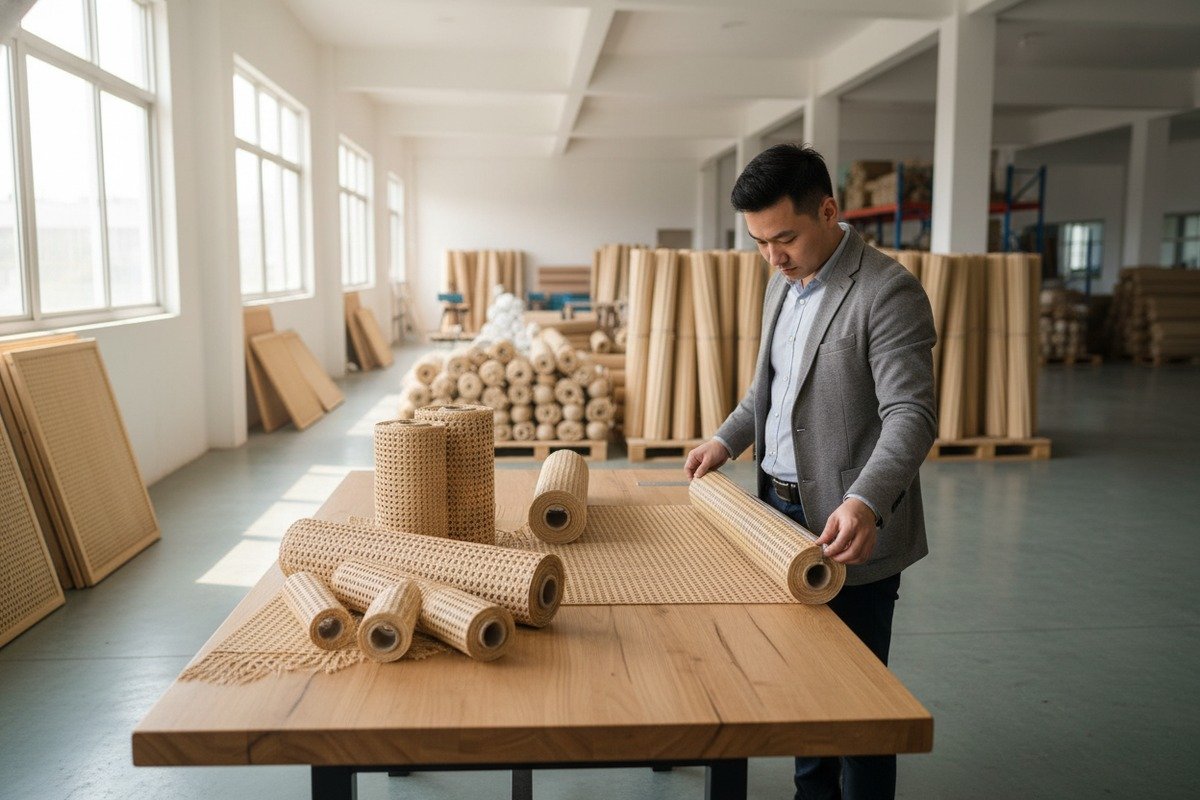
Every week, our sales team fields the same question from furniture factory buyers around the world—”What is the standard roll length for your rattan cane webbing?”
There is no single universal standard length for natural rattan cane webbing rolls. Common roll lengths range from 5 feet to 50 feet (approximately 1.5 to 15 meters), depending on the supplier, weave pattern, and intended application. Most professional-grade rolls ship in 10-meter or 15-meter lengths, while retail rolls often come in shorter 4-to-6-foot cuts.
The answer is not as simple as one number. Roll length depends on your project size, your budget, and how your supplier sources and processes the rattan Asie du Sud-Est 1. Below, we break down the key factors that determine roll length, how to choose the right option for your factory or workshop, and what to watch for when ordering in bulk.
What are the standard length options I can choose for my rattan webbing rolls?
Buyers who walk into this market for the first time often assume there is one fixed roll size, just like plywood or fabric bolts. That assumption leads to over-ordering, wasted material, and budget overruns.
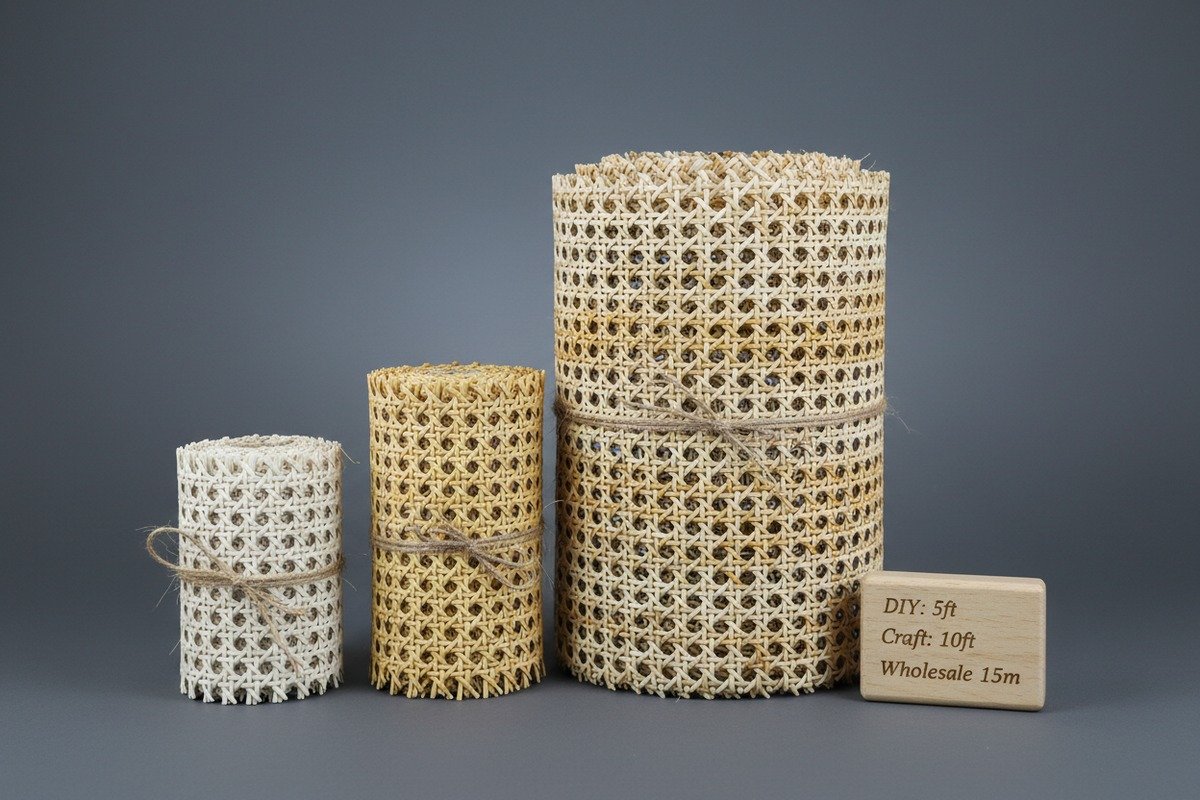
Natural rattan cane webbing is commonly available in roll lengths of 5 feet, 10 feet, 15 meters, and up to 50 feet. Retail suppliers typically offer shorter rolls from 4 to 10 feet, while wholesale and factory-grade suppliers provide longer rolls of 10 to 15 meters for production-scale projects.
Why There Is No Single "Standard" Length
Natural rattan comes from palmier rotin 2, a climbing plant harvested primarily in Southeast Asia. The raw material itself varies in length. Unlike synthetic alternatives that can be extruded to any length, natural rattan strands have natural limits. This biological reality shapes the roll lengths suppliers can offer.
At our rattan processing facility in Indonesia, we work directly with harvested rattan cane. The usable strand length after cleaning, splitting, and grading determines how long a continuous weave can run. Premium weaves like Fin 1/2" octogonal 3 require longer, defect-free strands. Simpler open square grid patterns are more forgiving and can be produced in longer continuous rolls.
Common Roll Length Options by Market Segment
| Market Segment | Longueur typique du rouleau | Plage de largeur typique | Utilisation principale |
|---|---|---|---|
| DIY / Retail | 4–6 feet (48–72 inches) | 15.5"–24" | Chair seat repair, small crafts |
| Professional Restoration | 10 feet (120 inches) | 18"–30" | Furniture restoration, cabinet panels |
| Wholesale / Factory | 10–15 meters (32–50 feet) | 24"–39.5" | Production runs, large furniture |
| Custom / Bulk Orders | Up to 50 feet (600 inches) | 12"–39.5" | Bespoke projects, architectural panels |
Width Matters Too
Roll length never exists in isolation. Width is the other half of the equation. The most popular widths across our export markets—Netherlands, USA, Australia, and the Middle East—are 18 inches, 24 inches, and 36 inches. Wider rolls cost more per linear foot because they require more material and more complex loom setups.
Pour fabricants de meubles 4 running production lines, we generally recommend 15-meter rolls in 24-inch width. This length covers most chair caning and cabinet panel jobs without excessive offcuts. For wholesalers who resell to smaller shops, 10-foot rolls in 18-inch or 24-inch width offer a good balance between manageable inventory and competitive retail pricing.
Weave Pattern Affects Available Lengths
Not all weave patterns come in the same length options. Here is a quick reference:
| Motif de tissage | Max Practical Roll Length | Notes |
|---|---|---|
| Fin 1/2" Octogonal | 10–15 mètres | Requires high-grade, long strands |
| Grille carrée ouverte | Up to 15 meters | More forgiving on strand length |
| Motif diamant | 8–12 meters | Tight weave limits continuous run |
| Radio Weave | 10–15 mètres | Classic pattern, widely available |
| Tissage dense | 5–10 meters | Heavy material, shorter rolls preferred for handling |
Retail platforms like Etsy now list custom-cut lengths in 6-inch increments, from 6 feet up to 49 feet. This is great for hobbyists, but for factory buyers, ordering from a dedicated wholesale supplier gives you better consistency, pricing, and quality control.
Can I customize the roll length to reduce material waste in my furniture factory?
One of the biggest headaches we hear from purchasing managers is le gaspillage de matière 6. A factory cutting 200 chair seats per day cannot afford to throw away 15% of every roll because the length does not match the production layout.
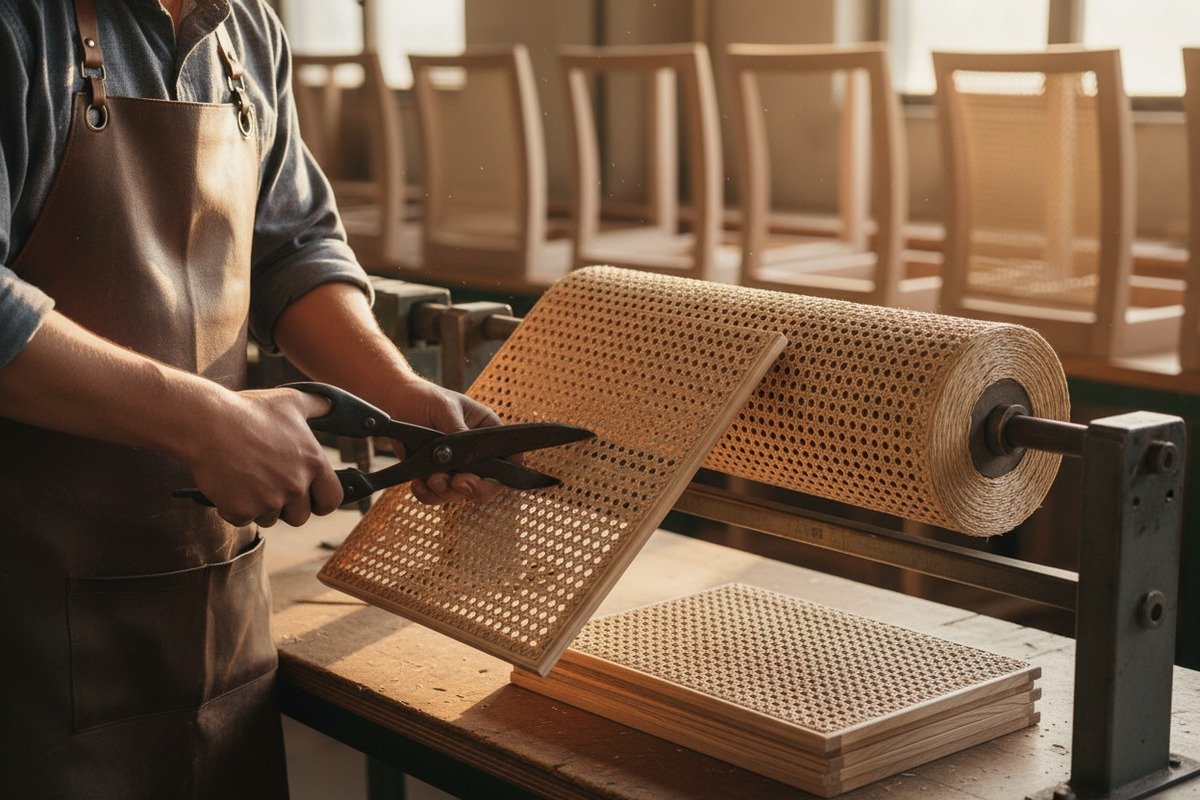
Yes, most established rattan webbing suppliers offer custom roll lengths tailored to your production needs. By specifying the exact length per roll based on your cutting layout, you can reduce material waste by 10–20%, lower per-unit costs, and streamline your factory workflow.
How Custom Lengths Work in Practice
When a furniture factory contacts us, our first step is to understand their cutting pattern. For example, if a buyer needs 18" × 20" pieces for chair seats with a 2-inch overhang on each side (so 22" × 24" actual cuts), we calculate how many pieces fit across the roll width and along the roll length. Then we recommend a roll length that yields whole-number cuts with minimal leftover material.
This is not a new concept in textiles. Fabric mills have done it for decades. But in the rattan industry, many smaller suppliers still only offer fixed lengths. Working with a manufacturer who controls the weaving process—like we do at our Indonesian facility—gives you the flexibility to specify exactly what you need.
The Math Behind Waste Reduction
Let us say you order a standard 15-meter roll in 24-inch width. Your cutting template is 22" × 24". You get one piece across the width. Along the 15-meter (590-inch) length, you get 26 pieces with about 18 inches of waste. That is roughly 3% waste—acceptable.
But if your template is 22" × 20", you get 29 pieces with about 10 inches of waste. Change the roll length to 14.8 meters (582.6 inches), and you get 29 pieces with under 3 inches of waste. That small adjustment saves material on every single roll across thousands of rolls per year.
Quantités minimales de commande pour les longueurs personnalisées
Custom lengths usually come with minimum order requirements. Here is what to expect:
| Type de fournisseur | Minimum Order for Custom Length | Délai de livraison | Price Impact |
|---|---|---|---|
| Wholesale Manufacturer (e.g., Seafan Rattan) | 50–100 rouleaux | 15–25 jours | Neutral to slight premium |
| Specialty Retailer (e.g., HH Perkins) | Not typically available | N/A | Fixed pricing |
| Online Marketplace (e.g., Etsy) | 1 roll (custom cut from stock) | 3–7 jours | 10–20% premium |
For factory-scale buyers ordering hundreds of rolls, the cost difference between a standard roll and a custom-length roll is often negligible. The savings from reduced waste far outweigh any per-roll premium. We have seen clients in Turkey and the Netherlands cut their annual rattan spend by 8–12% simply by switching from fixed 15-meter rolls to optimized custom lengths.
A Word of Caution on Custom Orders
Custom lengths are powerful, but they require clear communication. Specify the length in both meters and inches. Confirm the measurement method—some suppliers measure from the leading edge of the webbing, while others include the initial wrapped portion. Always request a sample roll first. One of our clients in Saudi Arabia once received 200 rolls that were each 6 inches short because the factory measured differently. That kind of error is preventable with a simple pre-production sample.
How does the roll length influence my shipping costs and the durability of the packaging?
Shipping costs 7 can make or break a deal in international trade. We have seen buyers choose a cheaper supplier only to discover that the shipping cost per roll erased the savings—because the rolls were too long for standard cartons and required special handling.
Roll length directly affects shipping costs through its impact on package dimensions, weight, and freight classification. Longer rolls (over 10 meters) often require reinforced cardboard tubes or wooden crates, adding 15–25% to packaging costs. Shorter rolls fit standard cartons, reducing both freight charges and damage risk during transit.
The Relationship Between Roll Length and Package Size
Rattan cane webbing is rolled around a cardboard or plastic core tube. The length of the roll determines the diameter of that cylinder. A 5-meter roll in 24-inch width has a relatively small diameter—easy to box, easy to stack on a pallet. A 15-meter roll of the same width has a much larger diameter and is heavier. It needs a sturdier tube, thicker outer wrapping, and more careful palletizing.
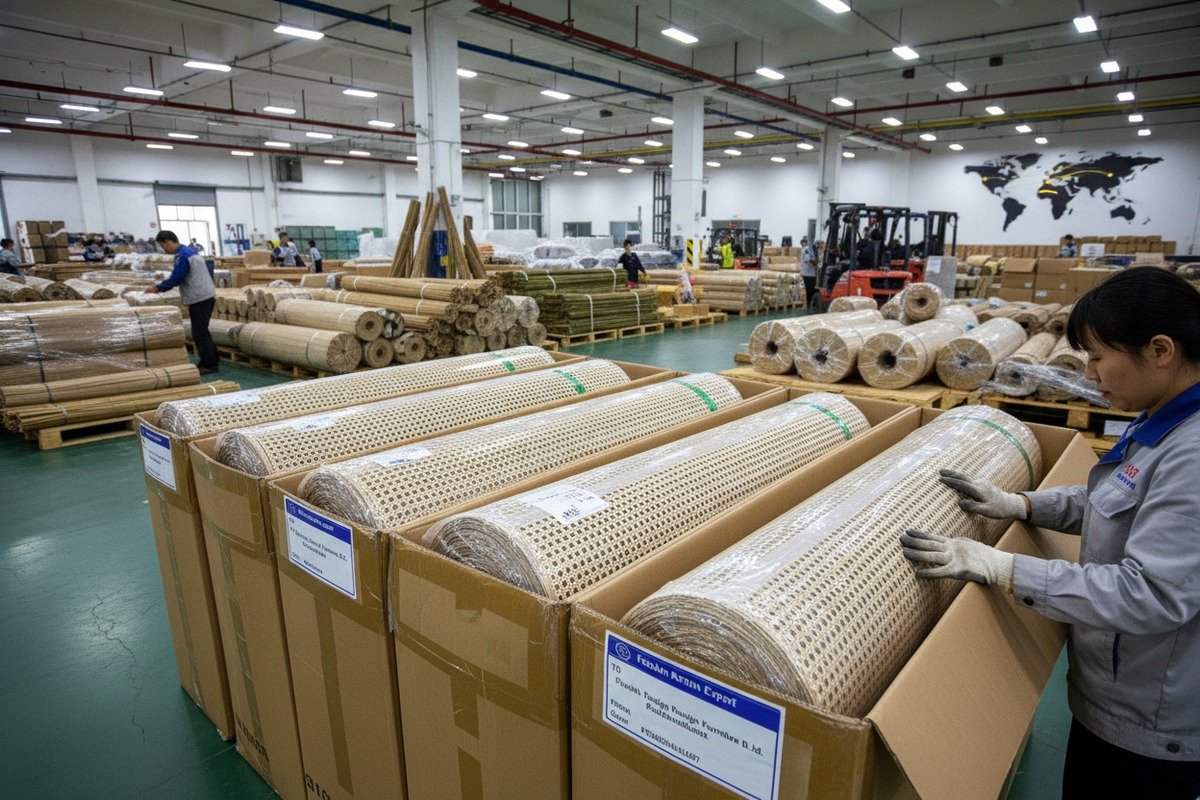
In our experience shipping to over a dozen countries, the sweet spot for ocean freight is the 10-meter roll. It fits well inside standard export cartons, stacks efficiently on pallets, and keeps the gross weight per carton under common carrier limits.
Packaging Options by Roll Length
Different roll lengths demand different packaging strategies. Here is what we typically recommend to our clients:
| Longueur du rouleau | Recommended Packaging | Approximate Package Weight (24" width) | Shipping Notes |
|---|---|---|---|
| 4–6 feet | Poly wrap + standard carton | 1,5–3 kg | Ships as small parcel; air freight viable |
| 10 feet | Poly wrap + reinforced carton | 3–5 kg | Standard carton, palletizable |
| 10 meters | Cardboard tube + carton + stretch wrap | 6–10 kg | Ideal for ocean freight |
| 15 mètres | Reinforced tube + wooden crate or pallet wrap | 10–15 kg | May require special handling |
| 50 feet | Wooden crate or custom pallet | 15–25 kg | Oversized freight charges may apply |
Damage Risk Increases with Length
Longer rolls are more vulnerable to damage. The two main risks are creasing and moisture damage. A crease in rattan webbing is permanent—it breaks the fibers and ruins the panel. Longer rolls have more surface area exposed to bending forces during handling. If a forklift operator tilts a pallet even slightly, a 15-meter roll can develop a crease that renders several feet of material unusable.
Moisture is the other enemy. Natural rattan absorbs humidity. During ocean transit—especially on routes through tropical zones—container humidity can spike. Longer rolls stored in non-ventilated packaging can develop mold spots deep inside the roll where air does not circulate. We combat this by adding silica gel packets inside every roll and wrapping with moisture-barrier poly film.
Cost Comparison: Short Rolls vs. Long Rolls
Counterintuitively, ordering many short rolls can sometimes be cheaper to ship than fewer long rolls. Ten rolls of 5 meters each weigh roughly the same as three-and-a-half rolls of 15 meters, but the shorter rolls pack into standard cartons that stack tightly on a pallet. The long rolls leave dead space and may require custom crating.
For our clients in the USA and Australia, where last-mile delivery costs are high, we often recommend 10-meter rolls as the best compromise. They are long enough for production efficiency but compact enough for economical freight.
How do you ensure the rattan quality stays consistent across the entire length of my roll?
Quality inconsistency is the silent killer of buyer confidence. A roll that starts with tight, uniform weaving but ends with loose strands and color variation is worse than a consistently mediocre product—because it creates unpredictable rejects on the production line.
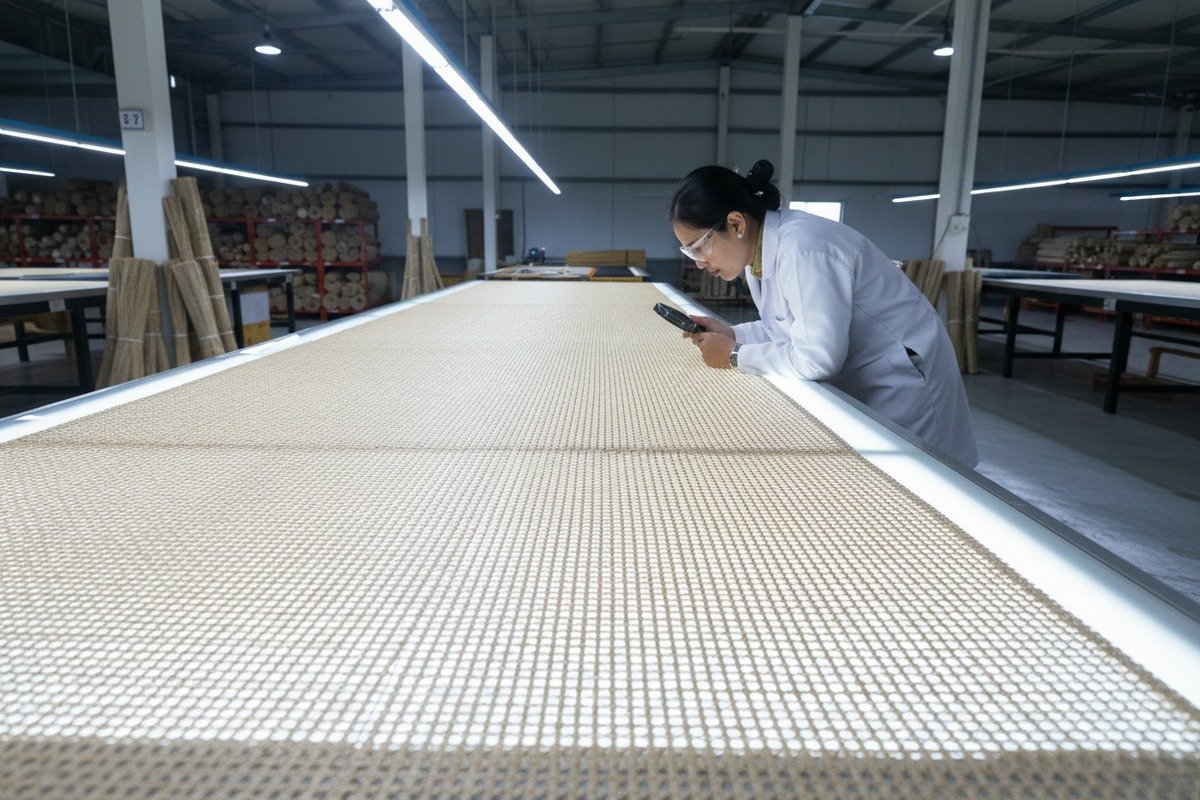
We maintain quality consistency across the full roll length through a multi-step process: grading raw rattan strands before weaving, using calibrated looms for uniform tension, conducting mid-roll visual inspections, and performing final quality checks on color, weave tightness, and strand integrity before packaging.
It Starts with Raw Material Grading
Cohérence de la qualité 8 begins long before the loom. At our Indonesian processing facility, incoming rattan strands are sorted by diameter, flexibility, and color. Strands that are too thin, too brittle, or off-color are separated out. Only Grade A strands—uniform in thickness and natural hue—go into our premium webbing rolls.
This grading step is critical because natural rattan varies from harvest to harvest. Rattan harvested during the dry season tends to be lighter in color and more brittle. Wet season rattan is more flexible but can carry more moisture. We blend batches to maintain a consistent look and feel throughout the year.
Loom Calibration and Tension Control
The weaving process itself is where consistency is either achieved or lost. Our looms are calibrated to maintain even tension across the entire width and length of the roll. loom calibration 9 If tension drops, the weave loosens. If it spikes, strands can snap.
For Fine 1/2" octagonal weave—widely regarded as the gold standard for furniture restoration—tension control is especially critical. The hexagonal openings must be uniform in size. Even a 2mm variation is visible in the finished product. Our loom operators check tension settings every 2 meters of output.
Mid-Roll and End-Roll Inspection
We do not wait until a roll is finished to check quality. Our inspectors examine the webbing at regular intervals during production. They look for:
- Weave uniformity: Are the openings consistent in size and shape?
- Strand integrity: Are there any cracked, split, or missing strands?
- Cohérence des couleurs: Does the webbing maintain the same shade from start to current point?
- Qualité du bord: Are the edges clean and even, or are there frayed or loose strands?
If a defect is found mid-roll, the section is marked and removed. The roll is then re-joined with a clean splice, and the splice location is noted on the packaging label so the buyer knows exactly where it is.
Pre-Soaking Test
Before packaging, we pull random samples from completed rolls and perform a soak test. Natural rattan cane webbing needs to be soaked in warm water for 15–30 minutes before installation to become pliable. Our test confirms that the webbing across the full roll length responds uniformly to soaking—no sections that stay stiff, no sections that become overly soft.
This is something many buyers overlook when evaluating suppliers. A roll that weaves beautifully on the loom but behaves unpredictably during soaking will cause problems on the factory floor. Our pre-shipment soak test catches these issues before the product leaves our facility.
Traceability and Batch Records
Every roll we ship carries a batch code that traces back to the raw material lot, the loom operator, the inspection records, and the production date. If a buyer in Spain reports an issue with roll number 2024-BH-0347, we can pull the full production history within minutes. This traceability is not common in the rattan industry, but it is essential for maintaining long-term quality partnerships.
For clients who require it, we also provide third-party inspection reports. Several of our wholesale buyers in the Netherlands and the USA have their own QC agents visit our facility before shipment. We welcome these inspections because they reinforce the trust that keeps our partnerships strong.
Conclusion
Choosing the right roll length for natural rattan cane webbing is not about finding a universal standard—it is about matching length to your project, your production workflow, your shipping logistics, and your quality expectations.
Notes de bas de page
1. Highlights Indonesia’s significant role in rattan production within Southeast Asia. ↩︎
2. Provides botanical information about the plant species Calamus rotang, also known as common rattan. ↩︎
3. Describes open weave cane webbing patterns, including hexagonal designs. ↩︎
4. Provides an overview of the furniture and related product manufacturing industry. ↩︎
5. Introduces cane webbing as a versatile material for furniture and decor. ↩︎
6. Explores strategies and the importance of reducing material waste in manufacturing processes. ↩︎
7. Details various factors that influence international freight shipping costs and rates. ↩︎
8. Emphasizes the critical importance of quality control in manufacturing operations. ↩︎
9. Discusses the role of calibration in ensuring accuracy and quality in textile production machinery. ↩︎
10. Explains the significance of raw material certification and inspection in manufacturing. ↩︎

 English
  Español de México
  العربية
  Deutsch
  Français
  Русский