
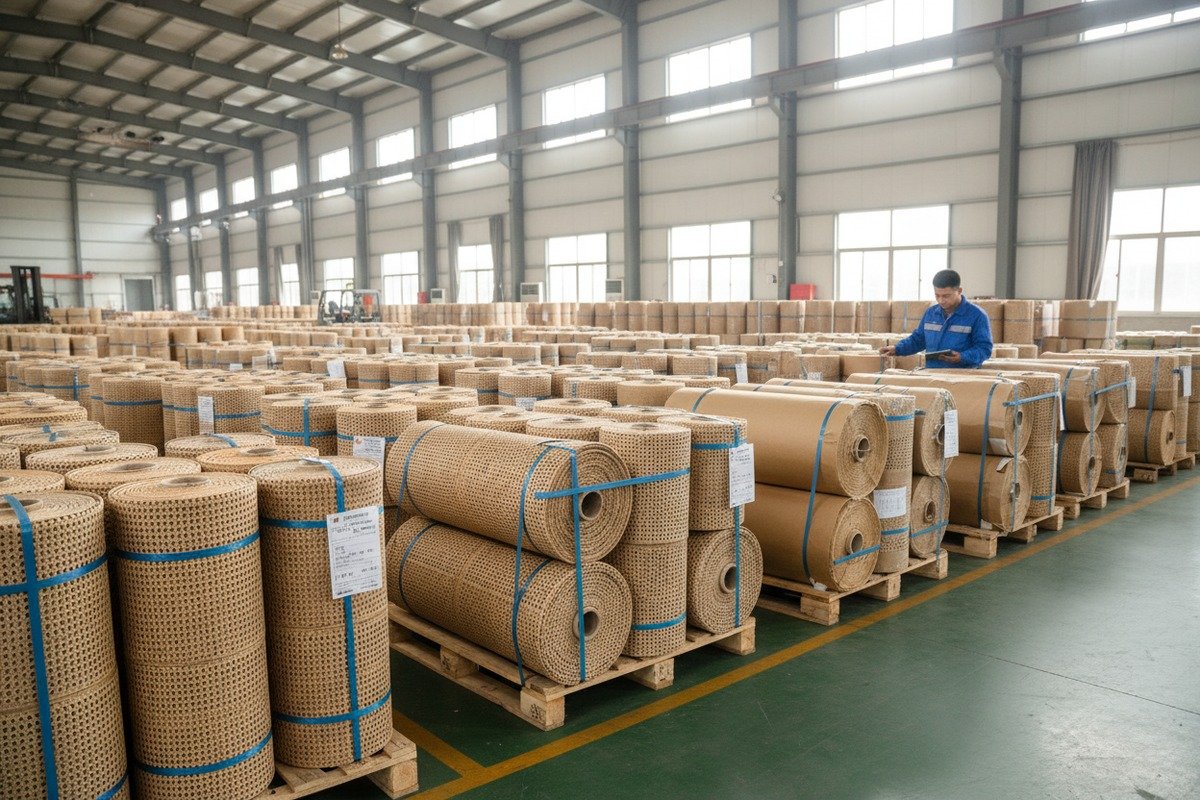
Every week, our warehouse in Foshan ships dozens of pallets loaded with rattan cane webbing to buyers across five continents. One recurring concern from new clients always surfaces: how exactly will my order arrive?
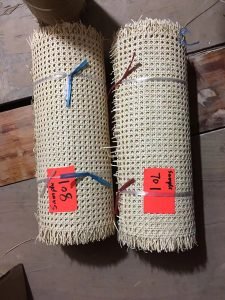
Natural rattan cane webbing for wholesale is typically packaged in tightly wound rolls, wrapped in moisture-proof kraft paper, reinforced with foam or corrugated cardboard layers, and secured with plastic straps or placed in bulk woven bags to prevent deformation, mold growth, and transit damage.
Packaging may seem like a small detail, but it directly affects product quality on arrival. Below, we break down every layer of protection, standard sizes, customization options, and how packaging durability ties to the webbing quality you unbox.
How can I ensure my bulk rattan cane webbing rolls are protected from moisture and damage during shipping?
Shipping natural rattan from our Indonesian processing facility to ports like Rotterdam or Los Angeles means weeks at sea. Humidity inside a steel container 1 can spike above 80%, and that is where most damage begins.
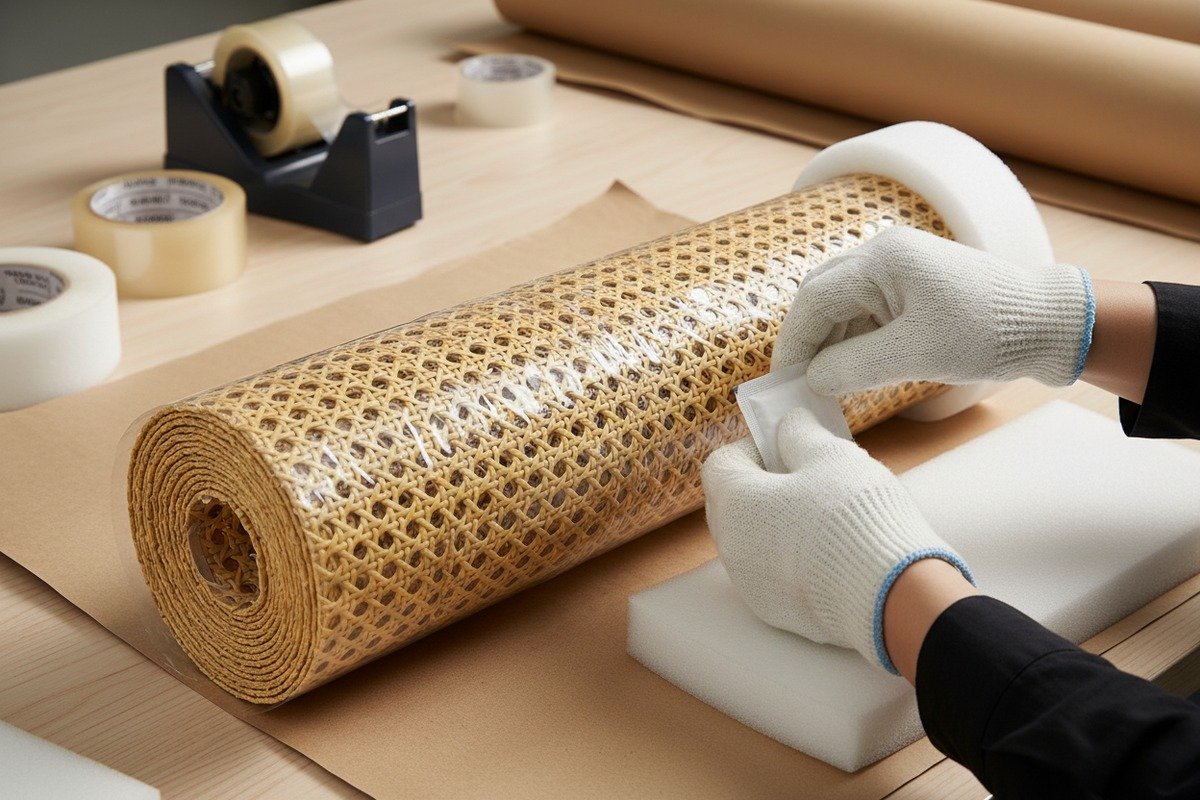
To protect bulk rattan cane webbing rolls from moisture and damage, use multi-layer packaging that includes moisture-proof kraft paper, polyethylene inner wrapping, foam padding, corrugated cardboard outer shells, plastic strapping, and biodegradable desiccant packets placed inside each roll bundle.
Understanding Moisture Risk
Le rotin naturel est un fibre végétale 2. It absorbs water from the air. When moisture content rises above 14%, mold colonies 3 can form within 48 hours. We learned this the hard way years ago when a shipment to Saudi Arabia arrived with green spots on 12% of the rolls. The root cause was insufficient inner wrapping. Since then, our team redesigned the packaging protocol from the inside out.
The ocean freight environment is harsh. Temperature swings between day and night cause condensation inside containers. This phenomenon, called "pluie de conteneur 4," drips water onto cargo. Without a barrier, rattan absorbs that moisture immediately.
Multi-Layer Protection Breakdown
Here is the layer-by-layer system we now use for every wholesale shipment:
| Couche | Matériau | Objectif |
|---|---|---|
| Layer 1 (innermost) | Polyethylene film wrap 5 | Creates a sealed moisture barrier around each roll |
| Layer 2 | Papier kraft imperméable | Absorbs minor humidity and adds cushioning |
| Layer 3 | Foam padding sheets | Prevents surface scratches and absorbs impact |
| Layer 4 (outermost) | Thick corrugated cardboard | Provides structural rigidity against compression |
| Securing | PP plastic straps | Holds rolls tight, prevents shifting in transit |
| Additive | Biodegradable desiccant packets 6 | Actively absorbs humidity inside the package |
Conseils pratiques pour les acheteurs
First, always request a fumigation certificate 7. Natural rattan must pass fumigation to clear customs in most importing countries. This process also kills insect larvae and bacteria that could degrade the product during storage.
Second, ask your supplier about vacuum sealing 8 for the inner layer. We offer this option for clients in tropical regions like Thailand and the Philippines, where post-arrival humidity remains high. Vacuum sealing reduces oxygen exposure and locks moisture content at the factory-tested level.
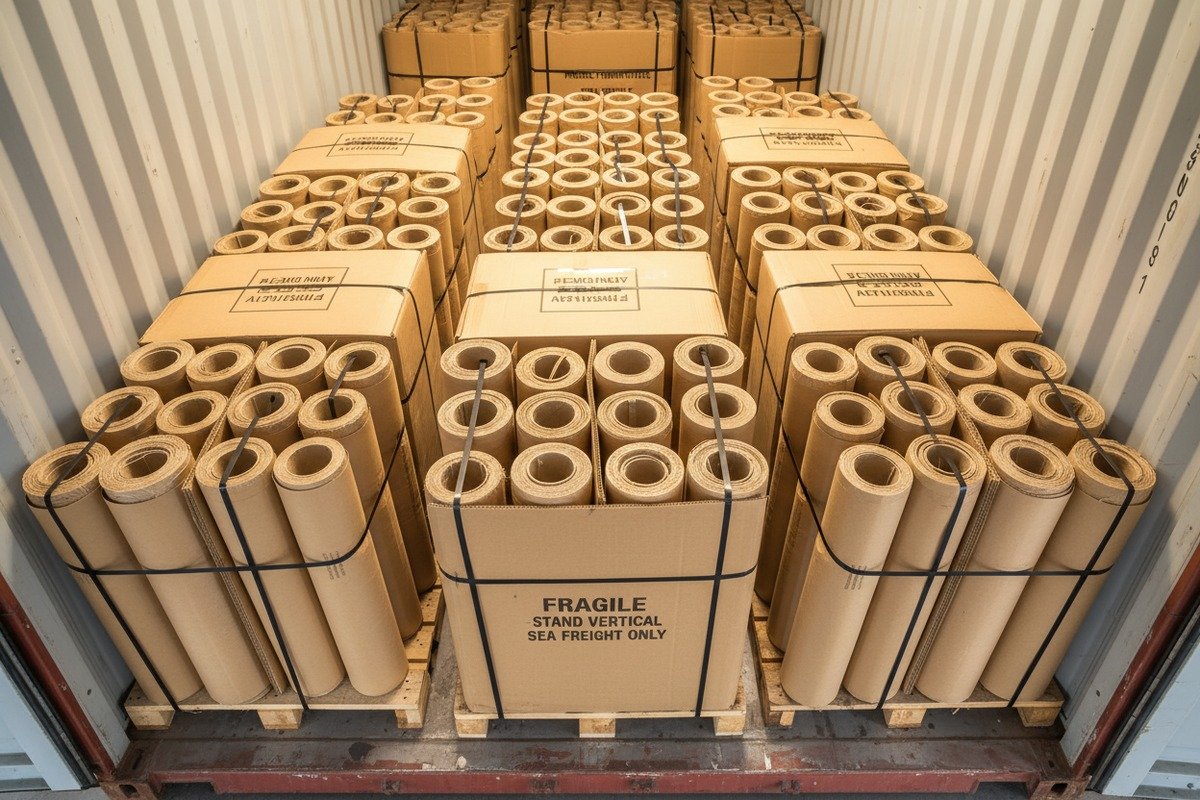
Third, specify container loading instructions. Rolls should stand upright, not lie flat. Flat stacking increases pressure on bottom rolls and causes oval deformation. When our logistics team loads a 20'GP container, we place wooden pallets on the floor and stand every roll vertically with cardboard dividers between groups.
Finally, consider silica gel or clay-based desiccant placement. We typically put two 500-gram packets per bundle of five rolls. This small addition costs very little but reduces humidity-related claims by over 90%, based on our shipment records from 2022 to 2024.
What are the standard roll sizes and packaging materials used for my wholesale rattan order?
When buyers visit our showroom in Nanhai, Foshan, the first question is almost always about dimensions. Roll sizes directly affect shipping costs, material waste, and project planning.
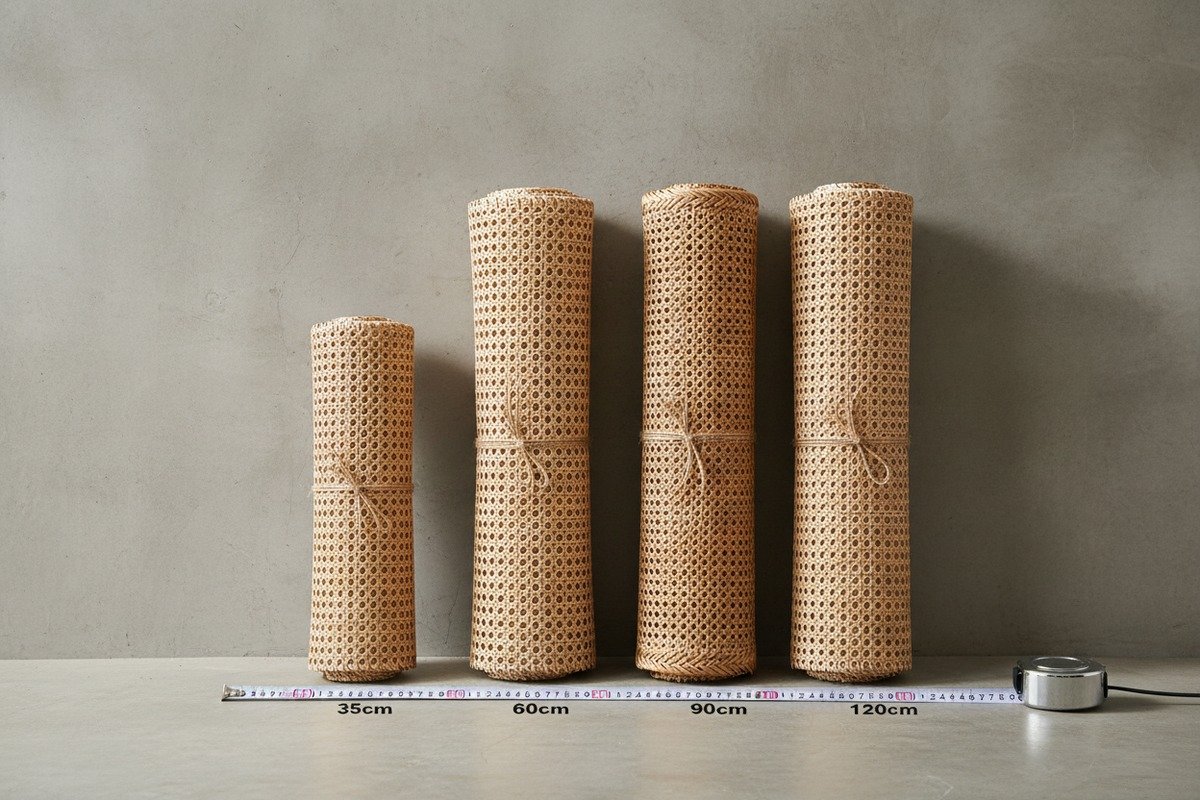
Standard wholesale rattan cane webbing rolls typically measure 60 cm (24 inches) in width and 10 meters (32.8 feet) in length, though widths range from 35 cm to 120 cm and lengths from 15 to 30 meters depending on weave pattern, supplier capability, and buyer specifications.
Common Roll Dimensions
Different weave patterns sometimes dictate available sizes. A close-weave rattan sheet can be produced wider because the tight structure holds its shape. Open hexagonal weaves are more fragile at wider widths, so they tend to ship in narrower rolls.
| Motif de tissage | Plage de largeur typique | Typical Length Range | Usage courant |
|---|---|---|---|
| Close weave (dense) | 45–120 cm | 15–30 m | Portes d'armoires, têtes de lit |
| Cannage hexagonal ouvert | 45–90 cm | 10–15 m | Dossiers de chaise, panneaux décoratifs |
| Chevrons | 50–100 cm | 15–25 m | Furniture panels, room dividers |
| Octogonal | 45–80 cm | 10–20 m | Accent furniture, screens |
| Simple square grid | 40–90 cm | 10–20 m | DIY projects, lampshades |
Our best-selling configuration is 60 cm × 15 m for furniture factories and 45 cm × 10 m for material wholesalers who resell in smaller cuts.
Packaging Materials We Use
The outer packaging materials differ based on order volume and destination. For a full container load (FCL), we use heavy-duty corrugated cardboard boxes reinforced with corner protectors. For less-than-container-load (LCL) orders, we add extra foam and strap each box to a wooden pallet for forklift handling at consolidation warehouses.
Standard packaging materials include:
- Polyethylene shrink film for the innermost moisture seal
- 80 gsm kraft paper for secondary wrapping
- 5 mm EPE foam sheets for impact absorption
- Five-layer corrugated cardboard for outer boxing
- PP strapping bands at 15 cm intervals
- Fumigated wooden pallets for base support
Sheet vs. Roll Format
Some buyers request flat sheets instead of rolls. Sheets are easier to cut for small projects, but they cost more to ship because they cannot be compressed. A roll of 60 cm × 15 m occupies roughly 0.03 cubic meters. The same material in flat sheets occupies 0.08 cubic meters or more. For wholesale buyers focused on cost efficiency, rolls are the clear winner.
That said, we do offer pre-cut sheet packs for clients who distribute to retail DIY markets. These come in standard sizes like 60 × 60 cm and 45 × 90 cm, stacked flat with interleaving tissue paper and shrink-wrapped in bundles of 10 or 20.
Can I customize the labeling and packaging to suit my private-label rattan business?
Many of our clients in the Netherlands, Australia, and the US run their own brands. They do not want packaging that says "Made in China" in generic fonts. They want their logo, their color scheme, and their care instructions printed right on the box.
Yes, most established rattan webbing wholesalers offer full packaging customization including private-label printing, branded kraft paper wraps, custom box designs, logo stickers, barcode labels, QR codes linking to product specs, and tailored roll dimensions to match your brand identity and retail requirements.
What We Can Customize
Our design team works with buyers to develop packaging that aligns with their brand. Here is what we typically customize:
- Outer box printing: Full-color logo, brand name, product description, barcode, and handling symbols
- Inner wrap branding: Kraft paper with repeated logo print in single-color ink
- Label inserts: Care instructions, origin information, sustainability certifications
- Roll end stickers: SKU number, batch code, dimensions, weight
- des codes QR: Link to installation videos, product pages, or certification documents
The Private-Label Process
The process is straightforward. A buyer sends us their brand guidelines — logo files, Pantone colors, preferred layout. Our in-house designer creates a packaging mockup within 3–5 business days. After approval, we produce a small sample batch. Once confirmed, we apply the custom packaging to the full production run.
Lead time for custom packaging adds about 7–10 days to the standard production schedule. The cost depends on complexity. A simple one-color logo sticker adds almost nothing. Full four-color printed corrugated boxes cost more but still represent less than 3% of the total order value for most buyers.
RFID and Smart Labeling
A newer trend we are seeing among larger wholesalers is the request for RFID tags 9 or scannable QR codes on each roll. These tags allow warehouse teams to scan incoming inventory instantly. The QR code can link to a digital product sheet showing the exact weave pattern, grade, batch number, production date, and even the factory where it was woven.
We implemented this for a client in Spain who manages inventory across three warehouses. Their receiving team now scans each roll on arrival and the data populates directly into their ERP system. It eliminated manual data entry errors and cut receiving time by 40%.
Minimum Order for Customization
Most suppliers, including our operation, require a minimum order quantity (MOQ) for custom packaging. Simple sticker labels can be applied to orders as small as 50 rolls. Fully printed custom boxes typically require a minimum of 200–300 rolls to justify the printing plate setup cost.
| Niveau de personnalisation | MOQ typique | Délai supplémentaire | Impact sur les coûts |
|---|---|---|---|
| Logo sticker on standard box | 50 rolls | 2–3 jours | Minimal (< 1%) |
| One-color printed kraft paper | 100 rouleaux | 5–7 jours | Low (1–2%) |
| Full-color printed outer box | 200–300 rolls | 7–10 jours | Moderate (2–3%) |
| RFID/QR code integration | 100 rouleaux | 5–7 jours | Low (1–2%) |
| Complete custom design package | 300+ rolls | 10–15 jours | Moderate (3–5%) |
How does the packaging durability impact the quality consistency of the rattan webbing I receive?
One of our long-term clients in Turkey once told us: "The rattan is only as good as the box it arrives in." After years of exporting, we cannot agree more. Packaging is not just a wrapper. It is a quality preservation system.
Packaging durability directly determines rattan webbing quality on arrival. Weak or thin packaging leads to moisture infiltration, fiber cracking, edge fraying, shape deformation, and color inconsistency, while robust multi-layer packaging maintains the webbing's original flexibility, weave integrity, and uniform appearance from factory to warehouse.

How Poor Packaging Causes Quality Problems
Natural rattan is organic. It responds to its environment. When packaging fails, the rattan inside suffers in specific, predictable ways.
Moisture penetration causes mold. Even a small tear in the outer wrapping can let in enough humid air to trigger mold growth within days. Mold stains are permanent. They cannot be cleaned without damaging the fibers. A moldy roll is a total loss.
Compression damage happens when packaging lacks rigidity. If a heavy box sits on top of rattan rolls during transit, the weave pattern flattens permanently. Hexagonal and octagonal patterns are especially vulnerable. Once the raised crossover points in the weave are crushed, the pattern loses its three-dimensional character.
Edge fraying occurs when rolls are not properly wrapped at the ends. The cut edges of rattan webbing are naturally loose. Without end caps or tight wrapping, fibers catch on adjacent surfaces and pull apart. A roll that arrives with 2–3 cm of frayed edges on each side loses usable width, which frustrates furniture makers who cut to precise dimensions.
The Cost of Packaging Failure
We track every quality claim submitted by our clients. Over the past three years, packaging-related complaints accounted for roughly 18% of all claims. The most common issues were:
- Mold spots from moisture infiltration (42% of packaging claims)
- Oval deformation from flat stacking (28%)
- Edge damage from insufficient wrapping (19%)
- Color fading from UV exposure through transparent wrapping (11%)
Each of these is preventable with proper packaging. That is why we invest in five-layer corrugated board instead of three-layer, EPE foam instead of basic newspaper padding, and sealed PE film instead of loose kraft paper.
Natural vs. Synthetic: Packaging Demands Compared
It is worth noting that synthetic rattan (PE plastic, paper cord) requires far less packaging protection. It does not absorb moisture, does not mold, and does not deform as easily. But natural rattan commands a price premium precisely because of its authentic texture, breathability, and eco-friendly appeal. Protecting those qualities during transit is a non-negotiable part of the supply chain.
Some buyers consider switching to synthetic alternatives to avoid packaging hassles. However, our experience shows that the aesthetic and sustainability advantages of natural rattan outweigh the extra packaging cost, which typically adds only 5–8% to the total landed price.
Verifying Packaging Quality Before Ordering
Before placing a large order, request a sample shipment. Not just a product sample — a full packaging sample. Ask the supplier to ship 2–3 rolls using their standard export packaging method. When the sample arrives, check for:
- Tightness of the inner PE wrap
- Firmness of the corrugated outer box
- Presence and condition of desiccant packets
- Roll shape (should be perfectly round, not oval)
- Edge condition (no fraying or fiber pull)
If the sample arrives in perfect condition after international transit, you can trust that the full order will too. If it does not, raise the issue before committing to volume. A good supplier will adjust packaging at no extra charge.
Conclusion
Good packaging is not a cost — it is an investment in the quality your customers expect. From moisture-proof layers to custom branding, every detail matters when sourcing natural rattan cane webbing at wholesale scale.
Notes de bas de page
1. Explains how humidity affects cargo inside shipping containers. ↩︎
2. Replaced 404 with an authoritative Wikipedia page on natural fibers. ↩︎
3. Details the conditions necessary for mold growth on organic materials. ↩︎
4. Explains the phenomenon of condensation and ‘container rain’ in shipping. ↩︎
5. Describes the properties and uses of polyethylene film in packaging. ↩︎
6. Discusses the function and types of desiccants for moisture control. ↩︎
7. Highlights the importance and requirements of fumigation for international shipping. ↩︎
8. Explains the benefits of vacuum sealing for product preservation and moisture control. ↩︎
9. Illustrates the application of RFID technology for efficient inventory management. ↩︎

 English
  Español de México
  العربية
  Deutsch
  Français
  Русский