
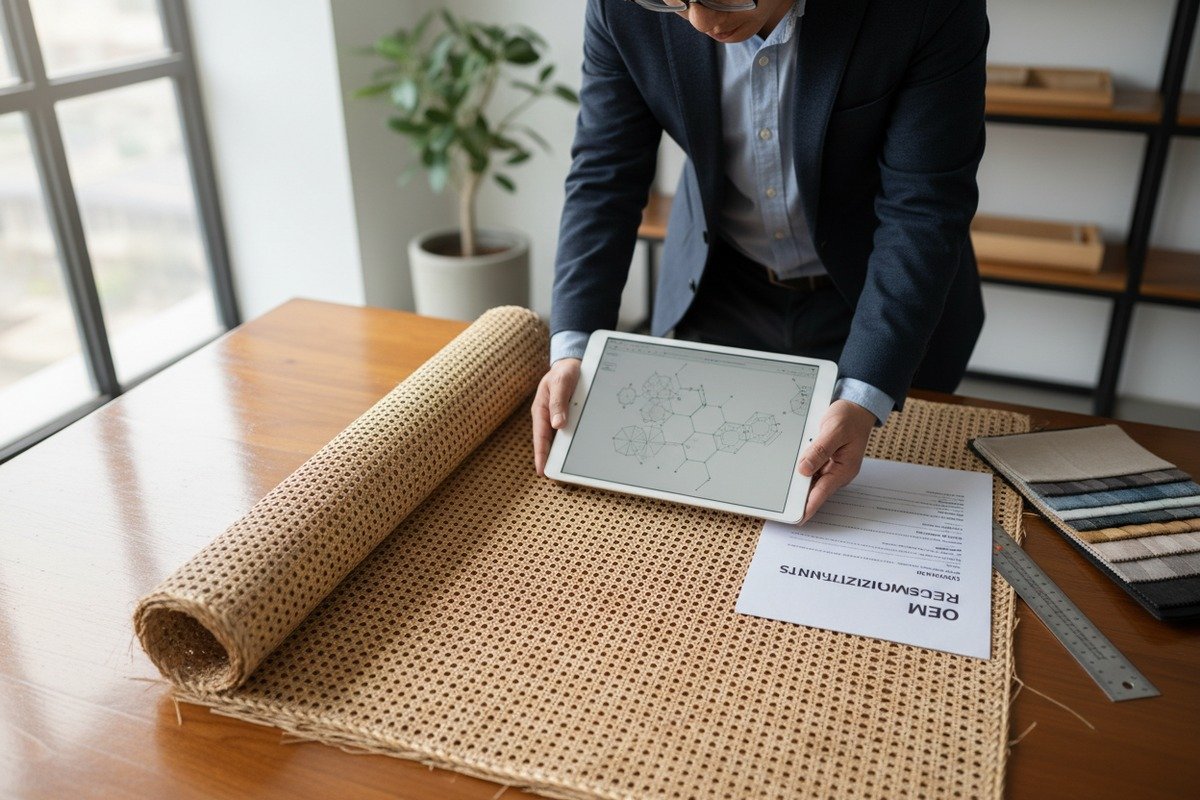
Every week, our team fields inquiries from purchasing managers who know exactly what they want but struggle to put it on paper le cannage en rotin naturel 1. The gap between a buyer’s vision and a factory’s output is where miscommunication breeds — and where costly rejects are born.
OEMs communicate customization requirements for natural rattan cane webbing through detailed specification sheets, CAD drawings, physical samples, and multi-stage approval processes that cover weave patterns, dimensions, material grade, treatments, packaging, and quality control checkpoints to ensure factory output matches exact expectations.
This guide walks you through the exact tools, templates, and strategies that successful OEMs use when working with rattan webbing factories CAD drawings 2. Each section tackles a specific communication challenge we see every day on our production floor in Foshan.
How do I clearly define my Grade A quality and sizing standards to a rattan factory?
Sizing errors and quality mismatches are the number one reason we see orders rejected at the port. When a buyer says "Grade A" without defining what that means, every factory will interpret it differently.
To clearly define Grade A quality and sizing, provide a written spec sheet that lists exact strand width, thickness tolerances, acceptable color range, defect rejection criteria, and roll dimensions with cutting margins — then confirm everything with a physical reference sample before production starts.

Que signifie réellement "Grade A" ?
The term "Grade A" has no universal standard in the rattan industry. It means different things to different suppliers. At our processing facility in Indonesia, we sort rattan strands by thickness uniformity, surface smoothness, and color consistency. But another factory may only sort by thickness.
This is why you must create your own grading document. List every attribute that matters to your end product. Be specific. Instead of saying "no defects," say "no cracks longer than 2mm, no dark spots larger than 5mm diameter, no uneven strand width exceeding 0.3mm variance."
Sizing Standards You Must Specify
Sizing is more than just roll width and length. You need to cover strand-level dimensions too. Here is a template we recommend to every new OEM partner:
| Spécification | What to Define | Example Value |
|---|---|---|
| Largeur du rouleau | Total width of the webbing roll | 60 cm / 90 cm / 120 cm |
| Longueur du rouleau | Total usable length per roll | 15 meters ± 0.5 m |
| Largeur du brin | Width of individual rattan strips | 2.5 mm ± 0.2 mm |
| Épaisseur du brin | Thickness of each strip | 0.8 mm ± 0.1 mm |
| Cutting Margin | Extra material on each edge | 3–5 cm per side |
| Taille de l'ouverture du maillage | Distance between woven intersections | 12 mm × 12 mm |
Why Physical Samples Beat Written Specs
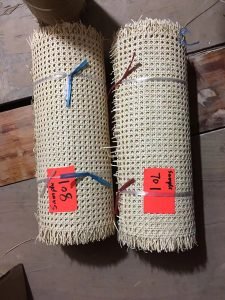
Written specs cover 80% of the job. The remaining 20% is texture, flexibility, and visual feel. We always advise buyers to request a pre-production sample panel — at least 30 cm × 30 cm — before approving mass production. Touch it. Bend it. Hold it next to your furniture frame. Numbers on paper cannot replace this step.
When you send your approval, mark the sample with a signature and date. Both you and the factory keep one copy. This becomes the "golden sample 3" — the benchmark for every inspection during the production run.
What technical details should I include in my customization brief for natural cane webbing?
Our sales team once received a brief that simply read: "hexagonal weave 5, natural color, 90 cm wide." That single line left at least twelve critical decisions to the factory's discretion — and the buyer was not happy with the result.
Your customization brief should include weave pattern type, strand material origin, strand dimensions, mesh density, color and finish requirements, treatment instructions for anti-mildew and moisture control, roll or sheet format, and installation compatibility notes — all documented with reference images or CAD files.
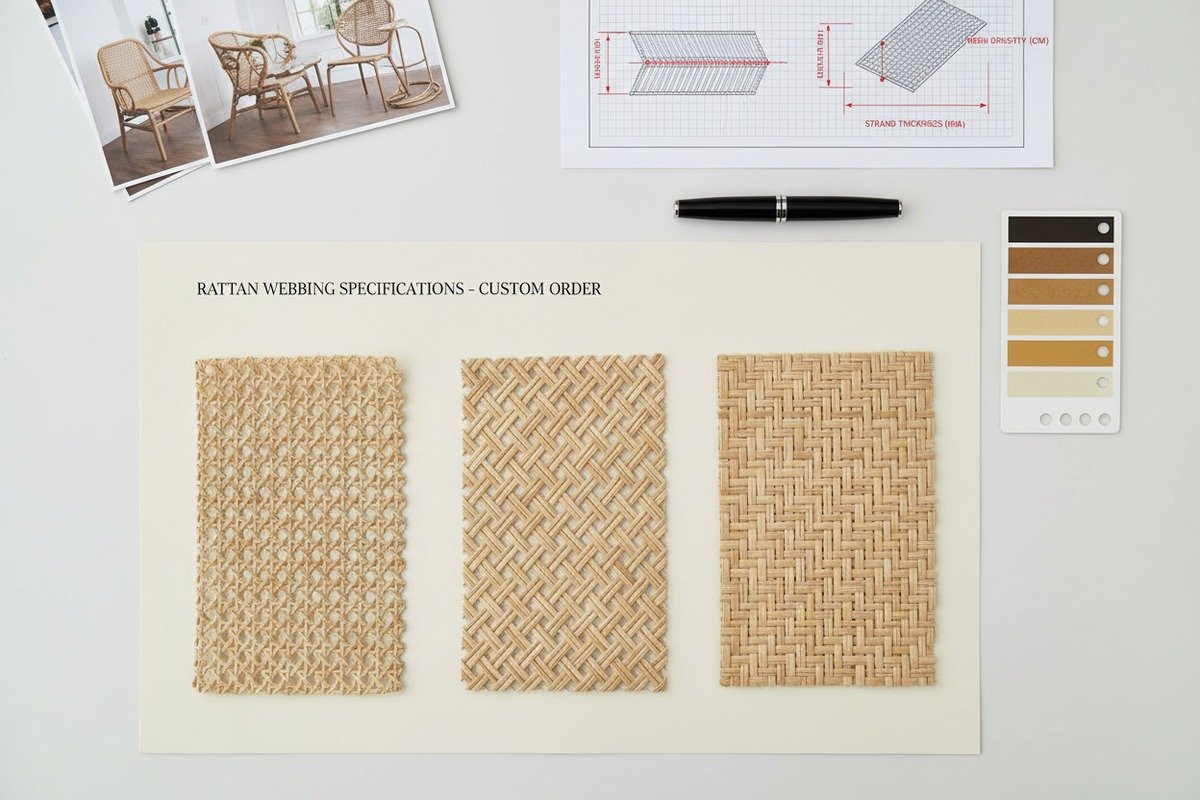
The Complete Technical Brief Checklist
A strong brief eliminates guesswork. Here is what we recommend including in every customization document:
Weave Pattern Details: Specify the exact pattern — hexagonal, octagonal, square grid (radio cane), diamond, star, or open weave. Include the insertion angle. For example, hexagonal weave requires strands inserted at 45-degree angles. If you have a custom pattern, provide a close-up photo or a CAD drawing with measurements.
Material Specifications: State clearly that you need rotin naturel 6, not synthetic PE plastic. This sounds obvious, but we have seen confusion happen. Specify outer bark strips for premium quality or inner core strips for budget lines. If origin matters, write "Indonesian rattan preferred" or "Tohiti rattan, strand thickness 1–2 inches."
Processing and Treatment Requirements: Natural rattan needs treatment to resist mold, insects, and cracking. Your brief should specify:
| Étape de traitement | Your Instruction | Objectif |
|---|---|---|
| Ébullition | Yes / No, duration | Improves flexibility |
| Séchage | Target moisture level (e.g., 12–15%) | Prevents mold during shipping |
| Blanchiment | Light / Medium / None | Achieves desired color tone |
| Anti-Mildew Coating | Required / Not required | Protects in humid climates |
| Oil or Sealant | Type (e.g., linseed oil) | Enhances durability and sheen |
| Protection UV | Required for outdoor use | Prevents color fading |
Natural vs. Synthetic: Clarify Early
Many factories produce both natural and synthetic rattan webbing on the same production lines. If your brand identity depends on authentic natural cane, state this in bold on your brief. Add a clause: "No PE or PVC substitutes accepted." This prevents any mix-up during sourcing or production scheduling.
Digital Files Speed Up Communication
We strongly encourage OEMs to share CAD/CAM files whenever possible. A 2D drawing that shows how the webbing integrates with your furniture frame saves weeks of back-and-forth. Include dimensions for the visible area, the wrap-around area, and the spline groove width. If you do not have CAD capability, a dimensioned hand sketch with clear labels works too.
One more tip: always specify the intended end use. A webbing panel for a cabinet door faces different stress than one for a chair seat. When our production team knows the application, we can recommend the right strand thickness and weave density to match.
How can I communicate my private-label packaging needs to ensure my products arrive safely?
Packaging is often the last thing buyers think about — and the first thing that goes wrong. On our production floor, we have seen beautiful Grade A webbing arrive at a buyer's warehouse with crushed edges and mold spots, all because the packaging spec was an afterthought.
To communicate private-label packaging needs, provide your factory with exact packaging dimensions, inner and outer box specifications, moisture barrier requirements, brand label artwork files in print-ready format, and clear instructions for roll orientation, padding, and palletizing to prevent transit damage.
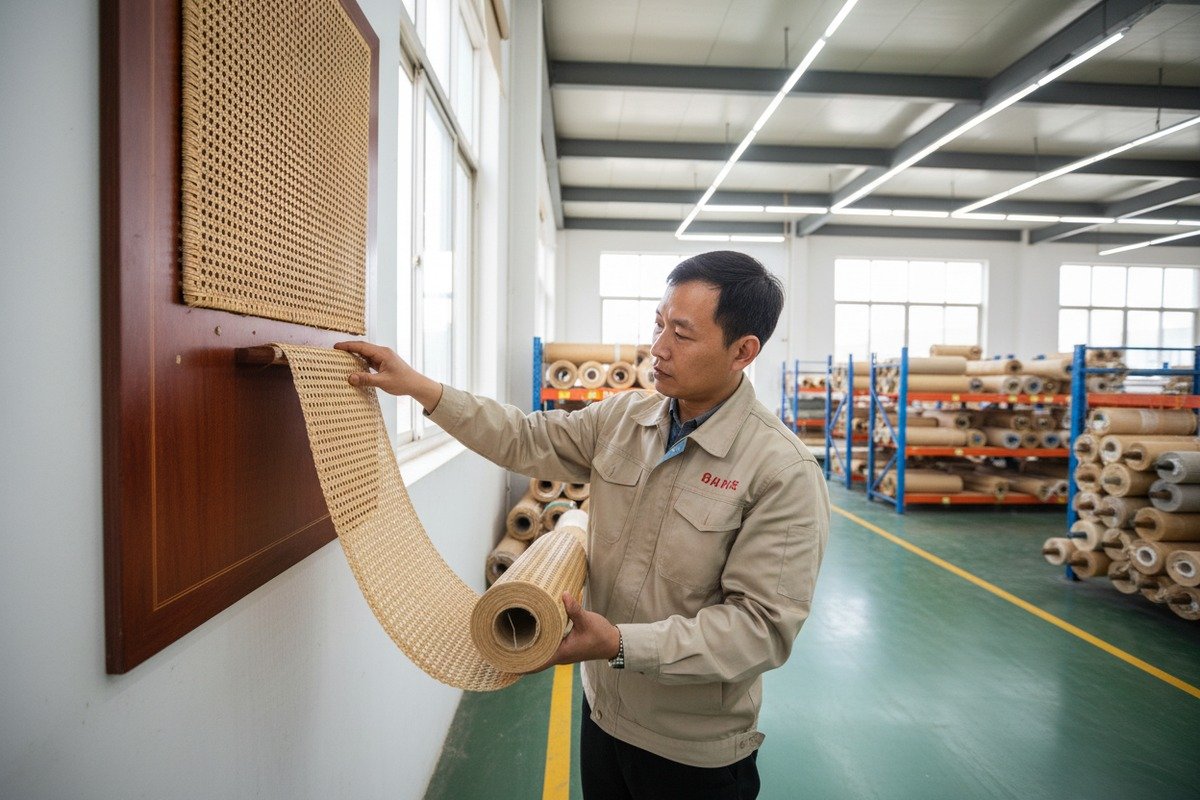
Packaging That Protects
Rattan webbing is flexible but fragile at the edges. Rolls can unravel. Sheets can crack if stacked under heavy weight. Your packaging brief should address three layers of protection:
Emballage intérieur : Each roll or sheet should be wrapped in moisture-proof plastic film. For shipments to humid markets, add sachets de gel de silice déshydratant 7 inside the wrap. Specify the number of packs per unit — we typically recommend 2–3 packs per roll for ocean freight containers.
Middle packaging: Place wrapped rolls inside corrugated cardboard tubes or boxes. If you sell sheets, use rigid cardboard with corner protectors. State the cardboard grade — at minimum, use double-wall corrugated for export.
Outer packaging: Master cartons or palletized bundles for container loading. Specify stacking limits. For example: "Maximum 4 cartons high on pallet."
Private-Label Artwork Requirements
If you sell under your own brand, send your label artwork as a vector file (AI, EPS, or high-resolution PDF). Include:
- Exact label dimensions
- Color codes (Pantone or CMYK)
- Placement position on the roll or box
- Barcode or QR code files
- Language requirements for the destination market
We print labels in-house, but we need at least 15 working days for first-run label production. Always request a label proof photo before mass printing begins.
A Packaging Spec Sheet Template
| Élément d'emballage | Your Specification |
|---|---|
| Inner Wrap Material | PE shrink film, 0.08 mm thickness |
| Dessiccant | 3 × 10g silica gel packs per roll |
| Roll Orientation | Horizontal, core facing outward |
| Inner Box | Single-wall corrugated tube, 650 mm length |
| Outer Carton | Double-wall corrugated, max 20 kg per carton |
| Label Position | Center of carton, short side |
| Pallet Type | Fumigated wooden pallet, ISPM-15 compliant |
| Stacking Limit | 4 cartons max per pallet column |
Communicate Shipping Conditions
Tell your factory the shipping method (ocean FCL, LCL, or air freight) and the destination climate. Ocean containers can reach 60°C inside during summer transit. This affects moisture decisions. A factory that knows your shipment route can adjust drying levels and packaging materials accordingly. We routinely reduce moisture content to 10–12% for shipments crossing the equator.
What is the most effective way for me to manage quality control expectations with my Chinese rattan supplier?
In our years of exporting to over a dozen countries, we have learned one hard truth: quality expectations that live only in email threads get lost. The buyers who get the best results are the ones who build a QC system — not just a QC request.
The most effective way to manage quality control is to establish a written QC protocol that defines inspection checkpoints at raw material intake, mid-production, and pre-shipment stages, combine it with a defect classification system and AQL sampling standards, and reinforce it through regular third-party audits or video inspections.
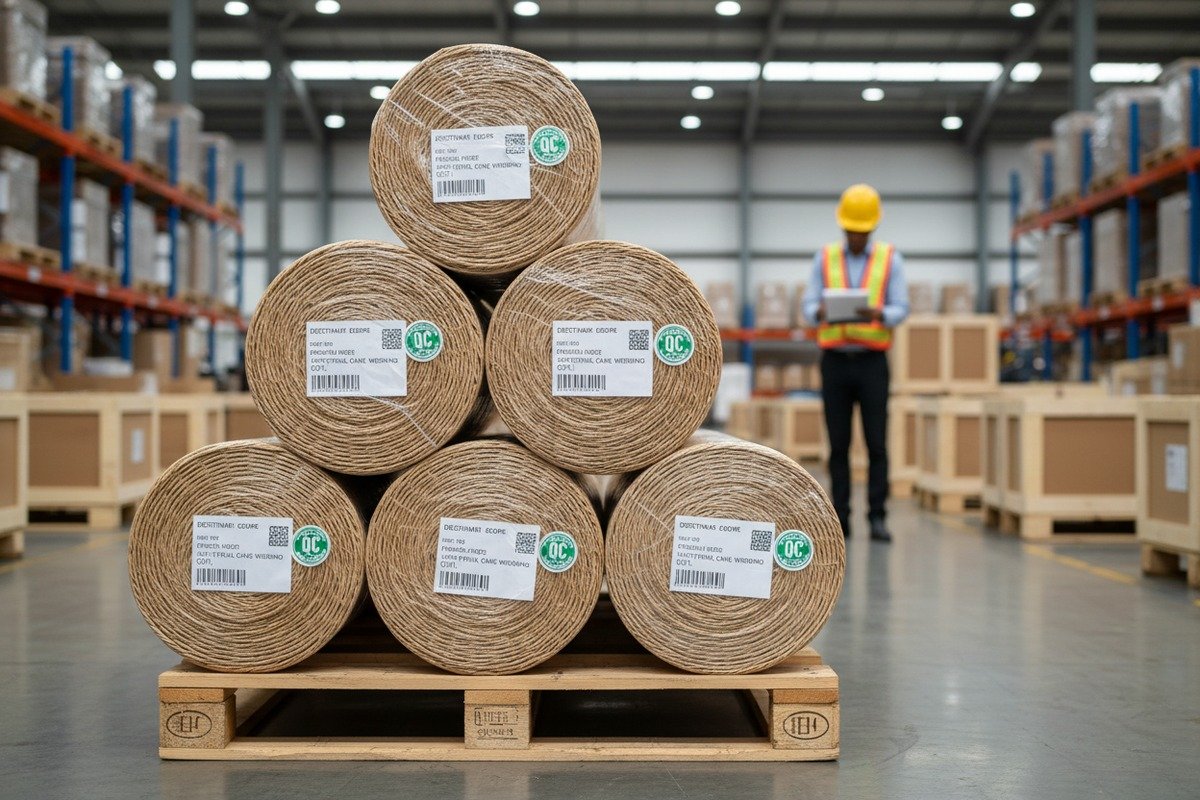
Build a Three-Stage Inspection System
Quality control should not happen only at the end. By then, it is too late to fix problems without delaying your shipment. Here is the three-stage model we use with our most demanding OEM partners:
Stage 1 — Raw Material Inspection: Check rattan strands before weaving begins. Verify strand width, thickness, color uniformity, and moisture level. Reject any batch with more than 5% out-of-spec strands. This single step prevents most downstream defects.
Stage 2 — In-Process Inspection: During weaving, inspect the first 50 meters of every roll run. Check weave pattern accuracy, mesh opening consistency, and edge alignment. If the first 50 meters pass, the rest of the run will likely hold. If not, stop and adjust the loom or worker technique immediately.
Stage 3 — Pre-Shipment Inspection: After cutting, treating, and packaging, pull random samples using AQL (Acceptable Quality Level) standards. AQL sampling standards 8 Most OEMs use AQL 2.5 for major defects and AQL 4.0 for minor defects. A third-party inspector can do this on your behalf if you cannot visit the factory.
Define Your Defect Classification
Not all defects are equal. A small color variation may be acceptable; a broken strand is not. Create a defect chart and share it with the factory before production. Here is an example:
| Defect Type | Classification | Action |
|---|---|---|
| Broken strand in weave | Critique | Reject unit |
| Color spot > 5 mm | Majeur | Reject unit |
| Color variation within 1 shade | Mineur | Accept |
| Strand width variance > 0.3 mm | Majeur | Reject unit |
| Slight edge fraying (< 1 cm) | Mineur | Accept if within cutting margin |
| Mold or mildew visible | Critique | Reject entire batch |
| Incorrect weave pattern | Critique | Reject and reweave |
Use Video Calls and Factory Visits
Technology makes remote QC easier than ever. We regularly conduct live video inspections with buyers over WhatsApp or WeChat. The buyer watches our team measure, bend, and photograph the webbing in real time. For large orders — say, a full 20-foot container — we recommend at least one in-person factory visit or a third-party audit from firms like SGS or Bureau Veritas.
Set Expectations in the Purchase Order
Your purchase order is a legal document. Include a QC clause that states:
- The AQL level you require
- Your right to reject non-conforming goods
- The factory's obligation to replace or credit rejected batches
- The timeline for resolving disputes
When both sides sign this, quality stops being a conversation and becomes a contract. That shift in formality changes factory behavior more than any polite email ever could.
The Role of Traceability
Some of our OEM partners now require supply chain traceability 9. They want to know which Indonesian plantation supplied the rattan, which processing batch it came from, and which worker team wove it. We assign batch codes to every roll and maintain records back to the raw material intake date. This traceability supports sustainability claims and simplifies root-cause analysis if a quality issue appears months later.
Conclusion
Clear communication between OEMs and rattan factories is not about sending more emails — it is about sending the right documents with measurable standards, approved samples, and enforceable QC protocols from day one.
Notes de bas de page
1. Explains properties, durability, and sustainability of natural rattan webbing. ↩︎
2. Provides a comprehensive and authoritative definition of CAD drawings and their use in various industries, including manufacturing. ↩︎
3. Defines golden samples and their critical role in manufacturing quality control. ↩︎
4. Explains the distinction between quality and grade in manufacturing contexts. ↩︎
5. Provides information on hexagonal openwork as a basketry technique. ↩︎
6. Discusses the characteristics and eco-friendly aspects of natural rattan material. ↩︎
7. Provides an authoritative explanation of silica gel, its properties as a desiccant, and its function in absorbing moisture to protect various items. ↩︎
8. Defines AQL sampling and its application in quality control inspections. ↩︎
9. Outlines the best practices and benefits of supply chain traceability. ↩︎

 English
  Español de México
  العربية
  Deutsch
  Français
  Русский