
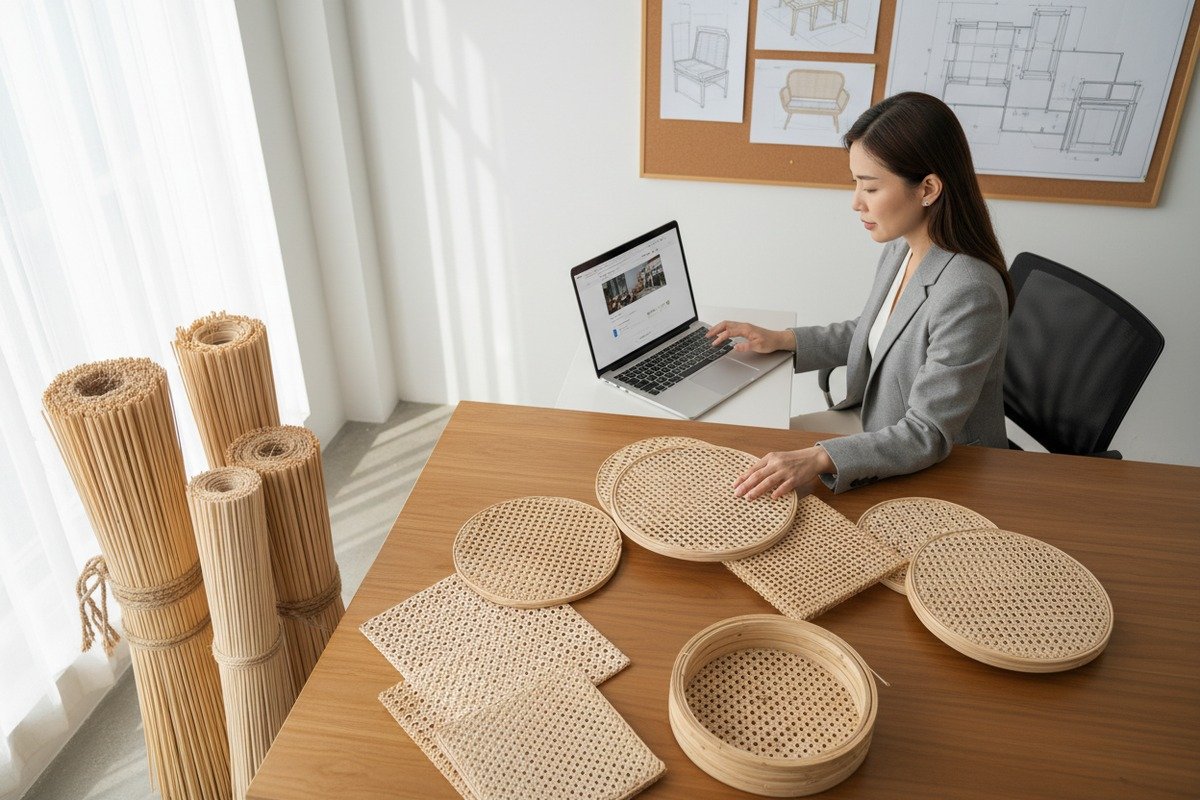
Every week, our sales team fields calls from buyers who received rattan webbing that looked nothing like the product photos online FOB price 1. Wrong weave density, inconsistent color, rolls too short for their production runs—these problems cost real money and delay entire furniture lines.
When buying natural rattan cane webbing online, confirm Grade A quality indicators, exact roll dimensions, competitive bulk pricing, and export-grade packaging. Request samples first, verify the supplier’s production origin, and ensure the weave pattern and material thickness match your project specifications before placing a large order.
This guide walks you through every checkpoint we recommend to our own B2B clients. Whether you run a furniture factory or wholesale operation, these steps will save you from costly mistakes. Let’s break it down section by section.
How do I ensure the natural rattan cane webbing I buy online is actually Grade A quality?
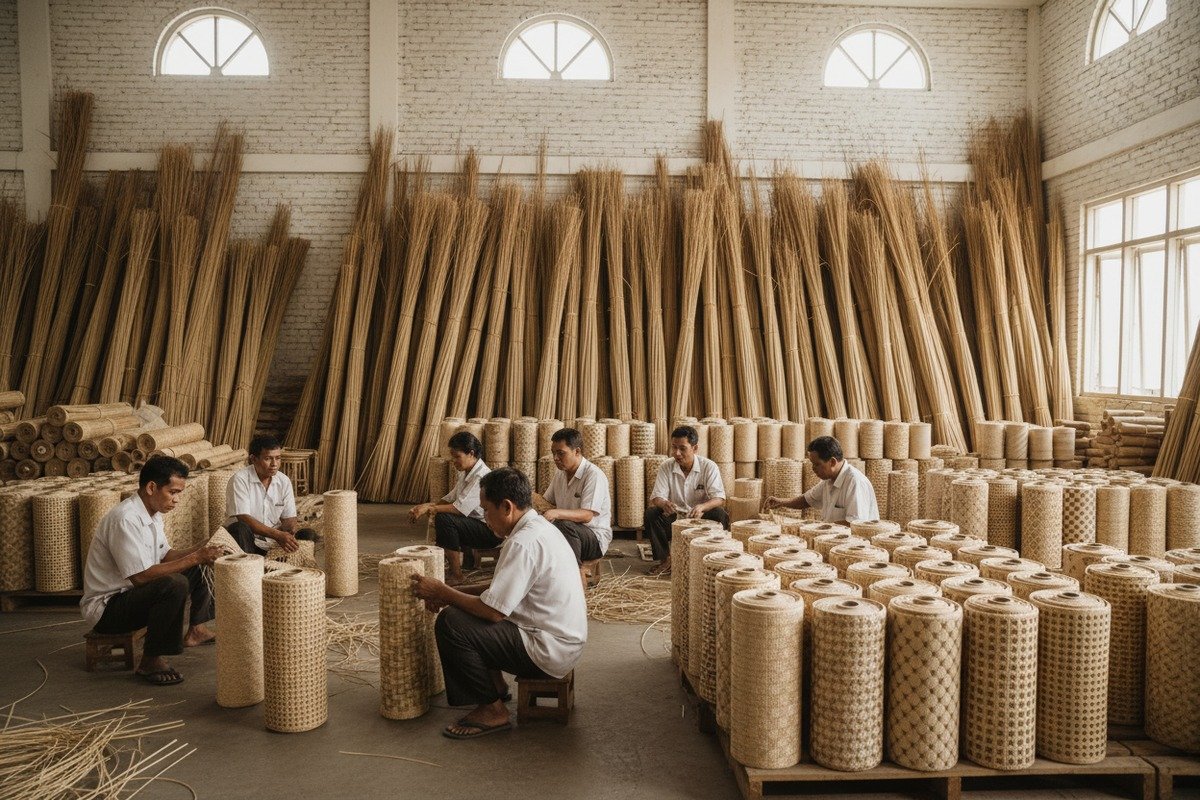
Our production floor in Indonesia processes thousands of أعمدة الروطان 2 each month, and we see firsthand how much raw material gets rejected before it earns a Grade A label. Yet many online listings use "Grade A" loosely, leaving buyers confused about what they are actually paying for.
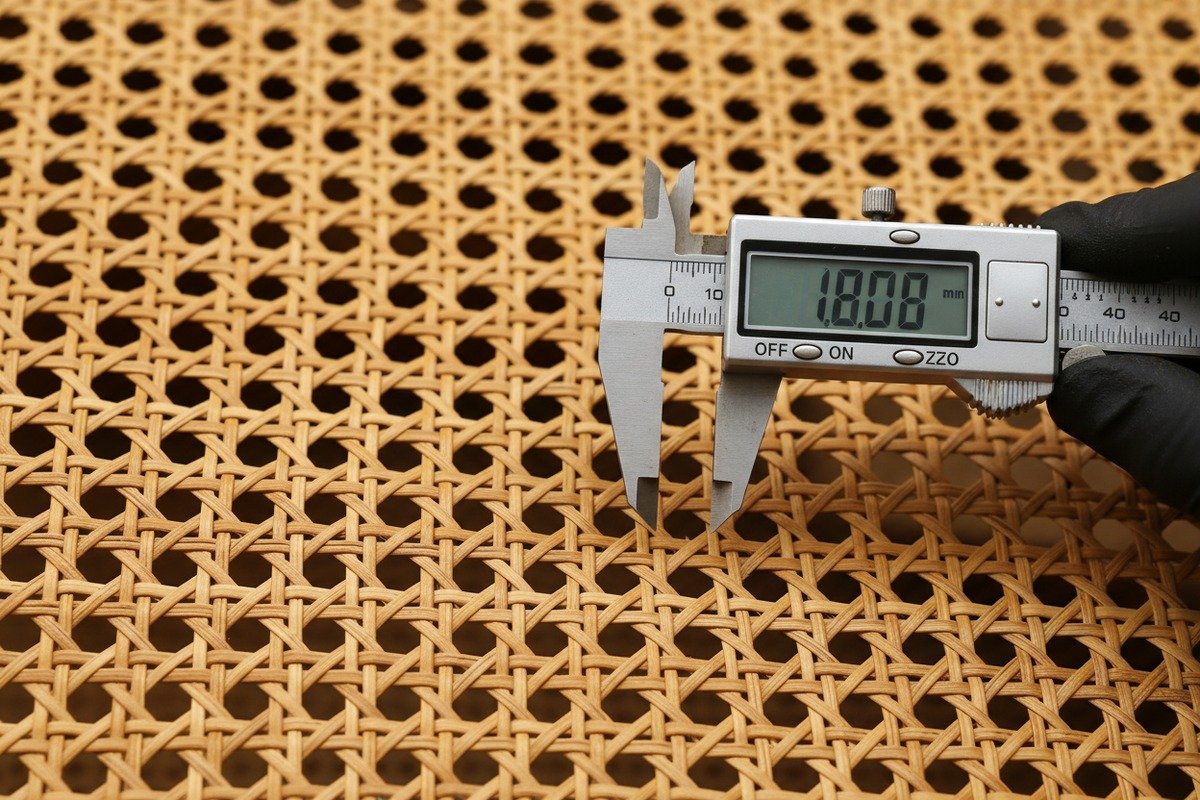
Grade A natural rattan cane webbing features uniform strand thickness, a tight and consistent weave with no gaps, a smooth sanded surface free of dark spots or cracks, and a natural golden-brown color with minimal node marks. Always request a physical sample and close-up photos before committing to bulk orders.
ماذا يعني "الدرجة الأولى" في الواقع؟
There is no universal certification body that stamps rattan webbing as "Grade A." The term is an industry convention 3. It refers to the top tier of a supplier's own sorting process. At our rattan processing facility, we grade based on five criteria: strand uniformity, weave tightness, surface finish, color consistency, and flexibility. Grade B and C materials have visible defects—uneven thickness, dark blemishes, or brittle strands that snap easily.
Key Visual Indicators to Check
When you receive a sample or review product photos, look for the following:
- سمك الخيط: Each strand should be close to the same diameter. Hold the sheet up to light. If you see wildly different strand widths, that is a lower grade.
- Weave pattern regularity: The hexagonal, octagonal, or square openings 4 should be even across the entire sheet. Lopsided holes signal rushed or unskilled weaving.
- نعومة السطح: Run your finger across the webbing. Grade A rattan is polished and sanded. You should not feel splinters or rough patches.
- Color: Natural, unbleached rattan ranges from pale straw to golden brown. Extreme dark spots indicate nodes that were not properly trimmed, or mold exposure during storage.
- المرونة: Bend a small section gently. It should flex without cracking. Brittle rattan was either harvested too early or dried improperly.
Grade A vs. Lower Grades: A Quick Comparison
| الميزة | Grade A | الدرجة ب | الدرجة ج |
|---|---|---|---|
| توحيد الخيوط | متسق للغاية | اختلافات طفيفة | Noticeable differences |
| إحكام النسيج | ضيق، لا فجوات | بقع فضفاضة عرضية | فجوات غير منتظمة |
| تشطيب السطح | Smooth, splinter-free | Slight roughness | Visible splinters |
| اتساق اللون | Even golden-brown | Some dark patches | Frequent blemishes |
| المرونة | ينحني دون تشقق | Slight stiffness | Prone to snapping |
| الاستخدام النموذجي | Premium furniture, export | Domestic market, mid-range | Budget products, filler |
The Sample Test: Never Skip It
We always encourage first-time buyers to order a sample pack before placing a bulk order. Many platforms like Etsy sell sample sets of 10 to 20 weave types for just a few dollars. For B2B transactions 5, most reputable manufacturers—including us—will send free or low-cost samples. When you receive the sample, test it. Soak a small piece in cool water for five minutes and then bend it around a curved surface. Grade A material will conform smoothly. Lower grades will resist or crack.
Beware of Bleached Material Sold as "Natural"
Some suppliers bleach rattan to achieve a uniform pale color and then market it as natural Grade A. Bleached rattan looks cleaner initially but loses strength over time. Ask your supplier directly: is this unbleached? True natural rattan has slight, organic color variations. That is actually a sign of authenticity, not a defect.
What roll widths and lengths should I confirm to minimize waste in my furniture manufacturing?
When we ship containers of rattan webbing to furniture factories in Europe and the Middle East, the most common regret we hear is: "We ordered the wrong width." A roll that is two inches too narrow for your chair seat means you either waste material on overlaps or re-order entirely.
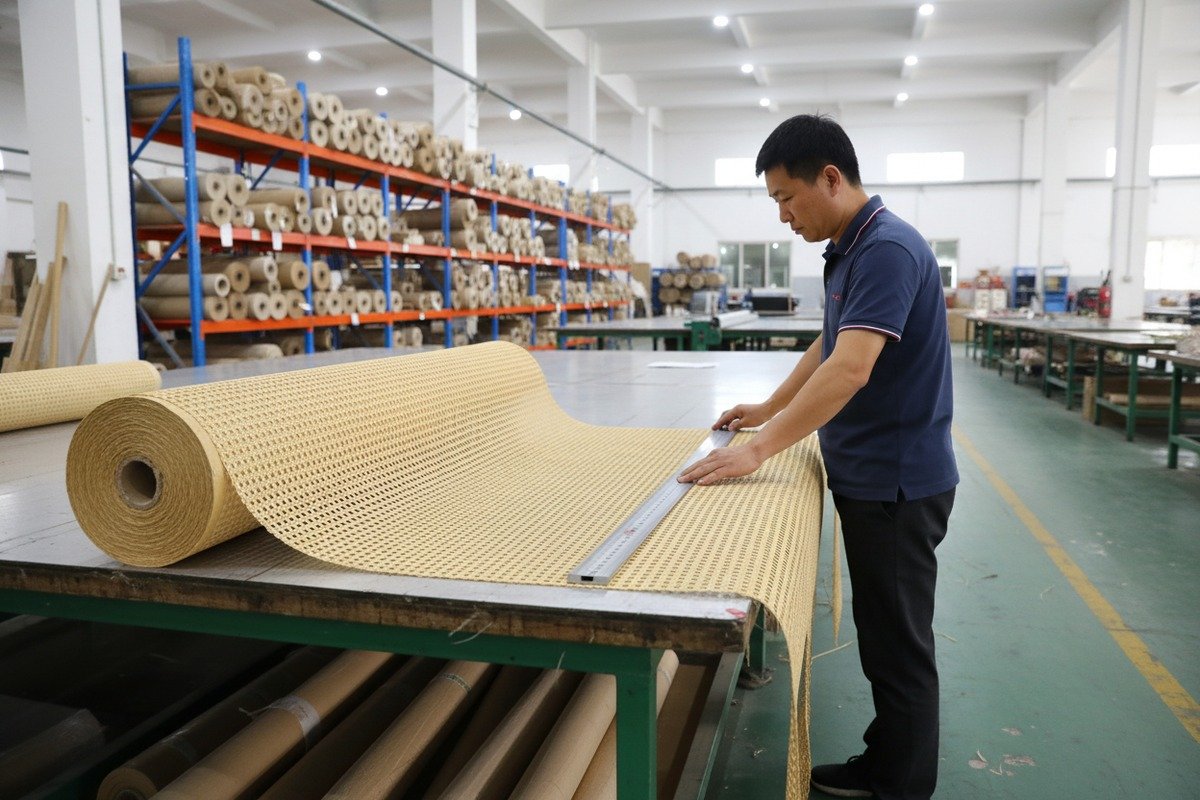
Confirm roll widths of 18 inches (45 cm), 24 inches (60 cm), or 27.5 inches (70 cm) based on your furniture dimensions. Standard roll lengths are 50 feet (15 meters), but custom lengths up to 100 feet are available. Measure your largest panel first, then add 2–3 inches per side for trimming and stapling allowance.
Match Roll Width to Your Furniture Design
The biggest source of waste in rattan furniture production is mismatched roll widths. If your chair back panel is 20 inches wide, buying 18-inch rolls forces you to splice two pieces—creating a visible seam and wasting labor. Buying 27-inch rolls for the same panel leaves 7 inches of scrap per cut. The math adds up fast over hundreds of units.
Here is a practical width guide based on common furniture applications:
| تطبيق الأثاث | عرض اللفة الموصى به | Typical Trim Allowance |
|---|---|---|
| مقعد كرسي طعام | 18"–19" (45–48 cm) | +2" per side |
| ظهر كرسي طعام | 19"–24" (48–60 cm) | +2" per side |
| إدخال باب خزانة | 12"–18" (30–45 cm) | +1.5" per side |
| لوح اللوح الأمامي | 24"–27.5" (60–70 cm) | +3" per side |
| شاشة تقسيم الغرفة | 24"–27.5" (60–70 cm) | +2" per side |
| لوحة جدارية زخرفية | 5. عرض مخصص | +2" per side |
Standard vs. Custom Roll Lengths
Most suppliers sell rolls at 50 feet (approximately 15 meters). This is the industry standard. For high-volume production, we offer 100-foot rolls that reduce the number of roll changes on the production line and cut down on end-piece waste. However, longer rolls are heavier and harder to handle. Discuss with your floor supervisor before ordering extra-long rolls.
How to Calculate Your Actual Needs
Follow this simple formula to avoid over-ordering or under-ordering:
- Measure the largest panel you need to cover in your product line.
- Add trim allowance: 2–3 inches on each side for folding, stapling, or gluing.
- Count total panels per production batch.
- Calculate linear footage: (Panel height + trim) × number of panels = total length needed.
- Add 10% buffer for defects, mis-cuts, and pattern alignment.
For example, if you produce 500 chairs and each seat panel requires 18 inches of linear webbing, your total is 500 × 18 inches = 9,000 inches = 750 feet. Add 10% buffer: 825 feet. That is about 17 rolls at 50 feet each.
Weave Pattern Affects Usable Width
Not all weave patterns behave the same when cut. Open hexagonal weaves can unravel slightly at the edges and need a wider trim margin. Close-woven or dense diamond patterns hold their edges better and allow tighter trimming. The fine 1/2-inch octagonal weave—considered the gold standard for furniture—falls somewhere in between. Factor the weave type into your trim calculations.
Ask Your Supplier About Tolerances
Roll widths can vary by ±0.5 inches between batches, especially with handmade webbing. Machine-woven rolls tend to be more consistent. Always ask your supplier about their width tolerance and whether they guarantee minimum usable width. At our factories, we guarantee that every roll meets the stated width as a minimum, so you never receive a roll that is narrower than what you ordered.
How can I verify that my supplier's pricing is competitive for the bulk volume I need?
Over the past decade, we have quoted rattan webbing to buyers in more than 20 countries. One thing we notice consistently is that many purchasing managers compare prices without comparing the same product specification. A $0.41 per unit quote and a $0.95 per square foot quote can look very different, but they might describe the exact same material.
To verify competitive pricing, normalize all quotes to the same unit of measure (price per square foot or per running meter), request quotes from at least three suppliers for identical specifications, and factor in shipping, customs duties, and MOQ requirements. The cheapest per-unit price is not always the lowest landed cost.
Normalize Your Price Comparisons
Different suppliers quote in different units. Some use price per roll, some per square foot, some per running meter, and some per piece. Before you compare, convert everything to one standard. We recommend price per square foot or price per running meter at a specified width. This eliminates confusion.
Here is an example of how the same material can look different depending on the unit:
| المورد | Quoted Price | Unit | العرض | Equivalent Price per Sq Ft |
|---|---|---|---|---|
| المورد أ | $0.41 | Per unit (1 sq ft) | 27.5" (70 cm) | $0.41 |
| المورد ب | $9.04 | Per roll (50 ft) | 24 بوصة (60 سم) | $0.09 |
| المورد ج | $3.79 | Per running foot | 19" (48 cm) | $2.39 |
| Supplier D | $0.95 | Per sq ft | 24 بوصة (60 سم) | $0.95 |
As you can see, Supplier B's roll price looks high at first glance but converts to just $0.09 per square foot—the cheapest option by far. Always do the math.
Get at Least Three Comparable Quotes
Reach out to a minimum of three suppliers. Make sure you send the exact same specification to each: weave pattern, width, length, grade, and whether you want bleached or unbleached. If one supplier quotes for a close-woven pattern and another quotes for open hexagonal, you are comparing apples to oranges.
Factor in Total Landed Cost
The unit price on the invoice is only part of the equation. Your true cost includes:
- FOB price (the product cost at the port of origin)
- شحن بحري (varies by container size and destination)
- التأمين
- رسوم الاستيراد والتعريفات الجمركية (check your country's رمز النظام المنسق 8 for rattan products)
- Inland transport from your local port to your warehouse
- Handling and inspection fees
A supplier offering $0.05 less per square foot might ship from a port with higher freight rates, erasing any savings. We always provide full FOB pricing and can arrange CIF quotes so our clients see the real cost before they commit.
MOQ and Volume Discounts
Most manufacturers, including us, offer tiered pricing. The more you order, the lower the per-unit cost. Typical MOQ for bulk rattan webbing starts at 200–500 rolls. If you only need 20 rolls, you will pay a premium. In that case, consider consolidating orders with other products from the same supplier—like rattan poles, rattan peel, or woven panels—to reach a volume tier that unlocks better rates.
Watch Out for Hidden Costs
Some suppliers quote low but charge extra for quality sorting, custom widths, palletizing, or fumigation certificates required for wood/rattan imports. Ask upfront: does your quote include fumigation? Does it include export packing? Does it include quality inspection? A transparent supplier will itemize everything. If they hesitate, that is a red flag.
What steps should I take to guarantee the packaging will protect my rattan rolls during international transit?
We learned this lesson the hard way early in our export history. A container of rattan webbing arrived in the Netherlands with moisture damage on the outer layers of nearly 30% of the rolls. The cause was not rain—it was condensation inside the container during a three-week ocean voyage. Since then, our packaging protocols have become one of the strictest in the industry.
To protect rattan rolls during international shipping, insist on individual plastic wrapping for each roll, moisture-absorbing desiccant packets inside the wrapping, rigid cardboard or wooden crate outer packaging, and proper palletization with stretch wrap. Also confirm that your supplier provides fumigation certificates and container loading plans to prevent crushing.
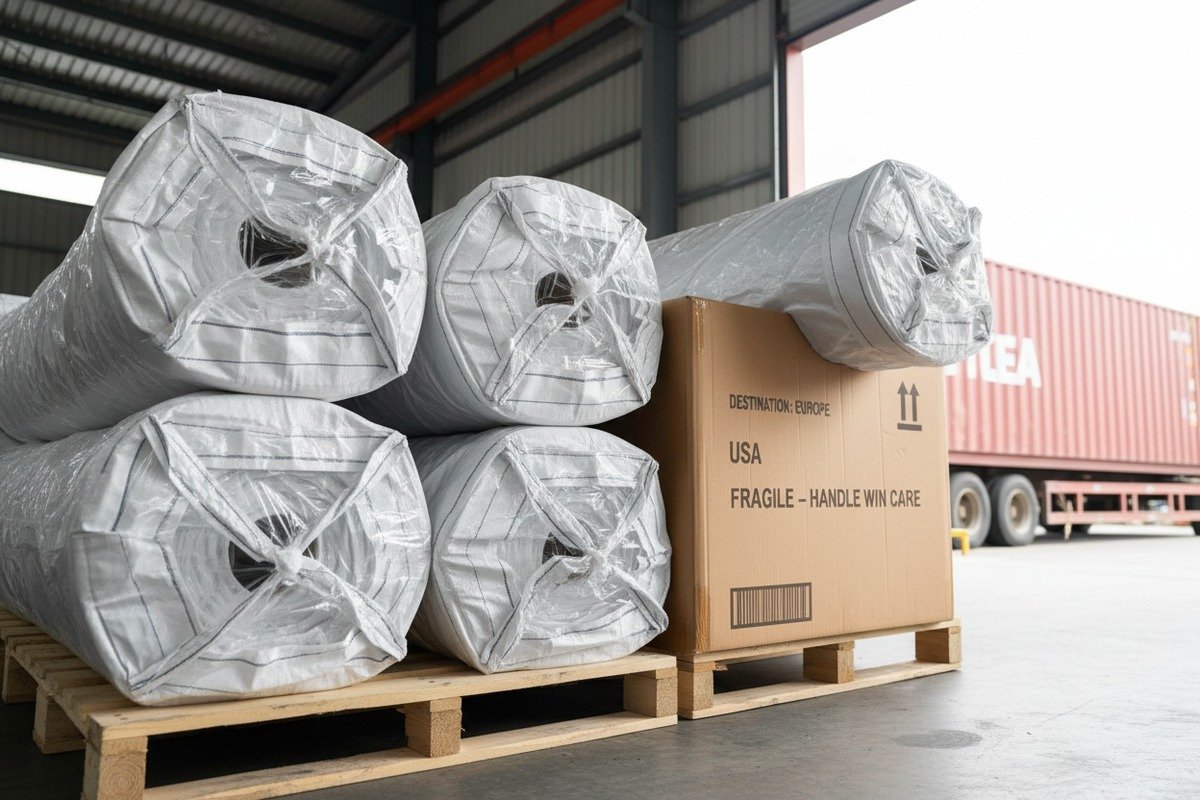
لماذا التعبئة والتغليف أهم مما تعتقد
الروطان الطبيعي مسترطبة 9. It absorbs moisture from the air. During ocean transit, container temperatures can swing 20–30°C between day and night, causing condensation—often called "container rain." If rolls are not properly sealed, this moisture soaks into the outer layers, causing mold, discoloration, and weakened fibers. By the time the container reaches your warehouse, the damage is done and often invisible until you unroll the product.
The Five Layers of Protection
Effective rattan packaging uses a multi-layer approach:
- غلاف داخلي: Each roll is individually wrapped in plastic film (PE shrink wrap) to create a moisture barrier.
- مجفف: Silica gel or calcium chloride packets are placed inside the wrap to absorb any trapped humidity.
- غلاف خارجي: A second layer of kraft paper or woven PP bag provides physical protection against scuffs and abrasion.
- Box or crate: Rolls are packed into sturdy cardboard boxes or wooden crates. Wooden crates are preferred for heavy or oversized shipments.
- التعبئة على منصات نقالة: Boxes are stacked on fumigated wooden pallets, secured with corner protectors and stretch wrap, and strapped with PP bands.
What to Ask Your Supplier Before Shipment
Before any container is loaded, get clear answers to these questions:
- Will each roll be individually plastic-wrapped?
- Are desiccant packets included inside the wrapping?
- What is the outer packaging—cardboard box or wooden crate?
- Are pallets heat-treated and ISPM-15 certified for international customs?
- Will you provide a container loading plan showing how rolls are stacked?
- Can you share photos of the packed goods before the container is sealed?
At our facility, we send our clients pre-loading photos and a packing list that details every roll's position in the container. This level of transparency prevents disputes and builds trust.
Fumigation and Compliance Documents
Many countries require a fumigation certificate or phytosanitary certificate for rattan products. Rattan is a plant material, and customs authorities want proof that it is pest-free. We handle ISPM-15 treatment for all wooden packaging and provide methyl bromide or heat treatment certificates for the rattan itself when required. Make sure your supplier knows your country's import regulations before shipping. A missing certificate can hold your container at the port for weeks, incurring daily demurrage charges.
أفضل الممارسات لتحميل الحاويات
How rolls are loaded inside the container matters just as much as how they are wrapped. Heavy rolls on the bottom, lighter ones on top. No gaps between pallets—fill voids with airbags or foam blocks to prevent shifting during rough seas. The container floor should be lined with moisture barrier paper. And ventilation channels between pallet stacks allow air circulation, reducing condensation risk.
Real Damage vs. Cosmetic Issues
Not all shipping imperfections are cause for rejection. Slight compression marks on the outer layer of a roll are cosmetic and disappear once the webbing is unrolled and installed. True damage—mold growth, water staining deep into the roll, or crushed weave structure—is grounds for a claim. Discuss damage assessment criteria with your supplier beforehand so both sides agree on what constitutes a valid complaint.
خاتمة
Buying نسيج الخيزران الطبيعي 10 online does not have to be risky. Confirm quality grades, match roll dimensions to your production needs, normalize pricing across suppliers, and demand export-grade packaging. These four steps protect your investment every time.
ملاحظات سفلية
1. Reference 8. ↩︎
2. Describes the harvesting and initial processing of rattan poles. ↩︎
3. Reference 4. ↩︎
4. Illustrates different common weave patterns in rattan webbing. ↩︎
5. Explains the concept of business-to-business commercial exchanges. ↩︎
6. Discusses different quality grades for natural rattan webbing. ↩︎
7. Discusses the process and effects of chemical bleaching on rattan. ↩︎
8. Explains the Harmonized System (HS) code for international trade. ↩︎
9. Defines ‘hygroscopic’ in the context of material properties. ↩︎
10. Provides a comprehensive overview of natural rattan cane webbing. ↩︎

 English
  Español de México
  العربية
  Deutsch
  Français
  Русский