
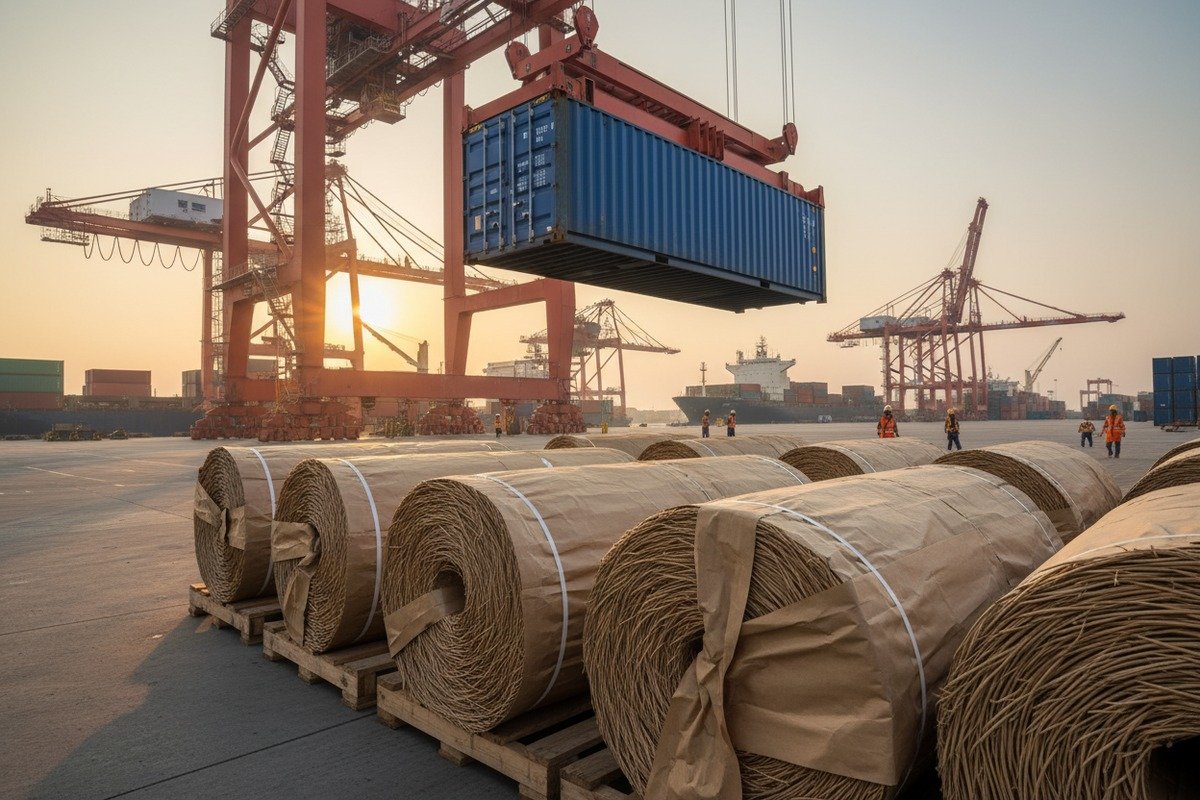
Every year, our warehouses in Foshan and Indonesia dispatch thousands of rattan cane webbing rolls to ports across the globe certificate of origin 1. The one thing that keeps buyers up at night is not the order itself — it is whether those beautiful, handwoven rolls will survive a 30-day ocean voyage. Moisture, mold, crushed edges, customs holds — we have seen it all bill of lading 2. And the painful truth is that most shipping disasters are preventable.
Shipping rattan cane webbing by sea demands careful attention to moisture-proof packaging, proper container ventilation, optimized load planning, and complete export documentation. Addressing these four pillars protects your cargo from mold, physical damage, customs delays, and inflated freight costs throughout the voyage.
Below, we break down each critical area so you can place your next bulk order with confidence. Whether you are a furniture factory in the Netherlands or a material wholesaler in Thailand, these lessons come straight from our shipping floor.
How can I protect my rattan cane webbing from moisture and mold during long sea voyages?
In our experience shipping to over 40 countries, moisture is the single biggest threat to شبكة الروطان الطبيعي الخاصة بنا 3 at sea. One client in Spain once lost an entire 20-foot container because a single layer of protection was skipped.
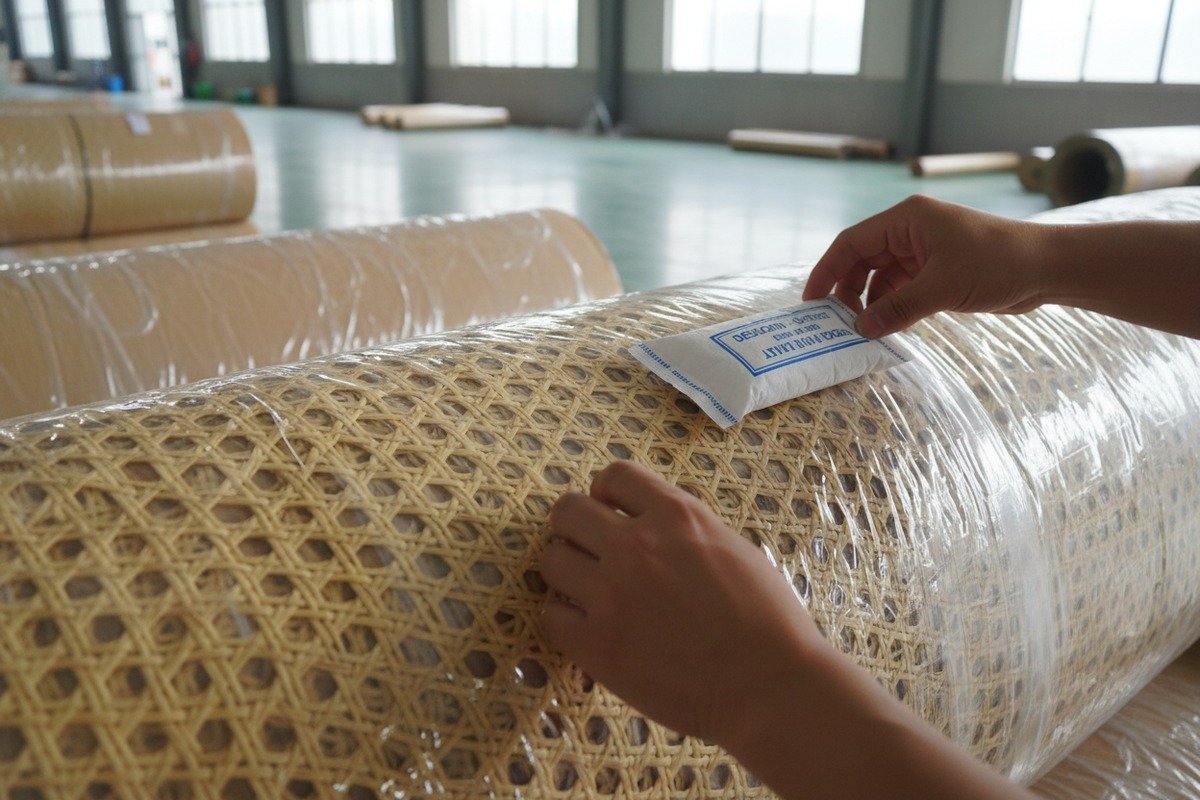
To protect rattan cane webbing from moisture and mold, use multi-layer moisture-proof packaging, place calcium chloride desiccants throughout the container, ensure proper ventilation gaps, and verify that material moisture content is below 12% before loading.
Why Moisture Is So Dangerous for Natural Rattan
Rattan is a hygroscopic material. It absorbs and releases moisture based on the surrounding environment. Inside a sealed steel container on the open ocean, temperatures swing dramatically between day and night. This creates "مطر الحاوية 4" — condensation that drips from the container ceiling directly onto your cargo. Natural rattan cane webbing soaks up that moisture. Within days, mold spores activate. The result is black spots, musty odor, and structural weakness that makes the webbing unsaleable.
Synthetic rattan (PE-based) handles humidity far better. But most buyers want natural rattan for its authentic look, warmth, and sustainability appeal. So we must manage the risk rather than avoid the material.
Pre-Shipment Moisture Control
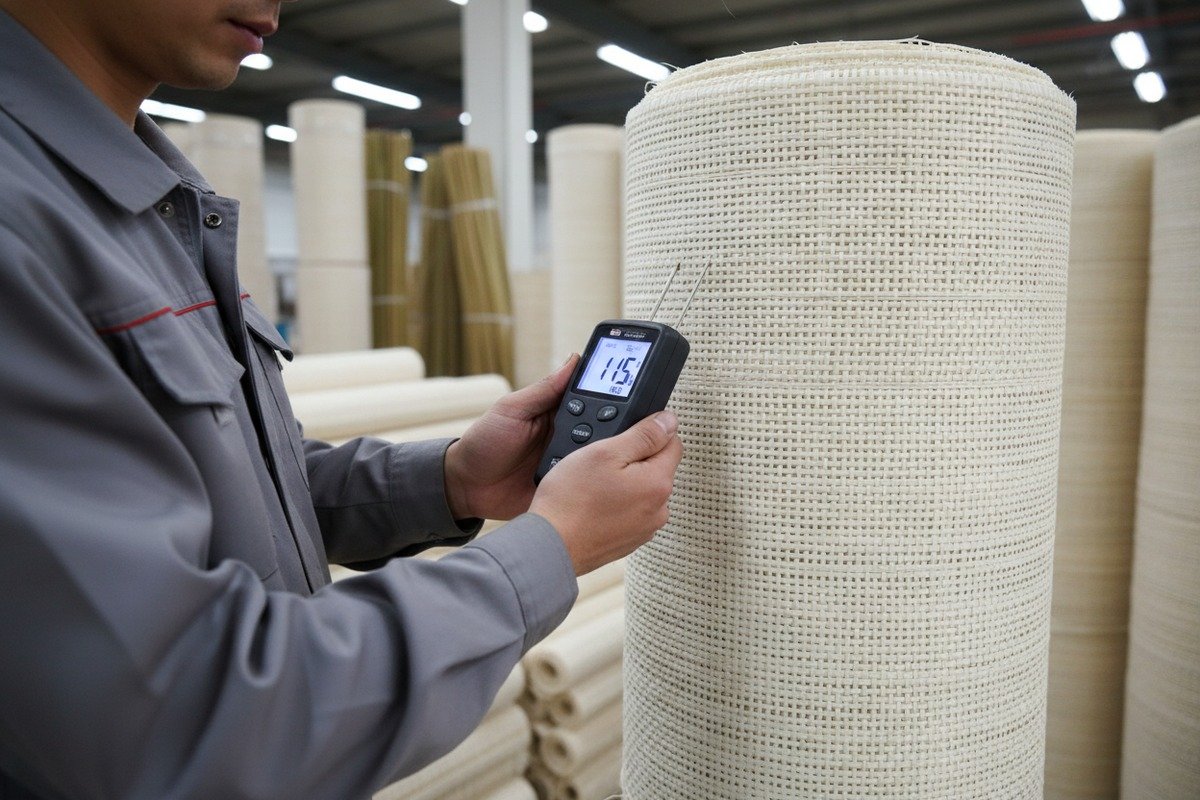
Before any roll leaves our factory, we measure its moisture content. We aim for below 12%. If the rattan was harvested during a wet season in Indonesia, extra drying time is scheduled. Rushing this step is the most common mistake we see from inexperienced suppliers.
In-Container Protection Layers
Here is the layered defense system we use for every sea shipment:
| Protection Layer | المواد المستخدمة | الغرض |
|---|---|---|
| غلاف داخلي | ورق كرافت مقاوم للرطوبة | Direct barrier against humidity on each roll |
| Secondary wrap | Polyethylene film | Seals out ambient moisture |
| Desiccant packs | Calcium chloride (CaCl₂) | Absorbs excess moisture inside the container |
| علبة خارجية | Double-wall corrugated board | Structural protection and airflow buffer |
| Container lining | Foil-backed insulation blanket | Reduces temperature swings and condensation |
Ventilation: The Hidden Debate
There is a genuine debate among logistics experts about ventilation. Tight wrapping prevents moisture ingress — but it can also trap existing moisture inside the packaging, creating a miniature greenhouse effect. Our approach is a compromise: we wrap each roll tightly but leave micro-perforations in the outer polyethylene layer. We also place desiccants both inside the roll wrapping and loose inside the container. This dual strategy handles moisture from both internal and external sources.
For voyages longer than 30 days, especially to Europe or the US East Coast, we double the number of desiccant packs. A standard 20-foot container gets 8 to 12 packs. A long-haul container gets 16 to 20.
Natural vs. Synthetic: Moisture Risk Comparison
| عامل | حشو الروطان الطبيعي | شرائط روطان اصطناعية (بولي إيثيلين) |
|---|---|---|
| Moisture absorption | High — hygroscopic fibers | Very low — plastic material |
| خطر العفن | High without protection | ضئيل |
| Container rain vulnerability | شديد | الحد الأدنى |
| Required desiccant quantity | 16–20 packs per 20ft container | 4–6 packs (precautionary) |
| Recommended moisture content before loading | أقل من 12% | غير قابل للتطبيق |
The takeaway is simple. Natural rattan demands more care. But with the right protocols, it arrives in perfect condition — and commands a higher market price.
What packaging standards should I expect to ensure my bulk rattan rolls arrive without damage?
When our team prepares a shipment for clients in Australia or the Middle East, packaging is where we spend the most planning time. A roll that shifts even a few centimeters during transit can end up with crushed edges or permanent deformation.
Expect export-grade packaging that includes moisture-proof kraft paper inner wrap, foam or corrugated padding, reinforced outer cartons or wooden crating, and industrial strapping. Each roll should be individually wrapped and secured to prevent movement inside the container.
The Anatomy of Proper Rattan Packaging
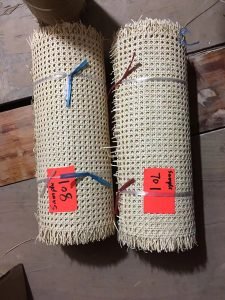
Rattan cane webbing comes in rolls and flat sheets. Rolls are typically 10 to 30 meters long, with widths ranging from 40 cm to 180 cm. Natural rattan rolls tend to be shorter — usually maxing out around 15 meters — because the raw cane strips have natural length limits. Synthetic rolls can be longer since the material is extruded continuously.
Each form factor has different packaging needs. Rolls need core tubes to prevent collapse. Flat sheets need rigid backing boards to prevent bending.
Packaging Layers in Detail
Our standard export packaging follows this sequence:
- Core tube insertion. Every roll is wound around a sturdy cardboard or PVC core tube. This prevents the center from collapsing.
- Inner wrap. Moisture-proof kraft paper goes around the entire roll. This is the first moisture barrier.
- Padding layer. Foam sheets or corrugated cardboard wrap around the kraft paper. This absorbs shocks from handling.
- Outer protection. The roll goes into a double-wall corrugated carton or, for large orders, a wooden crate. We use heat-treated wood that meets ISPM-15 standards 5 for international shipping.
- Strapping. Polypropylene or steel straps secure the package. We place at least two straps per roll to prevent shifting.
What About Palletization?
For container-load orders, we palletize rolls in groups. Each pallet is shrink-wrapped and corner-protected with L-shaped cardboard guards. Pallets are stacked no more than two high inside the container to avoid crushing. Between pallet layers, we insert plywood separator boards.
Common Packaging Failures We Have Seen
Over the years, we have received complaints — not about our own packaging, but from buyers who switched to cheaper suppliers. The most frequent issues:
- No core tube. The roll collapses inward, creating permanent creases in the webbing pattern.
- Single-wall cartons. These crush easily under container stacking pressure.
- No strapping. Rolls shift during transit, causing edge abrasion.
- Recycled packaging materials. Some suppliers reuse old cartons. These have weakened structural integrity and sometimes carry residual moisture.
We always recommend that buyers request packaging samples or photos before confirming an order. A trustworthy supplier will provide these without hesitation.
Roll Specifications and Packaging Requirements
| نوع الشريط | طول اللفة النموذجي | نطاق العرض النموذجي | Core Tube Required | التغليف الخارجي الموصى به |
|---|---|---|---|---|
| Natural open-mesh (radio weave) | 10-15 متر | 40–90 سم | Yes (cardboard) | كرتون مزدوج الجدار |
| Natural close weave (basketweave) | 10-15 متر | 45–100 سم | Yes (cardboard) | Double-wall carton or wooden crate |
| Bleached natural rattan | 10-15 متر | 40–90 سم | Yes (cardboard) | Double-wall carton with extra moisture wrap |
| الروطان الاصطناعي من البولي إيثيلين | 15–30 م | 60–180 cm | Yes (PVC) | Shrink-wrap + carton or crate |
Buyers should compare these specs against what their supplier quotes. Any significant deviation — especially shorter rolls or narrower widths — should be questioned before shipment.
How do I optimize my container load to get the best shipping rates for my wholesale order?
Our logistics team in Foshan handles container planning daily. The difference between a well-planned load and a poorly planned one can be $800 to $1,500 per shipment — money that goes straight to your bottom line.
To optimize container loads, match your order volume to standard container sizes, maximize cubic utilization by mixing roll sizes strategically, choose FOB terms for freight control, consolidate orders across product categories, and avoid dead space that inflates your per-unit shipping cost.
Understanding Container Economics
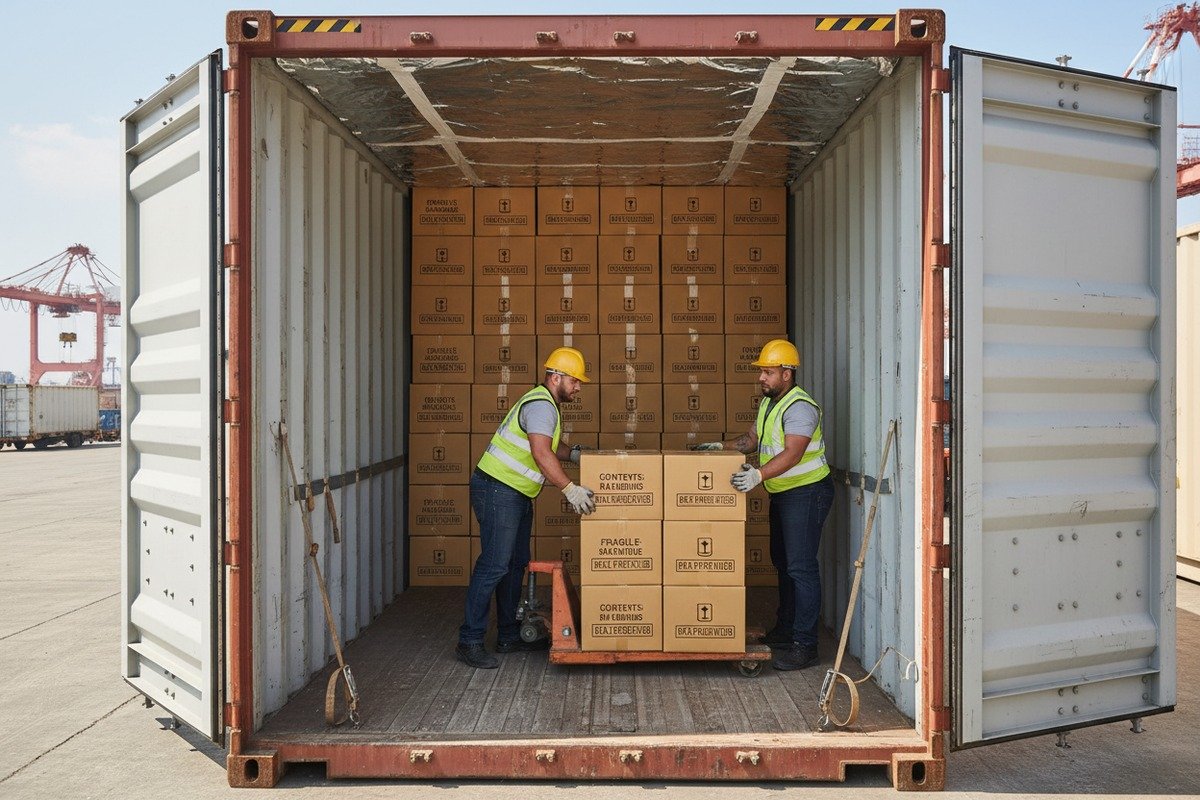
Sea freight is priced primarily by container, not by weight — unless your cargo is extraordinarily heavy. Rattan cane webbing is lightweight but bulky. This means you are almost always paying for space, not mass. The goal is to fill every cubic meter of the container.
A standard 20-foot container offers about 33 cubic meters of usable space. A 40-foot container gives roughly 67 cubic meters. A 40-foot high-cube container adds about 9 more cubic meters.
How We Plan a Load
When a buyer sends us their order list, our logistics team builds a 3D loading plan. We consider:
- Roll diameters and lengths
- Carton dimensions after packaging
- Stacking limits (weight and crush resistance)
- Aisle space needed for unloading at destination
- Desiccant and padding placement
We often recommend mixing products. For example, if you are ordering both wide-roll synthetic webbing 6 and narrow-roll natural webbing, we can nest the smaller rolls inside the gaps left by the larger ones. This approach regularly saves clients 10% to 15% on freight per unit.
FOB vs. CIF: Which Is Better for You?
| Shipping Term | Who Arranges Freight? | Who Pays Freight? | Who Bears Risk During Voyage? | الأفضل لـ |
|---|---|---|---|---|
| FOB (التسليم على ظهر السفينة) | Buyer or buyer's forwarder | المشتري | Buyer (after loading) | Buyers with established freight contracts |
| CIF (Cost, Insurance, Freight) | المورد | Supplier (included in price) | Buyer (after loading) | Buyers who want simplicity |
| EXW (Ex Works) | المشتري | المشتري | Buyer (from factory gate) | Very experienced importers only |
Most of our clients in the US and Europe prefer FOB. They have long-term relationships with freight forwarders who offer competitive rates. Our clients in the Middle East and Southeast Asia often prefer CIF because it simplifies their procurement process.
نصائح التجميع
If your rattan webbing order does not fill a full container, consider these strategies:
- Combine with other rattan products. We supply rattan poles, rattan peel, woven panels, and finished furniture components. Mixing categories in one container maximizes space.
- Share a container (LCL). Less-than-container-load shipping is an option, but per-unit costs are higher, and your cargo shares space with other shippers' goods — increasing handling risk.
- Time your orders. Placing a larger order every quarter instead of small monthly orders almost always reduces total freight cost.
Real Numbers
One of our regular clients in the Netherlands orders 800 rolls per quarter. By consolidating into two 40-foot high-cube containers instead of three 20-foot containers, they save approximately $2,200 per shipment. Over a year, that is nearly $9,000 — significant for a mid-sized wholesaler.
What documents must my supplier provide to ensure my rattan shipment clears customs smoothly?
Our export documentation team processes paperwork for shipments to dozens of countries each month. We know from hard experience that a missing certificate can hold your container at port for weeks — costing storage fees and delivery delays.
Your supplier must provide a commercial invoice, packing list, bill of lading, certificate of origin, phytosanitary certificate for natural plant materials, and any destination-specific fumigation or treatment certificates. Missing even one document can trigger customs holds and costly delays.

The Core Document Set
Every international rattan shipment requires a baseline set of documents. These are non-negotiable regardless of destination:
- الفاتورة التجارية. Details the buyer, seller, product description, quantity, unit price, total value, and payment terms. Customs authorities use this to assess duties and taxes.
- قائمة التعبئة. Itemizes every carton, roll, and pallet in the shipment. Includes dimensions, weights, and contents. This must match the الفاتورة التجارية 7 exactly.
- Bill of Lading (B/L). Issued by the shipping line. This is your proof of shipment and title to the goods. It comes in original or telex-release form.
- Certificate of Origin (CO). Proves where the goods were manufactured. Some countries require a Form A or Form E for preferential tariff treatment.
Phytosanitary Requirements: The Critical Extra Step
Natural rattan is a plant product. Many countries require a صحة نباتية 8 issued by the exporting country's plant quarantine authority. This confirms that the rattan has been inspected and is free of pests and diseases.
For our shipments from Indonesia, we obtain this certificate from the Indonesian Agricultural Quarantine Agency (Barantan). For shipments from our Foshan facility, the Chinese equivalent applies.
Some destination countries go further. Australia, for example, has extremely strict biosecurity laws. Rattan imports may require additional fumigation treatment — typically methyl bromide or heat treatment — with a certificate proving compliance.
The European Union requires compliance with EU wood and plant product regulations. The US requires adherence to USDA APHIS import guidelines for plant materials.
Common Documentation Mistakes
- Mismatched quantities. If the packing list says 500 rolls but the commercial invoice says 480, customs will flag it.
- Vague product descriptions. Writing "rattan material" is not enough. Specify "natural rattan cane webbing, open hexagonal weave, 60 cm width, 15 m rolls."
- Missing HS codes. Every product needs a Harmonized System code. For rattan webbing, the typical رمز النظام المنسق 9 falls under Chapter 46 (manufactures of plaiting materials). The exact subheading depends on whether the product is natural or synthetic.
- Expired phytosanitary certificates. These have a validity period — usually 14 to 21 days from issue. If your shipment is delayed, the certificate may expire before arrival.
Country-Specific Requirements to Watch
Not all countries treat rattan imports the same way. Here are a few we deal with regularly:
- Australia: Requires fumigation certificate, BICON import permit, and sometimes AQIS inspection upon arrival.
- USA: USDA phytosanitary inspection. قانون لاسي 10 compliance if claiming natural plant origin.
- EU: CE marking not required for raw materials, but EUDR (EU Deforestation Regulation) may apply to rattan sourced from certain regions starting 2025–2026.
- Saudi Arabia: SASO conformity certificate for certain finished goods. Raw webbing usually exempt, but confirm with your customs broker.
Insurance: Do Not Skip It
Standard marine cargo insurance covers loss from sinking, fire, or collision. But it often does not cover mold, discoloration, or moisture damage — the most likely risks for rattan. We strongly advise buyers to request "all-risk" coverage and specifically confirm that humidity-related damage is included. The premium difference is small — typically 0.3% to 0.5% of cargo value — but the protection is enormous.
One of our US clients once filed a claim for a $42,000 shipment that arrived with mold damage. Because they had all-risk coverage with explicit humidity protection, the insurer paid 85% of the claim. Without that clause, they would have received nothing.
خاتمة
Shipping rattan cane webbing by sea is reliable and cost-effective when you control moisture, packaging, container planning, and documentation. Work with a supplier who understands these details — your cargo will arrive intact, and your business will grow.
ملاحظات سفلية
1. Replaced HTTP 404 trade.gov link with a working and authoritative trade.gov page discussing certificates of origin. ↩︎
2. Official US maritime agency context for international shipping documentation. ↩︎
3. Background on the botanical properties and harvesting of natural rattan. ↩︎
4. Explanation of the condensation phenomenon inside shipping containers during transit. ↩︎
5. Official international standard for regulating wood packaging in global trade. ↩︎
6. Information on the composition and durability of synthetic resin wicker. ↩︎
7. Official US government guide on commercial invoices for international trade. ↩︎
8. Official USDA guidelines for plant health export certification and documentation. ↩︎
9. Official WCO explanation of the global product classification system. ↩︎
10. Official US law governing the trade of plants and plant products. ↩︎

 English
  Español de México
  العربية
  Deutsch
  Français
  Русский