
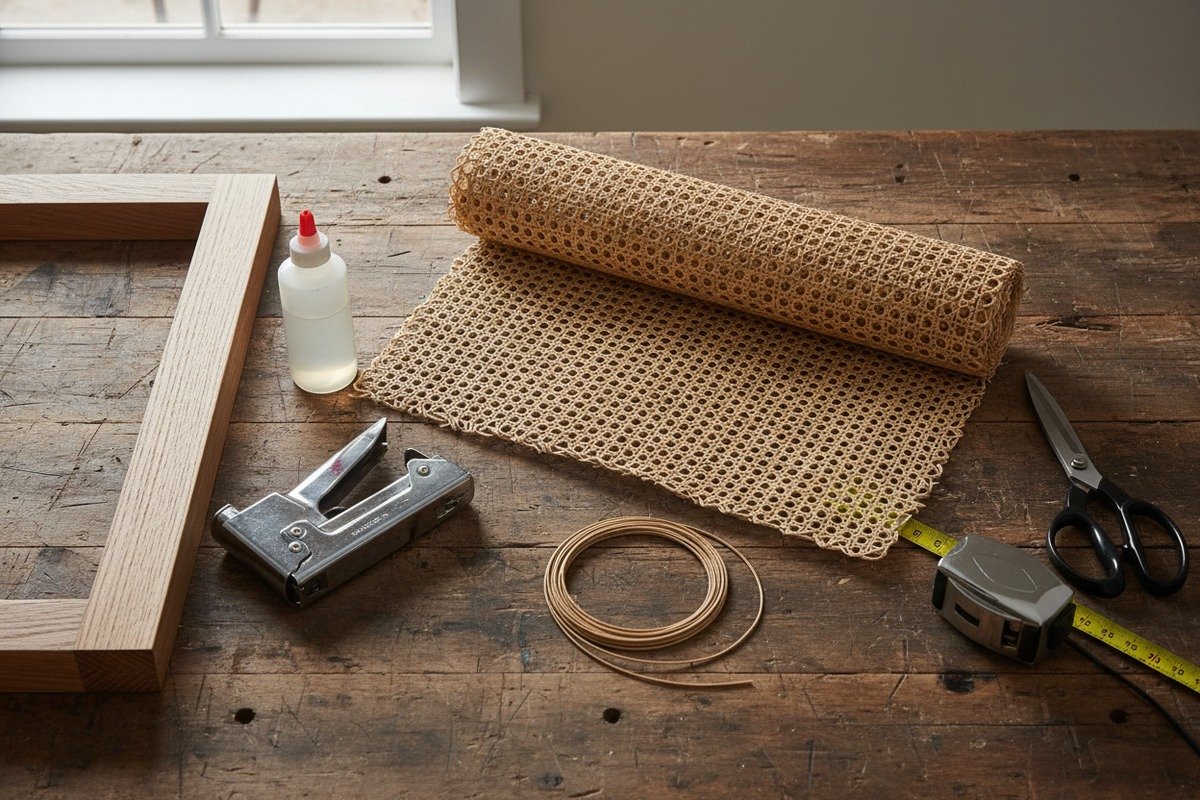
كل أسبوع، يشحن فريق الإنتاج لدينا في فوشان rattan cane webbing 1 to DIY enthusiasts and furniture makers worldwide. One question keeps coming back through WhatsApp, email, and social media: what exactly do I need to build a rattan screen from scratch? The problem is simple — start without the right materials, and you end up with a saggy, uneven, or short-lived screen. The frustration is real, especially when you have already cut into an expensive roll of premium webbing. The solution? Know your full materials list before you make a single cut.
A DIY rattan cane webbing screen requires natural or synthetic rattan webbing, a wooden frame built with grooves or flat rails, spline or round reed for edging, adhesives and fasteners like wood glue and a staple gun, basic cutting and measuring tools, and a protective finish such as sealant or stain for durability.
This guide breaks down every material and tool you need, from choosing the right grade of webbing to protecting your finished screen for years of use. Let’s walk through each step so you can plan your project with confidence.
How do I choose the right grade of rattan cane webbing for my DIY screen?
Picking the wrong grade of rattan webbing is one of the most common mistakes we see from first-time buyers. In our experience shipping to over 20 countries, the grade you choose affects everything — from how your screen looks to how long it lasts. The pain of receiving webbing that is too stiff, too loose, or poorly woven is something we help customers avoid every day.
Choose Grade A or Grade AA natural rattan cane webbing for screens, as these grades offer consistent strand thickness, uniform color, and minimal knots. For outdoor or high-traffic areas, consider synthetic rattan webbing, which resists moisture and UV damage while mimicking the natural look.
فهم درجات الخيزران
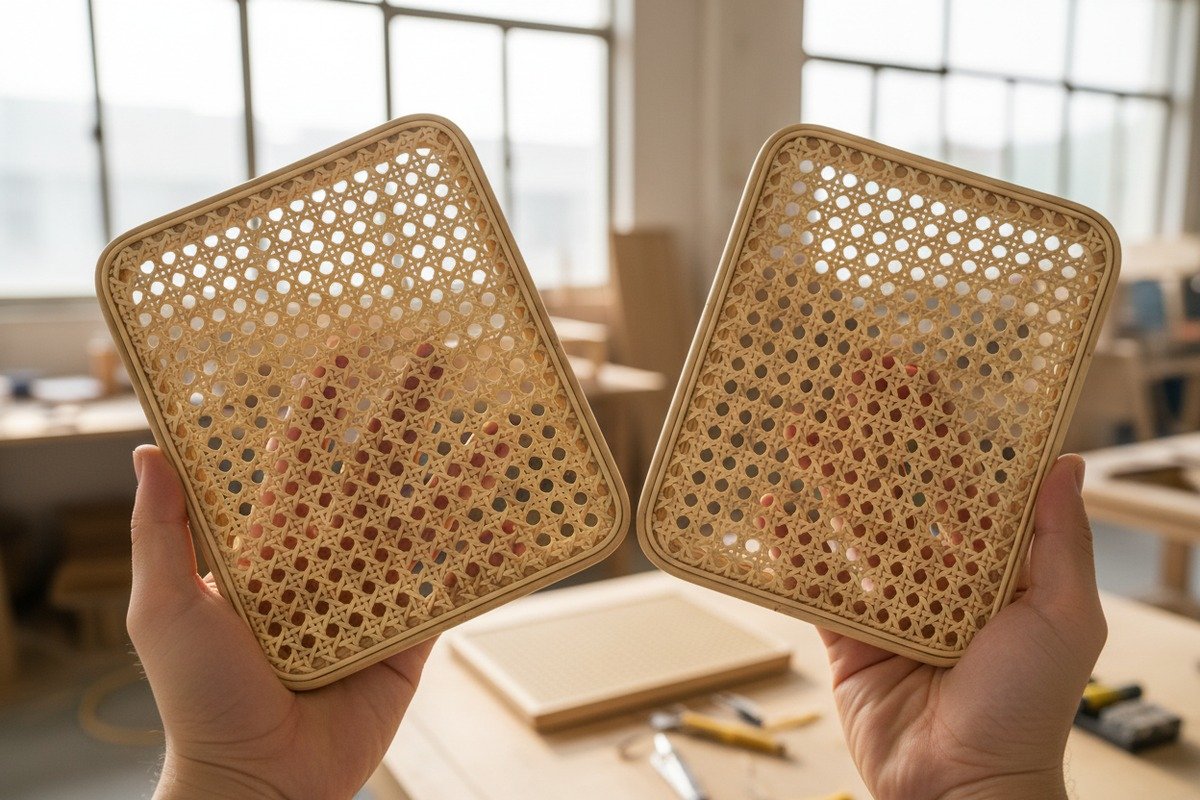
الروطان شبكة القصب 2 is graded based on the quality of the raw cane strands. Grade A means the strands are uniform in width, color, and flexibility. Grade B may have slight color variation or minor imperfections. Grade C often shows knots, splits, or uneven weaving. For a screen that sits in your living room or bedroom, Grade A is the minimum you should consider.
When we process rattan at our facility in Indonesia, the outer layer of the نخيل الروطان 3 is peeled, sorted, and graded before weaving. The best strands go into Grade AA webbing. These are the smoothest, most consistent pieces with a natural sheen. Lower grades still work for hidden applications like cabinet backs, but for a visible screen, quality matters.
Natural vs. Synthetic Rattan Webbing
This is a debate we hear constantly. Natural rattan offers warmth, organic texture, and a biodegradable footprint. It is lightweight and breathable. But it needs soaking in water for about 30 minutes before installation to become pliable. Synthetic rattan, on the other hand, skips the soaking step entirely. It is more durable in humid or outdoor settings and resists warping.
Here is a quick comparison to help you decide:
| الميزة | حشو الروطان الطبيعي | أشرطة الروطان الصناعي 4 |
|---|---|---|
| مصدر المادة | Rattan palm outer layer | Plastic or resin |
| هل يتطلب النقع؟ | Yes (30 minutes in warm water) | لا |
| مقاومة الأشعة فوق البنفسجية | Low — fades in direct sun | High — UV stabilized |
| الملمس والإحساس | دافئ، عضوي، خشن قليلاً | Smooth, uniform, less tactile |
| الصداقة البيئية | قابل للتحلل، متجدد | غير قابل للتحلل البيولوجي |
| أفضل استخدام | Indoor screens, boho decor | Outdoor screens, high-traffic areas |
| نطاق السعر | $15–$50 per roll | $20–$60 per roll |
Weave Patterns Matter
The weave pattern you choose changes the screen's look and function. An open hexagonal mesh (sometimes called "radio weave") lets more light and air pass through. It creates a soft, airy feel. A tighter square basketweave blocks more light and provides more privacy. A diamond motif or French weave sits somewhere in between.
For a room divider, consider how much privacy you need. An open mesh is great for a decorative accent. A tighter weave works better if you want to section off a space visually. Our clients who run furniture factories in the Netherlands and Australia often request medium Danish weave for its balanced look.
Sizing Your Webbing Roll
Standard rattan cane webbing comes in 24-inch-wide rolls, sold by the foot or in 10-meter lengths. For a three-panel folding screen, you will need enough to cover each panel plus 1 to 2 inches of overhang on every side. Measure twice, order once.
What specific tools and hardware do I need to assemble my rattan screen?
We have helped hundreds of buyers set up their first rattan screen projects, from small DIY hobbyists to furniture factories scaling production. The right tools make the difference between a frustrating weekend and a satisfying build. Without the correct hardware, even the best webbing will not sit right on your frame.
You need a measuring tape, pencil, saw, utility knife or scissors, staple gun, wood glue, sandpaper, a spline roller for grooved frames, clamps, hinges for folding screens, and optionally a spray adhesive or iron for heat-activated backing methods.
Cutting and Measuring Tools
Start with the basics. A measuring tape and pencil are non-negotiable. You need a saw — a circular saw, chop saw, or even a hand saw — to cut your frame lumber. For trimming the webbing itself, a sharp pair of scissors or a utility knife works well. A straight ruler or T-square helps you cut clean, even lines through the cane.
When our team demonstrates installations at trade shows, we always stress this: cut the webbing on a flat, clean surface. A self-healing cutting mat protects both your table and your blade.
Frame Building Essentials
Your frame is the backbone of the screen. Most DIY builders use pine or teak battens, typically 1-inch by 2-inch lumber. Plywood sheets work for flat-panel designs. You will need wood screws or finish nails to join the frame pieces. غراء خشب 5 adds strength to every joint. Sandpaper (120-grit and 220-grit) smooths the frame before finishing.
For folding screens, hinges 6 are essential hardware. Two hinges per panel junction is the standard. Use brass or stainless steel hinges — they resist corrosion and look clean.
Attachment Tools and Hardware
Here is where the method matters. There are two main approaches:
| Tool / Hardware | Staple/Glue Method | Grooved Spline Method |
|---|---|---|
| دباسة 7 | Required (staples every 2–3 inches) | غير مطلوب |
| بكرة الأخدود 8 | غير مطلوب | Required |
| Round reed or spline | Optional (decorative only) | Required (locks webbing in groove) |
| غراء خشب | For frame joints | For frame joints and spline |
| Spray adhesive | Optional for extra hold | Not typically used |
| Router | غير مطلوب | Needed to cut groove in frame |
| Clamps | Helpful during drying | Helpful during drying |
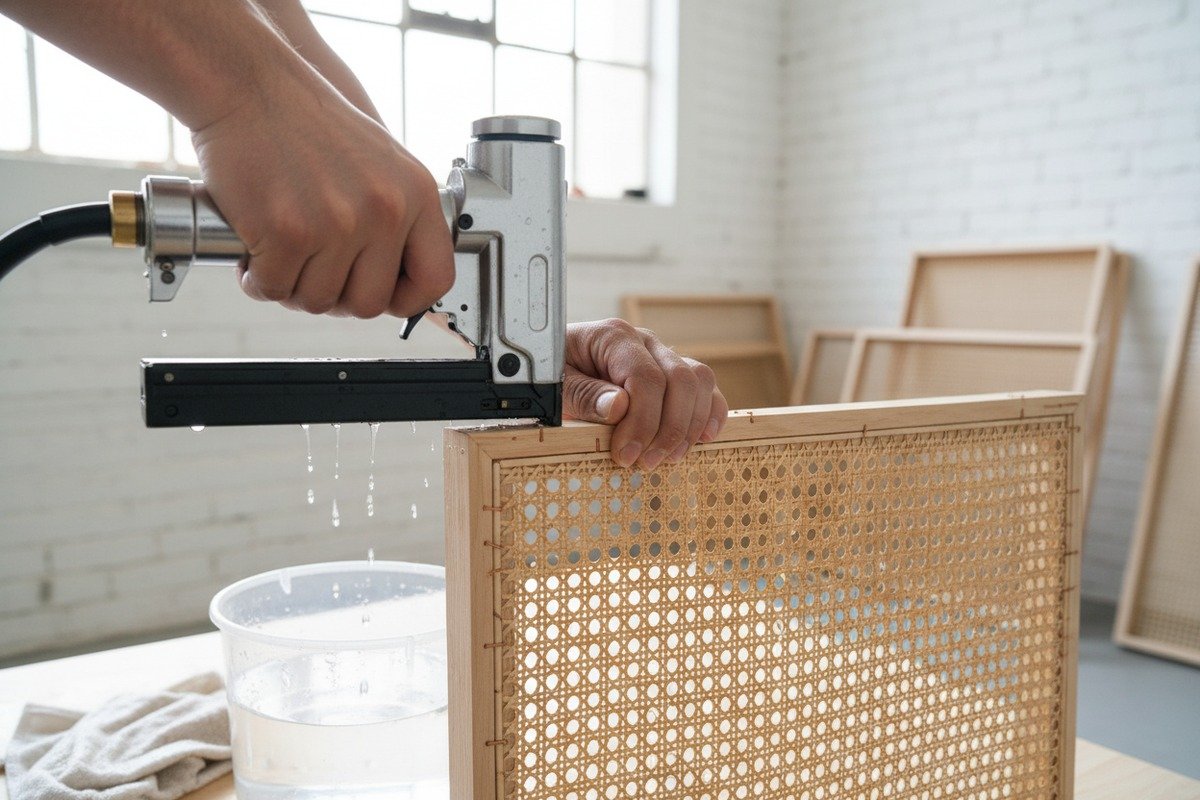
The staple-and-glue method is faster and easier for beginners. You staple the webbing to the back of the frame, then cover the staples with decorative trim. The grooved spline method is more professional. You route a groove into the frame, press the wet webbing into the groove, and lock it with a spline. The result is tighter, cleaner, and more durable.
Optional but Recommended Items
A damp cloth keeps your frame dust-free before gluing. Parchment paper protects your work surface and prevents glue from sticking where it should not. If you use heat-activated iron-on adhesive backing, you will need a household iron and a pressing cloth. For multi-panel screens, a drill and pocket-hole jig speed up frame assembly.
For freestanding screens taller than four feet, consider adding discreet weights to the base rail. This prevents tipping. You can use steel flat bar hidden inside a hollow bottom rail, or simply design wider feet for stability.
How much rattan webbing should I order to ensure I have enough for my project?
Running out of webbing mid-project is a problem our customers dread. We have fielded urgent reorder requests from buyers in the US, Australia, and Turkey who underestimated their needs. Shipping takes time, and dye lots can vary between batches. Planning your quantities upfront saves money, time, and frustration.
Measure each panel's height and width, add 2 inches of overhang on all four sides, then add 10–15% extra for cutting waste and pattern alignment. For a standard three-panel folding screen with 18"x60" panels, order at least 7 to 8 linear feet of 24-inch-wide rattan cane webbing.

Step-by-Step Calculation
Here is how to figure out exactly how much webbing you need. Take a single panel. Measure its width and height. Add 2 inches to each dimension for overhang — this gives you material to fold over or press into a groove. Then multiply by the number of panels.
Let's say you are building a three-panel folding screen. Each panel opening is 18 inches wide by 60 inches tall.
- Width per panel: 18 + 2 + 2 = 22 inches
- Height per panel: 60 + 2 + 2 = 64 inches
Standard webbing rolls are 24 inches wide. That covers your 22-inch width with 2 inches to spare. For height, you need 64 inches (about 5.3 feet) per panel. Three panels require 16 feet of webbing. Add 15% waste allowance and you get about 18.4 feet. Round up to 19 or 20 feet to be safe.
Webbing Calculation Table
This table covers common screen sizes:
| Screen Type | Panel Size (W x H) | Panels | Webbing Width Needed | Linear Feet Needed (with 15% waste) |
|---|---|---|---|---|
| Small room divider | 16" x 48" | 3 | 20" (fits 24" roll) | 14 ft |
| Standard folding screen | 18" x 60" | 3 | 22" (fits 24" roll) | 19 ft |
| Tall folding screen | 18" x 72" | 3 | 22" (fits 24" roll) | 22 ft |
| Wide room divider | 20" x 60" | 4 | 24" (fits 24" roll exactly) | 26 ft |
| Single decorative panel | 24" x 36" | 1 | 28" (needs wider roll or seaming) | 4 ft |
Dealing with Wider Panels
If your panel is wider than 22 inches (after adding overhang), a standard 24-inch roll may not leave enough margin. In that case, order wider webbing. We supply rolls in 24-inch, 36-inch, and custom widths. Alternatively, you can seam two pieces together, but this requires careful alignment and is visible on open-weave patterns.
Why You Should Order Extra
Pattern alignment matters. If you are using a hexagonal or diamond weave, you may need to shift the webbing to center the pattern on each panel. This wastes material. Natural rattan also has slight color variation from roll to roll. Ordering all your webbing at once from the same batch ensures color consistency.
From our production floor, we always recommend ordering at least one extra foot beyond your calculated need. It is cheaper than placing a second order and waiting for shipping. Many of our wholesale clients in Spain and Greece order 10-meter rolls to have surplus for future repairs or additional projects.
Soaking Considerations
Remember that natural rattan webbing expands slightly when soaked. After it dries on the frame, it shrinks back and becomes taut. Do not stretch it too tight during installation. Let the drying process do the tensioning work for you. This means your overhang measurement is important — leave enough slack so the webbing does not pull out of the staples or groove as it shrinks.
What materials do I need to finish and protect my rattan screen for long-term use?
After years of seeing rattan products come back from humid climates in Southeast Asia and dry interiors in the Middle East, our team has learned that finishing is not optional. An unfinished rattan screen yellows, dries out, and becomes brittle within a year or two. Protecting your investment takes just a few extra materials and steps.
To finish and protect your rattan screen, you need sandpaper for the frame, wood stain or paint for color, a clear polyurethane or lacquer sealant for the frame, and a light spray-on sealant or natural oil like tung oil for the rattan webbing itself. Apply finishes to the frame before attaching the webbing.
التشطيب المسبق للإطار
This is a critical step that many beginners skip. Apply your stain, paint, or sealant to the wooden frame pieces before you attach the webbing. If you paint or stain after installation, you risk discoloring the delicate cane strands. Drips, brush marks, and overspray on rattan are nearly impossible to remove cleanly.
Sand the frame with 120-grit sandpaper first, then follow with 220-grit for a smooth surface. Wipe off all dust with a tack cloth. Apply your chosen finish in thin, even coats. Let each coat dry completely before adding the next.
Choosing Your Frame Finish
Pine frames take stain well and can be finished to look like walnut, oak, or mahogany. Teak is naturally weather-resistant and often just needs a clear oil. For a modern look, matte black or white paint works beautifully against the warm honey tone of natural rattan.
الاستخدام polyurethane 9 (water-based for indoor screens, oil-based for outdoor) as a topcoat. This seals the wood against moisture and wear. Two coats is the minimum. Three coats is better for high-traffic areas.
Protecting the Rattan Webbing
Natural rattan benefits from a light protective coating. زيت التونغ 10 or Danish oil penetrates the cane fibers and adds moisture resistance without changing the color dramatically. Apply with a soft cloth, let it soak in for 15 minutes, then wipe off the excess.
For a more durable barrier, use a spray-on clear lacquer designed for natural fibers. Apply two light coats, allowing full drying between each. Avoid thick coats — they can clog the weave pattern and create a plastic-looking surface.
Synthetic rattan generally does not need finishing. Its plastic composition already resists moisture and UV. A simple wipe-down with a damp cloth keeps it clean.
Decorative Edge Finishing
Raw edges of cut rattan look unfinished. Round reed or decorative spline covers these edges and gives a professional appearance. Glue the reed over the edge of the webbing where it meets the frame. Some builders add thin molding strips instead, nailed or glued in place over the stapled edges.
A small bead of craft glue along the cut edges of the webbing prevents individual strands from unraveling over time. This is especially important on open-weave patterns where each strand is more exposed.
Maintenance Materials to Keep on Hand
Keep a small bottle of tung oil and a soft cloth for annual touch-ups. A can of clear spray lacquer is useful for spot repairs. If a strand breaks, a dab of wood glue holds it in place until you can patch the area. Store any leftover webbing in a cool, dry place — it stays usable for years if kept away from direct sunlight and moisture.
For bleached rattan cane webbing, which has a lighter, more neutral tone, avoid oil-based finishes that may yellow over time. Use water-based sealants to preserve the clean, pale aesthetic.
خاتمة
Building a rattan cane webbing screen is a rewarding project when you start with the right materials. Plan your webbing grade, tools, quantities, and finishing supplies before you begin, and your screen will look professional and last for years.
ملاحظات سفلية
1. Provides a comprehensive overview of rattan cane webbing, its origin, and uses. ↩︎
2. Explains what cane webbing is and how it is used in furniture. ↩︎
3. Details the botanical origin and characteristics of the rattan palm plant. ↩︎
4. Explains the composition, durability, and weather resistance of synthetic rattan. ↩︎
5. Provides an overview of different types and uses of wood glue. ↩︎
6. Provides an authoritative definition and information on hinges from Wikipedia. ↩︎
7. Provides an authoritative definition and explanation of a staple gun. ↩︎
8. Offers an authoritative definition of a spline roller from Wikipedia. ↩︎
9. Outlines the benefits and applications of polyurethane as a wood finish. ↩︎
10. Details the properties and traditional uses of tung oil for wood finishing. ↩︎

 English
  Español de México
  العربية
  Deutsch
  Français
  Русский