
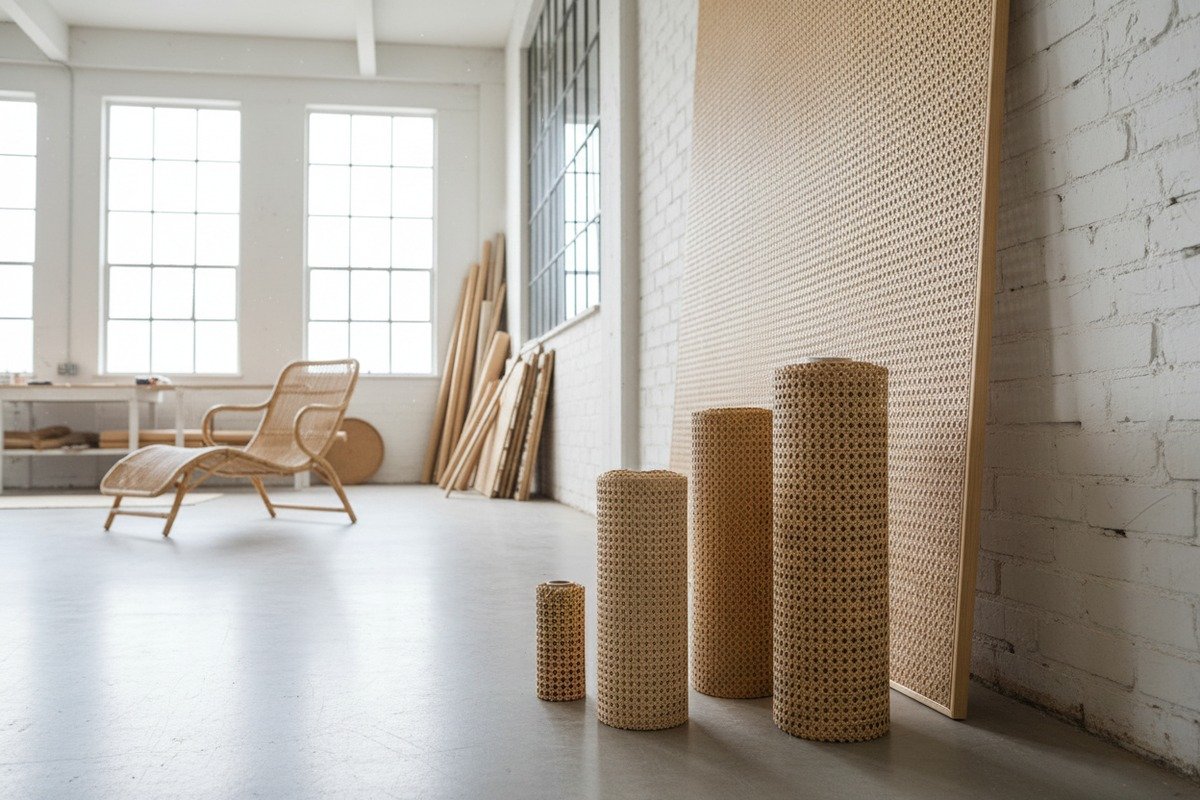
Over the years of producing and shipping rattan cane webbing from our factories, one question comes up again and again from buyers worldwide: which width do I actually need?
The best project for each width of natural rattan cane webbing depends on scale and function. Narrow widths (35–50cm) suit cabinet inserts, chair caning, and small accents. Medium widths (60–80cm) work for headboards and wardrobe doors. Wide widths (90–120cm) are ideal for large wall panels and commercial installations.
Picking the wrong width leads to wasted material, awkward seams, and frustrated customers material usage optimization 1. This guide breaks down the best uses for every standard width we produce, so you can order with confidence and cut your waste to near zero. Let’s walk through it section by section.
How do I choose the best rattan webbing width for my custom cabinet door projects?
Cabinet door projects 2 are some of the most common orders we fill at our Foshan facility. Yet many buyers order widths that are either too narrow or far too wide, leading to unnecessary cutting and material loss.
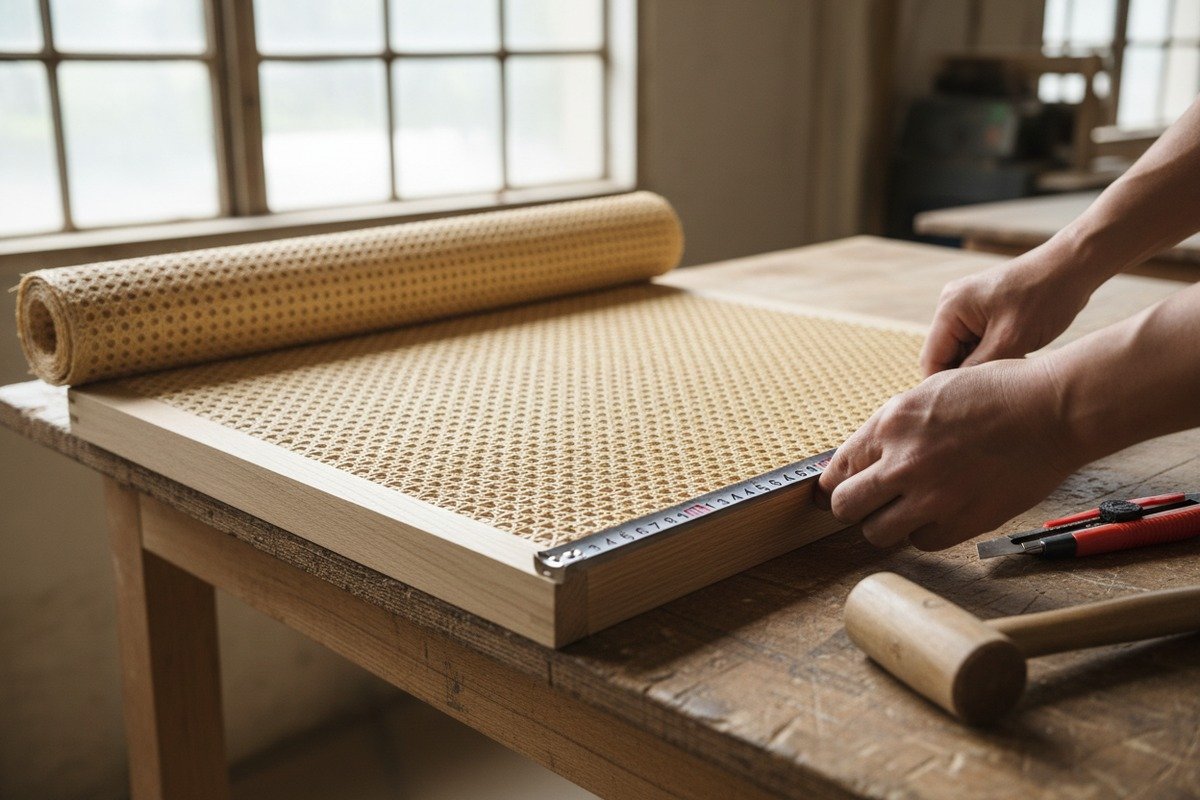
For custom cabinet doors, choose rattan webbing widths between 45cm and 60cm. These widths cover most standard cabinet door panel sizes with minimal trimming. Always measure the visible panel area first, then add 2–3cm on each side for overlap into the groove or frame.
Why Cabinet Doors Demand Precision
Cabinet doors are small, framed panels. The webbing sits inside a routed groove or behind a frame. This means precision matters more here than in almost any other rattan project. If your webbing is too wide, you waste material on every single door. If it is too narrow, you cannot cover the opening. Both mistakes cost money, especially in batch production.
Most kitchen cabinet doors have panel openings between 25cm and 45cm wide. Wardrobe cabinet doors can run slightly larger, from 35cm to 55cm. In our experience supplying furniture factories across the Netherlands, Spain, and Australia, the 45cm and 60cm rolls cover over 90% of cabinet door orders.
Matching Width to Cabinet Door Size
| Cabinet Door Type | Typical Panel Opening | Recommended Webbing Width | Why This Width Works |
|---|---|---|---|
| Small kitchen cabinet | 20–30cm | 45cm | Enough for panel + overlap |
| Standard kitchen cabinet | 30–40cm | 45cm or 60cm | Clean fit with minimal waste |
| Tall pantry door | 35–50cm | 60cm | Covers wider panels fully |
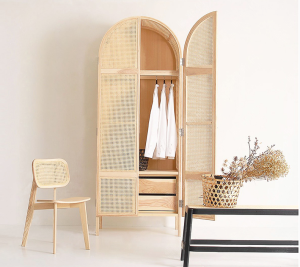
| Wardrobe door panel | 40–55cm | 60cm | Single piece, no seaming |
| Bathroom vanity insert | 15–25cm | 45cm | Narrower openings, less trim waste |
نمط النسيج مهم أيضًا
For cabinet doors, close weave and tight basketweave patterns are most popular. They give a refined, polished look. Open hexagonal weave works for decorative cabinet fronts where airflow matters, like media consoles or shoe cabinets. Both pattern types are available in 45cm and 60cm widths from our production line.
نصائح لتركيب أبواب الخزائن
Always soak natural rattan webbing briefly in cool water before fitting. This softens the cane and makes it easier to press into grooves. Cut the webbing about 2–3cm larger than the groove-to-groove measurement on each side. Use a spline and rubber mallet 3 to press the webbing into the groove. Trim excess after the spline is seated.
One common mistake we see from first-time buyers: ordering 90cm rolls for small cabinets. This doubles waste per door. If your factory builds only cabinet doors, stick with 45cm or 60cm rolls. Your material cost per unit drops significantly.
What are the most popular applications for my narrow 45cm natural rattan rolls?
When we ship 45cm rolls from our warehouse, they go to an incredibly wide range of end uses. This width is our best seller for good reason — it hits a sweet spot between versatility and economy.
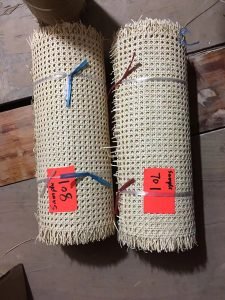
Narrow 45cm natural rattan rolls are most popular for chair seat and backrest caning, small cabinet door inserts, decorative drawer fronts, lampshade wrapping, framed wall art, and DIY craft projects. This width is easy to handle, minimizes waste on small-scale work, and fits most traditional furniture restoration needs.

Chair Caning and Furniture Restoration
The 45cm width is the industry standard for traditional تنجيد الكراسي 4. Most dining chair seats and backrests have openings between 30cm and 42cm. A 45cm roll gives you enough webbing to cover the opening plus the overlap needed for spline installation. This is why restoration workshops in the US and Europe order this width more than any other.
Mid-century modern chairs 5, Victorian parlor chairs, and bistro-style seating all fall within this range. If you restore furniture professionally, keeping 45cm rolls in stock means you are ready for the majority of jobs that come through your shop.
Small Accent Projects
Beyond chairs, 45cm rattan webbing shines in smaller accent applications. Here are some of the most popular:
- Drawer fronts: Replace solid wood drawer faces with rattan inserts for a textured, bohemian look.
- Lampshades: Wrap 45cm webbing around cylindrical or drum-shaped lampshade frames. The width is enough to cover most standard shades without seaming.
- Framed wall art: Stretch webbing across a picture frame for a simple, natural wall accent.
- Speaker and device covers: Use rattan as a decorative grille over smart speakers or ventilation openings.
- Jewelry and accessories: Ultra-narrow strips cut from 45cm rolls create bag panels, earrings, and wearable art.
Who Buys 45cm Rolls?
| نوع المشتري | الاستخدام الأساسي | حجم الطلب |
|---|---|---|
| Furniture restoration shops | Chair seats and backrests | Small to medium |
| DIY retailers and craft stores | Hobby packs and kits | متوسط |
| Small furniture factories | Cabinet and drawer inserts | Medium to large |
| Interior designers | Accent pieces and samples | صغير |
| Accessory makers | Bag panels, jewelry | صغير |
Handling and Storage
One practical advantage of 45cm rolls: they are easy to store. They fit on standard shelving, ship in compact cartons, and are light enough for one person to handle. For wholesalers who serve retail customers, this width is simple to repackage into smaller lengths for resale. We often cut 15-meter master rolls into 1-meter or 2-meter retail packs for our European distributors.
The flexibility of natural cane at this width is excellent. You can curve it around round lampshade frames, press it into tight cabinet grooves, and stretch it across chair openings without cracking. Just remember to dampen the webbing before installation.
When should I invest in extra-wide 90cm rattan webbing for my large-scale furniture designs?
Our production team developed the 90cm and wider rolls specifically for clients who work on large furniture and architectural projects. These rolls are heavier, harder to ship, and more expensive per unit. So the question is: when do they actually make sense?
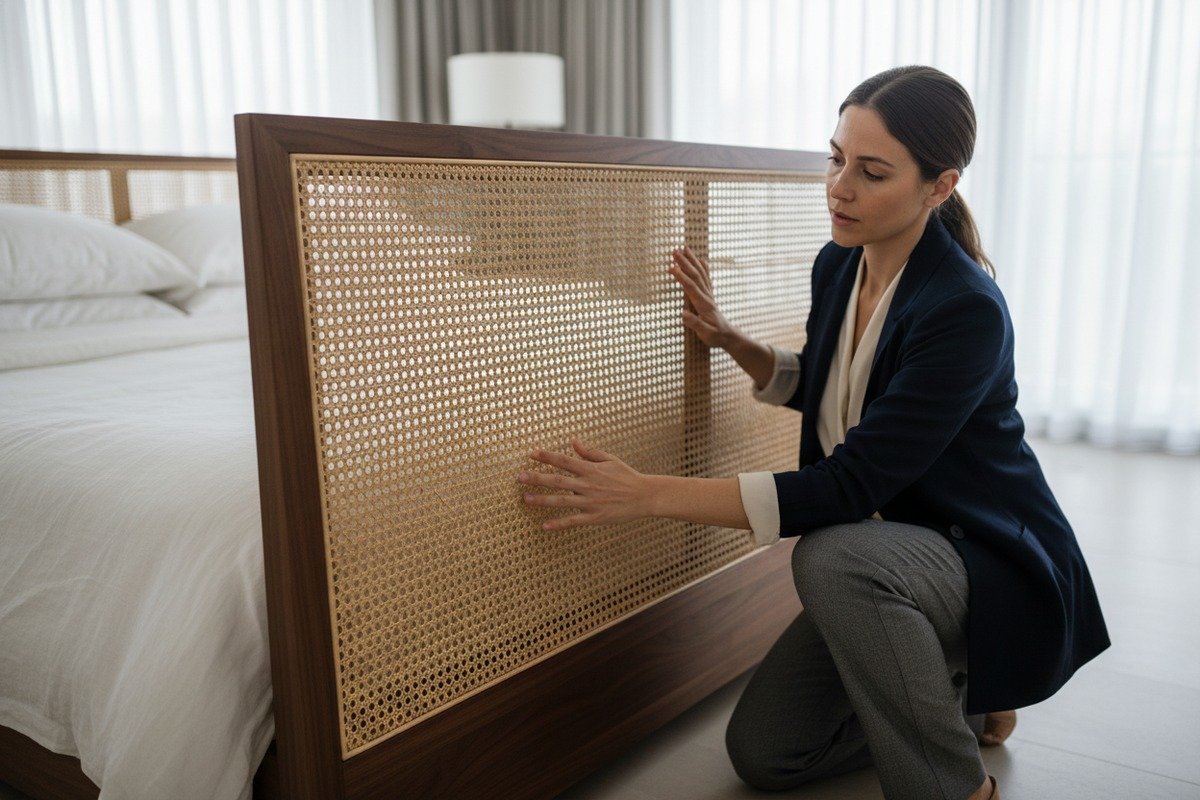
Invest in extra-wide 90cm rattan webbing when your project requires seamless coverage over large surfaces such as full-size headboards, oversized wardrobe doors, room dividers, wall feature panels, or commercial hospitality installations. Wide rolls eliminate visible joints and create a clean, unbroken natural texture across big areas.
The Seamless Advantage
The biggest reason to choose 90cm or wider webbing is simple: no seams. When you use narrow webbing on a large surface, you must join two pieces. That joint is almost always visible. It breaks the natural flow of the weave pattern. For high-end furniture and designer interiors, visible seams lower the perceived quality of the finished piece.
A king-size headboard panel can be 150cm wide. With 90cm webbing, you need only two pieces with one center seam — or you can request 100cm or 120cm rolls from our factory to eliminate seams entirely on panels up to 120cm.
Best Applications for 90cm Rattan Webbing
| التطبيق | حجم اللوحة النموذجي | Why 90cm Width Works |
|---|---|---|
| King-size headboard | 100–180cm wide | Fewer seams, cleaner look |
| Large wardrobe doors | 50–90cm per door | Single piece coverage |
| فواصل الغرف | 60–120cm per panel | Seamless natural panels |
| Feature wall panels | Variable, often 90cm+ | Dramatic visual impact |
| Restaurant/hotel décor | Large-scale installations | Consistent texture at scale |
| ألواح السقف | Variable | Reduces installation time |
| Sofa back panels | 60–100cm | One-piece coverage |
Commercial and Hospitality Projects
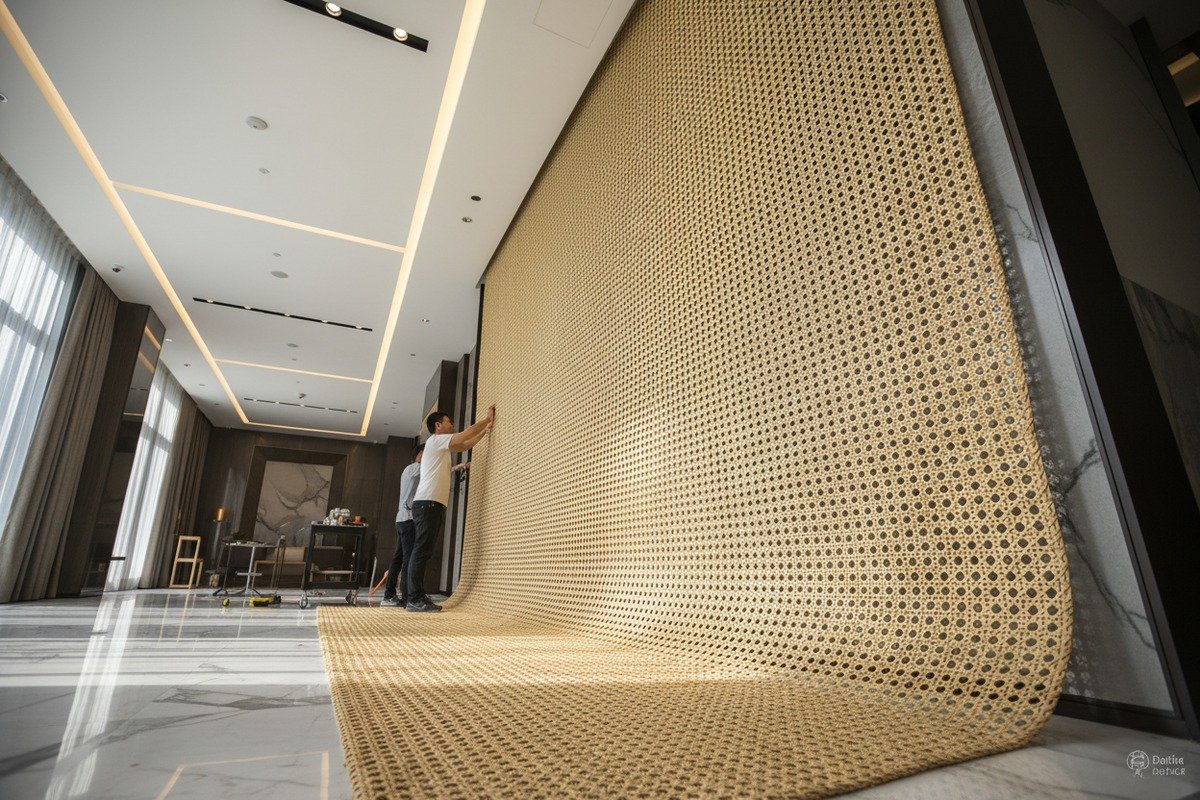
We have seen a strong trend over the past five years. Hotels, restaurants, and retail stores now use rattan webbing as a design feature on walls, ceilings, and built-in furniture. commercial hospitality installations 6 These projects demand wide rolls because the surfaces are large and the finished look must be flawless. Our clients in Dubai, Turkey, and Australia frequently order 90cm rolls in bulk for hospitality fit-outs.
For these projects, the close weave or herringbone pattern in a wide width creates a warm, natural backdrop that photographs beautifully and wears well in high-traffic spaces.
When Wide Rolls Are Not Worth It
If you are making small furniture — chairs, side tables, small cabinets — wide rolls create waste. You cut a 40cm piece from a 90cm roll and the leftover 50cm strip may not fit any other project in your production run. We always advise buyers to match their roll width to their largest panel dimension plus overlap.
Also consider storage and handling. A 90cm-wide roll of natural cane webbing at 15 meters long is heavy and bulky. It requires two people to unroll and cut. If your workshop is small or your projects are varied in size, keeping a mix of 45cm and 60cm rolls is more practical than stocking only 90cm rolls.
Biophilic Design and Vertical Plant Walls
One emerging application for wide rattan webbing is indoor garden features. Designers stretch 90cm panels across vertical frames and weave plants through the open hexagonal pattern. This creates a natural backdrop that allows air circulation. The rattan serves as both a structural support and a decorative element, blending التصميم الحيوي 7 with organic materials.
How can I optimize my material usage by matching specific widths to my production needs?
Running our three factories has taught us one thing above all: material waste is profit walking out the door. Every centimeter of rattan webbing you trim and throw away is money lost. Matching width to production needs is the single most effective way to cut costs.
Optimize material usage by auditing all panel sizes in your production line, grouping them by width range, and ordering the closest standard rattan webbing width for each group. Allow 4–6cm extra for overlap. Keep two to three widths in stock rather than one, and nest small parts from offcuts to approach zero waste.
Step 1: Audit Your Panel Sizes
Before you place your next order, measure every rattan panel in your product line. Write down the finished panel width for each product. Include the overlap allowance — typically 2–3cm per side for grooved installations. Now sort these measurements from smallest to largest.
You will likely find that your panels cluster into two or three size groups. Most furniture factories we work with have one cluster around 30–40cm, another around 50–65cm, and sometimes a third above 80cm. Each cluster maps to a standard webbing width.
Step 2: Match Clusters to Standard Widths
Here is a practical mapping based on common factory production:
| Panel Size Cluster | Add Overlap (4–6cm total) | Best Standard Width | Waste Per Panel |
|---|---|---|---|
| 25–35cm panels | 29–41cm needed | 45cm | 4–16cm |
| 36–45cm panels | 40–51cm needed | 50cm or 60cm | 9–20cm |
| 46–55cm panels | 50–61cm needed | 60cm | 0–10cm |
| 56–70cm panels | 60–76cm needed | 80cm | 4–20cm |
| 71–85cm panels | 75–91cm needed | 90cm | 0–15cm |
| 86–100cm panels | 90–106cm needed | 100cm or 120cm | 14–30cm |
Step 3: Use Offcuts Wisely
Even with good width matching, you will have strips of leftover webbing. Smart factories use these offcuts for secondary products: coaster sets, small drawer front inserts, sample swatches, or packaging decoration. One of our clients in the Netherlands saves all strips wider than 10cm and sells them as DIY craft packs through their online store. This turns waste into revenue.
Step 4: Consider Custom Widths
If your production runs are large and your panels are a non-standard size, ask your supplier about custom widths. At our factory, we can produce rolls in custom widths when the order quantity justifies the setup. If you make 5,000 headboard panels per year at 72cm wide, a custom 78cm roll eliminates waste far more effectively than buying 90cm stock rolls.
تكلفة الخطأ
Many buyers default to ordering the widest roll available, thinking flexibility is more important than precision. But the math tells a different story. If you use 90cm webbing for 40cm panels, you waste over 50% of every roll. Over a year of production, that adds up to thousands of dollars in discarded material. And natural rattan is not cheap — it is a premium, sustainably harvested resource 8.
Stock Management for Wholesalers
If you are a material wholesaler rather than a manufacturer, keep three widths in stock: 45cm, 60cm, and 90cm. This range covers the needs of small restoration shops, medium furniture makers, and large-scale designers. Offer cut-to-length service where possible. Selling by the meter from master rolls reduces leftover inventory and gives your customers exactly what they need.
شريط قصب الخيزران الطبيعي 9 is designated for indoor use only. Remind your customers of this when advising on width and project selection. If they need outdoor applications, steer them toward والنسيج الصناعي للخيزران 10, which is available in the same width range and weave patterns.
خاتمة
Choosing the right rattan webbing width saves money, reduces waste, and gives your finished projects a clean, professional look. Match your width to your panel size, and you are already ahead.
ملاحظات سفلية
1. Outlines effective strategies for reducing material waste and improving efficiency in manufacturing. ↩︎
2. Explains various methods and considerations for building cabinet doors. ↩︎
3. Illustrates the use of spline and mallet in cane webbing installation. ↩︎
4. Details the history and traditional techniques of chair caning. ↩︎
5. Explains the defining characteristics and origins of Mid-century modern furniture. ↩︎
6. Discusses current and future interior design trends in the hospitality sector. ↩︎
7. Explains the concept and six elements of biophilic design. ↩︎
8. Details sustainable harvesting practices and environmental benefits of rattan. ↩︎
9. Explains what natural rattan cane webbing is and its origin. ↩︎
10. Explains the composition, durability, and outdoor applications of synthetic rattan webbing. ↩︎
 English
  Español de México
  العربية
  Deutsch
  Français
  Русский