
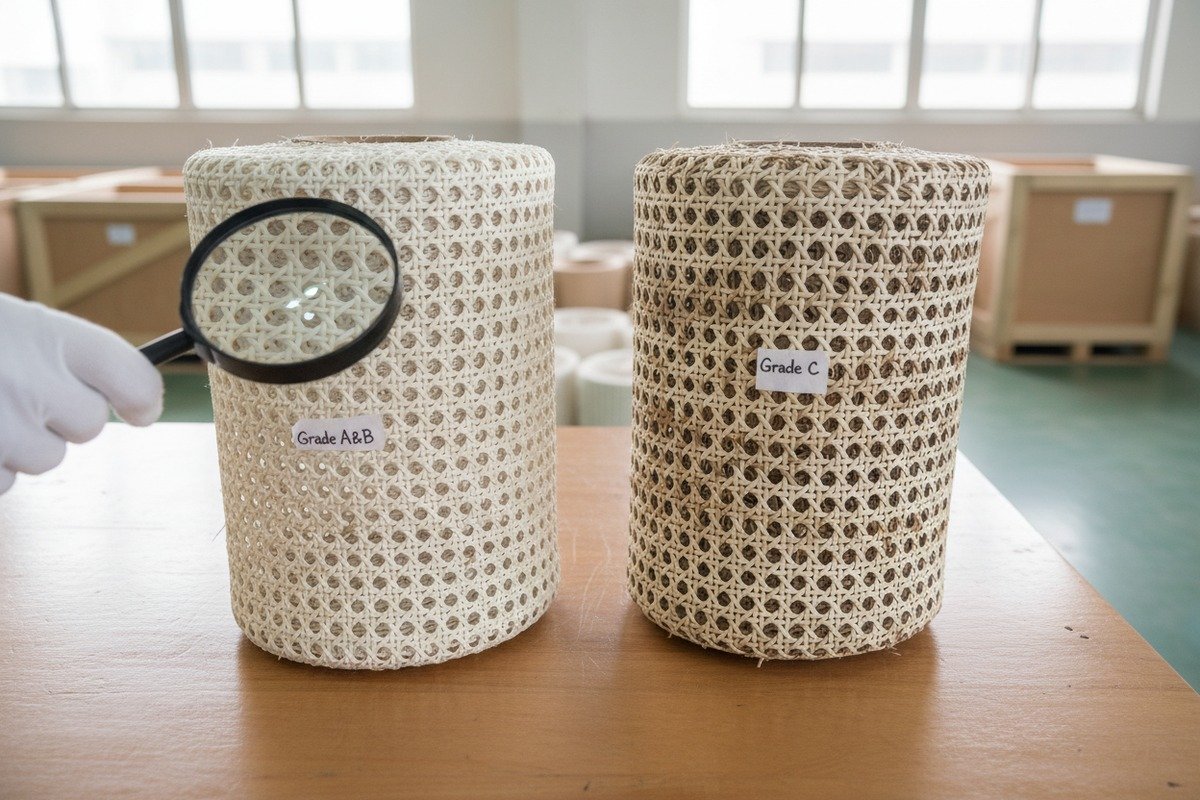
Jede Woche, unsere Qualitätskontrollteam 1 rejects rolls of rattan webbing that don’t meet our standards — and every week, buyers ask us why one roll looks perfect while another looks rough.
Grade A&B bleached natural rattan cane webbing uses premium, node-free rattan strips with uniform width, even bleaching color, and tight weave patterns. Grade C uses secondary rattan with more knots, irregular thickness, uneven bleaching, and looser weaves. The difference affects appearance, durability, and price.
Understanding these grades can save you thousands of dollars and prevent product returns. Let me walk you through everything you need to know — from visual identification to sourcing strategies — so you can make the right choice for your business.
How can I visually distinguish between Grade A&B and Grade C bleached rattan webbing?
When we lay Grade A&B and Grade C rolls side by side on our factory floor, the differences jump out immediately — yet many first-time buyers struggle to tell them apart from photos alone.
Grade A&B bleached rattan webbing shows a smooth, consistent surface with uniform light color, even strip widths of 2–5mm, and clean weave intersections. Grade C displays darker spots, uneven bleaching, visible knots, fraying edges, and noticeable gaps between strips.
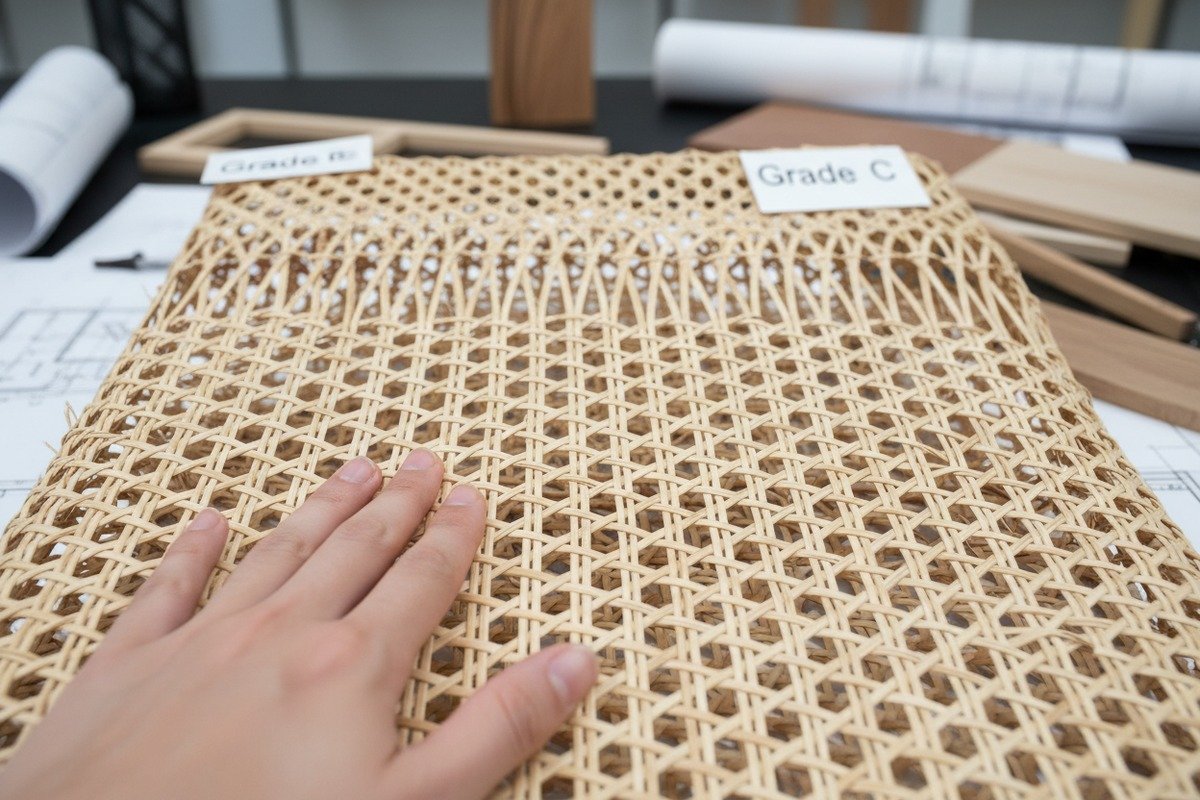
Surface Texture and Color Uniformity
The most obvious difference is color. Grade A&B achieves a consistent creamy white to light straw tone after bleaching. This happens because the raw rattan strips have uniform density, so they absorb the bleaching agent evenly. Grade C strips come from secondary rattan poles with varying densities. Some strips absorb more bleach than others. The result is a blotchy, uneven appearance with dark spots scattered across the surface.
Run your hand across a Grade A&B sheet. It feels smooth. The strips are flat and uniform. Now touch a Grade C sheet. You will feel bumps where knots sit and rough patches where the strips were not peeled cleanly.
Strip Width and Weave Precision
Grade A&B strips maintain a consistent width throughout the roll. Our cutting machines are calibrated to produce strips between 2mm and 5mm depending on the pattern. But the machine can only cut cleanly if the raw rattan is straight and node-free. Grade C rattan has more nodes, which cause the strips to vary in thickness. This leads to uneven tension in the weave.
Look at the weave intersections. In Grade A&B, the hexagonal or octagonal openings are symmetrical and consistent in size. In Grade C, some openings are larger than others. Some strips overlap unevenly.
Quick Visual Identification Checklist
| Merkmal | Grade A&B | Güteklasse C |
|---|---|---|
| Surface color | Uniform creamy white | Blotchy with dark spots |
| Streifenbreite | Consistent 2–5mm | Irregular, varies within same roll |
| Knots/nodes | Minimal bis keine | Frequent and visible |
| Webart | Tight, symmetrical openings | Loose, uneven openings |
| Kantenveredelung | Sauber, minimal ausgefranst | Noticeable fraying |
| Flexibilität | Smooth bending | Prone to cracking at knot points |
The Backlight Test
Here is a trick we teach our wholesale clients. Hold a sheet of Rattan-Gewebe 2 up to natural light. Grade A&B lets light pass through the weave openings evenly. Every hole looks the same size and shape. Grade C shows irregular light patterns. Some holes are larger, some smaller, and some are partially blocked by misaligned strips. This test takes ten seconds and works every time.
Also pay attention to the edges of the roll. Grade A&B rolls have cleanly cut edges with minimal loose fibers. Grade C rolls often have stray strips sticking out and fraying along the cut line. This matters during installation because frayed edges make it harder to get a clean finish inside a furniture frame.
Which grade should I choose to ensure the durability of my furniture projects?
Our production team has tracked customer returns over the past five years, and one pattern is clear: furniture makers who use the wrong grade for the wrong application end up with warranty claims and unhappy end users.
For furniture where the rattan webbing is visible and load-bearing — such as chair seats, headboards, and cabinet doors — Grade A&B is the right choice. Its uniform strips and tight weave resist sagging, cracking, and moisture damage far longer than Grade C, which suits only hidden or low-stress applications.

Understanding Structural Integrity
Durability in rattan webbing depends on three factors: strip strength, weave tightness, and bleaching quality. Grade A&B excels in all three. The strips come from the outer skin of mature, straight rattan poles. This outer layer is the strongest part of the plant. It has natural fibers running in parallel lines, giving it excellent Zugfestigkeit 3.
Grade C strips often come from younger poles or sections near nodes. Nodes are natural weak points. When stress is applied — someone sitting on a chair, for example — the webbing fails first at node points. We have seen Grade C chair seats develop holes within 18 months of normal use. Grade A&B seats in the same conditions last five years or more.
Durability Performance Comparison
| Haltbarkeitsfaktor | Grade A&B | Güteklasse C |
|---|---|---|
| Lebensdauer im Innenbereich | 5–8 years with proper sealing | 2–4 Jahre |
| Humidity resistance 4 | Good with anti-mildew treatment | Prone to mold in 1–2 years |
| UV-Beständigkeit 5 | Moderate; gradual yellowing | Faster discoloration and brittleness |
| Tragfähigkeit | Handles daily use on seating | May sag under repeated weight |
| Post-soak shrinkage | 5–7% (predictable) | 8–12% (inconsistent) |
| Rissbeständigkeit | High flexibility at weave joints | Cracking at knot points |
Abgleich von Güteklasse und Anwendung
Not every project needs Grade A&B. The key is matching the grade to the application. Here is how we advise our furniture factory clients:
High-visibility, load-bearing areas: Chair seats, dining chair backs, headboards, and room dividers. Always use Grade A&B. These areas take daily stress and are the first thing people see and touch.
Decorative but non-structural: Cabinet door inserts, wall panels, and lampshade wrapping. Grade A&B is ideal, but a high-quality Grade B can work if budget is tight. The webbing is protected behind glass or inside a frame, so it faces less stress.
Hidden or temporary uses: Backing panels, prototype furniture, event decorations, or craft projects. Grade C works here. The webbing is either not visible or not meant to last for years.
The Sealing Factor
Some buyers argue that Grade C performs just as well as Grade A&B if you seal it properly with lacquer or varnish. There is some truth to this — sealing does protect against moisture and UV damage. But sealing cannot fix structural weaknesses. A knotty strip sealed with lacquer is still a knotty strip. It will still crack under stress at the node point. Sealing extends lifespan, but it does not upgrade the grade.
We recommend sealing all grades. But think of it this way: sealing Grade A&B gives you maximum lifespan. Sealing Grade C gives you acceptable lifespan. The gap narrows, but never closes.
Why is the price difference between these rattan grades significant for my wholesale business?
When we quote prices to new wholesale clients, the first question is almost always the same: why does Grade A&B cost so much more? The answer lies in every step of the Lieferkette 6 — from the Indonesian forests to our finished rolls.
Grade A&B bleached rattan webbing costs 20–50% more than Grade C because it requires selective harvesting of premium rattan poles, stricter processing with lower material waste, more precise bleaching, and rigorous quality inspection — all of which reduce yield but dramatically improve the final product's market value.

Raw Material Sourcing Costs
About 80% of the world's rattan comes from Indonesia and China. Our own rattan processing facility in Indonesia gives us direct access to raw materials, so we see the cost differences firsthand.
Premium rattan poles suitable for Grade A&B are straight, mature, and have long sections between nodes. These poles make up only about 30–40% of a typical harvest. The rest have more nodes, curves, or surface damage. They go into Grade C production.
Because Grade A&B requires selective sorting, the raw material cost per usable kilogram is higher. Grade C uses a wider range of poles, so the per-kilogram cost is lower. This sorting step alone accounts for roughly 15–20% of the price gap.
Processing and Waste Rates
| Kostenfaktor | Grade A&B | Güteklasse C |
|---|---|---|
| Raw material waste | 20–30% (strict sorting) | 10–15% (accepts more irregularity) |
| Cutting precision | Tight tolerance, slower machine speed | Faster, wider tolerance |
| Bleaching process | Multiple controlled passes for evenness | Single pass, less controlled |
| Qualitätskontrolle | Every roll checked, defects rejected | Spot-checked, higher defect tolerance |
| Estimated wholesale cost | $5–10 per square meter | $3–6 per square meter |
| Reject rate at final QC | 5–8% of production | 2–3% (lower standard) |
The Real Impact on Your Margins
Let's say you buy 500 square meters of rattan webbing per month. Here is a simplified cost comparison:
With Grade A&B at $7.50/sqm, your material cost is $3,750. With Grade C at $4.50/sqm, it drops to $2,250. That is a $1,500 monthly saving — roughly $18,000 per year.
But here is what many buyers miss. Grade A&B furniture sells at a premium. A chair with Grade A&B webbing can retail for 30–60% more than one with Grade C. Your end customers — furniture stores, interior designers, hospitality projects — can see and feel the difference. They pay more for it.
Return rates matter too. We have seen furniture factories switch from Grade A&B to Grade C to save money, only to face a 15–20% increase in customer complaints within six months. Returns, replacements, and reputation damage cost more than the savings.
Strategic Grade Mixing
Smart wholesalers do not choose one grade for everything. They use Grade A&B for premium product lines and visible applications. They use Grade C for budget lines or concealed panels. This approach maximizes margin across the product range.
For our clients who run private-label brands 7, we often suggest a 70/30 split — 70% Grade A&B for their core product line, 30% Grade C for economy offerings or non-visible components. This balances quality perception with cost efficiency.
How do I ensure my supplier provides consistent Grade A quality for my private-label brand?
Over the past decade, we have shipped rattan webbing to wholesalers in more than 15 countries. The clients who succeed with private-label brands are the ones who build quality assurance into their supplier relationship — not the ones who simply trust a grade label on a shipping document.
To ensure consistent Grade A quality, establish clear written specifications with your supplier covering strip width tolerance, color range, defect limits, and weave density. Request pre-shipment samples from each production batch, conduct third-party inspections, and build long-term relationships with suppliers who own their processing facilities.
The Grading Standardization Problem
One of the biggest challenges in the rattan industry is that there is no universal grading standard 8. What one supplier calls "Grade A," another might label "Grade B." This inconsistency causes real problems for private-label brands that need identical quality across every shipment.
We have heard from buyers who received "Grade A" from a new supplier, only to find it was clearly inferior to what they had been getting from us. The strips were wider, the bleaching was uneven, and there were visible knots. The supplier genuinely believed it was their Grade A — because by their internal standards, it was.
This is why written specifications matter more than grade labels.
Building a Quality Specification Document
Work with your supplier to create a detailed product specification sheet 9. Here is what it should include:
Streifenbreite: Define acceptable range (e.g., 2.5mm ± 0.3mm).
Strip thickness: Specify minimum and maximum (e.g., 0.4–0.6mm).
Bleaching color: Provide a physical color swatch or Pantone reference range. Acceptable variation should be defined.
Defect tolerance: Maximum number of knots, dark spots, or broken strips per square meter (e.g., zero knots for Grade A, no more than two small dark spots per square meter).
Weave density: Specify the number of strips per 10cm in both warp and weft directions.
Rollenabmessungen: Standard width, length, and acceptable tolerance.
Inspection and Sampling Protocol
| Quality Step | What to Do | Wenn |
|---|---|---|
| Vorproduktionsmuster | Request 30cm × 30cm sample from raw material batch | Before each order |
| In-process check | Ask for photos/video of weaving and bleaching stages | Während der Produktion |
| Inspektion vor dem Versand | Hire third-party QC 10 or request detailed photos of every roll | Before shipping |
| Arrival inspection | Check 10–20% of rolls against specification sheet | Bei Lieferung |
| Ongoing feedback | Send photos of any defects found to supplier immediately | As issues arise |
Den richtigen Lieferanten auswählen
Not all suppliers can deliver consistent Grade A quality. Here are the signs of a reliable partner:
They own their processing facility. A supplier who controls the raw material processing — peeling, cutting, bleaching — has more control over quality than a trading company who buys from multiple small workshops. Our three factories, including our own facility in Indonesia, allow us to control quality from the raw pole to the finished roll.
They welcome factory visits and video calls. Transparency is a green flag. If a supplier avoids showing their production process, question why.
They provide batch traceability. Each roll should be linked to a specific production batch so that any quality issue can be traced back to its source.
They communicate proactively. Raw rattan quality varies by season. A good supplier tells you in advance if a batch might have slightly different characteristics and offers solutions — not surprises.
Long-Term Relationship Building
Consistency comes from relationships, not just contracts. The buyers who get the best quality from us are the ones who communicate regularly, provide clear feedback, and commit to long-term volumes. This allows us to reserve premium raw materials for their orders and calibrate our processing specifically to their requirements.
When a private-label brand treats a supplier as a partner rather than a vendor, both sides invest in maintaining quality. We have clients who have been with us for over seven years. Their quality complaints are near zero — because we know exactly what they need, and they know exactly what we deliver.
Conclusion
Choosing between Grade A&B and Grade C bleached natural rattan cane webbing comes down to your application, budget, and brand standards — and now you have the knowledge to decide with confidence.
Fußnoten
1. Explains the role and responsibilities of a quality control team in manufacturing. ↩︎
2. Provides a definition and overview of rattan webbing as a material for furniture. ↩︎
3. Defines tensile strength as a critical material property relevant to durability and structural applications. ↩︎
4. Explains the ability of materials to withstand moisture absorption and degradation. ↩︎
5. Defines UV resistance and its importance for materials exposed to sunlight. ↩︎
6. Found an authoritative article from IBM defining supply chain management and its key elements. ↩︎
7. Defines private label as custom products made by a third-party manufacturer and sold under a retailer’s brand. ↩︎
8. Discusses the concept of grading systems and their variations, implying a lack of universal standards in some contexts. ↩︎
9. Found a detailed article on The ODM Group explaining what a spec sheet is, what to include, and its benefits. ↩︎
10. Defines third-party quality control as independent product checks for quality and safety. ↩︎

 English
  Español de México
  العربية
  Deutsch
  Français
  Русский