
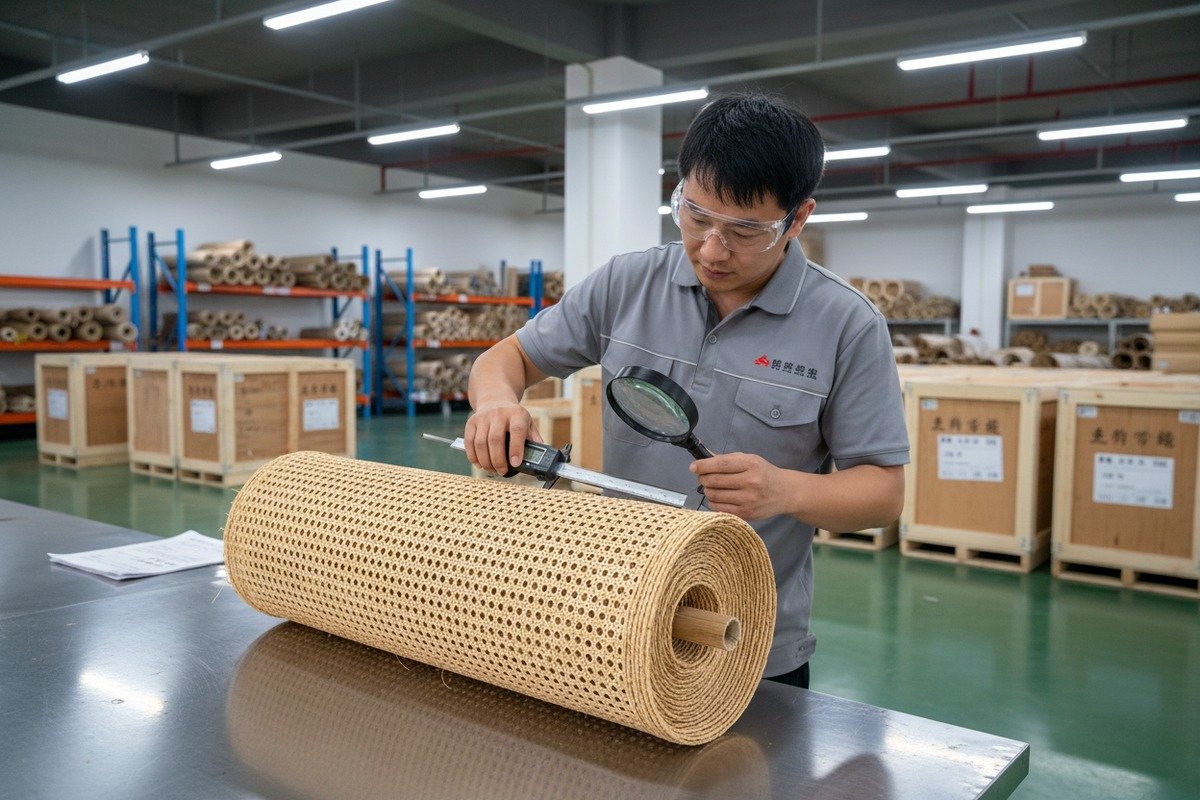
Every year, our warehouse team in Foshan rejects dozens of substandard rattan shipments before they ever reach our clients uniform strand width 1. The difference between a profitable furniture project and a costly disaster often comes down to how well you evaluate rattan cane webbing quality at the sourcing stage.
To evaluate natural rattan cane webbing quality, inspect weave uniformity, strand flexibility, color consistency, and moisture content. Request trade samples, verify the supplier’s processing methods including singeing and boiling, confirm the rattan origin, and check for anti-mildew and anti-insect treatments before placing bulk orders.
This guide walks you through the exact checks we use at our own factories and the red flags we tell our wholesale buyers to watch for. Whether you source rattan for furniture frames 2, cabinet doors, or architectural panels, these steps will protect your investment.
How can I distinguish between Grade A and lower-quality rattan cane webbing during my inspection?
When we ship samples to new buyers in the Netherlands or Australia, the first question is almost always about grading. Most buyers have seen "Grade A" printed on spec sheets, but few know what to look for in person.
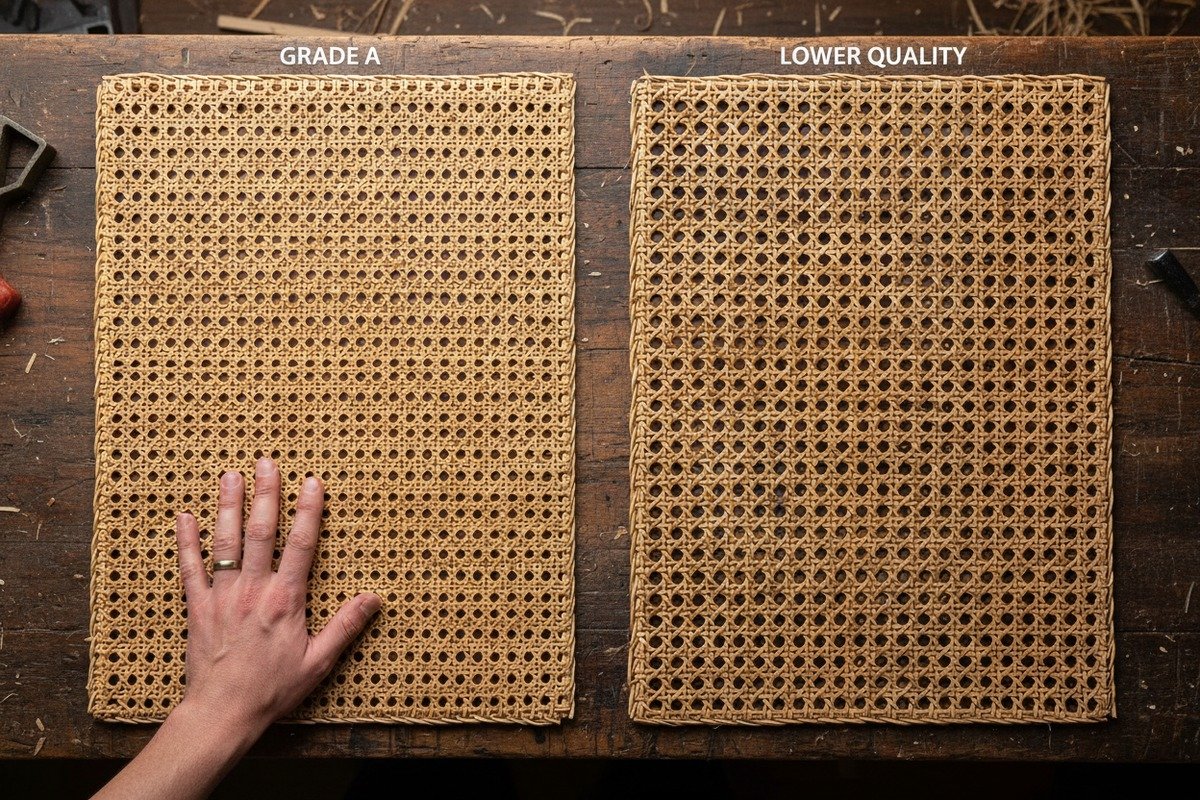
Grade A rattan cane webbing shows uniform strand width, consistent golden-brown color with minimal dark spots, smooth surfaces free of burrs, tight weave tension with evenly sized openings, and flexible strands that bend without cracking. Lower grades display irregular patterns, color mismatches, and rough textures.
Visual Checks You Can Do in 60 Seconds
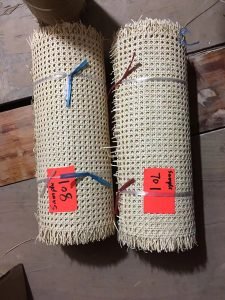
Start with your eyes. Lay a one-meter section flat on a clean surface. Grade A webbing will have openings that are nearly identical in size. The standard benchmark is a uniform half-inch measurement from the center of one hole to the center of the next. If you see openings that vary by more than 1-2 millimeters, the weave tension was inconsistent during production. That is a clear sign of a lower grade.
Next, look at the color. Natural rattan ranges from pale straw yellow to warm golden brown. A quality roll will show smooth color transitions. Watch for stark differences between individual strands. Some dark streaks are normal in unbleached cane, but large patches of discoloration suggest poor sorting at the processing stage. In our Indonesian facility, we sort strands by color tone before weaving. Skipping this step is one of the most common shortcuts lower-tier factories take.
The Bend and Snap Test
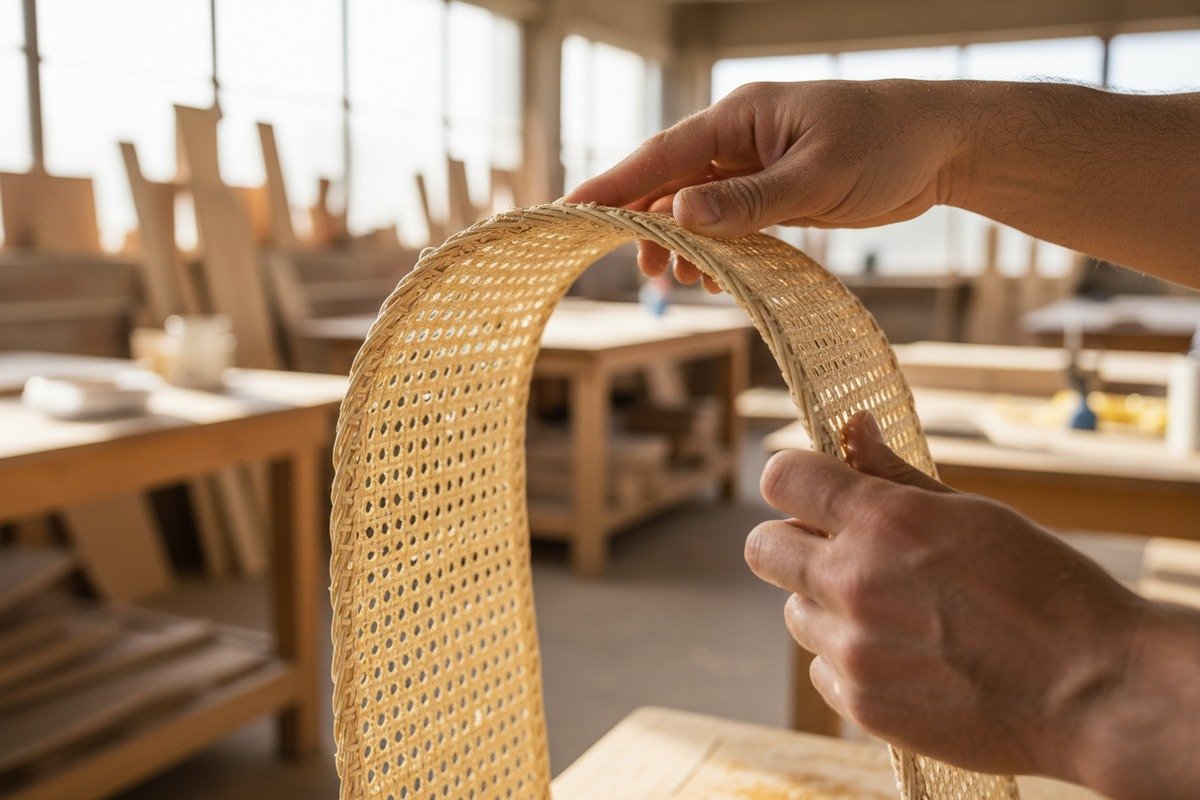
Pick up a single strand if possible, or flex a section of the webbing gently. Grade A cane should bend smoothly and spring back to its original shape. If it cracks, splinters, or stays bent, the material is either too dry or came from an immature palm harvested before the ideal 5-7 year window. Brittle rattan will crack further during installation, especially when stretched over frames.
Node and Surface Quality
Rattan has natural nodes, which are small growth marks along the stem. In premium webbing, these nodes are sanded or singed smooth. Run your fingertip along several strands. If you catch on rough bumps or tiny hair-like burrs, the paso de chamuscado 3 was skipped or done poorly. Singeing involves briefly passing the strand over a flame to burn off surface fuzz. It is a small step that makes a big difference in finished product feel.
Quick Grading Reference
| Característica | AAA (Premium) | Grade A (Good) | Lower Grade |
|---|---|---|---|
| Strand width uniformity | ±0.3 mm variance | ±0.5 mm variance | >1 mm variance |
| Consistencia del color | Very even, sorted | Minor natural variation | Obvious dark patches |
| Suavidad de la superficie | Fully singed, no burrs | Minimal burrs | Rough, unfinished |
| Weave opening size | Uniform half-inch | Ligera variación | Irregular openings |
| Flexibilidad | Bends and returns fully | Ligera resistencia | Cracks or stays bent |
| Node integration | Invisible or flush | Slightly raised | Rough, protruding |
Bleached vs. Unbleached Considerations
Bleached rattan offers a lighter, more uniform look. It is easier to color-match across rolls. Unbleached cane has a deeper, more rustic tone that darkens naturally over time. Some buyers prefer unbleached because it accepts stains and paints well. However, unbleached cane requires stricter sorting to avoid color mismatches. If your end product demands a consistent look across hundreds of units, bleached webbing from a reliable supplier reduces risk. If you want a handcrafted, organic aesthetic, unbleached is the better path — just ask your supplier about their sorting process.
What specific signs of quality consistency should I look for in a large-scale rattan order?
Our team has fulfilled bulk orders for furniture factories across Turkey, Spain, and the USA. The biggest lesson from those projects is that a great sample means nothing if the full production run does not match it.
For large-scale orders, check batch-to-batch uniformity by comparing rolls from different production dates. Measure strand thickness at multiple points, verify weave pattern alignment across rolls, confirm color matching under natural light, and request a quality control report showing rejection rates and inspection criteria from your supplier.
Why Batch Consistency Matters More Than Sample Quality
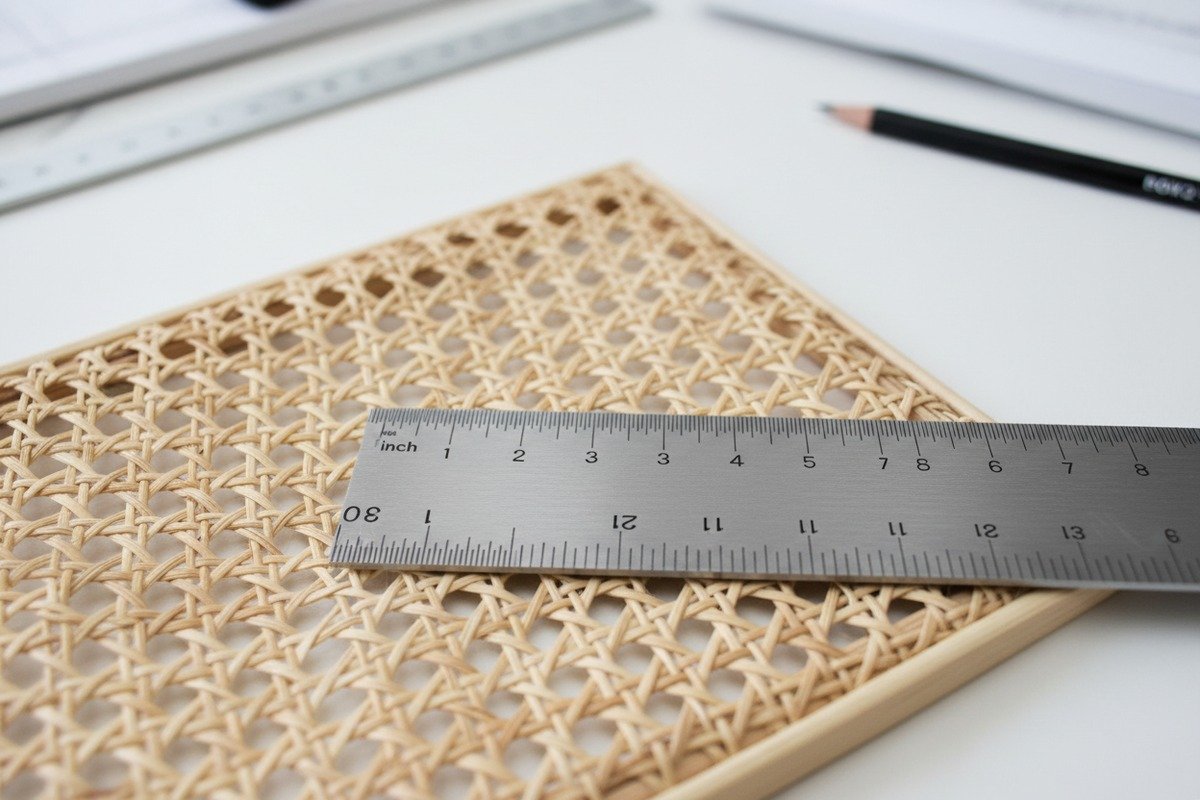
A supplier can hand-pick their best roll for a trade sample. The real test is what happens when you order 500 or 1,000 meters. We recommend asking your supplier to send samples from at least two different production batches. Lay them side by side. Compare the weave spacing, strand color, and thickness. If they match closely, the factory has good process control. If they look like two different products, that is a major warning sign.
Measuring Strand Thickness
Use a simple caliper or micrometer. Measure the thickness of individual strands at five random points across each roll. Premium cane webbing, such as cane from Rotin Tohiti palms 5, typically has strands between 1-2 inches in diameter at the raw stage, but the finished woven strand should be consistent within tight tolerances. A variance greater than 0.5 mm across a single roll suggests inconsistent splitting during processing. Across multiple rolls, the tolerance should hold.
Cross-Roll Color Matching
Color drift between rolls is one of the most common complaints in large orders. Always inspect color under natural daylight 6, not warehouse fluorescent lighting. Fluorescent lights can mask yellow-brown shifts. Unroll at least one meter from each roll and place them adjacent. For furniture factories producing matching sets — like dining chairs — even a slight tone difference between the seat and the backrest panel is visible to the end customer.
Weave Pattern Alignment
If your project requires joining multiple sheets of webbing, pattern alignment is critical. The most popular patterns include octagon, radio weave, square grid 7, and 3×3 closed weave. Each has a repeating unit. Check that the repeat unit dimensions are identical across rolls. If one roll has a slightly stretched octagon pattern and another has a compressed one, the seam between them will be visible.
Consistency Checklist for Bulk Orders
| Inspection Point | Método | Acceptable Range | Señal de alerta |
|---|---|---|---|
| Grosor de la hebra | Caliper at 5+ points per roll | ±0.3 mm within roll | >0.5 mm variance |
| Weave opening size | Ruler across 10 openings | ±1 mm from standard | >2 mm variance |
| Color tone | Visual under natural light | Slight warm shift OK | Stark mismatch between rolls |
| Roll length accuracy | Measure full unrolled length | ±2% of stated length | >5% short |
| Pattern repeat | Overlay two sheets | Identical repeat unit | Visible stretch or compression |
| Acabado del borde | Visual and tactile | Limpio, deshilachado mínimo | Heavy fraying, loose strands |
Ask About Rejection Rates
A factory that never rejects any material is not inspecting. In our own production line, we maintain a rejection rate 8 of around 5-8% on incoming raw rattan. That means we actively remove substandard strands before they enter the weaving process. Ask your supplier what their rejection rate is. If they cannot answer, or if they claim zero rejects, their quality control may be weak.
The Role of Origin in Consistency
Indonesian and Vietnamese rattan farms tend to produce the most uniform raw material for cane webbing. This is partly due to established farming practices, consistent climate, and experienced harvesters who select palms at peak maturity. Rattan from regions with less farming infrastructure can be perfectly usable, but batch consistency is harder to guarantee. When placing large orders, always confirm the origin and ask if the supplier can guarantee single-origin sourcing for your entire order.
How do I ensure the rattan material I source has been processed correctly to prevent future brittleness?
One of the most frustrating calls we get is from a buyer whose rattan webbing cracked six months after installation. The furniture looked beautiful at first, but then customers started complaining. Almost every time, the root cause traces back to processing errors before the webbing left the factory.
To prevent brittleness, verify that your supplier follows a complete processing chain: harvesting at 5-7 year maturity, proper separation and splitting, controlled boiling or steaming, appropriate drying to optimal moisture content, singeing for smoothness, and finishing with oils or sealants. Ask for documentation of each step.
Understanding the Full Processing Chain
Natural rattan goes through many steps before it becomes the webbing you install on furniture. Each step affects long-term durability. Here is the sequence and what can go wrong at each stage.
Harvesting. Rattan palms need 5-7 years to reach maturity. Immature palms produce thinner, weaker fibers. Over-mature palms can become too rigid. There is no easy way to verify harvest age from the finished product alone, so supplier transparency matters.
Separation and Splitting. The outer bark of the rattan stem is separated from the inner core. The outer bark is what becomes cane webbing — it is thin, pliable, and naturally glossy. The core is thicker and used for structural elements. If splitting is rushed or uneven, strand thickness varies, and weak spots form.
Boiling or Steaming. This step softens the fibers, removes natural sugars that attract insects, and prepares the material for shaping. Under-boiled rattan retains sugars and is more prone to insect damage and mold growth. Over-boiled rattan loses structural integrity.
Drying. Rattan must be dried to an optimal moisture level. Too dry, and it becomes brittle. Too moist, and it invites mildew. The ideal moisture content for finished cane webbing is typically between 10-14%. Some suppliers use sun drying, others use controlled kiln drying. Kiln drying is more consistent but costs more.
Singeing. Passing strands over a flame burns off tiny surface hairs and burrs, creating a polished, smooth finish. Unsinged rattan feels rough and can splinter over time.
Finishing. A light application of natural oil or a sealant protects against moisture swings. This is especially important for rattan that will be used in environments with fluctuating humidity.
Processing Step Impact Table
| Paso de Procesamiento | Propósito | Brittleness Risk if Skipped |
|---|---|---|
| Proper harvest timing | Ensures fiber maturity | Weak, thin fibers that snap easily |
| Even splitting | Uniform strand thickness | Thin spots crack under stress |
| Boiling/steaming | Removes sugars, softens fibers | Insect damage, mold, rigidity |
| Secado controlado | Optimal moisture content 9 | Too dry = brittle; too moist = mold |
| Singeing | Smooth surface finish | Surface splintering over time |
| Oil/sealant finishing | Moisture barrier | Absorbs humidity, swells, then dries and cracks |
How to Verify Processing Quality
You cannot visit every factory floor, but you can ask the right questions. Request a written description of the processing steps your supplier uses. A transparent supplier will list each stage and even share photos or videos of their facility. At our Indonesian processing plant, we document every batch with photos of the boiling vats, drying racks, and singeing stations. We share these with buyers upon request.
The Water Rinse Flexibility Test
A practical test you can do with a sample: lightly mist or rinse a section of the webbing with water. Natural rattan should absorb some moisture and become slightly more pliable without falling apart. After air drying, it should return to a firm but flexible state. If it stays stiff after wetting, or if it turns mushy, the processing was not done correctly.
Treatments for Long-Term Protection
Beyond basic processing, ask about post-weave treatments. Anti-mildew treatment is essential for any rattan used in humid environments. Anti-insect treatment prevents borer beetles, which are the most common pest for natural rattan. Some suppliers also offer UV-resistant coatings for rattan used near windows or in semi-outdoor applications. These treatments add cost, but they can double or triple the useful life of the webbing.
What are the key indicators that my supplier's packaging will protect the rattan quality during international shipping?
We have shipped rattan to over a dozen countries, and we have learned that even perfectly graded, properly processed webbing can arrive damaged if the packaging is wrong. This is one of the most overlooked aspects of the sourcing process.
Key packaging indicators include moisture-barrier wrapping such as plastic film or wax paper, rigid outer cartons or wooden crates to prevent crushing, internal padding between rolls, humidity indicator cards inside sealed packages, and clear labeling with handling instructions. Good suppliers also use vacuum sealing for long-distance ocean freight.

Why Packaging Deserves Serious Attention
Natural rattan is hygroscopic. It absorbs and releases moisture from the surrounding air. During a 30-day ocean voyage from Southeast Asia to Europe, the container interior can swing from hot and humid in the tropics to cool and damp in temperate zones. Without proper packaging, rattan can absorb excess moisture, leading to mold. Or it can dry out in a heated container, leading to brittleness on arrival. We have seen both happen, and both are preventable.
Moisture Protection Layers
The innermost layer should be a moisture barrier. Plastic film wrap or wax-coated paper works well. This layer traps the rattan at its ideal moisture level and buffers against external humidity changes. Some suppliers go a step further and include silica gel desiccant packs inside the wrapping to absorb any trapped moisture. For ocean shipments, vacuum sealing individual rolls is the gold standard. It eliminates air exchange entirely.
Crush Protection
Rattan webbing rolls can be compressed and deformed if heavy cargo is stacked on top. Rigid outer packaging — either reinforced cardboard cartons or wooden crates — prevents this. For high-value AAA-grade webbing, wooden crates are worth the added freight cost. For standard shipments, double-wall corrugated cartons with corner protectors provide adequate defense.
Humidity Indicator Cards
These small, inexpensive cards change color when humidity inside the package exceeds a set threshold. If your roll arrives and the indicator shows high humidity exposure, you know the conditions were not ideal during transit, even if the rattan looks fine on the surface. This is an early warning system that allows you to inspect more carefully before accepting the shipment.
Packaging Quality Checklist
Ask your supplier for photos of their standard packaging before the first order ships. Here is what to look for:
- Each roll individually wrapped in plastic or wax paper
- Desiccant packs placed inside the wrapping
- Rolls separated by foam or cardboard dividers
- Outer carton rated for international shipping weight
- Clear labels: "Keep Dry," "Do Not Stack Heavy," "This Side Up"
- Humidity indicator card visible without opening the inner wrap
Comparing Packaging Standards
| Packaging Feature | Básico | Estándar | Premium |
|---|---|---|---|
| Envoltura interior | None or thin plastic | Plastic film | Vacuum-sealed plastic |
| Desecante | Ninguna | 1-2 silica gel packs | Multiple packs per roll |
| Roll separation | Ninguna | Cardboard dividers | Foam padding |
| Contenedor exterior | Cartón de pared simple | Cartón de doble pared | Caja de madera |
| Humidity indicator | Not included | Included in carton | Included per roll |
| Etiquetado | Basic product info | Handling warnings | Full handling + storage guide |
What to Do on Arrival
Even with great packaging, inspect immediately upon delivery. Open a random selection of rolls — at least 10% of the order. Check for mold spots, unusual odor, or excessive dryness. Flex a section. Compare against your approved sample. If you find issues, document them with photos before moving the cargo from the delivery point. This documentation is essential for any quality claim with the supplier or the shipping insurance provider.
OEM Packaging and Custom Branding
For wholesale buyers who resell rattan rolls, some suppliers offer OEM packaging with your brand labels, care instructions, and even QR codes linking to installation guides. At our facilities, we provide this service with flexible minimum order quantities. It adds a professional touch for buyers who distribute to retail shops or online platforms. Custom packaging also lets you include care cards that educate the end user on maintaining the rattan, which reduces returns and complaints.
Conclusión
Quality rattan sourcing comes down to informed inspection, transparent supplier relationships, and attention to every step from harvest to delivery. Use the checklists and tables in this guide to protect your next order and build lasting confidence in your supply chain.
Notas al pie
1. Describes the importance of consistent strand width in cane webbing production for quality. ↩︎
2. Details how rattan is used in furniture making, including its core for frames. ↩︎
3. Describes the overall processing of rattan, including drying and finishing steps for smoothness. ↩︎
4. Explains the criteria and characteristics of Grade A rattan in quality grading systems. ↩︎
5. Provides details on Tohiti rattan, known for its quality, smooth texture, and use in luxury items. ↩︎
6. Discusses color consistency in rattan and the importance of sorting for uniform appearance. ↩︎
7. Explores various cane weave patterns, including hexagonal (octagon), and their applications in furniture. ↩︎
8. Defines rejection rate as a key performance indicator for quality control and operational efficiency. ↩︎
9. Explains how moisture content affects rattan’s mechanical properties and durability. ↩︎
10. Explains what rattan cane webbing is, its origins, characteristics, and applications. ↩︎

 English
  Español de México
  العربية
  Deutsch
  Français
  Русский