
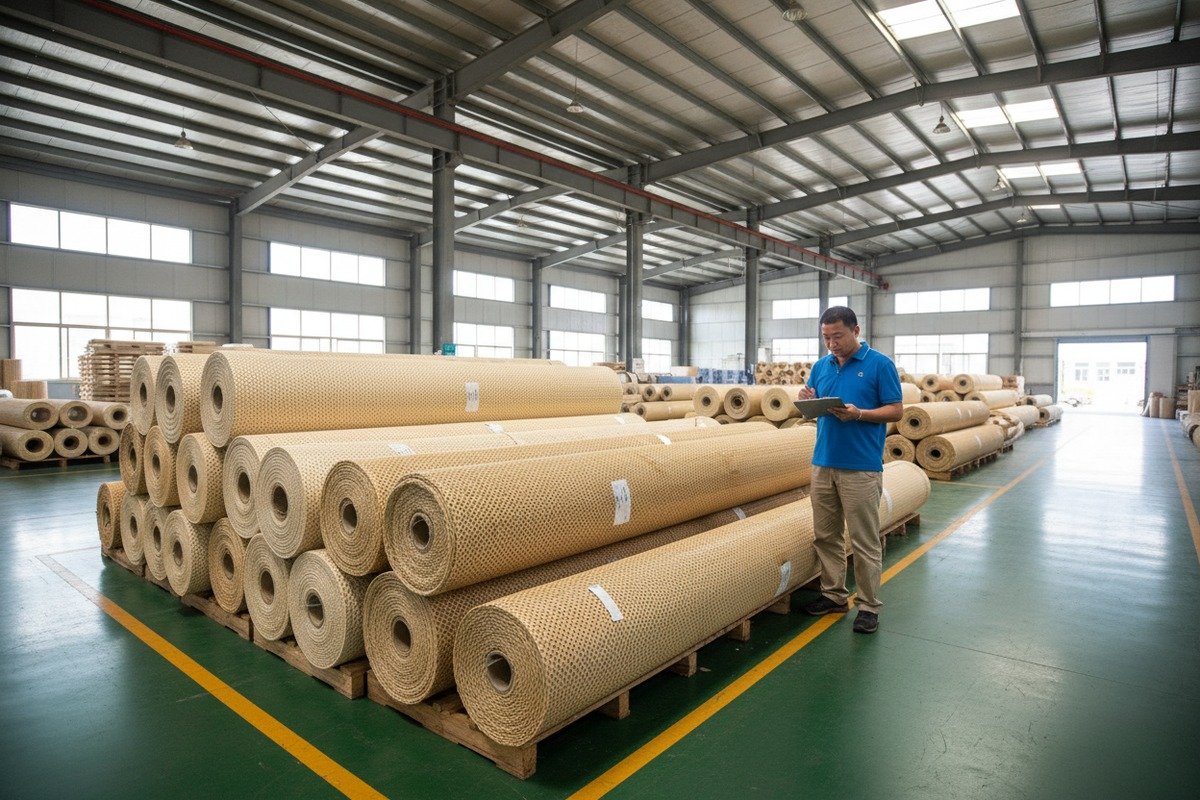
Every week, our sales team at Seafan Rattan fields the same question from furniture factories 1 and material wholesalers around the world—”What is your standard roll length?” The confusion is real because there is no single universal answer, and ordering the wrong length means wasted material, delayed production, or surprise shipping fees that eat into your margins.
There is no universal standard roll length for rattan cane webbing. However, the most common wholesale length is 15 meters (approximately 49 feet) per roll for natural rattan. Synthetic PE rattan webbing typically comes in longer rolls of up to 30 meters (about 98 feet). Widths range from 14 cm to 100 cm depending on the weave pattern and supplier.
This article breaks down everything you need to know about roll lengths, from factory defaults to custom cuts, shipping impact, and quality consistency. Whether you run a furniture factory or a wholesale distribution business, you will find clear answers below.
How long is a standard roll of rattan webbing for my furniture factory?
When we ship containers from our Foshan warehouse and our Indonesian processing facility, the question of roll length comes up in nearly every order discussion. Factories need to plan cutting layouts, and guessing wrong costs real money in scrap and downtime.
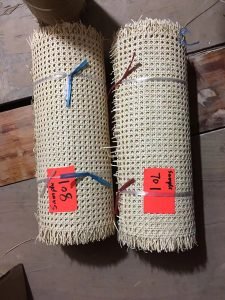
For most natural rattan cane webbing, a standard wholesale roll is 15 meters (49 feet) long. Synthetic PE rattan webbing rolls typically extend to 30 meters (98 feet). Retail and DIY rolls are much shorter, often ranging from 1 meter to 3 meters. The exact length depends on the material type, weave pattern, and supplier.
Why There Is No Single "Universal" Standard
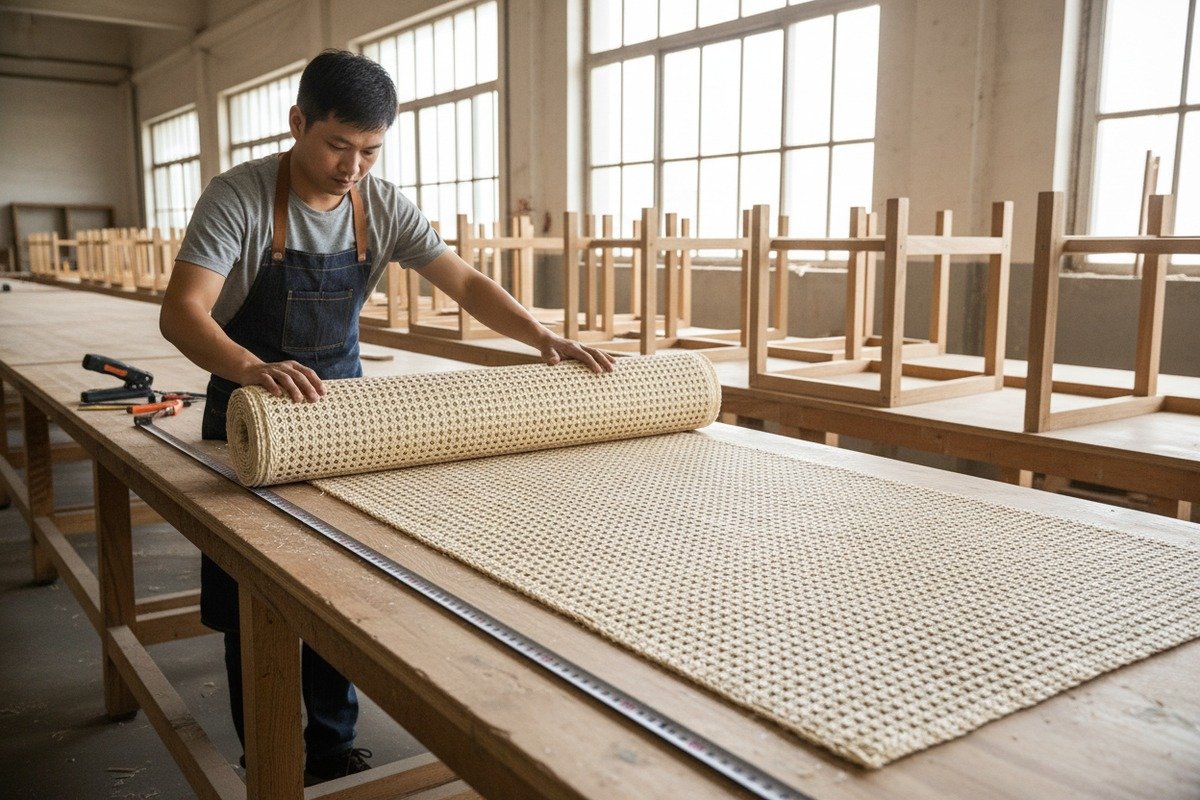
The rattan industry has no ISO standard 2 or global regulation that defines a fixed roll length. This surprises many buyers. The length depends on several factors:
- Tipo de material. Ratán natural 3 comes from palm vines harvested in Indonesia and Vietnam. The raw material has physical limits. Ratán sintético de PE 4 is extruded from plastic, so manufacturers can produce much longer continuous rolls.
- Patrón de tejido. A tight square basketweave behaves differently on the roll than an open hexagonal radio weave. Some patterns hold up better in longer rolls without cracking.
- Market segment. Wholesale buyers get full 15-meter rolls. DIY and Etsy sellers repackage them into short cuts of 1 to 5 feet.
Common Roll Lengths by Material and Application
| Tipo de material | Longitud típica del rollo | Typical Roll Width | Mejor para |
|---|---|---|---|
| Natural Rattan (Radio Weave) | 15 m (49 ft) | 40–100 cm (16–40 in) | Furniture factories, wholesale |
| Natural Rattan (Square Weave) | 15 m (49 ft) | 35–60 cm (14–24 in) | Cabinet doors, chair seats |
| Ratán sintético de PE | 30 m (98 ft) | 40–100 cm (16–40 in) | Outdoor furniture, commercial |
| Fine Cane Webbing (1/2" mesh) | 1–15 m (3–49 ft) | 35–45 cm (14–18 in) | Restoration, premium furniture |
| DIY/Retail Cuts | 0.5–1.5 m (1.6–5 ft) | 35–60 cm (14–24 in) | Home projects, small repairs |
How Weave Patterns Affect Roll Length
Not all patrón de tejido 5s ship in the same lengths. Our production teams have found that open weaves like the classic hexagonal radio pattern are more flexible and roll easily to 15 meters without damage. Dense diamond motifs and tight square weaves can be stiffer. They still reach 15 meters, but they need more careful handling during rolling and unrolling.
For synthetic PE webbing, the material is inherently more pliable and uniform. This is why 30-meter rolls are common and practical. The chevron wave design and other synthetic patterns maintain their shape over longer lengths because the plastic fibers do not dry out or crack like natural rattan can.
What About Bleached and Colored Rattan?
Bleached rattan cane webbing—the cream-white variety popular in Scandinavian and bohemian furniture—follows the same 15-meter standard. The bleaching process does not change the roll length. However, bleached rattan can be slightly more brittle, so we always recommend storing it flat or in a loose roll rather than tightly wound. This prevents cracking at the edges.
In our experience exporting to the Netherlands and Spain, bleached rattan in 15-meter rolls with 60 cm width is the most popular configuration for European furniture makers.
Can I request custom roll lengths to minimize waste in my production?
One of the biggest pain points we hear from purchasing managers—people like our long-term client Ranoo in Thailand—is desperdicio de material 6. When you buy standard 15-meter rolls and your cutting layout needs 4.8-meter pieces, that leftover scrap adds up fast across hundreds of rolls.
Yes, many wholesale rattan suppliers offer custom roll lengths. At the factory level, natural rattan webbing can be cut to specific lengths before shipping. However, custom lengths often require a minimum order quantity and may carry a small surcharge. Ordering lengths matched to your production layout can reduce waste by 10–20%.
How Custom Cutting Works at the Factory
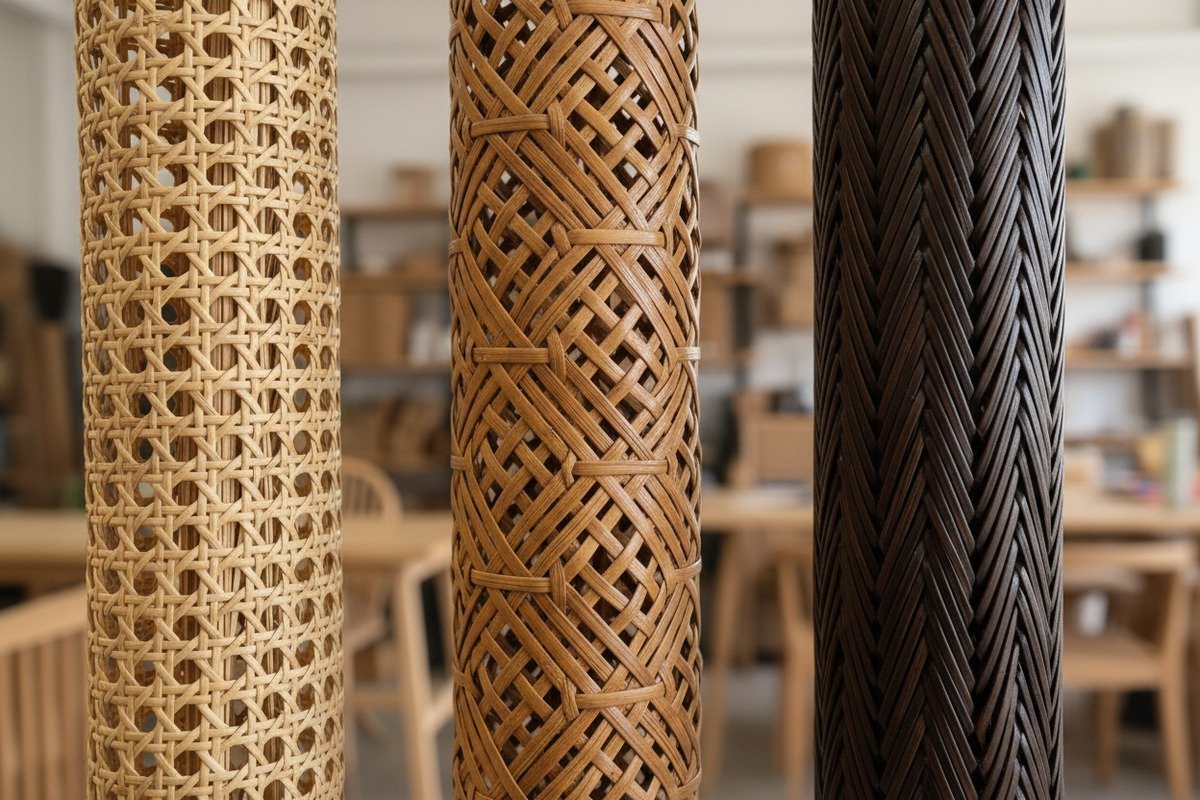
When we receive a custom length request, the process is straightforward. Our weavers in Indonesia produce webbing in continuous lengths. Before the material is rolled and packed, our quality team measures and cuts to the buyer's specification. This happens after the final quality inspection, so you still get a full Grade A check on every piece.
The key constraint is the raw material. Natural rattan vines can grow up to 200 meters, but once woven into webbing, practical roll lengths top out around 20 meters for natural material. Synthetic PE can go to 30 meters or more because the base material is manufactured in a controlled extrusion process.
When Custom Lengths Make Financial Sense
Custom rolls are not always the cheapest option per meter. Here is a simple comparison:
| Tipo de pedido | Longitud del rollo | Price per Meter | Waste Rate | Mejor para |
|---|---|---|---|---|
| Standard 15 m roll | 15 m | El más bajo | 5–15% | General production runs |
| Custom length (e.g., 4.8 m) | Per spec | 5–10% higher | Under 3% | Repeated identical cuts |
| Custom length (e.g., 7.5 m) | Per spec | 3–8% higher | Under 5% | Mid-size batch runs |
| Short retail cuts (1–2 m) | 1–2 m | Highest (up to 3x) | Near 0% | DIY, samples, prototyping |
The break-even point depends on your waste rate. If your factory wastes more than 10% of every standard roll, custom lengths usually pay for themselves. We recommend sending us your cutting layout, and our team will calculate the optimal roll length for your project.
Minimum Order Quantities for Custom Rolls
Most reputable suppliers, including our operation, set a minimum order quantity (MOQ) for custom lengths. This is because retooling the cutting station and adjusting packaging takes time. A typical MOQ for custom-length natural rattan webbing is 50 to 100 rolls. For synthetic PE, it can be as low as 30 rolls because the material is easier to handle.
The Customization Boom in the Rattan Industry
The market has shifted significantly since the pandemic-era DIY boom. Etsy sellers and small furniture workshops drove demand for short, project-specific cuts of 1 to 5 feet. On the wholesale side, factories now ask for precision lengths more often than ever. This trend has pushed suppliers like us to invest in better cutting and measurement equipment on our production lines.
For furniture factories running lean production, custom roll lengths are no longer a luxury. They are a competitive advantage. Less scrap means lower material cost per unit, which matters enormously when you are bidding on contracts against other factories.
How does the roll length impact my bulk shipping and packaging costs?
Shipping rattan webbing across oceans is something we do every day—containers leave our Foshan warehouse bound for over a dozen countries. shipping across oceans 7 The roll length you choose has a direct and sometimes surprising effect on your total landed cost.
Longer rolls reduce per-meter shipping costs because fewer rolls fit more material into each carton, cutting down on packaging weight and wasted container space. A standard 15-meter natural rattan roll is optimized for standard export carton sizes, while shorter custom rolls increase the number of packages and raise freight costs proportionally.

How Roll Length Affects Container Loading
A standard 20-foot shipping container 8 has about 33 cubic meters of usable space. Rattan webbing is lightweight but bulky. The way rolls are packed determines how many meters of material you can fit inside.
Longer rolls are more efficient. A 15-meter roll of 60 cm wide natural rattan webbing, when tightly rolled, forms a cylinder roughly 20 cm in diameter and 60 cm long. Shorter rolls of the same width create cylinders that are smaller in diameter but require more individual wrapping, more cardboard tubes, and more filler material.
Packaging Cost Breakdown by Roll Length
| Longitud del rollo | Rolls per Carton | Cartons per 20ft Container | Total Meters per Container | Packaging Cost per Meter |
|---|---|---|---|---|
| 15 m (standard) | 4–6 | 180–220 | 10,800–19,800 m | El más bajo |
| 10 m (custom) | 4–6 | 200–240 | 8,000–14,400 m | 10–15% higher |
| 5 m (custom short) | 6–10 | 220–260 | 6,600–13,000 m | 20–30% higher |
| 1–2 m (retail) | 10–20 | 250–300 | 2,500–6,000 m | 50–80% higher |
These numbers make it clear: shorter rolls cost more to ship per meter. The packaging materials—cardboard tubes, shrink wrap, edge protectors—add up when you have three times as many individual rolls to protect.
Protecting Quality During Transit
Roll length also affects quality during shipping. Longer rolls are more structurally stable when packed vertically in a container. They resist compression better than short rolls, which can shift and get crushed. We wrap every roll in moisture-barrier film because natural rattan is prone to mold in humid container environments during ocean transit.
For clients in the Middle East and Southeast Asia, where containers often sit in hot, humid ports, we double-wrap and add silica gel packets. This adds a small cost but prevents the kind of mold and mildew damage that ruins an entire shipment.
Optimizing Your Order for Freight Savings
Here are practical steps we recommend to our clients:
- Stick to 15-meter rolls when possible. They are the most freight-efficient option for natural rattan.
- Consolidate widths. Ordering multiple widths in the same roll length simplifies packing and reduces dead space in cartons.
- Ask for palletized loading. Pallets protect the bottom layer of rolls and speed up unloading at your warehouse.
- Plan for full container loads (FCL). LCL (less than container load) shipments add handling fees and increase the risk of damage from other cargo.
Our team in Foshan can provide a loading plan with diagrams before you confirm your order. This way, you know exactly how many rolls and cartons will fit, and there are no surprises when the container arrives.
Will I find consistent Grade A quality throughout the entire length of my rattan roll?
Quality consistency is the number one concern we hear from purchasing managers. When you unroll 15 meters of rattan webbing on your factory floor, the last meter should look and feel exactly like the first. But natural materials have natural variations, and that is where the real conversation begins.
Grade A natural rattan cane webbing should maintain consistent color, weave tightness, strand thickness, and surface smoothness throughout the entire roll. Reputable suppliers inspect every roll before shipping. However, minor natural color variations are inherent in real rattan and do not indicate a quality defect. The key is to work with a supplier who defines and enforces clear grading standards.
¿Qué Define el Ratán de Grado A?
At our facilities, Grade A means the roll meets all of the following criteria:
- Sin hebras rotas within the woven mesh.
- Uniform hole size across the entire weave pattern (critical for radio and hexagonal weaves).
- Grosor de hebra consistente with no thin spots or bulges.
- Clean surface with no visible scratches, stains, or mold spots.
- Proper drying to a moisture content below 12% 9, preventing mold during storage and transit.
- Even color with only the subtle natural variations you would expect from an organic material.
Where Quality Issues Typically Appear
In our years of processing rattan in Indonesia and finishing in Foshan, we have identified the specific points in a roll where problems are most likely to show up:
- The first and last 30 cm. These edges are handled the most during weaving and rolling. They can show slight fraying or compression marks.
- Splice points. In natural rattan webbing, weavers sometimes need to join new strands mid-roll. A poorly executed splice creates a visible bump or weak point. In Grade A rolls, splices should be nearly invisible.
- The center of wide rolls. On rolls wider than 60 cm, the center of the weave can sometimes be looser than the edges due to loom tension variations.
How We Ensure Consistency
Nuestro proceso de control de calidad 10 involves three inspection stages:
- Raw material grading. Before weaving begins in Indonesia, raw rattan poles are sorted by diameter, color, and flexibility. Only the top tier enters the Grade A production line.
- In-process checks. During weaving, our team monitors loom tension and strand alignment. Any roll showing inconsistency is pulled and downgraded immediately.
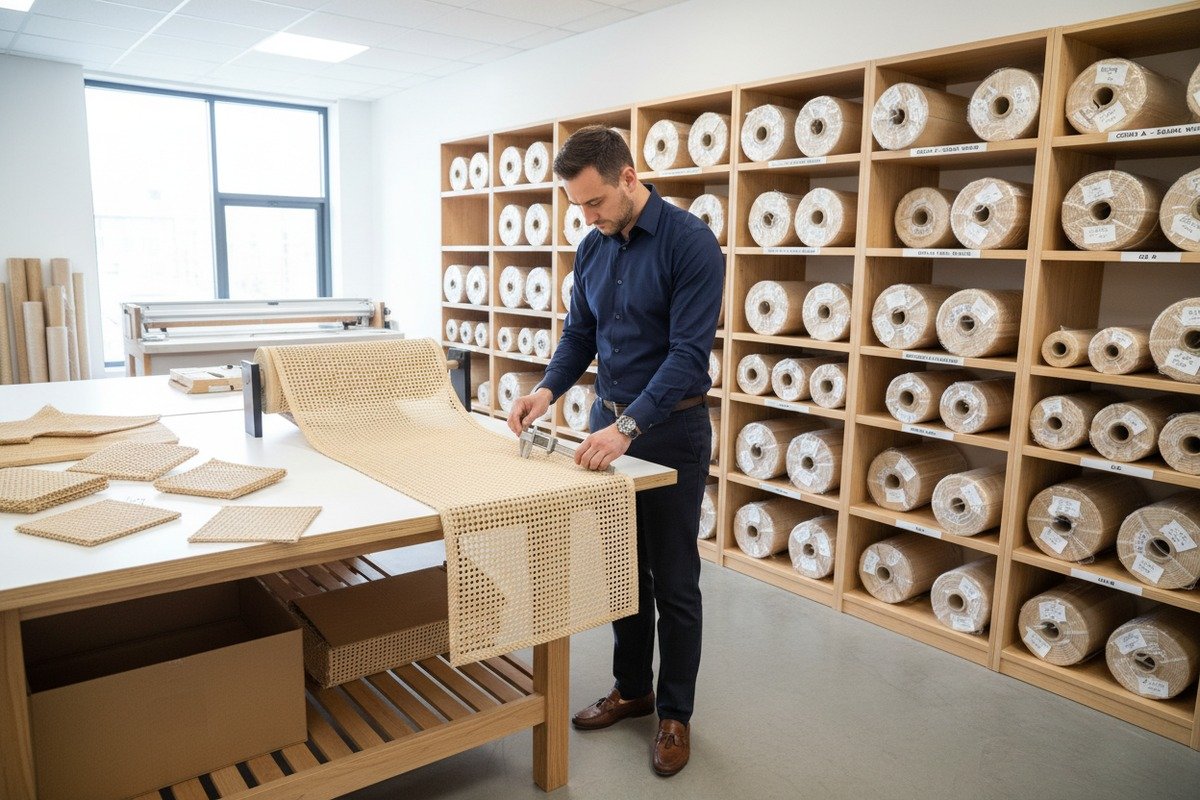
- Final roll inspection. Every finished roll is unrolled on a flat inspection table under bright lighting. Inspectors check both sides of the webbing, mark any defects, and measure the roll length and width.
Natural vs. Synthetic: Quality Consistency Compared
Synthetic PE rattan wins on pure uniformity. Because it is machine-extruded, every strand is identical in thickness, color, and flexibility. A 30-meter roll of synthetic webbing will look exactly the same from start to finish. There are no splices, no natural color shifts, and no risk of mold.
Natural rattan, on the other hand, carries the charm of organic variation. Two rolls from the same batch may differ slightly in tone—one might lean more toward straw yellow, the other toward warm cream. This is normal and expected. What is not acceptable in Grade A is inconsistency within a single roll.
Storage Tips to Preserve Quality After Delivery
Even the best Grade A roll can degrade if stored improperly. Here are our recommendations:
- Store rolls horizontally in a cool, dry space with humidity below 65%.
- Keep rolls in their original moisture-barrier packaging until ready for use.
- Avoid direct sunlight, which can bleach and dry natural rattan unevenly.
- Use rolls within 6 months of delivery for best flexibility and color consistency.
For factories in tropical climates like Thailand, India, and the Philippines, we strongly suggest climate-controlled storage. One of our clients in the Philippines lost an entire shipment to mold because the rolls sat in an open warehouse during monsoon season. That experience led us to upgrade our packaging with additional moisture barriers for all tropical destinations.
Conclusión
Understanding rattan cane webbing roll lengths helps you order smarter, reduce waste, and control costs. Whether you need standard 15-meter rolls or custom lengths, the right supplier makes all the difference. Reach out to our team at Seafan Rattan for samples and a personalized loading plan.
Notas al pie
1. Provides context on the global furniture manufacturing industry. ↩︎
2. Highlights the existence of ISO standards within the rattan industry. ↩︎
3. Wikipedia provides a comprehensive and authoritative definition of rattan. ↩︎
4. Describes the composition and manufacturing process of synthetic rattan. ↩︎
5. Wikipedia provides an authoritative overview of weaving and different weave patterns. ↩︎
6. Discusses the economic impact of material waste in manufacturing. ↩︎
7. Explains the logistics and challenges of international shipping. ↩︎
8. Boxhub provides a comprehensive guide to shipping container dimensions, including 20-foot containers. ↩︎
9. Details the importance of moisture control for rattan quality. ↩︎
10. Describes the systematic approach to ensuring product quality. ↩︎

 English
  Español de México
  العربية
  Deutsch
  Français
  Русский