
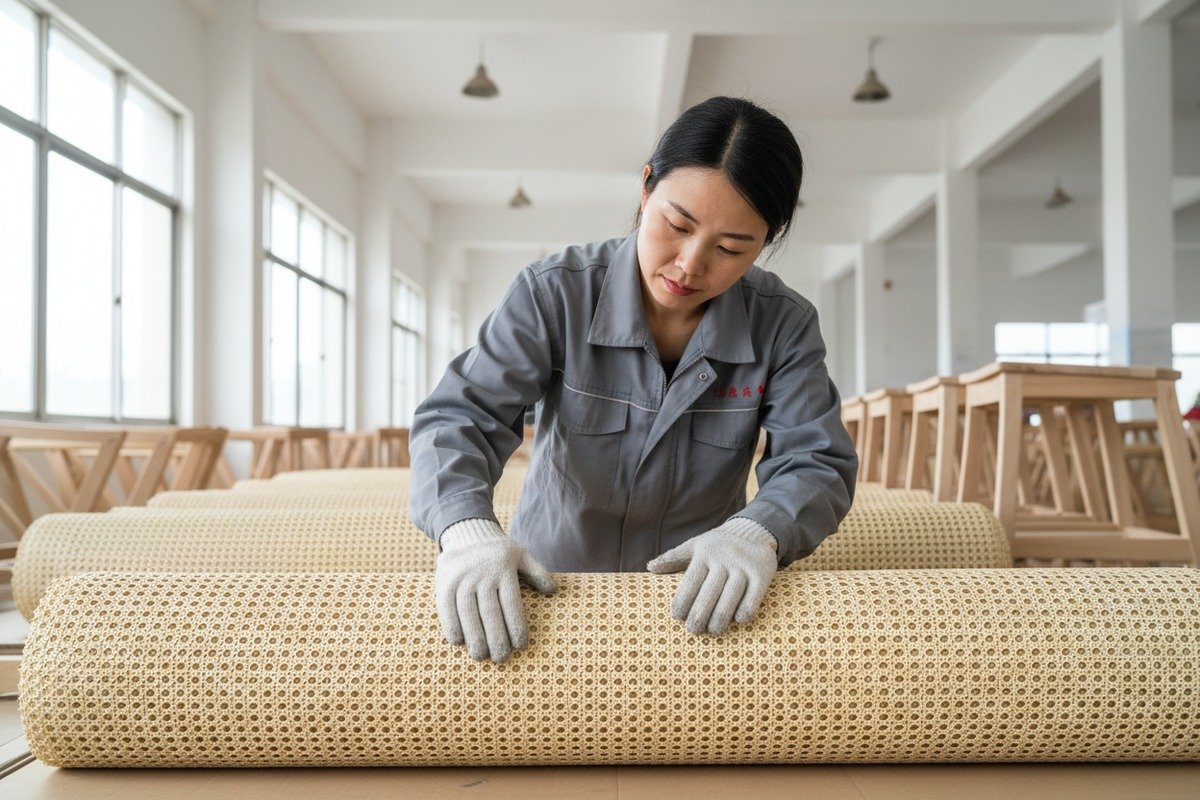
Every week, our customer service team fields calls from frustrated furniture makers who just received tejido de caña de ratán 1 that cracked right on the production floor. The waste adds up. The delays hurt. And if you have been in this business long enough, you know that a single bad batch can cost you an entire season of orders.
Rattan cane webbing breaks mainly because of moisture imbalance—either too dry and brittle or too damp and swollen. Quality sourcing from mature, sustainably harvested rattan with proper moisture content, flexible strands, and minimal nodes is the key to preventing breakage and ensuring long-lasting furniture products.
In this guide, we break down the exact reasons your rattan webbing fails, how to tell real Grade A material from cheap alternatives, what to demand from your Chinese supplier, and how to keep your rolls flexible no matter the climate furniture manufacturing process 2. Vamos a ello.
Why is my rattan cane webbing splitting or breaking during the furniture manufacturing process?
We have seen this problem hundreds of times on our own production lines in Foshan. A furniture factory buys what looks like decent rattan webbing, starts stretching it across a frame, and snap—strands split right down the middle. The frustration is real, and the root cause is almost always preventable.
Rattan cane webbing splits during manufacturing primarily because the material lacks proper moisture content, was not soaked before installation, or was sourced from immature rattan with excessive nodes. Environmental factors like dry workshop air and sealed finishes also accelerate brittleness and cracking.
Understanding the Material
Rattan cane webbing is the thin outer skin peeled from rattan palm vines 3. It is not the thick inner core used for furniture frames. Because it is so thin, it reacts fast to changes in humidity and temperature. Think of it like skin—without moisture, it cracks.
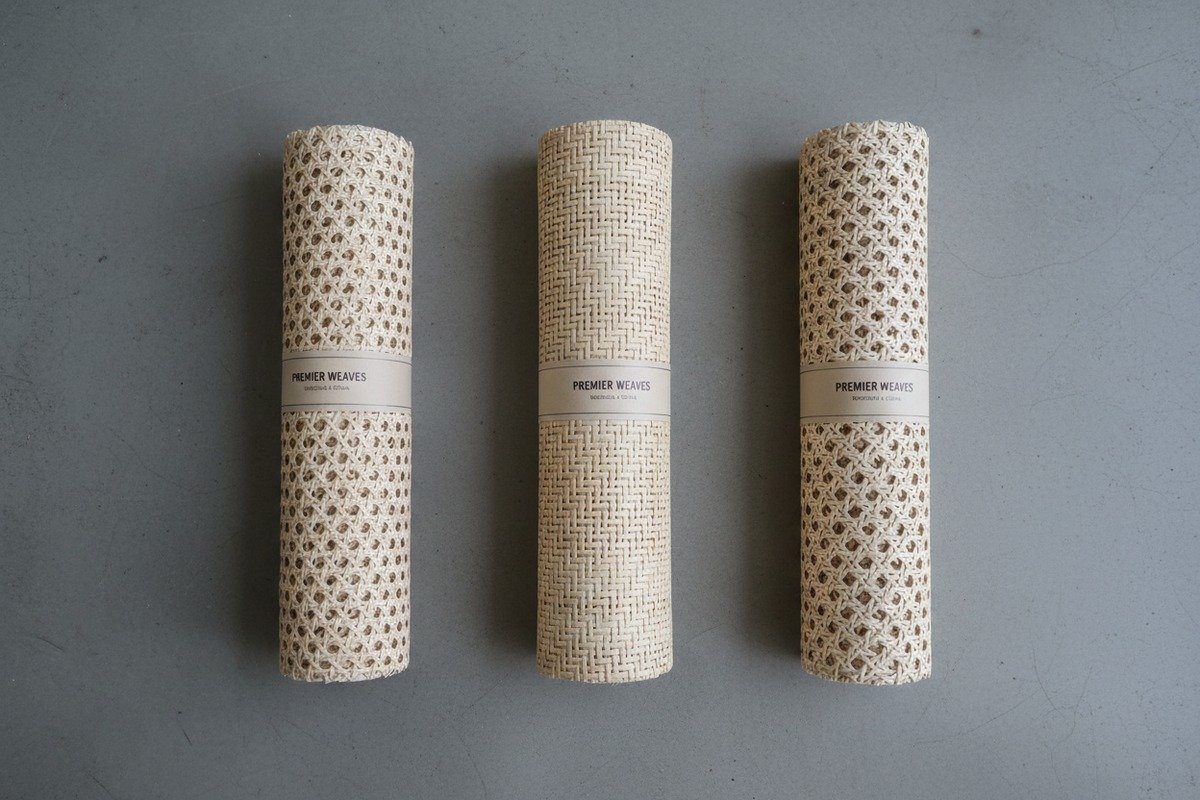
The webbing gets woven into sheets with patterns like malla abierta hexagonal 4 (radio weave), dense square basketweave, or diamond motifs. Each pattern places different stress on the strands. Tighter weaves hold up better under tension. Open weaves need more careful handling.
The Top Causes of Breakage
Here is a clear breakdown of why rattan webbing breaks during manufacturing:
| Causa | Qué sucede | Cómo prevenirlo |
|---|---|---|
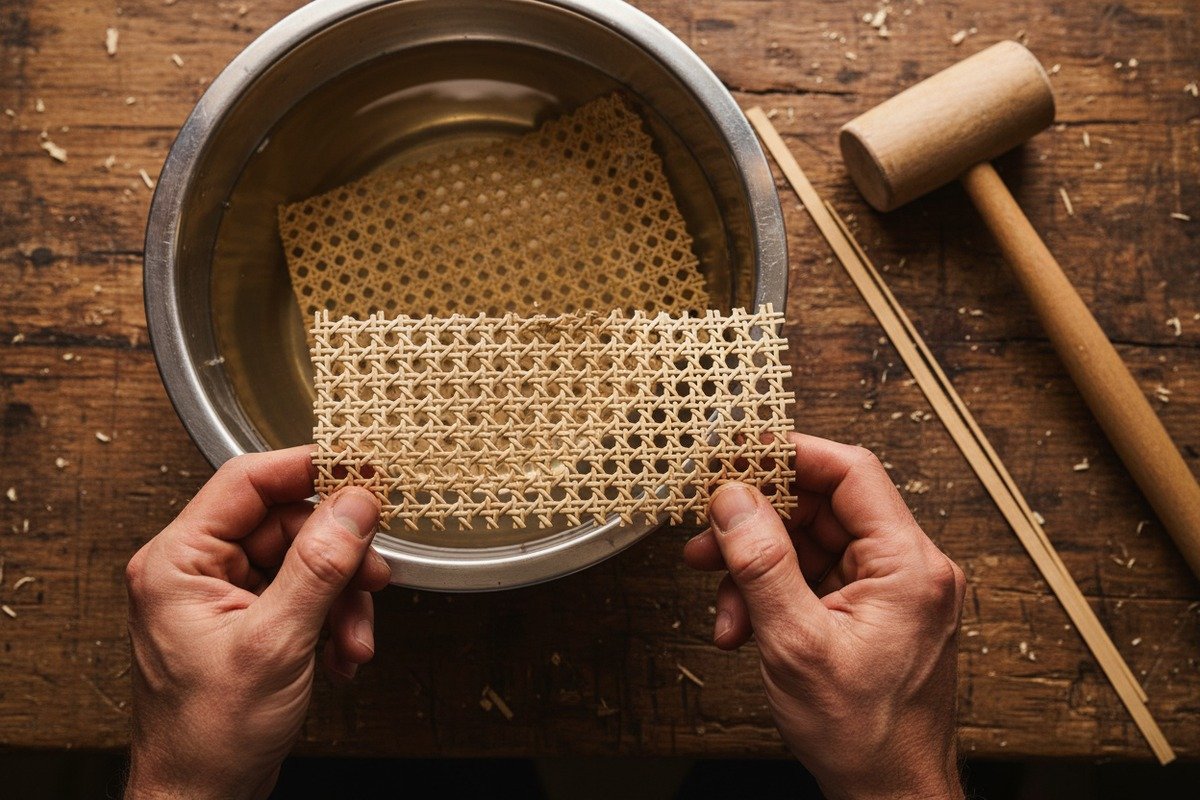
| Skipping the soaking step | Dry webbing snaps when stretched into the groove | Soak webbing and spline in warm water for 15–30 minutes before installation |
| Over-drying in storage | Strands lose all flexibility and become brittle | Store rolls in a dry but ventilated area; avoid heat sources |
| Sealing the underside | Varnish or shellac blocks the cane from breathing | Leave the underside unfinished or use a breathable sealant only |
| Node-heavy material | Nodes are weak points where cracks start | Source Grade A webbing with minimal nodes |
| Aggressive sanding of frames | Rough grooves tear the webbing edges | Sand frames smooth before pressing webbing in |
| Wet webbing + glue | Excess moisture prevents adhesive from bonding | Let webbing reach damp—not dripping wet—before gluing |
Installation Errors That Cause Damage
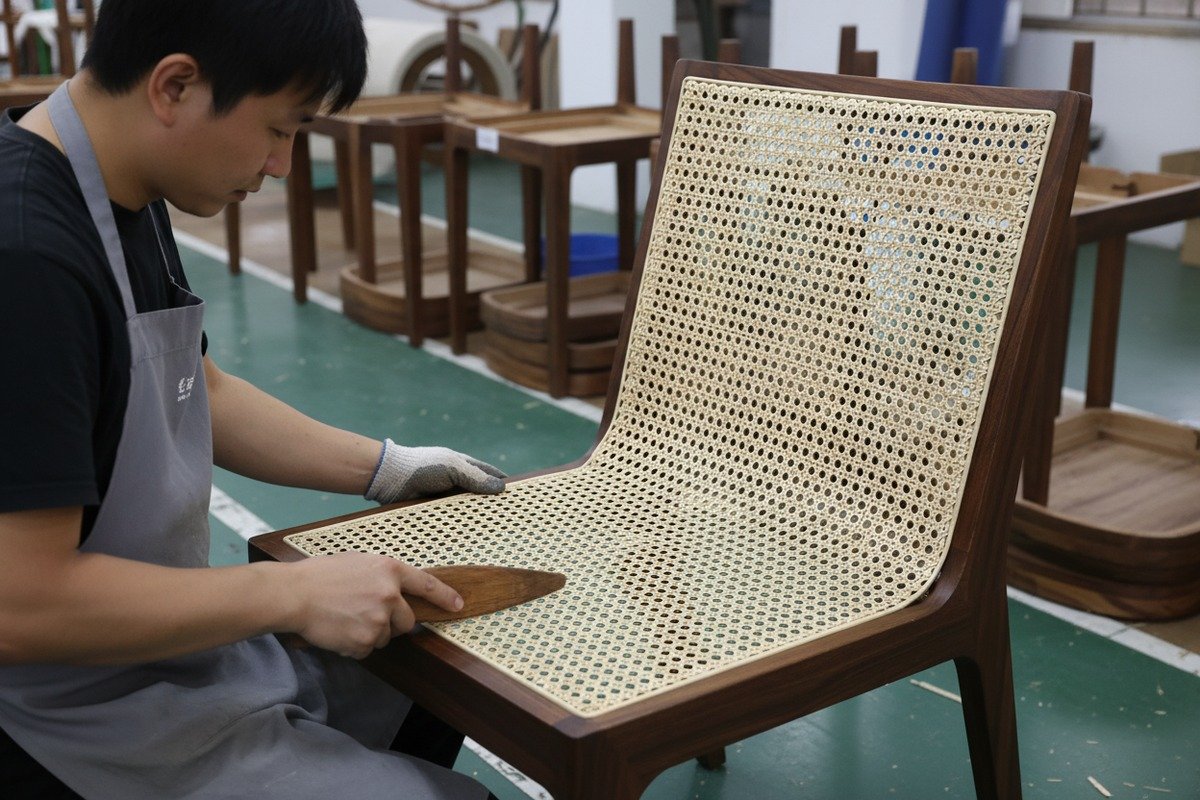
One mistake we see often is trimming the webbing too soon. When you cut the excess while the cane is still wet, it shrinks as it dries. This leaves gaps along the groove and loose edges that peel away. Always wait at least 24 hours before trimming.
Another common error is using an ill-fitting spline. If the spline is too thick, it forces the webbing and cracks the strands. If it is too thin, the webbing stays loose and wrinkles. Match the spline diameter to the groove width exactly.
From our experience shipping to furniture factories in the Netherlands and Australia, workshops with climate control 5 have far fewer breakage issues. If your factory sits in a dry region, run a humidifier near your rattan workstation. It makes a noticeable difference.
Age and Quality Factors
Not all breakage is caused by the installer. Sometimes the material itself is the problem. Low-grade rattan harvested too young lacks the densidad de fibra 6 needed to withstand bending. It looks fine on the roll but fails under stress.
Quality rattan should bend smoothly without cracking and spring back to its original shape. If you snap a strand and see a clean break with no fiber pull, the material is too dry or too low-grade. Good rattan tears with visible fibers, almost like pulling apart wood grain.
How can I distinguish between Grade A and low-quality rattan materials for my wholesale business?
When we first started sourcing raw rattan for processing at our Indonesian facility, telling good material from bad was one of the hardest lessons we learned. The price difference between grades is slim, but the performance gap is enormous. One bad shipment taught us more than any textbook could.
Grade A rattan cane webbing shows consistent golden-brown color, smooth and flexible strands, minimal nodes, and uniform weave tension. Low-quality material feels brittle, has dull or uneven coloring, contains frequent nodes, and cracks when bent. A simple bend test reveals the difference instantly.
Lista de verificación de inspección visual
Your eyes are your first tool. When you receive a sample or open a roll, look for these signs:
- Consistencia del color. Grade A webbing has a warm, even golden-brown or straw-yellow tone. Low-grade material has dark spots, gray patches, or an overall dull appearance.
- Strand thickness. Good webbing has even strand thickness across the entire sheet. Uneven strands mean inconsistent peeling during processing.
- Suavidad de la superficie. Run your fingers along the strands. Grade A feels smooth with a slight natural sheen. Low-grade feels rough or splintery.
- Node frequency. Nodes are the natural joints where leaves grew on the vine. Fewer nodes mean fewer weak points. Premium varieties like Rotin Tohiti 7 have very few nodes.
La prueba de flexión
This is the simplest and most reliable test. Take a single strand and bend it 90 degrees. Grade A material bends smoothly and returns to shape. Low-grade material cracks, snaps, or stays bent. If you hear a crackling sound, the rattan is too dry or harvested too young.
We run this test on every batch that arrives at our Foshan warehouse. It takes 30 seconds and saves thousands of dollars in rejected furniture down the line.
Material Comparison for Wholesale Buyers
| Característica | Grade A Natural Cane | Low-Grade Natural Cane | PE Synthetic Rattan 8 | Paper Webbing |
|---|---|---|---|---|
| Color | Consistent golden-brown | Uneven, dull, dark spots | Uniform (manufactured) | Flat beige |
| Flexibilidad | Se dobla sin agrietarse | Cracks or snaps on bend | Flexible but plastic feel | Stretches easily |
| Node count | Minimal (1–2 per meter) | Frequent (5+ per meter) | Ninguna | Ninguna |
| Lifespan | Decades to centuries with care | 1–3 years before failure | 5–10 years outdoors | Under 1 year |
| Mejor uso | Indoor premium furniture | Budget decor, short-term use | Outdoor furniture | Temporary DIY projects |
| Punto de precio | Más alto | Bajo | Medio | Lowest |
Rattan vs. Bamboo vs. Synthetic
This is a question that comes up in almost every trade conversation we have. Rattan is a solid, flexible vine—it bends without breaking. Bamboo is hollow and rigid. You cannot peel bamboo into thin weavable strips the way you can with rattan. They are fundamentally different materials.
Synthetic PE rattan mimics the natural look and works well outdoors. It resists rain and UV light. But it cracks in extreme cold and never achieves the warm, artisanal texture of real cane. For indoor furniture markets in Europe and the Middle East, our buyers consistently prefer natural cane for its authenticity.
Paper webbing is the cheapest option. It works for quick DIY projects and decorative panels. But it stretches under weight, absorbs moisture fast, and is not waterproof. No serious furniture factory should use paper webbing for structural seats or backs.
Sourcing from the Right Region
The origin of rattan matters. Indonesian rattan, particularly from Kalimantan and Sulawesi, is known for superior flexibility and fiber density. This is one reason we invested in our own processing facility in Indonesia—to control quality from harvest to shipment.
Look for suppliers who can trace their rattan back to specific farms or regions. If a supplier cannot tell you where the rattan was grown, that is a red flag. Sustainable harvesting from mature plants (typically 7–10 years old) produces the strongest, most flexible cane.
What should I look for in a Chinese rattan supplier to ensure my bulk orders meet international standards?
Over the past decade, we have worked with purchasing managers from more than 20 countries. The questions they ask during factory audits have taught us exactly what matters—and what gets overlooked. Finding a reliable rattan supplier in China is not just about price. It is about consistency, communication, and capability.
When evaluating a Chinese rattan supplier, verify they have their own processing facilities or direct partnerships with Southeast Asian rattan farms, request physical samples with bend and moisture tests, confirm they offer consistent grading standards, and check their export packaging for international shipping durability.
Key Criteria for Supplier Evaluation
Not all rattan suppliers are equal. Some are trading companies that buy whatever is cheapest on the market. Others—like us—invest in their own supply chain. Here is what to check:
Direct material sourcing. Ask where the raw rattan comes from. A serious supplier can name the country, region, and even the farm network. If they cannot, they are likely buying from unknown middlemen, which introduces quality risk.
Processing capability. Does the supplier process the rattan themselves or outsource it? Self-processing means better quality control. When we peel, split, and weave rattan at our own Indonesian facility, we reject substandard material before it ever reaches China.
Grading system. Ask for their grading criteria in writing. Grade A, Grade B, and mixed-grade should have clear definitions. If a supplier says everything is "Grade A" with no documentation, walk away.
Questions to Ask Before Placing a Bulk Order
Here are the essential questions every purchasing manager should ask:
- Can you provide physical samples from the exact batch I will receive?
- What is the moisture content of the webbing at the time of packing?
- How do you package rolls for international shipping?
- Do you have sustainable sourcing certifications?
- What is your defect rate, and what is your policy for defective goods?
- Can you provide references from buyers in my target market?
Supplier Red Flags vs. Green Flags
| Señal de alerta | Green Flag |
|---|---|
| Cannot name rattan origin country | Traces material to specific Indonesian or Vietnamese farms |
| No physical samples available | Sends samples from the production batch |
| "Everything is Grade A" with no documentation | Has written grading standards with photos |
| Thin, flimsy packaging for international shipping | Double-layer wrapping with moisture barriers |
| No se permiten visitas a la fábrica | Open factory policy with video tours available |
| No export experience or references | Exports to multiple countries with verifiable references |
| Prices far below market average | Competitive pricing with transparent cost breakdown |
Packaging and Shipping Standards
This is where many suppliers fail, and where many buyers do not check carefully enough. Rattan webbing is hygroscopic—it absorbs moisture from the air. If it is packed in a sealed container without ventilation, it can develop mold during a 30-day ocean crossing. If it is packed too loosely, rolls get crushed.
At our Foshan facility, we wrap each roll in breathable kraft paper, then protect it with moisture-absorbing silica gel packets inside a secondary layer. For palletized shipments, we use stretch wrap with ventilation holes. This system evolved from years of feedback from our buyers in the US, Netherlands, and Australia.
Certifications and Sustainability
International buyers increasingly require proof of sustainable sourcing. Look for suppliers who can provide La certificación FSC (Forest Stewardship Council) 9 or equivalent documentation. CITES regulations may also apply to certain rattan species. Your supplier should know which species are restricted and which are freely traded.
Sustainability is not just a marketing badge. Mature, sustainably harvested rattan produces better material. Overharvested young rattan is exactly the low-grade, brittle webbing that breaks on your production floor.
How do I maintain the flexibility of my rattan rolls to prevent breakage in dry climates?
When we ship rattan cane webbing to buyers in Saudi Arabia, Iran, or parts of Australia, we always include care instructions. Dry climates are the number one enemy of natural rattan. Without proper maintenance, even Grade A webbing will turn brittle within months. The good news is that prevention is simple and cheap.
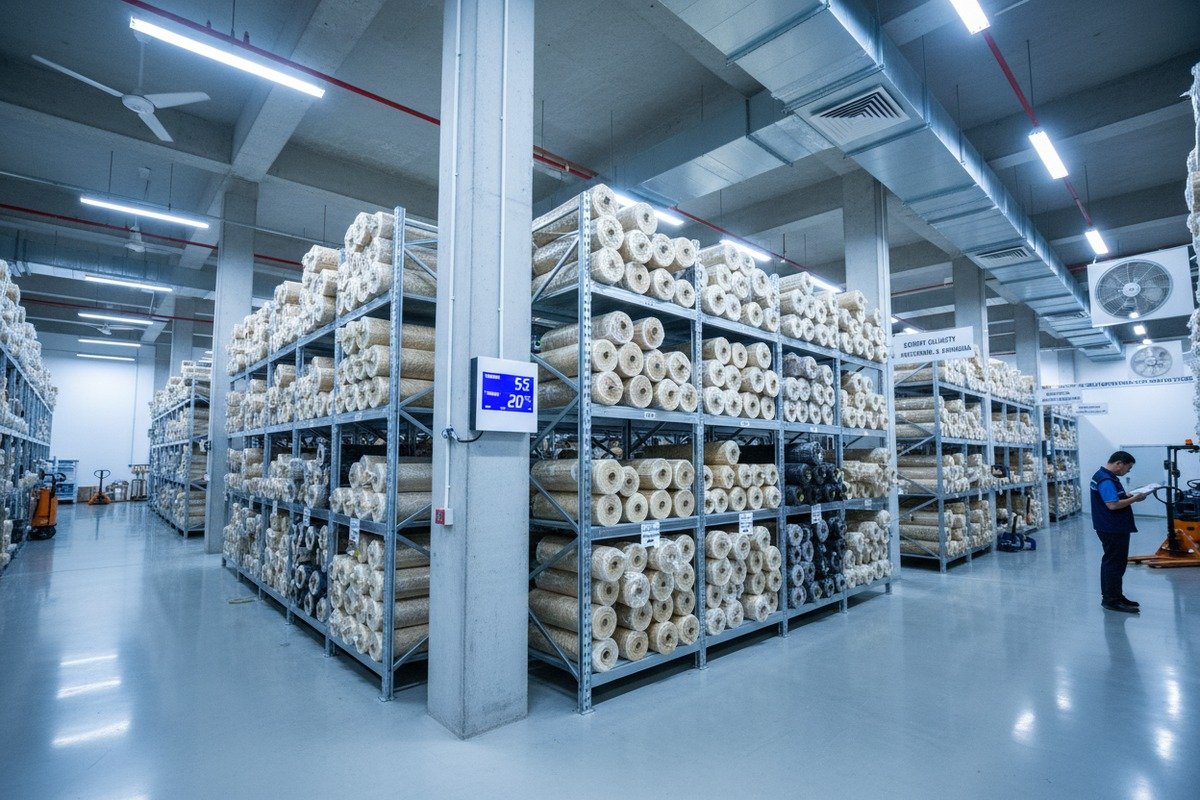
To maintain rattan flexibility in dry climates, store rolls in ventilated areas away from direct sunlight and heat sources, apply linseed or mineral oil every three to six months, mist webbing lightly with water before use, and never seal the underside with non-breathable finishes like polyurethane or shellac.
Why Dry Air Destroys Rattan
Rattan cane webbing needs to breathe. Its natural fibers absorb and release small amounts of moisture from the surrounding air. This constant exchange keeps the strands pliable. In dry climates—or in air-conditioned warehouses—the ambient humidity drops below what rattan needs. The fibers shrink, harden, and eventually crack.
Direct sunlight compounds the problem. UV rays break down the natural oils in rattan and fade the golden-brown color. Over time, sun-exposed webbing turns gray and becomes chalky to the touch. At that point, no amount of oiling will fully restore it.
A Simple Maintenance Schedule
We recommend the following routine based on climate conditions:
| Tipo de clima | Oiling Frequency | Misting Frequency | Storage Notes |
|---|---|---|---|
| Dry/arid (below 30% RH) | Cada 3 meses | Weekly light mist | Keep in enclosed, ventilated room; use humidifier if possible |
| Moderate (30–60% RH) | Cada 6 meses | Monthly light mist | Standard warehouse storage is fine |
| Humid/tropical (above 60% RH) | Once per year | No necesario | Ensure air circulation to prevent mold; avoid sealed plastic wrap |
Best Oils and Treatments
Not all oils work well on rattan. Here is what we recommend from our testing:
Aceite de linaza is the gold standard. It penetrates deep into the fibers, restores flexibility, and adds a subtle warm glow. Apply with a soft cloth, let it soak for 30 minutes, then wipe off excess. Do not use boiled linseed oil indoors without ventilation—it has a strong odor.
Aceite mineral is a safe, odorless alternative. It does not penetrate as deeply as linseed, but it creates a protective surface layer that slows moisture loss. Good for quick maintenance.
Evitar olive oil, coconut oil, or any food-based oil. These can turn rancid and attract insects. Also avoid spray-on furniture polishes that contain silicone. Silicone creates a plastic-like barrier that stops the cane from breathing—the exact opposite of what you want.
Mejores prácticas de almacenamiento
How you store unused rattan rolls matters as much as how you treat them. Rolls stored flat on a concrete floor in a sealed room will absorb cold moisture from below and dry out from stagnant air above. This creates a moisture gradient that warps the webbing.
Instead, store rolls vertically on racks in a ventilated room. Keep them away from heating vents, radiators, and windows with direct sunlight. If you are in a very dry region, place a shallow pan of water near the storage rack to add passive humidity.
For long-term storage (3+ months), loosely wrap rolls in breathable kraft paper. Do not use plastic wrap. Plastic traps any internal moisture and creates a microclimate that leads to mold on one side and excessive drying on the other.
Quick Recovery for Dried-Out Webbing
If you receive webbing that already feels too dry, do not install it immediately. Lay the roll flat and cover it with a damp (not wet) cotton towel for 2–4 hours. This slowly reintroduces moisture without shocking the fibers. Then let it air-dry to a damp state before soaking for installation.
We have saved many rolls this way for our buyers. It is not a perfect fix for severely damaged material, but for mildly dried webbing, it restores enough flexibility for clean installation.
Conclusión
Rattan cane webbing breaks because of moisture imbalance 10, poor sourcing, and improper handling. Quality starts at the harvest and continues through processing, shipping, storage, and installation. Choose your supplier carefully, test every batch, and maintain your material with simple oiling routines.
Notas al pie
1. The page provides a comprehensive guide to what cane webbing is, its origin from rattan, and its production process. ↩︎
2. The page provides an overview of the furniture manufacturing process, including design, cutting, shaping, joining, finishing, and assembly. ↩︎
3. Describes rattan as a climbing palm vine and its botanical characteristics. ↩︎
4. This page from the original domain specifically describes ‘NATURAL Rattan Cane Webbing Mesh | HEX Circle | 9mm’ with an ‘Open weave Hexagonal Pattern’. ↩︎
5. Explains the importance of climate control in manufacturing for product quality and efficiency. ↩︎
6. Discusses the inherent properties and structure of rattan as a natural fiber. ↩︎
7. This page from the original domain lists ‘Rotin Tohiti’ under ‘Types of Rattan Used in Webbing’ and describes its characteristics. ↩︎
8. This article provides a comprehensive guide to ‘What Is PE Rattan?’, exploring its types and production process, which is highly relevant to ‘PE Synthetic Rattan’. ↩︎
9. Provides information on the Forest Stewardship Council and its certification standards. ↩︎
10. This article directly addresses how humidity affects rattan and cane furniture, causing fibers to lose flexibility or loosen, which aligns with ‘moisture imbalance’. ↩︎

 English
  Español de México
  العربية
  Deutsch
  Français
  Русский