
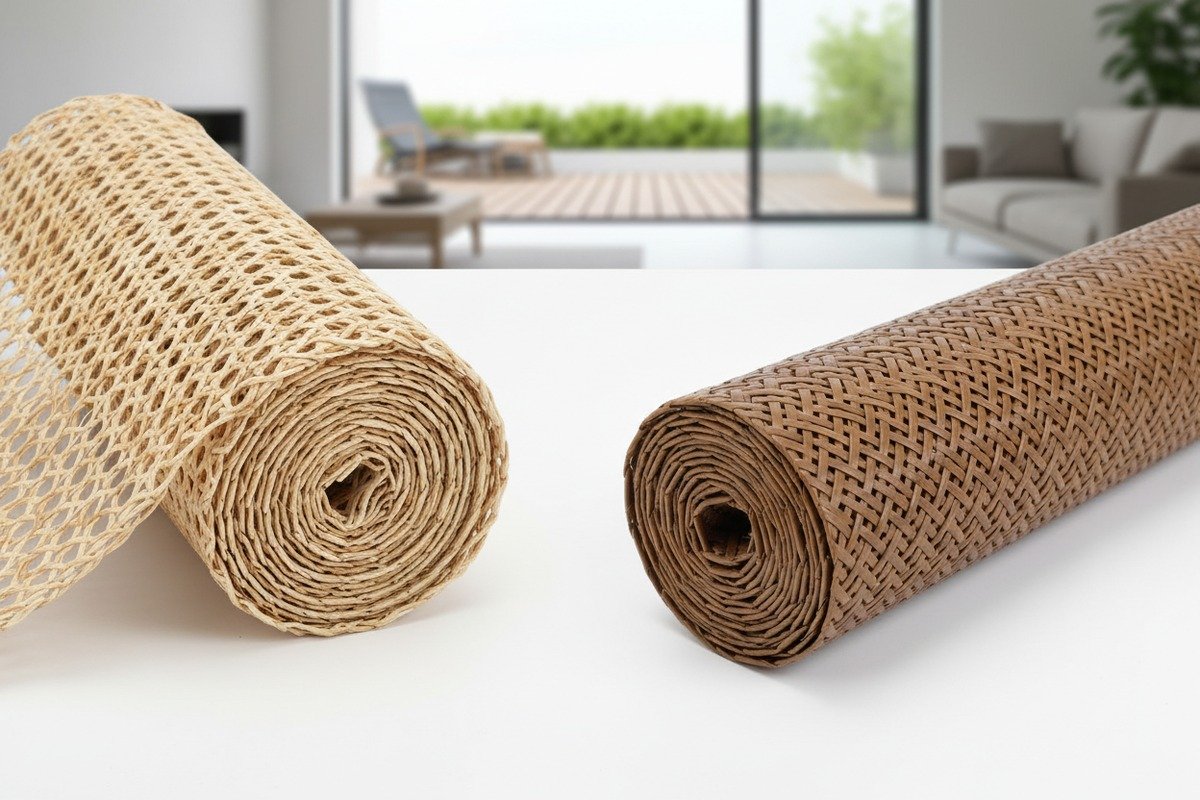
Every week, our sales team fields dozens of calls from furniture factories asking one question: natural or synthetic rattan cane webbing?
Natural rattan cane webbing comes from the outer bark of rattan palm vines, offering organic texture and warmth for indoor use. Synthetic rattan webbing is made from PE or PP plastics, delivering superior weather resistance, uniformity, and low maintenance for outdoor furniture applications.
The choice between these two materials affects your production cost, product lifespan, customer satisfaction, and even your brand positioning weather resistance 1. Below, we break down every angle so you can make a confident purchasing decision for your next bulk order.
How do I decide if natural or synthetic rattan is better for my furniture factory's production?
Running three factories and coordinating with over 30 partner workshops in Foshan has taught our team one clear lesson: the "better" material depends entirely on where your finished furniture will live.
Choose natural rattan cane webbing if your factory produces indoor decorative furniture like headboards, cabinet inserts, and lounge chairs. Choose synthetic rattan if your product line targets outdoor patios, poolside settings, or high-humidity environments where weather resistance is essential.
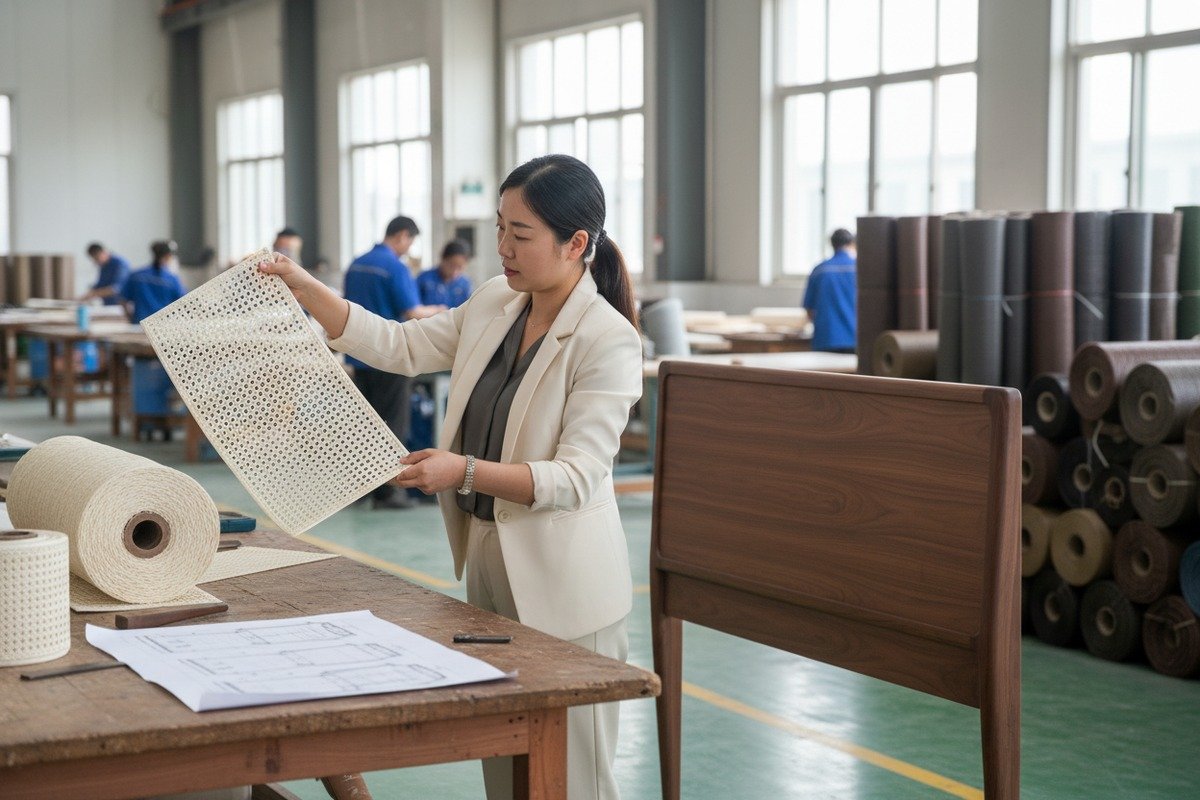
Understanding What Rattan Actually Is
Before picking a material, it helps to know the basics. Rattan is a climbing palm vine that grows in tropical regions of Southeast Asia 2. rattan palm vines 3 The plant has two useful parts. The outer peel is smooth, flat, and flexible. This is called "cane." Factories peel it off and weave it into sheets or rolls. The inner core is thicker and wood-like. People call it "reed" or "rattan core." It is used for furniture frames and basket structures.
Wicker 4 is not a material. It is a weaving technique. You can weave wicker from natural rattan, synthetic plastic, or even paper. This distinction matters when you write product descriptions or negotiate specs with buyers.
Natural Rattan: Best Fit Scenarios
Natural cane webbing shines in indoor settings. It offers a warm, rustic feel. The organic texture has slight color variations — from light beige to straw yellow — that give each piece a handcrafted look. This is exactly what biophilic design trends 5 demand in 2026. High-end furniture brands in the Netherlands and Australia regularly order our Indonesian-sourced cane for luxury headboards and room dividers.
However, natural rattan is sensitive. It cracks in dry air. It molds in damp rooms without ventilation. It fades under direct sunlight. If your factory ships to tropical coastal regions for outdoor use, you will get returns.
Synthetic Rattan: Best Fit Scenarios
Synthetic rattan webbing is extruded from PE or PP plastic. PE or PP plastics 6 It mimics the look of natural cane but resists UV rays 7, rain, dust, and mold. Our clients in Saudi Arabia, Dubai, and Spain order synthetic webbing almost exclusively because their end customers use furniture outdoors year-round.
The weave is precise. The color is consistent. Production is scalable. If your factory runs high-volume orders with tight color-matching requirements, synthetic is far easier to quality-control.
Quick Decision Framework
| Your Factory's Need | Best Material Choice | Why |
|---|---|---|
| Indoor luxury furniture | Natural rattan cane webbing | Authentic texture, warm aesthetic, premium feel |
| Outdoor patio furniture | Synthetic rattan webbing | UV-resistant, waterproof, low maintenance |
| High-humidity bathrooms | Synthetic rattan webbing | Mold-proof, no warping |
| Bohemian/mid-century décor | Natural rattan cane webbing | Organic imperfections add character |
| High-volume, tight tolerances | Synthetic rattan webbing | Uniform color and weave consistency |
| Eco-conscious premium brand | Natural rattan cane webbing | Biodegradable, renewable resource |
The bottom line is simple. Match the material to the end environment. Do not force natural rattan into outdoor applications, and do not waste synthetic on a luxury indoor piece where buyers expect authenticity.
Which rattan webbing material will offer the best cost-to-quality ratio for my bulk imports?
When we quote prices for wholesale buyers in Turkey, Greece, and the US, the first surprise is often this: the cheapest option per square meter is not always the cheapest option per year of use.
For bulk imports, synthetic rattan webbing typically offers a better cost-to-quality ratio because its lower unit price, longer outdoor lifespan, and minimal maintenance reduce total ownership cost. Natural rattan costs more upfront but delivers premium perceived value for indoor luxury segments.
Price Breakdown: Natural vs. Synthetic
Natural rattan cane webbing involves harvesting from wild or semi-cultivated rattan palms. The peeling, drying, sorting, and weaving process is labor-intensive. Indonesian rattan — lighter and smoother — commands a higher price than Vietnamese rattan, which tends to be darker and rougher. Shipping raw rattan from Indonesia to our processing facility and then to your factory adds logistics cost.
Synthetic rattan is manufactured through plastic extrusion 8. The process is faster, more predictable, and easily scaled. Raw material cost for PE and PP is lower than premium natural cane. Production waste is recyclable. These factors combine to make synthetic webbing more affordable per roll at bulk volumes.
Total Cost of Ownership
Smart procurement managers look beyond the purchase price. They consider how long the material lasts, how much maintenance it needs, and how often it gets replaced. total ownership cost 9
| Cost Factor | Natural Rattan Cane Webbing | Synthetic Rattan Webbing |
|---|---|---|
| Unit price per square meter | Higher | Lower |
| Shipping weight | Lighter | Slightly heavier |
| Expected indoor lifespan | 8–15 years with care | 10–20 years |
| Expected outdoor lifespan | 1–3 years without treatment | 5–10 years |
| Maintenance cost | Regular sealing, careful cleaning | Hose off with water and soap |
| Replacement frequency (outdoor) | High | Low |
| Perceived retail value | Premium, artisanal | Practical, modern |
Where Natural Rattan Wins on Value
If your buyers sell to interior designers and boutique furniture stores, natural rattan commands a price premium at retail. The word "natural" on a product tag increases perceived value. Customers touch it and feel the difference. That tactile warmth and organic irregularity justify a higher retail margin.
Our clients exporting to the Netherlands and Australia report 20–40% higher retail markups on natural cane furniture compared to synthetic alternatives. So even though the raw material costs more, the margin potential is bigger.
Where Synthetic Rattan Wins on Value
For outdoor furniture catalogs, contract hospitality projects, and high-traffic commercial spaces, synthetic rattan delivers the best return. It does not fade in the Spanish sun. It does not mold in Dubai humidity. It does not crack in a Russian winter. One purchase lasts years with zero maintenance cost. For volume buyers ordering container loads, the savings compound fast.
Packaging and Shipping Considerations
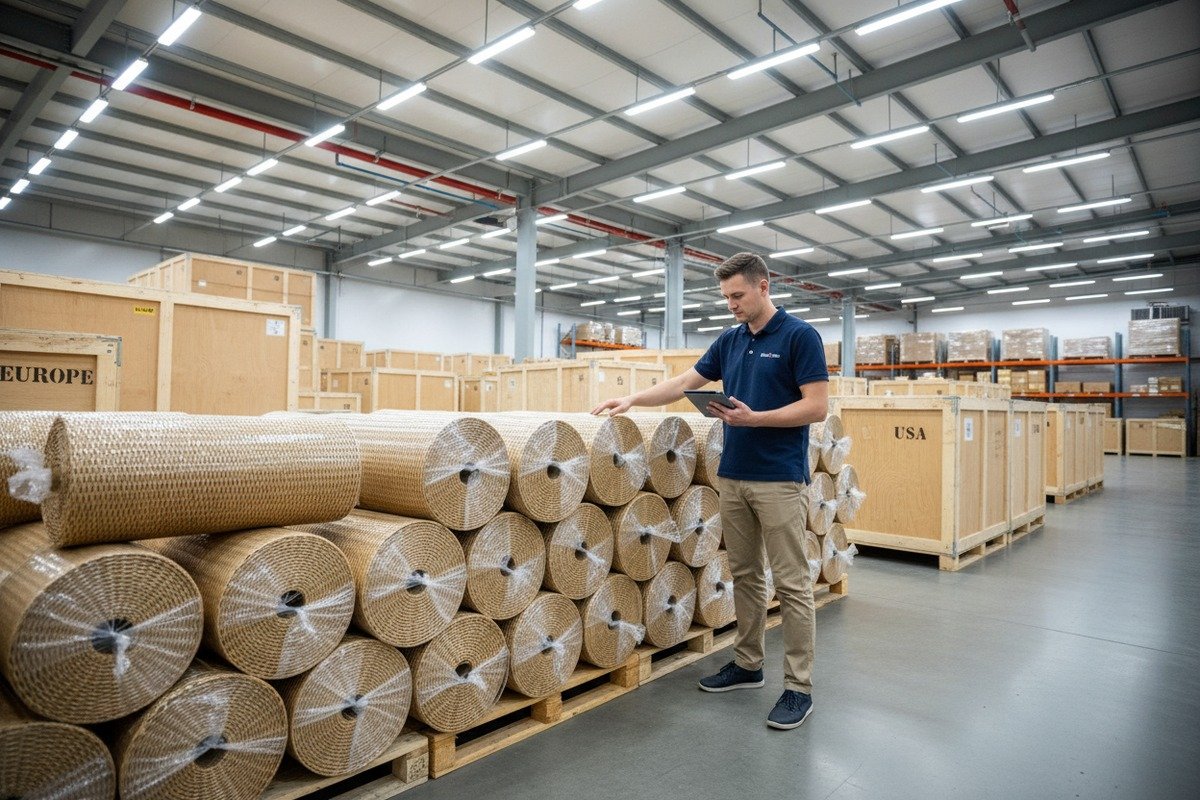
Our warehouse team often reminds buyers that natural rattan webbing requires careful packaging. It can crack or snap if rolled too tightly in dry conditions. We use moisture-controlled packaging for shipments to arid regions. Synthetic webbing is more forgiving. It tolerates tighter rolls and rougher handling. This reduces damaged-goods claims and lowers your effective import cost.
How can I tell the difference in quality between natural and synthetic cane webbing for my projects?
During quality inspections at our Indonesian processing facility, our team uses a set of reliable tests that take less than a minute. These same methods work for any purchasing manager receiving a shipment.
You can distinguish natural from synthetic cane webbing through three methods: visual inspection for color variation and weave irregularities, tactile testing for softness and flexibility, and a burn test where natural rattan produces white smoke and ash while synthetic melts into black or green smoke with plastic residue.
The Visual Test
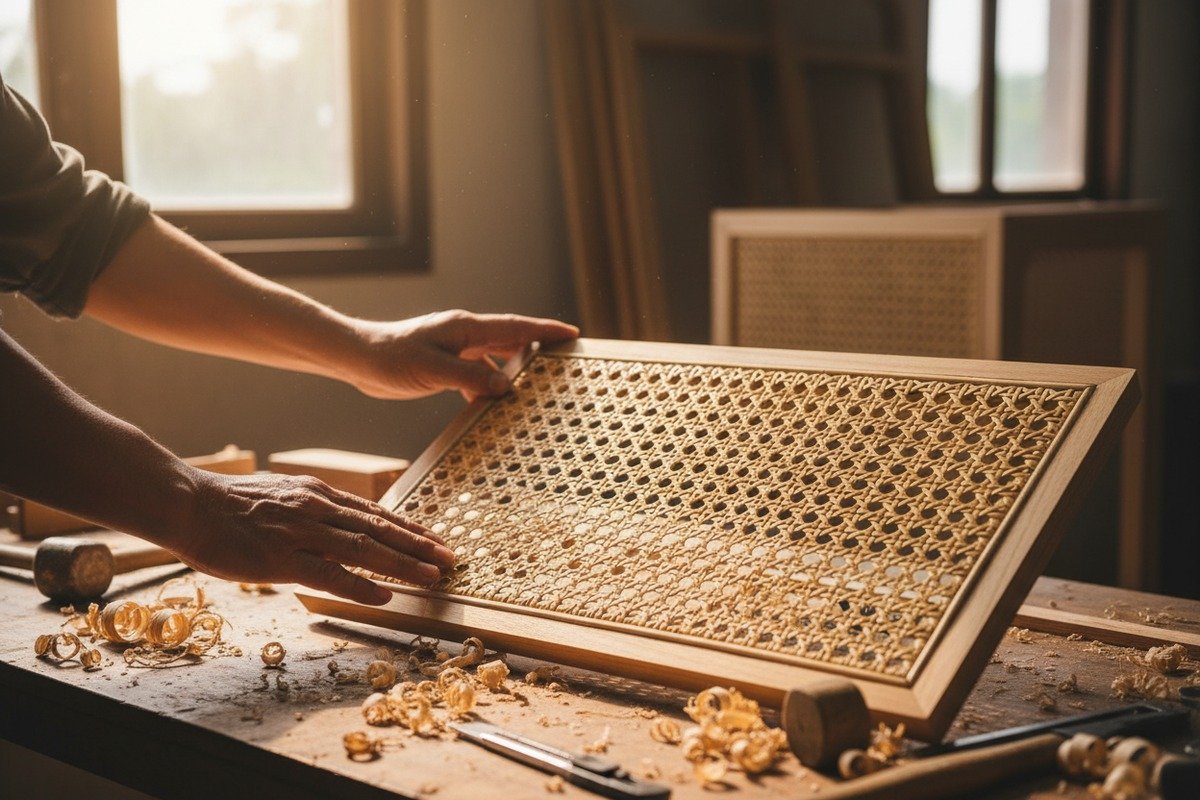
Hold a section of webbing under good light. Natural rattan cane webbing shows subtle color shifts. You will see strands that range from pale cream to golden brown, sometimes within the same roll. The weave has slight imperfections — tiny gaps, uneven strand widths, small knots. These are signs of genuine plant material.
Synthetic webbing looks uniform. Every strand is the same width, the same color, and the same texture. The weave pattern repeats precisely without variation. If it looks "too perfect," it is almost certainly synthetic.
The Tactile Test
Run your fingers along the surface. Natural cane feels soft, slightly fibrous, and warm. It flexes easily when you bend it. You can feel the matte texture of real plant fiber.
Synthetic cane feels firmer and smoother. It has a slight plastic rigidity. When you bend it, it springs back with more resistance. In warm weather, synthetic webbing feels warmer to the touch because plastic absorbs heat. Natural rattan stays cooler.
The Burn Test
This is the definitive method. Take a small strand from an inconspicuous area. Light it with a match.
| Test Criteria | Natural Rattan Cane | Synthetic Rattan |
|---|---|---|
| Flame behavior | Burns steadily, like wood | Melts and drips |
| Smoke color | White or light gray | Black or greenish |
| Smell | Woody, like burning grass | Sharp, chemical, plastic |
| Residue | Fine white/gray ash | Hard black or dark plastic blob |
This test is quick and conclusive. Our quality control team uses it on every incoming batch from partner factories. We recommend all purchasing managers keep a lighter handy during container inspections.
Grading Natural Rattan Quality
Not all natural rattan is equal. Indonesian rattan species produce lighter, smoother cane that is ideal for fine, complex weaves like the hexagonal "radio weave" pattern. Vietnamese rattan tends to be darker with a rougher surface. It works well for dense basketweave patterns but may not suit delicate decorative panels.
Grade A natural cane webbing has consistent strand width, minimal knots, clean edges, and no mold spots. Lower grades show more variation, broken strands, and discoloration. When ordering bulk, always request a sample roll first. Check it against these criteria before confirming the full order.
Grading Synthetic Rattan Quality
For synthetic webbing, quality depends on the polymer used and the UV stabilizer content. High-quality synthetic rattan uses HDPE with built-in UV inhibitors. It will not fade or become brittle for years. Low-quality synthetic uses recycled or thin PP that cracks after one season in the sun.
Ask your supplier for material certification. Check if the product includes UV resistance ratings. Pull a strand and bend it 180 degrees. Good synthetic webbing should not crack or whiten at the bend point.
What are the durability and maintenance trade-offs for my natural versus synthetic rattan orders?
Our warehouse in Nanhai stores both natural and synthetic rattan rolls. The difference in how we handle them tells you everything about durability and maintenance trade-offs.
Natural rattan cane webbing lasts years indoors with regular cleaning and protective coatings but deteriorates quickly outdoors from UV, moisture, and mold. Synthetic rattan webbing withstands sun, rain, and dust with almost zero maintenance, making it the clear winner for durability in exposed environments.
Durability in Real-World Conditions
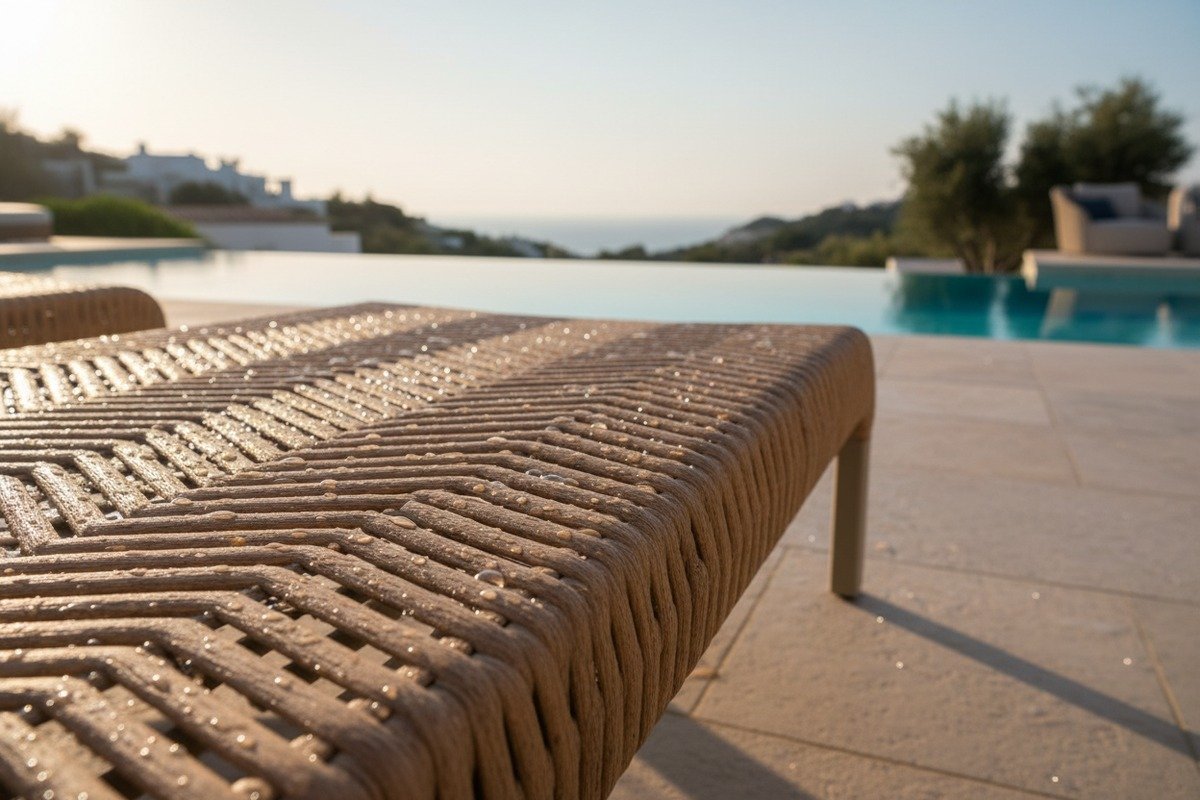
Durability is not a single number. It depends on where the furniture lives. A natural rattan headboard in an air-conditioned bedroom in the Netherlands may look beautiful for 15 years. The same material on a balcony in Dubai will crack and mold within months.
Synthetic rattan handles extremes. Our clients in Saudi Arabia leave synthetic wicker chairs outside in 50°C heat. The chairs look the same after three summers. Clients in Russia report synthetic rattan surviving freeze-thaw cycles without cracking.
How Natural Rattan Degrades
Natural rattan is an organic material. It responds to its environment. High humidity causes swelling and mold. Low humidity causes drying and cracking. UV light bleaches the color and weakens the fibers. Insect larvae can bore into untreated cane. Over time, heavily used seats develop thinning at stress points.
To slow degradation, natural rattan needs periodic treatment. A light coat of furniture oil or lacquer protects the surface. Cleaning requires a damp cloth — never a wet hose. Avoid placing natural rattan near heating vents or in direct sunlight streaming through a window.
How Synthetic Rattan Degrades
Synthetic rattan is not immortal. Low-quality PP weave can become brittle after prolonged UV exposure. The color may dull slightly over several years. Extreme cold can cause micro-cracks in thin strands. However, high-quality HDPE synthetic rattan with UV stabilizers resists all of these issues for 5–10 years outdoors with no intervention.
Maintenance is simple. Hose it down. Wipe with mild soap if needed. No oiling. No sealing. No special storage in winter.
Repairability
Here is one area where natural rattan has an advantage. Skilled artisans can re-weave damaged sections of natural cane webbing. A single broken strand does not ruin the whole panel. This repair tradition is alive in Southeast Asia and parts of Europe.
Synthetic rattan is harder to repair. If a section tears or melts, you typically need to replace the entire panel. The plastic strands do not take well to spot-weaving. For furniture factories, this means stocking replacement panels rather than offering repair services.
The Patina Factor
Natural rattan develops a patina over time. The color deepens. The surface smooths. Many designers and end customers love this aged look. It adds character and a sense of history to a piece of furniture.
Synthetic rattan does not develop patina. It looks the same on day one and day one thousand. For some buyers, that consistency is a benefit. For others, it feels static and lifeless. This is a subjective trade-off, but it matters when positioning your product line.
Environmental Trade-Offs
The sustainability debate is real and ongoing. Natural rattan is renewable. Rattan palms grow fast and can be harvested without killing the plant. It is biodegradable. But overharvesting in Southeast Asian forests is a concern. Certified sustainable sourcing helps, but not all suppliers comply.
Synthetic rattan is made from plastic. It does not biodegrade. It contributes to microplastic pollution 10 if it breaks down in landfills. However, HDPE is recyclable. Some synthetic rattan manufacturers now use recycled plastics. And because synthetic rattan lasts longer, fewer replacements mean less total waste over a product's life.
There is no clear environmental winner. The best approach depends on your brand values and your customers' priorities. We supply both types and help our clients make informed decisions based on their specific market positioning.
Conclusion
Choosing between natural and synthetic rattan cane webbing comes down to your end use, budget, and brand positioning. Match the material to the environment, and your customers will stay satisfied for years.
Footnotes
1. Defines weather resistance and its importance for materials. ↩︎
2. Replaced HTTP 403 with a Wikipedia page detailing rattan’s habitat, an authoritative and accessible source. ↩︎
3. Provides botanical information and origin of rattan palms. ↩︎
4. Clarifies that wicker is a weaving technique, not a material. ↩︎
5. Explains the concept and principles of biophilic design. ↩︎
6. Compares properties and uses of polyethylene and polypropylene. ↩︎
7. Details the effects of UV radiation on various materials. ↩︎
8. Replaced HTTP 404 with a Wikipedia page providing a comprehensive overview of plastic extrusion, an authoritative source. ↩︎
9. Defines Total Cost of Ownership (TCO) in a business context. ↩︎
10. Replaced HTTP 404 with a working page defining microplastics from a government (.gov) environmental agency. ↩︎

 English
  Español de México
  العربية
  Deutsch
  Français
  Русский