
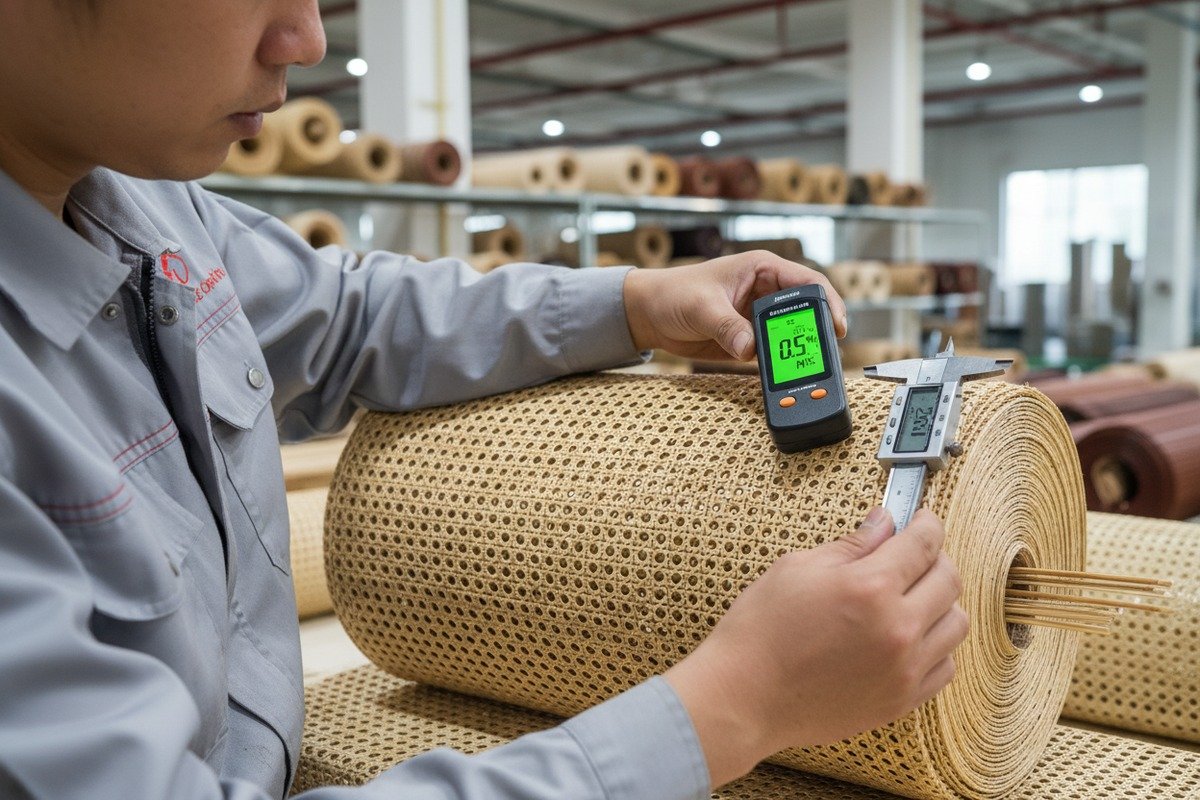
Every month, our production floor in Foshan processes thousands of meters of rattan cane webbing 1 for clients across five continents. Yet the most common complaint we hear from new buyers is not about price — it is about inconsistency. One roll looks perfect. The next one cracks during installation. The frustration is real, and it costs money.
The key quality indicators when sourcing rattan cane webbing include uniform strand width and thickness, consistent honey-toned color, tight and even weave tension, proper moisture content between 8–12%, high flexibility without cracking, smooth grain free of blemishes, and a solid tap sound indicating dense fibers.
Understanding these indicators can save you from costly returns and production delays. Below, we break down each quality checkpoint so you can source with confidence, whether you are buying ten rolls or ten thousand.
How can I identify the difference between Grade A and lower-quality rattan cane webbing?
When we grade rattan at our Indonesian processing facility, every single peel goes through manual inspection before it enters the weaving stage. Most buyers never see this step, but it determines everything about the final product. Skipping grade verification is the fastest way to end up with webbing that warps within months.
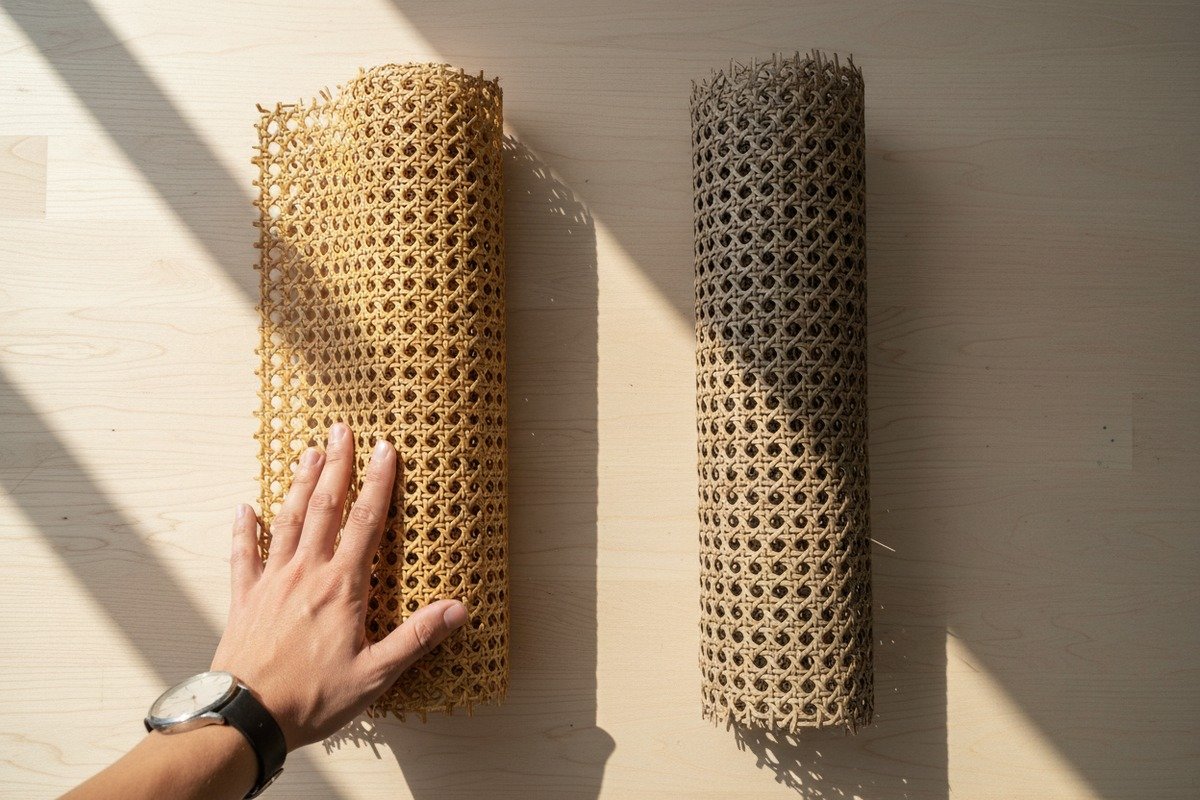
Grade A rattan cane webbing features uniform strand width, consistent rich honey tones, a smooth surface free of splits or rough patches, high fiber density, and a tight weave with 8–12% moisture content. Lower grades show irregular dimensions, dull color, coarse grain, and brittleness under flex.
Understanding the Grading System
The rattan industry 2 uses two main grading scales. Some suppliers use AAA, A, B, and C. Others use A through D. Both systems rank the same core traits. The top grade means the rattan peel was harvested at peak maturity, dried correctly, and sorted to remove any strand with defects.
At our facilities, we sort raw canes before any processing begins. The outer peel is separated from the core. Each peel is sanded for uniformity. Then our team inspects every strand by hand. Strands with knots, discoloration, or uneven thickness go into the lower-grade bins.
Grade Comparison Table
| Quality Trait | Grade AAA / A | Grade B | Grade C / D |
|---|---|---|---|
| Strand Width | Uniform, consistent | Slightly tapered | Irregular, uneven |
| Color | Rich honey tone | Pale or slightly dull | Blotchy, dark spots |
| Surface Texture | Smooth, fine grain | Minor roughness | Coarse, visible splits |
| Fiber Density 3 | High, solid feel | Medium | Low, hollow feel |
| Weave Tightness 4 | Even tension throughout | Minor loose spots | Loose, gaps visible |
| Moisture Content | 8–12% | 12–16% | Over 16% or under-dried |
| Flex Test | Bends without cracking | Slight resistance | Cracks or snaps easily |
Quick Authenticity Tests You Can Do On-Site
You do not need a lab to spot the difference. Here are four tests we recommend to every buyer visiting a warehouse or receiving samples:
- The Tap Test. Tap a strand against a hard surface. Grade A produces a crisp, solid sound. Lower grades sound hollow or dull.
- The Smell Test. Premium natural rattan has a mild, earthy scent. If you detect mustiness, chemical odors, or mildew, the material was stored or processed poorly.
- The Bend Test. Gently bend a single strand 90 degrees. Bend Test 5 Grade A flexes smoothly and springs back. Grade C snaps or shows stress lines.
- The Visual Scan. Hold the roll up to natural light. Grade A shows consistent color from edge to edge. Lower grades reveal streaks, dark patches, or pale spots.
These tests take less than two minutes. They can save you from accepting a shipment that fails during production. In our experience exporting to buyers in the Netherlands, Australia, and the USA, the clients who test samples before confirming orders almost never file quality complaints afterward.
What visual defects should I check for to ensure my rattan rolls have a consistent color and weave?
Our quality control team rejects roughly 8–15% of raw material before it ever reaches the loom. That number surprises many buyers. But those rejected strands are exactly the ones that cause complaints downstream — uneven color, loose weave patterns, and visible knots that ruin a finished furniture piece.
Check for stark color variations between strands, uneven weave gaps, loose or protruding strands, visible knots or nodes that disrupt the pattern, surface splits, fungal or dark spots, and inconsistent strand thickness. These defects signal poor sorting, improper drying, or low-grade raw material.
Color Consistency Matters More Than You Think
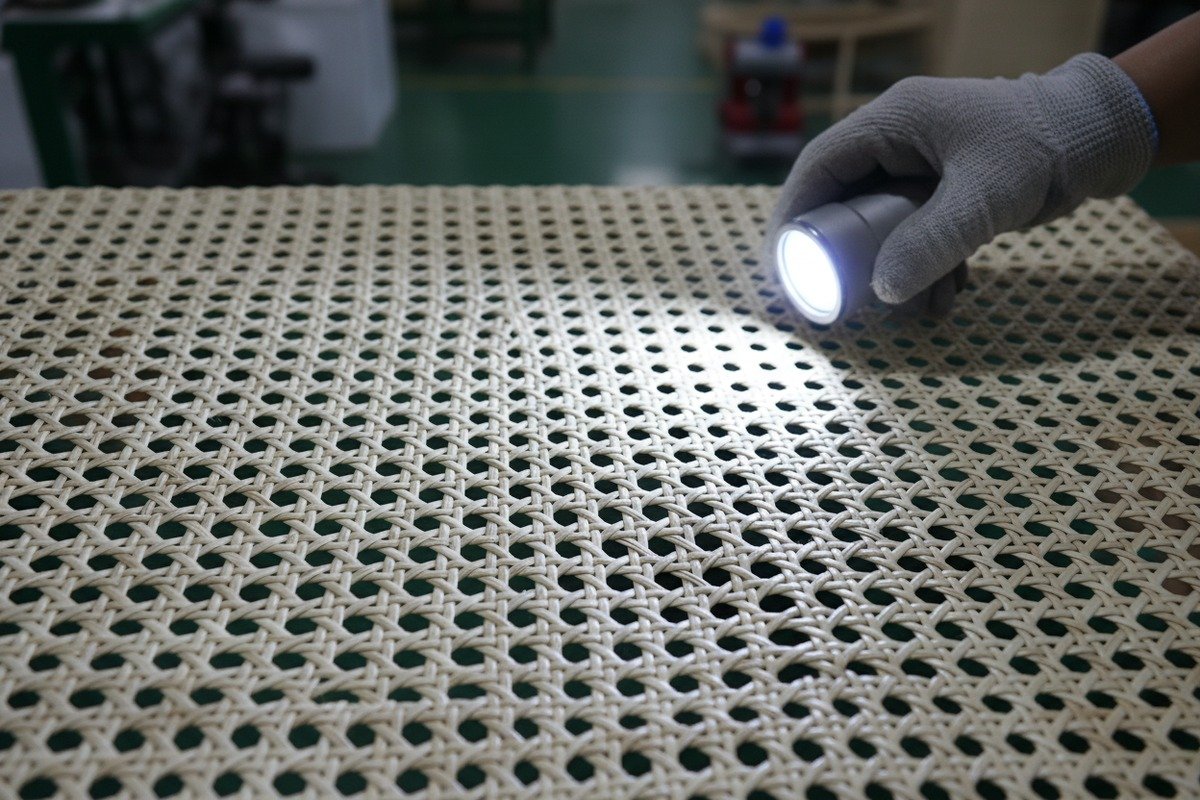
Natural rattan has organic variation. That is part of its beauty. But there is a clear line between natural charm and a quality problem. Premium bleached rattan webbing, for example, goes through advanced processing to achieve uniform cream or white tones. If you see yellow patches or gray streaks on a bleached roll, the processing was incomplete.
For natural-finish rattan, the ideal look is a warm honey to light straw tone across the entire roll. We source our raw cane from specific regions in Indonesia where the soil and climate produce consistent coloring. Even so, our workers sort strands by shade before weaving begins. This step alone takes significant labor but makes a visible difference in the final product.
Common Visual Defect Checklist
| Defect Type | What It Looks Like | Likely Cause | Impact on Use |
|---|---|---|---|
| Color Blotching | Dark or pale patches on strands | Poor sorting or uneven drying | Looks unprofessional on finished furniture |
| Loose Strands | Strands poking out of the weave | Insufficient weave tension | Unravels over time, catches on objects |
| Visible Knots | Bumps or raised nodes in pattern | Low-grade cane not properly trimmed | Disrupts smooth surface, catches fabric |
| Surface Splits | Thin cracks along the strand length | Over-drying or old stock | Breaks under stress, shortens lifespan |
| Fungal Spots | Black or green dots on surface | Moisture exposure during storage | Spreads to furniture, health concern |
| Weave Gaps | Uneven spacing between strands | Manual weaving error | Weakens structural integrity |
How to Inspect a Roll Properly
Do not just look at the outside layer. Unroll at least one to two meters and inspect the inner layers. Problems often hide inside the roll where the buyer does not look. We always encourage our clients to request photos of the inner portion of sample rolls before placing large orders.
Hold the webbing at eye level against a light source. This reveals even tiny gaps or inconsistencies in the weave pattern. A proper herringbone or close-weave pattern should show symmetry and rhythm. If the pattern shifts or wobbles, the weaving tension was uneven.
For radio weave and hexagonal open-mesh patterns, check that every opening is the same size. Use a simple ruler to measure five random openings across the roll. In Grade A material, the variance should be less than one millimeter. Anything more suggests the weaver lost control of tension, and the pattern will look sloppy on your finished product.
Run your hand across the surface of the webbing. It should feel smooth with a slight natural texture. If it feels rough, catches your skin, or has sharp edges, the sanding step was rushed. This is a common cost-cutting shortcut in lower-tier factories.
How do I test the strength and flexibility of rattan webbing before using it in my furniture designs?
We have seen beautiful furniture designs ruined by rattan webbing that cracked the moment it was stretched over a frame. It happens when buyers skip material testing or trust a supplier's word without verification. In our workshops, every batch goes through both manual and basic mechanical testing before we approve it for shipment.
Test rattan webbing by bending individual strands 90 degrees — Grade A bends smoothly and returns to shape without cracking. Soak a small piece in water for 15–20 minutes; quality webbing absorbs water uniformly and becomes pliable without becoming mushy. Also check the weight-to-strength ratio and perform a pull test on the weave intersections.
The Bend Test in Detail
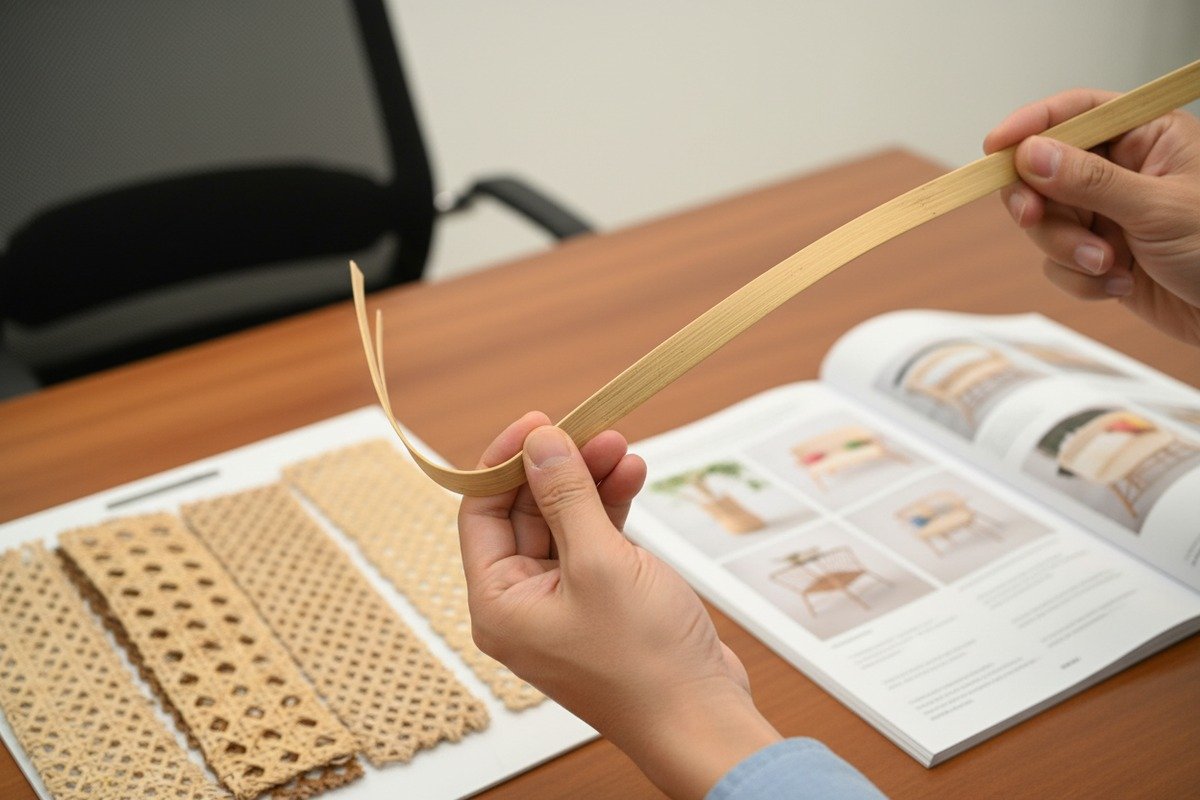
This is the simplest and most revealing test. Take a single strand from the edge of the roll. Bend it slowly to 90 degrees. A premium strand bends like a green twig — smooth and elastic. It springs back to nearly its original shape when released. A low-grade strand resists the bend, shows white stress lines at the bend point, or snaps outright.
We recommend testing at least five strands from different parts of the roll. This tells you whether the drying process was consistent throughout the batch. If three strands flex perfectly but two crack, the drying was uneven, and you will encounter problems during production.
The Soak Test
Natural rattan cane webbing needs to be soaked before installation on most furniture frames. This step reveals a lot about quality. Cut a small piece — roughly 15 cm by 15 cm — and submerge it in room-temperature water for 15 to 20 minutes. Soak Test 8
Grade A webbing absorbs water evenly. The entire piece becomes uniformly pliable. You can stretch it gently and it holds its new shape without tearing. When it dries, it tightens and returns to a firm state.
Lower-grade webbing reacts differently. Some strands absorb water faster than others, creating an uneven texture. Cheap material may become mushy or even start to disintegrate at the weave intersections. If the strands separate easily when wet, the material will fail under long-term use.
The Pull Test
Grip two adjacent strands at a weave intersection and pull them apart with moderate force. Pull Test 9 In quality webbing, the strands hold firm. The weave intersection acts as a lock. You should feel significant resistance.
If the strands slide past each other or the weave loosens easily, the tension during manufacturing was too low. This webbing will sag on furniture frames within weeks.
Strength and Flexibility Benchmarks
| Test | Grade A Result | Grade B Result | Grade C Result |
|---|---|---|---|
| 90° Bend | Smooth flex, full return | Slight resistance, partial return | Cracks or snaps |
| Soak (15 min) | Uniform absorption, pliable | Uneven absorption | Mushy or disintegrating |
| Pull at Intersection | Strong hold, no sliding | Minor give | Strands slide apart |
| Weight Feel | Dense, solid | Medium weight | Light, hollow |
| Tap Sound | Crisp, clear | Slightly dull | Hollow thud |
| Recovery After Soak/Dry | Tightens firmly | Slight looseness | Warps or stays limp |
Why Moisture Content Determines Everything
The moisture content of rattan at the time of purchase is the single biggest predictor of its performance. Our drying process targets 8–12%. Below 8%, the fibers become brittle. Above 12%, they are prone to mold and dimensional instability.
If you are buying in bulk and cannot test moisture with a meter, use the flexibility and smell tests as proxies. Properly dried rattan flexes easily and smells earthy. Over-dried rattan is stiff and can smell slightly burnt. Under-dried rattan feels heavy for its size and may have a musty odor.
Furniture factories that work with us in Spain and Turkey have told us they always request a moisture certificate with each shipment. This simple document, backed by a spot-check on arrival, has eliminated most of their quality issues.
What should I ask my supplier to guarantee the long-term durability and packaging of my rattan shipment?
After years of shipping rattan cane webbing to clients in over 20 countries, our team has learned that the shipment is only as good as its packaging and the guarantees behind it. We once had a client in the Middle East receive perfect-grade material that arrived damaged because the packaging was not sealed against humidity during a monsoon-season transit. That was an expensive lesson for everyone involved.
Ask your supplier about their grading certification or proof, anti-mildew and anti-pest treatment methods, moisture content documentation, packaging materials and moisture barrier details, minimum order flexibility, replacement or refund policies for defective rolls, and whether they offer third-party quality inspection before shipping.
The Right Questions Save You Money
Most buyers ask about price and lead time. Smart buyers ask about process. Here is a checklist of questions we recommend before confirming any supplier:
- What grading system do you use, and can you provide photo documentation of your grading process? A reliable supplier will show you their sorting and inspection steps.
- What anti-mildew treatment do you apply? Untreated natural rattan is vulnerable to mold, especially during ocean freight. Our factory applies a food-safe anti-mildew solution that does not alter the rattan's color or smell.
- What is the moisture content at the time of packing? Ask for a written specification. If they cannot answer or seem unsure, consider it a red flag.
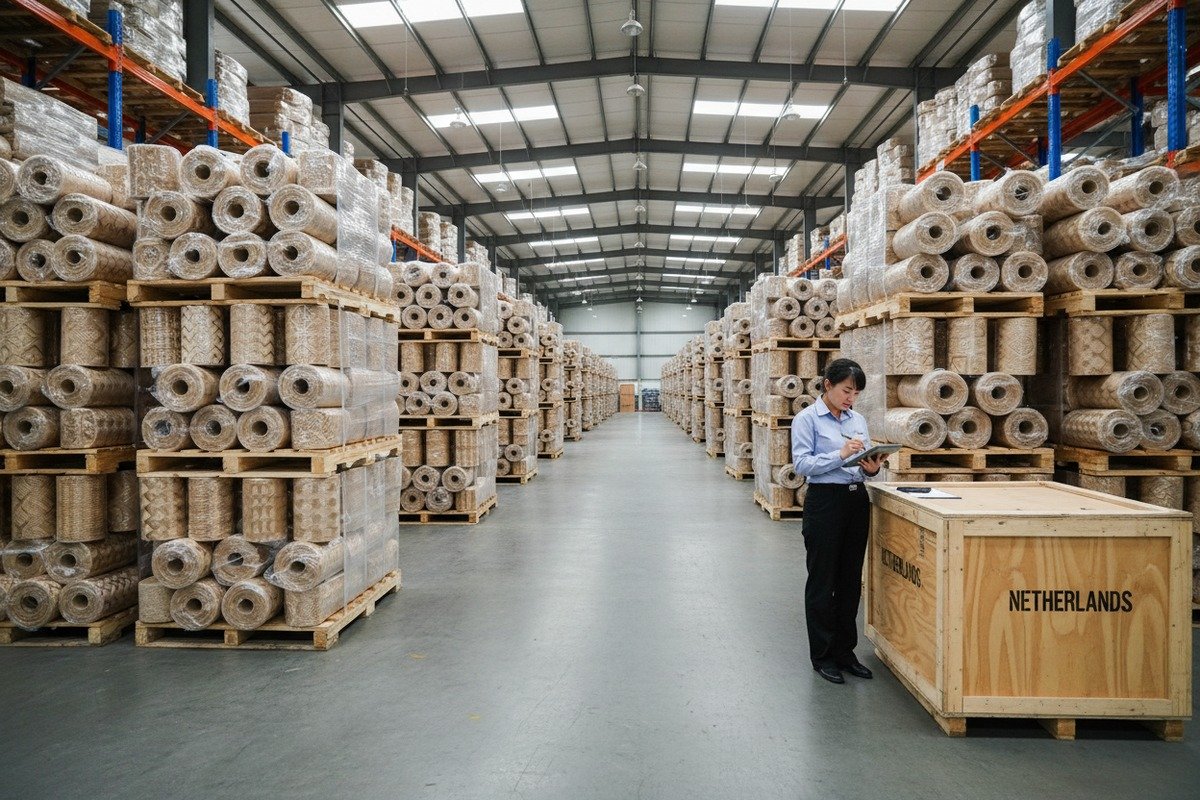
- How do you package rolls for export? Rolls should be wrapped in moisture-barrier material 10, then placed in sturdy cartons or on pallets. Plastic shrink wrap alone is not enough for long sea voyages.
- What is your policy if I receive defective material? Get this in writing before you pay. A trustworthy supplier will offer partial refunds, replacements, or credits for verified defects.
Packaging Standards That Protect Your Investment
Poor packaging is the silent killer of rattan quality. Even Grade AAA material can arrive warped, moldy, or cracked if it is not packed correctly. Here is what proper export packaging looks like:
- Inner wrap: Each roll wrapped in moisture-barrier film or wax paper.
- Outer protection: Cardboard tube or rigid carton to prevent crushing.
- Moisture absorbers: Silica gel packets placed inside the carton.
- Labeling: Each roll labeled with grade, dimensions, production date, and moisture content.
- Palletization: Rolls stacked vertically on fumigated pallets, strapped and shrink-wrapped.
At our Foshan warehouse, we have a dedicated packing line for rattan webbing. Our packing team follows a standard operating procedure that we developed after years of feedback from international clients. We share photos of the packed shipment with every client before the container is sealed.
Durability and Lifespan Expectations
Premium Grade A rattan cane webbing, used indoors and maintained properly, lasts 15 to 20 years. That lifespan assumes the material stays away from direct sunlight, high humidity, and standing water. Regular dusting and occasional light wiping with a damp cloth keep the material in top condition.
For projects exposed to semi-outdoor conditions — covered patios or shaded verandas — the lifespan drops to 5 to 8 years without UV treatment. If your application requires outdoor exposure, ask your supplier about UV-resistant coatings or consider synthetic rattan alternatives. We produce both natural and synthetic options, and we always recommend matching the material to the environment.
Supplier Evaluation Scorecard
Use this simple scorecard when comparing potential suppliers. Rate each criterion from 1 to 5 based on evidence, not promises.
| Evaluation Criterion | What to Look For | Score (1–5) |
|---|---|---|
| Grading Documentation | Written standards, photo proof | ___ |
| Anti-Mildew Treatment | Specific method described, certifiable | ___ |
| Moisture Content Guarantee | Written spec of 8–12% | ___ |
| Packaging Quality | Moisture barriers, rigid protection, silica gel | ___ |
| Defect Policy | Written replacement or refund terms | ___ |
| Sample Availability | Willingness to send samples before bulk order | ___ |
| Communication Speed | Responds within 24 hours | ___ |
| Factory Visit Option | Open to on-site inspection or video tour | ___ |
| Export Experience | Ships to your region regularly | ___ |
| Third-Party Inspection | Accepts or arranges independent QC | ___ |
A supplier scoring 40 or above out of 50 is likely a strong long-term partner. Below 30, proceed with extreme caution or look elsewhere.
Red Flags That Should Stop You From Ordering
- The supplier cannot name their rattan's country of origin.
- Sample quality does not match the bulk shipment.
- No written quality guarantee or return policy exists.
- Packaging arrives wet, crushed, or without moisture barriers.
- The supplier avoids questions about treatment or drying processes.
- Rolls arrive with a strong chemical or mildew smell.
Trust your instincts. If something feels off during the negotiation stage, it will likely get worse during fulfillment. Our long-term clients — from furniture wholesalers in Russia to building material suppliers in Saudi Arabia — stay with us because we treat transparency as a non-negotiable part of the relationship.
Conclusion
Sourcing quality rattan cane webbing comes down to testing, asking the right questions, and choosing transparent suppliers. Use the checklists and benchmarks in this guide to protect every order you place.
Footnotes
1. Comprehensive guide on rattan cane webbing. ↩︎
2. Provides an overview of the global rattan trade and its economic significance. ↩︎
3. Explains the concept of fiber density and its importance in material properties. ↩︎
4. Explains how weave density (tightness) influences fabric strength and properties. ↩︎
5. Explains the importance of flexibility in rattan quality assessment. ↩︎
6. Explains natural rattan webbing quality grades, including Grade AAA. ↩︎
7. Highlights the importance of moisture content for natural fiber performance and comfort. ↩︎
8. Provides scientific context for water absorption testing in natural fibers. ↩︎
9. Describes the methodology and purpose of a pull test for material strength. ↩︎
10. Explains how moisture barrier materials work and lists best materials. ↩︎

 English
  Español de México
  العربية
  Deutsch
  Français
  Русский