
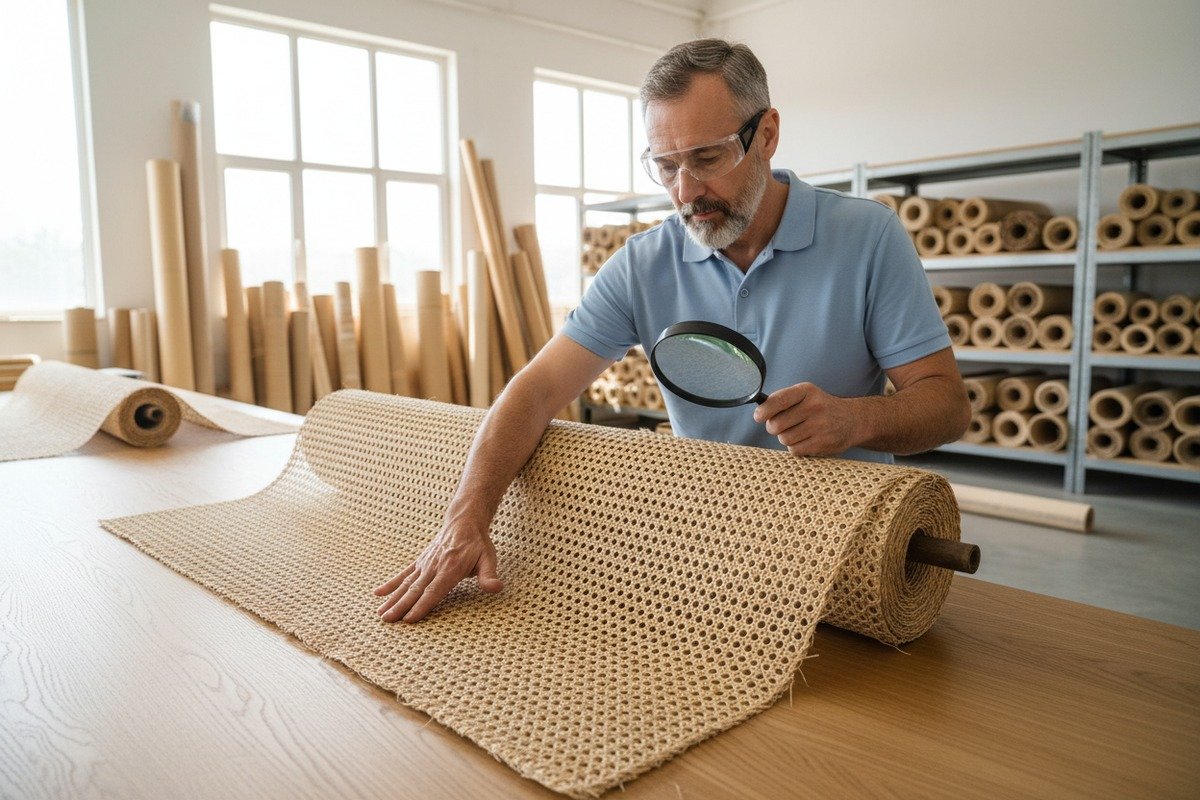
Every week, our customer service team fields calls from furniture factories that received rattan cane webbing 1 rolls that looked fine on the outside but hid defects inside.
To inspect natural rattan cane webbing quality upon receipt, check the weave uniformity, strand integrity, mesh size consistency, moisture level, color evenness, and packaging condition. A systematic visual and tactile inspection catches defects before they reach your production line and cause costly rework.
This guide breaks down the exact steps you should follow the moment your rattan shipment arrives weave uniformity 2. Each section covers a specific inspection area so you can build a reliable, repeatable quality check process 3.
How can I identify if the rattan cane webbing I received is true Grade A quality?
When we ship Grade A rattan cane webbing 4 from our facilities, it has passed multiple internal checkpoints. But once it travels thousands of miles, things can change uniform bleaching 5. The real question is: how do you verify that quality at your door?
True Grade A rattan cane webbing shows uniform strand thickness, consistent weave tension, no broken or frayed strands, even color throughout, and a clean surface free of dust, mold, or chemical residue. Any deviation from these markers signals a lower grade.
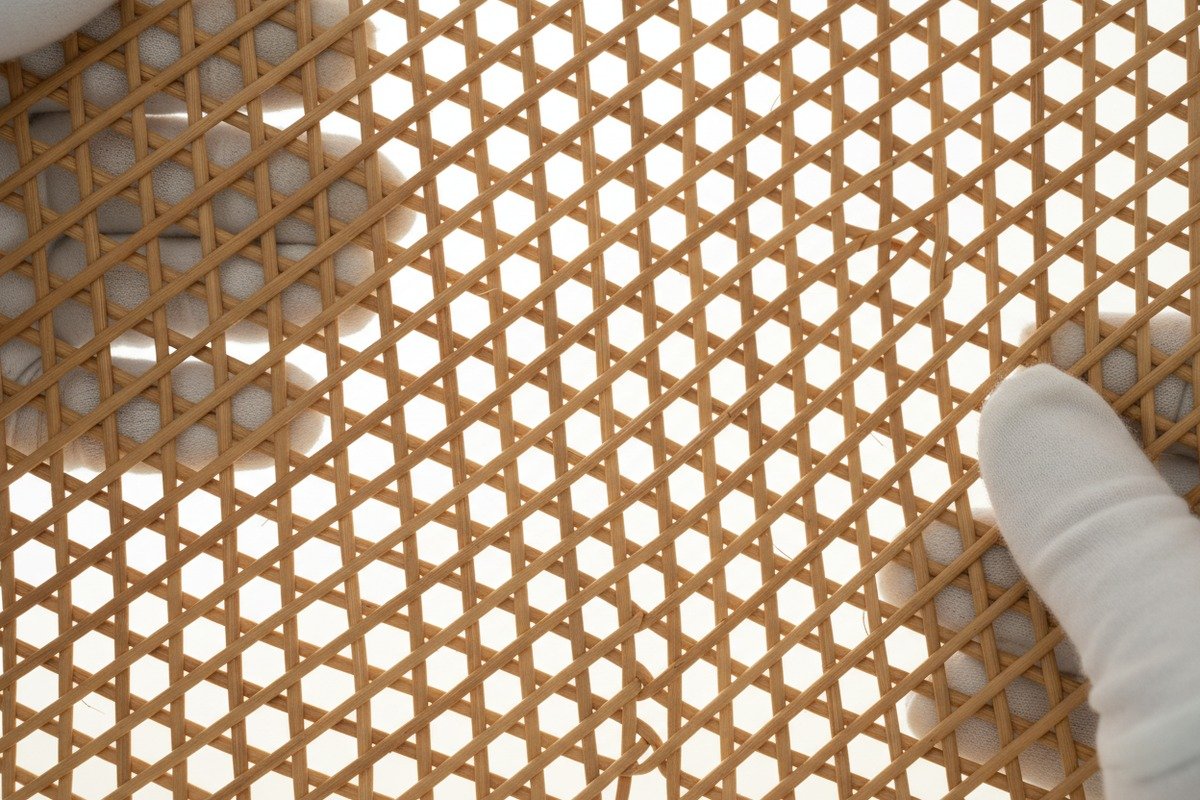
Grade A is not just a label. It is a set of measurable characteristics. Let me walk you through each one so you can spot the difference between genuine Grade A and material that falls short.
Strand Thickness and Profile
Pick up the webbing and look closely at individual strands. Grade A strands are uniform in width and thickness. They should not be flattened on one side or bulging on the other. Run your fingers along a strand. It should feel smooth and round, not rough or splintery.
If you see strands that vary noticeably in thickness within the same roll, that is a red flag. It means the raw rattan was not properly sorted before weaving.
Weave Tension and Pattern Regularity
Hold the webbing up to the light. The openings in the weave pattern should be uniform in size and shape. For standard hexagonal cane webbing 6, the mesh opening is typically about half an inch, measured from center hole to center hole.
Look for spots where the weave appears bunched or stretched. Uneven tension causes problems during installation because the webbing will not sit flat against the frame.
Surface Condition
Grade A webbing has a clean, smooth surface. There should be no sticky residue, sawdust, or manufacturing debris caught in the mesh. Check both sides. Some defects hide on the back face.
Quick Grade Comparison
| Feature | Grade A | Grade B | Grade C |
|---|---|---|---|
| Strand uniformity | Highly consistent | Minor variations | Visible inconsistencies |
| Weave tension | Even throughout | 1–2 loose areas per roll | Multiple uneven sections |
| Surface finish | Smooth, clean | Occasional rough spots | Frequent rough spots or splinters |
| Color consistency | Uniform tone | Slight shade shifts | Noticeable blotches or dark spots |
| Broken strands | None | 1–2 minor repairs | Multiple repairs or loose ends |
| Mesh size | Consistent ±1mm | Consistent ±2mm | Inconsistent beyond ±2mm |
The Soak Test
Here is a practical test we recommend to our clients. Cut a small sample piece, roughly 6 inches by 6 inches. Soak it in room-temperature water for 20 to 30 minutes. Grade A rattan absorbs water evenly and becomes uniformly pliable. If some strands stay stiff while others become limp, the fiber quality is inconsistent. After soaking, the strands should not split or fray. If they do, the rattan was either over-processed or sourced from immature canes.
This test takes minimal time but tells you a lot about fiber health. It is especially useful when you are evaluating a new supplier for the first time.
What specific defects should I look for when checking the weaving consistency and roll dimensions?
Our quality control team inspects every roll before it leaves the warehouse. Still, we always encourage buyers to perform their own inspection. Catching defects early saves everyone time and money.
When checking weaving consistency, look for irregular gaps, loose or broken strands, pattern shifts, and unraveling edges. For roll dimensions, measure the width at three points and verify the total length against the order. Deviations beyond 2mm in width or 5% in length warrant a claim.
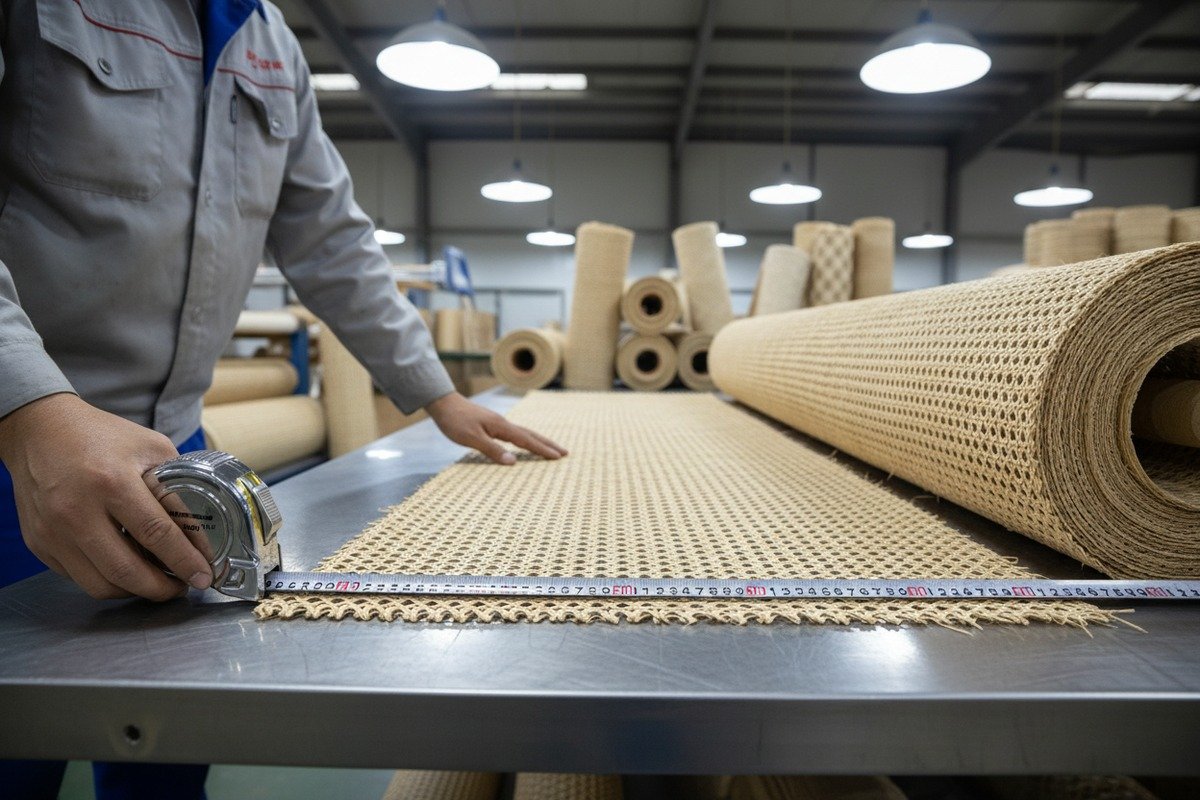
Defects in rattan cane webbing fall into two categories: weaving defects and dimensional defects 7. Both can disrupt your furniture production. Here is how to systematically check for each.
Common Weaving Defects
Lay the webbing flat on a clean, well-lit surface. Walk along its length and scan for these issues:
- Loose strands: Strands that are not woven tightly into the pattern. They stick out or can be pulled free easily.
- Broken strands: Snapped cane pieces within the weave. These create weak spots.
- Pattern shifts: Areas where the weave pattern changes direction or becomes irregular. This often happens when a weaving machine was improperly calibrated or when manual weavers lost tension.
- Unraveling edges: The edges of the roll should be clean-cut or bound. If strands are pulling free along the edges, the finishing was poor.
- Knots or overlaps: Spots where one strand ends and another begins. In Grade A webbing, these transitions should be minimal and well-hidden.
Dimensional Checks
Use a tape measure or ruler. Measure the width at three points: both ends and the middle. The width should match your order specification. Common widths include 16 inches, 18 inches, and 24 inches.
For length, unroll and measure the entire piece if practical. For large orders, measure a representative sample of rolls.
Defect Tolerance Table
| Defect Type | Acceptable (Grade A) | Marginal (Grade B) | Unacceptable |
|---|---|---|---|
| Loose strands per meter | 0 | 1–2 | 3 or more |
| Broken strands per roll | 0 | 1 (repaired cleanly) | 2 or more |
| Width deviation | ±1mm | ±2mm | Beyond ±2mm |
| Length deviation | Within 2% | 2–5% | Beyond 5% |
| Edge unraveling | None | Minor fraying (< 5mm) | Strands pulling free |
| Pattern irregularities | None visible | 1 minor shift | Multiple or obvious |
How to Document Defects
If you find defects, photograph them immediately. Include a ruler in the photo for scale. Note the location on the roll—distance from the start and position across the width. This documentation helps when filing quality claims. It also helps your supplier trace the issue back to a specific production batch.
At our factories, we track every complaint and tie it back to the weaving station or batch number. Detailed defect reports from our clients help us improve. So do not hesitate to share this information with your supplier.
Why Edge Quality Matters
Many buyers overlook the edges. But if you are cutting the webbing to fit frames, clean edges save labor. Frayed or unraveling edges mean your workers spend extra time trimming and securing loose strands. Over hundreds of chairs, that adds up quickly.
How do I assess if the packaging was durable enough to protect my rattan from moisture or breakage?
We have shipped rattan cane webbing to over 20 countries. Through years of experience, we have learned that even perfect webbing can arrive damaged if the packaging fails during transit.
Assess packaging durability by checking for water stains, tears, crushed sections, and condensation inside the wrapping. Open the outer layer and inspect for mold, musty odors, or permanent creases in the webbing. Good packaging uses moisture barriers, rigid tubes or cores, and protective outer layers.
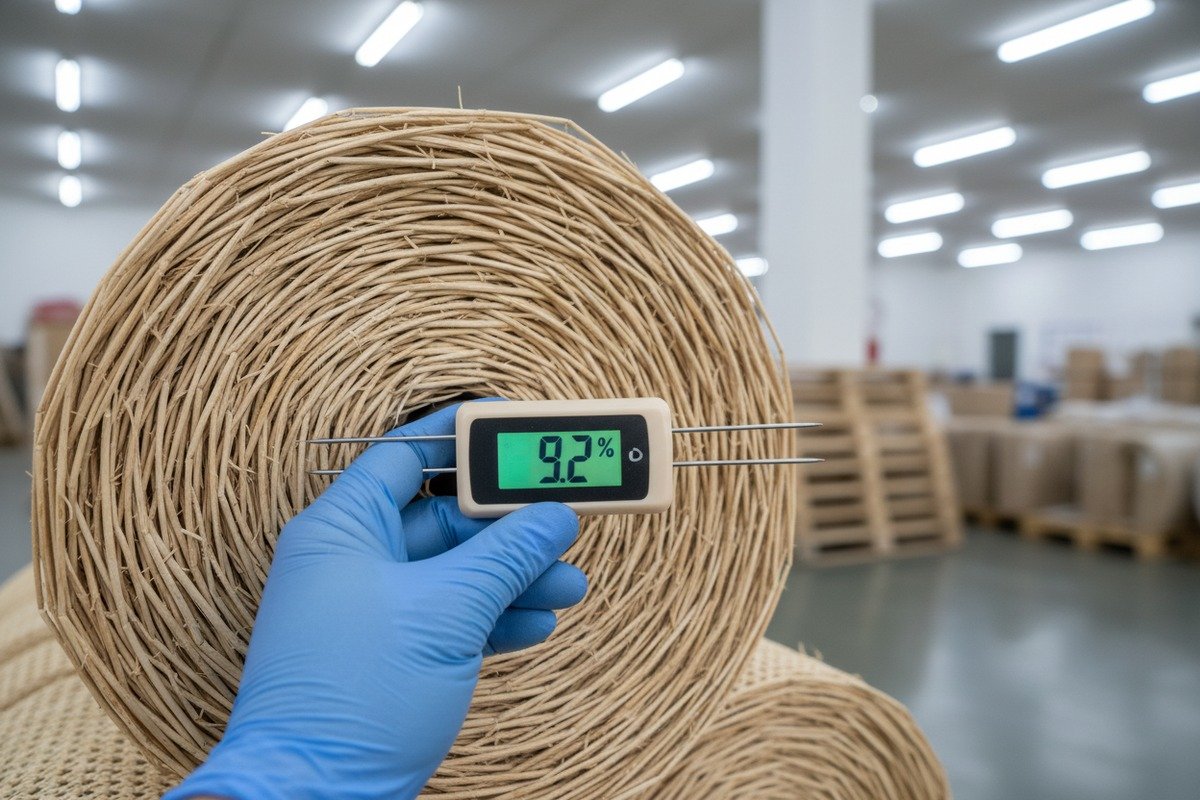
Packaging is the first thing you see, and it tells a story about what happened to your order during shipping. Here is how to read that story.
External Packaging Inspection
Before opening anything, look at the outside of the package. Check for:
- Water stains or discoloration on the cardboard or wrapping
- Crushed corners or dents that suggest rough handling
- Tears or punctures that may have exposed the webbing to air, dust, or moisture
- Tape integrity—if tape is peeling or reapplied, the package may have been opened
If you see any of these signs, photograph them before opening. This documentation is critical for filing shipping damage claims 8.
Internal Packaging Assessment
Open the package carefully. Check for:
- Condensation or moisture inside the plastic wrapping
- Mold or mildew spots on the webbing or packaging material
- Musty or chemical odors—musty smells indicate moisture exposure; harsh chemical odors suggest improper treatment
- Permanent creases or folds in the webbing caused by compression
What Good Packaging Looks Like
Quality suppliers use layered packaging systems. Here is what to expect:
- Inner layer: Plastic wrap or moisture barrier film 9 directly around the webbing roll
- Core support: A cardboard or plastic tube inside the roll to maintain its shape
- Padding: Foam, bubble wrap, or corrugated cardboard around the roll
- Outer layer: A sturdy carton or wooden crate for structural protection
If your rolls arrive without a core tube, they may have collapsed during shipping. Collapsed rolls develop flat spots and creases that affect how the webbing lays during installation.
The Smell Test
This is simple but effective. Unwrap the webbing and smell it. Quality rattan has a mild, natural scent—slightly woody or grassy. A musty or sour smell means moisture was trapped in the packaging. A strong chemical smell may indicate excessive bleaching or anti-mildew treatment. Neither is acceptable for Grade A material.
Post-Receipt Storage
Even after the webbing passes your packaging inspection, store it properly. Keep it in a dry room with good airflow. Avoid direct sunlight. Do not stack heavy items on top of webbing rolls. Maintaining 40–60% relative humidity 10 is ideal. Too dry, and the rattan becomes brittle. Too humid, and mold can develop within days.
What is my checklist for ensuring the color and texture match my furniture production standards?
In our experience exporting to furniture factories in the Netherlands, the US, and Australia, color and texture mismatches are the number one reason for rejected shipments. Getting this right is non-negotiable.
To ensure color and texture match your standards, compare the received webbing against a pre-approved sample under natural daylight. Check for uniform bleaching, consistent gloss level, smooth strand surfaces, and no blotchy or yellowed areas. Always keep a reference sample from each approved batch.

Color and texture are where the natural variability of rattan challenges production consistency. Here is how to manage that challenge.
Why a Reference Sample Is Essential
Before you place a bulk order, request and approve a sample. Keep that sample stored in a dark, dry place. When the bulk shipment arrives, compare the new material directly against the sample. Do this under natural daylight—artificial lighting can mask subtle color differences.
If your supplier sends you a sample that looks one way and the bulk order looks another, you have grounds for a quality claim. But without the sample on hand, you lose that leverage.
Color Inspection Steps
- Unroll the webbing on a clean white surface
- Examine the color under natural daylight, not fluorescent or LED light
- Check three zones: both ends and the middle of the roll
- Look for yellowing, dark spots, or uneven bleaching
- Compare against your reference sample
For bleached rattan, the color should be a consistent light straw or cream tone. For unbleached rattan, expect a warmer tan or golden shade. Either way, the tone should be even across the full roll.
Texture Assessment
Run your hand across the surface. Grade A rattan feels smooth and even. You should not catch splinters or rough patches. The strand surfaces should have a consistent matte or semi-matte finish. Glossy spots or dull patches suggest uneven coating or processing.
Also check strand firmness. Squeeze a section lightly. The strands should feel firm but not rigid. Overly soft strands may indicate water damage or poor curing.
Color and Texture Matching Table
| Characteristic | Acceptable | Unacceptable |
|---|---|---|
| Color uniformity | Even tone across full roll | Blotchy, streaked, or patchy coloring |
| Bleaching consistency | Uniform light cream/straw | Dark spots, yellowing, or brown patches |
| Surface smoothness | Smooth to touch, no splinters | Rough, splintery, or flaky strands |
| Gloss level | Consistent matte or semi-matte | Mixed glossy and dull areas |
| Strand firmness | Firm but slightly flexible | Overly soft, mushy, or rigid and brittle |
| Match to sample | Within acceptable natural range | Clearly different shade or texture |
Dealing With Natural Variation
Natural rattan is not plastic. There will always be minor variations between batches. The key is to define your tolerance. Some furniture makers accept a range of ±1 shade on a standard color chart. Others require near-exact matches.
Communicate your tolerance clearly to your supplier before ordering. At our processing facility, we sort rattan by color grade before weaving. This minimizes batch-to-batch variation. But we can only match your expectations if we know what they are.
When to Reject a Shipment
If the color is clearly off—for example, you ordered bleached white and received yellowish webbing—reject it immediately and contact your supplier with photos and your reference sample for comparison. Minor natural tone differences are normal. Major shifts are not.
If the texture is inconsistent within a single roll—smooth in some sections and rough in others—that indicates a processing failure. The roll should be replaced.
Conclusion
A disciplined receipt inspection protects your production line, your reputation, and your bottom line. Use this guide as your standard process every time a rattan shipment arrives.
Footnotes
1. Provides a general overview of rattan cane webbing and its use in furniture. ↩︎
2. Explains how to maintain consistent tension and avoid defects during the weaving process. ↩︎
3. Provides a comprehensive guide to implementing a systematic quality control process in manufacturing. ↩︎
4. Found a detailed article on rattan webbing quality grades, including Grade A. ↩︎
5. Discusses the importance of consistent color treatment and quality checks in rattan. ↩︎
6. Describes the common hexagonal pattern and its characteristics in cane webbing. ↩︎
7. Explains what dimensional defects are, their causes, and impact in manufacturing. ↩︎
8. Provides a step-by-step guide on how to file claims for damaged shipments. ↩︎
9. Defines moisture barrier packaging and its function in protecting sensitive products. ↩︎
10. Located a clear and concise explanation of relative humidity. ↩︎

 English
  Español de México
  العربية
  Deutsch
  Français
  Русский