
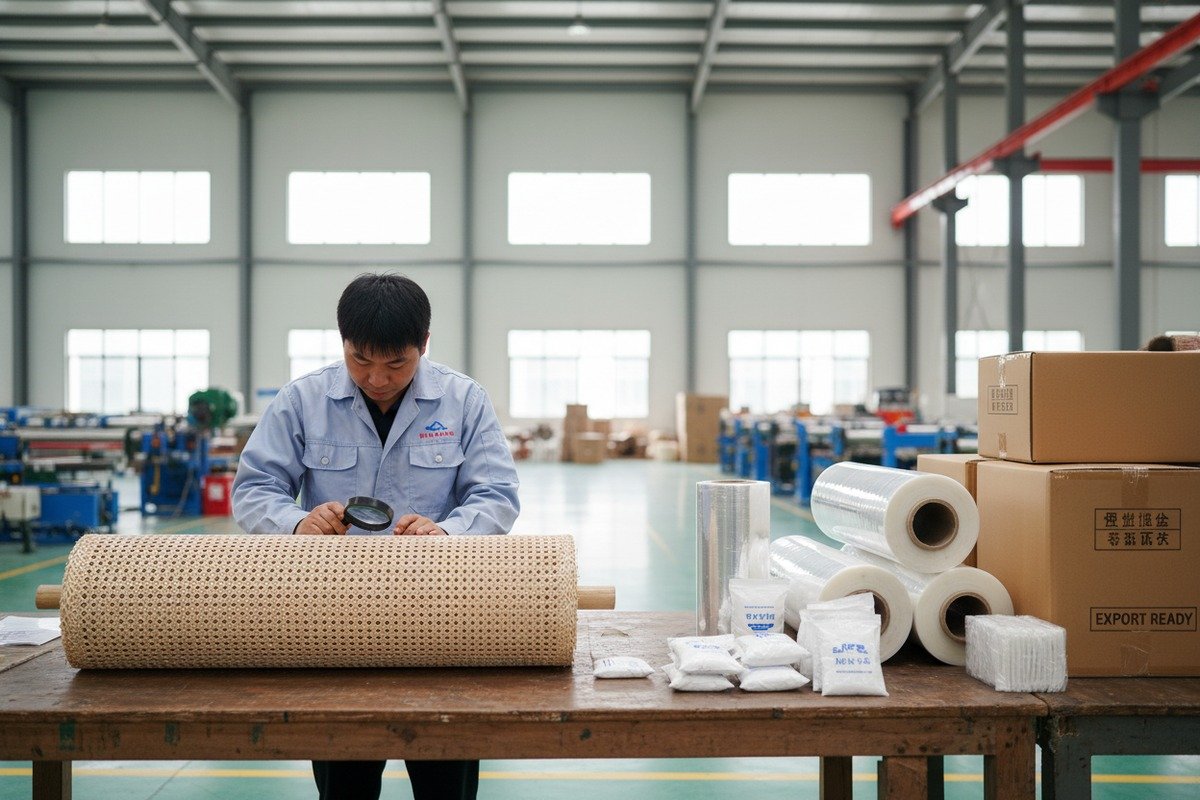
Every year, our warehouse teams in Foshan and Indonesia process thousands of rattan cane webbing 1 rolls destined for furniture factories across four continents. Yet one recurring problem keeps showing up in buyer complaints: shipments arriving with mold spots, cracked fibers, or crushed edges. The frustration is real. A single container of damaged rattan webbing can cost a furniture manufacturer weeks of production delay and thousands of dollars in waste.
To prevent damage to natural rattan cane webbing during long-distance shipping, you must combine proper pre-treatment (light oiling and moisture balancing), tight rolling techniques, multi-layer moisture-barrier packaging with desiccants, sturdy outer crating, and climate-aware logistics planning to protect against mold, cracking, deformation, and breakage in transit.
Below, we break down the exact steps—from factory floor packaging to final inspection at your warehouse door. Whether you import full containers by sea or smaller shipments by air, this guide gives you a practical, field-tested protocol to keep every roll of rattan webbing intact.
How can I ensure my rattan cane webbing is packed securely for international sea freight?
We have shipped rattan webbing to over 30 countries, and sea freight 2 remains the most common—and most risky—method. Ocean containers face rough seas, stacking pressure, and temperature swings that can destroy poorly packed natural rattan 3 in days.
To secure rattan cane webbing for sea freight, roll each piece tightly to prevent creasing, wrap it in moisture-resistant plastic film, cushion it with foam or bubble wrap, and place it inside reinforced corrugated boxes or wooden crates with desiccant packs to control humidity throughout the voyage.
Why Tight Rolling Matters
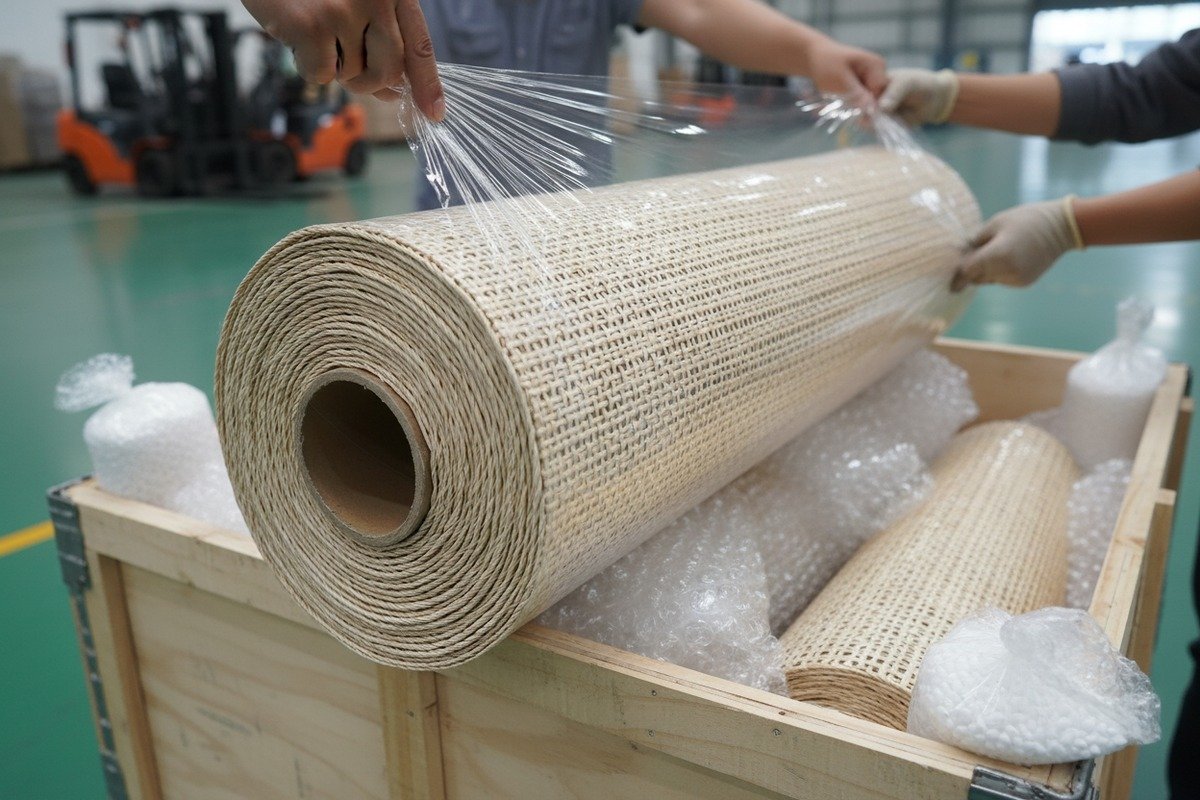
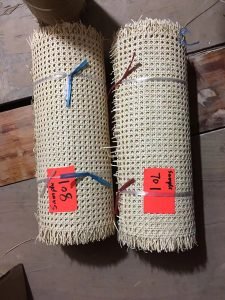
Loose or folded rattan webbing develops permanent creases during transit. At our Indonesian processing facility, every roll is wound around a rigid cardboard or PVC core. This keeps the weave flat and uniform. Standard roll specs are 15 meters in length and widths from 40 cm to 120 cm. The core prevents the center from collapsing under stacking weight.
A common mistake is rolling too loosely to "save time." But loose rolls shift inside the container. They press against each other. The weave pattern deforms. Once deformed, the webbing cannot be straightened without soaking and re-stretching—adding cost and delay at the buyer's end.
Layered Wrapping Protocol
One layer of plastic is not enough. Sea containers can experience condensation called "container rain 4," where temperature drops cause moisture to drip from the ceiling. Here is the wrapping sequence we use:
| Layer | Material | Purpose |
|---|---|---|
| 1st (Inner) | Soft cotton cloth or tissue paper | Prevents surface scratches and absorbs minor moisture |
| 2nd | Polyethylene (PE) stretch film | Creates a sealed moisture barrier |
| 3rd | Bubble wrap or foam sheet | Absorbs shocks and vibration |
| 4th (Outer) | Corrugated cardboard box or wooden crate | Provides structural rigidity against stacking pressure |
Each layer serves a distinct function. Skipping the inner cloth layer, for example, means the plastic film 5 sits directly on the rattan. If any trapped moisture exists, it has nowhere to go. The cloth acts as a buffer.
Securing the Outer Package
Strong packing tape should seal all seams. But tape must never touch the rattan surface directly. Adhesive residue can stain the natural fibers and leave marks that are impossible to remove. We use release paper between tape and rattan at all contact points.
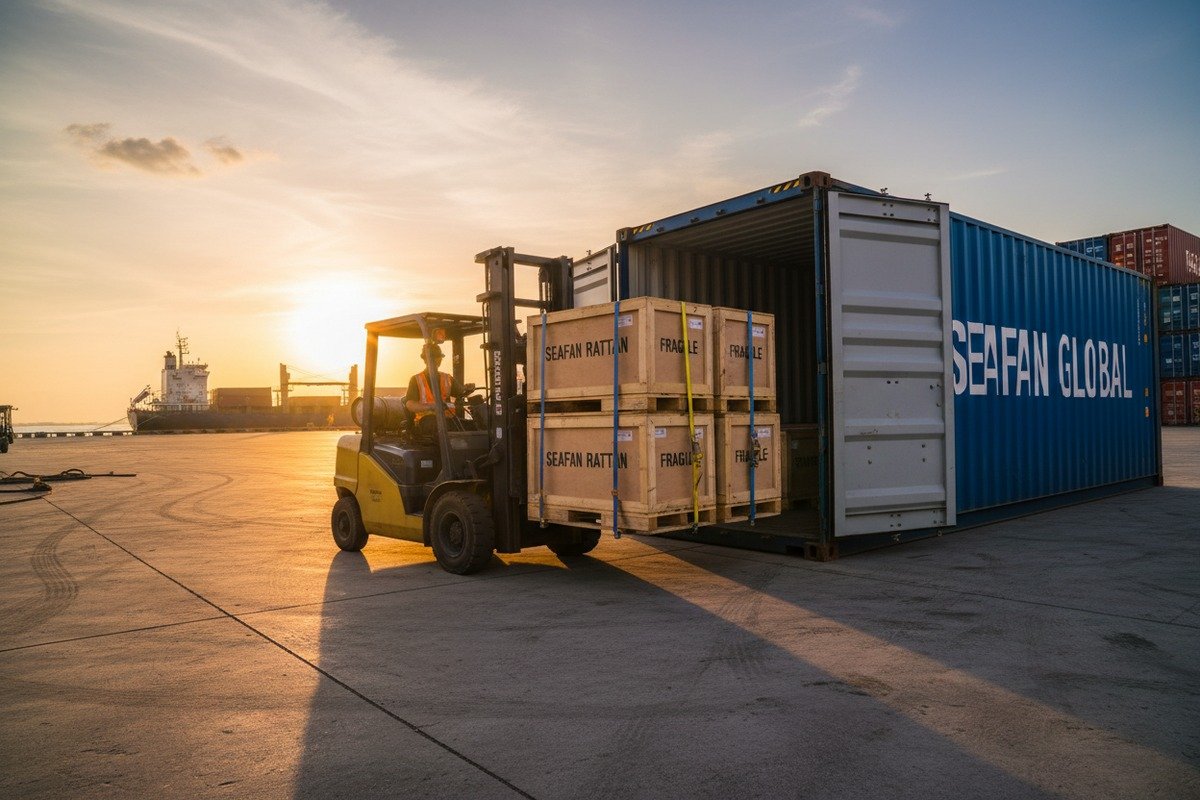
For bulk orders—say, 200 or more rolls in a 20-foot container—wooden pallets 6 are essential. Rolls are stacked horizontally, never vertically, to distribute weight evenly. Void spaces between rolls get filled with crumpled kraft paper or inflatable dunnage bags 7 to stop shifting.
Labeling and Handling Instructions
Every outer box leaving our factory carries clear labels: "Fragile," "Handle with Care," "Keep Dry," and "This Side Up." These labels are printed in English, Chinese, and the destination country's language when possible. Simple, but it reduces mishandling at port transfers significantly.
What steps should I take to prevent mold and moisture damage to my natural rattan during transit?
Mold is the number one enemy of natural rattan cane webbing in transit. In our experience exporting to humid markets like Thailand and the Philippines, even a small oversight in moisture control can ruin an entire shipment within two weeks at sea.
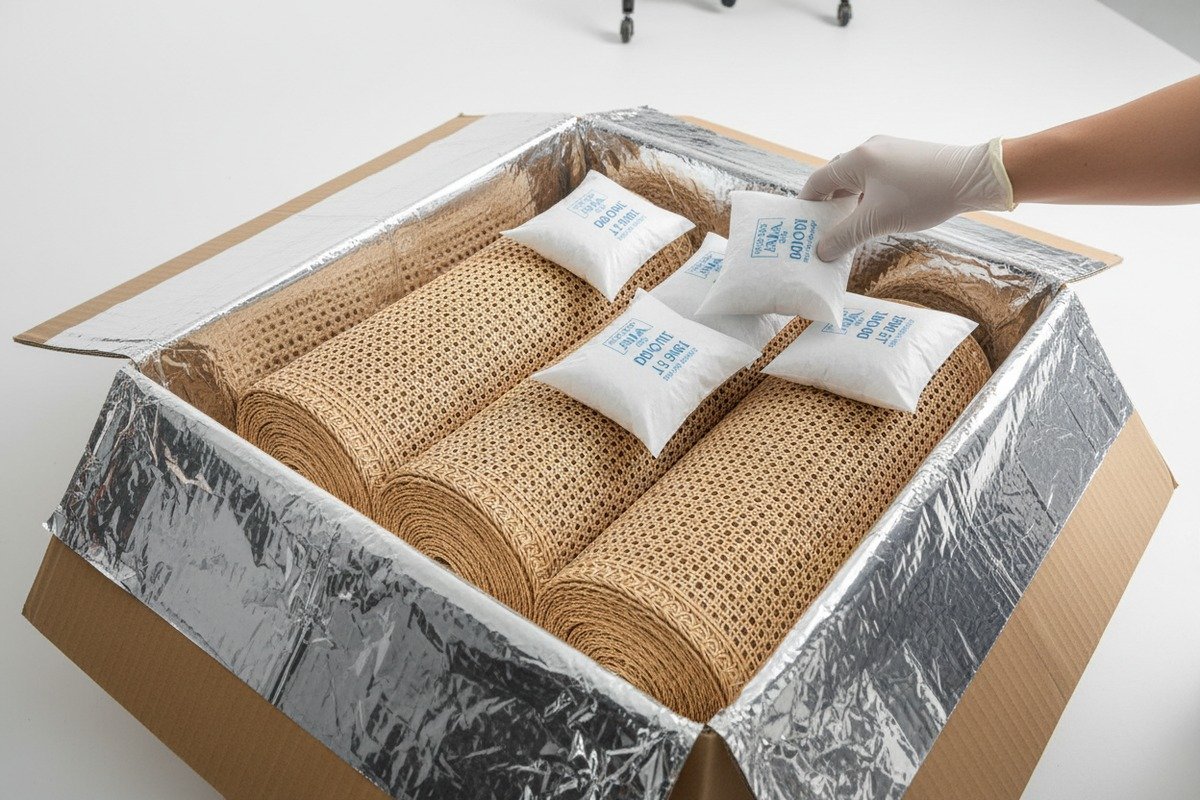
To prevent mold and moisture damage, balance the rattan's internal moisture content before packing, seal rolls in PE film with silica gel desiccant packs, ensure the shipping container is clean and dry, avoid loading during rain, and consider climate-controlled containers for shipments crossing tropical or monsoon zones.
Understanding Rattan's Hygroscopic Nature
Natural rattan is hygroscopic 8. It absorbs and releases moisture from the surrounding air. This is what makes it flexible and workable. But it also makes it a perfect host for mold spores when humidity stays above 65% for extended periods.
Indonesian-sourced rattan peels—the kind we process at our facility in Kalimantan—have naturally higher initial moisture content due to the tropical climate. Before any webbing leaves our factory, we dry it to a target moisture content of 10–14%. Too dry (below 8%), and the fibers become brittle and crack. Too wet (above 16%), and mold risk spikes.
Pre-Treatment Options
A light coating of mineral oil or coconut oil before shipping serves two purposes. First, it locks in a stable moisture level. Second, it creates a thin barrier that slows moisture absorption from external humidity. However, there is an important caution here.
Over-oiling is a real problem. Some suppliers soak the webbing heavily, thinking more oil means more protection. But excess oil traps moisture underneath. It creates the exact warm, damp environment mold loves. The correct approach is a thin, even wipe—not a soak.
| Pre-Treatment Method | Benefit | Risk If Overdone |
|---|---|---|
| Light mineral oil wipe | Maintains fiber hydration, prevents cracking | Excess oil traps moisture, promotes mold |
| Coconut oil coating | Natural antimicrobial properties, eco-friendly | Can turn rancid in extreme heat if applied too thickly |
| Air drying to 10–14% MC | Optimal balance of flexibility and mold resistance | Over-drying below 8% causes brittleness and cracking |
| Silica gel desiccant packs 9 | Absorbs excess humidity inside sealed packaging | Insufficient quantity fails to control moisture in large rolls |
Desiccant Placement Strategy
For a standard roll (15m × 90cm), we place two 50-gram silica gel packs inside the inner cloth wrap and two more inside the outer box. For full-container loads, we also hang container desiccant strips from the ceiling bars of the shipping container. These strips can absorb up to 300% of their weight in moisture.
Loading Day Protocol
We never load containers during rain. Even light drizzle introduces moisture into the container. Before loading, our team inspects the container floor and walls for rust holes, water stains, or residual odors from previous cargo. A dry, clean container is non-negotiable.
If the shipment crosses multiple climate zones—say, from tropical Indonesia through the Indian Ocean to cold Northern Europe—temperature swings cause condensation. In these cases, we recommend using a container liner, which is a large foil-and-desiccant blanket that lines the entire interior. It adds cost, but it prevents container rain entirely.
Ventilation vs. Sealing: The Debate
Some buyers ask us to leave small ventilation holes in the wrapping. The logic is that airflow prevents moisture buildup. But in a sealed shipping container, the air itself is humid. Ventilation holes let that humid air in. Our field data shows sealed wrapping with desiccants outperforms ventilated wrapping in mold prevention by a significant margin.
How do I verify that my supplier uses reinforced packaging for my bulk rattan webbing order?
When our clients—especially purchasing managers at furniture factories—place their first bulk order, packaging quality is often an afterthought. They focus on weave pattern, width, and price per meter. Then the container arrives, and 15% of the rolls are unusable. Trust, but verify. That is the lesson we share with every new buyer.
To verify reinforced packaging, request detailed packing photos and videos before shipment, ask for a written packaging specification sheet, require third-party pre-shipment inspection, and insist on sample shipments first to evaluate the supplier's actual packaging quality against their promises.
Ask for a Packaging Specification Sheet
A professional supplier should provide a written document that lists every packaging layer, material type, and quantity. At our company, we include this spec sheet in every proforma invoice. It details the core type, wrapping layers, desiccant count, box material, and palletizing method.
If a supplier cannot produce this document, that is a red flag. It means packaging is handled ad hoc, without a standard process. Ad hoc packaging produces inconsistent results—some rolls arrive fine, others arrive damaged.
Request Pre-Shipment Photos and Videos
Photos should show the rolls at each stage: bare, after oiling, after inner wrapping, after outer wrapping, and after boxing. Videos should show the stacking inside the container. We send a photo set of at least 10 images per order to our clients via WhatsApp or email before the container door closes.
Pay attention to the details in these photos. Are the rolls uniform in size? Is the plastic film sealed tightly without gaps? Are desiccant packs visible? Is the container floor dry and clean?
Third-Party Pre-Shipment Inspection
For orders above $5,000, we actively recommend that buyers hire a third-party inspection company 10 like SGS, Bureau Veritas, or a local Chinese inspection firm. The inspector visits the warehouse, checks a random sample of rolls for quality and packaging, and issues a report before the goods ship.
Here is what a thorough inspection covers:
| Inspection Item | What to Check | Pass Criteria |
|---|---|---|
| Roll tightness | No gaps between layers of the roll | Core visible, no sag when held horizontally |
| Moisture content | Digital moisture meter reading | 10–14% for natural rattan |
| Wrapping integrity | All four layers present and sealed | No tears, gaps, or exposed rattan |
| Desiccant placement | Correct number inside inner and outer packaging | Minimum 2 packs per roll (50g each) |
| Outer box strength | Box compression test | No collapse under 30kg stacking weight |
| Labeling | Fragile and handling labels present | Labels in English plus destination language |
| Container condition | Floor, walls, ceiling inspected | No rust, holes, water stains, or odors |
Sample Shipments: Test Before You Commit
We always encourage new buyers to order a small sample shipment—typically 5 to 10 rolls—before committing to a full container. This lets you evaluate the actual packaging quality, transit time, and product condition on arrival. It costs much less than discovering problems on a $20,000 order.
Our sample rolls ship via air or express courier, arriving in 5–7 days. The packaging mirrors exactly what we use for bulk orders so the test is meaningful.
Red Flags to Watch For
If a supplier resists sending packing photos, refuses third-party inspection, or cannot describe their packaging process in detail, proceed with extreme caution. Low pricing often correlates with minimal packaging. A supplier offering rattan webbing at $0.29 per meter may be cutting costs on packaging to maintain margins. That savings disappears quickly when 20% of your shipment is unusable.
When containers arrive at our clients' warehouses, the initial excitement of receiving goods can lead to rushed inspections. In our years working with furniture factories in the Netherlands, Spain, and Australia, we have seen buyers accept delivery only to discover mold patches or cracked fibers weeks later—well past the dispute window.
To inspect rattan shipments for hidden damage, open a random sample of at least 10–15% of rolls immediately upon delivery, unroll 2–3 meters of each sampled roll to check for internal mold or cracks, use a moisture meter to verify fiber hydration, and photograph every defect before signing the delivery receipt.

Inspect Before You Sign
This is the single most important rule. Once you sign the delivery receipt, your leverage in any damage claim drops dramatically. Take 30 minutes to open the container and do a preliminary check. If you see external damage—crushed boxes, water stains on cartons, or a musty smell when the doors open—note it on the delivery document immediately.
The Unrolling Test
Surface-level visual checks miss hidden damage. Mold often starts at the center of a tightly wound roll where air circulation is lowest. Cracks from over-drying may only appear on inner layers that experienced the most pressure.
For each sampled roll, unroll at least 2–3 meters from the center. Look for:
- Gray, green, or black spots: These indicate active mold. Even small spots spread quickly in a warm warehouse.
- Brittle or snapping fibers: Press a strand between your fingers and bend it gently. Premium Indonesian rattan should flex without breaking. If it snaps, the moisture content is too low or the material is inferior grade.
- Discoloration or dark patches: These may indicate water damage that occurred in transit.
- Uneven weave tension: Pull gently on different sections. The tension should feel uniform. Loose sections suggest the webbing was stretched unevenly or damaged.
Use a Digital Moisture Meter
A pin-type or pinless moisture meter costs around $20–$50 and gives you instant readings. Check at least three points on each sampled roll: the outer layer, a middle layer, and the innermost layer near the core.
Acceptable readings for natural rattan cane webbing at arrival:
- 10–14%: Ideal. The rattan is in good condition.
- 8–10%: Slightly dry. Allow it to acclimatize in your warehouse for 48 hours before use. Light misting can help.
- Above 16%: Too wet. Check immediately for mold. Spread the rolls in a ventilated area to dry.
- Below 8%: Excessively dry. The fibers may be brittle. Soak in water for 15–30 minutes before use to restore flexibility.
Document Everything
Photograph every defect with a timestamp. Include wide shots that show the roll's position in the container and close-ups of the specific damage. This documentation is critical if you need to file a claim with the shipping insurer, the supplier, or both.
Our standard practice is to provide buyers with a damage claim template that lists all required photos and measurements. This speeds up the resolution process significantly.
Post-Inspection Acclimatization
Even rolls that pass inspection need time to adjust. Move them to a covered, ventilated storage area. Do not place them on a concrete floor—concrete sweats and transfers moisture upward. Use pallets or shelving. Allow 24–48 hours for the rattan to equilibrate with your local humidity and temperature before cutting or installing.
This acclimatization step is especially important for buyers in dry climates like the Middle East or cold climates like Northern Europe. The rattan has spent weeks in a sealed container. Sudden exposure to a very different environment can cause warping or micro-cracking if rushed into use.
Conclusion
Protecting natural rattan cane webbing during long-distance shipping requires attention at every stage—from pre-treatment and wrapping at the factory to container loading, transit monitoring, and thorough inspection upon arrival. Work closely with your supplier, verify packaging standards, and never skip the arrival inspection. Your rattan investment depends on it.
Footnotes
1. Explains what rattan cane webbing is and its uses. ↩︎
2. Provides a comprehensive explanation of the sea freight process. ↩︎
3. Describes the characteristics and properties of natural rattan. ↩︎
4. Explains the phenomenon of container rain and its causes. ↩︎
5. Original URL returned HTTP 405. Wikipedia is an authoritative source providing a broad overview of plastic films and their applications. ↩︎
6. Details international standards for wooden pallets in shipping. ↩︎
7. Explains the function and benefits of dunnage bags for cargo stabilization. ↩︎
8. Defines hygroscopy and explains how materials absorb moisture. ↩︎
9. Explains the purpose and function of silica gel as a desiccant. ↩︎
10. Details the role and importance of third-party inspection in quality control. ↩︎

 English
  Español de México
  العربية
  Deutsch
  Français
  Русский