
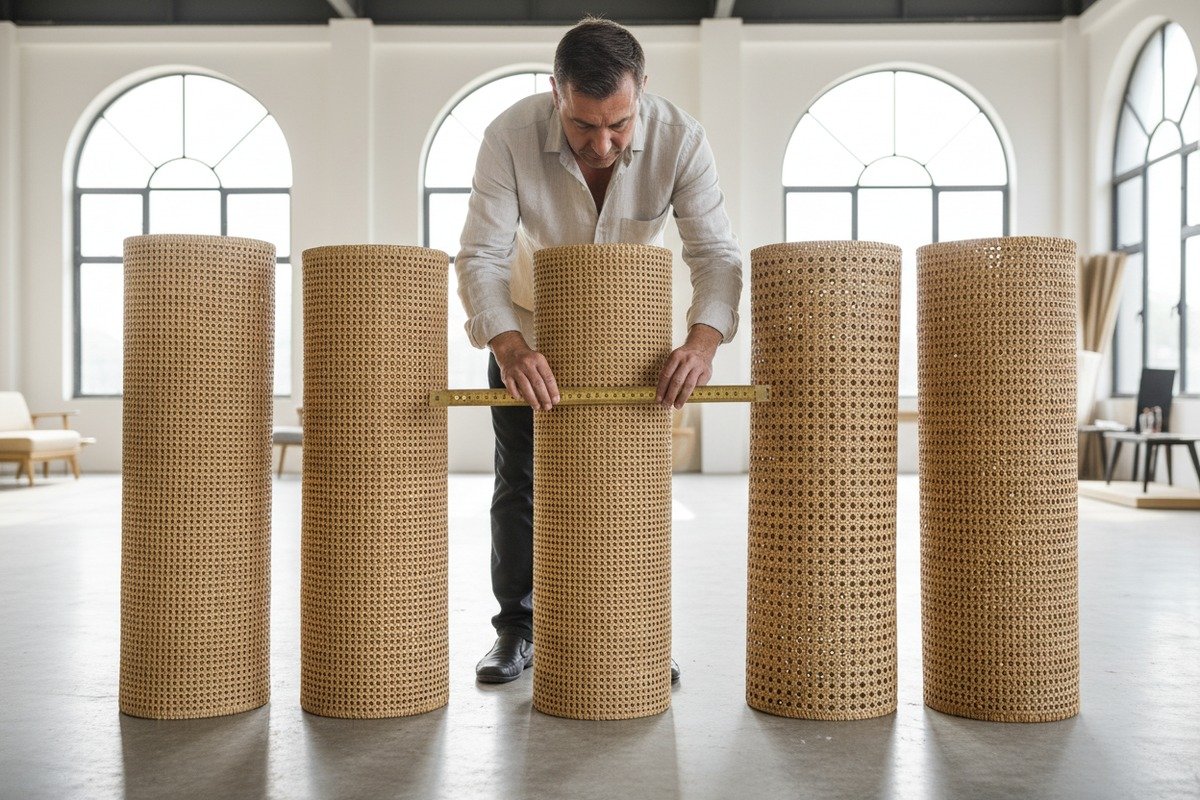
Every week, our sales team fields the same question from purchasing managers worldwide: “What mesh size do I need?” It sounds simple, but picking the wrong mesh size leads to wasted material, production delays, and frustrated end customers load-bearing requirements 1. After shipping rattan cane webbing to over 30 countries from our factories, we have learned that mesh size confusion is the single biggest sourcing mistake buyers make.
Standard mesh sizes for natural rattan cane webbing range from 3/8 inch to 1 inch, measured center-to-center between holes. The most common and widely used size is 1/2 inch. These sizes come in hexagonal, octagonal, and square weave patterns, available in rolls or sheets from Southeast Asian suppliers.
This guide breaks down every standard mesh size, explains how to match the right one to your project, and shares practical sourcing tips we have gathered from years on the production floor. Let’s start with the most important decision: choosing the right mesh size for your furniture line.
How do I choose the right mesh size for my specific furniture manufacturing needs?
Matching mesh size to furniture type is something we help our clients with daily at our Foshan headquarters. The wrong choice doesn't just look bad—it can compromise the structural integrity 2 of the finished piece. We have seen entire container orders rejected because a buyer assumed all mesh sizes were interchangeable.
To choose the right mesh size, first measure your furniture frame's groove dimensions and intended application. Use 1/2-inch mesh for classic chair seats, 3/8-inch for delicate decorative panels, and 3/4-inch or 1-inch for contemporary cabinet doors. Always match mesh density to the load-bearing requirements of the piece.

Start With the Furniture Type
The function of the furniture piece dictates the mesh size. A dining chair seat bears significant weight. It needs a tighter weave. A decorative cabinet door panel carries no load at all. It can use a larger, more open mesh for visual impact.
Here is a simple rule we share with every new buyer: tighter mesh equals more support, larger mesh equals more airflow and a modern look.
Measure Your Frame First
Before you place any order, measure three things on your furniture frame:
- Groove width — The channel where the cane webbing sits. Most grooves are 4mm to 6mm wide.
- Groove depth — The rattan core pith should be about 1mm smaller than the groove depth for a snug fit with the reed spline.
- Opening dimensions — The length and width of the area you need to cover, plus at least 2 inches of overhang on each side.
Match Mesh Size to Application
| Furniture Application | Recommended Mesh Size | Weave Pattern | Why This Works |
|---|---|---|---|
| Dining chair seats | 1/2 inch | Hexagonal or octagonal | Best balance of support and classic look |
| Chair backs | 1/2 inch or 5/8 inch | Hexagonal | Moderate support with good breathability |
| Cabinet door panels | 3/4 inch or 1 inch | Open hexagonal | Decorative appeal, no load bearing needed |
| Headboards | 5/8 inch | Octagonal | Medium density suits large flat surfaces |
| Room dividers / screens | 3/4 inch | Open weave | Allows light to pass through |
| Delicate accent furniture | 3/8 inch or 7/16 inch | Fine hexagonal | Refined, traditional appearance |
Consider the Aesthetic Outcome
Mesh size directly shapes the final look. A fine 3/8-inch mesh gives a traditional, almost textile-like appearance. It suits classic European-style furniture and Thonet chair restorations 3. A 1-inch jumbo mesh creates an airy, bohemian or mid-century modern vibe. Our clients in the Netherlands and Australia tend to favor the 1/2-inch and 5/8-inch range for their versatility.
Don't Forget Structural Rigidity
Tighter weaves are inherently more rigid. They resist stretching better over time. If your furniture will see heavy daily use—think restaurant seating or hotel lobby chairs—go with 1/2-inch or smaller. For low-traffic decorative pieces, larger mesh sizes work beautifully and use less material per square meter, which can reduce costs.
Test Before You Commit
We always recommend ordering a sample roll or sheet before committing to a full production run. Even a 1/16-inch difference between Fine-Fine (7/16 inch) and Standard (1/2 inch) can change the visual character of your finished product. At our facility, we cut sample swatches and ship them within 3 days so buyers can test the fit on their actual frames.
What are the most common standard mesh sizes I should expect from a rattan wholesaler?
When we onboard new wholesale clients, the first thing we do is walk them through our full mesh size catalog. Many buyers come to us knowing only about the 1/2-inch standard. But the full range is wider than most people expect, and understanding it gives you a real competitive edge when designing your product line.
The most common standard mesh sizes from rattan wholesalers are 3/8 inch, 7/16 inch (Fine-Fine), 1/2 inch (the industry standard), 5/8 inch (Medium), 3/4 inch, and 1 inch (Jumbo). These are measured center-to-center and come in hexagonal, octagonal, square (Radio Weave), and herringbone patterns.
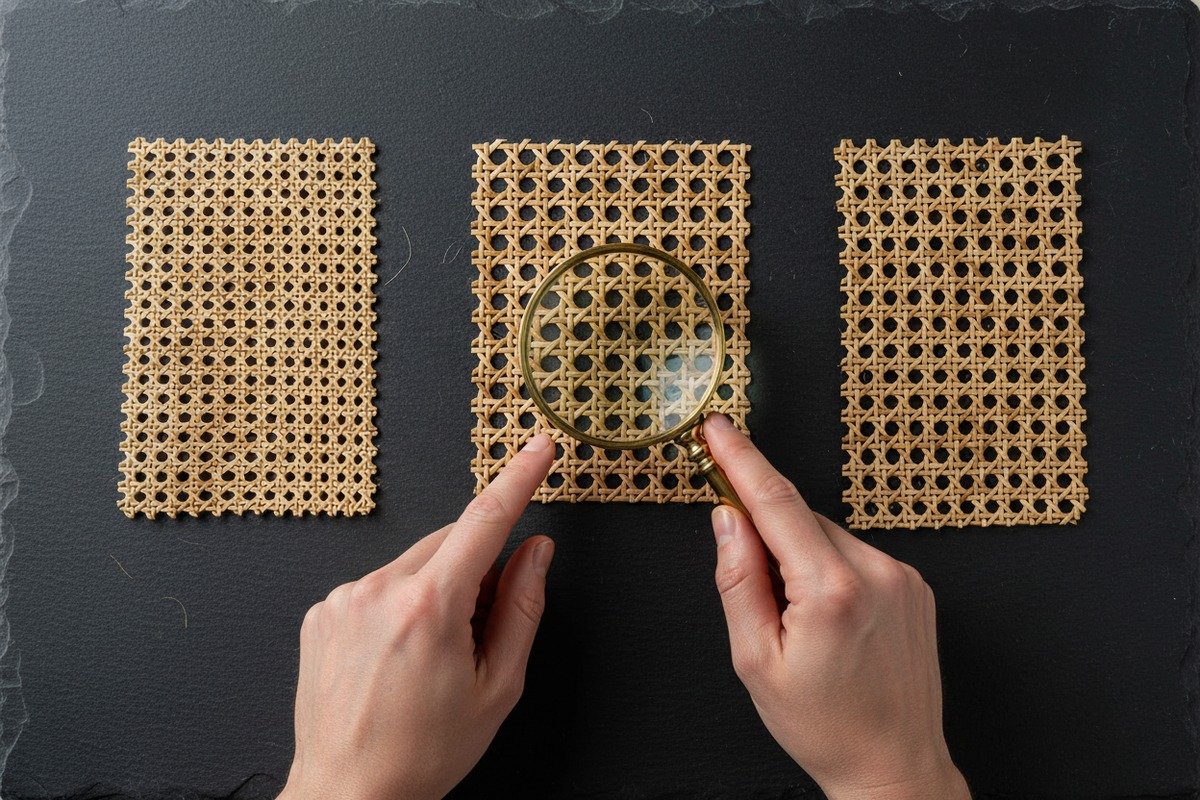
The Six Core Sizes
Let's break down each size and what it is best used for.
3/8 inch — The smallest commonly available mesh. It creates a very tight, almost fabric-like surface. It is harder to find in bulk from Asian exporters but available from specialty US suppliers. Ideal for fine antique restoration work.
7/16 inch (Fine-Fine) — Only 1/16 inch smaller than the standard 1/2 inch, but that small difference matters. It gives a slightly more refined look. Available in 18-inch and 24-inch widths. Popular among European furniture restorers.
1/2 inch — This is the workhorse of the industry. If you are unsure which size to stock, start here. It works for chair seats, backs, headboards, and cabinet panels. Nearly every wholesaler carries it. It is the size most often specified by interior designers and architects.
5/8 inch (Medium) — A step up in openness. Typically woven in an octagonal pattern. Good for pieces where you want a noticeable weave texture. Available in 18-inch to 24-inch widths.
3/4 inch — A larger open weave. Also octagonal. Creates a bold visual statement. Popular for decorative panels and room dividers. It allows more light and air to pass through.
1 inch (Jumbo) — The largest standard mesh. Less common and often requires specialty ordering. Best for contemporary and bohemian designs. Rarely used for seating due to lower structural support.
Complete Size Comparison Table
| Mesh Size | Pattern Type | Common Widths | Best Application | Availability |
|---|---|---|---|---|
| 3/8 inch | Fine hexagonal | 18"–24" | Antique restoration, delicate panels | Specialty only |
| 7/16 inch | Fine-Fine hexagonal | 18"–24" | European-style chairs, refined furniture | Moderate |
| 1/2 inch | Hexagonal / octagonal | 18"–36" | Universal: chairs, cabinets, headboards | Very widely available |
| 5/8 inch | Octagonal | 18"–24" | Mid-size furniture, chair backs | Widely available |
| 3/4 inch | Open octagonal | 18"–24" | Decorative panels, room dividers | Widely available |
| 1 inch | Jumbo open weave | 18"–24" | Contemporary decor, cabinet inserts | Specialty / limited |
Weave Patterns Beyond Hexagonal
Most buyers think of the classic hexagonal open-mesh pattern first. But there are several other patterns you should know about:
- Octagonal (Traditional) — Common in 5/8-inch and 3/4-inch sizes. Creates a slightly more structured look than hexagonal.
- Square (Radio Weave) — Referenced by fineness grades like 6×6 (approximately 2mm strand width) and 5×5 (approximately 2.5mm strand width). This is a grid pattern, not an open mesh. Popular for mid-century modern furniture.
- Herringbone — A diagonal zigzag pattern. Available in medium 3mm (18-inch width, Z-pattern) and superfine 2mm (24-inch width). Adds visual movement to flat panels.
- Ladder Weave — Features thin horizontal strands. A more contemporary look.
Roll and Sheet Formats
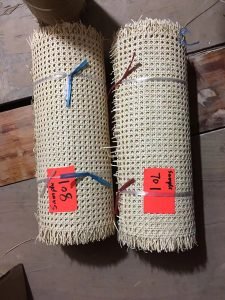
Standard roll lengths run 15 meters. This is the industry norm from Vietnamese and Indonesian factories 4. Some US suppliers offer 50-foot specialty rolls. Sheets typically come in 40×100 cm or 75×100 cm sizes—these suit smaller projects or sample testing.
Standard widths include 18 inches, 24 inches, and 36 inches. In metric, that translates to roughly 45 cm, 60 cm, and 90 cm. Our production lines in Indonesia can cut custom widths, but standard sizes ship fastest and cost less.
A Note on US vs. Asian Sizing
This is a subtle but important sourcing detail. US suppliers like HH Perkins label mesh sizes very precisely—Fine-Fine, Standard, Medium, and so on. Asian exporters often list roll dimensions and widths but may not specify hole size in the same way. This can lead to mismatches if you are not careful. Always ask for center-to-center hole measurements in your purchase order. We include this specification on every invoice and packing list to avoid confusion.
How can I ensure the mesh size consistency matches my Grade A quality standards?
Quality consistency is the number one pain point we hear from purchasing managers. Our client Ranoo in Thailand told us he once received a shipment where the mesh openings varied by nearly 2mm across a single roll. That kind of inconsistency ruins a production run. We have spent years building quality systems to prevent exactly this issue.
To ensure mesh size consistency at Grade A level, request pre-production samples for approval, specify center-to-center measurements in your purchase contract, and require the supplier to conduct roll-by-roll inspection. Look for suppliers who provide test reports, maintain controlled drying processes, and use calibrated weaving machines.

Why Inconsistency Happens
Natural rattan is an organic material. It swells when wet and contracts when dry. If a factory does not control the moisture content 8 during weaving and drying, the mesh openings can shift. Strand thickness also varies from harvest to harvest. Without grading and sorting, thicker strands produce smaller holes and thinner strands produce larger ones.
Machine calibration matters too. Older looms drift over time. A factory that does not maintain its equipment will produce rolls where the first meter looks perfect and the last meter is off-spec.
Our Quality Control Process
At our Indonesian processing facility, we follow a five-step quality process:
- Raw material grading — Rattan strands are sorted by diameter before weaving. Only strands within a 0.2mm tolerance band go into the same batch.
- Machine calibration — Looms are checked and adjusted at the start of every shift.
- In-line inspection — Operators check mesh openings every 2 meters during weaving using a simple go/no-go gauge.
- Post-weave drying — Rolls are dried to a target moisture content of 12–14% in controlled conditions. This prevents post-shipment shrinkage.
- Final inspection — Every roll is visually inspected and spot-measured before packing.
What to Specify in Your Purchase Order
| Quality Parameter | What to Specify | Acceptable Tolerance |
|---|---|---|
| Mesh opening (center-to-center) | Exact size in inches or mm | ±1mm |
| Strand diameter | Target width in mm | ±0.3mm |
| Roll width | Exact width in inches or cm | ±5mm |
| Roll length | Standard 15m or custom | ±0.5m |
| Moisture content | 12–14% at packing | ±2% |
| Color grade | Natural, semi-bleached, or dark | Match approved sample |
| Defect allowance | Max defects per roll | ≤2 minor per 15m roll |
Grading: What "Grade A" Actually Means
There is no universal ISO standard for rattan cane webbing grading 9. The term "Grade A" is used loosely across the industry. At our company, Grade A means:
- No broken strands within the usable area
- Consistent mesh openings within ±1mm across the entire roll
- Uniform color with no discoloration or mold spots
- Smooth strand surface with no rough splinters
- Properly trimmed edges
Grade B might have minor color variation or 1–2 broken strands per roll. Grade C is typically reserved for craft or DIY use where cosmetic perfection is not critical.
Red Flags to Watch For
If a supplier refuses to send pre-production samples, walk away. If they cannot provide center-to-center mesh measurements in writing, that is another warning sign. We also recommend asking for photos of their drying facility. Proper drying is the single biggest factor in preventing mesh size drift after the webbing reaches your factory.
Natural rattan has a practical shelf life of about 24 months under proper storage conditions. If rolls sit in a humid warehouse too long, the material can expand, mold, or become brittle. Ask your supplier about their inventory turnover rate.
Can I source custom mesh dimensions and roll widths for my private-label projects?
This is where things get exciting for brands that want to stand out. More than half of our private-label clients now request at least one custom specification—whether it is a non-standard width, a unique weave pattern, or a specific color tone. Our three factories give us the flexibility to handle these requests without outsourcing.
Yes, you can source custom mesh dimensions and roll widths for private-label projects. Most established rattan manufacturers offer bespoke options including non-standard widths (e.g., 600mm or 910mm), custom weave patterns, and tailored roll lengths. Expect minimum order quantities of 5–10 rolls and lead times of 7–14 days for custom orders.

What Can Be Customized?
Almost everything. Here is what our factory can adjust:
- Mesh opening size — We can produce non-standard sizes between the six standard increments. For example, a 9/16-inch mesh if you want something between 1/2 inch and 5/8 inch.
- Roll width — Beyond the standard 18", 24", and 36", we can produce rolls at 20", 30", 45", or any width up to 90cm.
- Roll length — Standard is 15 meters, but we can produce 10m, 20m, or 25m rolls based on your packing and shipping needs.
- Weave pattern — Over 20 patterns are available, including herringbone, ladder, diamond lattice, and complex basketweave designs.
- Color and finish — Natural light beige, semi-bleached (lighter tone), dark natural (radio rattan), or custom stain colors.
The Custom Order Process
Here is how a typical custom order works with us:
Step 1: Specification discussion. You send us drawings, photos, or reference samples. We confirm feasibility.
Step 2: Sample production. We produce 1–3 sample rolls or sheets at your exact specifications. This takes about 5–7 days.
Step 3: Sample approval. You test the samples on your furniture frames. We adjust if needed.
Step 4: Production order. Once approved, full production begins. Standard lead time is 7 days for 1–50 rolls. Larger orders of 100+ rolls may take 14–21 days.
Step 5: Quality inspection and shipping. Every roll is inspected against the approved sample before packing.
MOQs and Pricing for Custom Orders
Custom orders naturally come with higher minimum order quantities and slightly higher unit costs compared to standard sizes. Here is a general pricing framework based on our current production capabilities:
| Order Size | Standard Mesh Price (per roll) | Custom Mesh Price (per roll) | Lead Time |
|---|---|---|---|
| 1–4 rolls (samples) | $65–$75 | $80–$95 | 5–7 days |
| 5–50 rolls | $55–$65 | $65–$75 | 7–10 days |
| 51–100 rolls | $50–$60 | $58–$68 | 10–14 days |
| 100+ rolls | Negotiable | Negotiable | 14–21 days |
These prices are approximate and based on our Vietnam/Indonesia production lines shipping to major markets. Exact pricing depends on pattern complexity, width, and material grade.
Private-Label Packaging
For private-label clients, we also offer custom packaging. This includes branded roll labels, custom box printing, and tailored roll dimensions that match your retail display requirements. Several of our European clients sell rattan webbing under their own brand on e-commerce platforms. We handle everything from production to labeled packaging, so the product arrives at their warehouse ready to ship to end customers.
Sustainability Certifications
Sustainability is increasingly important for private-label brands. Our Indonesian factory sources rattan from managed plantations. We can provide documentation for Global GreenTag certification 10 and other eco-labels. Natural rattan is inherently sustainable—it is a fast-growing vine that does not require deforestation to harvest. This is a strong selling point for brands targeting eco-conscious consumers in Europe and Australia.
Synthetic vs. Natural for Custom Projects
Some buyers ask about synthetic PE rattan for custom projects, especially for outdoor furniture. Synthetic rattan offers better weather resistance and longer outdoor lifespan. But for indoor applications, natural rattan remains the preferred material. It breathes better, feels warmer to the touch, and carries the authentic aesthetic that consumers associate with quality craftsmanship. We supply both, but we always recommend natural rattan for indoor private-label products where authenticity drives the brand story.
Conclusion
Choosing the right mesh size is the foundation of successful rattan cane webbing sourcing. Measure your frames, match the mesh to the application, verify quality standards with samples, and explore custom options when your brand demands it. If you need guidance, our team at Seafan Rattan is ready to help you get it right the first time.
Footnotes
1. Identified a page explaining strength and load-bearing tests for furniture, including relevant standards. ↩︎
2. Explains the concept of structural integrity in furniture design and durability. ↩︎
3. Provides historical context for Michael Thonet and his iconic chair designs. ↩︎
4. Highlights key regions for rattan production and manufacturing. ↩︎
5. Defines the material and its origin for furniture and decor. ↩︎
6. Describes the role and services of a rattan wholesaler and supplier. ↩︎
7. Explains the characteristics and construction of the Radio Weave pattern. ↩︎
8. Explains the impact of humidity and moisture on rattan material. ↩︎
9. Provides context on international standardization bodies and their role. ↩︎
10. Explains the purpose and scope of Global GreenTag certification for sustainable products. ↩︎
 English
  Español de México
  العربية
  Deutsch
  Français
  Русский