
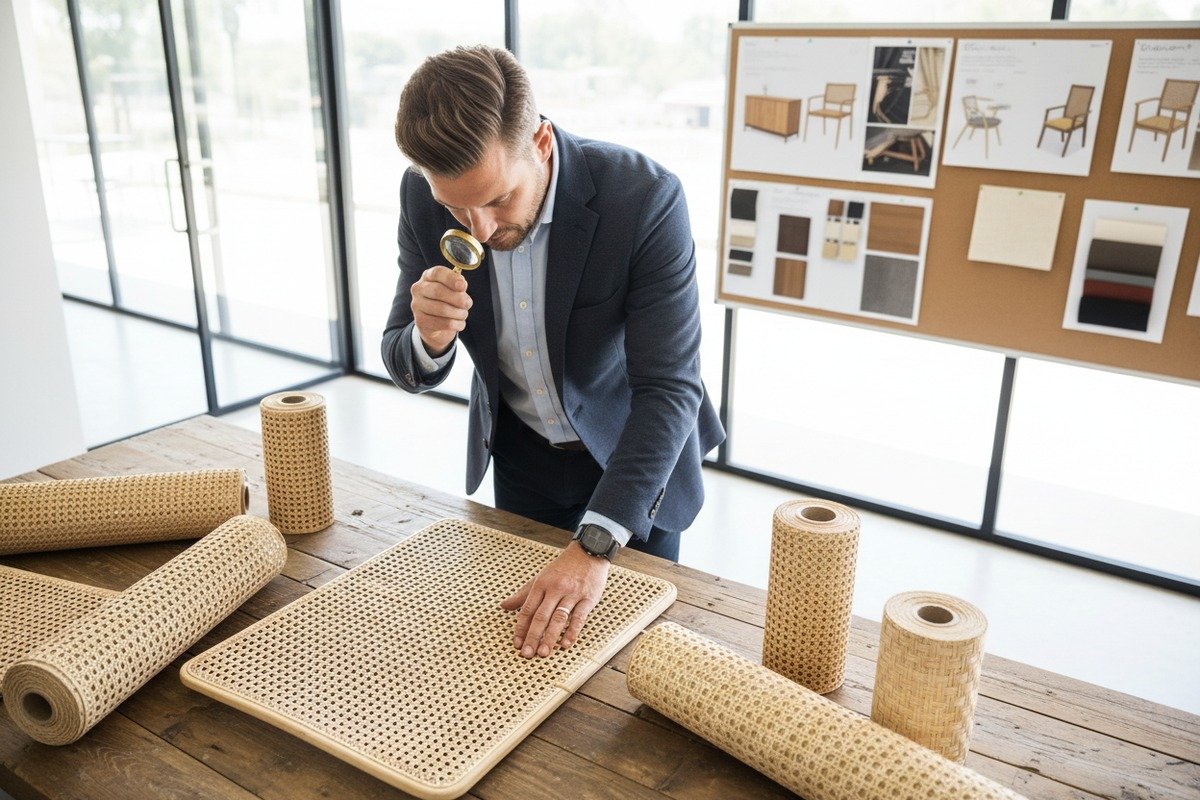
Cada año, nuestro equipo de ventas recibe cientos de consultas de compradores que fueron estafados por un proveedor anterior de ratán: rollos que llegaron agrietados, correas irregulares o precios que se duplicaron sin previo aviso inspección previa al envío por terceros 1. Estos problemas son prevenibles, pero solo si sabe qué buscar antes de comprometerse con una orden de compra.
Al elegir un proveedor de tejido de ratán, debe evaluar el origen y la clasificación del material, la consistencia de la producción, las credenciales de la fábrica, la transparencia de los precios, la flexibilidad de personalización y los estándares de embalaje. Estos factores en conjunto determinan si su proveedor puede ofrecer una calidad uniforme a escala sin sorpresas costosas.
A continuación, desglosamos las preguntas más críticas que nos hacen los compradores B2B, y las respuestas honestas que les damos basadas en años de procesamiento de ratán en nuestras instalaciones en Indonesia y Foshan, China.
How do I ensure the rattan cane webbing quality is consistent across all my bulk orders?
La inconsistencia en las correas es la queja número uno que escuchamos de los gerentes de compras que cambian de proveedor protección contra la humedad 2. Un lote se ve perfecto. El siguiente tiene hebras irregulares, cambios de color o secciones quebradizas que se agrietan durante la instalación.
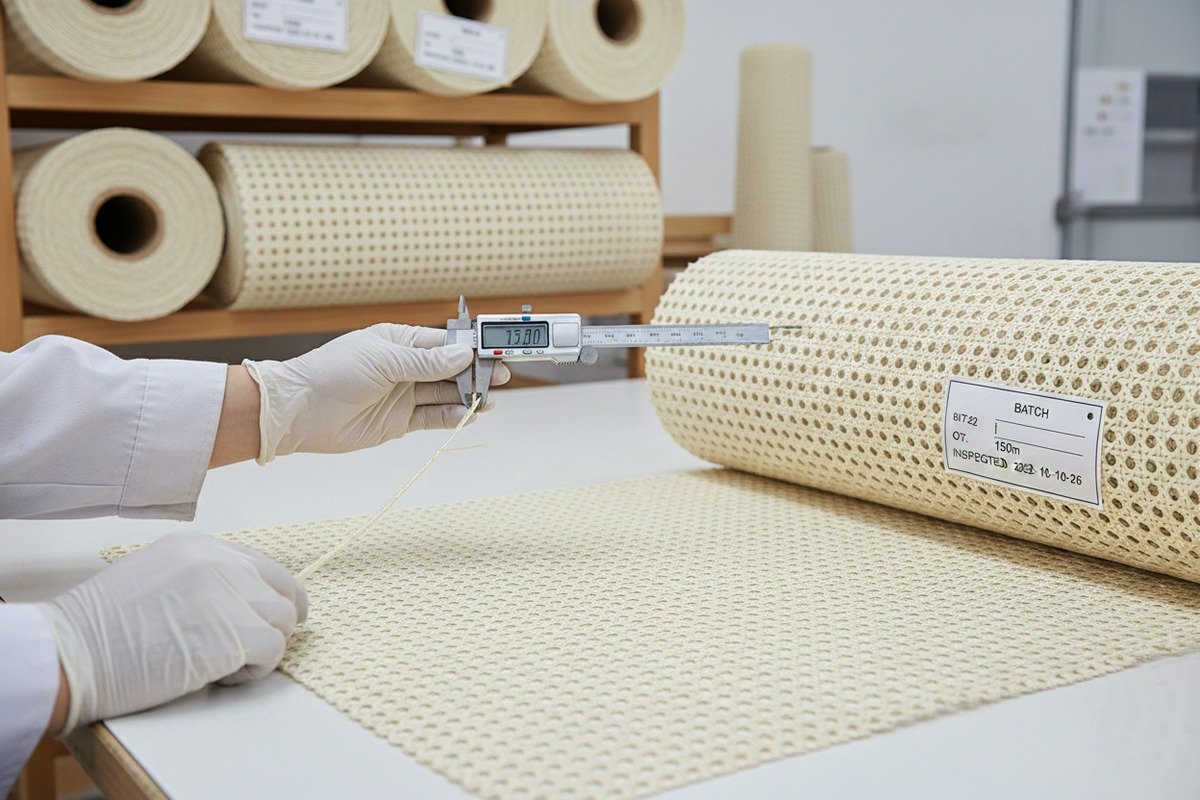
Para garantizar una calidad constante en los pedidos de mimbre de ratán a granel, exija el abastecimiento de materias primas clasificadas, procesos de producción estandarizados, inspecciones previas al envío y muestras de referencia conservadas. Estos cuatro controles juntos evitan la variación de lote a lote en el color, la flexibilidad y la uniformidad del tejido.
Por qué ocurre la inconsistencia en primer lugar
El ratán es un material natural 3. Crece en bosques tropicales del sudeste asiático. No hay dos cosechas idénticas. El diámetro, el contenido de humedad y el color de los postes de ratán crudo cambian con la estación, la región e incluso la edad de la planta. Sin una clasificación estricta en la etapa de materia prima, estas variaciones naturales pasan directamente a las correas terminadas.
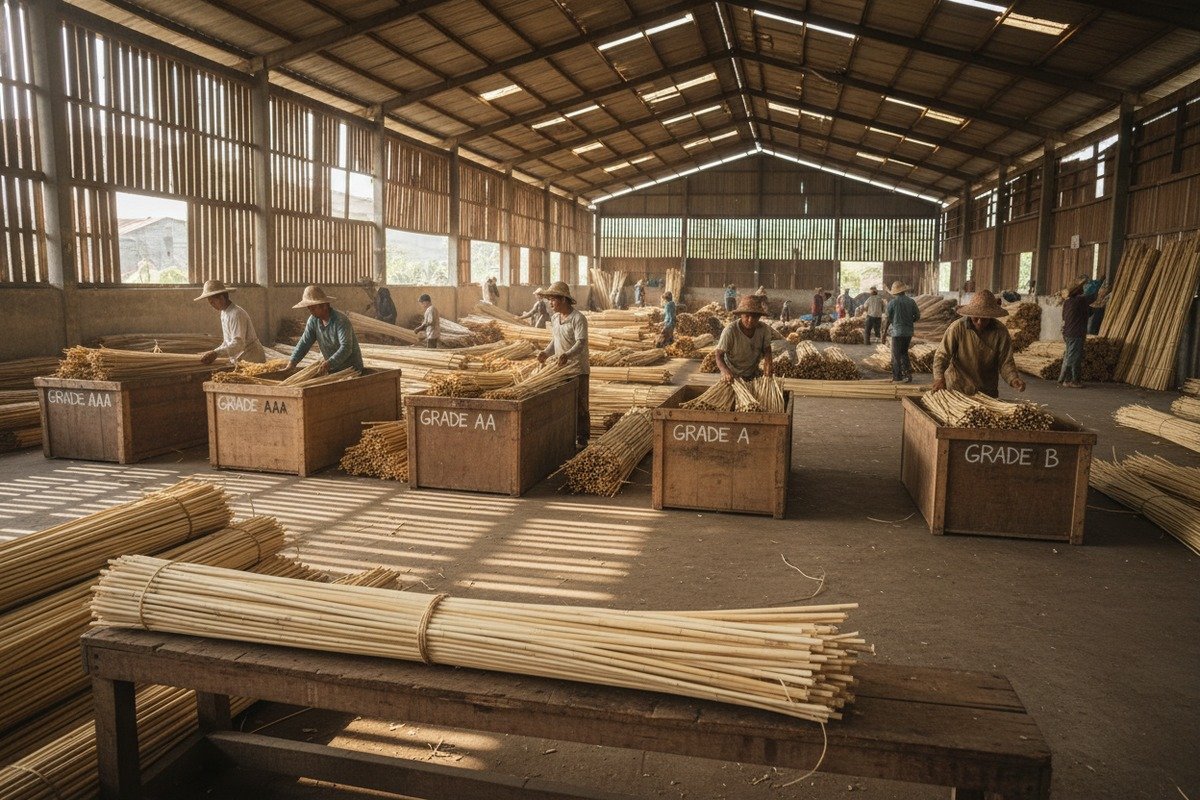
En nuestra planta de procesamiento en Indonesia, cada lote entrante de ratán crudo pasa por un proceso de preparación de cinco pasos: clasificación por diámetro, pelado para separar la caña exterior del núcleo interior, adelgazamiento a un grosor uniforme, secado controlado y clasificación final. Clasificamos nuestra caña pelada de AAA a D. Solo los grados AAA y A se utilizan en nuestros rollos de correas premium. Los grados B y C se utilizan para productos de gama económica. El grado D se rechaza por completo.
El Sistema de Clasificación Explicado
| Grade | Origen | Uniformidad de la hebra | Consistencia del color | Mejor Uso |
|---|---|---|---|---|
| AAA | Indonesia (principal) | Excelente — grosor casi perfecto | Beige claro muy uniforme | Muebles de alta gama, paneles de diseño |
| A | Indonesia / Malasia | Bueno — se permite una ligera variación | Coherente con ligeros cambios de tono | Muebles de gama media, gabinetes |
| B | Fuentes mixtas | Moderado — variación de grosor visible | Rango de color notable | Muebles económicos, particiones interiores |
| C | Fuentes mixtas | Inferior — algunos puntos finos/gruesos | Amplia variación de color | Proyectos de manualidades, decoración no estructural |
| D | Cualquiera | Pobre — defectos presentes | Inconsistente | Rechazado / no recomendado |
Pasos prácticos que puede tomar como comprador
Primero, solicite una muestra de referencia antes de realizar su pedido a granel. Guárdela. Cuando llegue su envío, compare lado a lado. Segundo, pregunte a su proveedor si conservan muestras de producción de cada lote. Nosotros guardamos muestras etiquetadas en nuestro almacén durante seis meses para que cualquier disputa pueda rastrearse hasta el lote de producción exacto. Tercero, especifique su rango de tolerancia aceptable por escrito. Por ejemplo, podría indicar que el ancho de la hebra debe estar dentro de ±0.3 mm y que el color debe coincidir con la referencia Pantone dentro de una tonalidad. Finalmente, considere organizar un tercero inspección previa al envío 4, especialmente para los primeros pedidos que superen las $5,000 en valor. Este pequeño costo inicial puede evitarle rechazar un contenedor completo.
Natural vs. Sintético: Una comparación de consistencia de calidad
Vale la pena señalar que la ratán sintético de PE ofrece inherentemente una mayor consistencia de lote porque se extruye a máquina a partir de gránulos de plástico uniformes. El ratán natural siempre tendrá alguna variación orgánica. Si su proyecto exige una uniformidad absoluta, como paneles de cabeceros de hotel a gran escala donde cincuenta unidades deben verse idénticas, considere si una opción sintética de alta calidad podría satisfacer mejor sus necesidades. Sin embargo, para los compradores que valoran la calidez auténtica y la textura artesanal del ratán real, una clasificación y selección adecuadas pueden acercar el ratán natural de manera impresionante a la consistencia de nivel sintético.
¿Qué credenciales de fábrica debo verificar para confirmar que mi proveedor tiene una fuente de materia prima estable?
Cuando asistimos a ferias comerciales en Europa y Oriente Medio, surge la misma pregunta una y otra vez: "¿Cómo sé que mi suministro no se verá interrumpido?". Es una preocupación legítima. Desde que Indonesia prohibió las exportaciones de ratán crudo en 2011, la estabilidad de la cadena de suministro se ha convertido en un verdadero diferenciador entre los proveedores.
Check for direct ownership or long-term contracts with rattan processing facilities in producer countries like Indonesia, relevant certifications such as FSC or ISO 9001, verifiable export history, and transparent documentation of their raw material grading and sourcing pipeline.
Por qué el acceso a la materia prima importa más de lo que crees
Indonesia es el mayor productor de ratán del mundo. La prohibición de exportación de ratán crudo y semielaborado de 2011 fue diseñada para mantener los trabajos de procesamiento a nivel nacional. Lo que también hizo fue crear un cuello de botella. Los proveedores sin sus propias operaciones de procesamiento dentro de Indonesia ahora dependen de intermediarios, lo que aumenta el costo y reduce el control. Cuando la demanda aumenta, como ocurrió durante el auge mundial de la renovación del hogar, estos proveedores dependientes de intermediarios son los primeros en enfrentar escasez y aumentos de precios.
Nuestro enfoque ha sido invertir directamente. Operamos nuestra propia planta de procesamiento de ratán en Indonesia, lo que nos da acceso prioritario al ratán cosechado de comunidades agrícolas contratadas. Esto no es algo que todos los proveedores puedan afirmar, y es algo que debe verificar.
Credenciales clave para solicitar
Aquí hay una lista de verificación práctica que puede usar al evaluar a cualquier tejido de caña de ratán 5 proveedor:
| Credencial | Qué demuestra | Cómo verificar |
|---|---|---|
| Fábrica propia en Indonesia o en un país productor importante de ratán | Acceso directo a la materia prima, sin depender de intermediarios | Solicitar la dirección de la fábrica, fotos y un recorrido en video |
| certificación FSC 6 | El ratán se cosecha de bosques gestionados de forma sostenible | Solicite el número de certificado y verifíquelo en la base de datos de FSC |
| ISO 9001 7 | El sistema de gestión de calidad está implementado | Solicite copia del certificado; verifique el organismo emisor |
| Licencia de exportación y registros aduaneros | Historial comprobado de envíos internacionales | Solicite copias recientes de conocimientos de embarque o estadísticas de exportación |
| Contratos a largo plazo con comunidades agrícolas | Suministro estable y recurrente de ratán crudo | Solicite documentación o referencias de socios locales |
| Informes de auditoría de terceros | Verificación independiente de las condiciones y procesos de la fábrica | Pregunte si han sido auditados por SGS, Bureau Veritas o similares |
Señales de Alerta a Tener en Cuenta
Tenga cuidado si un proveedor no puede nombrar su fuente de materia prima. Frases como "obtenemos de varios lugares" o "nuestro ratán proviene del sudeste asiático" sin detalles son señales de advertencia. Un proveedor creíble debería poder decirle exactamente de qué región proviene su ratán, qué especies utilizan y cómo se procesa antes de tejerlo.
Además, desconfíe de los proveedores que afirman ofrecer ratán indonesio de primera calidad a precios muy por debajo de las tasas del mercado. Desde la prohibición de exportación, el ratán indonesio procesado tiene un precio mínimo que refleja los gastos de mano de obra local, procesamiento y cumplimiento. Si el precio parece demasiado bueno, el material podría estar mal etiquetado o mezclado con caña de menor calidad de otros orígenes.
El papel de las certificaciones en la adquisición B2B
Para compradores que revenden en los mercados europeos o norteamericanos, las certificaciones no son solo un extra. Los minoristas exigen cada vez más pruebas de abastecimiento sostenible. Tener una cadena de suministro certificada por la FSC 8 puede abrir puertas a contratos con las principales marcas de muebles y minoristas de artículos para el hogar que exigen documentación de la cadena de custodia. Hemos visto a compradores perder acuerdos simplemente porque no pudieron proporcionar esta documentación cuando se les solicitó.
¿Cómo puedo encontrar un proveedor que ofrezca precios competitivos y cumpla con mis requisitos de tamaño específicos?
Las conversaciones sobre precios en nuestra industria pueden parecer opacas. Hemos tenido compradores potenciales que nos dicen que recibieron cotizaciones que oscilan entre $2 y $8 por metro para lo que parecía ser el mismo producto. La verdad es que el precio de la esterilla de ratán depende de múltiples factores que no siempre son visibles en una hoja de cotización.
Para encontrar precios competitivos con tamaños personalizados, compare cotizaciones de al menos tres proveedores utilizando especificaciones idénticas, solicite desgloses de costos detallados, negocie descuentos por volumen y confirme que los anchos o largos personalizados no generen recargos desproporcionados o plazos de entrega extendidos.
Qué impulsa el precio de la esterilla de ratán
El precio de la esterilla de ratán está determinado por el grado de la materia prima, patrón de tejido 9 la complejidad, las dimensiones del rollo, el volumen del pedido y la logística de destino. Un tejido hexagonal abierto simple en ratán de grado B costará significativamente menos que un tejido de patrón de diamante denso en caña de grado AAA. Comprender estas variables le da una posición de negociación más sólida.
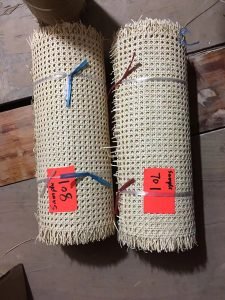
Los rollos de esterilla estándar suelen tener 50 pies de largo y están disponibles en varios anchos comunes, generalmente 18, 24 y 36 pulgadas. Sin embargo, muchas fábricas de muebles y proveedores de materiales de construcción necesitan tamaños no estándar. En nuestras instalaciones de Foshan, podemos producir anchos personalizados de 10 cm hasta 120 cm. La pregunta clave sobre el costo es si el tamaño personalizado encaja dentro de nuestras configuraciones de telar existentes o requiere cambios de configuración. Si encaja, el recargo es mínimo. Si requiere un nuevo utillaje, los costos aumentan.
Marco de comparación de precios
Al solicitar cotizaciones, utilice una hoja de especificaciones estandarizada para comparar manzanas con manzanas. Aquí hay un formato de ejemplo:
| Especificación | Su requisito | Proveedor A | Proveedor B | Proveedor C |
|---|---|---|---|---|
| Tipo de material | Caña natural, Grado A | ✔ | ✔ | Grado B ofrecido |
| Patrón de tejido | Radio (hexagonal abierto) | ✔ | ✔ | ✔ |
| Ancho del rollo | 60 cm | ✔ | Solo estándar de 45 cm | ✔ |
| Longitud del rollo | 15 metros | ✔ | 15 metros | Solo 10 metros |
| MOQ | 200 rollos | 100 rollos | 300 rollos | 500 rollos |
| Precio unitario (FOB) | — | $3.20/m | $2.80/m | $2.50/m |
| Recargo por tamaño personalizado | — | Ninguna | 10% | 15% |
| Tiempo de entrega | — | 20 días | 30 días | 45 días |
Esta tabla revela inmediatamente los costos ocultos. El proveedor C parece el más barato por metro, pero el MOQ más alto, la longitud de rollo más corta y el tiempo de entrega más largo pueden anular esa ventaja. Siempre calcule su costo total de llegada, incluido el envío, los aranceles aduaneros y el desperdicio potencial de longitudes de rollo no estándar.
Precios por volumen y flexibilidad de MOQ
La mayoría de los proveedores de ratán B2B ofrecen precios escalonados. Cuanto más pida, menor será el costo unitario. Pero los requisitos de MOQ varían ampliamente. Algunas fábricas establecen mínimos de 500 rollos. Otras, incluidas las nuestras, ofrecen MOQs flexibles a partir de 50-100 rollos para clientes establecidos. Si usted es un mayorista que realiza pedidos mensuales recurrentes, negocie un acuerdo de volumen anual. Esto fija los precios y garantiza la prioridad de producción durante las temporadas altas.
El costo oculto del abastecimiento barato
Es tentador buscar el precio más bajo. Pero en nuestra experiencia enviando a más de una docena de países, los compradores que priorizan solo el precio a menudo terminan pagando más a largo plazo. La cincha de baja calidad genera más desperdicio durante la producción de muebles. Los rollos de tamaño inadecuado requieren recortes, lo que aumenta los costos de mano de obra. Y las devoluciones o rechazos anulan cualquier ahorro del descuento original. El punto óptimo para la mayoría de los compradores profesionales es la calidad de nivel medio a alto a precios de volumen competitivos, no la opción absolutamente más barata disponible.
¿Qué estándares de embalaje debo exigir para evitar que mis rollos de ratán se dañen durante el transporte?
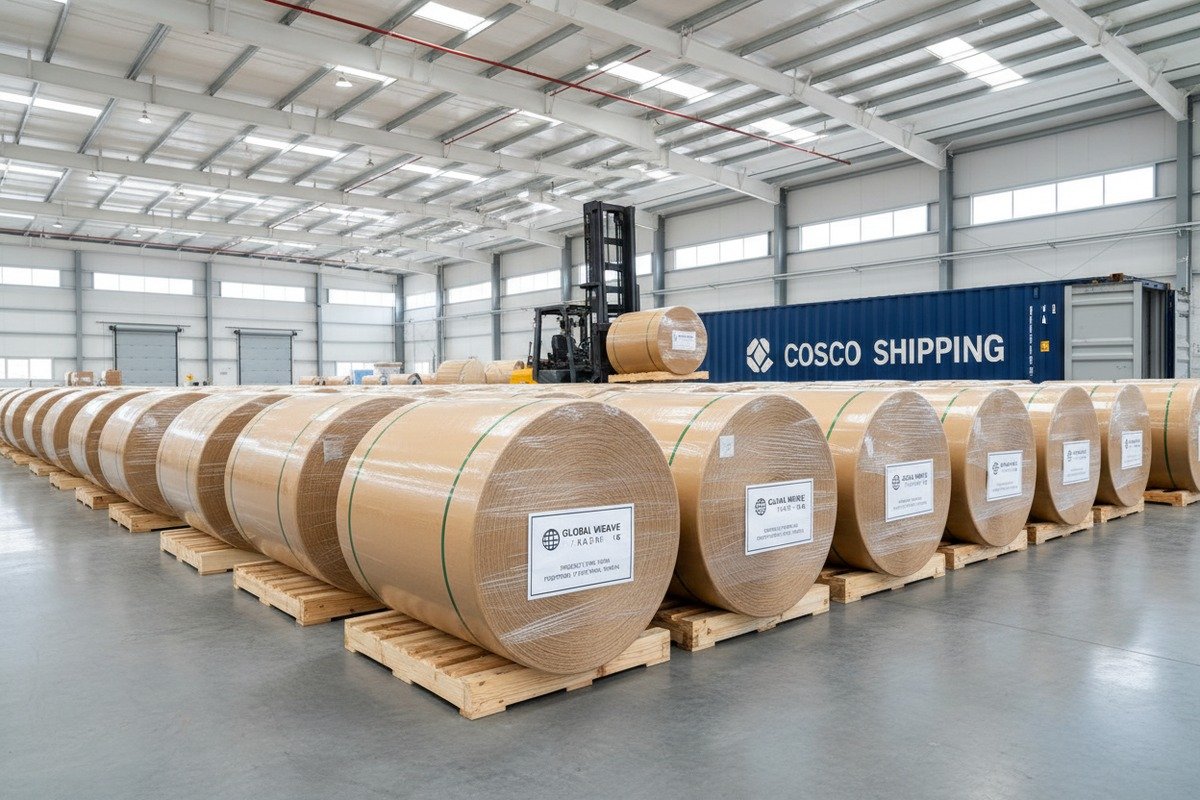
El embalaje es el factor que la mayoría de los compradores pasan por alto, hasta que llega su primer envío dañado. Aprendimos esto de la manera difícil durante nuestros primeros años de exportación. Un contenedor de tejido de ratán perfectamente tejido llegó a España con bordes aplastados y manchas de humedad porque el embalaje no estaba diseñado para las condiciones del transporte marítimo. Esa costosa lección dio forma a los protocolos de embalaje que utilizamos hoy.
Demande de film plastique intérieur pour la protection contre l'humidité, de tubes ou mandrins rigides en carton pour éviter l'écrasement, de renforts de carton extérieur, de cerclage de palette pour la stabilité du conteneur et d'étiquettes de manipulation claires. Ces cinq couches d'emballage protègent ensemble les rouleaux de rotin de l'humidité, de la compression et des chocs pendant le transport maritime international.

Por qué el ratán es especialmente vulnerable durante el tránsito
El ratán natural es higroscópico: absorbe y libera humedad según su entorno. Un buque portacontenedores que cruza el ecuador puede exponer la carga a fluctuaciones de temperatura de 30 °C o más en un solo viaje. Sin barreras de humedad, el tejido de ratán absorbe la humedad, lo que puede causar moho, decoloración o deformación. Al mismo tiempo, el ratán es lo suficientemente rígido como para agrietarse si se comprime de manera desigual. Una caja pesada apilada sobre rollos empaquetados de forma suelta aplastará el patrón de tejido de forma permanente.
El tejido de ratán sintético es más indulgente, pero incluso el tejido de PE puede deformarse bajo presión si los rollos no están soportados por núcleos internos.
Nuestra especificación de embalaje recomendada
Basándonos en envíos a mercados de cuatro continentes, esto es lo que especificamos para cada pedido saliente:
Capa 1: Envoltura interior. Cada rollo se envuelve individualmente en una película de polietileno transparente. Esto crea una barrera contra la humedad y mantiene el polvo fuera.
Capa 2: Soporte del núcleo. Los rollos se enrollan alrededor de tubos resistentes de cartón o PVC. El diámetro del tubo debe coincidir con la curvatura natural del tejido para evitar que se aplaste. Para rollos anchos (más de 60 cm), utilizamos tubos reforzados con mayor resistencia a la compresión.
Capa 3: Cartón exterior. Los rollos envueltos se colocan dentro de cartones corrugados de doble pared. Cada cartón está etiquetado con los detalles del producto, el número de lote y las instrucciones de manipulación.
Capa 4: Ensamblaje de palets. Los cartones se apilan en paletas de exportación estándar, se envuelven con film retráctil y se aseguran con flejes de poliéster. Se añaden protectores de esquina para evitar daños en los bordes.
Capa 5: Protección del contenedor. Dentro del contenedor, utilizamos bolsas de estiba entre las filas de paletas para evitar desplazamientos durante el transporte. Gel de sílice desecante 10 se colocan paquetes dentro del contenedor para absorber el exceso de humedad.
Qué especificar en su acuerdo de compra
No asuma que su proveedor empaquetará según estos estándares a menos que los declare explícitamente. Incluya los requisitos de embalaje en su orden de compra o contrato. Aquí están las especificaciones mínimas que debe exigir:
- Envoltura individual del rollo en film de PE
- Tubo de núcleo rígido (especificar material y grosor mínimo de pared)
- Cartón de doble pared con una resistencia mínima a la explosión de 200 PSI
- Flejado y film retráctil para paletas
- Paquetes desecantes para envíos de carga marítima
- Etiquetas de manipulación: "Mantener seco", "Esta cara hacia arriba", "Frágil"
Si su proveedor se opone a alguno de estos puntos, pregunte por qué. El ahorro de costos en embalaje nunca vale la pena el riesgo de un envío dañado. Un solo contenedor rechazado cuesta mucho más que unos pocos dólares adicionales por rollo en materiales de embalaje.
El ratán blanqueado requiere un cuidado adicional
Si está pidiendo tejido de ratán blanqueado, el embalaje se vuelve aún más crítico. El proceso de blanqueo hace que el ratán sea de color más claro, pero también ligeramente más quebradizo y más susceptible a las manchas de humedad. El tejido blanqueado que absorbe la humedad durante el transporte puede desarrollar manchas amarillas imposibles de eliminar. Para los productos blanqueados, añadimos una capa adicional de papel de seda sin ácido entre los rollos y aumentamos la cantidad de desecante en un 50%.
Conclusión
Elegir el proveedor de cincha de ratán adecuado se reduce a calidad verificable, abastecimiento estable, precios justos y embalaje profesional: si aciertas en esto, tu cadena de suministro se convertirá en una ventaja competitiva en lugar de un dolor de cabeza recurrente.
Notas al pie
1. SGS es una empresa líder que proporciona servicios de inspección previa al envío, una fuente autorizada. ↩︎
2. Britannica es una enciclopedia autorizada con información sobre materiales de embalaje y barrera. ↩︎
3. Wikipedia define los materiales naturales, lo que es relevante para la clasificación del ratán. ↩︎
4. Visión general autorizada de la OMC sobre las normas de inspección previa al envío. ↩︎
5. Wikipedia proporciona una visión general del ratán y sus usos, incluida la cincha de ratán. ↩︎
6. El sitio web oficial del Forest Stewardship Council, una fuente autorizada sobre certificación. ↩︎
7. El sitio web oficial de ISO, que proporciona información sobre la norma ISO 9001. ↩︎
8. Sitio web oficial del Forest Stewardship Council. ↩︎
9. Wikipedia proporciona una visión general completa del tejido y diferentes patrones de tejido. ↩︎
10. Definición del material absorbente de humedad utilizado en el embalaje. ↩︎

 English
  Español de México
  العربية
  Deutsch
  Français
  Русский