
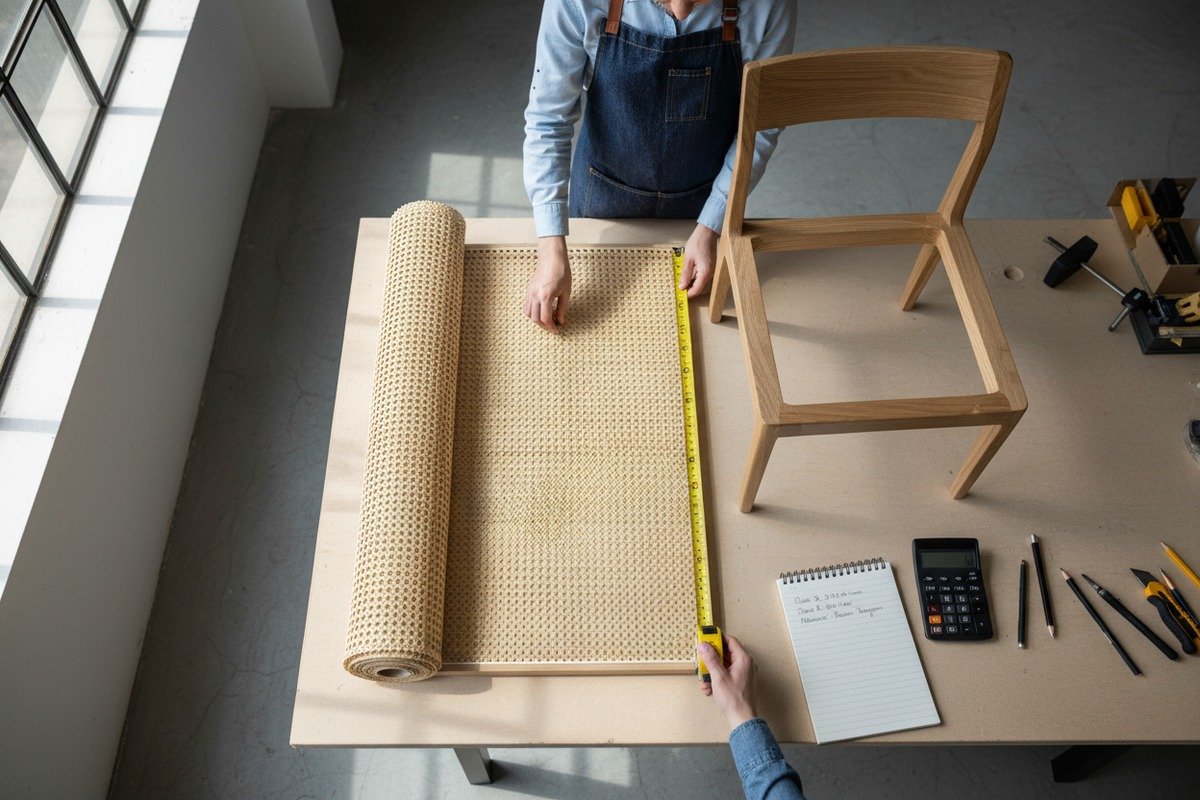
Every week, our sales team at Seafan Rattan fields dozens of inquiries from furniture factories asking the same question: how much cane webbing do I actually need? It sounds simple, but we have seen countless orders go wrong because of inaccurate seat measurements. Buyers end up with too little material and face production delays, or they order too much and waste money on surplus stock. Either way, it hurts the bottom line. After years of shipping tejido de caña de ratán 1 to factories across the US, Europe, and Southeast Asia, we have developed a clear, repeatable method that eliminates guesswork.
To calculate rattan cane webbing needs, measure your chair seat from groove to groove in both width and length, add 4 inches to each dimension for installation allowance, then convert to linear feet and order webbing in the appropriate roll width to cover the adjusted measurements.
This article walks you through every step of the calculation process. We will cover how to measure your chair frame 2, how much extra material to add, which roll width saves you the most money, and how to scale up for bulk orders. Let us get into the details.
How do I accurately measure my chair frame to find the right rattan webbing size?
One of the most common mistakes we see from our overseas buyers is measuring the wrong reference point on the chair frame. The visible seat opening is not the same as the measurement you need for ordering webbing. This small error leads to big problems during installation.
To accurately measure your chair frame, locate the routed groove around the seat perimeter and measure from the center of the groove on one side to the center of the groove on the opposite side, capturing both the width and the length dimensions separately.
Understanding the Groove-to-Groove Method
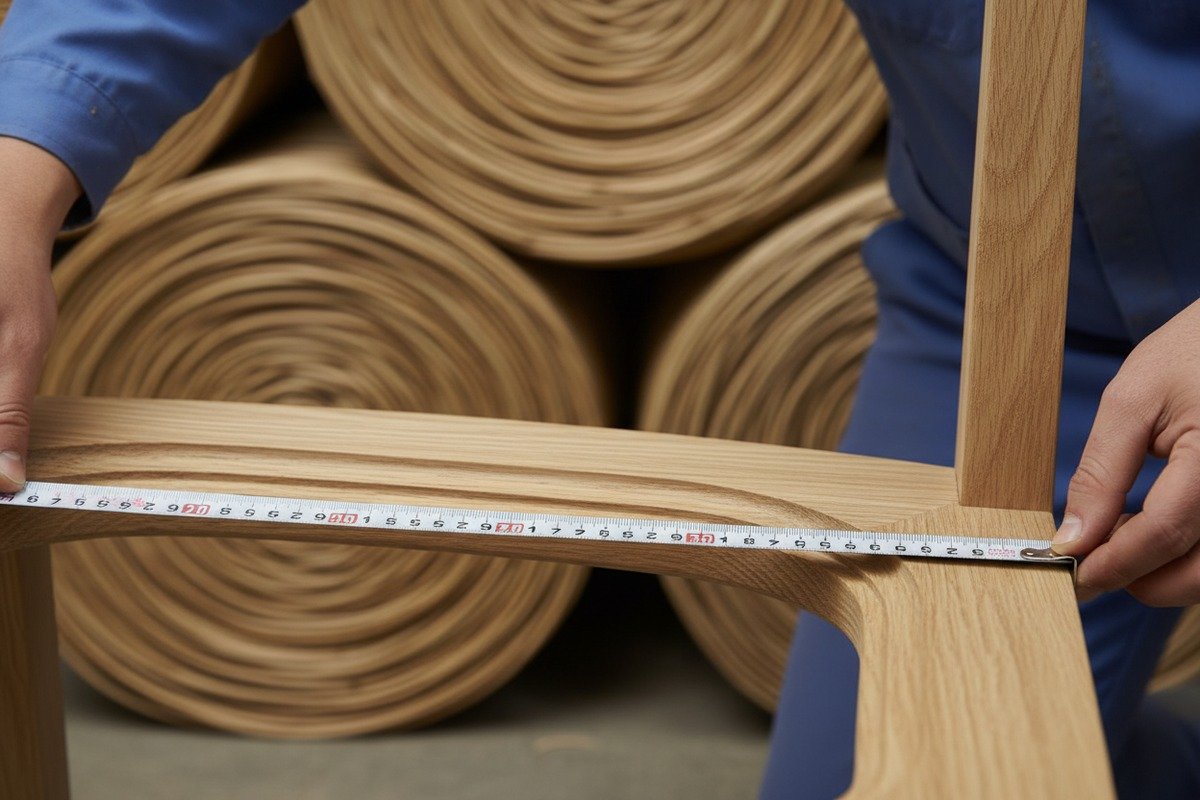
The groove is the channel carved into the chair frame where the webbing gets pressed in and secured with a spline. You do not measure the outer edge of the frame. You do not measure the visible opening. You measure from the center of one groove to the center of the opposite groove. This gives you the true coverage area.
Use un flexible tape measure 3 for curved frames. For straight frames, a rigid ruler works fine. Always measure in inches first. Take the width measurement (side to side) and the length measurement (front to back) separately. Write both numbers down.
Why Multiple Measurements Matter
Not all chair frames are perfectly symmetrical. Our production team has inspected thousands of chair frames over the years, and we can confirm that slight irregularities are common. The front of a seat may be wider than the back. The left side may differ from the right by a fraction of an inch.
Take measurements at multiple points. For width, measure at the front, the middle, and the back of the seat. For length, measure at the left side, the center, and the right side. Use the largest measurement in each direction. This ensures your webbing covers the entire opening without falling short.
Differentiating Between Groove Seats and Drilled-Hole Seats
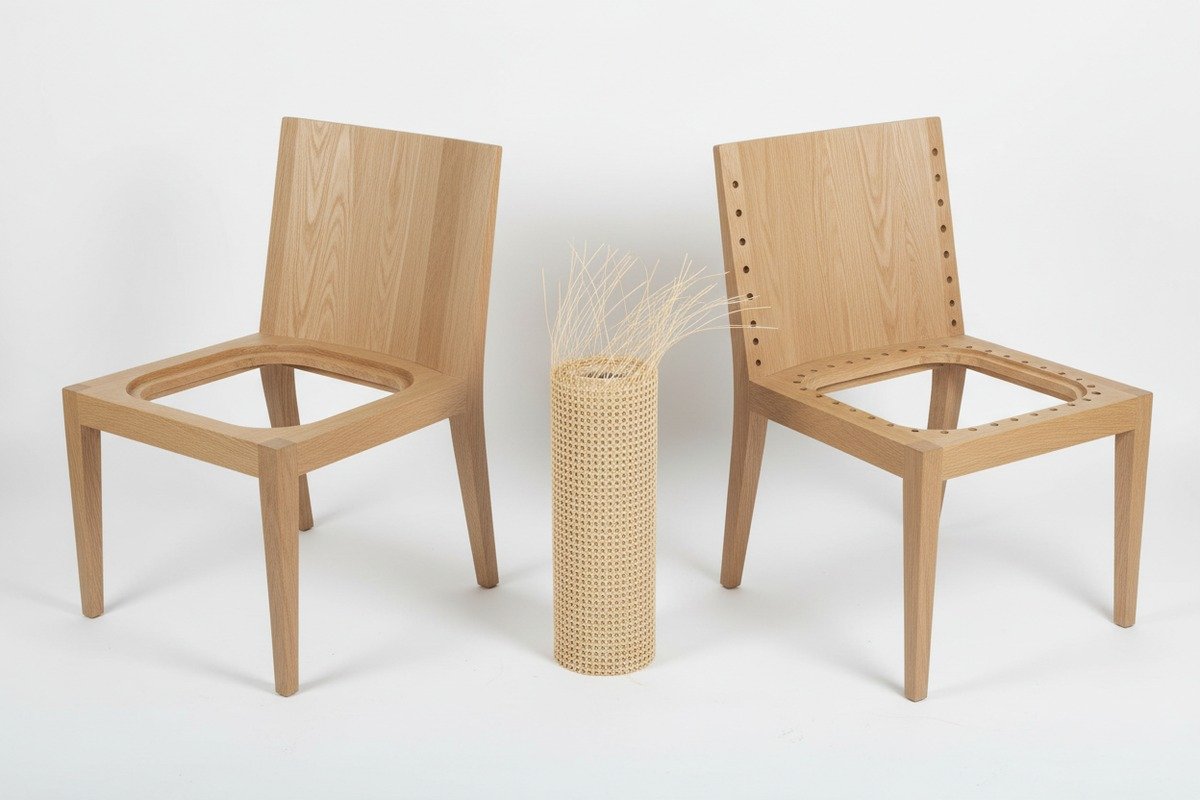
Before you measure, confirm that your chair uses cane webbing with a groove-and-spline system. Some older or handmade chairs have drilled holes around the perimeter instead. These require strand chair cane 4 and a completely different measurement approach. If you see a continuous channel around the seat, you need sheet cane webbing. If you see individual holes, you need strand cane.
| Measurement Point | What to Measure | Tool Recommended |
|---|---|---|
| Width (side to side) | Center of left groove to center of right groove | Flexible tape measure |
| Length (front to back) | Center of front groove to center of back groove | Flexible tape measure |
| Ancho de la ranura 5 | Inner wall to inner wall of the channel | Calipers or small ruler |
| Profundidad de la ranura | Top of frame surface to bottom of channel | Thin ruler or toothpick |
Measuring the Groove Itself
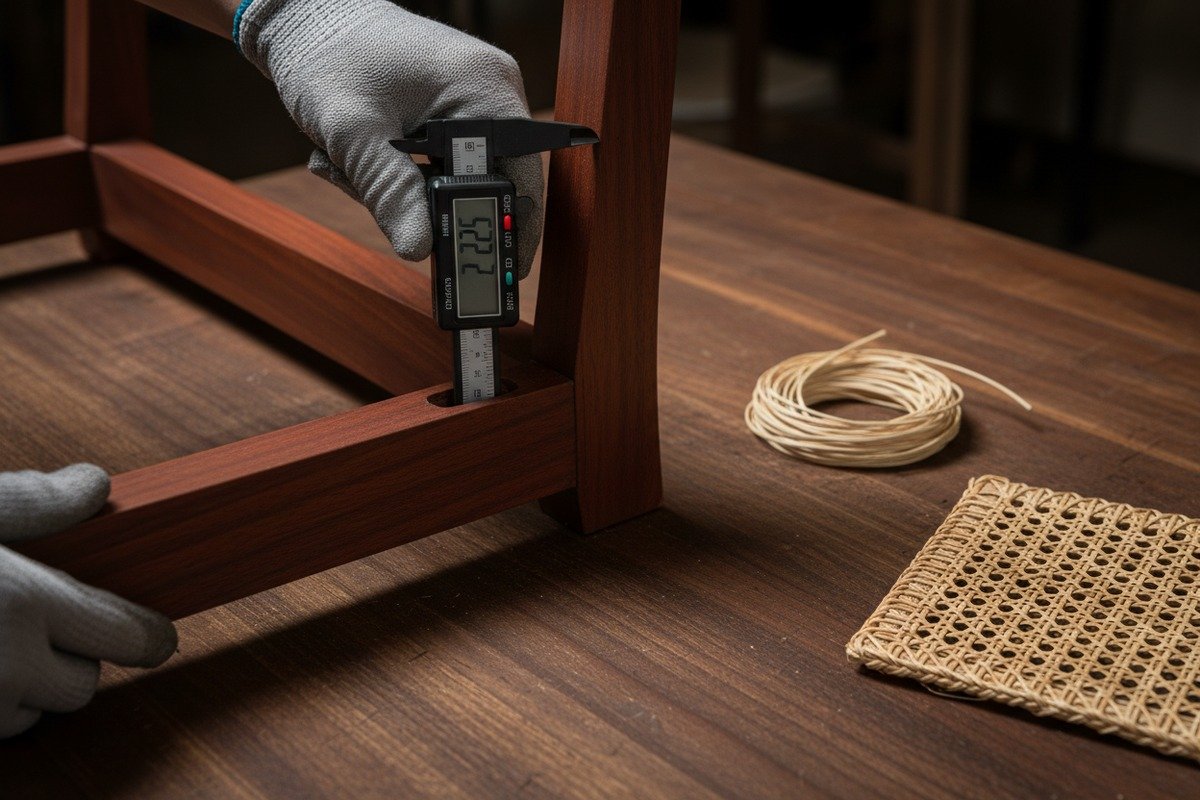
You also need to measure the groove width. This determines the spline size you will need. Common groove widths range from 5/32 inch to 1/4 inch. Use calipers for precision 6. Do not measure your old spline to determine groove size. Old splines compress over time and give inaccurate readings. Measure the actual groove.
Creating Templates for Irregular Shapes
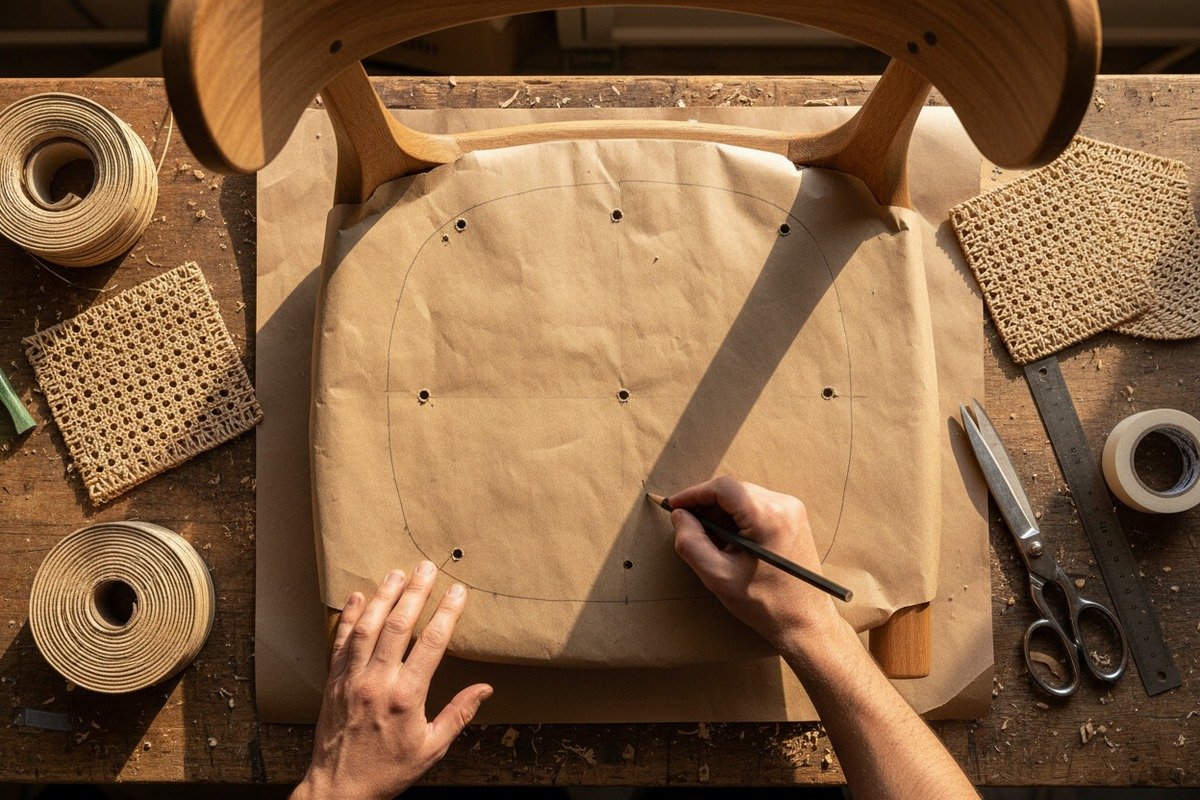
Some chairs have curved, trapezoidal, or otherwise irregular seat shapes. In these cases, lay a piece of kraft paper 7 or cardboard over the seat opening. Trace the groove line onto the paper. Cut it out. This template gives you an exact shape to work with. You can lay it over the webbing during cutting to minimize waste. We recommend this approach especially for high-end or vintage restoration projects where precision matters most.
How much extra allowance should I include in my rattan cane webbing calculations for installation?
When our warehouse team cuts webbing for client orders, we always build in a buffer. Cutting webbing to the exact groove-to-groove measurement is a guaranteed path to a failed installation. The material needs to extend beyond the groove on every side so you can grip it, stretch it, and press it down properly.
Add 4 inches to both the width and length measurements of your groove-to-groove dimensions. This 2-inch overhang on each side provides enough material for gripping, stretching, trimming, and pressing the webbing into the groove during installation.
The 4-Inch Rule Explained
The standard industry practice is to add 4 inches total to each dimension. That means 2 inches of extra material on each side. So if your groove-to-groove width is 14 inches, your cut width should be 18 inches. If your groove-to-groove length is 16 inches, your cut length should be 20 inches.
This extra material serves several purposes. First, it gives you something to hold onto when stretching the soaked webbing across the frame. Second, it allows you to use caning wedges 8 to temporarily hold the webbing in the groove while you work around the perimeter. Third, it provides a margin of error for slight misalignment during installation.
What Happens If You Skip the Allowance
We have heard from buyers who tried to save material by cutting too close to the groove measurement. The result is almost always the same. The webbing pulls out of the groove on one side while you are pressing it in on the other. You cannot get proper tension. The finished seat sags or has uneven tightness. In some cases, the webbing tears at the groove edge because there is not enough material to absorb the stress of installation.
Consideraciones de remojo y encogimiento
Natural rattan cane webbing must be soaked in warm water before installation. Soaking times range from 30 minutes to 4 hours depending on the thickness and weave density. When wet, the cane becomes pliable and stretchy. After installation, the cane dries and contracts, pulling tight across the seat frame.
This shrinkage is your friend. It creates a taut, drum-like surface. But it also means you need that extra material to account for the slight dimensional changes during the drying process. Malla de ratán sintético 9 does not require soaking and does not shrink, but the 4-inch allowance still applies for handling purposes.
| Escenario | Groove-to-Groove (inches) | Add Allowance | Final Cut Size (inches) |
|---|---|---|---|
| Small dining chair (width) | 12 | +4 | 16 |
| Small dining chair (length) | 14 | +4 | 18 |
| Standard dining chair (width) | 15 | +4 | 19 |
| Standard dining chair (length) | 17 | +4 | 21 |
| Wide armchair (width) | 20 | +4 | 24 |
| Wide armchair (length) | 22 | +4 | 26 |
Do Not Forget the Spline Allowance
Beyond the webbing itself, you need to calculate spline length separately. Measure the total circumference of the groove. Add 1 foot to that number. This extra foot covers the overlap at the joint and gives you room for adjustment. Spline only needs a brief soak before use, so you can dip it in water right as you begin pressing it into the groove.
Humidity and Environmental Factors
If you are installing in a humid climate, keep in mind that natural cane will absorb ambient moisture over time. In very dry environments, it can shrink further than expected. Our experience shipping to clients in the Middle East versus Southeast Asia has shown that environmental conditions do affect long-term tension. Ensuring sufficient initial tension and proper allowance during installation helps compensate for these fluctuations.
Which rattan roll width will help me minimize material waste for my specific chair dimensions?
From our production line in Foshan, we manufacture rattan cane webbing in two standard roll widths. Choosing the right one is not just about covering the seat. It is about reducing scrap and keeping your per-unit material cost as low as possible. When you are producing hundreds or thousands of chairs, even a small percentage of waste adds up fast.
Rattan cane webbing typically comes in 18-inch (1.5 feet) and 24-inch (2 feet) roll widths. Choose the 18-inch width for standard dining chairs with adjusted dimensions under 18 inches, and the 24-inch width for larger seats, benches, or projects where the adjusted dimension exceeds 18 inches.
Matching Roll Width to Your Adjusted Dimensions
After you have added the 4-inch allowance to your measurements, compare the adjusted width to the available roll widths. If your adjusted width is 16 inches, an 18-inch roll gives you just 2 inches of waste on one side. If your adjusted width is 20 inches, you must use a 24-inch roll, which leaves 4 inches of waste.
The key principle is simple: pick the smallest roll width that still covers your adjusted dimension. This minimizes the strip of unused material on each cut.
Orientation Matters
Here is a tip many buyers overlook. You can orient the webbing in either direction. If your adjusted width is 20 inches but your adjusted length is only 17 inches, consider rotating the webbing 90 degrees. Use the 18-inch roll width to cover the 17-inch dimension, and cut your length from the roll to cover the 20-inch dimension. This can save significant material over a large production run.
However, be aware that the patrón de tejido 10 may look different when rotated. Square weave patterns are generally symmetrical and look the same in both orientations. Hexagonal or octagonal patterns may have a directional appearance. Check with your design team before rotating.
Waste Calculation Example
Let us say you are producing 500 dining chairs. Each chair has an adjusted seat dimension of 17 inches wide by 19 inches long.
Using an 18-inch roll: The 18-inch width covers the 17-inch adjusted width with 1 inch of waste. You need 19 inches of linear material per chair. For 500 chairs, that is 9,500 linear inches, or about 791.7 linear feet.
Using a 24-inch roll: The 24-inch width covers the 17-inch adjusted width with 7 inches of waste per chair. That is 3,500 inches of wasted width material across 500 chairs. Clearly, the 18-inch roll is the better choice here.
| Adjusted Width (inches) | Best Roll Width | Waste Per Cut (inches) | Waste Over 500 Chairs (inches) |
|---|---|---|---|
| 14 | 18-inch | 4 | 2,000 |
| 16 | 18-inch | 2 | 1,000 |
| 17 | 18-inch | 1 | 500 |
| 19 | 24-inch | 5 | 2,500 |
| 22 | 24-inch | 2 | 1,000 |
| 24 | 24-inch | 0 | 0 |
Pattern and Mesh Size Considerations
When selecting roll width, also consider the mesh size of the weave. Fine open mesh (1/2-inch hole spacing) has a more delicate appearance and works well for smaller, refined chairs. Medium mesh (5/8-inch hole spacing) is more durable and suits standard dining chairs and everyday furniture. The mesh size does not change the roll width options, but it does affect the visual result and the perceived quality of the finished seat.
Both square weave (radio cane) and hexagonal (open weave) patterns are available in both roll widths. Square weave is more traditional and versatile. Hexagonal weave offers a decorative, star-like pattern that suits bohemian and mid-century modern aesthetics. Our factory produces both in natural, bleached, and synthetic varieties to match any design brief.
Natural vs. Synthetic: A Brief Note
Natural rattan webbing has organic color variations in light beige, straw yellow, and cream tones. It is biodegradable and has an authentic artisanal look. Synthetic rattan webbing mimics this appearance in durable plastic and is better for outdoor use. Synthetic does not require soaking and resists moisture damage. Both types come in the same standard roll widths and are calculated the same way.
How do I calculate the total number of rattan rolls I need for my bulk furniture order?
Scaling from a single chair to a factory order of 500 or 5,000 units requires a systematic calculation. When our clients in the Netherlands or Australia send us procurement requests, we walk them through this exact process to ensure they order the right quantity the first time. Reordering mid-production costs time and money, especially with international shipping lead times.
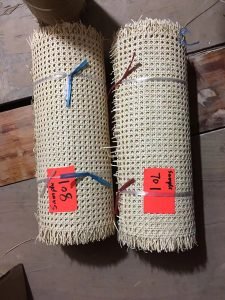
To calculate total rolls needed, multiply the adjusted length per chair by the total number of chairs to get total linear inches, convert to linear feet, then divide by the roll length (commonly 50 feet for bulk rolls), and round up to the nearest whole roll to ensure full coverage.
Step-by-Step Bulk Calculation
Let us work through a real-world example. You are a furniture factory producing 300 dining chairs. Each chair seat measures 15 inches wide by 17 inches long, groove to groove.
Paso 1: Add 4-inch allowance. Adjusted width: 19 inches. Adjusted length: 21 inches.
Paso 2: Choose roll width. The adjusted width is 19 inches, so you need the 24-inch roll.
Paso 3: Calculate linear material per chair. You need 21 inches of linear webbing per chair from the roll.
Paso 4: Multiply by the number of chairs. 21 inches × 300 chairs = 6,300 linear inches.
Step 5: Convert to linear feet. 6,300 ÷ 12 = 525 linear feet.
Step 6: Divide by roll length. Standard bulk rolls are 50 feet. 525 ÷ 50 = 10.5 rolls.
Step 7: Round up. You need 11 rolls of 24-inch wide cane webbing, each 50 feet long.
Adding a Safety Buffer for Bulk Orders
We always recommend adding 5–10% extra material to bulk orders. This covers defective cuts, installation errors, damaged pieces during shipping, and quality control rejects. For 300 chairs needing 525 linear feet, a 10% buffer adds 52.5 feet. Your total order becomes 577.5 feet, which rounds to 12 rolls.
Spline Calculation for Bulk Orders
Do not forget spline. Measure the groove circumference of one chair. A typical dining chair might have a groove circumference of about 52 inches. Add 12 inches (1 foot) for overlap. That gives you 64 inches per chair, or about 5.33 feet.
For 300 chairs: 5.33 × 300 = 1,600 feet of spline. Spline is typically sold in coils of 250 or 500 feet. You would need 4 coils of 500 feet, or you could order 7 coils of 250 feet.
Complete Bill of Materials Example
| Artículo | Per Chair | For 300 Chairs | With 10% Buffer | Cantidad del pedido |
|---|---|---|---|---|
| 24" cane webbing | 21 linear inches | 525 linear feet | 577.5 linear feet | 12 rolls (50 ft each) |
| Reed spline (#8) | 64 linear inches | 1,600 linear feet | 1,760 linear feet | 4 coils (500 ft each) |
| Caning wedges | 8 pieces | Reusable | N/A | 2 packs (reusable) |
| Cola de madera | 10 ml | 3,000 ml (3 liters) | 3.3 liters | 4 bottles (1 liter each) |
Volume Pricing and Order Optimization
Many suppliers, including our operation at Seafan Rattan, offer automatic discounts at certain volume thresholds. A common breakpoint is 10 feet, where you might receive 10% off. Bulk rolls of 50 feet offer better per-foot pricing than buying by the running foot. When calculating your order, check whether rounding up to the next pricing tier actually saves money overall.
For very large orders, consider ordering full container loads. A 20-foot container can hold a substantial quantity of rattan webbing rolls. We help our clients optimize container loading to maximize the material shipped per container and reduce per-unit freight costs.
Mixed-Product Orders
If your production line makes multiple chair models with different seat dimensions, calculate each model separately, then combine the totals. Group models by roll width. All chairs needing 18-inch webbing go into one calculation. All chairs needing 24-inch webbing go into another. This prevents confusion and helps your warehouse team allocate materials correctly.
Lead Time Planning
Natural rattan is a seasonal raw material. Our rattan processing facility in Indonesia works year-round, but supply can fluctuate based on harvesting cycles and weather conditions. We recommend placing bulk orders 4–8 weeks before your production start date. This gives enough time for manufacturing, quality inspection, and international shipping.
Conclusión
Calculating rattan cane webbing needs comes down to accurate groove-to-groove measurements, a consistent 4-inch allowance, smart roll width selection, and systematic bulk scaling with a safety buffer.
Notas al pie
1. Provides an overview of rattan cane webbing and its types. ↩︎
2. Explains the components and function of a chair frame. ↩︎
3. Defines what a flexible tape measure is and its uses. ↩︎
4. Found a comprehensive guide that discusses strand cane and cane sizing for chair caning. ↩︎
5. Explains how groove width relates to spline size. ↩︎
6. Defines calipers as precision measuring instruments. ↩︎
7. Wikipedia provides an authoritative definition and overview of kraft paper. ↩︎
8. Explains the purpose and use of caning wedges in installation. ↩︎
9. Describes the properties and benefits of synthetic rattan webbing. ↩︎
10. Illustrates different types of cane weave patterns. ↩︎

 English
  Español de México
  العربية
  Deutsch
  Français
  Русский