
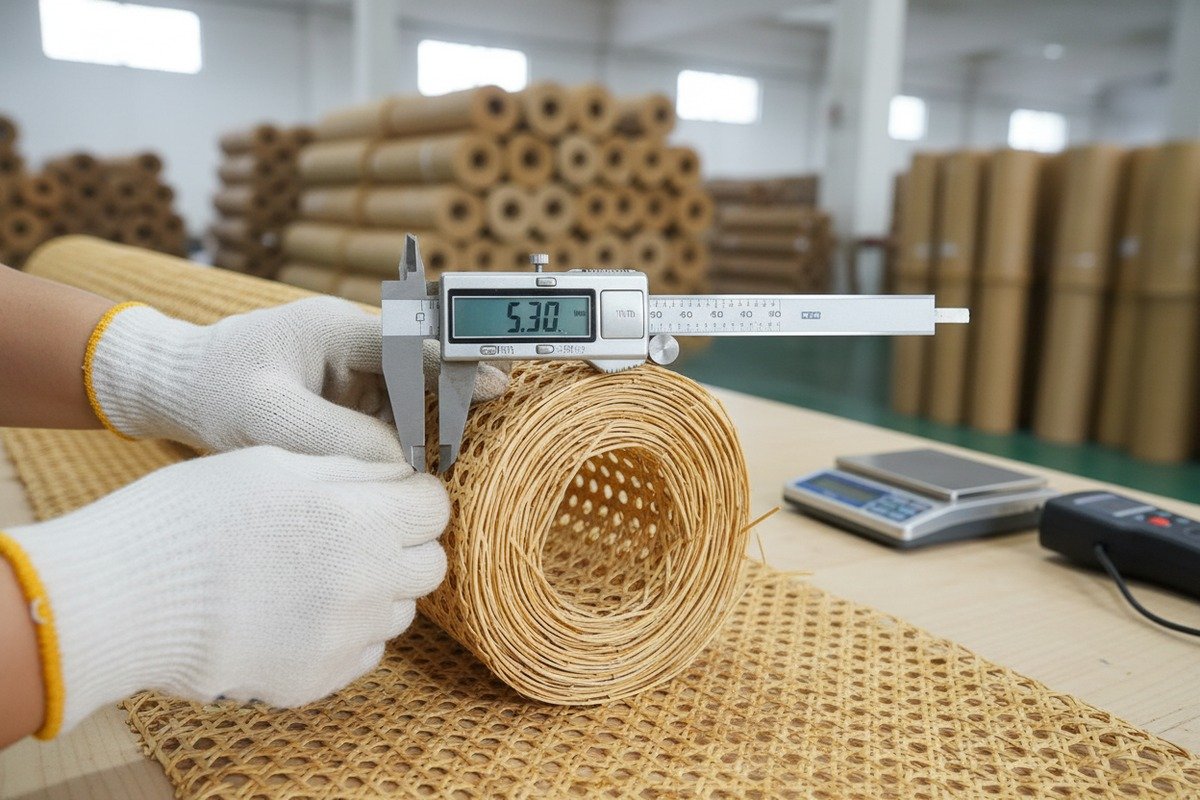
Cada semana, nuestro equipo de control de calidad 1 in Foshan reviews dozens of rattan webbing rolls before they ship overseas. The number one complaint we hear from new buyers? Density inconsistency between the sample they approved and the bulk delivery they received inspección de terceros 2. It costs them time, money, and sometimes an entire furniture production run. This problem is preventable, but only if you know exactly what to check and when to check it.
To verify rattan cane webbing density standards, measure hole-to-hole spacing with a caliper, compare weight per square meter (GSM) against your approved sample, inspect strip width uniformity, test moisture content at 8–12%, and request AAA/A grade certifications from your supplier before confirming bulk orders.
This guide walks you through every step of the density verification process. Whether you source natural rattan cane webbing for high-end furniture or synthetic PE rattan for outdoor projects, the methods below will help you avoid costly mistakes. Let’s start with the most fundamental skill: how to measure density accurately.
How do I accurately measure the hole-to-hole density of rattan cane webbing during my inspection?
When we ship rattan webbing to furniture factories in the Netherlands or Australia, the first thing their QC teams check is hole-to-hole spacing. A small deviation here can ruin the look of an entire chair seat or cabinet door panel. Yet most buyers don't know the right way to measure it.
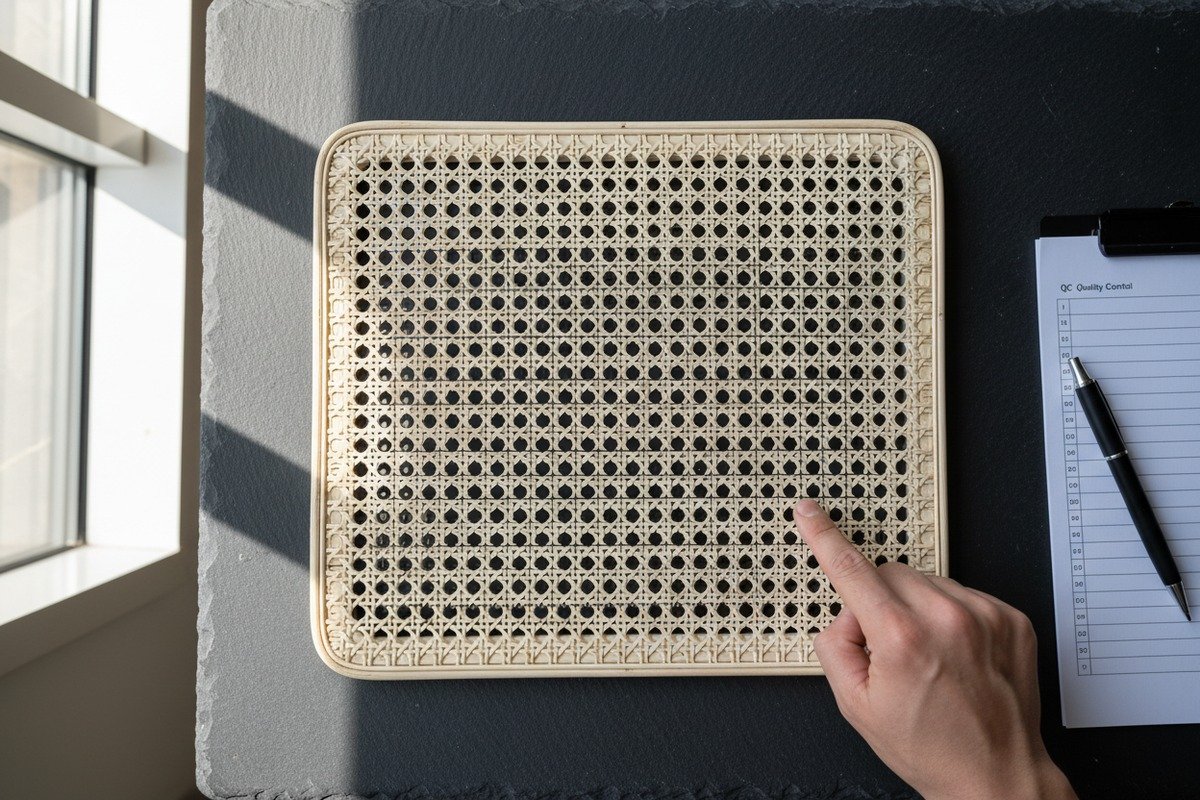
Accurately measure hole-to-hole density by using a digital caliper or ruler across a 10cm × 10cm sample area, counting the number of holes per row both horizontally and vertically, then comparing results at three or more random spots on the roll to confirm uniformity throughout.
Choose the Right Tools
You don't need expensive lab equipment. A calibrador digital 3 (accurate to 0.1mm), a transparent grid ruler, and a portable medidor de humedad 4 are enough. At our inspection stations, we also use a small kitchen scale to weigh cut samples. These four tools cover 90% of density checks.
The Step-by-Step Measurement Method
Start by laying the webbing flat on a clean, hard surface. Do not stretch it. Cut or mark a 10cm × 10cm square. Count the holes along one horizontal row. Then count the holes along one vertical row. Multiply these two numbers. That gives you your "holes per 100 cm²" count. Repeat this at three random locations on the roll: near the start, in the middle, and near the end. All three counts should match within ±1 hole.
For example, a standard 6×6 radio weave should give you roughly 6 holes per inch in each direction. If you measure in centimeters, that translates to approximately 2.3–2.5 holes per centimeter. Any reading below this signals a loose weave.
Use Weight as a Backup Metric
Hole counting works for open weaves. But for closed weaves like 3×3 or dense basketweaves, weight per unit area is more reliable. Cut a 30cm × 30cm sample. Weigh it in grams. Convert to GSM (grams per square meter) by multiplying the weight by 11.11. grams per square meter (GSM) 5 Compare this GSM number to your reference sample.
| Weave Pattern | Typical Hole Count (per inch) | Expected GSM Range | Inspection Priority |
|---|---|---|---|
| 1/2" Open Mesh | 2 per inch | 180–250 | Espaciado de agujeros |
| 6×6 Radio Weave | 6 per inch | 300–400 | Hole count + GSM |
| 3×3 Closed Weave | Dense, minimal holes | 450–600 | GSM + strip width |
| Hexagon/Octagon | Varies with diagonals | 350–500 | Diagonal integrity + GSM |
Errores comunes a evitar
Don't measure on a curved surface. Don't measure immediately after unrolling — let the webbing rest flat for at least 10 minutes. And never trust a single measurement point. Inconsistency within the same roll is the most common defect we catch during our pre-shipment inspections. A roll might start tight and gradually loosen toward the center. Only multi-point checks reveal this.
Also, be aware of temperature and humidity conditions during measurement. Rattan absorbs moisture from the air. A roll stored in a humid warehouse will weigh more and feel denser than the same roll in a dry environment. This is why moisture testing matters, which we cover below.
What specific density standards should I require for my high-end furniture projects?
Our production team in Indonesia processes rattan for clients building luxury hotel furniture and premium residential pieces. These buyers demand consistency that goes beyond "looks good enough." They need hard numbers tied to specific quality grades.
For high-end furniture, require AAA or A-grade rattan cane webbing with GSM values of 400–600 for closed weaves, strip width tolerance within ±0.3mm, moisture content between 8–12%, and zero visible defects such as knots, fungal marks, or irregular tapering across the entire roll.

Comprensión del sistema de clasificación
There is no single global ISO standard for rattan webbing density. The industry relies on supplier-defined grades. However, the most widely accepted system uses AAA, A, B, and C tiers. Here is what each grade typically means in practice, based on what we see across our three factories and thirty-plus partner facilities:
| Grade | Uniformidad de la tira | Calidad de la superficie | Contenido de humedad | Density Feel | Mejor Uso |
|---|---|---|---|---|---|
| AAA | ±0.2mm tolerance | Lisa, sin nudos | 8–10% | Heavy, substantial | Luxury furniture, designer pieces |
| A | Tolerancia de ±0.3mm | Smooth, minor grain | 8–12% | Solid, consistent | High-end residential, boutique retail |
| B | ±0.5mm tolerance | Light roughness | 10–14% | Moderada | Mid-range furniture, decorative panels |
| C | >0.5mm de variación | Nudos ásperos y visibles | Variable | Light, flexible | Budget items, temporary installations |
Set Your Specifications in Writing
Never rely on verbal agreements. Before placing your order, create a specification sheet 6 that includes:
- Weave pattern name (e.g., 6×6 radio weave, hexagon, 3×3 closed)
- Minimum GSM (based on your approved sample weight)
- Strip width range (e.g., 2.5mm ± 0.3mm)
- Moisture content (8–12%)
- Acceptable defect rate (e.g., less than 2% of total area)
- Rango de color (light beige to straw yellow, with reference photos)
When we work with purchasing managers like our clients in Thailand and the USA, we always co-sign a spec sheet. It protects both sides. If the delivered goods don't match, you have documented proof.
Why Moisture Content Matters for Density
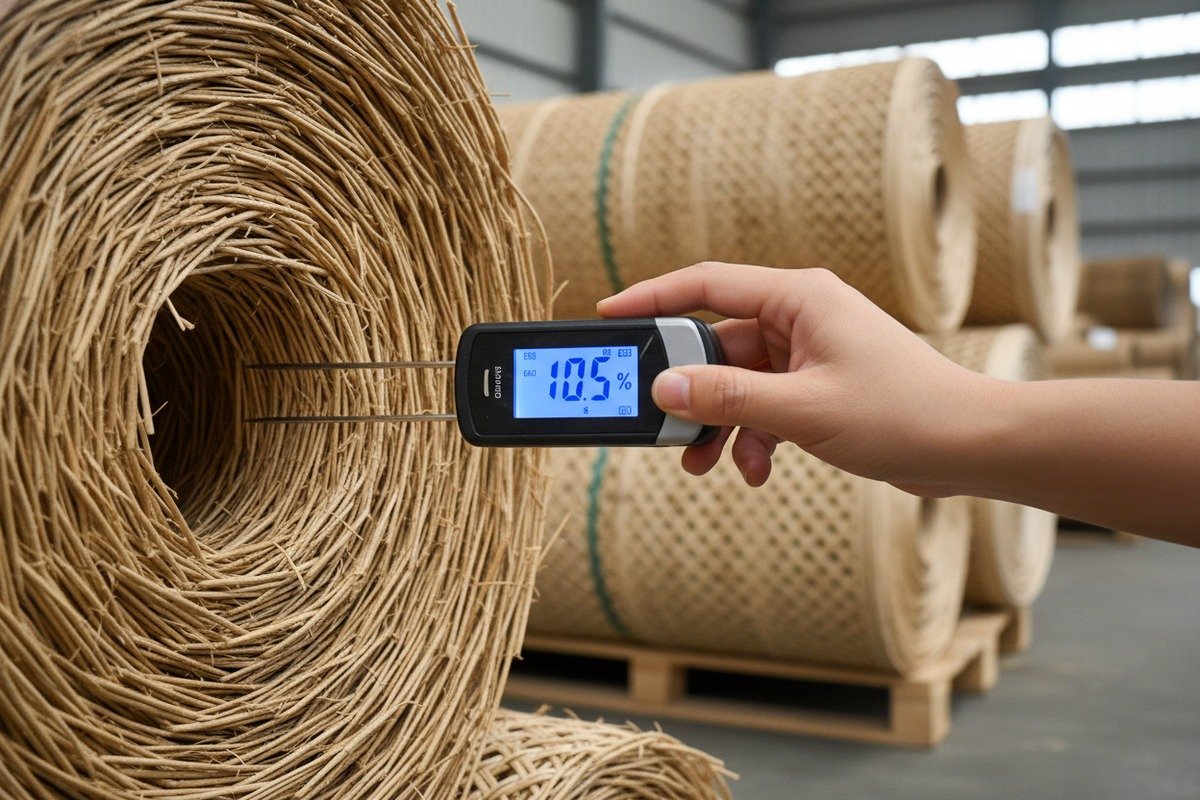
A roll of rattan at 15% moisture might feel dense and heavy. But once it dries in a heated furniture workshop, it shrinks. The holes widen. The weave loosens. Suddenly, your "high-density" webbing looks like budget grade. The ideal window is 8–12%. Below 8%, the cane becomes brittle and cracks during installation. Above 12%, it risks fungal growth 7 and warping.
Use a pin-type moisture meter. Insert the pins into the rattan strip — not the hole — and take readings at five spots per roll. Average the results. If any single reading exceeds 14%, reject that roll.
The Role of Origin and Pre-Treatment
Indonesian rattan is generally considered the benchmark for quality. The species grown there produce thicker, more uniform cane with tighter grain. But origin alone doesn't guarantee density. Pre-treatment steps matter just as much. Proper cooking softens the cane for even peeling. Bleaching creates color consistency. Anti-mildew treatment prevents post-shipment degradation. Ask your supplier which pre-treatment steps they use and request documentation.
In our showroom in Nanhai, Foshan, we keep side-by-side samples of every grade we produce. Buyers who visit can feel the difference in seconds. But when you're sourcing remotely — through a website, Alibaba listing, or WhatsApp conversation — you need a systematic approach to tell premium from poor before you commit money.
Distinguish premium tight-weave from loose-weave rattan by performing five checks: flex the sample without cracking, verify uniform strip width with a caliper, confirm a tight and even pattern with no gaps, feel for substantial weight versus flimsiness, and compare natural grain texture against synthetic imitations using a burn test.
La verificación de calidad de cinco puntos
Here is a practical framework you can use with any sample, whether you receive it by mail or inspect it at a trade fair.
1. The Flex Test. Take a strip from the edge of the webbing. Bend it 90 degrees. Premium rattan bends smoothly without cracking or splintering. Low-quality rattan snaps or shows white stress marks along the bend. This tells you about both material quality and moisture content.
2. The Strip Width Test. Use your caliper on at least 10 random strips across the sample. Premium webbing (AAA/A) will show variance of no more than 0.3mm. Low-grade webbing often has strips that taper noticeably — wide at one end, narrow at the other. This tapering is a sign of poor cutting, either from worn blades or rushed production.
3. The Pattern Integrity Test. Hold the sample up to a light source. In a premium tight weave, the holes are uniform in size and shape. In a loose weave, you'll see irregular gaps, overlapping strips, or areas where the pattern shifts. For hexagon weaves, pay special attention to the diagonal strips. They require extra manual steps during production. Sloppy diagonals are the first thing to degrade in a low-quality hexagon webbing.
4. The Weight Test. Cut identical-sized pieces from two different samples. Weigh them. The premium piece should be noticeably heavier. This simple comparison eliminates a lot of guesswork.
5. The Burn Test (Natural vs. Synthetic). If you suspect a sample might be synthetic PE rattan disguised as natural, clip a small piece and hold a flame to it. Natural rattan smells like burning wood or paper. Synthetic PE rattan melts and smells like plastic. This test takes five seconds and can save you from a fraudulent shipment.
Natural vs. Synthetic: A Density Comparison
Both natural and synthetic rattan have their place. But their density characteristics differ significantly. Here's what to know:
| Característica | Natural Rattan (Cane) | Synthetic (PE/HDPE) Rattan |
|---|---|---|
| Density Source | Natural fiber mass, weave tightness | Polyethylene thickness, strand diameter |
| Grain Texture | Visible, organic variation | Uniform, sometimes embossed |
| Sensación de peso | Substantial but lightweight | Can be heavier due to plastic mass |
| Flex Behavior | Bends with slight spring-back | Bends and holds shape |
| Resistencia a la Intemperie | Low (indoor preferred) | High (UV, rain, humidity resistant) |
| Density Verification | GSM, hole count, flex test | Thickness gauge, UV test, GSM |
For outdoor furniture, synthetic PE rattan with high-density polyethylene construction 8 is the practical choice. It won't warp, crack, or grow mold. But for indoor high-end pieces — the kind that sell for premium prices in European and American markets — natural rattan's authentic grain and tactile warmth remain unmatched. The key is knowing which you're buying and verifying it matches your project requirements.
Red Flags That Signal Low Quality
Watch for these warning signs in any sample or roll:
- Blotchy, uneven color with dark spots (possible fungal contamination)
- Strips that feel papery thin or overly flexible
- Visible knots or joints in the middle of strips
- A sour or musty smell (high moisture, mold risk)
- Edges of the roll that fray or unravel easily
- Weave pattern that shifts direction or spacing across the sheet
Any two of these red flags appearing together should prompt you to reject the sample and request a replacement from a different production batch.
What are the best ways for me to verify that my bulk order matches the density of the initial sample?
This is where most sourcing relationships succeed or fail. We've built long-term partnerships with furniture wholesalers in Spain, the USA, and the Middle East largely because we address this exact pain point. Sample approval is easy. Bulk consistency is hard. Here is how to protect yourself.
Verify bulk order consistency by retaining a sealed reference sample, requiring pre-shipment third-party inspection with GSM and moisture testing, implementing random roll selection for measurement, demanding batch-specific quality certificates, and establishing clear rejection criteria in your purchase contract.
Step 1: Create a Sealed Reference Sample
When you approve a sample, don't just keep it on your desk. Cut a 30cm × 30cm piece. Weigh it. Record the GSM, hole count, strip width, and moisture content. Seal it in an airtight bag with a desiccant packet. Label it with the date, supplier name, and order number. This becomes your legal reference point. When the bulk order arrives, you compare directly against this sealed piece.
In our experience shipping to over fifteen countries, disputes almost always arise when the buyer has no documented reference. A sealed sample with recorded data eliminates ambiguity.
Step 2: Require Pre-Shipment Inspection
Don't wait until the container arrives at your warehouse. Arrange for inspection at the factory or warehouse before shipping. You have three options:
- Self-inspection — If you have a local agent or office near the supplier, send them with the reference sample and tools.
- Inspección de terceros — Companies like SGS, Bureau Veritas, or TÜV offer per-shipment inspection services. They'll measure GSM, moisture, visual defects, and pattern consistency.
- Supplier-provided inspection report — Acceptable from trusted, long-term suppliers, but always cross-verify with your own spot checks on arrival.
Step 3: Random Roll Selection Protocol
Never let the supplier choose which rolls to inspect. Specify a random selection method in your contract. A common approach: inspect at least 10% of total rolls, selected using a random number generator. For a 200-roll order, that means pulling 20 rolls at random, measuring each at three points, and averaging the results.
Step 4: Define Rejection Criteria Clearly
Your purchase order or contract should include an acceptance quality limit (AQL) 9. Here's a practical framework we recommend to our clients:
| Tipo de defecto | Critical (Reject Entire Batch) | Major (Reject Affected Rolls) | Minor (Accept with Note) |
|---|---|---|---|
| GSM deviation | >15% from reference | 10–15% from reference | 5–10% from reference |
| Moisture content | >16% | 13–16% | 12–13% |
| Hole count variance | >3 holes per 100cm² | 2–3 holes | 1 hole |
| Strip width variance | >0.8mm | 0.5–0.8mm | 0.3–0.5mm |
| Visual defects | Fungal marks, cracks | Knots, color blotches | Desplazamiento de color menor |
Step 5: Build Traceability Into Your Supply Chain
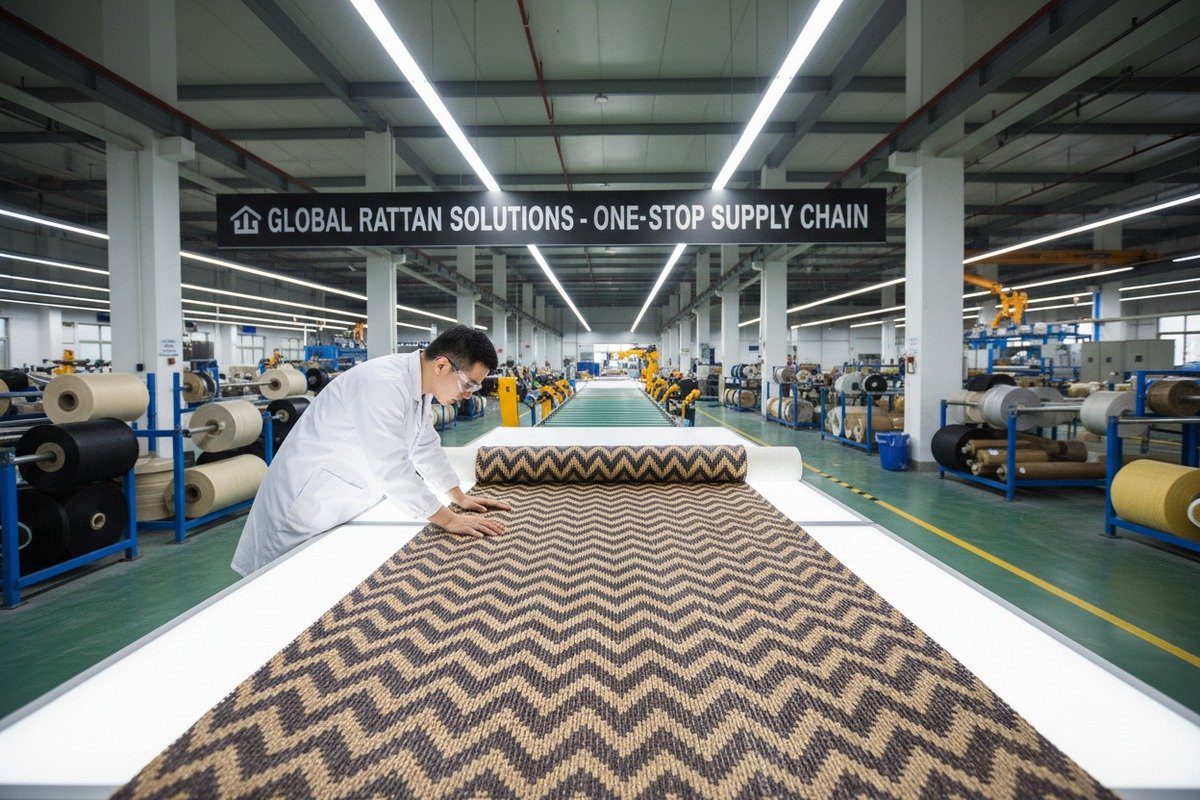
Ask your supplier to label each roll with a batch number, production date, and grade. This allows you to trace any problem roll back to a specific production run. At our factories, we stamp each roll and maintain batch records that include the raw material source, weaving machine used, drying duration, and QC sign-off. When a client in Australia flagged two rolls last year with slightly wider hole spacing, we traced the issue to a single weaving frame that needed recalibration. We replaced the rolls and fixed the machine within 48 hours.
This kind of traceability also supports sustainability audits. If your market requires proof of ethical sourcing 10 — increasingly common in the EU and North America — batch-level records help you demonstrate that your rattan comes from responsibly managed forests.
Step 6: Establish a Long-Term Quality Agreement
For repeat orders, move beyond per-shipment inspections. Negotiate a quality agreement with your supplier that includes annual factory audits, quarterly sample submissions, and agreed penalties for non-conformance. This shifts the relationship from transactional to partnership. Both sides invest in consistency.
We've found that clients who sign multi-year agreements with clear quality benchmarks receive the best results. It gives our production team stable targets and motivation to maintain standards, because the business relationship has real, long-term value.
Conclusión
Verifying rattan cane webbing density is a hands-on process that requires the right tools, clear specifications, and consistent inspection routines. Protect your investment by measuring, documenting, and holding every shipment accountable.
Notas al pie
1. Explains the role and importance of a quality control team in production. ↩︎
2. Replaced HTTP unknown link with a highly authoritative source (TUV Austria) that clearly defines third-party inspection and outlines its benefits, aligning perfectly with the anchor text. ↩︎
3. Provides a general overview of calipers, including digital types and their use. ↩︎
4. Replaced HTTP 404 link with a Wikipedia page providing a general overview of moisture meters, their types, and working principles, which is an authoritative and accessible source. ↩︎
5. Defines GSM as a standard for measuring fabric weight and its significance. ↩︎
6. Explains what a specification sheet is and its crucial role in product development. ↩︎
7. Outlines the specific environmental conditions required for fungal growth. ↩︎
8. Describes the properties and advantages of High-Density Polyethylene (HDPE). ↩︎
9. Defines AQL as a statistical method for quality control in product inspection. ↩︎
10. Explains ethical sourcing principles, including human rights and environmental sustainability. ↩︎

 English
  Español de México
  العربية
  Deutsch
  Français
  Русский