

Every year, we watch buyers cycle through three or four rattan suppliers before landing on a stable one quality consistency 1. The cost of that trial-and-error is enormous.
Building long-term partnerships with premium rattan cane webbing suppliers requires verifying quality consistency, negotiating transparent pricing, choosing suppliers with direct processing facilities, and demanding secure export packaging. These four pillars protect your supply chain and lower total cost over time.
Below, we break down each pillar with practical steps drawn from decades of rattan export experience wholesale pricing 2. Whether you run a furniture factory or a materials wholesale business, these insights will help you find and keep the right supplier.
How can I verify the quality consistency of my rattan cane webbing supplier?
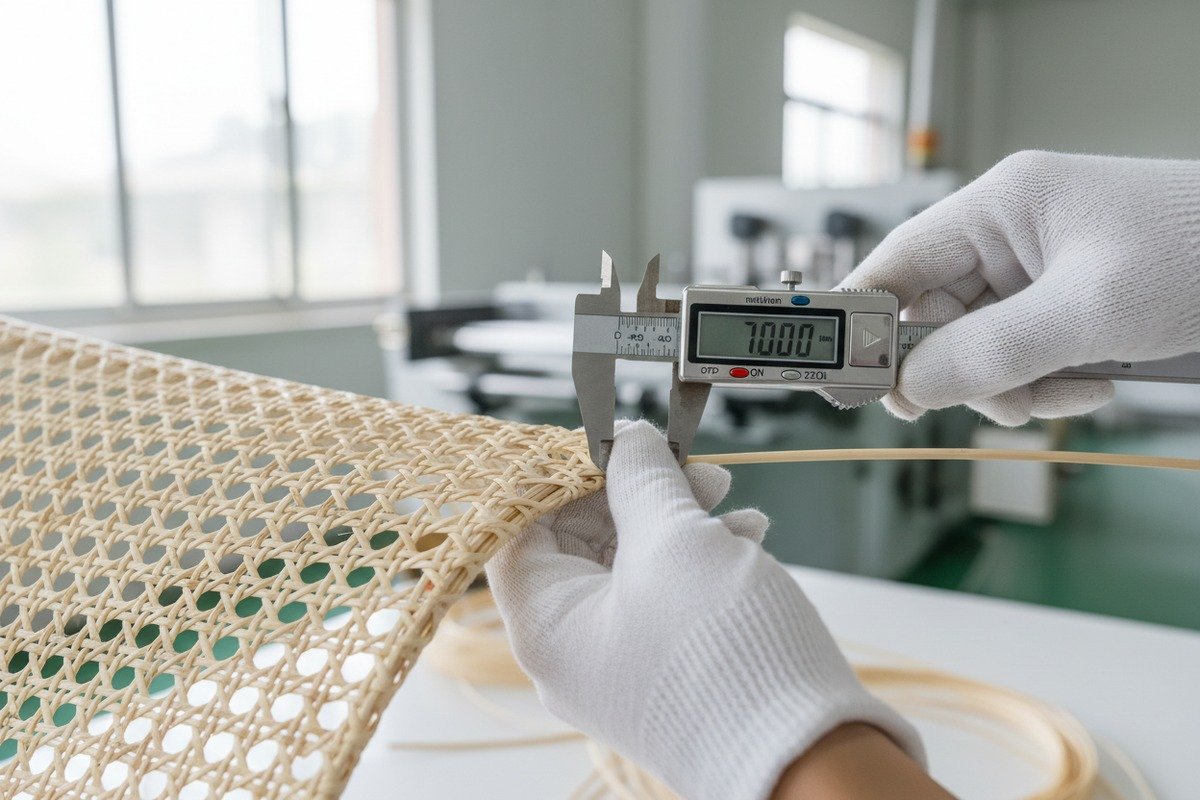
We have shipped rattan cane webbing 3 to over 30 countries since 1995, and the single biggest complaint we hear from new clients is about their previous supplier's inconsistent quality. One batch looks perfect. The next batch arrives with uneven color, brittle strands, or loose weave tension.
Verify quality consistency by requesting AAA-grade samples before each production run, conducting stage-by-stage inspections during weaving, checking for uniform strand thickness and color, and requiring third-party quality reports for every shipment. Consistent suppliers welcome this scrutiny.
Why Inconsistency Happens
Rattan is a natural material. It grows in tropical forests 4 across Indonesia and Southeast Asia. No two harvests are identical. Differences in rainfall, soil, and harvest timing affect strand diameter, flexibility, and color. A supplier who does not sort and grade raw rattan before weaving will produce inconsistent webbing.
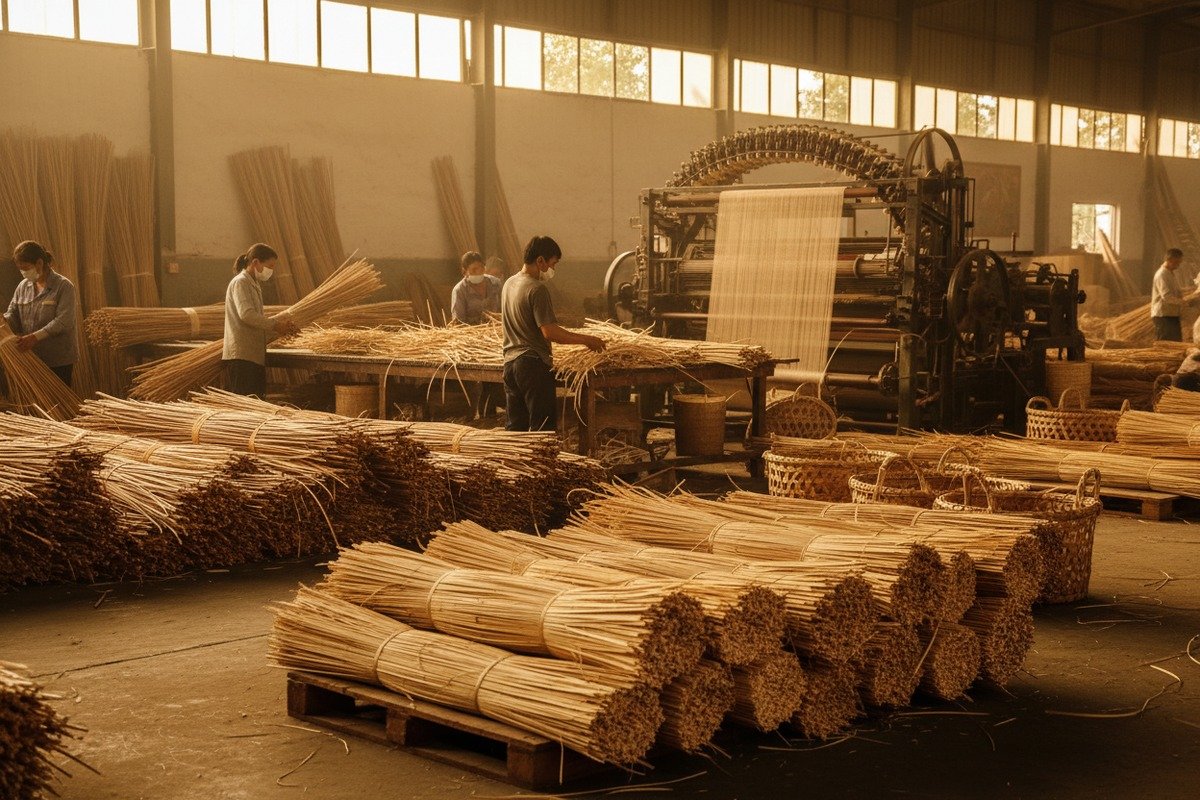
At our Indonesia processing facility, we sort raw rattan into strict grades before it enters the production line. First-layer peel rattan goes to premium orders. Inner core rattan goes to standard lines. This separation happens before a single strand is woven.
The Stage-by-Stage Inspection Method
Do not wait until the finished roll arrives at your port. That is too late. Instead, ask your supplier to provide checkpoints during production.
| Inspection Stage | What to Check | Red Flag |
|---|---|---|
| Raw material intake | Strand diameter, moisture content, surface cracks | Mixed grades in the same batch |
| Pre-weaving treatment | Boiling/fumigation records, mold prevention | No treatment documentation |
| Weaving process | Pattern tension, hole uniformity, edge alignment | Loose or skipped strands |
| Post-weaving finishing | Color uniformity, flexibility test, trimming | Brittle snapping when bent |
| Final packing | Roll length accuracy, labeling, protective wrap | No inner moisture barrier |
How to Request Samples Properly
Never accept a single sample piece. Ask for three sample cuts from three different production batches. Compare them side by side. Bend them. Hold them against natural light. Premium rattan webbing should have a warm, even tone with no dark splotches or white dry spots. The strands should flex without cracking.
We keep a standing sample library at our Foshan headquarters. Clients can request fresh comparison samples any time. This practice has helped us maintain relationships with furniture factories in the Netherlands, Australia, and the USA for over a decade.
Third-Party Audits
For large recurring orders, invest in a third-party audit 5. An independent inspector visits the factory, checks material storage conditions, and reviews production logs. This costs a few hundred dollars per visit, but it can save thousands in rejected shipments.
How do I negotiate competitive wholesale pricing for my bulk rattan orders?
Pricing conversations make or break supplier relationships. Over the years, we have seen buyers push too hard on price and end up with downgraded material. We have also seen buyers overpay simply because they did not understand the cost structure behind rattan webbing production.
Negotiate competitive pricing by understanding the cost breakdown of raw rattan, weaving labor, pattern complexity, and shipping volume. Request tiered pricing based on order quantity, commit to recurring schedules for better rates, and compare value per square meter rather than unit price alone.

Understanding the Real Cost Structure
The price of rattan cane webbing is not arbitrary. It reflects specific cost layers. When you understand these layers, you negotiate from a position of knowledge instead of guessing.
| Cost Component | Approximate Share of Final Price | Notes |
|---|---|---|
| Raw Indonesian rattan | 30–40% | Varies by harvest season and grade |
| Weaving labor | 20–30% | Handwoven costs more than machine-assisted |
| Pattern complexity | 5–15% | Radio weave is standard; herringbone and octagon cost more |
| Treatment and finishing | 5–10% | Boiling, fumigation, bleaching add cost |
| Packaging and logistics | 10–15% | Firm packaging to prevent deformation |
| Supplier margin | 10–15% | Covers overhead, QC, and after-sales support |
Tiered Pricing and Volume Commitments
Most premium suppliers, including our operation, offer tiered pricing. The more you order, the lower your per-unit cost. But here is the key insight: a commitment to a recurring order schedule often gets you a better rate than a single large order.
Why? Because recurring orders let the factory plan production efficiently. We can allocate machine time, schedule artisans, and purchase raw rattan in bulk from our Indonesian facility when we know a client will order every month or every quarter.
Compare Value, Not Just Price
A roll of radio weave rattan webbing at $8 per meter from Supplier A might seem cheaper than $9.50 per meter from Supplier B. But if Supplier A's roll has loose tension and inconsistent strand width, your furniture factory wastes material trimming and patching. The real cost per usable meter might be $11 or higher.
Always request a test roll before committing to bulk. Measure the actual usable area. Count defects per roll. Calculate your true cost per square meter of finished product. That number tells the real story.
Payment Terms as a Negotiation Tool
Instead of pushing only on unit price, negotiate payment terms. A 30% deposit with 70% against bill of lading is standard. But for long-term partners, some suppliers offer 60-day net terms or letter of credit arrangements. These terms improve your cash flow, which can be worth more than a small price discount.
Why should I prioritize a supplier with a direct Indonesian processing facility?
When we first invested in building our own rattan processing facility in Indonesia, many people asked why. The answer is simple: control. Controlling the raw material source is the most powerful advantage in the rattan supply chain 6.
Prioritize suppliers with direct Indonesian processing facilities because Indonesia produces the world's highest-quality rattan, and direct sourcing eliminates middlemen, reduces cost, ensures raw material traceability, and gives the supplier full control over grading, treatment, and consistency from harvest to finished webbing.
Indonesia's Rattan Dominance
Indonesia supplies the vast majority of the world's commercial rattan 7. The tropical climate, rich soil, and centuries of cultivation knowledge produce rattan with superior characteristics: plump cross-sections, strong fiber density, low thermal conductivity, and a naturally warm color tone. No other region matches this combination.
A supplier who buys rattan through three or four intermediaries before it reaches their weaving factory has no visibility into the raw material's origin, grade, or treatment history. By the time it arrives, grades may be mixed, moisture levels may be uncontrolled, and costs have been inflated at every step.
Direct Facility Benefits for Buyers
Having a direct Indonesian facility changes the entire supply equation. Here is how it benefits you as a buyer:
| Benefit | Without Direct Facility | With Direct Facility |
|---|---|---|
| Raw material cost | Higher (middlemen markups) | Lower (direct procurement) |
| Grade consistency | Unpredictable | Controlled sorting at source |
| Traceability | Limited or none | Full harvest-to-shipment records |
| Customization | Restricted to available stock | Custom grades, colors, treatments |
| Lead time | Longer (multiple handoffs) | Shorter (streamlined logistics) |
| Sustainability verification | Difficult to confirm | Auditable on-site practices |
The Hybrid China-Indonesia Model
Our operation follows a hybrid model. Raw rattan is processed and graded at our Indonesia facility. It then ships to our three factories in Foshan, China, where weaving, finishing, and packaging happen. This model combines Indonesia's raw material advantage with China's manufacturing efficiency and export infrastructure.
With over 165 machines and a production capacity of 3,500 tons per month, our Foshan operations handle everything from classic hexagonal radio weave to complex herringbone and octagon patterns. Finished products ship to clients in over 30 countries.
What to Ask Your Supplier
If a supplier claims direct Indonesian sourcing, ask for proof. Request photos of the facility. Ask for the facility address and registration details. Inquire about the number of workers and monthly throughput. A genuine operation will provide these details without hesitation.
We regularly invite key clients to visit both our Indonesian facility and our Foshan factories. Seeing the full chain in person builds trust faster than any sales pitch.
Sustainability at the Source
Direct facility ownership also enables genuine sustainability practices. We select rattan from managed cultivation areas, ensuring regrowth cycles are respected. First-layer peel is used for premium products. Inner core is used for standard lines. Nothing is wasted. This approach is only possible when you control the source directly.
How can I ensure my rattan materials are packaged securely for my international shipments?
Packaging failures are among the most frustrating problems we solve for new clients switching from other suppliers. Rattan cane webbing arrives at the destination port deformed, moldy, or crushed. The product was fine when it left the factory. The packaging failed during transit.
Ensure secure international packaging by requiring firm inner rolls to prevent deformation, moisture-barrier wrapping to block mold, rigid outer cartons or wooden crates for crush protection, and clear labeling with handling instructions. Test packaging with a trial shipment before committing to full container orders.
Why Rattan Packaging Is Uniquely Challenging
Rattan is a natural, hygroscopic material 8. It absorbs and releases moisture. During a 20–30 day ocean freight journey 9, temperature and humidity inside a container swing dramatically. Without proper protection, moisture condenses on the webbing surface. Mold forms. Strands soften and deform under the weight of stacked rolls.
This is not a theoretical risk. We have seen it happen to competitors' shipments. That is why our packaging protocol was developed over years of trial and refinement.
Our Multi-Layer Packaging System
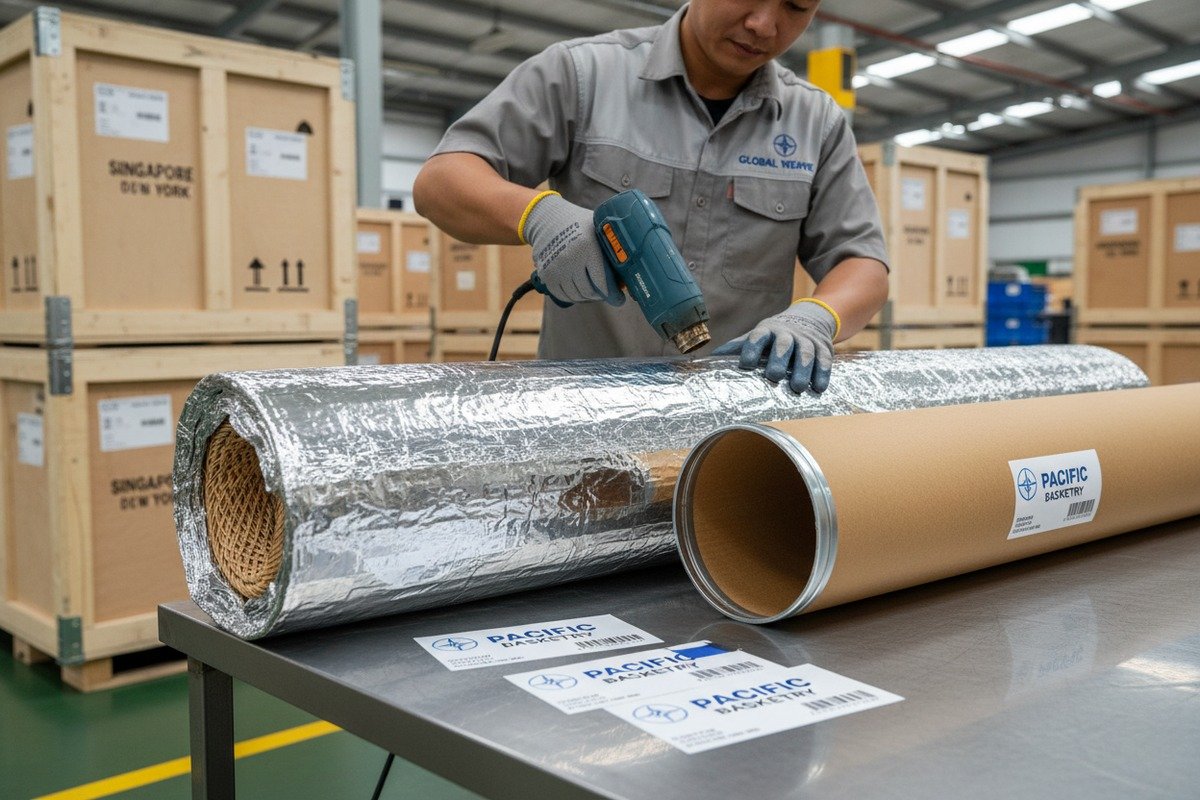
Each roll of rattan cane webbing leaving our factory goes through a specific packaging sequence:
Step 1: Firm Core Insert. Every roll is wound around a rigid cardboard or PVC core tube. This prevents the roll from collapsing inward during stacking.
Step 2: Moisture Barrier. The roll is wrapped in polyethylene film. For high-humidity routes (e.g., shipments to the Middle East or Southeast Asia), we add desiccant packs inside the wrapping.
Step 3: Protective Outer Layer. Rolls are placed in reinforced corrugated cartons. For large or heavy rolls, we use wooden crate frames. Edge protectors prevent crushing at contact points.
Step 4: Container Loading Plan. Rolls are stacked with spacers between layers. Heavy items go on the bottom. Lighter items go on top. We provide a loading diagram to the freight team.
Packaging Specifications by Product Type
| Product Type | Core Insert | Moisture Barrier | Outer Protection | Special Notes |
|---|---|---|---|---|
| Natural radio weave (15m rolls) | Cardboard tube | PE film + desiccant | Corrugated carton | Avoid direct sunlight exposure |
| Bleached rattan webbing (15m rolls) | Cardboard tube | Double PE wrap + desiccant | Corrugated carton | Bleached material is more moisture-sensitive |
| Synthetic PE webbing (30m rolls) | PVC tube | Single PE film | Reinforced carton | Less moisture-sensitive but needs crush protection |
| Wide sheets (40–120cm) | Flat cardboard stiffener | PE film | Wooden crate | Stack flat, never fold |
Trial Shipment Strategy
Before placing a full container order with any new supplier, request a trial shipment of 5–10 rolls. When the shipment arrives, inspect every roll. Check for mold spots. Measure whether the roll dimensions match the spec. Test strand flexibility. If the packaging held up, you can confidently scale.
We encourage all new clients to start with a trial. It costs a fraction of a full order, and it reveals how seriously the supplier treats the final mile of quality control. Packaging is not glamorous, but it is where many partnerships either solidify or collapse.
OEM Packaging and Labeling
For wholesale clients who resell under their own brand, we offer OEM packaging with custom labels, printed cartons, and branded documentation inside each box. This saves your team repackaging time and presents a professional appearance to your own customers.
Conclusion
Long-term rattan supplier partnerships rest on four pillars: verified quality, fair pricing, source control, and secure packaging. Get these right, and your supply chain becomes a competitive advantage.
Footnotes
1. Defines quality control and its role in ensuring consistent product standards and performance. ↩︎
2. Offers guidance on setting prices, including wholesale strategies for small businesses. ↩︎
3. Provides a comprehensive overview of rattan, its species, and traditional uses. ↩︎
4. Replaced HTTP 404 National Geographic link with an authoritative Wikipedia page on tropical rainforests, which aligns with the original anchor text and content. ↩︎
5. Explains the concept of certification and independent audits by third parties for quality assurance. ↩︎
6. Offers a professional definition and overview of supply chain management and its components. ↩︎
7. Replaced HTTP 404 FAO link with another relevant FAO document providing an overview of the rattan industry and its commercial aspects. ↩︎
8. Defines hygroscopy as the ability to attract and hold water molecules from the environment. ↩︎
9. Provides an overview of ocean freight, its processes, and role in international trade. ↩︎

 English
  Español de México
  العربية
  Deutsch
  Français
  Русский