
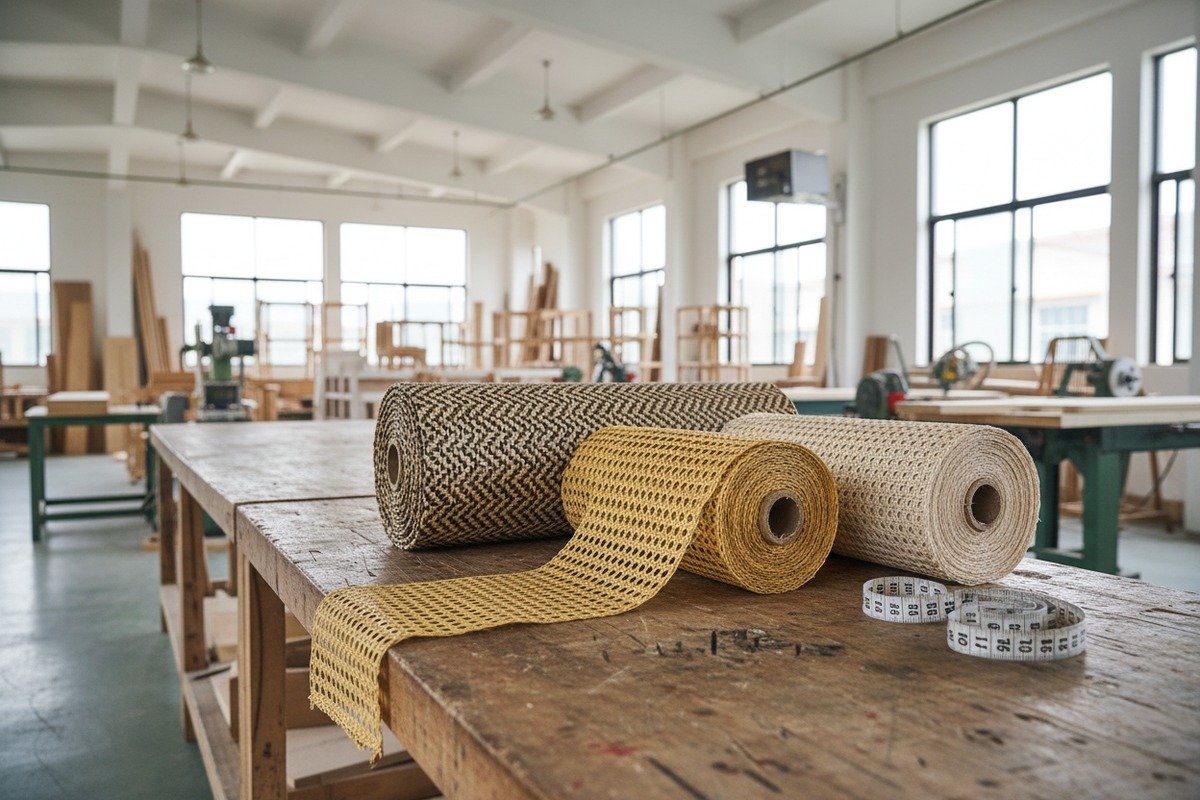
Every week, our sales team fields the same question from purchasing managers around the world extruded in a factory 1. They want a simple answer about rattan cane webbing roll lengths—but the truth surprises most buyers.
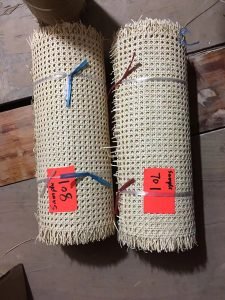
There is no single universal “standard” length for rattan cane webbing rolls. Common lengths range from 5 feet for small DIY repairs to 50 feet or more for professional furniture production, with natural rattan rolls typically maxing out around 15 meters (49 feet) and synthetic PE rolls reaching up to 30 meters (98 feet), depending on the supplier, weave pattern, and width.
This guide breaks down everything you need to know about roll lengths. We cover supplier comparisons, custom options, ordering calculations, and shipping considerations so you can make the smartest purchasing decision for your business.
What is the standard length of a rattan cane webbing roll for my wholesale order?
When we first started shipping rattan cane webbing from our Foshan warehouses to buyers in the Netherlands and Australia, we quickly learned that "standard" means different things to different markets. Many buyers assume there is one fixed length—and that assumption can lead to costly ordering mistakes.
The most common wholesale roll lengths are 15 meters (approximately 49 feet) for natural rattan and 30 meters (approximately 98 feet) for synthetic PE rattan webbing. However, these vary widely across suppliers, with retail rolls often sold at 5 to 20 feet and professional rolls at 50 feet or longer.

Why There Is No Single "Standard"
The idea of a universal standard roll length is a myth. Rattan cane webbing comes from natural plant bark 2. The raw material itself has physical limits. A single rattan vine 3 can only produce so much continuous strip before a join is needed. This is why natural rattan rolls rarely exceed 15 meters.
Synthetic PE rattan 4, on the other hand, is extruded in a factory. There is no natural limit on length. Our PE production line can produce rolls up to 30 meters without any seams. This makes synthetic webbing popular for large-scale commercial projects.
Comparing Roll Lengths Across Major Suppliers
Here is a side-by-side look at what different suppliers offer. This data comes from published product listings and our own industry knowledge.
| Supplier / Source | Material Type | Typical Roll Length | Common Widths | Notes |
|---|---|---|---|---|
| Seafan Rattan (Our Factory) | Natural Rattan | 15m (~49 ft) | 35–100 cm | Custom lengths available |
| Seafan Rattan (Our Factory) | Synthetic PE | 30m (~98 ft) | 35–100 cm | Seamless, weather-resistant |
| HH Perkins (US) | Natural Pressed Cane | 50 ft (fixed) | 18–36 in | Sold by hole size |
| Etsy Small Vendors | Natural Rattan | 5–40 ft | 15.5–39.5 in | Cut-to-order common |
| DIY Repair Kits | Natural Rattan | 5 ft | 24 in | Basic chair seat repair |
| Indonesian Exporters | Natural Rattan | 10–15m | 40–90 cm | Bulk only |
Natural vs. Synthetic: The Length Factor
Natural rattan webbing has a warm, fibrous texture 5 with organic color variations in light beige, straw yellow, and cream tones. It is beautiful and authentic. But the material limits mean rolls top out around 15 meters. Every meter beyond that increases the risk of joins and weak points.
Synthetic PE rattan mimics the organic look of natural fibers. It comes in woven textures with chevron, basketweave, and diamond patterns. The big advantage is roll length. A single PE roll can reach 30 meters. For outdoor furniture makers or large commercial projects, this saves time and reduces waste from seaming.
Weave Pattern Affects Perceived "Standard"
The weave style also influences what length a supplier considers standard. Open hexagonal mesh 6 (the classic "radio weave") is the most common and widely available in longer rolls. Close-woven patterns using 3mm cane take more material and labor, so rolls tend to be shorter. Specialty weaves like the X-factor reed-integrated pattern or superfine 3/8-inch hole mesh are often produced in smaller batches.
From our experience producing for buyers across 15+ countries, the most requested combination is hexagonal open-mesh webbing in 15-meter natural rolls with a width of 60 cm. But calling this "standard" would ignore the fact that a US buyer typically orders 50-foot rolls in 24-inch width, while a European buyer prefers metric measurements and wider sheets.
Can I request custom roll lengths to fit my specific furniture manufacturing needs?
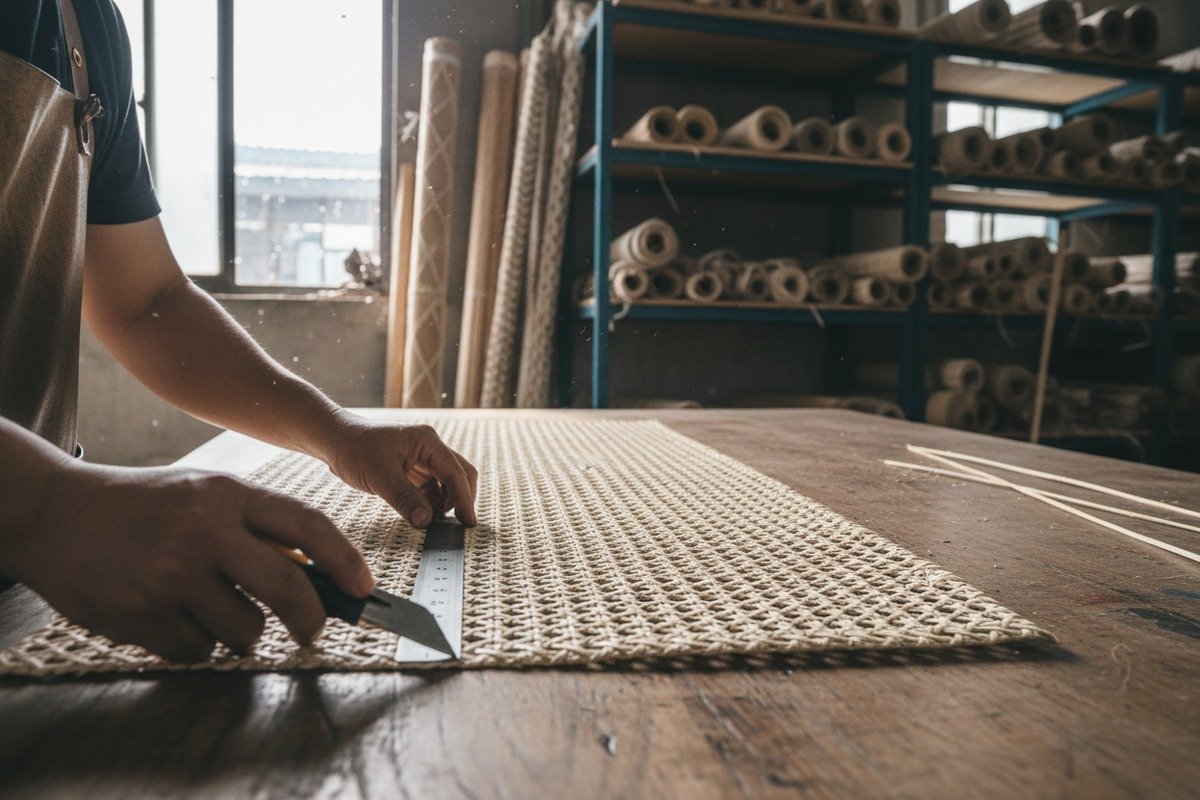
Our production team in Nanhai handles custom length requests 7 almost daily. One of our regular buyers in Turkey needed 8-meter rolls to minimize cutting waste on a specific cabinet line. Another client in Spain wanted 25-meter rolls for a hotel renovation. Both were possible—but the details matter.
Yes, most established rattan webbing manufacturers and wholesalers accept custom roll length requests, especially for bulk orders. Custom lengths help furniture factories reduce material waste, streamline production, and match exact project specifications. Minimum order quantities and lead times typically apply for non-standard lengths.
When Custom Lengths Make Sense
Custom roll lengths are not just a luxury. They are a smart production decision. If your factory produces dining chairs that each require 1.2 meters of webbing, a 15-meter roll gives you 12 pieces with 0.6 meters of waste. But a custom 12-meter roll gives you exactly 10 pieces with zero waste. Scale that across 10,000 chairs, and the savings are significant.
Here are the most common scenarios where our clients request custom lengths:
- Repetitive furniture production with fixed webbing dimensions per unit
- Architectural panels where each wall section has a specific measurement
- Retail packaging where a reseller wants to offer unique roll sizes (e.g., 3-yard hobby packs)
- Mixed-width orders where different products need different lengths on the same shipment
What You Need to Specify for a Custom Order
When placing a custom roll length order, provide your supplier with the following details:
| Detail | Why It Matters | Example |
|---|---|---|
| Desired roll length | Determines production setup and cutting | 8 meters per roll |
| Width | Must match your frame or panel dimensions | 60 cm |
| Weave pattern | Affects material availability and lead time | Hexagonal open mesh |
| Material type | Natural vs. PE affects max feasible length | Natural rattan |
| Quantity (total rolls) | Impacts MOQ eligibility and unit pricing | 500 rolls |
| Tolerance | Acceptable variation in length per roll | ±5 cm |
Minimum Order Quantities for Custom Lengths
Most suppliers, including our factory, require a minimum order quantity 8 (MOQ) for custom lengths. This is because changing the cutting setup on our production line takes time. Running a batch of non-standard rolls is only economical above a certain volume.
For our natural rattan lines, the typical MOQ for custom lengths is 200 rolls. For synthetic PE, it drops to 100 rolls because the extrusion process is more flexible. Smaller vendors on platforms like Etsy may offer cut-to-order in shorter runs, but the per-foot cost is significantly higher—often $4 to $8 per foot compared to $1.50 to $3 per foot at wholesale.
Lead Time Considerations
Custom lengths usually add 3 to 7 days to production lead time 9 compared to stock rolls. If you combine a custom length with an unusual weave pattern or bleached finish, expect the total lead time to extend by 10 to 14 days. Planning your orders 4 to 6 weeks ahead of your production schedule is the safest approach.
One tip from our experience: if your required length falls close to a supplier's standard offering, consider adjusting your design slightly. For instance, if our standard is 15 meters and you need 14.5 meters, using the 15-meter roll and trimming 0.5 meters is faster and cheaper than ordering a custom 14.5-meter run.
How do I calculate how many rolls I should buy for my upcoming project?
We have seen buyers under-order and halt their production line for two weeks waiting on a restock. We have also seen buyers over-order by 40% and struggle with storage costs. Getting the quantity right is critical, and it starts with a simple formula.
To calculate the number of rolls needed, measure the total webbing area required for your project, add a 10–15% waste allowance for cutting, overlap, and defects, then divide by the usable area per roll. Always round up to the nearest whole roll to avoid shortages during production.
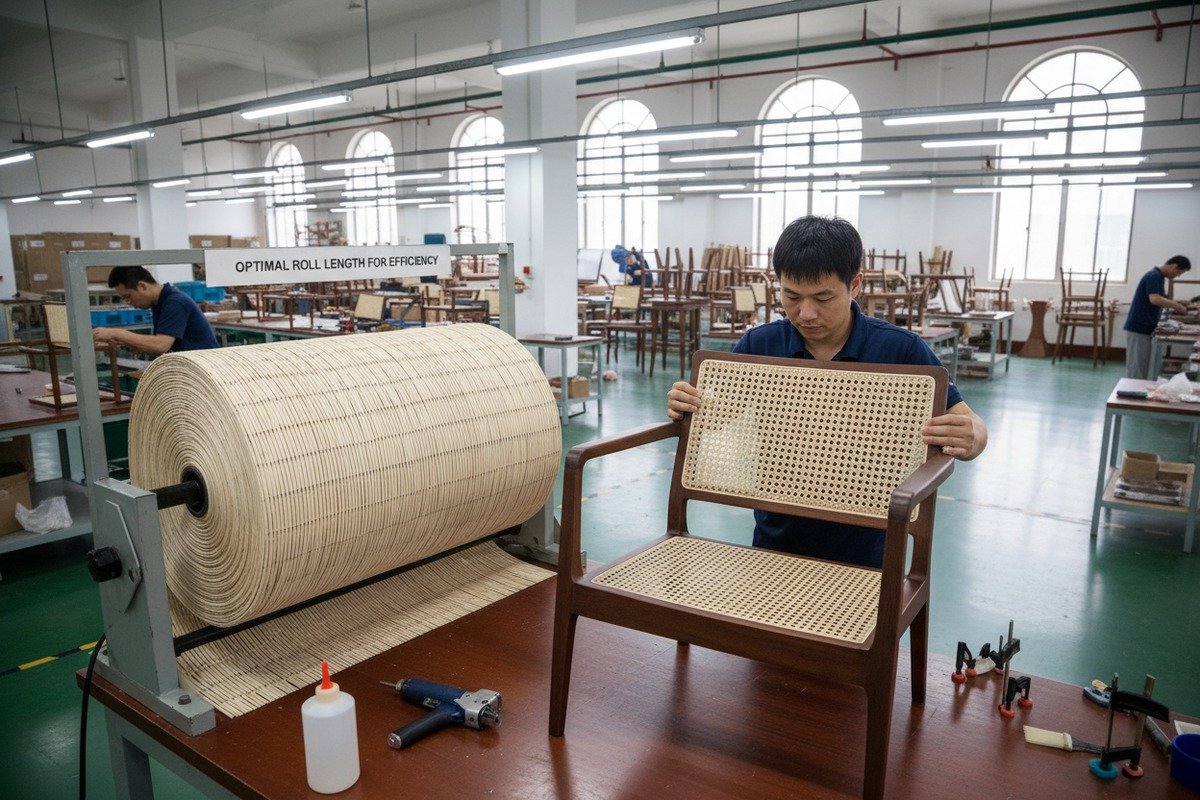
The Basic Calculation Formula
Here is the step-by-step method our sales team recommends to every new wholesale client:
- Measure each piece. Determine the length and width of webbing needed per furniture unit. Include a 1 to 2 inch overlap on each side for attachment.
- Count total pieces. Multiply by the number of units you plan to produce.
- Calculate total area. Total pieces × area per piece = total webbing area.
- Add waste allowance. Multiply total area by 1.10 (for 10% waste) or 1.15 (for 15% waste if using intricate patterns).
- Divide by roll area. Roll length × roll width = usable area per roll. Divide your adjusted total by this number.
- Round up. Always round to the next whole roll.
Worked Example: Dining Chair Production Run
Let us walk through a real scenario. Suppose you are producing 500 dining chairs. Each chair seat requires a piece of webbing measuring 45 cm × 45 cm (including overlap).
| Step | Calculation | Result |
|---|---|---|
| Area per chair | 0.45m × 0.45m | 0.2025 m² |
| Total area for 500 chairs | 500 × 0.2025 | 101.25 m² |
| Add 10% waste | 101.25 × 1.10 | 111.375 m² |
| Area per roll (15m × 0.6m) | 15 × 0.6 | 9.0 m² |
| Rolls needed | 111.375 ÷ 9.0 | 12.375 → 13 rolls |
So you would order 13 rolls. Ordering only 12 would leave you short and potentially delay your entire production run.
Adjusting for Weave Pattern and Stretch
Not all webbing yields the same usable area. Open hexagonal mesh stretches slightly when soaked and installed, which means you might get a bit more coverage per roll. Close-woven webbing does not stretch and is stiffer, requiring more precise cuts.
For open weave patterns, a 10% waste allowance 10 is usually sufficient. For close-woven or specialty patterns like diamond motifs, increase your waste allowance to 15% or even 20%. The tighter the weave, the less forgiving it is when you make a cutting error.
The Soaking Factor
Natural rattan cane webbing must be soaked in water before installation. This makes it pliable and allows it to tighten as it dries, creating a snug, drum-like surface. However, soaking also temporarily changes the dimensions. The webbing can expand 2 to 3% in width and length while wet. Plan your cuts based on dry dimensions, not wet ones.
From our production floor, here is a practical tip: cut your webbing pieces while the material is dry, then soak each piece individually before applying it to the frame. This approach gives you the most accurate cuts and the best final tension.
Buffer Stock for Quality Assurance
Even with Grade A quality rattan (which is what we ship to all our wholesale clients), occasional imperfections exist. A small knot, a color variation, or a minor weave inconsistency might make a section unusable for a visible furniture surface. We recommend keeping 2 to 3 extra rolls on hand beyond your calculated quantity. Think of it as insurance. The cost of a few extra rolls is far less than the cost of halting a production line.
Will the roll length affect the shipping and packaging durability of my rattan materials?
Packaging durability is one of the top three pain points our clients raise—right alongside quality consistency and competitive pricing. We have shipped rattan cane webbing to over 15 countries, and we can tell you from hard-won experience that roll length absolutely impacts how your materials arrive.
Yes, roll length directly affects shipping and packaging durability. Longer rolls require larger-diameter cores, heavier packaging, and more careful handling to prevent crushing, cracking, or moisture damage during transit. Shorter rolls are easier to protect but may increase per-unit shipping costs due to more individual packages.
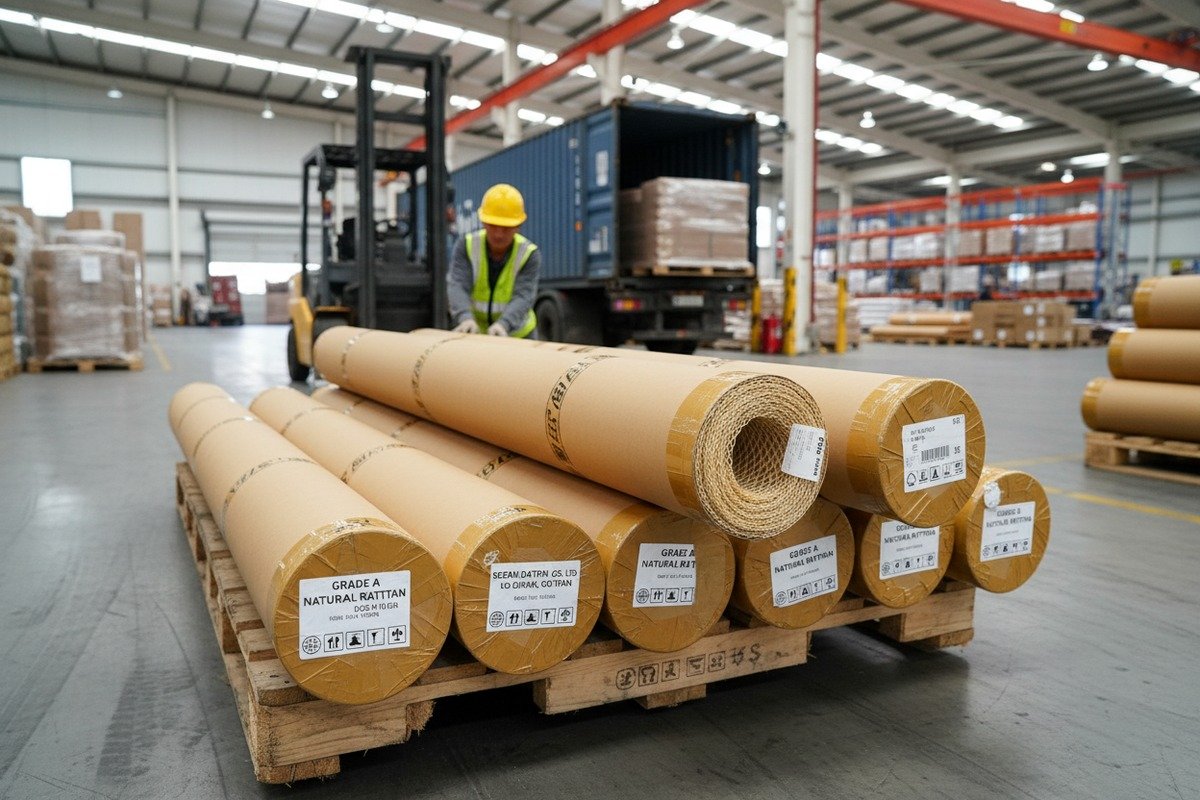
How Roll Length Impacts Package Size and Weight
A 15-meter roll of natural rattan webbing (60 cm wide) weighs approximately 2.5 to 3.5 kg depending on the weave density. It rolls onto a cardboard core with a finished diameter of about 15 to 20 cm. A 30-meter synthetic PE roll of the same width weighs 4 to 6 kg and has a diameter of 25 to 30 cm.
The larger the diameter, the more vulnerable the roll is to crushing during container loading and unloading. This is why our packaging team uses rigid cardboard tubes reinforced with corner protectors for rolls exceeding 20 meters.
Packaging Methods by Roll Length
| Roll Length | Typical Packaging | Durability Risk | Our Recommendation |
|---|---|---|---|
| 5–10 ft (1.5–3m) | Shrink wrap + flat box | Low | Good for retail and small DIY orders |
| 15–30 ft (5–10m) | Rolled on core + kraft paper | Medium | Add silica gel packets for moisture control |
| 30–50 ft (10–15m) | Rigid core + corrugated wrap | Medium-High | Use corner protectors and strap to pallet |
| 50+ ft (15m+) | Reinforced tube + stretch film | High | Double-wall corrugated + moisture barrier |
The Moisture Problem
Natural rattan is hygroscopic. It absorbs moisture from the air. During a 30-day ocean shipment from Foshan to Rotterdam, the humidity inside a container can fluctuate dramatically. If a long roll absorbs too much moisture, the inner layers can develop mold. If it dries out too fast in a heated warehouse, the outer layers become brittle and crack.
We address this with a three-layer packaging system for all rolls over 10 meters:
- Inner layer: Acid-free tissue paper to prevent staining
- Middle layer: Polyethylene moisture barrier film
- Outer layer: Double-wall corrugated cardboard tube with sealed ends
For shorter rolls (under 10 meters), a single moisture barrier wrap and shrink film are usually sufficient.
Shipping Cost Considerations
Longer rolls mean fewer individual packages per order, which generally reduces handling fees and simplifies logistics. But they also mean heavier, bulkier packages that take up more container space. The sweet spot for container efficiency, based on our shipping data, is the 15-meter roll. It balances packaging durability, weight, and cubic volume.
If you order custom lengths that are very short (say, 3 meters each), you end up with many small packages. Each one needs its own core, wrapping, and labeling. The labor and material cost per meter of webbing increases. This is why we always advise wholesale buyers to order the longest feasible roll length for their application and cut on-site.
Storage After Delivery
Once your rolls arrive, proper storage extends their usable life. Keep rolls horizontal on shelving, not standing upright. Avoid direct sunlight, which bleaches natural rattan unevenly. Maintain a storage humidity of 40 to 60%. And never stack heavy items on top of rolled webbing—this flattens the weave and creates permanent creases that are visible on finished furniture.
Our clients in Saudi Arabia and the UAE face the opposite climate challenge from those in the Netherlands. Extreme dry heat can make natural rattan brittle within weeks if stored improperly. We include climate-specific storage instructions with every shipment, tailored to the destination country.
Conclusion
Rattan cane webbing has no universal standard roll length. Choose your length based on your project scale, material type, waste tolerance, and shipping needs—then work with a supplier who offers the flexibility to match.
Footnotes
1. Explains the general plastic extrusion manufacturing process. ↩︎
2. Clarifies rattan’s botanical origin as a climbing palm, not tree bark. ↩︎
3. Provides a comprehensive overview of rattan as a climbing palm. ↩︎
4. Replaced with a comprehensive guide on PE rattan, its types, and production process. ↩︎
5. Replaced with an article specifically discussing rattan texture and its characteristics. ↩︎
6. Describes open hexagonal rattan webbing and its applications. ↩︎
7. Replaced with an article defining custom manufacturing, which includes tailoring products to individual requirements like custom lengths. ↩︎
8. Replaced with a detailed explanation of Minimum Order Quantity (MOQ), its meaning, and how it’s used. ↩︎
9. Defines production lead time as the duration from raw material processing to finished product. ↩︎
10. Defines scrap allowance as permitted material waste or defective items in manufacturing. ↩︎

 English
  Español de México
  العربية
  Deutsch
  Français
  Русский